Sports Illustrated recently ran a portion of Jerry West's biography and it revealed that the NBA's iconic figure (literally) led a miserable life of depression and self-loathing. The NBA's logo is an artistic rendition of West on the move. Nobody moved quicker, with more determination, or with better accuracy. West played before the 3-point era, but that didn't stop him from shooting from that territory or beyond (even beyond the half-court line). Reading this biography reminded me of a day when elite athletes played for something other than giant bags of money.
That, in turn, reminded me of the real and practical reason ordinary people pay attention to elite athletes, musicians, and artists of all stripes; they remind us that humans can be incredibly special and near-godlike (by a believable definition of "godlike"). Money removes that reminder and replaces it with something more crass and less admirable. Jerry West played like a demon to quiet the demons in his head and from his past. The best musicians have something to prove, too. Songs to express, heart to expose, words to ventilate and enlighten, and sounds in their heads that need to find air to move and ears to respond. When those moments are preserved in a recording, music takes on history and it's a rare kind of history that can be repeated in the privacy of our homes or even all but inside our heads with in-ear monitors and a mobile player. To clear out the Thanksgiving dust, here's a little inspiration:
Nothing like a little Jeff to brighten up a winter's day. My kind of Xmas music.
Thursday, November 24, 2011
Wednesday, November 16, 2011
Serving Music?
In my manufacturing career as a quality and manufacturing engineering manager, I was always asking my employees and managers, “Who does this serve?” whenever they wanted to implement a procedure, change a process, or add paperwork to our workload. One of the late-great Quality Management concepts was that everyone in an organization "serves" someone. From the CEO to the shipping clerk, all of those jobs exist to provide service to someone in the customer or organizational chain. When that system fails, we end up with a society like the one the 1% have created today and, historically, that never lasts long.
Last week, I took some friends to the local jazz club, the Artist Quarter, to listen to a well-known local jazz saxophonist and that question popped into my head for the first time in a few years. In my opinion, the best music is created by musicians who are “serving” the assembly of sounds the whole group creates and that the rest of us call “Music.” In the classical world, I think this goal is commonly accepted principle. In an orchestra, everyone, including the featured soloists, is focused on the whole they are creating. They all obey the conductor who is the conduit to the audience for the musical environment being created. There is no shortage of oversized egos, varying talents, or personality conflicts in classical performances, but they are mostly sublimated in the service of the music printed on the page in front of every player. Even solo classical performances are still directed by the directions on that page that describe how to best service the composer’s aural vision. On average, I would argue that classical music performed in groups is more closely directed toward the service of the music.
In the pop world, this ideal is rarely reached because the service goal for popular music is profit, not music. The engineer, producer, and record label drones all serve as focus groups who analyze the gross aspects of a recorded performance for the possible financial return. “Will it sell?” is infinitely more important than “is it beautiful?” There are obviously violations of this generalization, but those only occur when the “music industry” is in disarray and the financial interests have lost control of where the music is going. That may never happen again in our constantly-connected, followed, friended, and information-manipulated world. Pop music is so thoroughly commercialized that musicians call it that, “commercial music.” That’s a term that used to apply to music made as background for advertisements. Today, a prime goal of popular musicians is to have a song end up in a commercial or as background in a television series. The service of music as an ideal entity is becoming a vanishing cause in the pop world.
Jazz pretends to be a different animal than either pop or classical music. Since jazz presents practically no possibility for financial reward, jazz musicians can imagine themselves to be in a similar boat as classical musicians. Since improvisation is valued over sheet music regurgitation, jazz musicians tell themselves they are more purely serving music, following the muse, as it pops into their heads.
In application, jazz often fails to live up to the best goals of either pop or classical music. The performance I took my friends to was a case-in-point. As if there were some rule that stated each of the four musicians would be allowed a moment in every song to show off, every tune followed the same sax-melody-sax-solo-piano-solo-bass-solo-drum-solo, rinse, and repeat routine.
To be upfront, I have to say that 99.9% of every bass and drum solo I have ever heard has been a miserable exercise in gymnastics. Bass players insist on showing off how fast they can play “pittoon-pitoon-thump-thump-pitow.” Drummers piddily-piddle, paradiddle, and whack the crap out of their percussion paraphernalia until the audience is looking for any excuse to drink more or take up smoking outside in the rain. There is nothing musical about listening to the rhythm section be non-rhythmic. On a commercial basis, selling a drum solo (outside of the Safari’s 1963 fluke hit Wipeout or the few seconds of Steve Gadd’s work in Steely Dan’s Aja) or a bass solo (I have no examples of that.) is ludicrous. Can’t happen. Outside of nihilistic minimalist modern weirdness, classical music is without any examples of extended bass or drum solos. Only jazz musicians imagine that an audience wants to listen to that silliness.
Music is not what is being served in traditional combo jazz, at least in the live performance venue. Musicians’ egos are the one and only focus. Everyone gets a place to show off and disrupt the music for a moment of self-proclaimed glory.
I believe, that’s why modern jazz musicians like Pat Metheny and Lyle Mays, Stanley Clarke, Keith Jarrett, Gary Burton, Larry Carlton, Chick Corea, Larry Coryell, Al Di Meola, Mark Egan, Béla Fleck, Jeff Lorber, and hundreds of other pop-influenced, jazz oriented musicians have found an audience. They waste minimal time stroking their egos and maximum time serving their vision of Music. Sometimes, that veers toward commercial music, for the same reason pop music was perverted by hard cash, but just as often modern jazz musicians reflect the attitudes and dedication of the players who created jazz. While many of the players in Duke Ellington’s bands received solo opportunities, they didn’t expect ten minutes of attention in every tune. Most of the acknowledged classic jazz albums featured incredibly brief moments of rhythm section solo time, if any at all; Miles Davis’ Kind of Blue, Dizzy Gillespie’s An Electrifying Evening, and Charles Mingus Mingus Ah Um, Dave Brubeck Time Out, and an almost infinitely long list of great performances that created a genre and audience.
Live jazz, however, still appears to be working at repelling all but the most tolerant audience more interested in X-games performance and less absorbed in Music.
Last week, I took some friends to the local jazz club, the Artist Quarter, to listen to a well-known local jazz saxophonist and that question popped into my head for the first time in a few years. In my opinion, the best music is created by musicians who are “serving” the assembly of sounds the whole group creates and that the rest of us call “Music.” In the classical world, I think this goal is commonly accepted principle. In an orchestra, everyone, including the featured soloists, is focused on the whole they are creating. They all obey the conductor who is the conduit to the audience for the musical environment being created. There is no shortage of oversized egos, varying talents, or personality conflicts in classical performances, but they are mostly sublimated in the service of the music printed on the page in front of every player. Even solo classical performances are still directed by the directions on that page that describe how to best service the composer’s aural vision. On average, I would argue that classical music performed in groups is more closely directed toward the service of the music.
In the pop world, this ideal is rarely reached because the service goal for popular music is profit, not music. The engineer, producer, and record label drones all serve as focus groups who analyze the gross aspects of a recorded performance for the possible financial return. “Will it sell?” is infinitely more important than “is it beautiful?” There are obviously violations of this generalization, but those only occur when the “music industry” is in disarray and the financial interests have lost control of where the music is going. That may never happen again in our constantly-connected, followed, friended, and information-manipulated world. Pop music is so thoroughly commercialized that musicians call it that, “commercial music.” That’s a term that used to apply to music made as background for advertisements. Today, a prime goal of popular musicians is to have a song end up in a commercial or as background in a television series. The service of music as an ideal entity is becoming a vanishing cause in the pop world.
Jazz pretends to be a different animal than either pop or classical music. Since jazz presents practically no possibility for financial reward, jazz musicians can imagine themselves to be in a similar boat as classical musicians. Since improvisation is valued over sheet music regurgitation, jazz musicians tell themselves they are more purely serving music, following the muse, as it pops into their heads.
In application, jazz often fails to live up to the best goals of either pop or classical music. The performance I took my friends to was a case-in-point. As if there were some rule that stated each of the four musicians would be allowed a moment in every song to show off, every tune followed the same sax-melody-sax-solo-piano-solo-bass-solo-drum-solo, rinse, and repeat routine.
To be upfront, I have to say that 99.9% of every bass and drum solo I have ever heard has been a miserable exercise in gymnastics. Bass players insist on showing off how fast they can play “pittoon-pitoon-thump-thump-pitow.” Drummers piddily-piddle, paradiddle, and whack the crap out of their percussion paraphernalia until the audience is looking for any excuse to drink more or take up smoking outside in the rain. There is nothing musical about listening to the rhythm section be non-rhythmic. On a commercial basis, selling a drum solo (outside of the Safari’s 1963 fluke hit Wipeout or the few seconds of Steve Gadd’s work in Steely Dan’s Aja) or a bass solo (I have no examples of that.) is ludicrous. Can’t happen. Outside of nihilistic minimalist modern weirdness, classical music is without any examples of extended bass or drum solos. Only jazz musicians imagine that an audience wants to listen to that silliness.
Music is not what is being served in traditional combo jazz, at least in the live performance venue. Musicians’ egos are the one and only focus. Everyone gets a place to show off and disrupt the music for a moment of self-proclaimed glory.
I believe, that’s why modern jazz musicians like Pat Metheny and Lyle Mays, Stanley Clarke, Keith Jarrett, Gary Burton, Larry Carlton, Chick Corea, Larry Coryell, Al Di Meola, Mark Egan, Béla Fleck, Jeff Lorber, and hundreds of other pop-influenced, jazz oriented musicians have found an audience. They waste minimal time stroking their egos and maximum time serving their vision of Music. Sometimes, that veers toward commercial music, for the same reason pop music was perverted by hard cash, but just as often modern jazz musicians reflect the attitudes and dedication of the players who created jazz. While many of the players in Duke Ellington’s bands received solo opportunities, they didn’t expect ten minutes of attention in every tune. Most of the acknowledged classic jazz albums featured incredibly brief moments of rhythm section solo time, if any at all; Miles Davis’ Kind of Blue, Dizzy Gillespie’s An Electrifying Evening, and Charles Mingus Mingus Ah Um, Dave Brubeck Time Out, and an almost infinitely long list of great performances that created a genre and audience.
Live jazz, however, still appears to be working at repelling all but the most tolerant audience more interested in X-games performance and less absorbed in Music.
Saturday, January 15, 2011
Then and Now
While suffering a 21st Century moderately high-tech DJ/VJ presentation last week, I was reminded of a similar experience from 25 years ago. Friends of my wife did a regular AV show in a small performance area in a restaurant in southern California. This was in the early days of semi-affordable video processing and one of the artists was a laser tech who did work for Disney and lots of rock bands.
For that particular show, these guys wanted to include a blast from AV's psychedelic past along with their high tech gear. So, they brought in an old fashioned overhead projector and my wife added an oil-paint-on-water component to the one large screen where all three visual artists combined their output.
The other aspect of this performance was aural. For that the "musicians" were two electronic music performers and a percussionist. The link between the three musicians was a click/sync signal provided by one of the performer's sequencer-synths that electronically tied the two synth performers together and provided the percussionist with an audible beat. In the mid-80's, SMPTE could have been used to tie it all together but the visual artists chose to make most of their component respond to the audio. The laser artist used a lot of Lissajous figures generated by some or all of the audio. By today's tech standards, this sounds pretty benign but all of the artists were pioneers in computer art technology and they all went on to be a big part of that world in the next 20 years. It was, in retrospect, a big deal. It was, in fact, a a pretty amazing event. Visually and musically it was one of the best live events I've participated in (I provided the sound for the show.).
The point of this article is that, at the end of the night, the audience was overwhelmingly interested in the sounds and sights that came from . . . the percussionist and my wife's oil-on-water work. $300k worth of lasers and $100k in cameras were grossly overshadowed by a 2nd hand public school overhead projector (slightly modified for higher output by the laser guy). A dozen synthesizers and a couple of 1980's Apple computers were put into the background by "that little Indian drum" or an ordinary drum kit. I don't mean mostly, I mean entirely. At the wrap-up party all of the tech artists complained about being relegated to being background for "prehistoric" instruments and a lady who dripped oil colors into a glass pan and swirled them with a stick.
The more recent version of this combination of visual and aural art was missing the percussionist and the old-school hippy artist and it was boring as death. What does that tell you?
For that particular show, these guys wanted to include a blast from AV's psychedelic past along with their high tech gear. So, they brought in an old fashioned overhead projector and my wife added an oil-paint-on-water component to the one large screen where all three visual artists combined their output.
The other aspect of this performance was aural. For that the "musicians" were two electronic music performers and a percussionist. The link between the three musicians was a click/sync signal provided by one of the performer's sequencer-synths that electronically tied the two synth performers together and provided the percussionist with an audible beat. In the mid-80's, SMPTE could have been used to tie it all together but the visual artists chose to make most of their component respond to the audio. The laser artist used a lot of Lissajous figures generated by some or all of the audio. By today's tech standards, this sounds pretty benign but all of the artists were pioneers in computer art technology and they all went on to be a big part of that world in the next 20 years. It was, in retrospect, a big deal. It was, in fact, a a pretty amazing event. Visually and musically it was one of the best live events I've participated in (I provided the sound for the show.).
The point of this article is that, at the end of the night, the audience was overwhelmingly interested in the sounds and sights that came from . . . the percussionist and my wife's oil-on-water work. $300k worth of lasers and $100k in cameras were grossly overshadowed by a 2nd hand public school overhead projector (slightly modified for higher output by the laser guy). A dozen synthesizers and a couple of 1980's Apple computers were put into the background by "that little Indian drum" or an ordinary drum kit. I don't mean mostly, I mean entirely. At the wrap-up party all of the tech artists complained about being relegated to being background for "prehistoric" instruments and a lady who dripped oil colors into a glass pan and swirled them with a stick.
The more recent version of this combination of visual and aural art was missing the percussionist and the old-school hippy artist and it was boring as death. What does that tell you?
Tuesday, January 11, 2011
How to Tell when You Are too Late to the Party
Recently, the NY Times did an article on law student debt and the lack of jobs in that once profitable field. Who would have thought that the country would ever have too many lawyers. What will John Grisham write about now?
The interesting part of the NY Times article was that law schools are ignoring reality out of the usual profit motive and encouraging gullible students to dive into a quarter million dollars in debt. Regardless of the bleak prospects their students face after college, law schools are promoting a future that doesn't exist because they can get away with it. Berklee College of Music published the results of a survey on ProSound News a while back that stank of the same phony statistics.
It's a tough world out there, especially for the "lost generation" that was sacrificed by the pseudo-conservative movement starting in Reagan's administration and continuing through Bush I and Clinton and really going into overdrive during the Bush II "no child's behind left alone" programs. No only have they had their self-esteem hyped by the K-12 education system's touchy-feely psycho-babble, but they've been dumped into the most vicious economic depression (it's only a "recession" to the 75% who still have jobs) but they're being suckered by a desperate corporate education system that could care less about their future opportunities.
There is a plethora of education money-sinks advertised on late night television. Everything from chef schools to motorcycle mechanic schools to recording and live sound engineering. How does the modern student find a real career among the imaginary prospects? I have to think back to my electrical engineering education in the 1970s for my answer. When I was a young (yes, I was young once), all of my professors were of two types: old or part-time. The old guys were mostly teaching basic electronics, math, and theory classes. They had once been real engineers, many working in power electricity or tube electronics, but were now relegated to education because their skills were obsolete. The younger guys (and none were younger than 40-something) were working engineers who had some weird compulsion to teach the technology they were working with. As a student, you would work your way through the legion of old professors, getting basic concepts and mathematics under your belt, chomping at the bit to take the few classes offered with the adjunct instructors.
I realize now that I under-appreciated the old guys because I couldn't identify with their work history. I over-appreciated the adjunct instructors because they often tried to skip the messy steps to understanding and just talked about the cool stuff they were working on. Their tips-and-tricks were often really useful, but many students weren't even close to ready to design guidelines. While the classes were often fun, they weren't often valuable or useful for the work many of us would be doing. The basic classes taught by the old guys were the core of what many of us (definitely me) would use as engineers all through our careers.
So, with that background, this is my suggestion for picking a career field: If the instructors at your prospective school are young, talented, and in the prime of their careers, run-don't-walk away from formal training in that career path as fast as you can.
At best and if you really want to do that kind of work, just go do it. You won't need a degree if the best people in the business aren't able to make a good living doing the work. The education system is all about security, not opportunity. Instructor salaries are low. Choosing a career in education instead of the field being taught is an admission that you are either not good enough to work in that field or that the field is economically bereft. If the best people in a field choose to teach a field instead of work in it, you know something is wrong.
What this situation tells us is that the best years of that particular career are in the past; or they never existed, but the glamor attached to that business is still hanging on. Going for that glamor isn't an insane move, unless you attach a few tens of thousands in student loans or a few hundreds of thousands in the case of the law students. The education system is slow, inbred, and self-referential, so it is rarely able to see a trend before the trend is in the dust and the rear view mirror. If you think about the history of popular music, for example, it's obvious how slow academia is. When pop music was in its prime, electric instruments were about as welcome in colleges as venereal diseases. When there were staff recording engineering jobs, there were no programs (outside of the major record labels) to train engineers. The only booming part of the music industry is in the live sound area and that is only life-like in the "house of worship" business. There are substantial differences between live sound for a rock band and sound reinforcement in a modern church. By the time this becomes common knowledge, academia will have waited until the next Enlightenment to get with that program.
The interesting part of the NY Times article was that law schools are ignoring reality out of the usual profit motive and encouraging gullible students to dive into a quarter million dollars in debt. Regardless of the bleak prospects their students face after college, law schools are promoting a future that doesn't exist because they can get away with it. Berklee College of Music published the results of a survey on ProSound News a while back that stank of the same phony statistics.
It's a tough world out there, especially for the "lost generation" that was sacrificed by the pseudo-conservative movement starting in Reagan's administration and continuing through Bush I and Clinton and really going into overdrive during the Bush II "no child's behind left alone" programs. No only have they had their self-esteem hyped by the K-12 education system's touchy-feely psycho-babble, but they've been dumped into the most vicious economic depression (it's only a "recession" to the 75% who still have jobs) but they're being suckered by a desperate corporate education system that could care less about their future opportunities.
There is a plethora of education money-sinks advertised on late night television. Everything from chef schools to motorcycle mechanic schools to recording and live sound engineering. How does the modern student find a real career among the imaginary prospects? I have to think back to my electrical engineering education in the 1970s for my answer. When I was a young (yes, I was young once), all of my professors were of two types: old or part-time. The old guys were mostly teaching basic electronics, math, and theory classes. They had once been real engineers, many working in power electricity or tube electronics, but were now relegated to education because their skills were obsolete. The younger guys (and none were younger than 40-something) were working engineers who had some weird compulsion to teach the technology they were working with. As a student, you would work your way through the legion of old professors, getting basic concepts and mathematics under your belt, chomping at the bit to take the few classes offered with the adjunct instructors.
I realize now that I under-appreciated the old guys because I couldn't identify with their work history. I over-appreciated the adjunct instructors because they often tried to skip the messy steps to understanding and just talked about the cool stuff they were working on. Their tips-and-tricks were often really useful, but many students weren't even close to ready to design guidelines. While the classes were often fun, they weren't often valuable or useful for the work many of us would be doing. The basic classes taught by the old guys were the core of what many of us (definitely me) would use as engineers all through our careers.
So, with that background, this is my suggestion for picking a career field: If the instructors at your prospective school are young, talented, and in the prime of their careers, run-don't-walk away from formal training in that career path as fast as you can.
At best and if you really want to do that kind of work, just go do it. You won't need a degree if the best people in the business aren't able to make a good living doing the work. The education system is all about security, not opportunity. Instructor salaries are low. Choosing a career in education instead of the field being taught is an admission that you are either not good enough to work in that field or that the field is economically bereft. If the best people in a field choose to teach a field instead of work in it, you know something is wrong.
What this situation tells us is that the best years of that particular career are in the past; or they never existed, but the glamor attached to that business is still hanging on. Going for that glamor isn't an insane move, unless you attach a few tens of thousands in student loans or a few hundreds of thousands in the case of the law students. The education system is slow, inbred, and self-referential, so it is rarely able to see a trend before the trend is in the dust and the rear view mirror. If you think about the history of popular music, for example, it's obvious how slow academia is. When pop music was in its prime, electric instruments were about as welcome in colleges as venereal diseases. When there were staff recording engineering jobs, there were no programs (outside of the major record labels) to train engineers. The only booming part of the music industry is in the live sound area and that is only life-like in the "house of worship" business. There are substantial differences between live sound for a rock band and sound reinforcement in a modern church. By the time this becomes common knowledge, academia will have waited until the next Enlightenment to get with that program.
Monday, September 20, 2010
The Dukes
My wife and I saw this show on September 6th at the St. Paul Fairgrounds. I have been marinating on writing about the Dukes' performance for a long while. The Dukes of September is a road band highlighting the music of Donald Fagan (62), Boz Scaggs (66), and Michael McDonald (58). The rest of the band was made up of younger studio session players: Jon Herington (guitar), Freddie Washington (bass), Michael White (drums), Michael Leonhart, Walt Weiskopf and Jay Collins (horns), Jim Beard (keys), and background singers Carolyn Escoffery and Catherine Russel.As a hint toward the oddness of this set, Fagan does a Dan-influenced version of the Dead's "Shakedown Street" that put most of the geriatric audience on its feet dancing. We were an old crowd, too. The (real) Donald hinted at that when he continually called the audience "you kids." The band did covers of the O'Jay's "Love Train," several Motown/Stax R&B favorites, Chuck Berry, Aretha Franklin, Muddy Waters, a few hits from all three of the stars, and what seemed to be a random assortment of fun tunes from the 50's & 60's. The trio shared songs from The Band and each picked a tune that closely fit their style and tastes; Fagan - King Harvest, Scaggs - Rag Mama Rag, and McDonald - The Shape I'm In. I had Richard Danko flashbacks, seeing him wrestling his bass into submission in the backline and hearing his strained voice in the harmonies.
Fagan, McDonald, and Scaggs go a long way back personally and professionally. Before his stint with the Doobies, McDonald was a Steely Dan "member," if such a thing exists other than Becker and Fagan. When Scaggs Lido Shuffle came out, I first thought it was a Steely Dan hit. The three headliners hit the stage together after a brief classic 60's R&B-style introduction by the backup band. They sing harmonies on each other's tunes and swapped leads on every song. It was obvious that they were having a great time, especially Donald who channels Ray Charles when he really gets into a show.
"This is so much fun that there's the danger that the music will be like what they say about sex: We may be the only ones enjoying it," says McDonald, 58. From reading some reviews, Michael was right. A lot of people expected a night of predictable hits reproduction. Instead, they got a loose R&B band that locked into a groove and pounded it into submission on every one of their unpredictable song selections.
I can't say enough about the sound company and FOH engineer for this show. It was as close to a perfect job as I've ever heard in my life. There is some evidence that Michigan's Thunder Audio did the sound for the tour and, if so, they absolutely deserve their nomination as "Sound Company of the Year" and a Parnelli award. There wasn't a moment in the show that got out of control and the mix was as close to record-perfect as possible.
Thursday, August 5, 2010
Stepping Backwards
For most of my "career," I've been driven by a corporate demand to "stay current"; to use the most up-to-date technology. I've worked for small companies and Fortune 500 corporations that had IS departments who automatically updated the software I used, regardless of security, function, or need. The school where I currently work has the same policies. Like some sort of braindead robot, I have followed suit personally.
Not any more.
My current office computer came with Win7 and Office 2007 installed. I put up with those two user-hostile programs for as long as it took to complete my 2009 taxes and a couple of pressing projects that had been held up when my last office computer died. Once those tasks were out of the way, I reformatted my OS hard drive, installed WinXP SP3 and Office 2003. I'm done with "upgrades" for the rest of my life, most likely. My production computer, a Mac PPC tower, is probably my last Mac, too. I can do anything I need to do on that machine. Apple has decided to obsolete the PPC machines and their support, so I can't upgrade my software even if I had a reason to want to upgrade my software. So, I am motivated to stick with what I have. The upside to this is I'm done spending money and have nothing left to do but do work.
Win7 wasn't terrible, but it isn't particularly compatible with Office 2003 or many of my other programs. The real reason for moving backwards was that Office 2007 is a joke. Almost every function I regularly use in MS Office has been buried in a completely obscure menu structure. I have no good reason to spend time learning a brand new software layout. The one I used for decades works fine. If MS had its head out of its ass, the company would have left users with a "classic" option. They didn't and because of that I'm more inclined to mess with a completely different program (like Open Office) rather than figure out the new organization of MS Office.
The same goes for Apple's new Intel machines. Rather than buying new, expensive equipment from a company that has a long user-hostile history, I'm tempted to build a Hackintosh and avoid Apple whenever possible. Since my PPC is working and doing the job, I'll put that off for a while but it's the logical option.
I know guys who are running productive, profitable recording studios on OS 9 machines. I know a couple of authors who write on Win for Workgroups 3.11 and make a boatload more money as authors than I'll ever approach. A fair number of authors still use Wordstar on MSDOS machines, for that matter. Upgrading isn't even a question for these people. They are too busy working. I'm going to try to follow their example.
Not any more.
My current office computer came with Win7 and Office 2007 installed. I put up with those two user-hostile programs for as long as it took to complete my 2009 taxes and a couple of pressing projects that had been held up when my last office computer died. Once those tasks were out of the way, I reformatted my OS hard drive, installed WinXP SP3 and Office 2003. I'm done with "upgrades" for the rest of my life, most likely. My production computer, a Mac PPC tower, is probably my last Mac, too. I can do anything I need to do on that machine. Apple has decided to obsolete the PPC machines and their support, so I can't upgrade my software even if I had a reason to want to upgrade my software. So, I am motivated to stick with what I have. The upside to this is I'm done spending money and have nothing left to do but do work.
Win7 wasn't terrible, but it isn't particularly compatible with Office 2003 or many of my other programs. The real reason for moving backwards was that Office 2007 is a joke. Almost every function I regularly use in MS Office has been buried in a completely obscure menu structure. I have no good reason to spend time learning a brand new software layout. The one I used for decades works fine. If MS had its head out of its ass, the company would have left users with a "classic" option. They didn't and because of that I'm more inclined to mess with a completely different program (like Open Office) rather than figure out the new organization of MS Office.
The same goes for Apple's new Intel machines. Rather than buying new, expensive equipment from a company that has a long user-hostile history, I'm tempted to build a Hackintosh and avoid Apple whenever possible. Since my PPC is working and doing the job, I'll put that off for a while but it's the logical option.
I know guys who are running productive, profitable recording studios on OS 9 machines. I know a couple of authors who write on Win for Workgroups 3.11 and make a boatload more money as authors than I'll ever approach. A fair number of authors still use Wordstar on MSDOS machines, for that matter. Upgrading isn't even a question for these people. They are too busy working. I'm going to try to follow their example.
Friday, July 2, 2010
Public Address
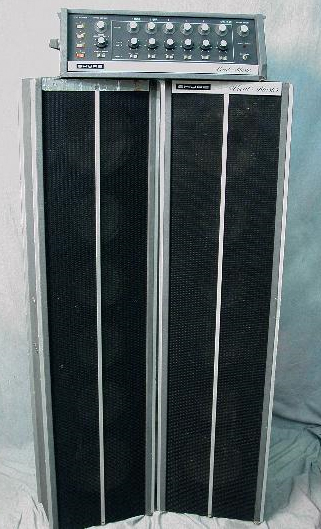
The "PA system" (public address) is damn near as old as me. Maybe older. When I was a kid, an auditorium PA system was often a 15W Bogen tube amp and one or two Shure Vocalmaster columns. Some folks used Shure's mixer/power amp, but anyone who did that produced awful noises that couldn't be identified as either human or musical. The PA system has grown up in the last 60 years. It hasn't become better but it's definitely louder.
When I worked for QSC Audio in the 80's and 90's, we grew from a small company that made extremely solid, dependable, and reasonably good sounding amps to a major competitor in the pro audio field. During that period, pro audio went through some changes that it is still suffering from; the smaller and lighter is better movement. To be honest, the company that started that trend in power amps was Carver; with the PM 1.5. This POS amp was hyped as being able to drive 750W per channel into a 4 ohm load and weighed 16 pounds. When it clipped, it made exploding noises that often took out drivers. When it didn't clip, it was harsh sounding. If you pushed the amp hard, it would thermal cycle or die. Regardless, because it weighed a fraction of amplifiers with similar specs (more evidence that "anyone can write a spec sheet") the sound companies loved it. At QSC, we almost went broke before a few of our old customers came back to us after their Carver experiment.
Twenty years later, the whole industry is driven by Carver-style components: amps, speakers, consoles, and most of the signal path. Amps are multi-stepped or digital and weigh less than a 1960's microphone. Speakers are arrayed and tiny and sound like rejects from the Bose consumer product line. Consoles are digital and so menu-layered that most FOH mixers set 'em and leave 'em, regardless of how godawful the show sounds.
This week, I subjected myself to another round of suffering modern sound systems to get to see an old musical hero: Steve Winwood. Winwood was the intro act for Santana and I haven't seen Steven since Traffic. Since I had comp tickets (no concert sells out in 2010), the cost of seeing Winwood was whatever I paid for parking. Supposedly, the St. Paul Xcel Center is a great sounding room. I hoped that would be so for this show. It wasn't. As usual, the arrayed cluster-fuck of tiny horn boxes was tasked with the impossible duty of providing reinforcement for this large hockey gym. While the designers of the Xcel Center put a lot of work into deadening the room for musical performances, nothing those designers could do could have compensated for modern array speaker systems.
As best I can tell, the contract for all R&R concerts specifies a minimum volume level for shows. Nobody apparently cares how awful it sounds, as long as it is loud. In my 50 years in audio, I have never heard anything coming from an arrayed speaker system that is anything but painful and tonally irritating. Honestly, the theory behind these systems leaves me doubting the mathematical capabilities of the designers, but the practical application proves the theories to be flawed.
For the Winwood portion of the show, the system's resonances were somewhere between painful and obscuring. There was a pile of 70-400 Hz crap that the under-capable arrays failed to produce, so the system "engineer" (using that term grossly loosely) tried to correct with his subwoofer system. If you've read my take on subwoofers, you know how I am going to feel about this tactic. Winwood's bass came from the B3 petals. A B3's bass is one of the most totally cool bottom-end instruments ever invented, but you can't reproduce it with a pile of resonant horns. The sound is too complicated, too powerful, and too characteristic for a reproduction system that turns every LF note into "whoomph." So, the bottom end of the system was a muddy mess.
Winwood's voice was pretty well matched to the rest of the system's midrange capabilities, but everything else was reduced to OEM-quality car stereo fidelity and the FOH goofball's attempt to create top end from his garbage horns was painful, at best. I suspect the FOH doofus was running the system from his laptop, because I didn't see (or hear) anyone working the mix. It could be that he was at the audiologist's office getting his hearing aid battery replaced. If so, he didn't miss much.
Santana's set was about the same, only louder. He had a light show and a video screen to compensate for the lack of a sound system, but it wasn't enough. When my hearing protection was clearly failing to provide adequate protection, we left.
As usual, the show was about 1/3 attended with a substantial number of comp tickets given way to fill some of the empty seats. A lot of people gave up late in Winwood's set and left to save their hearing. When we were left, probably mid-way through Santana's set, we weren't alone in the parking lot.
I think, if live music ever hopes to make a comeback, sound companies are going to have to give up on the fantasy that light and small and loud are more important than fidelity. I'm unconvinced that making customers suffer for musicians' "art" is a winning tactic. Most of the under-30 crowd that I know consider major concerts to be miserable experiences that they hope to avoid for the rest of their lives. I'm starting to think they are right.
Friday, May 7, 2010
A Tool?
I just finished a one day "experience" with Apple's iPad and I'm just short of amazed. I'm amazed that anyone could consider this product anything but a toy. As usual, I'm wrong.When I returned it to the IS guy who is promoting the iPad as an "educational tool" and described my opinion, it was obvious that I'd offended his finer sensibilities. When I said, "I can't imagine a job so detail-free, so simple, that this thing could be considered a 'tool'." He replied, "I could do my job with it."
I'm clearly from another generation. My generation was one where IS guys wrote code, maintained hardware and software, and did stuff. This more modern version of an IS guy uses his "tools" to "go to meetings, maintain work-flow charts, and for simple email." Holy crap! Again, I have missed the career boat. I blew off systems management as a late-life career opportunity because I thought I'd have to learn stuff about stuff I don't care about. Obviously, any idiot can do the job if this POS is a tool of that trade.
Aside from that sort of realization, my opinion of the iPad is that it is a toy. If you want to watch movies or television or YouTube in low-fi resolution, via WiFi, the iPad is for you. If you're mostly interesting in purchasing and/or observing other people's content, the iPad is your vehicle. If browsing the Web without being able to produce any sentient content yourself is your idea of "work" or "recreation" you are going to love this thing. It's a really expensive toy, but a toy just the same.
Saturday Night Live did a pretty decent routine on the iPad back in January. In the end, they recommended a real computer for the few of us who have to do "real work." I totally agree. If you are a Y-Gen twit, the iPad will do a perfectly good job of allowing you to type in (at your usual 5 wpm rate) your idiot messages to your friends. You can watch YouTube and Netflix until your parents evict you from the basement and you have to find a bridge to live under and aspire to that Starbucks clerk job your $80k in college loan debt prepared you for.
Tuesday, March 2, 2010
In Times Like These
No particular reason for this entry, other than the fact that I love this song and this performance. Wish I'd have been there. Alan Price is one of my favorite 1960--70's performers. The low point in his career was as the keyboardist for the Animals. (Any time spent behind or anywhere near Eric Burton would have to be regarded as painful at best.) His follow-up band, The Alan Price Set, was terrific and his version of "I Put A Spell On You" is freakin' spooky. Last I knew, Price was screwing off on a beach in Australia. I hope he's having fun.
Saturday, February 27, 2010
Acoustic Music Is Dead
A few weeks back, I ranted about a godawful Minnesota Orchestra pops “concert’ I suffered. This week, I recorded an electric/acoustic act that had pretensions of acoustic-ness that they didn’t bother to live up to. I mean, they didn’t attempt an acoustic sound.
Years ago, my partner and I rented out our sound company to a couple seasons of bluegrass festivals. We had a very high fidelity sound system with plenty of power to provide audio to several thousand outdoor rock and rollers and enough stage monitoring to keep most lead guitarists and screaming metal-head vocalists happy. With that capacity, we always found ourselves short on the necessary acoustic power to satisfy solo banjo pickers and the rest of the characters who qualify as “entertainers” on the bluegrass circuit.
The sound of a banjo picker whacking on the vocal mic, saying, “Can you hear this out there? I can’t hear a damn thing” still haunts my memories of doing live sound in that venue. Led Zepplin has nothing on a bluegrass quartet, when it comes to stage volume. Their hearing defect is the core to the problem with acoustic music. Fragile egos, hearing impairment, or ordinary poor taste has convinced almost every musician that deafening stage volume is a necessary component of every performance. With that as a given, delicate and sophisticated tonal character is sacrificed for the God of Gain over Feedback. A microphone doesn’t have a chance in hell of picking up a usable tone from an acoustic instrument in the midst of that atonal racket.
The problem is that tone and volume do not co-exist. Sound companies have been proving that for more than 50 years and the evidence is better today than ever. Every musician makes a choice before every performance, “Do I want to sound good or do I want to be loud?” The answer to that question goes to the heart of a musician’s reason for selecting a particular instrument, for practicing and perfecting technique, and for being a musician. The answer, too often, is the one that drives guitarists to select a pickup over a microphone or performing without amplification.
That was 30 years ago. Today, acoustic music is dead. I miss it and I doubt that it is resting in peace.
I can’t remember the last time I saw a folk, classical, or jazz solo guitarist who didn’t bring more amplification to a small club than would be needed to thoroughly overwhelm a small auditorium. Not only do they carry this crap to every living room jam session, but they feel compelled to use it.
It’s one thing to be an electric guitarist who happens to like the feel of a full-bodied acoustic instrument. It’s another thing to pretend to be an acoustic guitarist while depending on a few hundred watts to blast every audience into submission. Sometimes I suspect the real reason musicians pick acoustic instruments is that it gives them an excuse to sit while they play. It sure isn’t because they like the way an acoustic guitar sounds because nothing coming out of an overpriced faux-hi-fi amplifier supplied with the signal provided by a Mickey Mouse rubber band “guitar” pickup.
When I try to position a microphone in front of an acoustic instrument, the claim I almost always get from a guitarist, violinist, or bassist sounds a lot like, “You don’t need a microphone, my pickup sounds great.”
I can think of one instance that I found that claim to be half-true. Otherwise, I think all acoustic instrument pickups belong in rock and roll bands where sound quality is the dead last show concern. They no more sound like acoustic guitars than does a Les Paul plugged directly into a console through a DI. That’s the nicest thing I can say about the lot. Most piezo pickups make an objectionable sound that only a deaf modern musician could love. Their magnetic cousins just turn an acoustic guitar into an oversized electric.
The sound of the acoustic guitar pickup is one that I’ve been trying to find a home for in the mix for 40 years. Usually, the best thing that can be done for that tone is to treat it like a jazz guitar and bury it in delays, chorus, and behind every other instrument in the mix. Otherwise, it just sounds like that miserable noise Al Di Meola has been making since Ovation purchased his soul.
This is coming from someone who loves acoustic guitars. A well-mic’d acoustic guitar is one of my favorite musical instruments. An acoustic guitar, left to its own devices, with no electronics between its output and my ears is up there with any musical sound made by any instrument or voice. Pickups and guitar amplifiers just don’t have anything resembling the nuance to reproduce the instrument. I hate what they do to my favorite instrument and don’t have a lot of love for musicians who can’t hear the difference.
I’m no more fond of those abominations on violins, basses, or mandolins. They are just fine on banjos because there is no way to screw up the tone of that instrument. I guess it doesn’t matter, though. Musicians don’t have the ear, patience, or audience for acoustic music in almost every venue, so let’s just agree that acoustic music is dead and quit pretending that playing something with a hollow body is in any way similar to an acoustic instrument.
The sound of a banjo picker whacking on the vocal mic, saying, “Can you hear this out there? I can’t hear a damn thing” still haunts my memories of doing live sound in that venue. Led Zepplin has nothing on a bluegrass quartet, when it comes to stage volume. Their hearing defect is the core to the problem with acoustic music. Fragile egos, hearing impairment, or ordinary poor taste has convinced almost every musician that deafening stage volume is a necessary component of every performance. With that as a given, delicate and sophisticated tonal character is sacrificed for the God of Gain over Feedback. A microphone doesn’t have a chance in hell of picking up a usable tone from an acoustic instrument in the midst of that atonal racket.
The problem is that tone and volume do not co-exist. Sound companies have been proving that for more than 50 years and the evidence is better today than ever. Every musician makes a choice before every performance, “Do I want to sound good or do I want to be loud?” The answer to that question goes to the heart of a musician’s reason for selecting a particular instrument, for practicing and perfecting technique, and for being a musician. The answer, too often, is the one that drives guitarists to select a pickup over a microphone or performing without amplification.
That was 30 years ago. Today, acoustic music is dead. I miss it and I doubt that it is resting in peace.
I can’t remember the last time I saw a folk, classical, or jazz solo guitarist who didn’t bring more amplification to a small club than would be needed to thoroughly overwhelm a small auditorium. Not only do they carry this crap to every living room jam session, but they feel compelled to use it.It’s one thing to be an electric guitarist who happens to like the feel of a full-bodied acoustic instrument. It’s another thing to pretend to be an acoustic guitarist while depending on a few hundred watts to blast every audience into submission. Sometimes I suspect the real reason musicians pick acoustic instruments is that it gives them an excuse to sit while they play. It sure isn’t because they like the way an acoustic guitar sounds because nothing coming out of an overpriced faux-hi-fi amplifier supplied with the signal provided by a Mickey Mouse rubber band “guitar” pickup.
When I try to position a microphone in front of an acoustic instrument, the claim I almost always get from a guitarist, violinist, or bassist sounds a lot like, “You don’t need a microphone, my pickup sounds great.”
I can think of one instance that I found that claim to be half-true. Otherwise, I think all acoustic instrument pickups belong in rock and roll bands where sound quality is the dead last show concern. They no more sound like acoustic guitars than does a Les Paul plugged directly into a console through a DI. That’s the nicest thing I can say about the lot. Most piezo pickups make an objectionable sound that only a deaf modern musician could love. Their magnetic cousins just turn an acoustic guitar into an oversized electric.
The sound of the acoustic guitar pickup is one that I’ve been trying to find a home for in the mix for 40 years. Usually, the best thing that can be done for that tone is to treat it like a jazz guitar and bury it in delays, chorus, and behind every other instrument in the mix. Otherwise, it just sounds like that miserable noise Al Di Meola has been making since Ovation purchased his soul.
This is coming from someone who loves acoustic guitars. A well-mic’d acoustic guitar is one of my favorite musical instruments. An acoustic guitar, left to its own devices, with no electronics between its output and my ears is up there with any musical sound made by any instrument or voice. Pickups and guitar amplifiers just don’t have anything resembling the nuance to reproduce the instrument. I hate what they do to my favorite instrument and don’t have a lot of love for musicians who can’t hear the difference.
I’m no more fond of those abominations on violins, basses, or mandolins. They are just fine on banjos because there is no way to screw up the tone of that instrument. I guess it doesn’t matter, though. Musicians don’t have the ear, patience, or audience for acoustic music in almost every venue, so let’s just agree that acoustic music is dead and quit pretending that playing something with a hollow body is in any way similar to an acoustic instrument.
Subscribe to:
Posts (Atom)
Wirebender Audio Rants
Over the dozen years I taught audio engineering at Musictech College and McNally Smith College of Music, I accumulated a lot of material that might be useful to all sorts of budding audio techs and musicians. This site will include comments and questions about professional audio standards, practices, and equipment. I will add occasional product reviews with as many objective and irrational opinions as possible.