Saturday, November 7, 2015

Driving A Throwaway World

My hometown theater spent about $150,000 on audio gear this year. The theater was pretty well equipped before, with JBL MP418SP subs and JBL MP415 mains, a decent collection of QSC power amps, perfectly functional monitors and side-fills, and a 24-channel Yamaha analog mixer. Everything worked and it was paid for, something hardly anyone cares about in today’s jacked-up credit card and second-mortgage world. For the $150k, the town got a 48-channel DiGiCo SD-9 Surface & Two D-Rack. SD-9, Dynacord PWH subs and Dynacord Cobra tops, with Dynacord VL 262 under-balcony fills and front stage boxes, and a crap-load of EV power amps oddly located about 100’ from the speaker boxes (a whole ‘nother discussion). So far, pretty much no one substantial who has played the auditorium has wanted to mix on the DiGiCo. So, mostly the ~$40k spent on the mixer has been for some pretty undemanding shows with the toughest stuff being low-turnout local pop bands. As a local taxpayer, I’m less than impressed with the decision process the city used to spend my money.

At a completely different end of this discussion, though, I can’t see anyone having a good justification for spending more than $5-8k on a digital console of any sort. Using actual business rationale, the payback on digital gear has to be really short to make any sense at all. The Return on Investment (ROI) should be calculated to arrive in 3-5 years (max) because the equipment will be obsolete and unrepairable in about that time. If you don’t think that is either a reality or an important part of the decision-making process, you are part of the reason that we live in an unsustainable throwaway society.

my boots

On a much lower economic scale, I recently bought a pair of Red Wing boots. I live in Red Wing and some of my neighbors make these things, so I decided to spend big and buy local. The boots I bought, on the left, are pretty high priced but they are tough and well-built and super comfortable and (above all, for the investment price) are repairable. They can be resoled by pretty much any shoe repair shop anywhere in the country. I expect to be wearing these boots the day I die. On the other hand, Red Wing and pretty much everyone else imports boots from China and other low-labor-cost places like the boots on the right. redwing_606_bootsThey are, admittedly, a little cooler looking, cheaper, and just as tough and comfortable. I don’t know if those things are true, but I assume they are and don’t care. I can not convince myself to spend $200 on a pair of boots that I’ll wear out in a year and have to toss because the soles are not replaceable. Crazy, right? Probably.

Likewise, I can’t convince myself that there is any sonic or functional value to a $30k DiGiCo console over a $5k Midas or Yamaha or, even, a $2500 Presonus digital console. I sincerely do not believe there will be any noticeably audible difference in any of this equipment and I fully expect each of these products to be junk in well under a decade. Since you could buy 6 of the Midas/Yamaha consoles for the same money in that period, I’d think the decision is a no-brainer. Why it wasn’t for our city confuses me.

Friday, October 16, 2015

Quality in the Disposable World

I’m taking the Guitar Repair and Building Program at my local technical college. During a discussion with an instructor, we touched on a misconception about customers’ expectations and dissatisfaction inclinations. Like a lot of small business people, my instructor was under the delusion that customers will naturally complain if they are disappointed with service or product quality. Many larger companies are equally happy to pretend that they are getting 100% “compliance” from dissatisfied customers. The fact is that most customers simply log their dissatisfaction and tell themselves they will remember to never buy that particular company’s product or service again. Most executives are perfectly happy with that outcome. Sounds like a perfectly balanced system, right?

At the other end of this “system” is the wrong-headed conclusion most business people make about customer loyalty. I’ve heard more than a few executives claim that customers don’t shop out of loyalty any more. The problem isn’t with customers, it’s with businesses. Loyalty is not a one-way street: you have to give it to get it. Counter-intuitively, you have to work at giving it.

During my ten years with QSC Audio Products, we’d developed a pretty thorough system of handling customer complaints, tracking customer purchases, feeding back customer and product information to marketing, engineering, and manufacturing, and statistically analyzing our product warranty problems and costs. When I left that company, I’d been recruited by an MI conglomerate to turn their low end sound equipment division into something more resembling a competent manufacturer. During the initial talks, I’d been led to believe the company was considerably more substantial—organizationally and financially—than it actually was. So, that moment of employment was doomed from the beginning. If I wanted to fund a start-up with my own equipment I’d have started-up my own company.

Late in the 30 days I wasted in Indiana, I was asked by the company’s guitar division customer service manager to explain QSC’s quality management system.  About 1/10th of the way into the discussion, he interrupted me to say, “That’s all way too complicated and expensive.” He went on to say that the company shipped product with a known 50% defect rate, based off of the internal random inspection data from a few years back (Since they quit inspections after a few months, product quality had probably gotten worse.). From a suspected 50% defect rate, about 1% of the company’s customers complained, expecting some sort of warranty response. If they stonewalled that first complaint, about 1% of the first 1% would come back for more abuse. No special inspection was done for warranty replacement instruments, so at least 50% of the replacements were also defective out-of-the-box. According to the manager, that 1%-of-1% routine applied to warranty replacement complaints. So, while at QSC we were aiming for 6-sigma (99.99966% defect-free, but often struggling with three-sigma performance; 99.73% defect-free), his company could boast an uninformed-by-reality 99.99235% non-warranty-claim rate without spending a dime on quality control and while shipping product that most customers would call “junk.” Between that and a conversation with the CEO regarding the discrepancy between the information in my offer letter and reality, I quit a couple of days later.

Those statistics are from large-quantity production. Small quantity (boutique) production and service businesses don’t have access to actual numbers and formal inspection procedures and if they rely on customer complaints for feedback they are committing business suicide. In fact, the only way a small business can get any kind of information about customer satisfaction is to hunt for it. When someone cares enough about the product or its performance to complain, a conscious customer service tech should take that complaint seriously and to heart. The 1% of your customer base who care enough about your product or their expectations to complain are rare and valuable. If you choose to ignore them, don’t complain when your customer base makes its buying decisions solely on price and delivery. You have informed them through your actions that you don’t give a shit about their expectations and the result is that they won’t care about you or your company’s survival.

Saturday, October 3, 2015

Pure Acoustic Bullshit

40 years ago, my partner and I did a summer’s worth of acoustic music festivals, mostly bluegrass shows. After the 90th time hearing some toothless bullshit artist jabber about how “pure” his “acoustic music” was, compared to rock or R&B, while he thumped on his mic saying, “Can you hear this, I cain’t hear nothin’,” I pretty much had all I could stand of bluegrass, hillbillies, and anything “country.” After that season, Dan quietly packed up his stuff and left the business and we folded the studio, equipment rental business, sound system design and consulting, and repair/maintenance services not too many months later. Today, it was “déjà vu all over again.” I helped setup the stage and do the sound check for an oversized group of young people pretending to be acoustic musicians at the local theater. The sound check reminded me of why I am a volunteer for this work, not a paid professional. In fact, the only way I would have money in this game would be if it were mine and I could hire and fire “musicians” at will.

Let me make this perfectly clear, in case you are not only deaf but incredibly stupid: if you need amplification to present your music in a 250 person theater, you are not an acoustic musician. If you have a pickup installed in your guitar and that is how your instrument conducts signal to the FOH board, you are not an acoustic musician. If your stage volume (monitors and POS personally owned equipment included) are adjusted to be too loud for the acoustics in the room, before the front of house (FOH) system is even engaged, you are a pitiful combination of the Nitty Gritty Dirt Band and Spinal Tap.

In this particular group, the only person on stage who seemed to have the slightest notion that the sound system bullshit was grossly out of control was the fuckin’ clogger. When a tapdancer who brings his own sound stage thinks you are “too loud,” you are way past too loud.

There is a concept in music, at least in the studio, called “serving the music.” It is apparently a non-issue in live music and it’s 99.999..% of the reason why rational people rarely attend live music performances. Serving the music means that musicians do anything necessary to ensure the music is delivered to the audience in the best possible manner. It means that the FOH system gets setup first, then whatever minimal reinforcement the musicians need to hear themselves well enough to perform well is added. Since most of the great performances I’ve seen were sans-monitor system, it’s pretty obvious that great musicians don’t need their own mini-concert system at all. Bluegrass musicians ought to be able to hear the damn instruments on stage without anything resembling a monitor system. If they can’t, they have wreaked hearing and should give it up and go back to their Spinal Tap cover band career.

So, the next time you find yourself fucking with the monitor gain-before-feedback when you haven’t even fired up the FOH system, remember this: I fucking hate the way you sound and so does everyone who has ever bought a record and listened to it carefully. As long as your own ego is the main focus on your stage, you are not a musician but you are definitely a spoiled child who didn’t get enough attention from mommy when you were nursing or being potty trained. Or maybe the last one never happened?

Sunday, September 13, 2015

Why Do Guitar Parts and Instrument Manufacturers Call Vibrato “Tremolo” and Vise Versa?

All Rights Reserved © 2015 Thomas W. Day


VIBRATO adjective: a slightly tremulous effect imparted to vocal or instrumental tone for added warmth and expressiveness by slight and rapid variations in pitch.

TREMOLO noun:

1. a : the rapid reiteration of a musical tone or of alternating tones to produce a tremulous effect

b : vocal vibrato especially when prominent or excessive

2. a mechanical device in an organ for causing a tremulous (nervousness or shaky) effect.

Like many of the bad things in electric guitar history and technology, you might blame this pair of misnomers on Leo Fender. DeArmond[1] introduced the “Tremolo Control,” (created for organs, not guitars) an amplitude-varying device with “increase” (depth) and “speed” (rate) in the early 1940’s. Harry DeArmond named his device correctly and musically. Since Leo Fender was more of a technician and a manufacturing-oriented guy than an inventor, he often co-opted inventor’s designs and made minimal changes to avoid having to pay patent rights. This would be one of those instances. Fender’s "vibrato" effect—which is technically a tremolo effect—started with its introduction on the 1956 Fender Vibrolux and Vibroverb model guitar amplifiers. The effect has commonly been misnamed ever since.

Like many inventions attributed to Leo Fender and Les Paul, the first guitar vibrato unit was a Rickenbacker design.[2] Oddly, the device was electric only installed on Rickenbacker’s Vibrola Spanish guitars. A Rickenbacker collaborator, Doc Kauffman, designed the device and its purpose was to imitate the variable pitch of steel guitars (slide). Hand operated versions showed up on Rickenbacker's Capri guitars in the late 1950’s. Rickenbacker consistently called their devices “vibrato.” Bigsby made the first successful commercial vibrato unit (still called “vibrato” by that company), with the first known version showing up on guitars demonstrated in 1952. Merle Travis recalled the Bigsby company making a unit for him in “the late 40’s.”

Leo Fender’s “synchronized tremolo” appeared in 1954 on the Stratocaster. This might be the moment the musical effect of vibrato was misnamed "tremolo" as Fender described his device as the "tremolo arm." Thanks to Leo’s ignorance or business sense, as Wikipedia so aptly puts it, “electric guitarists traditionally use the terms ‘vibrato’ and ‘tremolo’ in the opposite senses to all other musicians when describing these hardware devices and the effects they produce.”

Oddly, in my 50+ year career in various aspects of music, I can’t remember any player ever calling this device a “tremolo.” “Whammy bar,” yes. “Tremolo” nope, not ever. Most of the musicians I’ve worked with both in bands, on stage, and in studios know the difference between “vibrato” and “tremolo.” Singers and horn players and classical string players, obviously, use the term in the musical sense and in the recording studio misnaming musical terms is grounds for ridicule and unemployment. I admit to having disliked the sound of amplitude modulation (tremolo) on guitar for more than 50 years. The Dwayne Eddy warble and the goofy sound of surf guitarists in the 1950’s is part of what helped me select the trumpet as my first instrument. So, if my dislike is displayed as cynicism, I’m good with that.

It turns out that the name for a guitar’s mechanical vibrato is brand/inventor dependent. If the mechanical vibrato device is a Fender or a Fender improvement/replacement (including Floyd Rose), it’s a “tremolo.” So much for original thought in the 21st century. If it’s a Bigsby, producing vibrato is done by using a mechanical “vibrato.”

Electronically, vibrato is one of the many things you can obtain with a pitch-shifter, chorus, and many moderately complex digital or less complicated but lower fidelity analog delay devices. Electronic tremolo is an insanely simple circuit and can be obtained for as little as $25. (Behringer’s Ultra Vibrato UV300, for example. Yeah, I know they call it a “vibrato,” but Behringer isn’t known for being smart, original, or musically or technically competent.) If you want an excuse to spend two or three times what the device is worth, you can buy all sorts of boutique tremolo pedals (that all do the same boring thing the same low-tech way) or learn something by building your own. Since the basic circuit is as simple as electronic circuits get, building a device probably provides infinitely more education value than the musical contribution this silly effect creates.


[1] http://www.vintageguitar.com/18545/dearmond-tremolo-control/ “DeArmond’s Tremolo Control did just this. It debuted in about 1946; the earliest known brochure is dated July of that year, according to historian Dan Formosa. ‘This precedes guitar/accordion amps with tremolo (the Premier/Danelectro amps date to 1947 and Gibson to 1948)… It’s most probable that the use of tremolo by guitarists would pre-date the commercially available units (otherwise, why would the manufacturers be prompted to create amps or effects units – unless it was an accordion thing),’ he notes. ‘The earliest recorded guitar tremolo I’ve come up with (so far) is Roosevelt Sykes, 1941-44.’” You can also read a lot about the history of this device at http://www.premierguitar.com/articles/19777-a-brief-history-of-tremolo.

[2] http://guitar.wikia.com/wiki/Whammy_bar This site does a fine job of briefly describing the history of the guitar-based mechanical device.

Sunday, August 16, 2015

Microphones Are Not Your Friend

Lately, I’ve been experiencing the sad fact that too many hobby musicians seem to think that microphones are some sort of corrective device; like Auto-Tune©, but smarter. A local bookstore hosts an open mic event every 2nd Thursday of the month and there is a surprising amount of talent, young and old, in Red Wing. A few days later, I was listening to some experienced musicians at the Unitarian Universalist Society of River Falls and saw that deluded faith in microphones again. All of the characteristics and qualities microphone designers know about microphones seem to have failed to filter down to musicians, poets, and nearly anyone who touches a microphone with sound reinforcement in mind.

The open mic experience probably bothers me more because it’s obvious that the people on that stage are simply imitating the stupid crap they see on television or stage from so-called “professionals” who are most likely simply lip-synching a fake performance. Sound reinforcement is close to perfectly unnecessary when your audience is fewer than two dozen people. Musicians survived and thrived for hundreds of years without the help of low fidelity electronics and electro-mechanical devices. Audiences were more polite, more engaged, and more informed about the music, the musicians, and the sound of instruments and voices before electronics distorted and deformed live music. There is some hope, though. Occasionally, I see a musician using those incredible analysis devices called “ears” to make informed decisions about how to use (or not use) the microphones placed on the stage. Not often enough, but at least it happens. If it happens once during each evening, it might catch on and happen twice. Next thing you know, we have a revolution and music sounds . . . musical again.
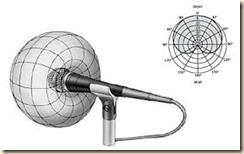
cardioidHere’s the first thing to know about decent microphones: you will sound more natural, more musical, if you get the hell away from the damn things. Cardioid microphones (like the one in this picture) have the reasonably useful characteristic of being able to ignore some signals from the off-axis (backside) of the microphone where the stage monitor often is. This can, sometimes, provide a ik-iklip-4-largeslight improvement in gain-over-feedback. The nasty compromise this “polar pattern” brings to the party is that as you get closer to the mic the tonal characteristics become grossly weird. P’s, t’s, b’s, and other “plosive” signals are emphasized as are s’s, h’s, c’s, and other “sibilance” signals. You may think you are sounding intimate when you “eat” the microphone, but you are mostly sounding awful and irritating. The sound-doofus may try to “fix” the mess you and the microphone are making with EQ, but that will only add to the irritation. You’re still going to sound awful.

Bob-Dylan-Rare-High-Quality-Picture-04Try backing up a foot or two. Even better, back-up and drop the mic below your collarbone a few inches. Some of the power of your voice comes from your chest, stuffing the mic up your nose does what you might expect it to do; it makes your voice sound “nasal.” If you are a solo vocalist or a speaker, the same thing goes for you. Get the hell away from the mic at least a spread hand’s distance and drop the mic below your mouth at least six inches. If it was good enough for Bob Dylan, it’s more than good enough for you.

Don’t be surprised if this is harder to do that you expected, the first time. You’ve probably grown used to the oversized sound of your proximity-enhanced voice. It probably sounds “big” to you on stage, but if you wanted someone else’s voice you should have become a mimic. Any musician worth listening to is trying to be himself, not some hyped and distorted poor copy. Remember, we’re talking about a venue that is no larger than a decent living room. If you need a PA to entertain yourself in your living room, you’ve got problems I can’t help you with.

One of the things that always amazes me about singers is their lack of attention to the most important details in their live performance: the microphone and microphone technique. Guitarists bring their own instruments, including amplification, but vocalists just show up and depend on the kindness of usually-deaf sound-doofuses. If you are a singer with some talent and a voice, you should study microphones until you know enough to find one that reproduces your voice as you hear it in your head. Then, you bring that instrument with you everywhere you perform. If you are an acoustic instrument musician, the same applies to you. The microphones you are most likely to be stuck with in a live performance venue probably suck. The industry standard, the Shure SM-58, is insanely durable, but sounds somewhere between awful and mediocre. The same goes for a whole collection of 58-look-a-likes from practically every manufacturer. Unfortunately, quality isn’t cheap. Expect to spend $500-1,000 for an excellent vocal microphone.

ptse23One of the worst personality characteristics microphones appeal to is ego. Some musicians simply want to be loud. The thing they most want to be loud is their voice, so their accompanying instrument is either grossly distorted by godawful pickups or doesn’t exist at all. The picture at left of this paragraph is a good example of that defective thinking. If the microphone output were being recorded, the two acoustic guitars would be barely audible and pretty awful sounding. The off-axis frequency response of an SM-58 is generously described as “gross.” If this were, as it appears to be, a live performance, the two voices will often be distorted, poorly blended, and overpowering through the PA (this mic’ing technique would not qualify as sound reinforcement). These two musicians would be far better off without a PA, but they might never know it because they think the microphone is a crutch. It’s not, it’s a handicap unless you know what you are doing and 99% of musicians and 99.99….% of public speakers are totally clueless when it comes to the technical side of microphones.

Monday, July 27, 2015

Saying Goodbye to My Hands

For more than fifty years
My hands have been my life
My fingers have made my living
My hands have fed my family
My hands have built our home
My fingers played the music,
Said the things my heart could not.


Now, old man’s disease, arthritis
Is putting an end to all of that.
With hands that are becoming claws
With fingers that jerk and stall
I can’t hold a handkerchief to my nose
I can’t swing a hammer, hold a guitar pick,
Wield a soldering iron, squeeze my wife’s hand.


The fingers that I broke years ago
Now twist and deform like wilting flowers.
The bones that were smashed by work
and careless disregard for the future
are getting their revenge on the brain
that said “Keep going, keep working.
Play through it. Ignore the pain.”
 

Today, I can’t.
They won’t perform on command.
My hands are dying.
My fingers are putting an end
To any dreams I might have
Of a future as a builder, a maker,
A musician, a lover, a man.
Goodbye my old abused and tortured friends.


I woke up at 3AM a few nights ago couldn't close my right hand, even a bit. My left was slightly less impaired, but certainly not useful or strong enough to make up for the loss of the right. At that moment, I realized that this might be my last year for a lot of things, like playing guitar or construction projects or typing. There was no chance that I’d sleep more that night. I got up and worked on a Tom Waits song I've fooled with for the last year: “Shiver Me Timbers.” I wrote a half-dozen essays. For the first time since I was a teenager in love, I wrote something the Pressure Press folks call "a poem" That was the bit that opened this essay.

The "poetry" is exaggerated. But I have known way, way too many people younger and older than me who have lost a lot of their ability to be themselves due to arthritis. Some even decided they’d lost enough of themselves to give up on life. A friend of my grandmother--a woman who had been a musician and an artist and a gardener and an inspiration to everyone who knew her—was reduced to wandering around her backyard looking at the weeds overtaking her once-beautiful gardens and staring at her crabbed hands. She managed to turn the gas on her oven, stuck her head into the stove, and smothered herself. No one wondered why. A cousin--a man who is a decade younger than me and was once one of the most active people I’ve known—can’t write his name, drive a car, hold his wife’s hand, or help one of his kids into the car thanks to arthritis.

Personally, I hate this disease more than cancer. Cancer is, usually, terminal and often fairly quick. Arthritis is endless torture.

I have hammered these poor appendages into submission for 67 years, but they are starting to fight back. It does remind me of something I've said for decades, though. "If I'd have known I would live this long, I'd have taken better care of myself.

Seriously, I'm in pretty good shape. The whole prose thing came from the "inspiration" of waking up unable to use my right hand and thinking that someday could be the last day I can do the things I take for granted. The next day, I met a young lady who has been dealing with this pain and incapacity since she was a young teenager. Forty years ago, the girlfriend of the keyboard player for a band I was in was so stricken with degenerative arthritis that she was unable to receive a hip transplant because her pelvis was so wreaked. I'm not whining, feeling sorry for myself, or asking anyone to feel sorry for me. I’m just shouting at the night.

I'm 67 and have broken bones in my hands (and other places) so many times I couldn't begin to get a straight count. I quit hitting the heavy bag in 2013 because my hands were so messed up the next day. This isn't a sudden change but the obvious disability feels sudden.

I'm sort of inspired that the pain aimed me at doing a breed of writing I haven't attempted in 40 years. I'm humbled that I have so many friends who were moved by that inspiration.

Tuesday, July 21, 2015

Making Your Own Pace of Change

I attended a discussion group at the Unitarian Universalist Society of River Falls last weekend on the topic of “The Pace of Change”: “The culture around us is evolving technologically and this affects the way we live as familiar ways of doing things become outdated. As the pace quickens how do you feel and what do you think about that? Choose an example that affects you directly and share your thoughts and feelings.”

A lot of the group’s feelings were centered around disgust and/or paranoia about “planned obsolescence.” Some of that conversation was pretty much outside of my own experience with product design and manufacturing. Assuming that engineers are capable of good design is often a gross miscalculation. I saw unintentional fatal errors like placing temperature sensitive components next to parts that run hot by design, seriously underestimating the need for component selection safety margins, and completely idiotic part placement in vibration-prone products in at least five different industries and a dozen companies; four of which were highly reliability-sensitive industries. Another common and valid complaint was regarding unrepairable products. This isn’t planned obsolescence, this is terrible design. Design Magazine has a column titled “Designed by Monkeys” that highlights stupid stuff like this and it’s always refreshing to hear an engineer ridicule his fellow monkeys in this format.

In audio, lots of people resort to buying “old school” products to avoid the unrepairable issue: vintage microphones, analog tape recorders, etc. Another, more practical approach, is to hunt down and support those companies whose products are known for reliability and whose customer service is known for providing a quality response. In practically every area, we all know who the low quality vendors are, but figuring out who the good guys are is much harder.

One obvious clue for the good guys is available service information. In my own recent consumer experience, Volkswagen is the most customer-hostile car company I can imagine. They make service information difficult and expensive for independent service centers and even more impossible for customers who want to service their own vehicles. Volkswagen’s dealer service is nationally notorious for incompetence and high cost. Nissan, on the other hand, makes service manuals available (for free) in PDF format on the NissanUSA website. Nissan is extremely helpful to independent service centers. Parts and service information is as available to independents and customers as those commodities are to their own dealer network.

As for doing the work yourself, I recommend it. In fact, I really recommend either carefully researching the products you buy for available service information or when a particular product’s service information is absolutely not available from any vendor in the market, pay the least possible for the product. Paying a premium for Apple’s iCrap is idiotic, now that the company has embraced the “Retina” design philosophy. I don’t have a problem with “throw-away” products as long as they sell for throw-away prices. An iPad sells for $600 and, for the most part, can’t be repaired in any practical sense. There are a large number of Android-OS pads that are well under $70 and they do every useful thing the iPad can manage. The things the iPad does that can’t be done on an Android pad would quickly be available on the cheaper devices if Apple’s sales collapsed. For that matter, Apple’s prices would follow the market if it weren’t for their Kool-Aid drinking fanboys and girls.

In the last two years, I have installed SSD’s in four computers (including a 2009 Apple MacBook Pro), installed operating systems and programs on a half-dozen computers, repaired the cooling system of my MacBook Pro, upgraded the video on my 2008 Mac Pro tower, rebuilt one motorcycle fuel injection system, rebuilt one lawnmower carburetor, changed the oil on all of my vehicles and lawn care appliances, troubleshot and repaired the electronics package on a Winnebago Rialta/VW Eurovan,  fixed the AC on two vehicles, learned how to pour a new floor and wall in my underground garage, repaired a small pile of pro audio electronics and music equipment, wired a good bit of two houses, disassembled and repaired the lens mechanism on my 8 year old digital camera, and repaired more things than I can remember for family, friends, and customers. I’m not convinced that all modern products are unrepairable or even designed so they can’t be repaired. I am convinced that most people are so helpless that they are walking Darwin Awards waiting for the moment that solar flare-generated EMP takes out the technology they cling to so precariously.

One of the things you learn from owning an old home is that engineers, carpenters, electricians, plumbers, masons, and everyone involved in product design 50-150 years ago had the same diverse collection of “talents” today’s technicians exhibit. Some were good and some were awful.

Wednesday, July 1, 2015

Intuition Is Sometimes Right, Even Mine

When I decided to retire from teaching, I felt pretty strongly that Id overstayed my welcome. My patience for bureaucracy, students, and even a few of my friends at the school was wearing thin. I’d stopped having fun teaching more than a year earlier, for multiple reasons. While the subjects still fascinated me, my never-particularly-tolerant tolerance for fools began to suck the life out of my classroom attitude. My last couple of labs were so painfully pointless that I could barely stand the idea of showing up to class on those days. And four of the work days required me to be in those two labs. Between the cell phone addictions and the “Tom, Tom, Tom, Tom . . .” interruptions from a couple of ADHD-diagnosed kids with no more self-discipline than baby bobcats I was back to dragging myself out of bed to go to work. So, two years ago, today I decided I wasn’t going back for the 2013 fall semester.

Off and on, I’ve wondered if I retired too early. If I still had something worth providing to the few students who actually give a crap about music, audio, technology, and the rest of the skills that are required to make a few bucks in the “music business.” One piece of evidence that I’d made the right decision was, oddly, from LinkedIn.com. My youngest daughter, Genya, turned me on to LinkedIn years ago, after I’d left medical devices and was wandering around looking for a 5th (or 15th) career direction. The site never really did anything for my career options, until I’d already began my teaching career. However, it has been an interesting social networking resource, allowing me to keep in touch with past co-workers, friends, students, and employees. LinkedIn has a silly feature that allows users to “endorse” their connections with a button-push; not exactly a rousing recommendation or even something that requires much thought. My friends have generously provided me with hundreds of endorsements for my “skills” ranging from electronic design to recording engineering to musical capability. The last 12 years of my career certainly provided me with more LinkedIn endorsements than the previous 30 years of my career, mostly (I hope) because this kind of resource didn’t exist until recently.

I don’t pay much attention to stuff like this because its no longer relevant to whatever future I have left. I haven’t counted my endorsements or tried to encourage (or discourage) anyone to endorse me. I’m not really looking for work and I don’t care all that much who knows what I know (or used to know) or what my talents are or were. I’m done with a lot more stuff than I expect to do.

However, when I was in New Mexico over the winter of 2013-2014, I offered myself up as an extra-curricular instructor for the Truth or Consequences high school; teaching the same subjects I’d taught at McNally Smith College of Music. Not much happened from my offer for a month or so and I decided to rattle the music department’s cage to see if I’d fallen through the cracks. What I learned was that the school was pretty much dropping music and art in order to concentrate on bringing the state and the school’s ranking up from dead bottom. The only comment the about-to-be-unemployed music teacher had for me was, “Nobody had much to say about your teaching ability on LinkedIn.”
As far as the button-pusher rankings, he was right. I hadn’t noticed that, but I didn’t have a single vote for any aspect of teaching/education/classroom/mentoring bullshit. Not a subtle hint.

Wednesday, May 27, 2015

Professionals?

We have progressed from when "professional" meant someone who made a living and supported a family in a profession to where anyone who once held a job or an internship until discovered to be incompetent can claim to "have been a professional." The current definition is leaning toward "I paid a shitload of cash (in unpaid loans) to be education in a professional and while I'm too lazy, incompetent, and/or untalented to even find an unpaid internship in that field, I deserve to be called a professional." I can't even imagine what's next.

Wirebender Audio Rants

Over the dozen years I taught audio engineering at Musictech College and McNally Smith College of Music, I accumulated a lot of material that might be useful to all sorts of budding audio techs and musicians. This site will include comments and questions about professional audio standards, practices, and equipment. I will add occasional product reviews with as many objective and irrational opinions as possible.