In an article about the NBA’s Allen Iverson’s economic troubles, the author quoted his artist-girlfriend, "To be radical in your art, you need to be conservative in your life." Similar to the excellent advice Dessa once gave to McNally Smith’s graduates, “Keep your overhead low,” this way of looking at finance and freedom is critical to artistic integrity. Honestly, I think it’s good advice for anyone with a creative bent. These days, most Americans are “conservative”; which is another way of saying that we are terrified of pretty much everything, especially ideas. The only thing we appear to be fearless in the face of is debt. Our president is a king of leveraged fake “wealth” and many Americans appear to admire Trump’s willingness to pretend to be rich in the face of constant business and investment failure. The US median household owes around $140,000, pays about $1,300 in annual credit card interest, and even the over-65 crowd’s median savings is well under $100k while middle-aged Americans average about $25k in savings. There is nothing conservative about those numbers. So long ago I can’t remember when or who, someone told me that you can’t retire until you own your home. This isn’t the bullshit “homeownership” crap people spout when they still owe 20-150% of their home’s value to a bank. This is outright ownership. To own a home, you need some luck and a lot of financial restraint. You’ll have to give up a lot to be a homeowner at the end of a 50 year work life. Giving up things for a better future or to obtain a goal seems to be a vanishing American trait. Most Americans appear to believe they can have it all: new cars, new computers, new big screen televisions, cell phones, an active social life, etc. The fact is, if you aren’t earning big money you can’t afford to spend big money.When I left McNally Smith College in 2013, it was pretty obvious that the school had totally lost sight of any aspect of that fact. There were a few more folks in administration than there were instructors and the administration people were clearly convinced the purpose of the school was to support them and their habits, hobbies, and perversions. It was not a fun place to work anymore. Paraphrasing Larry Niven and Greg Benford, from, Bowl of Heaven, “[He] thought that life’s journey wasn’t to get to your grave safely in a well-preserved body, but rather to tumble in, wreaked, shouting, What a ride!” Of course, the trick is to do that tumbling in the last few minutes of your life. Crashing with a decade or two of life left means living under a bridge for a couple of decades and that isn’t an adventure, it’s a disaster. I think you have to “live to scale”: meaning you set your expectations, expenses, and anticipated opportunities based on your average past income and expenses. If you plan on being rich in the future and spend like that in the present you’re more than likely going to be worse than disappointed. You are going to be homeless, broke, and without a chance in hell of any sort of hopeful future. On the other hand, if you are conservative with your resources and expectations, you can go way out on a limb in your art. You can take the kind of risks that so often leads to success because you have something to fall back on and are not gathering so much karmic and economic mass that when you have to fall back you are crushed. That’s what being conservative is really all about. Creating a space cushion for yourself that provides time and resources to regroup and make another run at your goals.
Way back in 2014, I bought a used Composite Acoutics Cargo travel guitar. I liked it a lot then and I like it more now. Peavey bought the remnants of CA and that company appears to be purging the memory of the original company as quickly as possible. So, I thought I’d try to compile a little history while it’s still possible:
I recently did FOH and monitors for a rock band in a small (250 seat), historic, municipal auditorium. It was a four-piece group: two guitars, bass, and drums along with three vocals. I’d never worked that room before, which meant a lot of new things for me to figure out. It would be my first time out with the Behringer X32 digital mixer along with a few other firsts. One of the reasons I took the job was that the director of the facility is a big proponent of low volume shows and there had been some discussions about keeping it small and quiet from past show experiences. The room acoustics weren’t great, but they weren’t terrible either. The auditorium’s equipment was decent and so, it turned out, was the band.
Mostly because the previous house engineer had a show “scene” from the last year’s show, I sort of went with his stage setup. I mic’d both guitar amps and ran a DI from the bass. I setup two overhead mics and a kick mic on the kit, abandoning the previous session’s snare and tom mics. In the end, I used about 16 channels for the 4-piece band. We did a quick sound check, first with the FOH system for me followed by ringing out the monitors. The guitar player at far stage right complained that he couldn’t hear the bass (who was setup far stage left) and I ran up the bass in his monitor to the point it was cancelling the output from the bass player’s amp and overwhelming the FOH bass output. He still couldn’t hear it, so I dialed it back to where it interfered less with the FOH sound. He was the old guy in the group and the loudest amp on stage, so I made the assumption that he was stereotypically R&R deaf. It’s also possible that there was a LF phase-cancellation problem on the stage.
The facility manager complained about the volume during the sound check and I got the bass player and lead guitarist to dial it back a bit. The rhythm guitarist made a show of fake adjusting his amp, but it was obvious that he didn’t intend to comply with the venue’s volume limits. I didn’t bring an SPL meter because I assumed the venue had one, based on the fact that there is a loudness restriction there. I’d guess the show was somewhere between the low and mid-90dBSPL territory.
I started the show with instrument volumes very low to see where the players would go once they got into the performance. Pretty quickly, I pulled the rhythm guitar, bass, and kit out of the mix. I tried to mix the lead guitar signal, up during solos and down the rest of the time, but his signal was mostly so distorted (It was a Neil Young cover band after all.) that my addition to the distortion fog only served to screw up the rest of the mix. That was really demonstrated during a song where he solo’d without his distortion pedals and the guitar lept out of the mix all by itself. That clue’d me into the fact that, if I wanted to hear his solo guitar I needed to band-limit it drastically. I low-passed the lead guitar at about 3kHz and high-passed it at 300Hz, which gave me a signal that I could work with.
In the end, I found myself with faders up on three vocal mics, a DI’d acoustic guitar, and everything else fully attenuated or close to it. I had one moment, about 30 seconds long, where I brought the kit up noticably and I flailed away for most of the first set trying to figure out how to get the lead guitar prominently into the mix. I should have taken a picture of the console: two-to-three faders up and the rest all the way out. All that equipment, all that processing power, and no real need for me to be there for most of the show.
If I’d have just setup up three mics and one DI, I’d have had more sound than the room and audience needed. Even from the monitor standpoint, no one asked for drums in their monitors. The drummer wanted a little lead guitar and bass in his mix. I already talked about the rhythm guitarist’s problems. The end result, from front of house, of the monitor mix was that the bass was constantly overpowering the rest of the band; even though I didn’t put any of the bass in the FOH mix. I nagged the bass player to turn down during the break and he claimed that he didn’t change anything from the sound check. In retrospect, I should have believed him because I was what changed when I tried to make the drummer and rhythm guitarist happy with bass blast in their monitors.
It’s a serious temptation to use ‘em if you got ‘em. You spent all that time and energy setting up mics and running cables for no good reason other than the wild hope that you might actually get to mix a show. In my case, 12 of the 16 lines and mics I’d run were unnecessary. I suspect if I did this on a regular basis, I’d be inclined to give myself more faders to play with just out of boredom. The volume would creep up, the sound quality would disintegrate, but I’d be occupied. It’s something to keep in mind if mixing live sound is going to be your life. You are often unnecessary.
In late 1991, I left my job at QSC Audio Products and my 9 year career with that company for what turned out to be one of the dumbest career and relocation moves I could have possibly made. My tolerance for high density overpopulation and the Southern California pace had played out. A couple of QSC’s direct competitors had been trying to recruit me for a year or so and one company that was in a slightly different audio market made me an offer I decided not to refuse. That resulted in the shortest period of employment in my 55 year career; 30 days. The manufacturing leg and my office for my new employer were in Elkhart, Indiana and the headquarters were in Chicago. No decisions could be made without several meetings in the Chicago office and most decisions were undermined by the office politics that took place after I had returned to Elkhart. After what seemed like an infinite number of pointless meetings and product and production decision reversals and constantly shrinking mismanagement expectations and commitments, I began to suspect my employment with the company was a mistake. So, I expressed a little of my frustration to the CEO, “I’m surprised a $50M company has so many more financial limitations than a $25M company (my previous employer).”
He said, “What makes you think we’re a $50M company?”
“That’s what you had told me in the cover letter that came with your employment offer.”
“I guess that proves you can’t believe everything you read.”
I thought about that conversation on the way back to Elkhart, collected my test equipment and personal belongings from my office that evening, and wrote a letter of resignation that night. The next day I started shipping resumes to everyone I thought might be interested in my skills and experience, including both of those companies that had been interested before I moved to Indiana.
Within a few days, I had lined up interviews with a Bose design site in Michigan, a medical device company in Denver, Sony in San Diego, Underwriter’s Laboratory in Chicago, Audio Precision in Oregon, and Crown Audio in Elkhart, Indiana. I didn’t leave California with a lot of resources and quitting my new job on such short order meant Unemployment Insurance wasn’t an option, so time was fairly critical. I did phone and in-person interviews with UL, Bose, the Denver medical device company, and Crown by the end of my first full unemployed week. Crown called to setup a second interview for the end of the next week. Early that week, I received firm offers from the medical device company and Bose and both companies wanted a decision from me on fairly short order. For mostly personal reasons, I decided to accept the Denver offer on Thursday. I have liked Denver and loved Colorado since I was a kid. I was a little lonely and a good friend (who I would be working with) offered to put me up in his home for as long as I wanted to stay. Finally, the opportunity to work in an entirely new-to-me industry was an interesting challenge. Partially out of curiosity, I went back to Crown on Friday for the 2nd interview.
The Manufacturing Engineering Manager, whose name I have long forgotten, brought me into a fairly large corporate meeting room that was lined with poster paper full of relationships, responsibilities, activities, anticipated results and achievements, and likely advancement possibilities. Crown’s management had put more effort into my possible employment with the company than the management all of my previous 25 years of work. What followed was an interesting interview with a half-dozen managers and another half-dozen people I’d be working with or who would be working for me. I was a little more blunt and honest in my answers to their questions, since I was pretty committed to the Colorado offer I’d already conditionally accepted and to getting the hell out of Indiana (a generally low income state that could be the poster child for economical inequality). I hadn’t yet received the written details to the Colorado offer and the formal offer, so I could still change my mind without too much guilt and I could discuss the possible Crown job without feeling like I was wasting their time.
On Monday, the Denver job offer arrived in the mail with a Wednesday decision deadline. I hung on to it until a little before the end of the work day Wednesday and called to accept that job. My new employer sent a moving van for my stuff the next day and I was on the road to Denver Thursday evening. Friday night, I was camping in southern Illinois and called my wife in California to check in. She said someone from Crown had called and really wanted to talk to me, leaving a home number. It wasn’t that late, so I called the number and discovered that Crown had tried to contact me in my Elkhart apartment that afternoon to make a very generous offer of employment. I had to tell him I was “taken” and wouldn’t be coming back to Indiana any time soon. He sounded disappointed, but I had warned them my decision was time-sensitive and that there were lots of factors that would determine my next career move.
I left Indiana in mid-November and didn’t have to be at my new job until January 2 and my new employer had provided me with a signing bonus and moving allowance so I wasn’t even in much of a hurry to get to Denver. The friend I’d be staying would be available to receive the moving van, so even making sure my stuff arrived intact wasn’t pressing. I took a full month to get from Indiana to Denver and, other than a little recording engineering and occasionally music equipment repair business, I was out of audio for the next decade. I never forgot the impression Crown made with me, though. I honestly felt like I’d been working in a poorly equipped garage at QSC for the previous 9 years, Crown felt that much more substantial and organized than we’d been while I thought we were their most serious competitors.
So, when I read that Crown had been absorbed in 2000 by the music business’ brain-drain conglomerate, Harmon, I was both disappointed and glad I’d passed on the Crown job. Honestly, other than Crown there wasn’t much about Indiana that appealed to me. I might not have lasted long there. Harmon was purchased by Samsung Electronics last November and the writing was on the wall for Elkhart before that depressing news. This month, when I read that Crown was closing the Indiana facility doors for good and only 115 jobs were affected, I have to admit I felt more than a little sadness. When I interviewed with Crown, I’d guess the facility employed at least 500 people. More importantly, there were a lot of decent, hard-working, competent people making and designing Crown products in 1991 and I hate to think that their efforts were wasted.
At one time, Crown was the only target in our sights at QSC. They were the industry leaders and everyone else was at our level or below. Go back to the late 1960’s and Crown’s DC300 solid state power amp was the only serious pro power amplifier game in town. Crown was an innovative, trustworthy, and decent American company and there is nothing good to say about the death of that sort of business. There aren’t many left and as the US continues to de-evolve into a minor 3rd world industrial power there will be a whole lot fewer in our future.
A few weeks ago, on summer evening, while I was enjoying a beautiful evening and ignoring a painfully loud and poorly mixed live music show at the outdoor performance theater in my hometown, I was again reminded of the connection between money and art. Mostly, I was reminded of how much money it takes to survive in the arts. Live music doesn’t require a lot of money, but musicians and venues will pick money over quality and talent every time. Concert riders are all about demanding a fair amount of money be spent to “earn” the right to suffer a collection of musicians’ egos. Venue budgets, especially publically financed venues, are all about building empires and bragging rights.
A feature of getting old is that everything reminds you of every other thing you’ve lived through. Listening to the mess of a mix that night reminded me of my first show in West Hollywood’s Roxy Theater. This is a bit of a convoluted memory, but most of mine are. Our band, Sum Fun, was scheduled to go on fairly early in the show and the house mixer was a little pissed that I wasn’t willing to let him do his usual damage to the band. There was no real sound check, since the audience was mostly there long before any of the bands showed up. The house FOH guy had removed the console’s labeling, with an eraser and fingernail polish remover, from every control on the console; as job security. I got through the show, but it wasn’t much fun. When we were loading out, after the last act played and the crowd went home, I saw the house sound guy climb into a new Mercedes and drive off. No way could he afford that on the pittance the Roxy paid him, but it is par for the course. You just have to assume that anyone who can afford to diddle with music for a living is either willing to live on the edge of catastrophe or is someone who has a pile of trust fund money as a security blanket. More often, these days, it’s the second case.
I’m not the only person thinking that rich kids are becoming the only people who can afford to be in the arts. Actual artists have been dropping out of the game for decades, leaving the field to those with trust funds and no real pressing need to create anything other than something to fill the time and ward off boredom. Making art is expensive, especially art that requires technology; like live sound. The problem with stuffing the arts with bored rich kids is that those kids are rarely particularly talented, motivated, or even interested in art. A typical artistic compromise is for an actual artist to marry someone with a paying gig. That “solution” has its own set of problems, of course.
Unfortunately, having money and having taste are rarely combined. Like that summer evening’s sonic disaster, the big bucks spent to acquire the necessary equipment to make the rider author happy did not result in a musical event. The combination did produce the usual boom-and-screech mess we used to call the “Peavey smile” theory of sonic madness. A combination of a speaker system with lots of 100-250Hz and the usual combination of harsh sounding horns and SM58’s that results in a 6-15dB peak at 3-6kHz often results in a kneejerk EQ response to supplement those characteristics with other non-musical frequencies. Most AM radios can do that job perfectly awfully, although you can usually understand the words on an AM radio.
I’m becoming convinced that the connection between money is negative. Artists are people who are driven to do something—things like play music, paint, sculpt, write, sing, dance, and even play sports—they will do those things with or without money; if they are artists. If they are just self-promoters, money is a requirement. That’s why you will often find some of the most amazing talent in the most obscure places; like small town open mic evenings. Likewise, characters like Kanye West or the vast and talentless array of posing, Auto-Tuned, lip-sync’ing metal and pop singers who, apparently, are swimming in money demonstrate no talent at all. Every time I hear someone claim some big money star is the “greatest [fill in the blank] ever,” I suspect that person doesn’t get out much.
I was reminded of this when a small Unitarian Universalist group my wife and I belonged to suddenly decided it need to “progress” beyond being a friendly group of like-minded people who got together to talk about life, the universe, and everything to an “organization” with salaries and financial committments from the members. Initially, the group was roughly formed around a retired UU minister who decided he wasn’t yet ready to retire because he still felt the need to “preach.” Some friends of his decided it would be ok to be an audience, so he wouldn’t feel like one of those crazy dudes on street corners in L.A. shouting about the Apocolypse or some such silly crap. After a few meetings, the retired minister decided he needed to be paid for talking to us. Minnesotans are notoriously passive-aggressive and while several people expressed disappointment that the group was morphing into something different than what they were hoping to build, most went along with the change. My wife and I decided that this wasn’t what we’d signed up for and we’re sort of drifting, community-wise. The problem with declaring that you “need to preach” (or play music or paint or dance or toss a football or catch one) is that your need does not inspire me to pull cash from my wallet. In fact, if you really need it, I just have to wait a bit and you’ll do it for free. [Just like anyone reading this blog realizes about my “need” to write. As a great American author once said, “I write for the same reason cows give milk.”]
The word “need” is often confused with “want.” The things we need are food, shelter, clothing, energy, medical care, and a very few other items in declining importance. Entertainment is a want item. We can not only live without entertainment, but we have no reason to do so since talent and inspiration lives all around us and is just waiting to find an audience. Maybe the whole idea of art for money is flawed at the core.
I did a live sound gig last weekend and experienced the ultimate in sound guy silliness: an arrogant, hipster waltz and polka-playing accordian player.
Accordians may not be particularly musical, but they are funny. They are, however, a lot funnier if you don’t have to listen to them any longer than a typical ringtone.
One of the weird and unsatisfying things about being a tech(nologist) rather than a musician is that we’re supposed to be music-neutral. When artists come into our studios or live venues, we’re supposed to do the best job we can, regardless of how we feel about their art. When a luthier makes a guitar, there is no expectation from the guitarists as to whether the luthier believes the instrument he made is going to make horrible noises or be somewhat musical. When a technican is asked to build a recording studio, fix a piece of gear, or sort out some kind of electronic or mechanical mess a musician made with equipment, the tech is expected to be genre and quality-neutral.
But it doesn’t work that way, does it? Musicians and studio owners and clubs all bitch about the technicans they work with, “They just don’t seem to care.” In fact, they probably don’t. And they probably shouldn’t be expected to, either.
Back in the 70’s, when my partner and I were first starting up our music services business, we had a purpose for doing what we were trying to do. I wanted to record the area’s great, mostly jazz, musicians and he wanted to create the most transparent sound system possible and run it with the area’s terrific musicians as a sound source. Of course, all of that cost a small fortune and not having a trust fund to pay for it we ended up doing work for anyone who could and would pay the bills. For three years, he did two or three shows a week (along with his day job and assisting me weekends in the studio) and I assisted. I did that many sessions a weekend (along with my day job and assisting him on the live shows) or more when we were doing jingles. While that was going on, I was also doing tech and recording engineering work for two other studios in the area. Along with my day job. After three years, my partner had enough. He quit, got a better day job, and never looked back at music again.
I moved to a bigger city, got a day job doing something closer to music (manufacturing audio consoles), and found another partner who specialized in jingles and kept doing the tech and contract recording engineering work. Then, I moved to the biggest city (L.A.) and got a far more demanding day job and started going to school nights. If it hadn’t been for an accidental connection to a great band, I’d have been out of music (other than making equipment) for that whole decade. However, I lucked into a relationship with a really special, really talented band (The Sum Fun Band) and I worked with them anytime they played for about 8 years. If they hadn’t appeared in my life at that time, I might have never gone back to live music or, maybe, music in any way.
This show was recorded before I met these guys, but it’s a pretty good representation of what they did while I was their FOH and monitor system guy. Often, the band was a couple of pieces bigger, which only made it better. Which brings me to the point of this rant.
When I moved to California, I was tired of doing the jack-of-all-brands-of-music thing. During the past ten years, I’d recorded country, country and western, bluegrass, hillbilly, bubblegum pop, heavy metal, and probably a few other genres of “music,” all of which I hated or, at best, ridiculed. We did live shows for all of that crap, too. My partner left music forever, thanks to that experience. I wasn’t that smart or that flexible, whichever comes first. Like I used to tell my students, “If you want to stay in this business you have to do a little of everything.” The other message should have been, “If you want to end up hating your life in music, do a little of everything including the crap you despise.”
My friend, Scott Jarrett, used to say, “If you can imagine making a living any way but through music, you should.” There is an aspect of desperation to that statement that I did not get for a long time. There are many ways to make a living that do not require ignoring your own opinions and tastes. Working at the technology end of music is not one of those. I remember being backstage at an Iron Maiden show in Irvine and listening to the roadies describe how much they despised the band and how “I could play better than these blokes with ten busted fingers.” I remember all of the country and bluegrass concerts and festivals where I wished I could experience total, but temporary, deafness for a few hours. (Earplugs don’t even get close to doing that job.) I remember spending hours tweaking a record for “artists” who would not be able to reproduce anything resembling that music on their own and wondering, not just would they notice my work, but would I even get paid?
I retired in 2013 and “retirement,” for me, meant no longer having to do unappreciated, uninteresting work. For the first year or two, when someone asked what I’d charge to record their music, I’d tell them, “I have to hear it first. If I like it, I’m cheap. If I don’t, you can’t afford me.” I need to progress from that to either “no” or “hell yes.” I’m slowing integrating into the music community in my new home and getting asked to do more live shows and, even with my current lightweight recording rig and borrowed facilities, more recording gigs. 50 years of saying “yes” to everything is making this transition difficult. However, disobeying this rule can mean that I do one crap gig and I don’t want to do another one for a couple of years; if ever again.
The thing that is hard to sell to musicans and venues is that, at this point, I have finally arrived where my partner laneded 35 years ago. If I don’t love the music, I don’t have any reason on earth to hear it. If I never hear another Beatle, Stones, Led Zep, Eagles, REO, Skynard, Dylan, Bill Monroe, etc. cover again, it would be a much better world for me. I don’t want to hear any of that geezer crap on the radio, either. Honestly, I’d go through a lot to get to tech, live or recorded, some really interesting acoustic jazz, world music, R&B, jazzy acoustic folk, or reasonably complicated original pop music.
So, after musing over this for about a week, I told the owner of one venue I have worked with that I wanted to be more focused on the type of music I worked on than just the venue’s needs and the response was, “Ok, no pressure on the Sept shows. I will do my best to fill them and, if I can't, I'll let you know. Sound ok? I know you are doing sound here, in part, to help us and we appreciate you a ton.”
Aw, now I’m back to saying “yes” to everything. Not really, but I do feel like the work I put into make a show sound the best it can is appreciated and that I’m on the right track here. Now, I’m going out into the backyard where I can practice saying “no” and “hell yes” until I can do both without choking.
Live sound goofballs do a lot of dumb things—from lousy gain structure to creating mixes that more resemble heavy equipment in operation than any sort of musical expression—but one of the most abused parts of a live sound system is, and probably will always be, the stage monitor system. The purpose of monitor systems is to give the performers some additional subtle feedback regarding timing, pitch, and balance beyond what they should be hearing from the FOH system. That purpose was lost sometime at least 40 years ago, when sound companies realized that most performers don’t give a good shit what the FOH system sounds like and could care less what their audience hears once those suckers have paid good money for an awful experience.
The the standard setup procedure, today, is to “wring out the monitors” as the band is setting up. That means some doofus will make huffing and plosive noises into various microphones until the monitor engineer has obtained the loudest, least musical possible sound from the monitor system. By the time the monitors are setup in this manner, the FOH system is usually unnecessary, volume-wise, and the FOH engineer is left to try to provide a micron of clarity to the mess that is blasting off of the stage. Usually, that underpaid and untalented soundclown takes that job slightly less seriously than the effort expended by a minimum wage private “security guard” at an abandoned Detroit public school building. The result is what we’ve all come to expect from most live music performances; even people in the industry are amazed at how awful live music sounds.
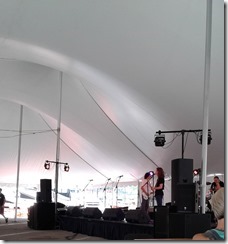
This weekend, I went to an outdoor show in town. The performance was hampered by being partially enclosed in a polyester PVC-coated stretched tents, which are pretty effective mid-range and above audio reflectors, but that didn’t explain how awful the sound was. The group was a 3-piece, very young, pop band with an over-achieving drummer who hammered the snare as if it were a tent post needing to be drilled deep into the asphalt. That set some kind of baseline for the monitor setup, since the drummer was (for once) the first guy on stage to be ready for the sound check. From there, everything went downhill fast. [You can tell by the stage picture, at left, that the sound company had a lot more monitor volume capacity than FOH capabilities.] I watched the sound check, but other than bumping monitor gains up until hitting the gain-before-feedback limits, I didn’t hear any output from the mains during the sound check. Honestly, I couldn’t tell if the mains ever made a contribution to the overall sound; even well into the show.
Obviously, there was zero intelligability from the system. Regardless of where I sat or stood, I couldn’t understand a word coming from the stage. They might as well been speaking French or Chinese, or both. Toward the end of the performance, I walked behind the stage and found (to no surprise at all) that the on-stage volume was substantially louder than the FOH output. While the on-stage sound quality was somewhat better than the FOH, it was mostly deafeningly loud. Probably so loud that the FOH mixer was already past the allowed volume for the venue (an outdoor festival).
For a few hours after leaving that show, I thought about the purpose of stage monitors in the current context. As best I can figure, monitor systems are intended to create acoustic space and physical distance between musicians and their audience. Not to bring the two together in a shared musical experience, but to drive a sonic wedge between the musicians, their fears and and insecurities and frustrations, and the overly-tolerant (and shrinking) audiences who are clearly not particularly discriminating because they put up with this abuse.
Earlier in the week, I was the FOH tech for a small venue performance. When I set up the system and stage, I took advantage of the fact that the performers didn’t list “monitors” in their equipment rider and left the monitors to the side where I could set them up if I needed them. Lucky for me and the audience, when the performers started testing their mics and instruments they were satisfied with the main’s spill and decided to go sans-monitors. The difference between the communication these musicians had with their audience, obviously aided by the close physical proximity, and the performance I saw later in the week was night-and-day. That physical proximity thing isn’t just a function of the venue setup, though. The loud group didn’t provide any high fidelity place for their audience to hear their music. Close or distant, it sounded muffled and distorted everywhere. In contrast, the acoustic/electric duo pictured next to this paragraph sounded clear, present, and natural everywhere in the room.
There has to be some sort of compromise louder acts can make to provide their audience with a decent aural experience. While most bands sound like crap, not all do. Not all bands that sound musical start with the mains, either, but they do make an effort to get out front and listen to the mains sometime before the show or early in the show. And when it sounds like crap, they do what it takes to fix it. One solution for the monitor mess is in-ear monitors, but that provides another level of isolation between the musicians and the audience; especially if the FOH system is overbearing. In-ears or traditional monitors, someone has to care what the audience is hearing and no artist worth listening to will leave that to a hired hand.
I recently took a train trip from my Minnesota home to Detroit, MI. Mostly, it was a pleasant experience and I’d recommend Amtrak to anyone not in a hurry or, like me, about as interested in submitting to the TSA bullshit as being sold into prostitution. The problem with going east from practically anywere civilized is Chicago. In particular, Chicago’s Union Station.Chicago is, in general, where ergonomics of any sort goes to die, but Union Station is the sort of organizational disaster usually described in Terry Gilliam movies or the noisy, disorderly hell-hole depicted in dysfunctional post-apocolypic movies where Donald Trump was elected President of the USA and human society collapsed into a drug-infested shooting gallery.
The station, itself, is a gothic cathedral sort of place with tunnels, alleys, and subteranian shopping malls all coupled, acoustically, with an excessive amount of echo and reverberation. It is noisy as hell, but half as pleasant. In a facility like this, you’d hope that public address audio would be abandoned as a useful medium to transfer information. You’d be disappointed. There are mumbling, distorted “messages” being broadcast constantly; including a feminine computer voice endlessly repeating “Track number 17, track number 17. . . “ Even in the waiting areas for specific train gates, useless information is regularly broadcast while the video screens are either filled with pointless TSA messages or are blank. Even stranger, there is elevator music straining to be heard, sometimes above, the pointless and unintelligable “directions,” arrival, and departure information.
This is a place where audio of any sort is nothing more than pollution. From the squeltching noises of the various police and security personnel to loud and confusing conversations to the P.A. system bullshit, no audio information of any sort is likely to be useful. However, the noise level everywhere I explored was well above industrial OSHA limits; often as high as 105dBSPL-A on a constant basis. However, where there were video displays with arrival and departure information, they were often placed where you couldn’t get close enough to read them or they were displaying information about every gate but the one they were near.
I managed to walk off without my 6-year-old Android tablet while I was trying to confirm the information on the Chicago Union Station’s website that said I needed a special boarding permit to get into any of the station’s waiting areas. That turned out to be untrue, but none of the Amtrak or Union Station employees seemed to know the website was incorrect. In all, my interactions with Union Station were miserable and among the dumbest I’ve experienced in my 69 years.
Sitting in the Chicago Amtrak station, surrounded by incomprehensible public address messages, OSHA-defying damaging noise levels from vehicles, police and Amtrak walky-talkies, people talking and shouting, and other machinery and equipment, I’m contemplating the death of the concept of high fidelity. While the bullshit end of the professional and audiophile audio industry are pretending to provide some sort of improved value from vinyl and high-def audio, 99+% of the public could not care less. It’s obvious in their everyday lives. The best evidence that a person doesn’t care about sound quality is the persistence of cellular telephones in their lives. Bandwidth-wise, a cell phone is about five generations down from 1950’s AM radio quality and not much better than an old Edison cylinder recording system. But that doesn’t seem to bother anyone. Except me, anyway.
I have friends who will speculate for hours on the fidelity difference between a half-dozen decent capacitor microphones and will carry on this conversation over a communications system that would make Patrick Stewart sound like Donald Duck. Asking for a repeat of a phrase a half-dozen times because the phone garbled that information into nonsense doesn’t bother them at all, but they pretend they can discern a 1dB difference between two microphones into a high quality preamplifier and recording system. I don’t buy it. If garbage in, garbage out doesn’t bother you on a daily basis, opining about one form of nearly perfect reproduction over another is pure self-delusion.
Fine tuned senses don’t work that way. Use ‘em or lose ‘em. Be picky (rightly) everywhere or be adult enough to admit you just don’t care.
Years ago, I changed our home telephone to a DSL-connected system from Ooma, on the advice of an engineer with whom I worked at the time and a small business man who was simply trying to save money. Immediately, I heard a dramatic improvement in sound quality over the hard line system we had previously from Comcast. Still, when I talk to many business tech or customer service or sales people, I’m impressed with how clear the audio quality is. When I get a call from an individual or, worse, a phone solicitor who is obviously on a cell phone, my first response is to hang up and see if they can call back on a better line. My second response is to downgrade my opinion of the person with whom I am having the conversation. Between the low fidelity, in the best moments, and the cut-outs, glitches, noises, and distortion during the worst, I am hard-pressed to imagine why anyone would consider a cell phone to be anything but an emergency communications device. Honestly, I’d be nervous about hoping to convey emergency information on a 911 call via cell phone, but if I’m lying in a ditch freezing to death or bleeding out, it’s probably the best I can hope for. If I’m home where I could be making the call from a decent telephone system, I can not imagine picking up a cell phone.
So, here’s my point. Pick one: your concern and obsession for high fidelity or your cell phone addiction. You can’t do both without making me laugh at your ridiculousness. If you can tolerate your cell phone, but whine about MP3 compression, you are only fooling yourself.
Over the dozen years I taught audio engineering at Musictech College and McNally Smith College of Music, I accumulated a lot of material that might be useful to all sorts of budding audio techs and musicians. This site will include comments and questions about professional audio standards, practices, and equipment. I will add occasional product reviews with as many objective and irrational opinions as possible.

 These days, most Americans are “conservative”; which is another way of saying that we are terrified of pretty much everything, especially ideas. The only thing we appear to be fearless in the face of is debt. Our president is a king of leveraged fake “wealth” and many Americans appear to admire Trump’s willingness to pretend to be rich in the face of constant business and investment failure. The US median household owes around $140,000, pays about $1,300 in annual credit card interest, and even the over-65 crowd’s median savings is well under $100k while middle-aged Americans average about $25k in savings. There is nothing conservative about those numbers.