Friday, December 18, 2015
Acoustics Resources–Sabin RT60 Calculator
Bullshit Audio Terms
I’m not even close to being the first guy to gag on the bullshit marketing terms applied to non-existent audio equipment qualities.
Immersive: As in “I felt the music was all around me. . .” (Other bullshit terms used for this generally non-existent quality are “open,” and “air.”) Bob Carver made a nasty audiophile device called the “Time Lens,” back in the 80’s. If you like “immersive,” you’d love this thing. This awful device screwed with mid and upper-mids L/R phase relationships so severely it was hard to locate any sound sources in some rooms. Carver had some really fancy explanations for why sound seemed to be originating everywhere but from the speakers, but simple test equipment (an oscilloscope) demonstrated the fact that frequency-dependent phase relationships were being messed with and the result was semi-entertaining until it gave you a headache. A surround sound mix can be “immersive,” if the speakers and listener are properly placed. Otherwise, stereo means “solid” which will always put the listener in a position facing the sound sources and, at best, a good mix and proper playback system will provide left, right, close and distant perspective. And that’s it. If you hear signals behind you, your system or room acoustics are screwed up.
Warm: (aka “creamy,” silkiness,” and “natural”) Ideally, you might hope this means some mild addition of even harmonics—mostly 2nd—distortion contribution that might seem pleasant. Usually, what most people call “warm” is the result of slew or crossover distortion and is in no way pleasant if you are used to listening to low distortion reasonably accurate sound reproduction. Distortion-wise, we tend to “like” what we’re used to hearing and if we spend enough time with low fidelity equipment and recordings we’ll learn to love that. That is not, however, a good thing.
Presence: Three decades ago, I had the pleasure of getting to mess with a Mark Levinson stereo power amplifier when I was a design and test engineer at QSC Audio Products. The Levinson claim to fame from advertising and reviewer hype was “presence.” hen I put a Mark Levinson amp on the bench, what I found was a slowly rising upper-midrange shelf that peaked at about 3dB at 3kHz (along with the associated phase distortion created by this built-in EQ). Otherwise, there was nothing special about this overpriced equipment in any regard. It wasn’t quick, it wasn’t particularly stable when super-sonic signals or reactive loads were introduced, and it wasn’t particularly low distortion (IMD or THD wise). A few moments with some simple electronic test tools would have dispelled the magical claims from a power amplifier with a silly built-in EQ, but audiophile magazines shy away from test equipment and objective listening tests.
Wide Dynamic Range: Dynamic range is a fairly straight-forward specification in audio equipment: “the ratio between the largest and smallest values of a changeable quantity.” At the most impractical theoretical extreme, the human ear is capable of detecting 140dB of aural signals. That assumes 0dBSPL as the threshold of hearing, which quickly deteriorates from infanthood to adolescence with age and noise exposure to more practical values of 15 to 30dBSPL. This also assumes the maximum sound pressure a human can tolerate and discern is 140dBSPL; a dubious claim at best. 140dBSPL is, for example, typically described as a full-throttle jet engine at 50 meters. A typical gun muzzle blast generates an impulse sound pressure level of 140dbSPL or more and that exposure is commonly known to cause permanent hearing damage. Relative to 1V (0dbV), the theoretical perfect (but practical) unity gain amplifier will produce 123dB of dynamic range. This can be bumped up to about 129dB if the relative maximum is 10VRMS. So, regardless of the unrealizable human hearing maximums, 123-128dB of dynamic range is pretty much as good as it gets in the real world. This relatively straight-forward specification and its associated practical limits are regularly ignored in the bullshit marketing world where numbers as insanely silly as “200dB” are quoted regularly and stupidly. Keeping in mind the analog thermal noise threshold, it’s useful to remember that every combination of amplifiers that produces an exponent of 2 (2, 4, 8, 16, 32, etc.) will reduce the combined dynamic range by 6dB. “Floating-point audio” or 64-bit or any other bullshit aside, physics and biology put an end to the realistic gains we’re going to get from playing with numbers.
This list of bullshit words is not by any means complete. I’ve left out color and taste sensory analogs, for example. A good rule to apply to modern ad-driven reviews and marketing claims is “any asshole can write marketing bullshit.” There is no one checking these claims with test equipment or even half-decent ears. So, if it sounds too good to be true, it is.
Saturday, December 5, 2015
Killing Music Loudly
Friday, December 4, 2015
On the Ground Video
More of a place marker than anything, but part off this video was recorded in our old Little Canada house.Through a weird combination of NPR and motorcycles, Andrew Melby included me on an email asking for an "abandoned house" that he could use as a backdrop for a Heireuspecs video. We were in the process of selling our home and moving to Red Wing, so while our place wasn't "abandoned," it wasn't being lived in at the time and I volunteered it for the project.
Our house is scattered all over this video. In order of appearance: the guitar player, Josh Peterson, is situated in my wife's old art studio, in the basement. The keyboard player, DeVon "DVRG" Gray, is sitting in front of our bedroom closet. Bass player, Sean "Twinkie Jiggles" McPherson (a fellow McNally Smith College instructor, is standing in front of a paneled bookshelf I'd built in the living room. Lead rapper, Midway Felix, is sitting in that same bedroom closet and, then, magically moves into the living room for that knotty pine paneling look near our bay window and down to the basement (where my bass trap comes into even better view). The drummer, Peter Leggett, is sitting under the stairwell in the basement, where I had installed a really terrific 5.1 entertainment system. You can even see the edge of one of my built-in bass traps at the far left of the camera.
I do not know the location of the decimated warehouse where the dancer is doing her bit, but that was NOT our home. ;-) I really don't where Chastity Brown is pictured singing her parts, either.
For us, this was a really nice ending to our 18 years in that home. When we moved there, in 1997, the place was a wreak. The previous owner had pretty much trashed the property, inside and out, and we wanted to live by a "lake" so badly that we took on far more of a project than we'd imagined. Our grandson grew up in that house and along the shores of that lake. 2 1/2 dogs and a half-dozen cats spent their lives in that home. Dozens of wonderful friends enjoyed fireworks on Little Canada Days in our backyard, starting with our oldest daughter's wedding reception and continuing until the last August we lived there, 2013. The yard was home to parties and a graduation ceremony for a summer Production class at McNally Smith College when the school decided to be too cheap to bother with a graduation ceremony for the first time in its history.
This was one of the official videos for Heiruspecs' album "Night Falls."
Creating Space
Performance-wise, the problem is even more dramatic. During a recent show, I solo’d up each vocal mic and discovered that the vocalists could be counted on one of two possibilities: 1) some singers naturally gravitated to grouping around a mic and singing “together” and 2) some naturally filtered to an abandoned mic and sang “solo.” If you’ve never sang in a group this might surprise you, but if you have this will be a no-brainer: the solo vocalists were consistently off-time and key and the together vocalists consistently delivered stronger, tighter, more in-key performances. So much so that I found myself naturally fading-out the solo mics and blending the group performers by ear, as I pulled down disagreeable faders and pulled up the performances that blended well.
Most recordists think the best way to record any signal sources more complicated than one voice is to distribute as many mics across the various sources as possible. Hell, hip-hoppers put two mics on one voice to optimize phase distortion and tonal weirdness. Here’s where I disagree with “common knowledge,” regarding the best way to record/reproduce/reinforce a group vocal. Sterling Audio’s article suggests, “There may not always be enough resources for separate microphones or recording tracks” as a reason for simplifying the number of microphones involved. I think the recordist better have a damn good reason for using more than a stereo pair in this kind of situation. “Depth of field” comes from the various time delays caused by the distance of the sound source from the mic. Vocal groups, horn players, and ensembles are often perfectly capable of figuring out where they should be, physically and sonically, in the mix and allowing them to perform for the microphone as a listener often produces incredible results.
POSTSCRIPT: A friend and ex-student, Steven Sullivan, took all of this to heart and produced a record limiting himself to no more than 8-tracks and very few effects.
A Beginner's Guide to Self Immolation
Saturday, November 7, 2015
Driving A Throwaway World
My hometown theater spent about $150,000 on audio gear this year. The theater was pretty well equipped before, with JBL MP418SP subs and JBL MP415 mains, a decent collection of QSC power amps, perfectly functional monitors and side-fills, and a 24-channel Yamaha analog mixer. Everything worked and it was paid for, something hardly anyone cares about in today’s jacked-up credit card and second-mortgage world. For the $150k, the town got a 48-channel DiGiCo SD-9 Surface & Two D-Rack. SD-9, Dynacord PWH subs and Dynacord Cobra tops, with Dynacord VL 262 under-balcony fills and front stage boxes, and a crap-load of EV power amps oddly located about 100’ from the speaker boxes (a whole ‘nother discussion). So far, pretty much no one substantial who has played the auditorium has wanted to mix on the DiGiCo. So, mostly the ~$40k spent on the mixer has been for some pretty undemanding shows with the toughest stuff being low-turnout local pop bands. As a local taxpayer, I’m less than impressed with the decision process the city used to spend my money.
At a completely different end of this discussion, though, I can’t see anyone having a good justification for spending more than $5-8k on a digital console of any sort. Using actual business rationale, the payback on digital gear has to be really short to make any sense at all. The Return on Investment (ROI) should be calculated to arrive in 3-5 years (max) because the equipment will be obsolete and unrepairable in about that time. If you don’t think that is either a reality or an important part of the decision-making process, you are part of the reason that we live in an unsustainable throwaway society.
On a much lower economic scale, I recently bought a pair of Red Wing boots. I live in Red Wing and some of my neighbors make these things, so I decided to spend big and buy local. The boots I bought, on the left, are pretty high priced but they are tough and well-built and super comfortable and (above all, for the investment price) are repairable. They can be resoled by pretty much any shoe repair shop anywhere in the country. I expect to be wearing these boots the day I die. On the other hand, Red Wing and pretty much everyone else imports boots from China and other low-labor-cost places like the boots on the right. They are, admittedly, a little cooler looking, cheaper, and just as tough and comfortable. I don’t know if those things are true, but I assume they are and don’t care. I can not convince myself to spend $200 on a pair of boots that I’ll wear out in a year and have to toss because the soles are not replaceable. Crazy, right? Probably.
Likewise, I can’t convince myself that there is any sonic or functional value to a $30k DiGiCo console over a $5k Midas or Yamaha or, even, a $2500 Presonus digital console. I sincerely do not believe there will be any noticeably audible difference in any of this equipment and I fully expect each of these products to be junk in well under a decade. Since you could buy 6 of the Midas/Yamaha consoles for the same money in that period, I’d think the decision is a no-brainer. Why it wasn’t for our city confuses me.
Friday, October 16, 2015
Quality in the Disposable World
I’m taking the Guitar Repair and Building Program at my local technical college. During a discussion with an instructor, we touched on a misconception about customers’ expectations and dissatisfaction inclinations. Like a lot of small business people, my instructor was under the delusion that customers will naturally complain if they are disappointed with service or product quality. Many larger companies are equally happy to pretend that they are getting 100% “compliance” from dissatisfied customers. The fact is that most customers simply log their dissatisfaction and tell themselves they will remember to never buy that particular company’s product or service again. Most executives are perfectly happy with that outcome. Sounds like a perfectly balanced system, right?
At the other end of this “system” is the wrong-headed conclusion most business people make about customer loyalty. I’ve heard more than a few executives claim that customers don’t shop out of loyalty any more. The problem isn’t with customers, it’s with businesses. Loyalty is not a one-way street: you have to give it to get it. Counter-intuitively, you have to work at giving it.
During my ten years with QSC Audio Products, we’d developed a pretty thorough system of handling customer complaints, tracking customer purchases, feeding back customer and product information to marketing, engineering, and manufacturing, and statistically analyzing our product warranty problems and costs. When I left that company, I’d been recruited by an MI conglomerate to turn their low end sound equipment division into something more resembling a competent manufacturer. During the initial talks, I’d been led to believe the company was considerably more substantial—organizationally and financially—than it actually was. So, that moment of employment was doomed from the beginning. If I wanted to fund a start-up with my own equipment I’d have started-up my own company.
Late in the 30 days I wasted in Indiana, I was asked by the company’s guitar division customer service manager to explain QSC’s quality management system. About 1/10th of the way into the discussion, he interrupted me to say, “That’s all way too complicated and expensive.” He went on to say that the company shipped product with a known 50% defect rate, based off of the internal random inspection data from a few years back (Since they quit inspections after a few months, product quality had probably gotten worse.). From a suspected 50% defect rate, about 1% of the company’s customers complained, expecting some sort of warranty response. If they stonewalled that first complaint, about 1% of the first 1% would come back for more abuse. No special inspection was done for warranty replacement instruments, so at least 50% of the replacements were also defective out-of-the-box. According to the manager, that 1%-of-1% routine applied to warranty replacement complaints. So, while at QSC we were aiming for 6-sigma (99.99966% defect-free, but often struggling with three-sigma performance; 99.73% defect-free), his company could boast an uninformed-by-reality 99.99235% non-warranty-claim rate without spending a dime on quality control and while shipping product that most customers would call “junk.” Between that and a conversation with the CEO regarding the discrepancy between the information in my offer letter and reality, I quit a couple of days later.
Those statistics are from large-quantity production. Small quantity (boutique) production and service businesses don’t have access to actual numbers and formal inspection procedures and if they rely on customer complaints for feedback they are committing business suicide. In fact, the only way a small business can get any kind of information about customer satisfaction is to hunt for it. When someone cares enough about the product or its performance to complain, a conscious customer service tech should take that complaint seriously and to heart. The 1% of your customer base who care enough about your product or their expectations to complain are rare and valuable. If you choose to ignore them, don’t complain when your customer base makes its buying decisions solely on price and delivery. You have informed them through your actions that you don’t give a shit about their expectations and the result is that they won’t care about you or your company’s survival.
Saturday, October 3, 2015
Pure Acoustic Bullshit
40 years ago, my partner and I did a summer’s worth of acoustic music festivals, mostly bluegrass shows. After the 90th time hearing some toothless bullshit artist jabber about how “pure” his “acoustic music” was, compared to rock or R&B, while he thumped on his mic saying, “Can you hear this, I cain’t hear nothin’,” I pretty much had all I could stand of bluegrass, hillbillies, and anything “country.” After that season, Dan quietly packed up his stuff and left the business and we folded the studio, equipment rental business, sound system design and consulting, and repair/maintenance services not too many months later. Today, it was “déjà vu all over again.” I helped setup the stage and do the sound check for an oversized group of young people pretending to be acoustic musicians at the local theater. The sound check reminded me of why I am a volunteer for this work, not a paid professional. In fact, the only way I would have money in this game would be if it were mine and I could hire and fire “musicians” at will.
Let me make this perfectly clear, in case you are not only deaf but incredibly stupid: if you need amplification to present your music in a 250 person theater, you are not an acoustic musician. If you have a pickup installed in your guitar and that is how your instrument conducts signal to the FOH board, you are not an acoustic musician. If your stage volume (monitors and POS personally owned equipment included) are adjusted to be too loud for the acoustics in the room, before the front of house (FOH) system is even engaged, you are a pitiful combination of the Nitty Gritty Dirt Band and Spinal Tap.
In this particular group, the only person on stage who seemed to have the slightest notion that the sound system bullshit was grossly out of control was the fuckin’ clogger. When a tapdancer who brings his own sound stage thinks you are “too loud,” you are way past too loud.
There is a concept in music, at least in the studio, called “serving the music.” It is apparently a non-issue in live music and it’s 99.999..% of the reason why rational people rarely attend live music performances. Serving the music means that musicians do anything necessary to ensure the music is delivered to the audience in the best possible manner. It means that the FOH system gets setup first, then whatever minimal reinforcement the musicians need to hear themselves well enough to perform well is added. Since most of the great performances I’ve seen were sans-monitor system, it’s pretty obvious that great musicians don’t need their own mini-concert system at all. Bluegrass musicians ought to be able to hear the damn instruments on stage without anything resembling a monitor system. If they can’t, they have wreaked hearing and should give it up and go back to their Spinal Tap cover band career.
So, the next time you find yourself fucking with the monitor gain-before-feedback when you haven’t even fired up the FOH system, remember this: I fucking hate the way you sound and so does everyone who has ever bought a record and listened to it carefully. As long as your own ego is the main focus on your stage, you are not a musician but you are definitely a spoiled child who didn’t get enough attention from mommy when you were nursing or being potty trained. Or maybe the last one never happened?
Sunday, September 13, 2015
Why Do Guitar Parts and Instrument Manufacturers Call Vibrato “Tremolo” and Vise Versa?
All Rights Reserved © 2015 Thomas W. Day
VIBRATO adjective: a slightly tremulous effect imparted to vocal or instrumental tone for added warmth and expressiveness by slight and rapid variations in pitch.
TREMOLO noun:
1. a : the rapid reiteration of a musical tone or of alternating tones to produce a tremulous effect
b : vocal vibrato especially when prominent or excessive
2. a mechanical device in an organ for causing a tremulous (nervousness or shaky) effect.
Like many of the bad things in electric guitar history and technology, you might blame this pair of misnomers on Leo Fender. DeArmond[1] introduced the “Tremolo Control,” (created for organs, not guitars) an amplitude-varying device with “increase” (depth) and “speed” (rate) in the early 1940’s. Harry DeArmond named his device correctly and musically. Since Leo Fender was more of a technician and a manufacturing-oriented guy than an inventor, he often co-opted inventor’s designs and made minimal changes to avoid having to pay patent rights. This would be one of those instances. Fender’s "vibrato" effect—which is technically a tremolo effect—started with its introduction on the 1956 Fender Vibrolux and Vibroverb model guitar amplifiers. The effect has commonly been misnamed ever since.
Like many inventions attributed to Leo Fender and Les Paul, the first guitar vibrato unit was a Rickenbacker design.[2] Oddly, the device was electric only installed on Rickenbacker’s Vibrola Spanish guitars. A Rickenbacker collaborator, Doc Kauffman, designed the device and its purpose was to imitate the variable pitch of steel guitars (slide). Hand operated versions showed up on Rickenbacker's Capri guitars in the late 1950’s. Rickenbacker consistently called their devices “vibrato.” Bigsby made the first successful commercial vibrato unit (still called “vibrato” by that company), with the first known version showing up on guitars demonstrated in 1952. Merle Travis recalled the Bigsby company making a unit for him in “the late 40’s.”
Leo Fender’s “synchronized tremolo” appeared in 1954 on the Stratocaster. This might be the moment the musical effect of vibrato was misnamed "tremolo" as Fender described his device as the "tremolo arm." Thanks to Leo’s ignorance or business sense, as Wikipedia so aptly puts it, “electric guitarists traditionally use the terms ‘vibrato’ and ‘tremolo’ in the opposite senses to all other musicians when describing these hardware devices and the effects they produce.”
Oddly, in my 50+ year career in various aspects of music, I can’t remember any player ever calling this device a “tremolo.” “Whammy bar,” yes. “Tremolo” nope, not ever. Most of the musicians I’ve worked with both in bands, on stage, and in studios know the difference between “vibrato” and “tremolo.” Singers and horn players and classical string players, obviously, use the term in the musical sense and in the recording studio misnaming musical terms is grounds for ridicule and unemployment. I admit to having disliked the sound of amplitude modulation (tremolo) on guitar for more than 50 years. The Dwayne Eddy warble and the goofy sound of surf guitarists in the 1950’s is part of what helped me select the trumpet as my first instrument. So, if my dislike is displayed as cynicism, I’m good with that.
It turns out that the name for a guitar’s mechanical vibrato is brand/inventor dependent. If the mechanical vibrato device is a Fender or a Fender improvement/replacement (including Floyd Rose), it’s a “tremolo.” So much for original thought in the 21st century. If it’s a Bigsby, producing vibrato is done by using a mechanical “vibrato.”
Electronically, vibrato is one of the many things you can obtain with a pitch-shifter, chorus, and many moderately complex digital or less complicated but lower fidelity analog delay devices. Electronic tremolo is an insanely simple circuit and can be obtained for as little as $25. (Behringer’s Ultra Vibrato UV300, for example. Yeah, I know they call it a “vibrato,” but Behringer isn’t known for being smart, original, or musically or technically competent.) If you want an excuse to spend two or three times what the device is worth, you can buy all sorts of boutique tremolo pedals (that all do the same boring thing the same low-tech way) or learn something by building your own. Since the basic circuit is as simple as electronic circuits get, building a device probably provides infinitely more education value than the musical contribution this silly effect creates.
[1] http://www.vintageguitar.com/18545/dearmond-tremolo-control/ “DeArmond’s Tremolo Control did just this. It debuted in about 1946; the earliest known brochure is dated July of that year, according to historian Dan Formosa. ‘This precedes guitar/accordion amps with tremolo (the Premier/Danelectro amps date to 1947 and Gibson to 1948)… It’s most probable that the use of tremolo by guitarists would pre-date the commercially available units (otherwise, why would the manufacturers be prompted to create amps or effects units – unless it was an accordion thing),’ he notes. ‘The earliest recorded guitar tremolo I’ve come up with (so far) is Roosevelt Sykes, 1941-44.’” You can also read a lot about the history of this device at http://www.premierguitar.com/articles/19777-a-brief-history-of-tremolo.
[2] http://guitar.wikia.com/wiki/Whammy_bar This site does a fine job of briefly describing the history of the guitar-based mechanical device.
Sunday, August 16, 2015
Microphones Are Not Your Friend
Lately, I’ve been experiencing the sad fact that too many hobby musicians seem to think that microphones are some sort of corrective device; like Auto-Tune©, but smarter. A local bookstore hosts an open mic event every 2nd Thursday of the month and there is a surprising amount of talent, young and old, in Red Wing. A few days later, I was listening to some experienced musicians at the Unitarian Universalist Society of River Falls and saw that deluded faith in microphones again. All of the characteristics and qualities microphone designers know about microphones seem to have failed to filter down to musicians, poets, and nearly anyone who touches a microphone with sound reinforcement in mind.
The open mic experience probably bothers me more because it’s obvious that the people on that stage are simply imitating the stupid crap they see on television or stage from so-called “professionals” who are most likely simply lip-synching a fake performance. Sound reinforcement is close to perfectly unnecessary when your audience is fewer than two dozen people. Musicians survived and thrived for hundreds of years without the help of low fidelity electronics and electro-mechanical devices. Audiences were more polite, more engaged, and more informed about the music, the musicians, and the sound of instruments and voices before electronics distorted and deformed live music. There is some hope, though. Occasionally, I see a musician using those incredible analysis devices called “ears” to make informed decisions about how to use (or not use) the microphones placed on the stage. Not often enough, but at least it happens. If it happens once during each evening, it might catch on and happen twice. Next thing you know, we have a revolution and music sounds . . . musical again.
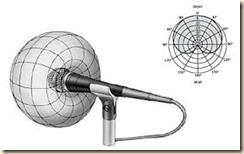
Here’s the first thing to know about decent microphones: you will sound more natural, more musical, if you get the hell away from the damn things. Cardioid microphones (like the one in this picture) have the reasonably useful characteristic of being able to ignore some signals from the off-axis (backside) of the microphone where the stage monitor often is. This can, sometimes, provide a
slight improvement in gain-over-feedback. The nasty compromise this “polar pattern” brings to the party is that as you get closer to the mic the tonal characteristics become grossly weird. P’s, t’s, b’s, and other “plosive” signals are emphasized as are s’s, h’s, c’s, and other “sibilance” signals. You may think you are sounding intimate when you “eat” the microphone, but you are mostly sounding awful and irritating. The sound-doofus may try to “fix” the mess you and the microphone are making with EQ, but that will only add to the irritation. You’re still going to sound awful.
Try backing up a foot or two. Even better, back-up and drop the mic below your collarbone a few inches. Some of the power of your voice comes from your chest, stuffing the mic up your nose does what you might expect it to do; it makes your voice sound “nasal.” If you are a solo vocalist or a speaker, the same thing goes for you. Get the hell away from the mic at least a spread hand’s distance and drop the mic below your mouth at least six inches. If it was good enough for Bob Dylan, it’s more than good enough for you.
Don’t be surprised if this is harder to do that you expected, the first time. You’ve probably grown used to the oversized sound of your proximity-enhanced voice. It probably sounds “big” to you on stage, but if you wanted someone else’s voice you should have become a mimic. Any musician worth listening to is trying to be himself, not some hyped and distorted poor copy. Remember, we’re talking about a venue that is no larger than a decent living room. If you need a PA to entertain yourself in your living room, you’ve got problems I can’t help you with.
One of the things that always amazes me about singers is their lack of attention to the most important details in their live performance: the microphone and microphone technique. Guitarists bring their own instruments, including amplification, but vocalists just show up and depend on the kindness of usually-deaf sound-doofuses. If you are a singer with some talent and a voice, you should study microphones until you know enough to find one that reproduces your voice as you hear it in your head. Then, you bring that instrument with you everywhere you perform. If you are an acoustic instrument musician, the same applies to you. The microphones you are most likely to be stuck with in a live performance venue probably suck. The industry standard, the Shure SM-58, is insanely durable, but sounds somewhere between awful and mediocre. The same goes for a whole collection of 58-look-a-likes from practically every manufacturer. Unfortunately, quality isn’t cheap. Expect to spend $500-1,000 for an excellent vocal microphone.

One of the worst personality characteristics microphones appeal to is ego. Some musicians simply want to be loud. The thing they most want to be loud is their voice, so their accompanying instrument is either grossly distorted by godawful pickups or doesn’t exist at all. The picture at left of this paragraph is a good example of that defective thinking. If the microphone output were being recorded, the two acoustic guitars would be barely audible and pretty awful sounding. The off-axis frequency response of an SM-58 is generously described as “gross.” If this were, as it appears to be, a live performance, the two voices will often be distorted, poorly blended, and overpowering through the PA (this mic’ing technique would not qualify as sound reinforcement). These two musicians would be far better off without a PA, but they might never know it because they think the microphone is a crutch. It’s not, it’s a handicap unless you know what you are doing and 99% of musicians and 99.99….% of public speakers are totally clueless when it comes to the technical side of microphones.