
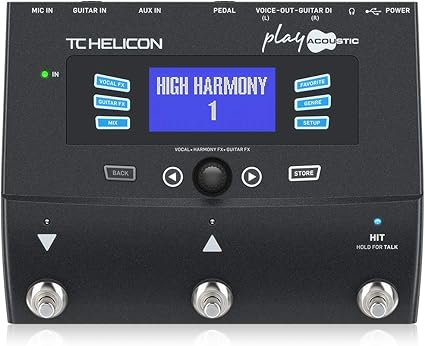
 The TC Helicon "Play Acoustic combines all the things you need to make a live acoustic performance shine: lavish vocal sounds, perfect backing harmonies, best-selling guitar effects, and unique processing that makes your six-string sing – in perfect harmony with your voice." Sounds pretty amazing, doesn’t it? Some of those claims are even true, if only somewhat useable. Four years ago, I wrestled with the decision for a vocal and acoustic guitar performance rig I’d be using most often in jam sessions, local open mics, and recording.
After a lifetime as a techie, I wanted to work on other skills, mostly vocal and guitar performance. With that in mind, a big part of what I was looking for was ease of use because I didn’t want to be wasting my time fooling with bells and whistles when want I wanted to work on was my performance chops. Four years ago, I decided on the TC Helicon Perform-VG for its simplicity and versatility, knowing that the Perform series of products were all downscaled versions of the Play Acoustic, Play Electric, and VoiceLive devices. With the Perform-VG, I have many of the Play Acoustic features without much of the flexibility. That is the downside. The upside is that I was up and running almost instantly with the VG and wasted most of an afternoon trying to figure out how to adjust a vocal compressor and set the harmonies for the Play Acoustic.
 A critical look at the back connector panel of the Play Acoustic illustrates two critical flaws of the Play Acoustic: 1) no guitar thru connector, 2) no vocal out signal path (both guitar and voice are stereo mixed to the two XLR output connectors. There is an “AUX” input, for bringing in external analog audio, a “Pedal” connector for either the Switch3 or Switch6 function selection foot switches, an 1/8” stereo headphone jack, and a mini-USB connector that supposedly supports "Stereo audio input and output via USB is also supported at 16 bit resolution with 44.1 or 48 kHz sample rate." I wrote “supposedly” regarding that USB recording function because there are mountains of reports on-line of users giving up on the Play Acoustic’s digital recording capability due to lousy driver support. That wasn’t going to be something I would care about, so it had no real effect on my opinion or this review.
As the YouTube research demonstrated, TC Helicon’s harmonizer is terrific and the Play Acoustic has an powerful and well-designed collection of harmony, chorus, reverb, and other effects for the voice channel. Many of the effects come from TC Electronic’s wonderful array of professional recording plugins and special effects devices. Only a portion of the Play Acoustic’s vocal harmony capability is available on the Perform-VG. The Perform-VG can, however, separate the vocal output from the guitar for both live performance mixing and recording purposes. I can’t even imagine what went through the designers’ heads when they decided that capability wasn’t necessary for the Play Acoustic.
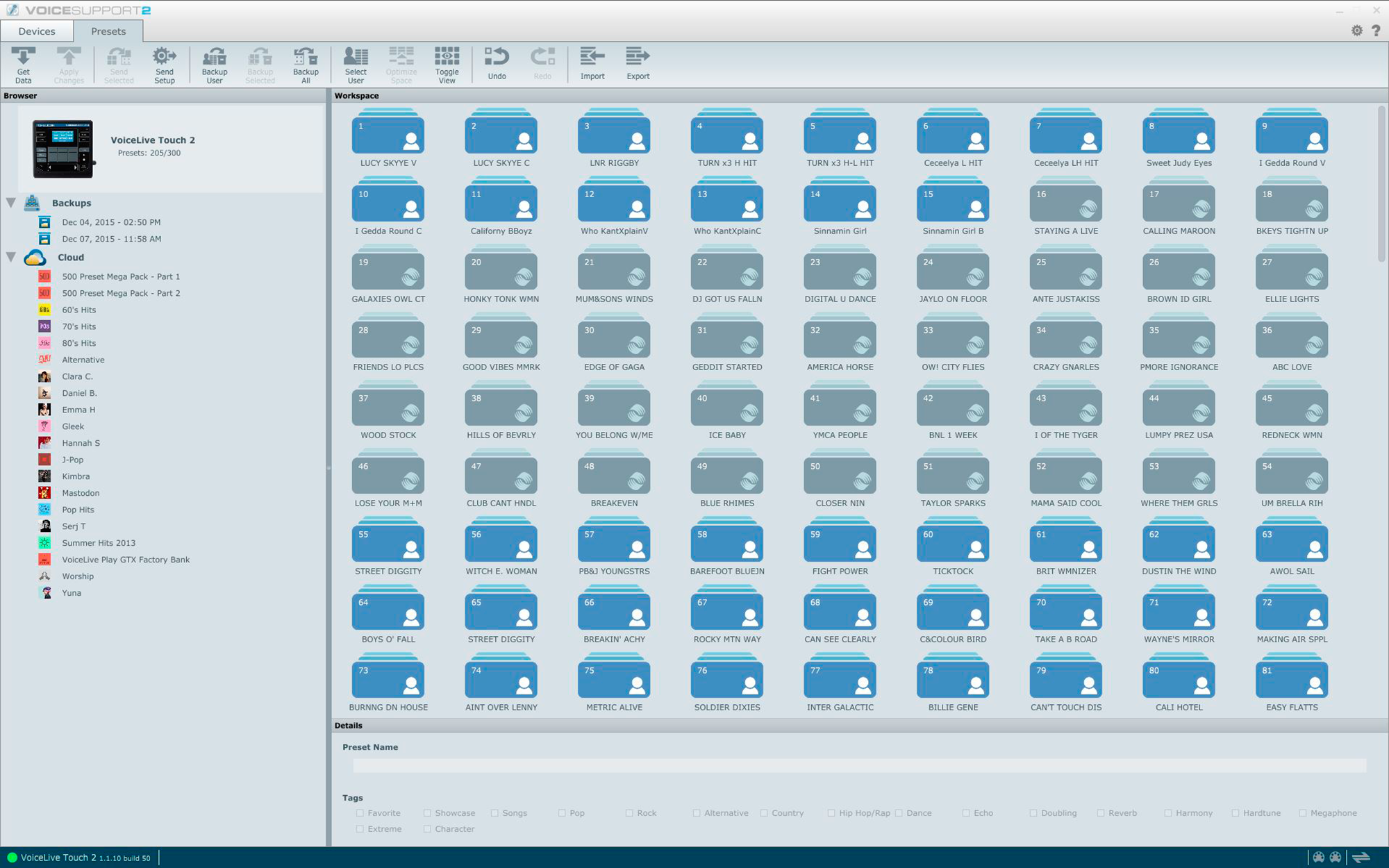
I’m not much for spending time wrestling with layered menus, either on my cars or my electronic devices. I really hate throwback software; been there, lived that. We are in an age of powerful, user-intuitive and friendly software and there is no excuse for any piece of digital electronic hardware forcing users to program a device through a crappy interface. That is exactly what you will have to do with the Play Acoustic, though. This incredibly ancient looking (and performing) piece of software is TC Helicon’s VoiceSupport 2 software as it looks on both Mac and Windows 10 machines. The software is pretty much Windows Explorer or Apple Finder for a few TC Helicon products. For the rest, this is nothing more than the overly complicated, under-performing interface TC Helicon uses to deliver firmware updates. You can reorganize your patches, you can download patches from TC Helicon’s cloud, but you can not edit anything usful with VoiceSupport 2. None of this should be surprising, though. TC Helicon/Electronic was acquired by Behringer in 2015 and it is safe to assume nothing innovative will come from the TC products in the future. Behringer is as notorious as was Norlin for taking gold and smelting it into oxidized lead.
So, for me, as powerful and interesting as the Play Acoustic is, it just isn’t worth the programming hassle. I messed with it for a day and sent it back to Sweetwater. For now, I’m fine with my Perform-VG until Zoom, Line6, Yamaha, Roland/Boss, or some other competent company comes up with a significant improvement. If you like fiddling with firmware more than playing, the Play Acoustic might be exactly what you are looking for, though. It has a lot of features, sounds great, and is a durable package (except for the notoriously fragile scroll wheel) that could give years of service. Of course, you’ll spend half of those years trying to tweek the thing into something you like using.


