
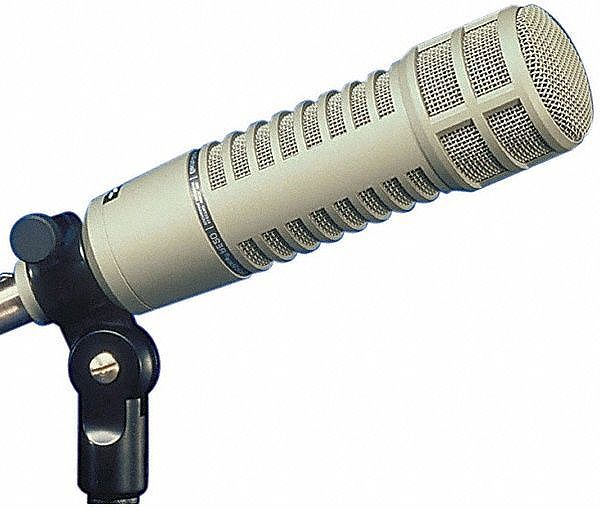
 If I were only allowed one microphone, it would be the Electrovoice RE-20. I've been a fan of the RE-20 for so long that I can't remember ever not having one and not reaching for an RE-20 whenever something difficult has to be mic'd. The key to the RE-20 has always been versatility. Anything you need to mic, the RE-20 will produce a respectable result.
This review is not about that kind of microphone. For example, the Electrovoice N/D868 has one purpose; bass. In particular, kick drum, although it will do a respectable job on loud electric bass, floor toms, and other loud, low frequency signals. Not only to record that kind of signal, but the N/D8689, Audix's D6, and Shure's Beta52 dramatically accent the qualities of those signals.
 To get an idea of the purpose of this microphone, look at the frequency chart at right from Shure's information on t he Beta52. At close proximity (3mm) the Beta52 provides almost 20dB of boost at 40Hz. That is a 100X power increase over the far field response. Clearly, this microphone is not intended for use anywhere other than right on top of the sound source if you hope to achieve any low frequency (LF) response from the microphone. Both of these microphones exhibit similar characteristics, exaggerated bass response in close proximity, incredibly high max SPL before distortion, and a very modern (as of 2007) LF sound quality when used on the intended instrument; kick drum.
Unless you are looking for an odd effect, I don't know why you would chose either of the microphones for anything but kick or electric bass. They are both physically large, heavy, and somewhat awkward to position (even in an open-back kick drum). At any distance beyond 2" they begin to loose so much LF response that they sound thin and harsh. Their mid-range (2-4KHz) is so busted in the attempt to flatten the LF-mid-range response at near-field, that they are simply irritating sounding beyond a few inches.
These microphones do not attempt to reproduce a natural kick drum sound. Instead, they are going for a dramatic, larger-than-life sound that is typical of modern pop music. For everything from rap to metal, this is the sound of the day (days between sometime in the 1990's up to now). An incredible number of rock records are looking for this sound from the kick drum; something between the overwhelming roar of a thunderstorm and the sound of 4,000 natives pounding on hollow logs in perfect sync. If that is what you are looking for, pick any of these three microphones, put the mic as close to the beater head as you can get it, and slam the meter to +3 (if you're recording to tape) and stick it there. If you're going to digital, forget about pinning the meter, but everything else applies.
Placement is everything with a mic that is this dependent on proximity for bass response. Moving the mic back 2" from the head can produce a signal that could be disappointing if you are expecting thunder. Moving the mic away from the beater and toward the shell will increase the LF incredibly, while mostly hanging on to the impact of the beater hit. Placing these mics near the front head creates a muffled thud that will need some assistance from a quicker, more closely placed mic or well-positioned overheads.
 On electric bass, these mics can turn a 10" studio amp into a stack of 15x4 cabinets that simply roar with power. Put a B52 close to the edge of the speaker cone and you may find yo urself rolling off 100-150Hz to make some room for the rest of the bottom end in your recording. Move the mic toward the center of the cone and you'll have plenty of punch from a slap-bass player along with tons of low end. Again, if you want bottom end, you'll have to keep any of these mics close to the speaker. Proximity is everything, if you want low end from these large-element dynamics.
You might be able to tell that I'm less than overwhelmed by the overwhelming kick sound these microphones produce. I'm in the minority, but I still like the sound of a real kick drum or the punch from a well-played electric bass. The hyped bottom this kind of mic produces is a sound that I believe will become dated soon. Like the super-isolated, close-mic'd sound of the late 70's and early-80's (i.e. Eagles and their imitators), the giant bottom, sub-woofing kick of the last decade will come to be a "sign of the times" and a sound that future engineers will avoid to keep from sounding "old."
 That will leave these microphones to become the useful tools they are, on the occasion that an engineer wants to take advantage of their special characteristics and tonal qualities. Putting a D6 under congas or a tabala, for example, to exaggerate the LF output of those instruments. Since all of these mics have a MaxSPL spec that exceeds any practical sound source, they would be ideal for recording extreme sounds, like guns, engines, and large machines near field. Their proximity bass enhancement would reinforce the power of those sounds. The D6 and the 868 make killer floor tom mics. Microphones are tools, you don't use the same tool for every job and some tools aren't ideal even for specific jobs. In the case of mic'ing the kick drum, I recommend using a smaller hammer, occasionally. You might learn to love the sound of the real instrument.


