Showing posts with label presonus. Show all posts

Monday, September 23, 2013

REVIEW: Presonus Firepod

NOTE: This review is truly ancient history, as in 2002 (back in the end of the Digidesign 001 days). The Firepod is gone, replaced by the FireStudio Project in the Presonus product line. I have long left Presonus A/D/A’s behind, but my unit served me well for at least 5 years before I sold it. A couple of features quit working (SPDIF and one channel’s trim control became unusably noisy) near the end and, as Presonus products so often do, I heard a lot of bad reports from others who used this unit and a few found that it met expectations. It is fragile, no doubt. Presonus is not known for making durable products and you should not expect this unit to survive ham-handed operation in any fashion.
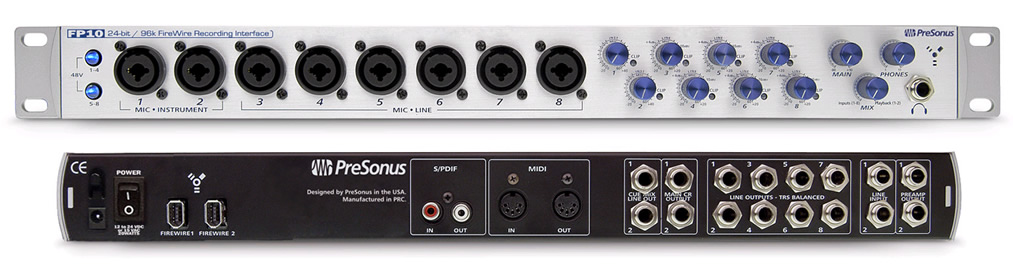
I purchased my Presonus Firepod practically the moment it became available at my local Guitar Center.  I paid $480 for the unit and put it to use immediately.  I immediately took a load of crap from other engineers for even considering such a low-priced piece of equipment, especially from Presonus.  I have to beg to disagree. 

First, I disagree that there is some inherent defect in the Presonus design philosophy.  I happen to believe that being quick, clean, and quiet is all a microphone preamplifier should be.  Others believe that a microphone preamplifier should have as much personality as microphones.  Presonus takes the less trendy approach and their engineers have created a collection of products that are, essentially, invisible to the record chain.  That works for me, but it may not be your cup of distortion.

The Firepod is one of the most successful Plug 'n Play devices I've ever experienced.  My Mac G4 and My WinXP laptop recognized and incorporated the Firepod seamlessly and flawlessly.  Unlike ever other piece of equipment I've added to either of my systems, the Firepod simple worked from the moment I connected the Firewire cable to the computer.  Even my old PC standby, CoolEdit Pro v1.2, snagged the Firepod device and was able to record, multi-track, without any difficulty.  Personally, I think this is a testament to both the Firepod and CoolEdit, since the software hasn't been updated since 2001 when Adobe bought Syntrillium and renamed CoolEdit "Audition." 

The eight microphone preamplifiers have 60dB of gain and can be used as either line amplifiers, mic pres, or instrument DIs.  The first two channels incorporate inserts, so external equipment (such as EQs, compressors, or alternative mic pres) can be inserted into the analog signal chain. 

The Firepod's outputs are equally flexible.  The back panel offers balanced main, cue, eight line (group) outputs, SPDIF, and MIDI outputs.  A pair of Firewire connectors complete the rear panel.  Up to three Firepods can be connected to create a 24-channel recording system.  One SPDIF channel pair can be used along with the included channels, upping the max record chain channel count to 26. 

I use Digidesign's 001/002 and the Firepod and my preference is toward the Firepod, both for sound quality and flexibility.  Since writing this review, I've run into several golden ear recordists who share my opinion.  If quiet and clean is your recording objective, I think you should consider the Presonus Firepod.

Saturday, September 7, 2013

Bigger is Always Better?

new console I had a weird confluence of audio technology moments this past week. #1 One of the guys who has haunted my Minnesota audio life was amazed at the fact that Behringer and Presonus make “under $5,000” digital consoles. He was raving about the fact that he never imagined he’d be able to buy a 24-channel digital console for his budget in his lifetime. #2 The school where I used to teach bought an Avid D-Show console and one of the kids who will use that system on a regular basis posted a picture and mini-rave about the features available on his new toy. #3 I heard one of the worst sounding shows from one of the best bands ever butchered by a sound system in an outdoor venue that had no excuse for being anything but terrific. That show was “mixed” (to abuse the term) on an Avid D-Show. #4 A guy who I respect a lot advertised his upcoming analog audio class with the claim “once we master the discipline of 4-tracks, we'll do some 24-track sessions.”

When I replied to the first guy’s rave about being able to buy a “large scale” console for less than a grand, I said something along the lines of “you get what you pay for.” 24 full-featured channels with automation, dynamic processing, EQ, and other toys for less than $1,000 means some really cheap and unreliable components have been used in the design. Like it or not, great faders still cost about $100 each and pretty good motorized faders (digital or analog) are still $40 each in quantity. Do the math and you’ll see that nothing in the “pretty good” category can be used in the product we’re discussing. He replied with a rant about how I’m not only a motorcycle “bigot” (for considering cruisers and big, blubbering twins to be the awful engineering botch-up they are) but an audio bigot because I have some quality standards there also.

I always take his insults with a block of salt because he is about as close to stone-deaf as a human can get and still carry on a conversation. Still, his fascination with more gear than he can figure out how to use was a reminder of how goofy the live sound business has become. Pretty much everyone has to have a 24-or-more channel digital console to call themselves “professional” and hardly anyone knows how to do a guitar-and-songwriter folk act in a small coffee shop without fucking it up.

Which leaps us to #4 above. The idea that anyone living today is capable of mastering “the discipline of 4-track” recording is laughable. Mastering anything is a lifetime accomplishment and spending a few hours watching someone else play with a 1/2” tape deck won’t get students anywhere near being basically competent, let alone in the master territory. The same goes for these large-scale, over-featured live sound consoles. If you can’t do a decent simple show, you have no chance in hell of doing any better with more equipment than you know how to use. My deaf friend, for example, wouldn’t know where to start in creating a balanced mix if he only had to balance a voice and an acoustic guitar (very much like the deaf guy who is in charge of screwing up the sound at First Avenue). Adding dynamics, time-based processing, and dozens of channels and signal-path options would only make anything these guys do . . . worse.

So, I think it’s safe to assume that live music is only going to become more of a punishment than entertainment and the only revenue stream available to modern pop musicians will dry up like recorded music sales. Someday, I can only hope that musicians will discover that “less is more” in the sound reinforcement world, just like it is everywhere else in human activity.

Wirebender Audio Rants

Over the dozen years I taught audio engineering at Musictech College and McNally Smith College of Music, I accumulated a lot of material that might be useful to all sorts of budding audio techs and musicians. This site will include comments and questions about professional audio standards, practices, and equipment. I will add occasional product reviews with as many objective and irrational opinions as possible.