Wednesday, July 9, 2025

Bend Over and Take Your Apple Like A Man

A few nights ago, I was playing music at an outdoor party with friends and when one of the players wanted to see the scrolling music app I was using on my tablet,Guitar Chords and Tabs (an Android app, which is also available on the web at https://www.chords-and-tabs.net/). He was excited, at first, that so many songs had already been worked out just for the taking, but when I told him it cost $5 “for life,” he started arguing “Why not $10, or $10 a year?  How can the guy make any money only charging $5?” 

This is a person who (I think) would probably describe himself as somewhere between liberal and socialist in his politics, but he has a giant fault line in his expectations: he owns an iPhone.  As an Apple product user, he has been conditioned to be ripped off every few moments when Apple “updates” some piddly aspect of their mediocre products and requires the Faithful to march down to the Apple Store or T-Mobile or where ever they take their Apple cornholing and spend ten times what the competition asks for a better, more flexible, and at least as secure product.  (Cell phones are notoriously insecure computers.)

I, of course, made it worse by demonstrating all of the free-to-$10 apps I use on my $80 Samsung phone and my $70 Hi10 (10”) XPro Android tablet. His marketing- tutored mind seemed to go into overload and he started to download Ultimate Guitar, a $90/year app that runs on Android and Apple.  I probably broke something else in his head when I told him that I get Ultimate Guitar for free because I submit 6-10 song “interpretations” to the app every year.  Years of Apple-conditioning has taught him “there is no reasonably priced lunch” and he couldn’t wrap his mind around the fact that someone working on a program in their spare time would settle for “only” making a few hundred thousand dollars on a very popular app that only costs $5 per customer.

I haven’t always despised Apple. Back in the early 80s the Apple II was sometimes the only small business computer that made sense.  Even up to the moment the Mac arrived, Apple was a reasonably customer-friendly and responsive company.  When Jobs squeezed Wozniak out of Apple in ‘83, the company started rolling downhill fast and by the time Jobs was back and in full control, the company tried to monetize every breath their sucker/customers took.  By the ‘87 an Apple keyboard, never a particularly impressive piece of equipment, cost $150 when even a decent name-brand PC keyboard from Logitech sold for about $50.  Software, hardware, and service were all sold at a premium and Apple’s customers loved the abuse.  Like the Trump cult, the more ruthlessly and rudely Apple treats its victims the more they lavish fealty to the rotten-cored company.

People are weird.

I got a big taste of those expectations on one of the Facebook groups when a few young Logic users practically came unglued on another musician for using an “obsolete Mac Pro running an unsupported OS and several generations ancient version of Logic.” Their “logic” was, “1) You can’t make good music on old software and 2) not running state-of-the-art software and hardware is ‘cheating the Apple developers.’”

When I taught music production classes I’d constantly remind my students that people made great records on every “crappy” old version of DAW software in existence. Supposedly, The Beach Boys (sans Brian Wilson) " Summer in Paradise” was one of the first albums recorded on Sound Tools, which later grew up and became Pro Tools.  That’s not saying much for Sound Tools, since that was a really awful Beach Boy’s album (covering songs from Sly Stone to The Drifters).  It has been a long time since a crappy sounding record was in any way the fault of the technology.  And that #2 argument is disgusting.  Software developers are the last people who would be rewarded (if ever) in a braindead, greedy, top-heavy corporation like Apple.  If you bought the software, it’s yours not theirs.  You owe them nothing, unless you stole it.  Even then, you could probably make a convincing argument that once it’s on your computer, it’s yours. 😉


Monday, April 7, 2025

If I’m Going to Suck, I’d Rather Suck Quietly

Earlier this week, Mrs. Day and I went to an odd kind of open mic and live performance event at a local venue.  A friend was playing with a 3-person pickup group and he’d invited us to hear him play.  The venue is an old (1899) theater that has been converted to a really nice restaurant, music venue, and events center.  The place has a nice stage with intelligent acoustic treatment and all of the seating is close to the stage with a capacity of about 300 people. 

As we entered the facility, a solo vocalist was accompanying herself on acoustic guitar and it was loud enough that I put in hearing protection as we entered the main room.  I suspect she might have had a reasonably decent voice, but the combination of poor microphone selection (the usual SM58), shrill EQ, possibly a harsh pole-mounted sound system, and about 15dBSPL too much volume for the venue just made her sound irritating.  As we entered the room it didn’t take long to ignore the performer and carry on a conversation with our friends who were already there.  We stayed for our friend’s act, which was pleasant and enjoyable but the sound system didn’t contribute anything positive to the experience.  The three acts that followed returned to the painful and ignorable quality of the first act. 

A not insignificant part of what motivated me to leave California and my job at QSC was the fact that it was obvious that our products were not enhancing music, just making it painfully louder.  As an electronics engineer, I’d kind of hoped that working in professional audio might be, at least, a benign contribution to society and, at best, a positive contribution to music.  Like my later medical device experience, it was pretty obvious by 1991 that making music louder has no upside.  Louder is just louder, it isn’t better, more musical, more dynamic, or even more intelligible.  More often than not, louder is outright harmful; causing hearing damage across the demographic board and wasting energy pointlessly. 

As a performer or a live sound tech, controlling volume has always been at the top of my list of important tasks.  99% of the time, when I go on to an open mic stage, I ask to have both the monitor and mains turned down.  I’m likely the last of a generation from when sound systems didn’t exist in small venues.  When I was a kid, I cobbled together enough money to take the train from west Kansas to Kansas City to see several of my jazz heroes on the famous 18th and Vine District.  I lucked into seeing Dave Brubeck’s quartet, Stan Getz, and several national and regional jazz groups in small clubs and theaters before I was snagged by the cops for being underage and escorted to the railroad station and sent back to Dodge.  There wasn’t an amplifier to be seen at any of those places, except for a couple of small Fender guitar amps.  Since then, I have been lucky enough to see enough low volume concerts and performances, across several genres of music, to know how small the contribution volume is to music.  And I have yet to see a high volume concert that was worth attending, termination with what was once one of my favorite bands putting the nail in the coffin of my fandom with one of the worst sounding FOH “mixes” possible. 

At the other end of that experience was a 1967 concert at the Dallas State Fair Music Hall Theater with Sam and Dave as the headliners, Otis Redding as the middle act, and (I think) Arthur Conley as the opener.  The “PA system” was a Shure Vocalmaster with a couple Vocalmaster columns and a total of 100 watts of moderate distortion power to drive it all.  The only thing in the pa was the vocals and the large horn band simply “mixed themselves” by listening to each other on stage.  The band was loud enough for the 3,400 capacity audience who were far from quiet or stuck to their seats.  I have yet to hear or see a better show. 

I have proven this, repeatedly, with the systems I’ve run over the years: if the music is good, people will shut up and listen.  If you suck, you can’t get loud enough to not suck.  When an audience has no good reason to listen to you, they won’t, no matter how loud you make your noise.  If you are doing something that draws their interest, you will be heard. 

Wednesday, November 13, 2024

Nothin' New Here

For as long as I have been aware of pop music, I have noticed a particular decline-and-fall-and-reinvent cycle for failed rock stars. As their rock careers either begin to fade or never get started, they merge into country “artists.” Of course, even more country stars gave up on the rock bit as soon as it was obvious they didn’t have what it takes, before anyone even noticed they were ever rock-wannabes they move to country.

Why? Because country music is a much less competitive field of music and you can get away with a lot less talent, creativity, or attractiveness. In fact, you can be seriously old and ugly and still be a country star, at least if you’re male. An article about the motivation for this career path was explained in a Houston Press article describing that Aaron Lewis’ “rationale for going country was a smart one. After all, country fans are some of the most loyal when it comes to purchasing music and listening to terrestrial radio.” You can certainly point to seriously skilled musicians and vocalists who have moved to or stayed in the country genre, Brad Paisley for example, but those exceptions are proving the rule. As always there are monster players in the studio background regardless of genre.

When your music trends change on a glacial pace, it’s hard to become obsolete in one lifetime. Check out this partial list of pop/rock-to-country stars:

  • Beyoncé
  • Bob Dylan
  • Bon Jovi
  • Brett Michaels
  • Carrie Underwood
  • Cindy Lauper
  • Conrad Twitty
  • Darius Rucker
  • Don Henley
  • Elvis Costello
  • Jelly Roll
  • Jerry Lee Lewis
  • Jessica Simpson
  • Jewell
  • Kenny Rogers
  • Kid Rock
  • Lionel Richie
  • Michelle Branch
  • Nelly
  • Post Malone
  • Ray Charles
  • Shania Twain
  • Steven Tyler
  • The Byrds and Roger McGuinn
  • Tiffany
  • Tina Turner
  • Tom Jones
  • Van Morrison
  • Ween
  • and the plethora of singer-songwriters who have skirted both genres for their whole careers; Jimmy Buffett, for example.

So it goes for hip-hop/rap, without the fading and restarting part. Skipping the hassle of learning to play an instrument, obtaining some kind of vocal ability, rap allowed some serious no-talents to jump the fence from spectators to “producers” without any wasted time learning a “craft.” So, the 2nd comparison is between soul/R&B and rap/hip-hop. If you don’t have the chops for the first, you might be over-talented for the 2nd.

You can like this, laugh at it, or hate it as “racist” or intellectually unenlightened. I don’t care and you have a right to and might be right in your opinion. Country music is largely less sophisticated, far less innovative, and less difficult than comparable pop/rock branches (heavy metal vs country metal, for example). Rap is a tiny fraction as musical as R&B. 50 Cent couldn’t do any part of Seal’s musical act, but anyone who can read fairly quickly can pull off a 50 Cent vocal performance. And Kanye West’s total failure to “sing” any part of Bohemian Rapsody (Rapshoddy?) pretty much put the nails in the coffin that carried his self-image as a singer.

Saturday, April 6, 2024

What Are You Going to Do with It?

Since COVID shut us down locally, some friends and I have been “getting together” to play music  online regularly for about 4 1/2 years. It began when a couple of us, who had been getting together once a week at the local music store for a few hours of round-the-circle music, wanted to keep something like that going while the world was shutdown. We started out fumbling around with Zoom and the other online meeting platforms, but they are all half-duplex (like cell phones) and that is pretty hopeless for music. Eventually, one of us found Jamkazam and we used that for two years. Weirdly, when Jamkazam started charging for the service in January of 2021 the program and support went to hell. We paid for it for a year, as a group, but eventually quit fighting and moved over to Sonobus, which is still free as of now. Both platforms allowed us to record our music and we shared the duties of organizing the performances/takes into recording sessions. Sonobus turned out to be massively better for recording purposes than Jamkazam.

Now, almost 4 1/2 years later, we have managed to record sixteen original songs written by one-to-three of our group and twenty-five covers. A while back, I took to putting all of our stuff on the USB sticks that provide the background music in our two vehicles and I’ve had a great time showing off what we’ve done to friends, family, and other victims who happen to find themselves in my car. I put one of the first songs I’d written and we’d recorded on YouTube and, mostly, re-discovered how much I hate video editing in the process:

In a fit of ego and silliness, I put about half of my compositions and productions up on Distrokid last year and made about $8 in streaming “income” from a $10 initial fee. I did my annual purge of credit card re-enlistments and I’ve been getting Distrokid warnings (“UPDATE: Your music is at risk of being deleted”) on a weekly basis since that initial subscription ran out. A friend who is much more committed to promoting his music said I actually did “pretty well,” but for most of us bothering with streaming distribution is obviously more about ego than anything else. All I have to do is look in the mirror and my ego is busted to bits. I am old. The normal Distrokid price is $20/year and that’s just silly and Distrokid is the cheapest way I’ve found to get nearly universal music streaming distribution.

About 40 years ago, after 15 years of being all sorts of bands and blowing my wad on owning a sound company and recording studio, a friend (Mike) called me with an “exciting opportunity” to be lead guitarist for a band he was assembling. Mike’s band had serious promotion, gigs lined up, and financial backing. I was well into my career as an electronics engineer, about half-way through my zillion-year attempt to get a college degree, and had just moved my family to Omaha, Nebraska. I was burned out from beating my head against the local and semi-national music scene and in a bad mode.

“So, what you’re asking is do I want to leave my family for several weeks while we woodshed somewhere putting together a line-up, spend a bunch of money on equipment I just got through selling, drive a few hundred miles every night for six months, every night haul a ton of equipment up or down stairs to the gig, set everything up in an hour or so, maybe cram down a bar burger before the show, play music I don’t like for three hours for a crowd I won’t like, tear everything down and haul it up or down stairs, load the trailer, probably sleep in the van half the time on the way to the next gig, and take my shif driving about the time I finally start to fall asleep? All that to, maybe, clear $5,000?” I pretty much delivered that soliloquy in one breath without thinking.

Mike was quiet for a bit. “You could have just said ‘no.’”

“Sorry, Mike. I probably didn’t know that would be the answer until I was about half-way through that rant. But, yeah, no. I’m good. I hope your blow ‘em away and have a great tour, Mike. Thanks for thinking of me.” We signed off pretty quickly and I didn’t hear from Mike again until several years later when he was in a similar situation with a band in Denver. That band wanted to record two of my songs—”Down on the Beach” and “I’m Gonna Quit”—without paying me anything for the publication rights. I passed on that “opportunity for exposure,” too.

Other than as a technician, I was pretty much done with the music business by 50. I was a technology instructor at a music college for 13 years, but if students were looking for an encouraging word about making a living in music they went to someone else. When a friend listened to one of our latest recordings, he asked “So what are you going to do with all that material?”

“Listen to it, enjoy the memories, share it with friends and family.”

“You don’t want to try to sell it? Put it on the Internet? Maybe put a band together and play this stuff for an audience?”

“Oh hell no! I’m happy that we managed to put up with each other for so long. I love putting on a set of headphones and recalling the feeling of playing with these guys over these past 4 years.” I told him about my experience with Distrokid. “There are a lot easier ways to lose $10 a year and more fun, too.

“And I definitely don’t want to be in a band ever again.” And I explained to him why, “Again, I can find easier ways to lose money than playing gigs. This is one of my hobbies and one that I enjoy. I’m not going to do anything to mess that up.” 

Wednesday, April 3, 2024

Sloppy Luck, Part 1

I’ve had “sloppy luck” for most of my life. I’ve never won a lottery, but I’ve won some stuff at company parties. My “career plan” was squashed in infancy, but my emergency “plan” (to grossly abuse that concept) turned out surprisingly well. There is nothing special about my genetics, but I have often “been able to take a punch” of all sorts and make some kind of comeback and keep going. Best of all, I have had a life full of wonderful, reliable, loving, brilliant friends. That is plain good luck.

Columbia Record Club ad 1962 vintage magazine orig print 1960s retro art  offer - Picture 1 of 1One of my first sloppy luck moments was when I was 11 or 12-years-old. On a whim, I signed up for the Columbia Record Club’s “special offer.” I remember it being 10 for $1, but that was a long, long time ago. First, I had to pick a music genre and I didn’t know squat about music except for my parents’ 78-rpm collection that I’d listened to in the basement of our home when I was supposed to be baby-sitting my 8-year-old brother. All of the records in our basement were from the 1940s or earlier and that big wooden console record player/radio had a tone arm that probably weighed a couple of pounds. My mother had died just a couple of years earlier and the records might have been hers. I never really saw any evidence that my father cared about music, other than singing in the choir or pep bands leading cheers for his basketball teams. The records I’d experienced were “classics” by Spike Jones, Duke Ellington, Tommy Dorsey, Glenn Miller, etc. On a whim, I picked Jazz and from among the jazz record category options I picked:
  • An Electrifying Evening with The Dizzy Gillespie Quintet (still my all time favorite record)
  • Birth of the Cool, Miles Davis
  • Sophisticated Swing, Cannonball Adderley
  • Brazil, Bossa Nova, and Blues, Herbie Mann 
  • Silver Vibes, Lionel Hampton
  • Cool Velvet, Stan Getz

Over the next year, every month the “pick of the month” card would show up in the mail and I’d procrastinate sending it back to reject the selection because I didn’t even know how to buy stamps. (The card with the original offer was postage paid.) After most of a year, I had a pretty decent collection of jazz albums and owed Columbia Record Club more than $100 before they stopped sending me the “pick of the month” selections. I listened to every one of those records practically until I could see light through the grooves. With those monthly picks and the Columbia catalog I discovered Davis’ “Kind of Blue,” “Brazil, Bossa Nova & Blues” by Herbie Mann, “Time Out” by the Dave Brubeck Quartet, Wes Montgomery’s “Movin’” and ”Bumpin’” and special members-only records by Charles Mingus, and Thelonious Monk.

After receiving a half-dozen unpaid-for-records , Columbia Record Club became less friendly. In fact, their letters became downright threatening. Their pick of the month was “only” $7.95, but after shipping-and-handling it was closer to $10. It’s only fair to mention that 1961’s $100 is the equivalent of more than $1,000 today. My father’s high school teaching annual salary was about $5,000 that year. For quite a while, I managed to intercept the mail before Dad got home from school, but eventually he spotted on of the “final notice” envelopes and opened it up. By then, I was getting the occasional bill collector telephone call, too. After chewing my ass into bite-sized bits, Dad got one of the bill collector calls and the conversation went something like this:

“Hello, who is this””

“My name is ____ and I’m calling for Columbia Record Club. Is this Mr. Thomas Day?”

“No. This is his father, Fred Day. What can I do for you?”

“Thomas has received almost a dozen records from our company and he owes Columbia Record Club $__. How do you plan to pay for the records?”

”I don’t and if you know how to put a lien on an 11-year-old boy I suggest you proceed with that action. However, I am not responsible for his bills and you should be ashamed of yourselves for being foolish enough to give credit to an 11-year-old kid. Tell you what, though. I’ll put all the records in a box and leave them on the front porch and you can come pick them up at your convenience.”

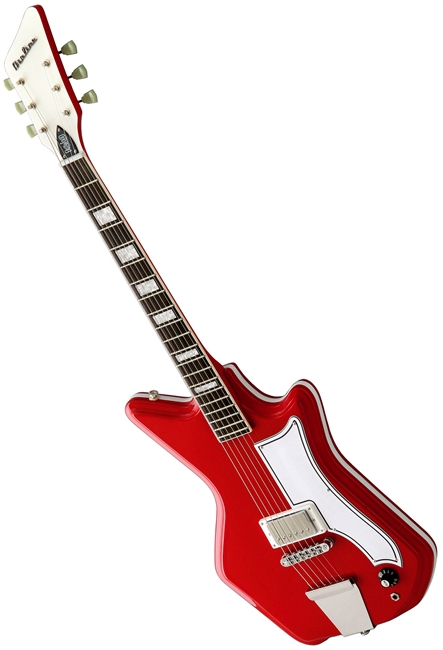
Airline '59 1P Custom Single Pickup Solid Body Electric ...We didn’t hear from Columbia Record Club again and Dad, eventually, let me take the box of 33rpm records back to the basement where I totally wore out all of them. Listening to Gillespie and Davis inspired me to want to play trumpet. Being always short on cash, I eventually inherited an awful Conn cornet from my step-mother’s brother and discovered that I had no talent for teaching myself trumpet, let alone jazz trumpet. A few years after taking up the trumpet, I managed to score an awful Sears Airline acoustic guitar. After struggling with that instrument for a while, I used my paper route money to buy a $35 Airline electric guitar from my local Western Auto store. Thanks to my Columbia Record Club jazz exposure, no part of early 60’s vocal music appealed to me, but I could get my teeth into The Ventures, Dick Dale, The Surfaris, and, thanks to the local music magician, Howard Roberts.

By the time the Beatles and the British Invasion straggled into the Midwest and KOMA radio, I had no interest in either British muppet music or vocals in general. Somewhere in that period, I found WLS out of Chicago and soul music. Imagine hearing Wilson Picket, James Brown, Otis Redding, the Staples, the Bar-Kays, or anything from Motown before you hear the Beatle’s chipmunk voices and the Stone’s limp R&B imitations and you’ll have a clue where I was coming from as a wannabe musician. It wasn’t until I heard “The Freewheelin' Bob Dylan” before I developed any kind of appreciation for lyrics.

I consider all of that sloppy luck. Every bit of it, from mailing in that Columbia Record Club enrollment card to picking “jazz” as my musical preference to that  music leading me to R&B instead of R&R pop to the trumpet-to-guitar progression to becoming who I am as a person and a still-tryin’-to-be-a-musician 76-year-old. It was all good luck.

Wednesday, December 6, 2023

My Slantmaster 50 Story

Back in the early 2000s, I was happily working as a college instructor for a music school in St. Paul. I was the school’s Student AES Club faculty advisor and I was having the time of my life working with brilliant, inspiring, energetic young people who were fascinated with all things audio. Back in my early-QSC Audio days, I’d built a pretty cool ABX tester and, later (after I’d left California and the pro audio business), QSC decided to build a much more sophisticated ABX tester and use it to promote the company’s products. That didn’t work out well and the ABX testers were recalled from the company’s sales force and, I’d been told, crushed to bury the evidence that someone at QSC once thought professional audio people gave a crap about audio fidelity and honest listening tests. I’d been that same dumbasss a decade earlier, so they had my sympathy. Because I’m lazy and that wheel had already been built, I’d bothered Pat Quilter often to see if he could find an unwanted ABX test box that hadn’t died in the garbage compactor.

Quilter letter

So, in late 2008 when Pat sent me an email warning me that there was a package coming my way, I thought I knew what would be in it. When it arrived, it seemed almost Amazon-oversized for what I thought would be a 1 rack-space piece. The box was also a lot lighter than I’d expected. I cracked the tape at the top of the box and saw the beige tolex, the leather handle, and the black dust cover and I was confused. I knew Pat was retiring from QSC Audio, so I assumed he’d built a model amp as a memento. When I pulled the amp from the box and saw the Slantmaster backCelestion Century 12” I suspected it was more than an empty box demo. I plugged it in, turned it on, and (like everyone I’ve ever show the amp to) said, “Wow!” There is a cool, brief light show from the backlit front panel as the amp powers up that blows everyone away. I spent the rest of the day playing with the amp, which was more guitar playing than I’d done in the past 20-some years.

https://images.reverb.com/image/upload/s--Yp0LAsA9--/f_auto,t_large/v1571546406/frdbeloncpgmtfp50wns.jpgI brought it to school the next day to show it off to students, employees and instructors, and anyone who was interested. We used it several times in recording sessions over the next couple of weeks. One to-be-unnamed guitar instructor tried to buy it from me, tried to get me to have Pat build one for him, and coveted it so blatantly that I started storing it in the secured record lab area so that it wouldn’t disappear. Over the next year, I used the Slantmaster dozens of times with all sorts of guitars and guitarists and it was universally loved by everyone who heard it. It is kind of sad to admit that the amp has never been used outside of McNally Smith College or my home studio. It has never seen a live gig other than the MSCM’s auditorium stage a couple of times by players who I trusted not to abuse it.

This is what the Quilter Labs website has to say about the Slantmaster 50, “Built to celebrate QSC’s 40th anniversary, the Slantmaster 50 used a linear amplifier to deliver 50 ‘hot watts’ to a simply awesome Celestion ‘Century’ neodymium speaker.

“This was the precursor to Quilter Labs foundation.

“Only one hundred were made and featured a spring reverb! These are very limited, so if you have one you are lucky!”

I have one (#72 of 100) and I am well aware of the fact that I am lucky to do so. I have meant to write something about this amazing gift for nearly 15 years, but a conversation about the Slantmaster in the Facebook “Quilter Musical Equipment Owners Group” about the Slantmaster moved me to finally do the work.

https://media.gettyimages.com/photos/patrick-quilter-of-qsc-started-making-guitar-amplifiers-in-the-1960s-picture-id566045317The day I started work at QSC Audio Products in Costa Mesa in early 1983 was the day Pat took his first vacation in a decade. Pat and his mother had booked a tour of Europe on the Orient Express and he’d entrusted me with overseeing the initial production of the first Series One amp, the 1400, without a single unit having yet passed through production. There were . . . problems, but the QSC team of that day pulled together and by Monday afternoon we were cranking out 1400s at a pretty decent pace. The Series One and Three amps were the breakthrough products that put QSC on the pro equipment map and for the next 9 years I was a product engineer, test engineer, manufacturing engineer, manufacturing engineering manager, and tech services manager: 5 different jobs, with a couple that lapped-over each other a bit, in 9 years. Pat and I became friends, partially because I was the interface between his working hours (noon to whenever in the evening) and everyone else and me (7AM to 5-or-whenever-PM). We shared an interest in audio electronics, psychoacoustics, music, guitars and guitar amplifiers, electric vehicles, science fiction and fantasy, literature, and the people we worked with. I quit QSC and left California, after giving notice almost 3 years earlier that I would be leaving when I graduated from Cal State Long Beach, because I could never see myself breaking even economically in southern California and for personal reasons. Pat and I have continued to communicate through email for the past 30 years. I keep his Xmas letters in the same envelope as the letter that came with the Slantmaster.

Tuesday, December 5, 2023

It’s A Smaller World Than I Imagined

I am working on finishing up, as it is, our basement office after my friend/contractor Dan Jacobson installed an egress window last weekend. That mostly means, so far, me puzzling together the ceiling tile mess the previous owner/nitwit/contractor made when he chopped up the ceiling to install the forced-air HVAC system the repossessing bank hired him to install. (“Wells Fargo, the dumbest bank on the planet.”) Because I don’t know what I’m doing with most of this job, that means a lot of trips to Menards and Ace for materials and, occasional, tools.

Since I’m spending more than the usual amount of time driving, I’m listening to my random playlist of music that I have stored on USB sticks in the pickup or CRV. I probably don’t have more variety on my playlist than most people, but I do have recordings from a lot of unusual artists. Not only do I have music from well-known artists from the 1930s to today, but I have lots of music that I have been personally associated with either as a musician and/or a recording technician since the mid-1970s. If I’d have known I was going to live this long, I’d have hung on to the stuff I recorded with the Tracers and other kid-bands in the 60s, especially my original songs. Sadly, all of that stuff accidentally ended up in a dump somewhere in Omaha when we moved from that city to L.A. in 1983. Still, I have almost 100 hours of music on my USB stick that I can almost guarantee nobody else in the world is playing at any given moment.

Yesterday after a hardware and grocery store run, the playlist landed on Scott Jarrett’s “Uneventful Lives” and, like everything on “The Gift of Thirst,” it’s a song I know pretty well and like a lot (I like everything on that album.). So, I ended up carrying on with the tune when I went into Aldi’s to buy the “software” for dinner last night. I listen to a lot of music that I usually assume nobody but me knows: stuff I’ve/we’ve written or recorded, music friends have recorded, records that I’ve owned for 30-50 years that was either regional or passed through the popular void unnoticed. Some days, it’s kind of a matter of pride to me that all of this great music is probably only being listened to by me at that particular moment. I mean in the whole world of 8 billion babbling nitwits I’m almost guaranteed to be the only person on the planet listening to a particular song at that moment: 1 in 8 billion, 1/8,000,000,000 or 0.0000000125% of the population are listening to what I’m listening to. I know that isn’t true for Scott’s first record, “Without Rhyme or Reason,” but, like a lot of great music, the two records he made in Hudson, WI didn’t get anywhere near the recognition and appreciation they deserved.

So with “Uneventful Lives” in my head as I left the truck, I walked into Aldi’s singing the random bits of chorus and verses (as usual, I can’t remember any lyrics accurately). About half-way into my shopping trip I was walking toward a woman about my age, pushing a cart in the opposite direction in the same isle. About that time I got to the end of a verse, “So we’ll pirouette away, as the band begins to play. And we’ll drink a toast to husbands and to wives.” And as I passed her she sang, in excellent harmony, “And the sweetness of our uneventful lives.”

Because I am incredibly slow-of-wit, I kept walking and singing to myself, but a big part of me was open-mouth stunned. Nothing like that has ever happened to me. A smarter, quicker guy would have turned around, introduced himself, and asked “Where do you know that song from?” or something equally witty. I did not. In fact, it didn’t occur to me that I should do that until I was loading groceries into the truck. By then, I probably couldn’t have picked her out of a lineup of two people, even if one wasn’t an older woman. So, we’ll likely never know who she is. But . . . damn! It is either one amazingly small world, or Scott’s music landed a lot more places than I knew.

Wirebender Audio Rants

Over the dozen years I taught audio engineering at Musictech College and McNally Smith College of Music, I accumulated a lot of material that might be useful to all sorts of budding audio techs and musicians. This site will include comments and questions about professional audio standards, practices, and equipment. I will add occasional product reviews with as many objective and irrational opinions as possible.