Showing posts with label artists. Show all posts

Sunday, February 22, 2026

AI Versus Me

Artificial Intelligence is somewhere in practically every media, entertainment, and conversation today.  I went on record, a long time ago, saying that “I’m not worried about AI, but LI [Low Intelligence] is gonna kill us all” and I still believe that.  That said, so far, AI’s “contribution” to anything more sophisticated than a Google search algorithm has been dismal-to-dangerously stupid (LI, even). 

When it comes to music, though, especially popular music the bar is so low that I suspect AI will be quite successful at creating pleasant background noises.  Yes, that’s where the bar is set for most of pop music.  While I am no longer involved in any part of the professional audio industry, I still get the industry rags: mostly Mix Magazine and Tape Op Magazine with a few other freebies showing up intermittently.  If nothing else, those magazines tip me off on what is supposedly new and cool, while they flail helplessly at their primary purpose, selling me new equipment and software.  I have too much of both already. For the most part, most of the new music discussed in the industry magazines leaves me sub-zero cold.  For that matter, that is true for most old pop music.  I’m a firm believer in 1950’s SF author Ted Sturgeon’s rule, “90% of everything is crap” and I still think Ted was an optimist.

For example, this month’s Mix Magazine does a several page, detailed description of the creation of Lily Allen’s new record, “West End Girl.”  (If you’re interested, you can read the article by following this link.)  According to the article, a lot of creativity and work went into the recording, but it sounds suspiciously repetitious and the production is not unlike, or superior to, work I’ve heard from dozens of regional pop artists done in their home studios.  [You can decide for yourself without investment listening to this YouTube link.]  The song, “Ruminating,” is a good example and is about the most AI-sounding thing I have ever heard.  If it shows up in the soundtrack of “Matrix 101: Doing Everything the Same Way All Over Again” I want it noted that I said it first here. 

On the AI end, Producer/YouTube dude Rick Beato, who absolutely hates AI, in a show about an AI artist, Sienna Rose, does a pretty good job of showing how little space there is between an AI “artist” and some human, but very similar and equally derivative, pop artists.   That wasn’t his intention, but it was a pretty solid side-effect.  The problem with Rick’s argument is that there is a long history of pop music that is soul-less, repetitive, imitative, and boring and much of the worst of that ilk have been hits.  Not only is the music blah, but pop music listeners are not in any way discerning. 

There are many areas of “art,” industry, science, medicine, law enforcement and legal system administration, transportation, and clerical tasks that AI will very likely do as well or better than human competition.  Since the 1980s, when I first heard about autonomous cars, I’ve argued that it wouldn’t take more than a Zilog Z80 processor with 64kb of memory and a 5Meg hard drive to outmaneuver 99% of American drivers. 

In general, and on average, humans suck at complex tasks requiring actual multitasking and computers excel at those same kinds of chores.  Our “justice” system is plagued with issues as blatant as judges issuing harsher penalties before lunch, than after, to the obvious fact that rich people have a totally different set of legal rules than the rest of us.  Doctors are overwhelmed with information and responsibilities and, as their numbers shrink (Thanks to Reagan’s idiot tax changes.) and workload increases and their patient data flow exponentially increases, AI will be moving from providing assistance to making decisions.  Electrical, mechanical, and civil engineering decisions and designs are becoming more AI-driven every year.  Everyone from self-publishing authors to book publishers are resorting to AI-generated artwork due to speed, flexibility, and necessity.  (Watch for my next essay.)  Currently AI is used for 5–10% of movie CG generation and that will increase exponentially in the next few years.  Pop music just isn’t anywhere near as complicated or, usually, creative an enterprise as any of those tasks. 

However, nobody (almost nobody, anyway) is likely to want to pay money to attend an AI concert and we’ve already suffered through disco and we’re not likely to go back there soon.  Musicians, live and locally, are not likely to be inconvenienced by AI music and that might not mean much change for 99% of music “artists.” 

Wednesday, April 3, 2024

Sloppy Luck, Part 1

I’ve had “sloppy luck” for most of my life. I’ve never won a lottery, but I’ve won some stuff at company parties. My “career plan” was squashed in infancy, but my emergency “plan” (to grossly abuse that concept) turned out surprisingly well. There is nothing special about my genetics, but I have often “been able to take a punch” of all sorts and make some kind of comeback and keep going. Best of all, I have had a life full of wonderful, reliable, loving, brilliant friends. That is plain good luck.

Columbia Record Club ad 1962 vintage magazine orig print 1960s retro art  offer - Picture 1 of 1One of my first sloppy luck moments was when I was 11 or 12-years-old. On a whim, I signed up for the Columbia Record Club’s “special offer.” I remember it being 10 for $1, but that was a long, long time ago. First, I had to pick a music genre and I didn’t know squat about music except for my parents’ 78-rpm collection that I’d listened to in the basement of our home when I was supposed to be baby-sitting my 8-year-old brother. All of the records in our basement were from the 1940s or earlier and that big wooden console record player/radio had a tone arm that probably weighed a couple of pounds. My mother had died just a couple of years earlier and the records might have been hers. I never really saw any evidence that my father cared about music, other than singing in the choir or pep bands leading cheers for his basketball teams. The records I’d experienced were “classics” by Spike Jones, Duke Ellington, Tommy Dorsey, Glenn Miller, etc. On a whim, I picked Jazz and from among the jazz record category options I picked:
  • An Electrifying Evening with The Dizzy Gillespie Quintet (still my all time favorite record)
  • Birth of the Cool, Miles Davis
  • Sophisticated Swing, Cannonball Adderley
  • Brazil, Bossa Nova, and Blues, Herbie Mann 
  • Silver Vibes, Lionel Hampton
  • Cool Velvet, Stan Getz

Over the next year, every month the “pick of the month” card would show up in the mail and I’d procrastinate sending it back to reject the selection because I didn’t even know how to buy stamps. (The card with the original offer was postage paid.) After most of a year, I had a pretty decent collection of jazz albums and owed Columbia Record Club more than $100 before they stopped sending me the “pick of the month” selections. I listened to every one of those records practically until I could see light through the grooves. With those monthly picks and the Columbia catalog I discovered Davis’ “Kind of Blue,” “Brazil, Bossa Nova & Blues” by Herbie Mann, “Time Out” by the Dave Brubeck Quartet, Wes Montgomery’s “Movin’” and ”Bumpin’” and special members-only records by Charles Mingus, and Thelonious Monk.

After receiving a half-dozen unpaid-for-records , Columbia Record Club became less friendly. In fact, their letters became downright threatening. Their pick of the month was “only” $7.95, but after shipping-and-handling it was closer to $10. It’s only fair to mention that 1961’s $100 is the equivalent of more than $1,000 today. My father’s high school teaching annual salary was about $5,000 that year. For quite a while, I managed to intercept the mail before Dad got home from school, but eventually he spotted on of the “final notice” envelopes and opened it up. By then, I was getting the occasional bill collector telephone call, too. After chewing my ass into bite-sized bits, Dad got one of the bill collector calls and the conversation went something like this:

“Hello, who is this””

“My name is ____ and I’m calling for Columbia Record Club. Is this Mr. Thomas Day?”

“No. This is his father, Fred Day. What can I do for you?”

“Thomas has received almost a dozen records from our company and he owes Columbia Record Club $__. How do you plan to pay for the records?”

”I don’t and if you know how to put a lien on an 11-year-old boy I suggest you proceed with that action. However, I am not responsible for his bills and you should be ashamed of yourselves for being foolish enough to give credit to an 11-year-old kid. Tell you what, though. I’ll put all the records in a box and leave them on the front porch and you can come pick them up at your convenience.”

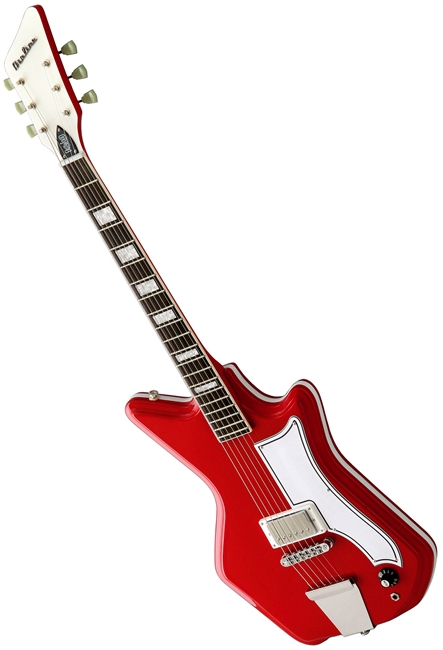
Airline '59 1P Custom Single Pickup Solid Body Electric ...We didn’t hear from Columbia Record Club again and Dad, eventually, let me take the box of 33rpm records back to the basement where I totally wore out all of them. Listening to Gillespie and Davis inspired me to want to play trumpet. Being always short on cash, I eventually inherited an awful Conn cornet from my step-mother’s brother and discovered that I had no talent for teaching myself trumpet, let alone jazz trumpet. A few years after taking up the trumpet, I managed to score an awful Sears Airline acoustic guitar. After struggling with that instrument for a while, I used my paper route money to buy a $35 Airline electric guitar from my local Western Auto store. Thanks to my Columbia Record Club jazz exposure, no part of early 60’s vocal music appealed to me, but I could get my teeth into The Ventures, Dick Dale, The Surfaris, and, thanks to the local music magician, Howard Roberts.

By the time the Beatles and the British Invasion straggled into the Midwest and KOMA radio, I had no interest in either British muppet music or vocals in general. Somewhere in that period, I found WLS out of Chicago and soul music. Imagine hearing Wilson Picket, James Brown, Otis Redding, the Staples, the Bar-Kays, or anything from Motown before you hear the Beatle’s chipmunk voices and the Stone’s limp R&B imitations and you’ll have a clue where I was coming from as a wannabe musician. It wasn’t until I heard “The Freewheelin' Bob Dylan” before I developed any kind of appreciation for lyrics.

I consider all of that sloppy luck. Every bit of it, from mailing in that Columbia Record Club enrollment card to picking “jazz” as my musical preference to that  music leading me to R&B instead of R&R pop to the trumpet-to-guitar progression to becoming who I am as a person and a still-tryin’-to-be-a-musician 76-year-old. It was all good luck.

Tuesday, December 5, 2023

It’s A Smaller World Than I Imagined

I am working on finishing up, as it is, our basement office after my friend/contractor Dan Jacobson installed an egress window last weekend. That mostly means, so far, me puzzling together the ceiling tile mess the previous owner/nitwit/contractor made when he chopped up the ceiling to install the forced-air HVAC system the repossessing bank hired him to install. (“Wells Fargo, the dumbest bank on the planet.”) Because I don’t know what I’m doing with most of this job, that means a lot of trips to Menards and Ace for materials and, occasional, tools.

Since I’m spending more than the usual amount of time driving, I’m listening to my random playlist of music that I have stored on USB sticks in the pickup or CRV. I probably don’t have more variety on my playlist than most people, but I do have recordings from a lot of unusual artists. Not only do I have music from well-known artists from the 1930s to today, but I have lots of music that I have been personally associated with either as a musician and/or a recording technician since the mid-1970s. If I’d have known I was going to live this long, I’d have hung on to the stuff I recorded with the Tracers and other kid-bands in the 60s, especially my original songs. Sadly, all of that stuff accidentally ended up in a dump somewhere in Omaha when we moved from that city to L.A. in 1983. Still, I have almost 100 hours of music on my USB stick that I can almost guarantee nobody else in the world is playing at any given moment.

Yesterday after a hardware and grocery store run, the playlist landed on Scott Jarrett’s “Uneventful Lives” and, like everything on “The Gift of Thirst,” it’s a song I know pretty well and like a lot (I like everything on that album.). So, I ended up carrying on with the tune when I went into Aldi’s to buy the “software” for dinner last night. I listen to a lot of music that I usually assume nobody but me knows: stuff I’ve/we’ve written or recorded, music friends have recorded, records that I’ve owned for 30-50 years that was either regional or passed through the popular void unnoticed. Some days, it’s kind of a matter of pride to me that all of this great music is probably only being listened to by me at that particular moment. I mean in the whole world of 8 billion babbling nitwits I’m almost guaranteed to be the only person on the planet listening to a particular song at that moment: 1 in 8 billion, 1/8,000,000,000 or 0.0000000125% of the population are listening to what I’m listening to. I know that isn’t true for Scott’s first record, “Without Rhyme or Reason,” but, like a lot of great music, the two records he made in Hudson, WI didn’t get anywhere near the recognition and appreciation they deserved.

So with “Uneventful Lives” in my head as I left the truck, I walked into Aldi’s singing the random bits of chorus and verses (as usual, I can’t remember any lyrics accurately). About half-way into my shopping trip I was walking toward a woman about my age, pushing a cart in the opposite direction in the same isle. About that time I got to the end of a verse, “So we’ll pirouette away, as the band begins to play. And we’ll drink a toast to husbands and to wives.” And as I passed her she sang, in excellent harmony, “And the sweetness of our uneventful lives.”

Because I am incredibly slow-of-wit, I kept walking and singing to myself, but a big part of me was open-mouth stunned. Nothing like that has ever happened to me. A smarter, quicker guy would have turned around, introduced himself, and asked “Where do you know that song from?” or something equally witty. I did not. In fact, it didn’t occur to me that I should do that until I was loading groceries into the truck. By then, I probably couldn’t have picked her out of a lineup of two people, even if one wasn’t an older woman. So, we’ll likely never know who she is. But . . . damn! It is either one amazingly small world, or Scott’s music landed a lot more places than I knew.

Sunday, August 23, 2020

Making Mistakes and Living with Them

Exactly seven years ago, today (8/23/2013), I sold my 1973 Dobro D-66 to Paul Mayasich for $1700. I wrote the following words the day after that guitar walked out of my life. I was incredibly depressed at the time. I had quit my teaching gig at MSCM after a 13+ year career there; probably the best job (at times) I had in my 55 year working life and when it ended almost all of the things I loved about that school were gone. My wife and I were leaving home for the winter and I wasn't looking forward to any part of traveling in a camper. 

This piece sounds really self-pitying; and it was. I was whipped. Since then, a few things have changed. Due to the onset of arthritis in my hands, I went back to playing guitar after we moved to Red Wing in 2015. In fact, I'm playing more now than I have in the last 30 years. I still suck, but I'm enjoying myself. I have been diagnosed with myasthenia gravis, which pretty much puts a terminal punctuation mark in my future. I'm not sure what the point in allowing this to post in 2020 would be, but I decided to let it stay on the queue to remind myself of . . . something.

I bought the Dobro (pictured at left) from one of the blues guys who used to play at the Howard Street Tavern, sometime around 1976. It was a well-used instrument when I bought it. Back in those good days, I ran sound occasionally at the Tavern, rented guitars, amps, and other gear to the bar when a traveling musician or band needed gear that wasn't available from the usual culprits, and bought and sold instruments, petals, and amps to pretty much anyone who called in the middle of the night strung-out, hung-over, in jail, or broke in Omaha or Lincoln. This great old guitar was the last holdover from that period of my life.

I can not explain this, but I was almost infinitely sad about giving up this instrument. I know, "Why did you sell it if you were going to miss it that badly?" The reason was that I was dumping all of my old pipe-dreams, one at a time, until I either found something to care about or decided I was too old, too burned out, too disappointed to care about anything.
After the guitar walked out of my life, I took our dog for a walk. It took about a mile of walking before it sank in that I'd given up an instrument that had been so much of my life during some of the best moments of my life. The real reason I was selling all of my guitars and equipment also sank in; at 65 if I never played another note, sang another song, or even whistled a tune, nobody would care. Not a single person who has ever heard me play guitar or sing has been positively affected by my love of music. A few weeks back, the wife of a friend was bugging me to pick a song and sing for a small group of friends. I begged off, eventually leaving the party to get out of being asked to perform. The real reason was that I was convinced that once she heard me sing or play that would be the last time she'd ask for that torture. When you know how the movie ends, you don't need to stay for the credits.

If you need a definition of failure, this is it. A friend, Scott Jarrett, quoted a car mechanic as saying, "You haven't failed, if you haven't quit." I quit on music, more than once in the last 60 years. When I was a kid, I was one of the few guys I knew in bands who wasn't playing music "for the chicks." In fact, I had almost no interest at all in the girls who hung out around bands and bars. I was there for the music. Worse, I didn't want to be a rock star, I wanted to be a jazzman.

Growing up in western Kansas with shit for a musical environment--and the polar opposite of the parents who used to drag their bored adolescent douchebags into the Musictech/McNally Smith College open houses hoping their offspring would become famous musicians--was a lot more than an uphill battle. It would have required superhuman abilities and commitment. I was more like subhuman. I copped out and played pop music, including a fair number of original tunes, because I had no idea how to get from beginner to jazz player. There were no such animals in Dodge City, Kansas in 1963. When I left home in 1965, there were still no such animals in Dodge or western Kansas and I wouldn't meet any until a decade later.

I got married when I was 19. Somehow, I thought my new wife liked my music and my playing. It turned out that she liked my "dependability" and the fact that I could manage to hold a job and support her. My music was rarely a significant part of me, as far as she was concerned. By the time we'd been married for six or seven years, she was close to hating the aspect of my playing that required practice. There wasn't a place in any of our homes that was far enough away from her to keep her from complaining about my playing. A real musician would have taken that as a sign that we were incompatible. I have never been a real musician or any kind of artist. Over the next two decades, I quit practicing and the less I practiced, the less I could tolerate my playing and less I wanted to play. Today, I can barely stand to touch a guitar because I suck so badly. So, seven years ago I sold my favorite guitar to a man who was a musician. I can't decide if I missed the guitar or the hope once had that I might become a musician.

Monday, February 10, 2020

It Just Doesn’t Matter to Me? I Guess Not

The title of a GetPocket.com article, “Are You Forgetful? That's Just Your Brain Erasing Useless Memories” struck a nerve with me. The contents of the article reinforced that reaction. For almost 40 years, I’ve complained that when I quit playing in bands in the early-80’s I lost the ability to remember song lyrics. A neuroscientist, Dr. Blake Richards explains that we mistakenly believe that the “argument is that memory isn’t supposed to act like a video recorder, but instead like a list of useful rules that help us make better decisions.”

For 15+ years, I had hundreds of songs memorized—lyrics, chord progressions, solos, harmonies and melodies—and within a few weeks, of my deciding that playing in a live band wasn’t for me, all of that vanished. Before the year was out, all of those once-useful memories disappeared and, for the most part, I didn’t give it a moment of thought. I was very busy in my new life. Off and on over the next four decades I would occasionally and unsuccessfully try to learn a new song and be mildly baffled at my lack of success. I wouldn’t make the attempt again for several years each time.

This idea that importance is linked to memory isn’t new to me. 30 years ago, I started a new career as an engineer in a medical device company. Part of my job included training new employees, sales representatives, doctors and nurses in the company’s products. I had been doing in-house industrial training since the 1970’s, but those experiences were considerably less formal (product certifications were involved in medical devices) and the outcome of my new job’s training product could be life-or-death. I was renting a room from a friend when I first started in that job and he regularly amazed me with his ability to remember our “students’” names. I am sure I told him, “I just can’t remember names.”

We regularly watched NBA games after work, I was still a big Showtime L.A. Lakers fan and we were watching a game at the time. He replied, “Bullshit. You know the names of every NBA player down to the 13th guy on the bench. You just don’t care about the sales reps’ names.”

Of course, he was right. I didn’t. For the most part, I never did care about sales reps’ names, ever.

A decade later, I was beginning another new career as a college educator. One of the instructors in my new department was fired, partially, because he couldn’t be bothered to learn the names of the students in his half-dozen student labs. Listening to my new boss talk about how he felt that was disrespectful, I promised myself that I would learn my students’ names if it required tattooing their names on my eyeballs. For the most part, I managed that objective and I did it be making sure that I always cared about my students as human beings and potential associates in the industry within which we were all aspiring to work.

Finally, back to why I can’t remember songs today, I really don’t care about individual songs enough to memorize them. I have to admit that. I don’t believe, at this point in my life, songs are an important thing in my life. Music is important, but specific songs are not. Pop music has been the soundtrack to my whole life, but it has been a 50-year-long soundtrack. Other than the jazz that I stumbled upon when I was 11 or 12, specific pieces of music have held almost no claim to my life. Music as an overall thing is not-lifesaving or threatening. Musicians and their music comes and goes and is forgotten or remembered at random based on mostly emotional, juvenile nonsense. People in my generation “love” the Beatles because they were young and cute and hopeful when they first heard that music. Today, they are mostly MAGA assholes who would burn the world to a crisp just to hang on to their gas-guzzling SUVs and golf carts. My kids’ generation clings to punk and metal and disco for the same lame reasons. And on that silliness goes.

I like all kinds of music from pretty much every generation that has touched my life: not all of any of it, but there is some music from every period between the 1920’s (my grandparents’ music) to today (my grandkids’ music) that strikes my fancy in some way. But I don’t love any of it, at least any of it that I’m technically capable of playing, enough to spend the energy and braincells to memorize it. And now that I know why I seem to be unable to memorize music, I’m going to quit beating myself up for that “inability.” I have almost 500 songs on my performance tablet, charted, organized,

The one exception to that failed memory in the last 10 years has been Tom Waits’ “Shiver Me Timbers.” The lyric to that song, if you know me and my life, is clearly why that song remains important to me:

  • I'm leaving my family,
  • leaving all my friends.
  • My body's at home,
  • but my heart’s in the wind.

The first time I heard that song, at the end of a “Numb3rs” television episode, it struck a chord (literally and pun intended) with me that stuck like glue. That song’s lyrics are important to me. In the last year, a John Mayer song, “Walt Grace's Submarine Test, January 1967," is beginning to stick, too. The lyric, “with a library card and a will to work hard” found a place in me that is as personal and important as “Shiver Me Timbers.”

Monday, December 2, 2019

Double-Edged Swords

A friend recently ended a jam session complaining, “I’m worried that musicians today don’t even know the names of the people I grew up idolizing and imitating.” (Or something close to that.) 

I responded with, “That goes both ways, with most of the folks in our generation pretending that no good music has happened since the 70’s or 80’s.” That was not received well. 

I just reviewed a book that I, mostly, disliked for the same reasons, A Craftsman’s Legacy by Eric Gorges, and you can read my opinion of that book on my Geezer with A Grudge blog. Every old generation imagines that it not only invented the wheels of society but perfected them so that every following generation can only screw up the work that went before them. It takes a special sort of arrogant blindness to believe that, but humans are really good at both arrogance and blind belief. It’s one of many things that has always convinced me that the natural state of human “civilization” is chaos. I wrapped up my review of A Craftsman’s Legacy with this: 

“Finally, I firmly believe that everything that requires skill is improved by every generation. You may be one of those addled characters who imagines that ‘good music’ stopped being made in 1960, 1970, 1980, or whenever, but you’re wrong. Likewise, most 1970’s era pro basketball players wouldn’t make the team for, even the freakin’ Clippers, today. Even Michael Jordan would have a hard time playing on a winning team today. It’s true that many people knew how to repair their cars and motorcycles in the 1950’s; because they needed to. A vehicle that lasted 25,000 miles without needing major work in 1950’s was a rarity. Today, we call any vehicle that fails before 200,000 miles a ‘lemon.’ Today, if I had to go to battle with a 15th Century sword I’d just use it on myself to get it over with efficiently. Vintage ‘skills’ are that because they are no longer state-of-the-art and, as such, are obsolete. If you think someone with a hammer and coal-fired forge can turn out a better steel tool than a modern factory, you’re only fooling yourself. If you don’t think a modern adventure touring motorcycle isn’t as well crafted as one of Gorge’s hippo-bikes, you don’t know what the word ‘craftsmanship’ means. If you think someone cobbling out plodding, non-functional ‘choppers, bobbers, and diggers’ could get a job on a modern factory motorcycle race team doing . . . anything, you are probably the ideal reader for A Craftsman’s Legacy.”

I absolutely believe all of that and even a moderate amount of exposure to the best of today’s young musicians would force almost anyone to acknowledge that the “good old” stuff is practically unlistenable in comparison. I admit that I’m not a typical Boomer in my tastes. I didn’t like the Beatles (but I am a huge George Martin fan, he could turn sow's ears into silk purses, repeatedly) or much of the British Invasion in the 60’s and I like most of that stuff even less now. A lot of great music, from R&B to jazz, was bounced off of popular radio by “yeah, yeah, yeah” and other teenybopper bullshit between 1964 and the early 80’s and I don’t think popular music has ever recovered from the damage done. Another Boomer friend commented on the “trivial character” of current music lyrics, as if songs-about-nothing like the Beatle’s “Hey Jude” or “Long and Winding Road” or “Number 9” and pretty much every Led Zeppelin song that wasn’t stolen aren’t only trivial but annoying. At least the Stones had “Street Fightin’ Man” had a point. 

That is such a lame complaint. It’s pop music, dude; music for kids by kids. Don’t expect poetry or meaningful commentary on the state of humanity from kids. 

Just because we’re old and full of ourselves now doesn’t mean that we were solid citizens or brilliantly insightful and creative 50 years ago. I am a firm believer in Theodore Sturgeon’s “90% of everything is crap” rule. I can’t think of a period where the overwhelming majority of popular music wasn’t garbage. For example, the furthest up the US pop singles charts Jimi Hendrix ever made it was #20 with “All Along the Watchtower” in late 1968. The chart topper at that time was “Harper Valley PTA” followed by the Beatles’ lamest ever “Hey Jude.”  Hendrix had 4 successful albums, If you look at almost any moment in pop music history, you’ll be discouraged at how generally mediocre the “hits” are. It was true in 1920 and it will be true in 2020 and 2050. The tastes of the average imbecile are predictably dismal. That casts no reflection on that period’s best and brightest, who will likely be an improvement on the skills and creativity of previous generations until humans vanish from the planet.

Monday, July 22, 2019

Backing Away from Students

Teaching humans anything is a frustrating task. Most people are infested with Dunning-Kruger Effect symptoms and are incapable of absorbing information on subjects that they have convinced themselves they are natural experts. By "most," I mean well over the average 50% of mediocrity. Unfortunately, that group are naturally inclined to be in a position where they need all of the educational help on the planet just to survive. They are ones most likely to be in a classroom and most likely to be unteachable.

I experienced a big contrast in local musicians a few weeks ago. It reminded me of why I have developed an “I don’t give a shit” attitude toward most musicians and their music; especially live. At one end has been working on a half-dozen recordings with Leonard McCracken. One of the best things about moving to Red Wing has been my friendship with Leonard. He is an incredibly generous musician/person and one of the nicest people I have ever known.

A few weeks earlier, after hearing him perform at Marie's Underground and knowing the difference between Leonard’s voice and what comes out of a microphone (SM58) with his traditional rock star technique, I carefully broached Len with the idea that eating the mic is only really useful when there is so much noise on stage that you’re just trying to get some damn vocal in the mic over the din of drums and stage bullshit. Playing solo, there is none of that competition and I suggested he could back off a few inches and let the microphone do some of the work. We talked a little about proximity effect and how that distorts the mic’s output (and emphasizes plosives and sibilance) so that the best you can hope from an already mediocre tool, the SM58, was a mediocre-to-awful signal that needed lots of assistance from EQ circuits that also introduce distortion, phase shift, and an output that barely resembled the input. Then I held my breath, realizing that I’d overstepped a few boundaries and probably pissed him off.

He ate it up and asked the kind of questions my favorite students often asked when they discovered that microphones are not a simple tool. He’s totally revised his technique and you can understand what he is saying and singing on any system. The following Friday night, I brought an EV RE18 to Marie's for Leonard to use in a gig there. Holy shit, he just sounded magical even on Beatles songs (which I usually hate) and was having a great time using a real microphone on his own system (which is pretty good). Then I went the other way. Leonard took a break and he asked a friend to do a song or two to hold his audience. The RE18 is hard for even a typical country singer to fuck up, although he gave it a shot. For the first time ever, I could hear his lyrics over a PA and discovered that I didn’t dislike his voice as much as I’d thought.

Leonard’s friend, Esther, was sitting next to me and started asking questions about microphones and technique and I explained a little, although her technique is pretty good in the first place. The country guy came back to the table and I complimented him on how good he sounded. He listened in for a bit and started contradicting me with total bullshit myths about microphones and tossed out a lot of terms he clear misunderstands (polarity patterns, frequency response, the tube mic religion, etc) and it turned pissy for a bit. Eventually, he resorted to “good microphones are too expensive,” which I thought was  hilarious coming from a fairly average guitarist who insists on an expensive guitar but even mostly considers himself a vocalist. Funny, but not even a little unusual.

Music stores make their living off of guitar players who think spending money will fix their playing, but who may never realize an acoustic guitar is, for most of us, just providing an simple accompaniment to our voices and songs and stories. Leonard regularly proves that cheap (<$300) guitars are fine. He has a fine collection of cheap Chinese and South Korean electric and acoustic guitars that our local repair guy says "are killing the sales of expensive brands because Leonard's guitars sound so good." Of course, the real story is that Leonard makes them sound good.

The other guy and I are probably not likely to be friends and I can’t say I give a fuck. I am, however,  using the experience to try to fashion this Wirebender blog piece. The experience did remind me that I am mostly done with teaching. It was plenty hard trying to teach anything technical,. controversial, or complicated to 20-somethings, but it’s almost always impossible to teach anything to people who have never studied a single adult subject, are cursed with Dunning-Kruger syndrome, and are OLD. Since Trump, my tolerance for stupid and stubborn has just shriveled to zip and my ideal retirement home looks better every day. Ignorant is a different case. I have no problem with people not knowing much about a subject. There are thousands of subjects that I know nothing about and about which would love to learn more. That is ignorance and there should be no shame in that. Stupidity is a chosen quality, though. Arrogance is even worse.

The cheap microphone argument leaves me pretty cold though. Yeah, I know your favorite rock stars lip-sync into SM58's on SNL and stage and if faking it with a cheap Shure mic is good enough for them it should be good enough for you. (About a decade ago, there was a brief period where Neumann and Sennheiser replaced the SM58's on the SNL stage and that was the ONLY period in that program's history where the music performers didn't sound awful.)

The problem is garbage-in/garbage-out. You can not "fix" the original signal; although you can remove some of the crappier parts and try to hide the deficiencies with EQ and compression. That's not a fix, that's just lipstick on a pig. Transient response, sensitivity, phase and frequency accuracy, off-axis response, and the collection of microphone characteristics that are even harder to quantify but we "know 'em when we hear 'em" are not fixable. If you've tried any of the microphone modeling programs, you (hopefully) have realized that you can not make a Neumann U87 out of an SM58 recording. Ideally, you start with either a well-known microphone of high quality or, even better, with a precision condenser microphone. You can always reduce the quality of a signal, but fixing it is beyond science or software and not even on the same planet as live music.

The question I'm asking is, if a $3,000 guitar will make your mediocre guitar playing sound better, why wouldn't a $500-1,000 microphone do the same for your voice? Trust me, it will do far more than the guitar could ever hope to do.

POSTSCRIPT: I recently watched John Mayer's "Where the Light Is" video. The effort he puts into selecting clothing, a watch, and his guitars vs the thoughtless decision to sing into a CB mic (the Shure SM58) is telling. Obviously, the recording and mix engineers put a lot of work into cleaning up the vocal mess Mayer dripped into their preamp, but his voice still sounds as muffled, sibilant, and distorted as does everyone else who improperly uses an already defective tool.

Recently, I talked a local songwriter into using my RE18, instead of his SM58 for a live recording of a performance that we recorded and will be sold as part of an artist grant project. I had to do almost nothing to the output of the RE18 to make the vocal stand clearly on top of the mix. The artist has commented several times on how great his voice sounded both during the performance and on the recording. He is now deciding on whether he will be replacing his 58 with either an RE15 or RE20, both of which has has owned for years and didn't realize were great live microphones. So, sometimes you win and sometimes you don't.

Monday, June 17, 2019

What You Sound Like Is Immaterial

In 1966 Eric Clapton recorded with John Mayall & the Bluesbreakers and music has steadily gone downhill ever since. In the book, The Birth of Loud, the author talks about how Clapton’s insistence on playing his Vox amp at full tilt during the session is what drove zillions of half-witted guitarists to “want his sound” and buy Les Paul guitars. Wrong. The recording tech’s ability to blend the guitar and sonic mess Clapton created into a coherent recording is what misled a generation of wannabe guitar heroes into breaking their backs with overweight Les Paul guitars and driving themselves deaf trying to “get that sound” in the real world. 

That Blues Breakers sound was the result of a coherent group of musicians playing together to create a piece of work that was a musical composition; even though that composition was artificial as hell. Every sucker who ever attended the sonic disasters that all Clapton concerts were from then on (with the possible exception of the Unplugged MTV concert) would confirm that Clapton no more resembled the musician on that recording than I resemble Lebron James. As for the Blues Breaker recording, I’m sure Clapton’s guitar mess bled into every mic in the room, but through a variety of Gus Dudgeon's clever acoustic and mixing tricks Mayall and the Blues Breakers got a decent recording in spite of Clapton’s ego. That’s my take, anyway. After making that record, Eric threw one of his trademark tantrums and moved on, leaving rock history with a mangled story to argue over. Several years of awful Cream concerts marketed by three brilliantly engineered and produced Tom Dowd records (including two miracle live records that almost made the group sound competent in concert) created a couple of generations of tone-deaf, functionally deaf, brain-dead guitar wannabe-heroes. Even someone as clueless as Ginger Baker could figure it out, “The incredible volume was one of the things that destroyed the band. Playing loud had nothing to do with music.”

For the next 50-some years, guitar players have been messing around with guitars, pickups, amplifiers, and techniques trying to create some sort of sound that either identifies them as individuals or covers them in the reflective glory of copying someone else fairly well. Been there, done that. What an audience is looking for is not a single instrument's "tone," but a well-constructed, balanced and interesting performance from a group (even if the "group" is an acoustic musician and his/her voice) and a song worth remembering. Except in a few instances, nobody would cross the street to hear the average guitarist fumble with their instrument, but most of us would dedicate some of our precious vanishing time to hear a great song.

In the end, Eric’s tone was about as important to the song as was the “tone” of every other instrument in the recording; especially the dubbed-in horn section. The song, the arrangement, and the mix are what make this tune worth listening to and that is the message that appears to be getting further lost in the weeds as time goes on. Pop “music” has become more of a visual performance “art” than a musical performance and audiences reflect that weirdness. “Musicians” spend more time on their dance steps and posing than their instruments or arrangements. At the club level, musicians are being taught to perform as a random bunch of individuals with self-interest overwhelming anything resembling music. Even jazz musicians in clubs as tiny as coffee shops “need” amplification because they are incapable of listening to each other and too egotistical to imagine that someone else might be the most important thing in a particular tune. And music dies a painful, sad death at the hands of electronics.

Monday, June 10, 2019

Holding A Grudge or Just Paying Attention?

After the Snarky Puppy misadventure, my wife (Elvy) and I had a couple of long conversations about concerts we’ve seen and loved or hated and the end results. Turns out, my Geezer with A Grudge habits apply to music, too. I have never been punished by an artist twice and we have made a habit of seeing the people who exceed my expectations at every opportunity. The last bit has slowed up considerably now that I am no longer in the business and live some distance from where most of the action happens. Because of the expense and hassle, I probably won’t be seeing many artists twice from here out.

For example, I’ve seen Pat Metheny almost a dozen times at a dozen different venues and never once felt betrayed, abused, or let down by his band’s performances. After that many shows, I am still willing to go a long distance to see him again. A small part of my motivation for moving to L.A. in the 80’s was to see the Crusaders in their native element; especially since that was the only way to see them by that late period in their careers. I saw them as the headlines for the 1983 Playboy Jazz Festival at the Hollywood Forum, at our local club (The Golden Bear) in Huntington Beach, and at a couple of outdoor shows in the South Beach area. Every show was knocked out and amazingly close to their recordings, quality-wise. Same for Jeff Beck; who I have seen 3 times and 4 if you count a 1960’s Yardbirds concert in a Denver bar. Jeff is often loud, but always musical and the sound quality has been close to state-of-the-art every time I’ve seen him play. Elvy isn’t as much of a jazz fan as me, so many of the above shows were my experience alone. On the other hand, we’ve been to more than a few pop music concerts because of her interests; Queen, for example.

An example of the other spectrum would be Robert Randolph and the Family Band. I bought 2003's Unclassified and 2006's Colorblind the moment they arrived. I used to intro my auditorium lecture classes with Squeeze or Ain’t Nothing Wrong with That. Like Snarky Puppy, I missed my first opportunity bto see RR when the band was at First Ave because I was working a gig, out of town, that evening. Then I saw Robert and his band at the Minnesota State Fair. The sound was terrible and, being an outdoor concert in a facility where I’ve heard some terrific shows, all of the blame landed on the band (and the FOH nitwit). I tried that show twice and the 2nd time was worse than the 1st. I haven’t paid a moment of attention to Robert Randolph since; nor bought any of the band’s newer music. I still think they are a good recording act, but as a live band they suck and I wouldn’t cross the street to see them for free.

To be clear, what I’m expecting in a live concert is at least the sound quality of a decent car stereo (sans hip-hop sub-woofer mess); at the dead minimum. There is no point in spending tens of thousands of dollars on a sound system that is worse than a car stereo; and that is not a high bar. A better goal would be to match the fidelity of a good home entertainment system. Still not a stretch, but an improvement over a car stereo. Excuses from FOH goobers for room acoustics, audience behavior, and the band’s stage excesses don’t mean a thing to me. The band and the FOH engineer are totally responsible for and in control of the concert sound quality. If, as is the usual case, they don’t care one result is either do I.

Even 20-50 years later, I can remember many of the concert moments that blew me away; some as if it were a recent experience. What I remember about the lousy sounding concerts I’ve experienced is “I’ll never do that again.” That, literally, is all I remember of non-musical experiences. That would be my Geezer reflex: “Fool me once, shame on you. Fool me twice, shame on me.” I had thought about doing a chart of a few of my concert experiences, but it would be a lot of one-time experiences and my HTML charting capabilities suck. Put it simply, there are far more “artists” who I have seen once and wouldn’t cross the street to see again. Too many musicians are more concerned with their egos than with their music. This is not a new thing, but a long-established tradition; especially with jazz and pop musicians.

The conversation Elvy and I had about our 50+ years of going to concerts together was a little surprising. She was even more adamant in her “I’ll never do that again” response. We did remember many of the same great shows close to exactly the same. For both of us, the memory of the sonically disappointing-to-awful shows was limited and a little irritating. We’re not rich and wasting money is something we’ve tried to avoid for all of our adult lives.

Monday, April 1, 2019

One Story, Two Books

One of my wife’s favorite concepts is “evolutionary convergance”; where the same evolutionary decision is made independently, likely because it is a good idea. The two books are The Birth of Loud: Leo Fender, Les Paul, and the Guitar-Pioneering Rivalry That Shaped Rock ‘N’ Roll by Ian S. Port and Play It Loud: An Epic History of the Style, Sound, and Revolution of the Electric Guitar by by Brad Tolinski and Alan di Perna. Play It Loud is a 2016 publication and The Birth of Loud came out this year. Your take on these two books will depend on your personality. The stories are, essentially, the same.

I read Play It Loud first and am just now finishing up The Birth of Loud. Of the two, Play It Loud is my choice.

There are too many technical flaws in The Birth of Loud and the writing style is too emotional and concentrated on personalities rather than technicalities. Your mileage will, probably, vary. Lines like this are show stoppers for me, “When Leo heard this story [about his pickups failing during a performance], he made sure that if the Esquire’s wiring shorted, the signal would only be diminished, not completely cut.” Wrong. If the wiring is “shorted,” there will be no output, regardless of Leo’s technical “genius.” Birth of Loud is littered with this kind of technical foolishness, to the point that when the author attempts to describe how anything works I have to kick into speed reading mode to get past his mistakes and misunderstandings. Otherwise, I’d toss the book in a pile and find something more interesting to read. There are moments in Birth of Loud that make suffering the flaws worthwhile, though. I knew almost nothing about Paul Bigsby, other than the fact that he knew the difference between vibrato and tremolo; unlike Leo Fender. By himself, he would be an interesting story, so the fact that there is a little more about Bigsby in Birth than Play makes that book worth reading; at least, for me. I do have to suffer through an awful lot of hyperbole, emotional language, and outright silliness to get to the good stuff, though. Port’s descriptions of the music discussed in the book are so over-the-top silly that it’s hard to take any of the book seriously.

Play it Loud is less emotional, more technically accurate, and a more entertaining and interesting read. The authors either check each other’s excesses and technical misunderstandings or they are simple more knowledgeable; or they had a better editor.

Interestingly, neither book is the usual Les Paul pandering that we’ve suffered for the last 40 years. I suppose Paul has been dead “long enough” that the shadow of his self-promotion is fading. I remember watching a Los Angeles AES discussion in the 80’s where Les Paul and Tom Dowd were on the panel and when Les started bragging about buying the “first Ampex 8-track machine,” Dowd reminded him that most of the design work on that machine came from Dowd and Ross Snyder’s idea of making a single 1” multi-track head, instead of Paul’s stacked individual heads and eight stacked ¼” tapes. Also, both Dowd and Paul ordered 8-track machines, more or less, at the same time and Paul’s was supposed to be delivered first, but Dowd snatched it off of the Ampex loading dock and installed it himself. Ampex delivered the 2nd one to Les Paul’s studio and installed it for him. Les Paul was the Jimmy Page of his time, claiming the creation of everything from electric guitar pickups to solid body Spanish-style guitars to recording techniques to tube amplifiers. Of course, there were predecessors for all of those inventions, but Paul made his claims more often, louder, and more prominently than that actual inventors. His contribution to the famous Gibson Les Paul guitars is accurately reduced to his signature on the instruments and some of people who actually designed those instruments are credited. History is catching up to Les Paul’s legacy.

Leo Fender gets a similar look in both books, probably more harshly/realistically in The Birth of Loud. His personal and technical limitations have been rarely discussed outside of knowledgeable conversations between engineers or technicians. The fact that Leo overcame his technical limitations with hard work is a fact, but the fact that his products were littered with the downside of those technical limitations has barely received a mention. The contributions of the many people who compensated for Leo’s limitations are finally documented in both of these books. Rarely, does one person actually “create” a significant product; almost never, in fact. Fender’s guitars and amplifiers are the product of a lot of unheralded effort by many people who at least get acknowledged in both of these books, more so in The Birth of Loud, to the credit of Ian Port.

Sunday, November 25, 2018

Concert Review: Crash Test Dummies at the Fitzgerald

crash test dummies 2The concert was billed as the "Crash Test Dummies: God Shuffled His Feet 25th Anniversary Tour." A better person would have known what that meant, but I was mostly a first Crash Test Dummies album fan. The tour started in St. Paul with the core band of Brad Roberts, Ellen Reid, Dan Roberts, Mitch Dorge, Stuart Cameron, and Eric Paulson.

Local bar solo act, Paul Metsa, was the opener. He was as surprised to be there on the Fitz stage as we were to see him there. He didn’t even manage to get the performance up on his webpage retroactively. He had moments of ok-ness and talked way more than he played, which was an odd choice since he seemed to believe he was getting a lucky showcase that night and should have used the time to demonstrate his musicianship. Ending with a patronizing version of the Star Spangled Banner was pure Toby Keith schmaltz. He was, apparently, desperate to get audience attention.

The FOH guy, as usual, was near deaf. As usual, from the start it was obvious he’d never heard an actual record and imagined that we were all just dying to hear kick drum and bass solos; especially that all-captivating territory between 15Hz and 80Hz. (Or maybe his own hearing is so damaged he needed those frequencies boosted 10-20dB to compensate.) As the night went on, the sound goof became more hearing-impaired and eventually it was difficult to even sense the existence of the vocals unless all three of the band’s singers were really wailing. That was particularly disappointing because I don’t often get to hear a singer with Brad Roberts’ mic and vocal technique. If there was ever a band that deserved to have the vocals upfront and on point, Crash Test Dummies are it.

crash test dummiesDuring the many quiet moments and, especially, when the musicians except Stuart Cameron (acoustic guitar) were absent, Roberts really knocked it out of the park. “Heart of Stone” was so incredible that my wife and I simultaneously and spontaneously turned to each other and said “that was worth the price of the trip, hotel, and concert tickets.” Of course the lyrics are close to our own story, "And so now we are old, both our stories are told and we wait for the end. If you're first to go I will follow you, know that my heart will not mend. And I wish I owned a heart of stone.” Trust me, it does not read as emotionally powerful as it sounded with Roberts’ incredible voice.

As hard as he tried, the FOH goof did not destroy the evening. The musicianship was solid and the spare arrangements allowed many of the high points to fight their way through the sound system incompetence. There were few moments where the lyrics were decipherable, but when those words were either heard or memorized the whole point of this philosophical, insightful band was proven to be true. If there was a Crash Test Dummies’ song that someone didn’t hear Friday night, it was a really obscure one. I held my breath hoping to hear Superman’s Song, but not expecting it if this was really supposed to be the God Shuffled His Feet 25th Anniversary Tour. They played Superman as the end of the regular set and the last song of the encore was "Mmm Mmm Mmm Mmm" Go Figure.

There were many moments that were worth the trip to St. Paul, the hotel hassle, and even the downtown St. Paul parking hassle. It takes a lot to overcome those obstacles, but Crash Test Dummies pulled it off.

Sunday, August 19, 2018

Peter Mayer and Live Music

mayer at Crossings

Saturday night (9/14/2018), I was the sound tech at Zumbrota’s Crossings Gallery for a Peter Mayer show. I’ve been a fan of Peter’s since I first heard “Brand New Harley” at least a decade ago. I bought the CD that song was a part of and discovered other Mayer gems: “John’s Garden,” “Africa,” “Holy Now,” among many other great songs of Peter’s that I’ve discovered (for myself) since. Peter has a solid, dedicated following of fans across the country and, according to posts on his Facebook page, the world.

20180714_212704He earnes it. Not only does he put on a show that covers as much of his huge discography as you would hope and could expect, he puts so much of himself into the performance he has to wind himself up and, then, down again; before and after the show. The sound check is as much a ritual he uses to gear himself up for the performance as it is an opportunity to optimize the sound system.

There is an aspect of performing this kind of personal music in this kind of venue that feels like someone has stripped themself naked in front of you. An audience can sense that kind of intimacy and, if the performer is lucky and talented, the audience can feedback some of that energy and love to the performer closing the loop and creating an environment that is particularly special to music.

Wednesday, July 18, 2018

Cool Snarky Puppy Stuff

In case I haven't made this clear, Snarky Puppy is my current favorite recording act. Someday, I hope to see them live and I really hope to make them my favorite live act. These are just a few of my favorite performances from this amazing band. At the least, listen to these pieces with decent headphones. SP goes to incredible lengths to produce high fidelity recordings. They deserve the respect of a decent reproduction system, at the least.

Friday, April 6, 2018

What I Learned This Winter

I learned a lot about running sound for a play, which was my 2018 late-winter, early-spring “experience.” I was the “sound designer” and FOH tech for a play, “Appropriate,” at the Sheldon Theater in Red Wing. I had a LOT to learn, since I have only been to kids’ and grandkids’ plays as a cheering section rather than participant or even an active and conscious observer. I have never thought about any aspect of sound for live drama . . . ever. When Bonnie Schock asked me to take this job back in late 2017, I asked about a few details and decided it wouldn’t be too much of a strain on my retirement. As I almost always am, when I say “yes,” I was wrong.

For starters, the reason I haven’t been a play-goer is because the historic quality of the performances or the non-subtle style of stage acting doesn’t work for me. I get the commitment and talent required and I respect that, but the art form just isn’t my bag. During my college years, a couple classes required watching video recordings of Shakespeare (who’s writing I love) performances and that reinforced my dislike of the aural aspect of stage acting. My wife, Elvy, is more of a fan of the format than me, partially because she enjoys the art of stage design. For her, the visual qualities distract her from the sound; as long as the audio isn’t awful. She really likes the traditional orchestra performances that are part of many plays, but I’d just as soon hear the orchestra without the play. I had given exactly NONE of that any thought when I agreed to be part of the Sheldon’s performance. At the time, it didn’t seem to matter much, because I figured getting a handle on the play’s audio would be fairly simple. Again, I was wrong.

I have done, and still occasionally do, sound design for television and budget film projects. It’s not like the job of creating audio cues and environments is foreign to me. However, that work has always involved a list of fairly concise sound-effect descriptions and audio cues that come reasonably far into the project’s development. There are usually some changes required, often determined after I deliver my first “draft” of the work, but the few directors I’ve worked with are pretty good at describing the changes they want and I’m billing them on an hourly basis so they have some motivation to be efficient. Plays are, apparently, not like that. The work is endless and the communications are as half-hearted as the focus on television and film audio was 50 years ago. In this production, I’d guess the director and stage manager put about 40 hours into the lighting design and about 15 minutes into the audio; although, there was always plenty of post-show and rehearsal criticism.


IMG_9278Like most facilities, the Sheldon’s FOH mix position is a good distance from ideal; sonically. As you can see from this picture, there is about 15’ of balcony overhang, a couple of very directional EV ceiling speakers, and a large projector shading the speaker and stage output from the FOH position. An upside is the extremely limited vertical dispersion (a claimed 5o, if you can believe that) of the main speaker system. The diffraction from that balcony edge provides a very noticeable phase error signal-mix with almost any level of volume from the FOH speakers. I’ve only worked a couple of live music events here and I never know what the rest of the room is hearing. That, however, is true for everyone in that room, though. The historic 1900’s architectural features of the Sheldon Theater are acoustically hostile. Sound is oddly reflected, focused by concave surfaces, lost through glass and doors, co-reverberated by coupled spaces, and unevenly absorbed by stage curtains and padded seats. So, the upside is that no seat in the house sounds like any other seat, but only a few locations are capable of rendering decent fidelity under limited conditions.

I have some personality quirks that make me imperfect for theater work. I hadn’t put these pieces together before the third or sixth or tenth rehearsal, but there are no more than a half-dozen movies that I’ve watched twice in my life. There are maybe three I’ve watched more than twice. Most of those, I was doing other things while the second run of the movie was playing in the background in my shop. I have never learned to recite a poem because I get bored and wander away after one or two passes.

IMG_9287
FOH tech, it is absolutely necessary to know the play almost as well as the actors, since no one cues the audio guy. However, you will have to listen to the lighting cues in your headset while you are trying to mix the show. Document the hell out of the script and color-code your documents. In the example at right, I have blue tabs are for my sound effects Pro Tools markers, the orange are sound effects fader positions, and the yellow are DiGiCo Snapshots. The underlined text are “key points” in the script to keep me in sync with the play action and the boxed text is where the Snapshots need to switch. Creating a document like this means I needed to be present for almost every full run-through of the play, which about quadrupled the amount of time I thought I’d need to invest in the project (Creating an hourly rate that I do not want to talk about.). Like I said at the beginning, I’m not a theater-goer, but I’d be surprised if many theater spaces are much better than this, acoustically or sonically. Theater is an art form mostly propped up by government and arts organization grants and one that mostly exists only in a few major cities. There are many reasons for that.

I can listen to the same ten second segment of a musical performance all day long without getting bored. The same is NOT true for a speech or play. I write a lot of stuff for a lot of outlets and industries, but once I’ve handed off a piece to an editor and I get paid or posted it to a blog, I do not ever re-read what I’ve written. No only does that mean I’m the wrong kind of audio guy for plays, but I have no chance of being a successful author because I would hate going to readings of my stuff. That is a deal-breaker.

The big picture for this kind of work is that you, the sound designer and/or FOH tech, are just a tool in the director’s pallet. More often than not, you will be the smallest, least important, least used tool in that toolbox. You will have as close to no control of your output as you would have working on a factory floor. Nobody wants your creativity, experience, or ideas unless those ideas can be morphed into the director’s vision. The audio tech is the low guy on the pecking order on stage, so expect to step and fetch for anyone from the props and scenery people to the lighting geeks. Audio is considered a necessary evil on the play stage and you are probably the only person in the organization who is not only unnecessary, you are unwanted. Keep that in mind when you ask for help, a budget, or equipment.

So, there are only two good reasons for doing this kind of job and, ideally, both justifications will be met in every project you do: #1 it pays a shit pile of money for the hours you’ll be working and/or #2 you desperately want the work to learn the equipment, the techniques, the credential, and the experience. I suppose you could do it for the art, too, but that means you don’t have any of your own and that’s just sad.

Epilogue: Not long after I wrote this, my wife and I watched a collection of big budget movies on our home theater system. The big takeaway from that experience was that with all of the talk about CG visuals and high tech videography, a substantial portion of all of those movies were . . . dark or pitch black. In other words, while we'd spent some money on our high resolution television, the audio system was about all that got a workout during several of these movies. 

As I wrote to a friend this week during a discussion about this play experience, "I did a bunch of television work between 1998 and 2010 and working the play was a lot like that. It's funny because when a camera guy screws up or a lighting cue gets missed or a whole bank of lights don't work, almost no one notices. It has to be a huge mistake before the audience will realize it wasn't an intended 'effect.' When one (out of a dozen or more) wireless mic cuts out or makes noise or a small part of the sound system fails or there is a break in the music, everyone is all over it. But we stay at the bottom of the pecking order because everybody thinks it's easy." It isn't and the general level of amateurism in most audio outside of movies and modern television demonstrates how hard audio is to do well and how "a little knowledge" isn't even close to enough to do a good job. 


When I was teaching audio students, I used to recommend that they stay to watch the credits roll after movies, just to see how many audio jobs there were in a typical big league film. The movies my wife and I watched this week were a good example; the audio credits roll for several minutes. As they should. Remember, sound without pictures is radio but a movie without sound is just pictures. These days, many people "watch" movies on their telephone or tablet screen but they listen to those movies on headphones. They are sacrificing the picture, but they don't lose much of the audio and they get the story just fine. 

Sunday, March 25, 2018

How Much Will This Cost?

repair_costOne of the many things students don’t get much of in school is practical economics. As a result, the hourly rate lots of freshly-hatched audio technicians earn is embarrassingly unlivable. One of many reasons the career-longevity of people in the music and entertainment business is notoriously short. While I was working on one of those projects that usually inspires the notion “I could be doing better than this working at a convenience store,” I decided to write something about my own business experience in the music and audio business.

Until the day I retired, I had a price list for the various services I supplied to a variety of; from musicians and facilities who hired me for location recording gigs to studio and audio equipment repair services for musicians and recording studios to building contractors (acoustic design consulting) to law firms (audio forensics). Some of my price list was determined by the liability insurance required which was mostly determined by the customer (law firms) and the risk (to me, financially) involved in making a court statement about whatever the law suit involved. Acoustic consulting work for commercial construction was almost as risky and required similar insurance protection.

My rates ran from $75/hour to $275/hour. Those are “billable” rates, however, which are not necessarily the same as the hours I actually spent on a project. For example, a lot of recording work requires prep time and effort that the customer doesn’t see or appreciate. So, it just gets folded in to the billed rate. Recording projects are particularly expensive, time-wise, from my perspective. It’s possible at the high end of the “audio engineering” world that people actually make a decent income, but I always suspect a trust fund is involved when someone can afford to spend a career in entertainment.

pyg7cOddly and classically American, my experience with the high-ticket projects came dangerously close to being volunteer work because my liability insurance was so expensive. When I started planning for retirement and was winding down my businesses, the legal work went first. That saved me about $3500/year in insurance costs. The only way doing that work makes sense is if you do enough of it to make up for the insurance cost; at least 20 billable hours. It isn’t reliable work and lawyers, as you might guess, don’t pay their bills quickly and are hard to collect from. It was easy work to give up.

closedFor that same reason, the acoustic consulting work went next. That saved me about $1500/year in insurance costs. Again, it is work you can’t count on and it’s usually not much fun. Although the engineer for the last contractor I worked with was terrific. He did everything he could to take responsibility from me for liability and customer interaction. Designing a quiet staircase in a multi-use building or plugging all of the sound passage routes between a first floor pediatric dental office and a lower-level computer programming company is just not exciting work. Recording studio work is fun, but not particularly profitable. Most of your customers are cheap and not particularly sophisticated and your competition all has a trust fund to spend.

Mostly because several of my ex-Studio Maintenance students were doing a lot of studio maintenance and looking for more work, that business was mostly easy to quit. I just started directing inquiries to them. In the last two years, I’d raised my prices to $225/hour hoping that would drive the business to cheaper techs. When that didn’t work, I had to tell a few customers that I was absolutely no longer interested in crawling around their studios or scouring the food, drink, and drugs out of their wreaked equipment. At least one of those characters had alienated every decent tech I knew of and, I suspect, they simply shut down the studio after the last piece of gear quit working.

Since the 70’s, I haven’t done music equipment repair for anyone other than myself, mostly buying broken gear and selling it in original or hot-rodded condition. In March, 2018, I had about a half-dozen pieces of equipment left in my shop and I am slowly working my way through the pile. When it’s done, I’ll probably convert the electronics shop to a guitar building and repair shop. Or maybe I’ll hand the bench over to my wife for her art projects.

I still do occasional location recording gigs, but with really limited capabilities: no more than 8 simultaneous channels and my interest in working on overdub or large-track-count projects is close to zero. My simple rule for recording projects is, “If I like what you’re doing and the project is fun (meaning, you are not an asshole), I do the job for my cost. If I don’t like you or the project, you can’t afford me.” Most people can’t afford me. I’ve quit pretending like people or projects that I’d just as soon avoid.

c7bbc0570f684ac0ca8fa94366f438dd27c40c37562726a6e386da61927fae2eI’m not being a snob, I would just rather be retired and working on my own projects than worrying about pleasing someone else. I spent more than 50 years of my life trying to make other people happy. For the few years I have left to live, the only person I’m interested in satisfying (avocationally and vocationally) is me. I’ve paid all of the multi-tasking, menial labor, service-job dues I’m planning on paying until I croak. For a long while, I was fairly good at pretending to care what marginally-talented, egotistical, humorless, joyless people thought of my work. Those days are done and, unless I find a way to go broke between now and my last breath, they will never return.

Wirebender Audio Rants

Over the dozen years I taught audio engineering at Musictech College and McNally Smith College of Music, I accumulated a lot of material that might be useful to all sorts of budding audio techs and musicians. This site will include comments and questions about professional audio standards, practices, and equipment. I will add occasional product reviews with as many objective and irrational opinions as possible.