Showing posts with label hearing impairment. Show all posts

Sunday, August 27, 2023

The Deaf Leading the Deaf

Because I’m a slow learner, I went to a local outdoor concert this past weekend. The headliner is a friend and I know a couple other folks who would be playing earlier in the day.Honestly, I felt a bit of an obligation to be part of the audience for their music. I know that a Red Wing, MN audience isn’t typical of pop music audiences with an average age approaching at least 70, but music “fans” of all ages are sadly similarly hearing-impaired. Depending on perspective, I was or wasn’t disappointed with the “music.”

Over the past couple of decades, I have become less inclined to suffer for someone else’s “art,” in the form of painfully loud, distorted, weirdly-mixed live music. This isn’t the first time I’ve written about this, so it might be boring. It struck me, about 3 songs into the set I’d come to see, that live music today is doomed because all ends of the people involved in production and listening are functionally deaf or, worse, don’t care about sound quality at all. My friend is a songwriter and his band is tasteful, talented, and they make an extreme effort to stay out of the vocalist’s way. The soundgoober (the man leaning on the console as if it were a drunk’s crutch) started the show with a severely distorted and loud kick drum and bass guitar blast and took 3 songs to squeeze the vocal a little way into the mix; not enough to understand the lyrics but enough to know there was a vocalist. Worse, it took him 45 minutes of “check, one, check, two” crap to do a musically pointless soundcheck, making the headline show start time 30 minutes late.

As usual, when I described my disappointment to other people who had seen the show, I was the Lone Ranger of Criticism. According to the National Institute on Deafness and Other Communication Disorders, “About 2 percent of adults aged 45 to 54 have disabling hearing loss. The rate increases to 8.5 percent for adults aged 55 to 64. Nearly 25 percent of those aged 65 to 74 and 50 percent of those who are 75 and older have disabling hearing loss.” I, personally, think that is grossly optimistic, based on my own experience with live and recorded music listeners. Back in the 80s, the Audio Engineering Society invited an otolaryngologist organization to test the Society’s convention participants on a voluntary basis. The outcome was the discovery that practically everyone involved in music recording and, especially, live music was functionally deaf. Today, most or much of the audience is equally hearing damaged. It is not even slightly odd to be in a small music venue with a band blasting deafening volume and some of the audience, even so-called critical listening reviewers, shouting “I can’t hear you!” In their arrogant, self-centered manner, they are clearly willing to damage everyone else in the room because they are disabled.

Standard NIOSH OSHACheck out these two charts, one from OSHA that was established during WWII manufacturing, and the other from NIOSH that more accurately reflects what is currently known about hearing loss from environmental “noise” (aka “music”). In some fairly progressive companies, the first numbers on either chart are used to determine when hearing protection is required for workers in those benevolent work environments. Typical amplified pop concerts subject their audiences to noise levels upwards from 115dBC, which means after about 30S of “music” you are experiencing permanent hearing damage. The music better be damned amazing to give away your hearing in exchange.

Friday, June 16, 2023

Ego Noise

This has been a week where two of my blogging interests, motorcycling and blogging, have unfortunately grown together into one large irritation. Last Monday, a parade of nitwit of bikers blubbered past our home at their usual barely-above-a-crawl speed and well-above-a-thunderstorm noise level, proving that there are more than enough reasons to defund the lazy, cowardly couch-potatoes who inhabit our local police and sheriff's departments. If you can’t identify a national, state, and local crime that produces enough noise to drown out a freight train, you are too dumb to be carrying a gun and badge and do not deserve to be wasting public funds pretending to be “law enforcement.” 

A few days later, I went to a downtown outdoor concert and was assaulted by another of the many painful, anti-musical sound systems I’ve suffered in my lifetime. I have an stock of ear plugs in the car, but I shouldn’t have to use them to protect myself in an outdoor concert that drew 75 people max. It took me a few moments to realize that it would only get worse and, as a result, my ears rang all through the next day.

A few days after that, we went to a graduation party for a friend who had been workingm part-time and nights, on her Master’s degree for the last 25 years. Her husband made the event into a “look at me” episode by playing in 3 different bands that were all so loud that nobody could carry on a conversation anywhere in the building. His wife’s celebration was turned into a “I can do stuff too” event for her husband. We all only have a wild hope that she heard, or recognized, at least a few of the many congratulations that were mimed her way.

At the first event, I got into a discussion with a self-admitted deaf guy who argued that the sound system wasn’t as bad as I alleged because he could pick out the three instruments and two voices with some effort. We’re talking about a male and female vocal, acoustic guitar, mandolin, and cajon. If you couldn’t at least make out the existence of those “voices,” the sound would amount to pure cacophony. That is a massively low bar for a sound goober to achieve. At the second event, a musician friend and I decided that an upside to this nonsense is that as long as live sound is this bad, there is no point in wasting a lot of energy on learning lyrics. As Ms. Day said, “Every song is ‘Louie, Louie’ so why bother learning any other song?” Honestly, as long as the vocals were sorta in the general territory of the key, even the melody was obscured by the noise, the dominating mediocre bass and guitars.

A few nights ago, an old friend and his daughter went to a Bastille, Nile Rodgers & CHIC, Duran Duran concert at the Atlanta State Farm Arena. His comment on the show was, "The bands were good. The sound was fairly unintelligible due to extreme loudness. But, I didn't let the sound people steal my joy!" He has been nearly a life-long fan of Rodgers and CHIC and “I didn't let the sound people steal my joy” was the best he could say for his outlay of several hundred dollars for the tickets, the cost of the trip and an overnight stay, and the experience. He also spent a good bit of his life working backstage and FOH with professional sound systems and touring companies. That is how low the bar for live, amplified music has become, at best, we hope the sound system doesn’t ruin the experience for us.

Friday, January 20, 2023

Tinnitus and Us

Survey’s indicate about 5% of all American adults admit to experiencing tinnitus. I use that qualifier in my first sentence because many people do not admit to having unintentionally damaged their hearing; especially musicians and audio “professionals” (using the term very tightly tied to the monetary definition of “professional”). Using that conservative number, at least 16 million US citizens are hearing tones (and probably voices for a loony percentage of that group) that don’t exist in the acoustic world. There is a financial reason for not admitting to tinnitus for many people in music, so expecting honesty from a group that is incentivized to lie about hearing deficiencies is irrational. For example, a recording engineer who admits his hearing is damaged badly enough that silent moments in a mix are filled with a variety of unrelated tones needs a younger, more physically capable assistant to be useful.

A great description from Dr. Amy Sarow on NPR’s 1A program from a few days ago, “What’s happening for those with tinnitus, the brain is searching for sound. And if you have some degree of hearing loss, which is the case for 80 to 90% of those with tinnitus, the brain says ‘Humm, something isn’t right here.’ And so it starts to increase the spontaneous firing rate of the nerve [intended to receive a specific frequency content] and this hyperactivity creates the perception of sound where there isn’t any.” Something about that “spontaneous firing rate of the nerve” explanation really struck an audible note with me. [pun intended] For years, I used an Automatic Gain Control (AGC) electronic analogy to explain the noises we hear in tinnitus. That wasn’t wrong, but it wasn’t entirely accurate either. And it wasn’t even slightly as elegant as the biological explanation.

One of the problems with that analogy is that it implies that the tinnitus frequency is directly related to the note you are hearing. That isn’t always the case. That spontaneous firing rate is likely to be more of a mechanical value generated by resonances in the nerve than a tone-loss relationship. I used to believe that the tinnitus tones were the frequencies lost by the hearing damage and that is also only sort of true.

Noise level and hearing acuity - Tests and applications - Thot Cursus

More importantly, though, it is absolutely useful to understand that the very narrow spectrum of sounds that a typical hearing test provides (see at left) don’t give you much of a picture of potential damage. For example, you might test in the “normal” range at 1000Hz, but be functionally deaf at 1100Hz. Noise-induced hearing damage can be that specific. That mitigates against the value of a traditional, low-tech audiologist’s office test, but it really makes the new over-the counter programmable hearing aids look like the ideal choice for anyone even moderately technical.

Monday, August 26, 2019

Requests, Are We Musicians or Just Player Pianos?

One of the many things I do not miss about being a working musician is requests from the audience. For all of my life, audience members not only assume they have the right to ask performers to play "their music," but that it is the obligation of the musicians performing to accommodate individual audience member's tastes; even when the request is in no way similar to the obvious performer's style. Throw in a tip jar and now you have a fully entitled audience who believes that the performers are barely more (or maybe less) than a player piano. Hell, even player pianos have a limited number of song selections, so being a performer in those situations is existing somewhere below the status of 1800's music replication equipment. 

What's the reward for putting up with that sort of disrespect? Continued employment, I guess. Of course, at the pay rate most music provides you'd be much better off taking a 2nd job at a convenience store. 

The often neglected motivation for doing any art is self-gratification. With music performance, there are at least two ways to achieve that: 1) pleasing yourself and 2) the power associated with manipulating an audience. Most art is some kind of self-expression, but not all art is that. Advertising art is absolutely designed to manipulate consumers; the "art's" audience. Cover bands are very similar to advertising art, especially show bands that cater to corporate gigs. A good friend has occasionally mentioned how much he enjoys reading a crowd and manipulating their energy with his song selections (and the resulting small fortune he makes in tips doing that). When I read the chapter on performing in Rockonomics, I was intrigued and a little baffled by the idea that many artists feel "powerful" or "indestructible" on stage, which sometimes leads to feeling weak and fragile when they are off-stage; followed by drug abuse and death. Tom Petty's story, alone, is a terrible example of that, since Petty practically had to be carried to the edge of the state, due to his broken hip and pain, but once he stepped out on the stage he was "indestructible." Until he wasn't.

Performing has never made me feel anything but incredibly nervous. In my cover-band and original music band years, I would almost always stay on stage playing solo while the rest of the band took a break, because the odds were good that if I left the stage I'd find a reason not to go back. Some of the open mics I frequent locally "offer the opportunity" to take a second pass at the performance stage. I often avoid that. Once I've managed to struggle through a song or three, I'm ready for a drink, something to eat, and a good while to unwind.I have to believe that if I had become a performing, professional musician I would, also, have become a drunk or drug addict to calm my nerves. None of that has improved with age, either.

Tuesday, July 16, 2019

Ending on A Great Note

In late 2017, I'd pretty much decided that my tech "career" in live music was about wrapped up. Then, a wonderful and generous friend (Thanks Doug!) who knew how much I enjoyed Peter Mayer's music tossed me the FOH gig at Crossings in Zumbrota last August. Doug handed it to me again this year and the odds are good that the June 22 performance at Crossings will be Peter's last Crossings show (Marie is retiring and selling the shop.). I don't have much of an opportunity to work with Peter anywhere else, so my interest in schlepping more gear is rapidly vanishing. (Although why Peter hasn't been a headliner at the Sheldon Theater in Red Wing totally escapes me. He's several times the performer and has a far bigger following than many of the acts the theater has booked in the past few years. More importantly, he has a large local group of dedicated fans who would love to see him in a Sheldon-style setting.) Hell, I'd even pay for that and Snarky Puppy pretty much put an end to my interest in seeing live music in person (From here out, I want my own volume control. I wouldn't trust a live doofus with a battery-powered megaphone.).

The Crossings stage, as you can see, is (or was) one of the rare "listening room" environments left on the planet. Working with Peter is a total throwback to a different, much better age. Peter is as disinterested in getting a perfect monitor mix as Bach or John Coltrane would have been. His total focus in a relatively long and detailed pre-show sound check is working toward a great sound for his audience. If you know me, you might guess that is right down my alley. For that goal, I'd show up, unpaid, ten hours early for a sound check.

Monday, May 27, 2019

Snarky Puppy in St. Paul

A couple of years ago, my ”yet to see” list was down to one artist and one group: Van Morrison and Snarky Puppy. There is, literally, no other live pop music act that I’m interested in suffering for. I have seen every group I’ve wanted to see and most of them have been sonically and musically grossly disappointing. Overwhelmingly, attending a live music performance is mostly about as fun for me as being one of Dick Cheney’s captured “armed combatants.” Venues and performers alike are careless with my hearing and their sound quality. From the performances on their live recordings, I had high hopes that seeing Snarky Puppy on 5/25/2019 at the St Paul Palace Theater might be an exception to what has become a hard-and-fast rule. When the tickets went on sale, in late January, I drove 100 miles round-trip to get a pair. Through the last few months of age-related medical problems and way too many doctors’ appointments and tests, I clung to the hope that I would see something like the kind of performances Snarky Puppy puts on its DVDs. I was wrong. I knew the odds were against me, since "quality" and "live sound" rarely coexist, but I had unrealistically high hopes based on Snarky Puppy's "live" recorded existing music catalog.

It’s hard to know who to fault for the generally awful sound of this terrifically talented band in what should have been pretty easy-to-manage venue. The Palace Theater (or Snarky Puppy’s road company) does have an array system, which more often than not seems to be an identifying marker for lousy sounding shows. Unfortunately, the sound system also includes subwoofers; hardware and technology that almost no live sound doofuses know how to use half-competently. I didn’t bother to get close enough to the FOH sound doofus to look at the console, but it was (obviously) digital and I suspect it was either Avid or DiGiCo. I figured if I got close enough to evaluate the mixer I’d be tempted to strangle or knife the moron. Seriously. There were many moments in Saturday night’s concert where I considered the risk of terminating that useless human wastebasket vs. the few months or years I might have left on my odometer spent incarcerated. He was that incompetent and destructive. I have to suspect he has never listened to a Snarky Puppy CD or heard an actual non-distorted musical instrument. He is too young to have grown up listening to AM radio, but just right for the iTunes 128kBPS MP3 experience.

From the start, it was obvious that the subwoofer component of the system overwhelmed his “talent” level. The first clue to what was to come arrived quickly as the intro act—a vocalist, keyboard, sax, bass, and drums—was as grossly distorted, poorly balanced and mixed, and unintelligible as the usual First Avenue sound disaster. The bass and kick drum merged into an atonal train rumble and the bottom end of the keyboard (anything under 200Hz) was added to the constant drone of the overloaded and poorly managed sub-channel. My wife, Elvy, kept looking at me, wondering, “Is this really the band you wanted to see?” It wasn't, but the band I came to see would prove to be an even bigger disappointment. 

After a pointlessly extended intermission break between acts, Snarky Puppy came on stage. Michael League mumbled some incoherent stuff about the band and, I think, the band crew, as an introduction and the mix went downhill from there. Even reinforcing simple speech was beyond the capabilities of the FOH moron. There was never a moment where anything in the mix improved, but it did get much louder and more distorted as the night went on.

From everything I thought I knew about Snarky Puppy, I did not imagine I would need hearing protection during one of their concerts. By the 3rd tune, I was cutting pieces of my clothing to stuff into my ears. If that was Nic Hard on the board, he has passed his prime (if he had one) and is well into needing hearing aids and another less complicated and largely unskilled profession. Hard gets credit for Culcha Vulcha, one of the Grammy-nominated SP records and the only one of their CDs I've sent back to Amazon due to what I thought was a defect (intermittent gross distortion) and I now suspect was "intended." My local library's copy of Culcha Vulcha has the same distortion, so I've moved from suspicious to sad confidence. I think League even threatened that the FOH nitwit would be mixing their next CD, which is no kind of good news. 

The sound was so out of control that we were even often abused by the high-pitched squeal of microphone feedback that the FOH doofus usually made worse before he “solved” it. He clearly never heard a sound system that was loud or distorted enough for his tastes. The sub-channel flat-out rattled, it was so overloaded. I would estimate that the overall sound system regularly produced 20-30% distortion at 125-130dBSPL and often pegged at solid clipping well over 30-50%. Close to the end of the show, League mentioned that the audience could buy downloaded copies of the show we saw. I could almost be convinced to spend that money since the live show was one of the least musical experiences I have ever had in a concert venue. On a perverse and unlikely level, I would kind of like to know what I missed.

The 9 pieces of Snarky Puppy were introduced as "band leaders in their own right," which was sadly reflected in the performances, too. Instead of a coherent group intent on blending their talents into the kind of rhythmic orchestrations we hear on the early Snarky Puppy recordings, Saturday night's performance was more like the usual 90% of jazz, which is a loose collection of individuals demonstrating their technical prowess at the expense of anything resembling "music." Unlike their best recordings where "solos" often are enhancements of the theme, most of the night's solos were exactly that; solos. Sadly, most of those excursions reminded me of the mindless and boring 60's and 70's guitar hero days or what my studio partner used to call jazz; "meandering saxophones." Weirdly, in 2021, Puppy released a double-CD set of their 2019 "Live at the Royal Albert Hall" performance that sounds absolutely nothing like an actual live Snarky Puppy show, based on my experience. If this record was an attempt to build their audience, I suspect it won't work with the victims who have heard an actual Snarky Puppy show.

Elvy, an experienced visual artist, called the light show “painful.” She spent a lot of the show with her eyes closed to avoid looking at the stage. For some weird reason, a good bit of the white spots were randomly aimed into the audience, creating a blinding effect similar to the deafening effect of the awful audio mix. So, pretty much every aspect of the show that the Snarky Puppy crew touched was a fucked-up mess. I'd love to report that the band overcame this deficit with tremendous performances, but from where we sat and stood it was almost impossible to make out any detail of the music. So, much of the evening seemed like a repetitive hip-hop loop of kick drum, snare, and gurgling subwoofer distortion. Rather than a jazz band, the best SP managed that night was something more akin to 1980's Studio 54 electronica "dance music." Perfect music for a near-overdose of coke, PCP, or ecstasy. The light show was probably aimed at those customers.

As a general principle, I’m against capital punishment. However, I would regularly make an exception for FOH doofuses who ruin otherwise excellent shows. At the least, I think morons like the Snarky Puppy FOH doofus should have been smacked on the back of his empty head by each of the 3200 sold-out show victims. The beauty of either beating to death or shooting FOH morons is that, if no one volunteered to do that job because of the risk no one would be inconvenienced. Many of the best shows I have ever heard were completely managed by the band from the stage. All of the worst shows had a “professional” mangling the mix from FOH. Two constant factors in the sound quality of the shows I have seen has been the FOH tech and the band. The sound system is inconsequential. The equipment is NEVER the problem and the people using said equipment are ALWAYS responsible for the sound quality of a show. You can find examples of that fact in many of the show reviews on this website and some of my rants about live music in general.

The Palace’s “acoustic treatments” are pretty hilarious, at best. Typical of First Avenue penny-pinching mismanagement habits, there are some tiny and pointless 1” thick strips of “acoustic foam” dangling from the balcony overhang and, maybe, some absorption materials behind the side curtains on the first floor. Otherwise, it’s a big oval-shaped 1900’s theater sans chairs with absorptive padding, a concrete floor, bare walls with residual bits of 1900’s fresco and artwork clinging to the walls, and a 21st Century high-volume, low fidelity array sound system poorly placed and aimed. In other words, 1st Ave spent as little as possible to bring this venue to life and expects to get a big return on the investment since the audience “taste” for actual music is declining exponentially in the current MP3-earbud-cellphone-industrial-noise climate.

Due to my wife's mobility problems, we were kindly given ADA seats right behind the FOH console. Our purchased seats were fairly high in the balcony and the Palace has limited elevator capabilities, so that was a really generous act by one of the facility's managers. We were there early, because of her limitations, which gave me the opportunity to move around a lot early in the show. I listened to the opening act at several points in the balcony and, before and during SP's set, on the floor (mostly in the 10-20' just in front of the house console). It wasn't any better than our seats at any of those spots, but most of the areas were considerably worse: closer was painfully louder and further away was incoherently more distorted and muddier. The balcony is a giant bass resonator, which only exacerbated the low frequency problems I've described above.

Speaking of the crowd, when did drill-Sargent level yelling throughout a concert become normal? On the floor level and all around the bar, most of the “audience” were more involved in max-volume yapping at each other than the music. On the floor, the crowd noise was at least as irritating as the sound system. I do believe the excessive volume of the sound system is partly to blame, since there was no effort at reproducing dynamics, fidelity, or even decent bandwidth in the sound system, it is clear that the band wasn’t particularly concerned with the audience's musical experience. That being the case, I guess a concert is an expensive way for people to come together for a really loud conversation about the usual drivel people talk about in bars. I generally avoid live music in bars for this reason and from here out I'll be avoiding indoor live music in general. I do not need the hear about the boring lives of wealthy 20-to-40-somethings at screaming volume.

I can’t decide if I would be relieved or disappointed to learn that the sound system was not the Palace’s house system. The upside might be that it could still be possible to see a show there that didn’t suck. The downside would be that Snarky Puppy and Michael League have lost their edge and concern for their fans’ experience. For me, it’s kind of the end of the trail, regardless. Live music has become such a painful experience, physically and sonically, that I generally avoid any indoor concerts out of self-protection. My anticipation and disappointment in this show was pretty obvious. On the way home, Elvy kept asking “Are you ok?” The next morning, she even cried in sympathy, knowing better than anyone how much I had looked forward to this concert. Since were were there early, I bought a copy of SP's Immigrance CD and a shirt before the show started. I have yet to open the wrapper of the CD and the shirt ended up in the rag bag this morning. I do not need a reminder of that evening. If I had waited to the end, I wouldn't have wasted that money.

Over the years, I have seen a handful of amazing live music performances. I’m OK with that, disappointed that part of my life is over, but I have some great memories. Snarky Puppy will not be among those, though.

Sunday, November 25, 2018

Concert Review: Crash Test Dummies at the Fitzgerald

crash test dummies 2The concert was billed as the "Crash Test Dummies: God Shuffled His Feet 25th Anniversary Tour." A better person would have known what that meant, but I was mostly a first Crash Test Dummies album fan. The tour started in St. Paul with the core band of Brad Roberts, Ellen Reid, Dan Roberts, Mitch Dorge, Stuart Cameron, and Eric Paulson.

Local bar solo act, Paul Metsa, was the opener. He was as surprised to be there on the Fitz stage as we were to see him there. He didn’t even manage to get the performance up on his webpage retroactively. He had moments of ok-ness and talked way more than he played, which was an odd choice since he seemed to believe he was getting a lucky showcase that night and should have used the time to demonstrate his musicianship. Ending with a patronizing version of the Star Spangled Banner was pure Toby Keith schmaltz. He was, apparently, desperate to get audience attention.

The FOH guy, as usual, was near deaf. As usual, from the start it was obvious he’d never heard an actual record and imagined that we were all just dying to hear kick drum and bass solos; especially that all-captivating territory between 15Hz and 80Hz. (Or maybe his own hearing is so damaged he needed those frequencies boosted 10-20dB to compensate.) As the night went on, the sound goof became more hearing-impaired and eventually it was difficult to even sense the existence of the vocals unless all three of the band’s singers were really wailing. That was particularly disappointing because I don’t often get to hear a singer with Brad Roberts’ mic and vocal technique. If there was ever a band that deserved to have the vocals upfront and on point, Crash Test Dummies are it.

crash test dummiesDuring the many quiet moments and, especially, when the musicians except Stuart Cameron (acoustic guitar) were absent, Roberts really knocked it out of the park. Heart of Stone” was so incredible that my wife and I simultaneously and spontaneously turned to each other and said “that was worth the price of the trip, hotel, and concert tickets.” Of course the lyrics are close to our own story, "And so now we are old, both our stories are told and we wait for the end. If you're first to go I will follow you, know that my heart will not mend. And I wish I owned a heart of stone.” Trust me, it does not read as emotionally powerful as it sounded with Roberts’ incredible voice.

As hard as he tried, the FOH goof did not destroy the evening. The musicianship was solid and the spare arrangements allowed many of the high points to fight their way through the sound system incompetence. There were few moments where the lyrics were decipherable, but when those words were either heard or memorized the whole point of this philosophical, insightful band was proven to be true. If there was a Crash Test Dummies’ song that someone didn’t hear Friday night, it was a really obscure one. I held my breath hoping to hear Superman’s Song, but not expecting it if this was really supposed to be the God Shuffled His Feet 25th Anniversary Tour. They played Superman as the end of the regular set and the last song of the encore was "Mmm Mmm Mmm Mmm" Go Figure.

There were many moments that were worth the trip to St. Paul, the hotel hassle, and even the downtown St. Paul parking hassle. It takes a lot to overcome those obstacles, but Crash Test Dummies pulled it off.

Thursday, August 23, 2018

Hey! This Guy Sounds Like Me

Steve La Cerra's “Mix Blog Live: How Big Does a Kick Drum Really Need to Be?” sounded a lot like the things I’ve been saying about live music for the last several decades. "In the past year or so, I’ve witnessed several major internationally acclaimed artists get murdered by their sound person. I won't mention names because there's no need to embarrass anyone, but I find it somewhat disturbing that an engineer can take a gig but not be responsible enough to do some homework, such as listening to the act’s recordings. It's a sign of respect for the band and their fans that an engineer is aware of an act’s musical legacy, and to honor that legacy." 

From rap to country to pop, it all sucks.

Screw that. I think the acts need to be named and the sound companies ridiculed until either this shit gets fixed or people quit going out for a night of sonic punishment from these nitwits.For two decades I've been advocating that every audience member pissed off at the lousy sound quality of a show "whack a sound doofus" on the way out the door. It is still the best option.

Friday, April 6, 2018

What I Learned This Winter

I learned a lot about running sound for a play, which was my 2018 late-winter, early-spring “experience.” I was the “sound designer” and FOH tech for a play, “Appropriate,” at the Sheldon Theater in Red Wing. I had a LOT to learn, since I have only been to kids’ and grandkids’ plays as a cheering section rather than participant or even an active and conscious observer. I have never thought about any aspect of sound for live drama . . . ever. When Bonnie Schock asked me to take this job back in late 2017, I asked about a few details and decided it wouldn’t be too much of a strain on my retirement. As I almost always am, when I say “yes,” I was wrong.

For starters, the reason I haven’t been a play-goer is because the historic quality of the performances or the non-subtle style of stage acting doesn’t work for me. I get the commitment and talent required and I respect that, but the art form just isn’t my bag. During my college years, a couple classes required watching video recordings of Shakespeare (who’s writing I love) performances and that reinforced my dislike of the aural aspect of stage acting. My wife, Elvy, is more of a fan of the format than me, partially because she enjoys the art of stage design. For her, the visual qualities distract her from the sound; as long as the audio isn’t awful. She really likes the traditional orchestra performances that are part of many plays, but I’d just as soon hear the orchestra without the play. I had given exactly NONE of that any thought when I agreed to be part of the Sheldon’s performance. At the time, it didn’t seem to matter much, because I figured getting a handle on the play’s audio would be fairly simple. Again, I was wrong.

I have done, and still occasionally do, sound design for television and budget film projects. It’s not like the job of creating audio cues and environments is foreign to me. However, that work has always involved a list of fairly concise sound-effect descriptions and audio cues that come reasonably far into the project’s development. There are usually some changes required, often determined after I deliver my first “draft” of the work, but the few directors I’ve worked with are pretty good at describing the changes they want and I’m billing them on an hourly basis so they have some motivation to be efficient. Plays are, apparently, not like that. The work is endless and the communications are as half-hearted as the focus on television and film audio was 50 years ago. In this production, I’d guess the director and stage manager put about 40 hours into the lighting design and about 15 minutes into the audio; although, there was always plenty of post-show and rehearsal criticism.


IMG_9278Like most facilities, the Sheldon’s FOH mix position is a good distance from ideal; sonically. As you can see from this picture, there is about 15’ of balcony overhang, a couple of very directional EV ceiling speakers, and a large projector shading the speaker and stage output from the FOH position. An upside is the extremely limited vertical dispersion (a claimed 5o, if you can believe that) of the main speaker system. The diffraction from that balcony edge provides a very noticeable phase error signal-mix with almost any level of volume from the FOH speakers. I’ve only worked a couple of live music events here and I never know what the rest of the room is hearing. That, however, is true for everyone in that room, though. The historic 1900’s architectural features of the Sheldon Theater are acoustically hostile. Sound is oddly reflected, focused by concave surfaces, lost through glass and doors, co-reverberated by coupled spaces, and unevenly absorbed by stage curtains and padded seats. So, the upside is that no seat in the house sounds like any other seat, but only a few locations are capable of rendering decent fidelity under limited conditions.

I have some personality quirks that make me imperfect for theater work. I hadn’t put these pieces together before the third or sixth or tenth rehearsal, but there are no more than a half-dozen movies that I’ve watched twice in my life. There are maybe three I’ve watched more than twice. Most of those, I was doing other things while the second run of the movie was playing in the background in my shop. I have never learned to recite a poem because I get bored and wander away after one or two passes.

IMG_9287
FOH tech, it is absolutely necessary to know the play almost as well as the actors, since no one cues the audio guy. However, you will have to listen to the lighting cues in your headset while you are trying to mix the show. Document the hell out of the script and color-code your documents. In the example at right, I have blue tabs are for my sound effects Pro Tools markers, the orange are sound effects fader positions, and the yellow are DiGiCo Snapshots. The underlined text are “key points” in the script to keep me in sync with the play action and the boxed text is where the Snapshots need to switch. Creating a document like this means I needed to be present for almost every full run-through of the play, which about quadrupled the amount of time I thought I’d need to invest in the project (Creating an hourly rate that I do not want to talk about.). Like I said at the beginning, I’m not a theater-goer, but I’d be surprised if many theater spaces are much better than this, acoustically or sonically. Theater is an art form mostly propped up by government and arts organization grants and one that mostly exists only in a few major cities. There are many reasons for that.

I can listen to the same ten second segment of a musical performance all day long without getting bored. The same is NOT true for a speech or play. I write a lot of stuff for a lot of outlets and industries, but once I’ve handed off a piece to an editor and I get paid or posted it to a blog, I do not ever re-read what I’ve written. No only does that mean I’m the wrong kind of audio guy for plays, but I have no chance of being a successful author because I would hate going to readings of my stuff. That is a deal-breaker.

The big picture for this kind of work is that you, the sound designer and/or FOH tech, are just a tool in the director’s pallet. More often than not, you will be the smallest, least important, least used tool in that toolbox. You will have as close to no control of your output as you would have working on a factory floor. Nobody wants your creativity, experience, or ideas unless those ideas can be morphed into the director’s vision. The audio tech is the low guy on the pecking order on stage, so expect to step and fetch for anyone from the props and scenery people to the lighting geeks. Audio is considered a necessary evil on the play stage and you are probably the only person in the organization who is not only unnecessary, you are unwanted. Keep that in mind when you ask for help, a budget, or equipment.

So, there are only two good reasons for doing this kind of job and, ideally, both justifications will be met in every project you do: #1 it pays a shit pile of money for the hours you’ll be working and/or #2 you desperately want the work to learn the equipment, the techniques, the credential, and the experience. I suppose you could do it for the art, too, but that means you don’t have any of your own and that’s just sad.

Epilogue: Not long after I wrote this, my wife and I watched a collection of big budget movies on our home theater system. The big takeaway from that experience was that with all of the talk about CG visuals and high tech videography, a substantial portion of all of those movies were . . . dark or pitch black. In other words, while we'd spent some money on our high resolution television, the audio system was about all that got a workout during several of these movies. 

As I wrote to a friend this week during a discussion about this play experience, "I did a bunch of television work between 1998 and 2010 and working the play was a lot like that. It's funny because when a camera guy screws up or a lighting cue gets missed or a whole bank of lights don't work, almost no one notices. It has to be a huge mistake before the audience will realize it wasn't an intended 'effect.' When one (out of a dozen or more) wireless mic cuts out or makes noise or a small part of the sound system fails or there is a break in the music, everyone is all over it. But we stay at the bottom of the pecking order because everybody thinks it's easy." It isn't and the general level of amateurism in most audio outside of movies and modern television demonstrates how hard audio is to do well and how "a little knowledge" isn't even close to enough to do a good job. 


When I was teaching audio students, I used to recommend that they stay to watch the credits roll after movies, just to see how many audio jobs there were in a typical big league film. The movies my wife and I watched this week were a good example; the audio credits roll for several minutes. As they should. Remember, sound without pictures is radio but a movie without sound is just pictures. These days, many people "watch" movies on their telephone or tablet screen but they listen to those movies on headphones. They are sacrificing the picture, but they don't lose much of the audio and they get the story just fine. 

Saturday, November 11, 2017

Musicians and Hobbyists

After a musical episode this past week, I once again got to thinking about the many musical differences between live music and recording studio work. I’ve written before about the concept of “serving the music” being too often the polar opposite of the intent of live music. I don’t often subject myself to a lot of hobby pop musicians and their weirdness and insecurities, but it happened twice this past week and I’m still stepping back from the experience; partially out of disappointment and partially to save my hearing.

It’s not a youth-oriented thing, either. A few weeks ago, I volunteered to be part of a setup band for a local open mic. We formed a temporary group of three: keys/guitar, bass, and drums with about 30 years of space between the oldest (me) and youngest member of the group. We rehearsed twice in the drummer’s living room. We didn’t bother with microphones and we, me and the keys/guitarist, calibrated our volume to the drummer’s acoustic output and we heard each other fine and I enjoyed every moment of practice with that group. Let’s call the keys/guitarist “Travis,” mostly because that’s his name. Travis has a strong voice, but he’s no screamer. I’m usually pretty quiet, vocally. There was absolutely no moment in 4-5 hours of playing together that made me wish for a PA system in that living room. For a few hours, I almost felt like a musician and sort of wished for a performance venue where we could play just like this.

bass_commandmentsIn contrast, this week in the same space there were four of us: all old guys. Guitar, harp, bass, and drums grouped around the drum kit in maybe 120 square feet of fairly live space. Before the guitarist fired up his trendy, over-priced, “hand-wired” boutique faux-Fender Deluxe, the harmonica player and drummer warmed up a bit and I had a brief moment of imagining “déjà vu all over again.”

As soon as the guitarist plugged in, that wet dream dried out fast. Like so many hobby guitarists, his “sound” required far too much output for the room. Obviously, the usual Fender-copy tube topology produces a fairly boring sound at anything less than ear-shattering volume, so ear-shattering it was. I needed a lot longer cord for my bass, or a wireless system that would let me pull back 50’ or so. It shouldn’t come as a surprise that the loud guitarist was also rhythm-deprived. Unhappily, the drummer tried hard to “follow” the guitar, since the guitar wasn’t following anything tempo-related and that makes for a miserable experience for me, the bass player. Topping it all off was an evening of Beatles and Grateful Dead nostalgia.

After almost 55 years of being around musicians, you’d think I’d have grown either more tolerant, or at least less disgusted, when the point of playing instruments is not to make music together. You can’t imagine how much I wish that were true. After all those years, the point of playing with other people, for me, is still to make music. I didn’t pick up a guitar or bass to meet girls, to express my inner teenage rage, to become rich and famous, or to play power games. Unlike Jimmy Page who loved the power of being the guy who could make 50,000 people go deaf with a twitch of his hand, I just wanted to make a poor approximation of the incredible sounds I heard on records from Miles Davis, Dizzy Gillespie, Herbie Mann, Cannonball Adderley, and the rest of my jazz heroes. By the time I was 18 or so, it was clear to me that I didn’t have the will power to persevere to their level of musicianship, but that didn’t mean I had to sound awful. It still doesn’t.

The difference between what I’ll call “a hobbyist” and “a musician” is that hobbyists don’t care about the sum of the parts in a musical performance. Their only focus is “how do I sound?” I realize that means a lot of “professionals” (a person engaged in a specified activity as one's main paid occupation rather than as a pastime) are glorified hobbyists. During the 70’s, as stage monitors allowed everyone on a stage to become the main act with everyone else playing a supporting part to “me,” pop musicians became less interested in the product of the parts and far too interested in their own contribution. Today, we’re saturated with performances that are contaminated by the acoustic mess the front of house tech is stuck wrestling with from stage monitors far too loud for the venue. This is all about ego, not music. It’s not only not musical, it’s anti-music. “Playing music” in a group requires listening to the other players. If all you can hear is you, you should at least have the decency to be a solo act. That will also provide you with the real information as to what your audience will be when you have it your way.

Thursday, October 5, 2017

Fragile Shadetree-Engineered Mess

img1017For much of my life, I’ve said that the human hearing mechanism is evidence that if god is an engineer, he’s one lousy manufacturing engineer. Our ears are one cobbled-together mess of mechanical, hydraulic, electrical, and chemical parts. The two smallest, most delicate bones in our body are the coupling between the outer and inner ear drums. They can be dislodged by the impact of a simple fall at any point in your life. The outer ear drum is plagued with all sorts of infection and perforation opportunities.

Practically all of the information we define as “sound” is made up of complex collections of audio (20Hz to 20kHz, is generally described as the human hearing frequency response) frequencies. There are root, or fundamental, tones and their associated harmonic frequencies; which we often define as “musical signals.” There are noise signals, which often have non-harmonically related frequency content along with more identifiable harmonic content.

6-damaged earThe most delicate of all the components are the cilia, the “hairs,” that line the cochlear. Those tiny hair cells are the devices our hearing uses to convert air waves into specific audio signals to be decoded in our brain. Those tiny sterocilia are the devices required to convert air motion (sound) into electrical signals sent to our brains. Different areas of the cochlea are responsible for different frequency ranges and each of those areas are made up of a collection of rows of cilia which are responsible for very specific frequencies.

cochlearOne of the most typical symptoms of damaged cilia is “tinnitus”: the perception of noise or ringing in the ear. Sometimes, tinnitus means you have done temporary damage, but often it means you have done permanent damage to a specific area of your cochlea. You may have lost the ability to hear the frequencies you are being cursed with “hearing” all of the time. Because those missing or damaged cilia are no longer sending the appropriate auditory nerve signals to your brain and your brain is “cranking up the gain” in an attempt to compensate for the reduced output. In electronic systems, when amplifier gain is increased beyond the point of stability, oscillation occurs: ie. the perception of noise or ringing in the ear.

Unfortunately for us, nothing in nature prepared our hearing mechanism for the abuse we would be subjecting it to in modern life. Outside of landslides, earthquakes, hurricanes and tornados there is nothing in nature as loud as the kind of crap we subject ourselves to every day with vehicles and traffic (loud pipes destroy lives), industrial noise, and modern music from the usual sources: speakers and headphones. The 120dBSPL+ levels we are regularly subjected to is far more than enough to cause permanent damage to practically every fragile area of our hearing mechanism, particularly the cilia.

Twenty years ago, I had reconstructive nasal surgery in an attempt to fix the damage of being my father’s failed student’s punching bag from when I was about 12 until around 17 when I made the decision to make every fight I was forced to participate in into a fight to the death or dismemberment. By then, my nose had been broken so many times, air could not pass through the left side at all and barely squeezed through a convoluted slit in the right side. The surgery was more complicated than the surgeon anticipated and probably needed a second pass. However, about a week after the surgery, a sneeze caused the right side to hemorrhage and I woke up pouring blood from my nose. I went to an emergency room, where a doctor inserted a 4” long piece of stiff absorptive gauze into my nose. Later, my surgeon replaced that with an inflatable device that forced the blood flow into my sinus cavity and nearly burst my ear drum. After a day of intense pain, I deflated the device and decided I’d rather bleed to death than have my hearing destroyed. In the end, I was stuck with an 8kHz ring, tinnitus, in my right ear. Over the years, that noise slowly reduced in volume, but it has been close to intolerable often.

Last night, at a local bar’s open mic, I slipped up and went unprotected, no hearing protection. I sat in the stupidest possible place in that bar, near the FOH speakers, and possibly did permanent damage to my hearing. When I got home, the volume of the tinnitus was the worst I’ve ever experienced in twenty years. I woke up at 4AM the next morning with approximately the same volume of noise. I am desperately hoping that I did temporary damage and it might go away with time. Tinnitus is intolerable for someone who has spent his whole life primarily driven and directed by hearing, sound, and music. I’ve put up with that damn background 8kHz for 20 years. This is not a background noise. It is front-and-center the loudest thing in any room I am in. If you want to know why I am such an opponent of pointless amplification, get into my head for a few hours and you’ll be ready to shoot anyone who fools with a volume control.

Monday, July 10, 2017

He Never Returned . . . Almost

I recently took a train trip from my Minnesota home to Detroit, MI. Mostly, it was a pleasant experience and I’d recommend Amtrak to anyone not in a hurry or, like me, about as interested in submitting to the TSA bullshit as being sold into prostitution. The problem with going east from practically anywere civilized is Chicago. In particular, Chicago’s Union Station.Chicago is, in general, where ergonomics of any sort goes to die, but Union Station is the sort of organizational disaster usually described in Terry Gilliam movies or the noisy, disorderly hell-hole depicted in dysfunctional post-apocolypic movies where Donald Trump was elected President of the USA and human society collapsed into a drug-infested shooting gallery.

IMG_8385The station, itself, is a gothic cathedral sort of place with tunnels, alleys, and subteranian shopping malls all coupled, acoustically, with an excessive amount of echo and reverberation. It is noisy as hell, but half as pleasant. In a facility like this, you’d hope that public address audio would be abandoned as a useful medium to transfer information. You’d be disappointed. There are mumbling, distorted “messages” IMG_8388being broadcast constantly; including a feminine computer voice endlessly repeating “Track number 17, track number 17. . . “ Even in the waiting areas for specific train gates, useless information is regularly broadcast while the video screens are either filled with pointless TSA messages or are blank. Even stranger, there is elevator music straining to be heard, sometimes above, the pointless and unintelligable “directions,” arrival, and departure information.

IMG_8389This is a place where audio of any sort is nothing more than pollution. From the squeltching noises of the various police and security personnel to loud and confusing conversations to the P.A. system bullshit, no audio information of any sort is likely to be useful. However, the noise level everywhere I explored was well above industrial OSHA limits; often as high as 105dBSPL-A on a constant basis. However, where there were video displays with arrival and departure information, they were often placed where you couldn’t get close enough to read them or they were displaying information about every gate but the one they were near.

IMG_8387I managed to walk off without my 6-year-old Android tablet while I was trying to confirm the information on the Chicago Union Station’s website that said I needed a special boarding permit to get into any of the station’s waiting areas. That turned out to be untrue, but none of the Amtrak or Union Station employees seemed to know the website was incorrect. In all, my interactions with Union Station were miserable and among the dumbest I’ve experienced in my 69 years.

Chicago, you and Rahm Emanuel deserve each other.

Monday, April 10, 2017

I Can’t Hear You!

Sometime in the 1980’s at the Los Angeles Audio Engineering Society (AES) convention a group of university audiologists offered to administer free hearing tests to any of the few thousand audio “professionals” attending the convention. “Free” is a pretty enticing price to most of the economic class of people who make a living in professional audio and the audiologists got a decent sample from a variety of what passes for disciplines in the audio profession: recording technicians, producers, live sound technicians, electrical design engineers, company management, etc. What they found shouldn’t have been surprising, but it apparently was either surprising or aggravating. In that year’s AES Journal and in an audiologists’ academic journal, the group reported that the majority of the audio professionals from recording to live sound were either “functionally deaf” or close enough to deaf for rock and roll. You might imagine that information would have been both enlightening and startling, but you’d be overestimating the intelligence of human beings. The immediate effect of learning that sound professionals are hard-of-hearing was that the members voted to ban hearing testing from all future conventions. I guess “hear no evil” extends to all bad news?

It shouldn’t be surprising that the people who work in the least health-regulated, highest volume occupations in the world are hearing damaged. It would be amazing if they weren’t. The surprise is that their reaction to this information was to ignore it. I suppose, like most areas of human activity, economics is the motivator. If our hearing-damaged customers learned that the people they pay to deliver a reasonably high quality audio product couldn’t hear the difference between a Neuman U87 and a busted Shure SM58 or a high quality studio monitor and a well-used Yamaha NS-10, they might be inspired to pay even less for our already barely-valued “talents.” It doesn’t help that the most-deaf musicians of the last ten or twenty generations of humans, 1960’s and 70’s rock icons, like Neil Young, Peter Townshend, Eric Clapton, Jack White, etc. are all not only poster-children for a variety of hearing-impaired charities but loud and insistent advocates for every golden ear’d bullshit from analog recording to high-def digital standards. Most likely, if these guys can convince you to spend more money on “high quality” versions of their work, you also believe Goldman Sachs deserved bailing out in 2008. From the performers to the audio technicians to our audience, hearing damage is key to practically everything we do.

The local performance theater is a great example. Red Wing, MN is a fairly typical small town (with a much larger town’s city budget thanks to a nearby nuclear power plant and its property taxes) with an aging population. The theater has “assistive listening devices available at no charge,” but like most such places you have to know this stuff is there to ask for it and, like most old and deaf people, the ones who need it the most are the ones who consistently shout “I can’t hear you!” at the dinner table. So, driven by the complaints of the deaf and dumber the production manager has spent a couple hundred thousand dollars on sound reinforcement equipment for an 800 person capacity facility. No, that doesn’t make the place sound better; it’s just a whole lot louder. That means the few people in the audience who are capable of hearing full-range music are being sacrificed for the deaf audience, hearing-impaired musicians, and the quickly-going-deaf FOH tech. This is a whole new definition of “disabled access,” where the disabled are empowered to equally disable everyone else.

It’s possible that, someday, human evolution will catch up to birds and most vertebrates (like lizards, fish, and frogs) and we’ll develop a repair mechanism for hearing damage. It’s about as likely that we’ll find a cure for the Dunning-Kruger effect and humans will suddenly stop our mindless drive toward the Sixth Extinction . . . but we can always dream. Until then, the obvious and well-known cause for hearing damage—environmental noise exposure—will continue to make us deafer and dumber and that will drive live music louder and force sound quality lower. Pretty soon, audiologists will be banned from every mall and medical facility so they can’t remind us of what we’ve lost.

Friday, July 2, 2010

Public Address

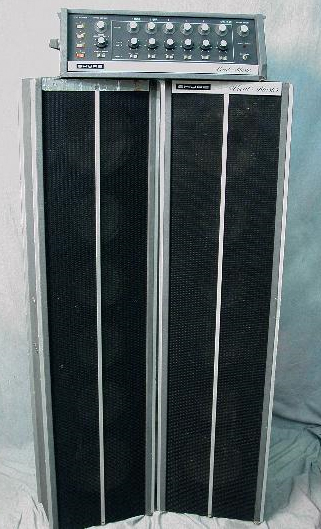
The "PA system" (public address) is damn near as old as me. Maybe older. When I was a kid, an auditorium PA system was often a 15W Bogen tube amp and one or two Shure Vocalmaster columns. Some folks used Shure's mixer/power amp, but anyone who did that produced awful noises that couldn't be identified as either human or musical. The PA system has grown up in the last 60 years. It hasn't become better but it's definitely louder.

When I worked for QSC Audio in the 80's and 90's, we grew from a small company that made extremely solid, dependable, and reasonably good sounding amps to a major competitor in the pro audio field. During that period, pro audio went through some changes that it is still suffering from; the smaller and lighter is better movement. To be honest, the company that started that trend in power amps was Carver; with the PM 1.5. This POS amp was hyped as being able to drive 750W per channel into a 4 ohm load and weighed 16 pounds. When it clipped, it made exploding noises that often took out drivers. When it didn't clip, it was harsh sounding. If you pushed the amp hard, it would thermal cycle or die. Regardless, because it weighed a fraction of amplifiers with similar specs (more evidence that "anyone can write a spec sheet") the sound companies loved it. At QSC, we almost went broke before a few of our old customers came back to us after their Carver experiment.

Twenty years later, the whole industry is driven by Carver-style components: amps, speakers, consoles, and most of the signal path. Amps are multi-stepped or digital and weigh less than a 1960's microphone. Speakers are arrayed and tiny and sound like rejects from the Bose consumer product line. Consoles are digital and so menu-layered that most FOH mixers set 'em and leave 'em, regardless of how godawful the show sounds.

This week, I subjected myself to another round of suffering modern sound systems to get to see an old musical hero: Steve Winwood. Winwood was the intro act for Santana and I haven't seen Steven since Traffic. Since I had comp tickets (no concert sells out in 2010), the cost of seeing Winwood was whatever I paid for parking. Supposedly, the St. Paul Xcel Center is a great sounding room. I hoped that would be so for this show. It wasn't. As usual, the arrayed cluster-fuck of tiny horn boxes was tasked with the impossible duty of providing reinforcement for this large hockey gym. While the designers of the Xcel Center put a lot of work into deadening the room for musical performances, nothing those designers could do could have compensated for modern array speaker systems.

As best I can tell, the contract for all R&R concerts specifies a minimum volume level for shows. Nobody apparently cares how awful it sounds, as long as it is loud. In my 50 years in audio, I have never heard anything coming from an arrayed speaker system that is anything but painful and tonally irritating. Honestly, the theory behind these systems leaves me doubting the mathematical capabilities of the designers, but the practical application proves the theories to be flawed.

For the Winwood portion of the show, the system's resonances were somewhere between painful and obscuring. There was a pile of 70-400 Hz crap that the under-capable arrays failed to produce, so the system "engineer" (using that term grossly loosely) tried to correct with his subwoofer system. If you've read my take on subwoofers, you know how I am going to feel about this tactic. Winwood's bass came from the B3 petals. A B3's bass is one of the most totally cool bottom-end instruments ever invented, but you can't reproduce it with a pile of resonant horns. The sound is too complicated, too powerful, and too characteristic for a reproduction system that turns every LF note into "whoomph." So, the bottom end of the system was a muddy mess.

Winwood's voice was pretty well matched to the rest of the system's midrange capabilities, but everything else was reduced to OEM-quality car stereo fidelity and the FOH goofball's attempt to create top end from his garbage horns was painful, at best. I suspect the FOH doofus was running the system from his laptop, because I didn't see (or hear) anyone working the mix. It could be that he was at the audiologist's office getting his hearing aid battery replaced. If so, he didn't miss much.

Santana's set was about the same, only louder. He had a light show and a video screen to compensate for the lack of a sound system, but it wasn't enough. When my hearing protection was clearly failing to provide adequate protection, we left.

As usual, the show was about 1/3 attended with a substantial number of comp tickets given way to fill some of the empty seats. A lot of people gave up late in Winwood's set and left to save their hearing. When we were left, probably mid-way through Santana's set, we weren't alone in the parking lot.

I think, if live music ever hopes to make a comeback, sound companies are going to have to give up on the fantasy that light and small and loud are more important than fidelity. I'm unconvinced that making customers suffer for musicians' "art" is a winning tactic. Most of the under-30 crowd that I know consider major concerts to be miserable experiences that they hope to avoid for the rest of their lives. I'm starting to think they are right.

Saturday, February 27, 2010

Acoustic Music Is Dead

A few weeks back, I ranted about a godawful Minnesota Orchestra pops “concert’ I suffered. This week, I recorded an electric/acoustic act that had pretensions of acoustic-ness that they didn’t bother to live up to. I mean, they didn’t attempt an acoustic sound.

Years ago, my partner and I rented out our sound company to a couple seasons of bluegrass festivals. We had a very high fidelity sound system with plenty of power to provide audio to several thousand outdoor rock and rollers and enough stage monitoring to keep most lead guitarists and screaming metal-head vocalists happy. With that capacity, we always found ourselves short on the necessary acoustic power to satisfy solo banjo pickers and the rest of the characters who qualify as “entertainers” on the bluegrass circuit.

The sound of a banjo picker whacking on the vocal mic, saying, “Can you hear this out there? I can’t hear a damn thing” still haunts my memories of doing live sound in that venue. Led Zepplin has nothing on a bluegrass quartet, when it comes to stage volume. Their hearing defect is the core to the problem with acoustic music. Fragile egos, hearing impairment, or ordinary poor taste has convinced almost every musician that deafening stage volume is a necessary component of every performance. With that as a given, delicate and sophisticated tonal character is sacrificed for the God of Gain over Feedback. A microphone doesn’t have a chance in hell of picking up a usable tone from an acoustic instrument in the midst of that atonal racket.

The problem is that tone and volume do not co-exist. Sound companies have been proving that for more than 50 years and the evidence is better today than ever. Every musician makes a choice before every performance, “Do I want to sound good or do I want to be loud?” The answer to that question goes to the heart of a musician’s reason for selecting a particular instrument, for practicing and perfecting technique, and for being a musician. The answer, too often, is the one that drives guitarists to select a pickup over a microphone or performing without amplification.
That was 30 years ago. Today, acoustic music is dead. I miss it and I doubt that it is resting in peace.

I can’t remember the last time I saw a folk, classical, or jazz solo guitarist who didn’t bring more amplification to a small club than would be needed to thoroughly overwhelm a small auditorium. Not only do they carry this crap to every living room jam session, but they feel compelled to use it.

It’s one thing to be an electric guitarist who happens to like the feel of a full-bodied acoustic instrument. It’s another thing to pretend to be an acoustic guitarist while depending on a few hundred watts to blast every audience into submission. Sometimes I suspect the real reason musicians pick acoustic instruments is that it gives them an excuse to sit while they play. It sure isn’t because they like the way an acoustic guitar sounds because nothing coming out of an overpriced faux-hi-fi amplifier supplied with the signal provided by a Mickey Mouse rubber band “guitar” pickup.

When I try to position a microphone in front of an acoustic instrument, the claim I almost always get from a guitarist, violinist, or bassist sounds a lot like, “You don’t need a microphone, my pickup sounds great.”

I can think of one instance that I found that claim to be half-true. Otherwise, I think all acoustic instrument pickups belong in rock and roll bands where sound quality is the dead last show concern. They no more sound like acoustic guitars than does a Les Paul plugged directly into a console through a DI. That’s the nicest thing I can say about the lot. Most piezo pickups make an objectionable sound that only a deaf modern musician could love. Their magnetic cousins just turn an acoustic guitar into an oversized electric.

The sound of the acoustic guitar pickup is one that I’ve been trying to find a home for in the mix for 40 years. Usually, the best thing that can be done for that tone is to treat it like a jazz guitar and bury it in delays, chorus, and behind every other instrument in the mix. Otherwise, it just sounds like that miserable noise Al Di Meola has been making since Ovation purchased his soul.

This is coming from someone who loves acoustic guitars. A well-mic’d acoustic guitar is one of my favorite musical instruments. An acoustic guitar, left to its own devices, with no electronics between its output and my ears is up there with any musical sound made by any instrument or voice. Pickups and guitar amplifiers just don’t have anything resembling the nuance to reproduce the instrument. I hate what they do to my favorite instrument and don’t have a lot of love for musicians who can’t hear the difference.

I’m no more fond of those abominations on violins, basses, or mandolins. They are just fine on banjos because there is no way to screw up the tone of that instrument. I guess it doesn’t matter, though. Musicians don’t have the ear, patience, or audience for acoustic music in almost every venue, so let’s just agree that acoustic music is dead and quit pretending that playing something with a hollow body is in any way similar to an acoustic instrument.

Wirebender Audio Rants

Over the dozen years I taught audio engineering at Musictech College and McNally Smith College of Music, I accumulated a lot of material that might be useful to all sorts of budding audio techs and musicians. This site will include comments and questions about professional audio standards, practices, and equipment. I will add occasional product reviews with as many objective and irrational opinions as possible.