Showing posts with label microphone. Show all posts

Sunday, February 19, 2023

Kick Drums and SM58s

For the first time in a while, I “experienced” a live sound-reinforced show last Friday night. At Red Wing’s Sheldon Theater, to be specific. I’d volunteered to monitor one of the Big Turn Music Festival venue’s gate and had occasional moments to wander the theater to hear the three acts from that evening. I’m sure you wouldn’t be surprised to know I was less-than-impressed with the sound goober’s “work.” In fact, it was about as SNAFU as is typical. The goober clearly believed impressing the audience with how much bass (exclusively kick drume) he could shovel into the mix was more important than attempting a musical demonstration. Nothing new there, but it was particularly depressing with the evening’s first act, Tony Cuchetti’s band, because Tony’s powerful voice did not blend well with a kick drum-dominated mix and the other musicians in his band, including the bass player, suffered the same clueless sonic disaster.

From my perspective, if the sound is obviously “reinforced, “ the sound goober is a screwup. Obviously, there are types of music where the sound has to be reinforced because the input is garbage and must be manipulated to resemble music: DJs, too much of hip hop, most metal, and almost all of the crap that falls into today’s Top 100, for example. But music and musicians only need subtle assistance from the sound goober to carry their music into the cheap seats. Doing more than that is just a sound goober projecting his/her own insecurities, sort of like the Harley Davidson characters trying to disguise their lack of motorcycling skills with the “loud pipes save lives” nonsense.

After my Sheldon shift, I took in a couple of the other venues and, Saturday, returned to tour the lot of the bars, stores, and churches that had volunteered to be in the Big Turn. A big part of the problem with several acts I heard over the two days was the chronic poor choice of vocal mics for every kind of singer. Over the past 50 years, I haven’t been shy about voicing my opinion of Shure’s SM58 workhorse. The mic is a brick, almost impossible to damage with all sorts of abuse, but it has limited musical applications. The mic’s bandwidth, proximity problems, self-noise, and polar pattern severely limits the SM58’s practical application; especially on quality voices.

Even more confusing is the fact that most vocalists don’t seem to know or care about the damage this lowfi hammer does to their voices. (If your own tool is an SM58, every voice sounds like a nail?) Why do musicians insist on playing their own instruments through their own amplifiers while appearing to be totally indifferent to the instrument their voice passes through? It’s not like it would be complicated to simply remove the 58 from the stand, clip and all, and replace it with a more suitable mic. If the goober can’t deal with the slight (or major, in the case of a condenser) variation in microphone sensitivity, that will be the least of your problems.

The advantage a serious vocalist would have in knowing how to replace the default poor microphone choice with their own well understood and properly selected replacement would be a night-and-day difference in the performance outcome. You could defuse any objections by telling the goober, “My RE20 (for example) has, essentially, the same sensitivity as your SM58, so you won’t need to change the preamp levels. However, I would like to have the vocal EQ set flat and I have selected my own high pass filter values. Thank you.” Or, in the case of a condenser, telling the goober how much gain to take off of the pre.

You might have to actually walk to the sound board to verify the goober knows how to do those things, but it would be worth a trip. It is always a good bet to assume incompetence when it comes to sound goobers. If you are pleasantly surprised, say so. One of the reasons bottom-of-the-barrel types end up running live shows is that the job is too often thankless. If no one notices a good job, the techs who know what they’re doing end up doing something else and the ones who don’t end up wreaking every show they touch.

Friday night, the one place the 58 did an acceptable job was with the last act’s “vocalist.” He was an atonal screamer whose range began where Tony’s left off. and never approached anything resembling musical. I still couldn’t understand the lyrics, but I wasn’t particularly tempted to put much effort into that task. 

Monday, October 26, 2020

Serious Music

Back in the late 70s, I signed up for a recording seminar at the University of Iowa. Believe it or not, Iowa City, IA had a very small recording program and decent studios (primarily for classical music and the college jazz band) in the 70s. The presenter was Stephen Temmer, who must have been in his early 50's when I met him but who seemed "ancient" to me at the time (I was in my late 20's.) Temmer died in 1992 at 64, which I would probably consider "young" today. 

Mr. Temmer later became an adjunct professor at the University of Iowa, but at the time we met he was still President and owner of Gotham Audio Corporation, the only North American distributor for AKG, Neumann, Studer, EMT (plate reverbs), Lexicon, and many other things European. At the time of the course I took, Temmer was just beginning to market a collection of audio cables that he claimed were significant improvements over "ordinary wires" and we had some spirited discussions about that subject, too. 

I was at least as big an asshole then as I am now. During Temmer's introduction to the two-week-long, 8-10 hour/day course, he said something like, "We won't be discussing popular music recording in this class. Our topics will all be regarding the recording of 'serious music.'" 

I couldn't let that pass. Up my hand went and I said, "I didn't think music was a 'serious' thing. If it's not fun, it doesn't have much point does it?" I got a scowl and no reply. That was on Wednesday, the first day of class. For the next two days, Mr. Temmer pretty much ignored me. 

Luckily, the school's studio maintenance tech, Stephen Julstrom and I had hit it off pretty well, mostly talking about tape deck and console maintenance and design. The "in" with Mr. Julstrom, who was about my age (and who later became a design engineer with Shure Brothers in Chicago about the time I went to work for QSC Audio Products), provided me with some amazing opportunities including recording student classical performances and the college jazz orchestra (I still have a copy of that last one.). Unfortunately, one of the nights I'd volunteered to help Stephen record a student jazz group at a local coffee shop was the night the rest of the class went to see one of my lifelong heroes, Dizzy Gillespie, direct the UofI's big band. I've always regretted that and didn't get to see Gillespie until the early 90s in Long Beach with a small, mostly electric band. However, I got to play with some very expensive microphones that I'd only read about up to that moment and work in the college's great performance spaces using the school's very expensive equipment; although some of it was expensive, but not particularly high fidelity.

When the first weekend came, Steve Julstrom had invited Mr. Temmer and me out to his lakeside place for an afternoon barbecue. Because we were a one-vehicle family at the time, I'd taken the bus from Nebraska to Iowa City and Mr. Temmer offered to give me a ride to the lake. The school had rented a Cadillac for Mr. Temmer and I hadn't been in a new Caddy for several years. At the least, it would be a comfortable drive, even if we didn't talk much. I'd mentioned this experience in another Wirebender essay a couple of years ago, "That’s Not Serious, It’s Art." Who knows why, maybe to irritate me, maybe because it's how he always traveled by car, maybe he thought he was going to educate me, but Stephen fired up the stereo as we took off and found a classical station. When the orchestra started playing something I wish I could remember, Temmer began to wave his arms while he drove and sing along with a pretty decent voice. I watched him for a bit and about the time I started to smile at his performance, he looked at me and started laughing. We laughed together for a bit and had a great conversation about music being about "fun" and entertainment and a distraction from serious stuff and by the time we arrived at Julstrom's home we were more than acquaintances. 

The next day, Sunday, the Stephen's invited me to help record a piano-violin Bartok record with two of the school's faculty musicians and a collection of Temmer's Neumann microphones; new and historical (Including a Neumann omni that Temmer said was either "Hitler's microphone" or one like that used to record Hitler's speeches. It looked a lot like the one in this picture, as I remember. Temmer was an Austrian immigrant.) I also included several of the Audio Technica and Tascam microphones from my own collection in the recording and, later, we did a single-blind comparison of all the microphones used in this recording with the rest of the class. To Temmer's mild disappointment, the class overwhelmingly selected my Teac ME-120 condensers as their favorite in that test. The "Hitler mic" was pretty obviously lacking in high end response as the violin would often slide above the mic's capabilities far enough that it vanished in the mix. If nothing else, that proved that there are some limits to the vintage cache. 

For the next several years, any time I came upon a low-to-moderate cost microphone that I thought was either interesting or exceptional, I would write Stephen Temmer about it and, often, he'd ask to borrow it for a bit. I fell out of that habit a little before I moved to California in 1983, after my 2nd studio closed and I was convinced my life in music was all but finished. At the time, I was managing a manufacturing company building everything from high voltage inductance test equipment to the Arrakis Systems broadcast equipment. That might seem like I was still working in audio, but it didn't feel much like it. In my last few months in Omaha, massive personal turmoil pretty much squashed everything in my life but work and home. I'd been working with a friend, Mark Hartman, on jingles and pitches for commercial music, but that sort of withered away in those last months before I accepted the QSC job. 

Once in California, I was a regular member and occasional officer with the Orange County Audio Engineering Society (which no longer exists) and I bumped into Stephen at least once at the LA AES Show before he retired from and sold Gotham Audio in '85. A year or two later, I ran into him at Wes Dooley's AEA Micophones facility in Pasadena, when I was buying a couple Audio Precision test fixtures for the QSC assembly line. It still would be a few years before I started collecting and messing with microphones again, but I always clung to the idea that music wasn't a serious thing. If it's not fun for someone it's not music. I didn't see or hear from Stephen again and didn't know he'd died in 1992 until recently.

Note: Heidevolk and their one and only flash-in-the-pan semi-hit, Vulgaris Magistralis, are the poster children for my music is "fun" point. It's hard to tell from their other songs, but I can only hope these characters are posing as Viking assholes. Regardless, I love this song and it never fails to make me laugh when i hear it. I would just as soon not know anything more about the band or their opinions on "life, the universe, and everything." They might be "serous," but I think they are hilarious.

Monday, August 5, 2019

Why Your PA Will Never Beat Physics

Live sound goobers delude themselves into imagining that with enough of the right equipment they can overcome room acoustics.( As a baseline reminder, these are the same people who can’t deliver a decent mix in an outdoor environment where they have absolutely no excuse for their incompetence and performance failures.) This is one more place where not knowing the basic concepts of a profession creates gross amateurs who do far more damage than good in their existence. If fact, sound goobers are often far greater performance offenders than enhancers. (See Snarky Puppy, for example.) 

The problems with a typical performance venue is that the RT60 time (reverberant energy from the loudest point to where the reverberant energy has degraded by 60dB) is measured in, at least, substantial portions of one second (1S). Due to room resonances, the decay is not typically a nice clean exponential curve, either. In fact, due to room modes the actual decay curve can be pretty long and lumpy. So, for a simple drum beat at 120bpm, it is likely that the constant reverberant energy in the room might be within 3-6dB of the original sound source. A highly counter-intuitive fact of reverberation is that, except for room resonance variables, reverberant energy is equal everywhere in a room. If the measured reverberant energy is 90dBSPL at the back of the room, it will be very close to that at every microphone on the stage. If the sound system is delivering 125dBSPL at the room’s critical distance (where the reverberant energy and direct sound energy are equal, the “noise level” (unwanted reverberant energy) will be very near 120dBSPL everywhere in the room. 

So, keeping that fact in mind, you might realize that the sound pressure level (aka noise level) at the element of every microphone on a stage in my last example (above paragraph) will be 120dBSPL. So, to achieve any level of isolation/discrimination/intelligibility at each microphone, at least 6dB and ideally 20dB or more of signal (direct signal) will need to be delivered to the microphone. This problem is neatly, if not particularly musically, resolved with the use of direct injection (DI) boxes. There is no acceptable fix, except for atrocious microphone technique, for vocals and instruments that require a microphone. The reason musicians use microphones like the SM57/58 and its lo-fi clones is because of that instrument’s undeserved reputation for high MaxSPL capability. There is a reason that Shure does not specify a “maxSPL” value and it is not because it is a happy marketing story. The SM57, for example, is selected for close mic’ing of loud guitar amplifiers because of the additional distortion it introduces. There are many far better choices for that job if you are not looking for the distortion contribution of the microphone. In the kind of high volume environment we’re talking about in the previous paragraph, hyper-high maxSPL specifications are a must: 140dBSPL and above, for example. 

140dBSPL and above sounds like an impossible sound pressure level, but if a loud voice is typical 88dBSPL at 1 foot, every halving of that distance results in a 6dB increase in sound pressure, eight half-steps would result in a 142dBSPL at the element. Since many pop singers insist on planting their lips right on the microphone grill (even though there is typically some space between the grill and the actual element) it is not inconceivable that sound pressure levels greater than 130dB are typical. That would provide at least a 12dB signal-to-noise range for the microphone in my worst case example; assuming the microphone can function in that hostile environment. 

Signal-to-noise ratios sum exponentially, though. If you have two channels combining where each channel has a 12dB S/N ratio, combining the two channels will cost you half of your S/N ratio. If you are going for any sort of quality sound, the key will always be to drive the average sound pressure level down, not up. I suspect, if you are a typical amplified music performer you are going for something other than quality sound. What that is I can’t guess.

Thursday, August 1, 2019

Real Time with the SM58

As much as I bitch about the Shure SM58, my recent experience with that blunt instrument has been as rare as possible. I really do dislike the damn things and recent familiarity bred a whole new level of contempt. 

Last night, at the Sheldon Theater’s Open Mic I had that dreaded experience for three different performances (as a vocalist and backup singer) and was reminded of how primitive that 1966-designed mic really is. 1st, the pop filter is a joke. At distance, for example the unspecified distance used in the Shure spec shee (at left), you'd think the 58's LF response would be fairly useful for vocals. Best I can figure, that distance must be at least a foot if not a meter. Anything within a could of inches from on-axis to the 58 gets a burst of breath noise that is unlike any other microphone sold today. If you don't roll off every thing below 150Hz or even higher, plosives and breath noise will wreak any attempt at a subtle vocal. 2nd, that infamous 3-6k bump mostly emphasizes sibilance artifacts without making any useful contribution to clarity or intelligibility. 3rd, Shure doesn't spec "max SPL" for the 57/58 models for obvious reasons; it isn't nearly high enough for modern applications. Many vocalists are able to blow the 58 into gross overload, even without the lousy mic hyper-close technique required for their out-of-control stage monitor environment. Likewise, the 57 is famous for it's contribution to the distorted sound of loud electric guitar. 

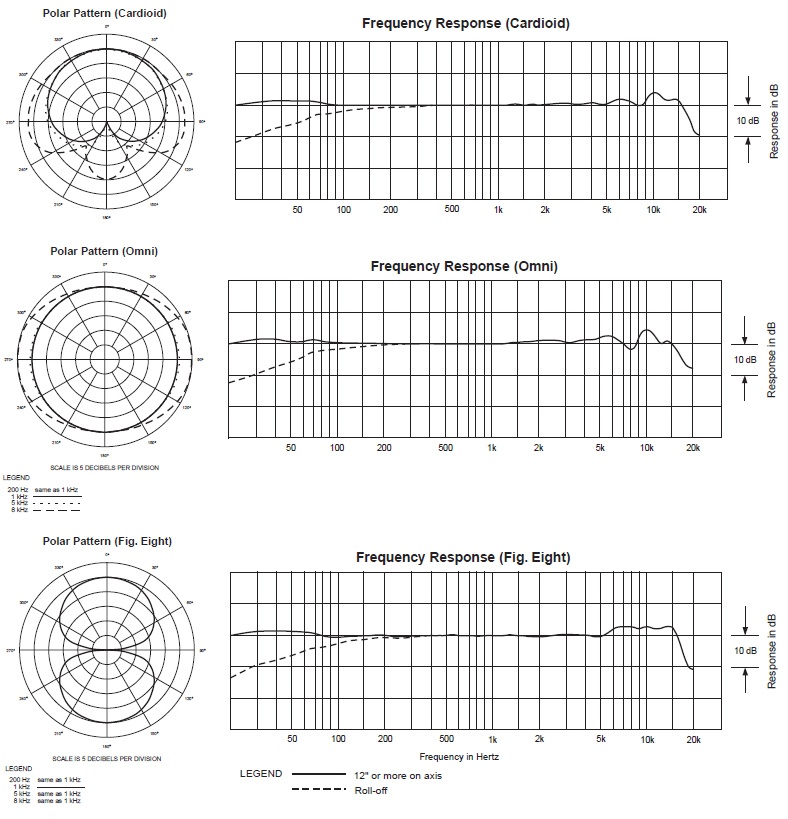
The spec sheet's description of the 57/58 polar pattern isn't anything I have ever put much faith in, either. You'd think that the damn thing was practically flat and feedback-predictable based on that highly creative illustration (see at right). In practice, that would be anything but true.

All of those 50+-year-old "qualities" have been improved upon by everyone from Shure to AT to Sennheiser to Neumann to Audix to cheap Chinese no-name microphones costing even less than the 57 or 58. You actually have to make an effort to find a microphone that delivers worse performance today and, based on what I see on live stages, that might be the only actual work many live sound goobers do.

The one and only claim to fame the 57/58 will hold maybe forever is indestructibility. If an ability to drive nails and keep squawking is the most important thing to you, you are the consummate SM58 customer. 

POSTSCRIPT:  (8/6/2019) This past week I had a double-whammy experience with the 58 vs something better. After years of wanting to see the John Mayer live "Where the Light Is" concert, I finally managed to snag a copy. It is particularly ironic to watch Mayer agonize over which multi-thousand-dollar watch to wear between sets, swap out various overpriced vintage Strats, while his voice consistently gets slaughtered by the 58 he mindlessly sings into as if it were as well-considered an instrument as his watches or guitars. Clearly, a lot of work went into cleaning up that vocal for the final product, but there is no way to make a silk purse from a sow's ear. Mayer tends toward mushmouth qualities in the studio, but live all of the worst qualities of his voice are emphasized. What a missed opportunity. 

My 2nd experience was with recording a local country/pop songwriter in a live setting that, acoustically, left a lot to be desired. Lucky for me, the artist was open to my swapping out his 58 with a recently rebuilt EV RE18. My job, post-recording, was made dramatically easier than what Chad Franscoviak and Martin Pradler had to contend with on the Mayer live recording. Getting a clear, crisp sound from the live vocal took minimal processing and the rest of my job was working with the rhythm section and lead guitar. Regardless of the song style, tempo, arrangement complexity, or vocalist's technique, the vocal sat where it belongs at the front and center of the mix. The fact that the artist's technique is excellent didn't hurt, but the fact that I wasn't wrestling with garbage-in/garbage-out was equally huge.

Sunday, November 25, 2018

Concert Review: Crash Test Dummies at the Fitzgerald

crash test dummies 2The concert was billed as the "Crash Test Dummies: God Shuffled His Feet 25th Anniversary Tour." A better person would have known what that meant, but I was mostly a first Crash Test Dummies album fan. The tour started in St. Paul with the core band of Brad Roberts, Ellen Reid, Dan Roberts, Mitch Dorge, Stuart Cameron, and Eric Paulson.

Local bar solo act, Paul Metsa, was the opener. He was as surprised to be there on the Fitz stage as we were to see him there. He didn’t even manage to get the performance up on his webpage retroactively. He had moments of ok-ness and talked way more than he played, which was an odd choice since he seemed to believe he was getting a lucky showcase that night and should have used the time to demonstrate his musicianship. Ending with a patronizing version of the Star Spangled Banner was pure Toby Keith schmaltz. He was, apparently, desperate to get audience attention.

The FOH guy, as usual, was near deaf. As usual, from the start it was obvious he’d never heard an actual record and imagined that we were all just dying to hear kick drum and bass solos; especially that all-captivating territory between 15Hz and 80Hz. (Or maybe his own hearing is so damaged he needed those frequencies boosted 10-20dB to compensate.) As the night went on, the sound goof became more hearing-impaired and eventually it was difficult to even sense the existence of the vocals unless all three of the band’s singers were really wailing. That was particularly disappointing because I don’t often get to hear a singer with Brad Roberts’ mic and vocal technique. If there was ever a band that deserved to have the vocals upfront and on point, Crash Test Dummies are it.

crash test dummiesDuring the many quiet moments and, especially, when the musicians except Stuart Cameron (acoustic guitar) were absent, Roberts really knocked it out of the park. Heart of Stone” was so incredible that my wife and I simultaneously and spontaneously turned to each other and said “that was worth the price of the trip, hotel, and concert tickets.” Of course the lyrics are close to our own story, "And so now we are old, both our stories are told and we wait for the end. If you're first to go I will follow you, know that my heart will not mend. And I wish I owned a heart of stone.” Trust me, it does not read as emotionally powerful as it sounded with Roberts’ incredible voice.

As hard as he tried, the FOH goof did not destroy the evening. The musicianship was solid and the spare arrangements allowed many of the high points to fight their way through the sound system incompetence. There were few moments where the lyrics were decipherable, but when those words were either heard or memorized the whole point of this philosophical, insightful band was proven to be true. If there was a Crash Test Dummies’ song that someone didn’t hear Friday night, it was a really obscure one. I held my breath hoping to hear Superman’s Song, but not expecting it if this was really supposed to be the God Shuffled His Feet 25th Anniversary Tour. They played Superman as the end of the regular set and the last song of the encore was "Mmm Mmm Mmm Mmm" Go Figure.

There were many moments that were worth the trip to St. Paul, the hotel hassle, and even the downtown St. Paul parking hassle. It takes a lot to overcome those obstacles, but Crash Test Dummies pulled it off.

Wednesday, August 22, 2018

Worshiping Tin-Lead and other Old Bits of Junk Technology

The following is a letter I sent to TapeOp Magazine regarding a silly end rant by John Baccigaluppi about how much he loves tin-lead solder and big iron audio electronic equipment. A year ago, I took a “ghost town Detroit” photography tour and I have stuck a video of that

While it is always entertaining to hear old men (or old souls) rhapsodizing about when “spirits were brave, the stakes were high, men were real men, women were real women and small furry creatures from Alpha Centauri were real small furry creatures from Alpha Centauri,” John Baccigaluppi’s “An Endangered Species” harping about the deficits of lead-free solder was funnier than I suspect it was intended to be. Solder defects have always been a substantial part of electronic equipment failures. In the 80’s, I had a side business repairing Roland Guitar-to-MIDI converters because that company failed to anticipate the mechanical stress of their power supply components on their fragile circuit boards. In my MI equipment repair career, I would estimate that at least 75% of all electronic component failures were initiated by solder connection failures. Even the often-praised point-to-point tube circuits were known to rely on their unreliable mechanical attachment to the terminal posts because the heat from the tube circuits and the lack of flux removal caused the lead to degrade into powdery lead-oxide. As many companies demonstrated over the last century, the beauty of tin-lead solder was that any half-trained chimp could make a mediocre but hard-to-inspect solder connection, but the flaw in that technology was that the circuit designs were rarely conducive to sufficient removal of the flux residue which led to deterioration of the connections with heat, moisture, or just oxygen exposure.

Like the lovers of big iron American cars, unreliable but repairable out of necessity overweight vintage motorcycles, and lead-based ceramics, Baccigaluppi’s rhapsody for the days past when equipment failed often but could sometimes be repaired with enough effort, patience, and money is nothing new. However, those old vehicles rarely survived 50,000 miles without some sort of major overhaul and while they might have survived in a climate-controlled garage for “60 to 70 years” they were useful transportation for about three years before the cost of repair overwhelmed the cost of replacement. Today, a car that doesn’t last for at least 200,000 miles before needing major work is clearly a lemon.

Likewise, I suspect at least a few thousand “vintage” large format consoles have ended up polluting the nation’s water supply because their performance and capabilities didn’t warrant the cost of repair, let alone the real estate necessary to house that equipment. Like old cars, motorcycles, and pottery, the collector/hoarder business in audio equipment is coming to an end. Baccigaluppi asked, “how many pieces of classic recording gear have you seen in a trash dump?” Last fall, I took a “ghost town Detroit” photo tour and saw a building full of “classic recording gear” and broadcasting gear abandoned to metal scavengers in a Detroit public school building: MCI and Otari tape decks, racks of AT&T patch panels, recording and broadcast consoles, effects and signal processing gear, and piles of audio and video patch cables. The school had, supposedly, tried to find a buyer for the broadcast vocational school’s equipment, but no one was interested. So, sooner or later all of that stuff will end up in a trash dump. About a decade ago, I had the opportunity to obtain a pair of Otari consoles that had been used on the first Star Wars movie, just for the cost of getting the consoles out of a 3rd floor warehouse and finding a place to store them. No thanks. So, to the trash dump they went along with a warehouse full of 1970’s and 80’s video equipment.

Some products are worth salvaging, if just for the historical value. Most electronic products are obsolete regardless of whether that was “planned” or not. There is an educational value to repairing an old piece of gear and that shouldn’t be discounted too quickly. There are, however, good reasons why the old equipment gets discarded for the new. There is a wide line between tossing a $600-1,000 phone every year to “stay current” and spending hundreds of hours maintaining old equipment that isn’t even close to capable of performing to modern standards. I suspect the best way to decide where you draw that line is by determining what your time is worth.

Monday, May 7, 2018

When to Give Up

ev re18If you’ve followed my microphone reviews and opinions, you might know that I am a big fan of Electrovoice’s RE-18 Variable-D hand-held vocal mic. I bought my first RE18 in the 70’s, new, and I’ve owned a dozen or so since. In experiments with a variety of vocalists, I’ve found this microphone to be superior to almost every other live vocal I’ve ever used. In every area (except one), the RE18 excels: handling noise, off-axis rejection and frequency response, proximity effect control (Variable-D), max SPL, distortion, clarity, humbucking noise-rejection, and durability. The one negative, repairability, is the focus of this article.

At one time, Electrovoice offered a “lifetime warranty” on all RE series microphones. After a few years of downsizing, being aquired by a variety of conglomerates, and lowered expectations, that “lifetime” is currently being defined as a "limited lifetime warranty on the acoustic element (due to defect in materials or workmanship), defined as ten years from the last date of the products manufacture." EV seems to have “lost” all of the technical information regarding many of the company’s most respected products, including the RE18, but I suspect that mic went out of production in the late 80’s when EV had all but disappeared from professional audio. Even getting an EV tech support person to admit that the RE18 ever existed requires arm-twisting.

One of the best features of the RE18 was it’s amazing lack of handling noise. That capability as created by incorporating shock-isolation between the element and steel outer case that used butyl-rubber doughnuts and viscous damping fluid. The foam breath and pop filtering was pretty sophisticated, too. To this date, I have not been able to find anything resembling a description of the parts required to repair this shock isolation system and it’s clear that 30+ years of use or improper storage will turn all of those parts into an unrecognizable mess of disolving chemicals. The shock isolation system for my RE18 remains incapacited.

RE-18 2With the assistance of the one helpful tech service person at EV, I was able to obtain a replacement foam filter and Variable-D baffle for their current version of the RE16, but that is a long way from anything used in the original RE18 design. The RE18 used a 3-layer pop filter system, but the RE16 is just typical low density foam. The once-impervious to vocal plosives and sibilance distortion RE18 is rendered passable with the RE16 replacement material.

After decades of recommending this microphone to vocalists of all sorts, I have to give in to the facts and admit that without some sort of support from the manufacturer or someone who was once involved in the design and/or production of this wonderful microphone repairing the RE18 is no longer practical. And, except in incredibly rare instances, I think you will find that upon removing the metal screen that every RE18 is likely in desperate need of serious repair. Typically, the foam has turned to a nasty combination of dust and sticky adhesive and the rubber shock mounts are likely totally deteriorated and there is no evidence that the viscous damping fluid ever existed or any way to determine what it once looked like for the purposes of fabricating a replacement system.

The RE18 shows up often on eBay and Reverb.com; often with an asking price of $200-or-more. Knowing that the microphone is likely in an unrepairable and deteriorating condition, it makes no sense to invest that kind of money in a once-terrific instrument. I would not, under any conditions, pay more than $100 for an excellent condition RE18 and sight-unseen (and before disassembly and inspection) no more than $20 for an on-line sale. At the absolute least, ask the seller to remove the metal screen and take a picture of the foam being distorted with a finger or blunt object to determine if that material is in a state of extreme decay. Usually, when the screen is unscrewed and removed the foam will fall out in pieces and clumps of dust.

Tuesday, June 20, 2017

Telephones or High Fidelity

Written 6/20/2017

Sitting in the Chicago Amtrak station, surrounded by incomprehensible public address messages, OSHA-defying damaging noise levels from vehicles, police and Amtrak walky-talkies, people talking and shouting, and other machinery and equipment, I’m contemplating the death of the concept of high fidelity. While the bullshit end of the professional and audiophile audio industry are pretending to provide some sort of improved value from vinyl and high-def audio, 99+% of the public could not care less. It’s obvious in their everyday lives. The best evidence that a person doesn’t care about sound quality is the persistence of cellular telephones in their lives. Bandwidth-wise, a cell phone is about five generations down from 1950’s AM radio quality and not much better than an old Edison cylinder recording system. But that doesn’t seem to bother anyone. Except me, anyway.

I have friends who will speculate for hours on the fidelity difference between a half-dozen decent capacitor microphones and will carry on this conversation over a communications system that would make Patrick Stewart sound like Donald Duck. Asking for a repeat of a phrase a half-dozen times because the phone garbled that information into nonsense doesn’t bother them at all, but they pretend they can discern a 1dB difference between two microphones into a high quality preamplifier and recording system. I don’t buy it. If garbage in, garbage out doesn’t bother you on a daily basis, opining about one form of nearly perfect reproduction over another is pure self-delusion.

Fine tuned senses don’t work that way. Use ‘em or lose ‘em. Be picky (rightly) everywhere or be adult enough to admit you just don’t care.

Years ago, I changed our home telephone to a DSL-connected system from Ooma, on the advice of an engineer with whom I worked at the time and a small business man who was simply trying to save money. Immediately, I heard a dramatic improvement in sound quality over the hard line system we had previously from Comcast. Still, when I talk to many business tech or customer service or sales people, I’m impressed with how clear the audio quality is. When I get a call from an individual or, worse, a phone solicitor who is obviously on a cell phone, my first response is to hang up and see if they can call back on a better line. My second response is to downgrade my opinion of the person with whom I am having the conversation. Between the low fidelity, in the best moments, and the cut-outs, glitches, noises, and distortion during the worst, I am hard-pressed to imagine why anyone would consider a cell phone to be anything but an emergency communications device. Honestly, I’d be nervous about hoping to convey emergency information on a 911 call via cell phone, but if I’m lying in a ditch freezing to death or bleeding out, it’s probably the best I can hope for. If I’m home where I could be making the call from a decent telephone system, I can not imagine picking up a cell phone.

So, here’s my point. Pick one: your concern and obsession for high fidelity or your cell phone addiction. You can’t do both without making me laugh at your ridiculousness. If you can tolerate your cell phone, but whine about MP3 compression, you are only fooling yourself.

Wednesday, May 10, 2017

Organization? We Don’t Need No Stinkin’ Organization

I have a pair of Electro-Voice RE-18’s in the shop that need, I hope, minor repair. The RE-18 was one of the best handheld vocal microphones ever made by anyone in audio history. That’s my opinion and I’m sticking with it because I’ve owned about a dozen of these amazing tools and everyone has been terrific. Every vocalist I’ve taught to use the RE-18 has taken to the microphone like it was a revelation. Every FOH engineer I’ve convinced to try the RE-18 has fallen in love with the mics. Obviously, the RE-18 was doomed to failure in an industry where the SM58 is considered “good enough” when it is obviously barely competent as a talkback mic or a taxi company dispatcher’s desk mike.

When I wrote EV’s misnamed “Technical Services” about obtaining repair parts for the RE-18, the response was, “Unfortunately, we no longer have parts or service to support this series." Although this was a very good mic it was discontinued around 1990.” I, of course, knew all of that except for the non-existent parts supply and EV’s arbitrary decision to discontinue their lifetime warranty, “Also, these microphones are guaranteed without time limit against malfunction in the acoustic system due to defects in workmanship and material.” [Words taken right from the RE-18’s Product Manual.] That warranty was one of the reasons EV was able to ask a premium price on all of the RE Series microphones: $350 back when an SM58 had a street price of $75. Bosch, a German company, has no clue how to deal with customer service, manage quality, or produce a competent product: a typical condition for German companies. Nothing new here. If a German company didn’t totally hose up customer service functions, I’d be suspecting someone else actually owned the company.

EV does, however, still make and sell the RE-16. Many of the RE-16;s parts are identical or close enough for practical purposes. After going around via email with the “we no longer have parts or service” Tech Service guy, I called Tech Services today. Same song and dance, except this guy knew he didn’t know much and really, really wanted to transfer me to “Parts.” Usually, I have had to go through Tech Service to get part numbers and/or assembly drawings. At EV/Bosch, Tech Service has none of that. In fact, I have to wonder what technical services Tech Services can provide without actual product information at hand.

Lucky for me, the woman who answered the parts call was, essentially, an actual Tech Services technician. We quickly identified the parts I wanted to buy, she priced them, she told me when I’d receive those parts (about 14 days), and took my order.

ev-re20-service-manual-coverAll of this hassle could have been easily resolved with a simple parts manual/service data sheet, like the one that is well-distributed and easily found for the RE-20. The fact that this information doesn’t seem to be even in-house at EV/Bosch is disturbing. A lot of companies seem to think manufacturing or service information is “proprietary” information. That philosophy is excessively customer-hostile and leads the company down a path of becoming known for lowered capabilities and lowered expectations from customers turns into lower performance. That results in lower price points because customers assume the company’s products are poor quality, poorly designed, poorly supported, and incompetently represented at all ends of the product chain. That is certainly what has happened to EV over the last 40 years. From a well-known, often used microphone supplier and technical resource in the early days through the 70’s, EV has slowly become a second tier company, mostly known for cheap knock-off microphones and with no real presence in the condenser market at all. In fact, the RE-20 is probably the company’s only well known, well respected microphone. That seems like a pretty serious problem.

Sunday, April 9, 2017

More Me!

One of the great curses of being on the providing end of everything in audio from live sound to recording engineering is the “I need more of me syndrome.” Even in the recording studio, the concept of serving the music is a vanishing idea. Everyone who has a place at the table, regardless of how insignificant, feels the need to be treated like a star.

For example, out of the insanity of the moment I recent volunteered (for the third mindless time) to be “production manager” for a local college’s annual variety show. This isn’t even a music school, but a technical college that has one of the country’s rare and precious musical instrument and repair programs. While many of the students are extremely talented musicians and a few are even composers, arrangers, and one-time music program students, very few are planning any sort of career as performers. The show is a wild mix of everything from classical woodwind and horn groups to singer-songerwritters to large horn bands with a full rhythm section. There is about 3-5 minutes of setup time allowed between acts and often that will involve tearing down a set with a dozen chairs and music stands, moving a few large instruments (piano, drum kit), and setting up microphones. To put it mildly, there isn’t any time for either precision or fine tuning, either during the sound check/rehersal or the show. The performers have a couple of months to get their act together, but the crew sees everything for the first time the afternoon of the show.

To simplify a lot of the setup, the microphone system for the show is a pair of Earthworks cardioid condensers in X/Y configuration centered downstage and many of the acts are just positioned quickly around that microphone pair. Instruments like the piano, drum kit(s), guitar, electric bass, etc often are handled with a single well-placed (hopefully) microphone. There are no stage monitors for anyone. The house speaker system has about 170o of dispersion and the house speakers are angled toward the center of the facility (don’t ask) which provides about 100% coverage to around 10kHz to the front 15’ of the stage.

Did I mention that I do this gig for free?

The sound check is performed in reverse order so we can leave the first act’s setup on the stage at the end. This year’s show, and most years are the same, the final act (first up for the sound check) was a decent sized band: three trumpets, four saxes, four trombones, three saxes, piano, drums, bass, and guitar. They made a run through their song and one of the sax players said, “I need a monitor and a mic. Traditionally, everyone on stage would have his own mic and monitor.” My response was, “’Traditionally,’ I shouldn’t have to mic or reinforce a band this big.” There were some laughs from the adults in the room, some whining from the kiddies, and we moved on. I’m always tempted to turn moments like this into teaching opportunities, but I’m trying to learn that I am not the jackass whisperer.

Did I mention that I do this gig for free?

The show went fine, I survived it. Afterwards, when I was whining to my wife about having to put up with punk kids who think they are junior college rock stars, she said, “He’s probably confusing those music stands they used to put in front of the musicians for monitors.” I really wanted to tell her she was wrong, but I half-suspect she isn’t. Holy crap! Some dumb kid thinks every guy in Tommy Dorsey’s band had a mic and a monitor? Never underestimate the stupidity of your fellow Americans; it will cost you money.

Saturday, April 8, 2017

You Think You Know What It Sounds Like?

One of the many painful things about being “experienced” (read, “old”) and having a technical background is that not that much surprises me any more. That is not a good thing, it’s not something I can brag about, it’s not something I’m happy about, it’s just a fact. Being surprised, having my stereotypes burst, learning something new and interesting is one of the joys of living. One of the things I loved about teaching music technology to “kids” who were three decades younger than me was being forced to re-evaluate my own biases and experience in a different context. Being retired deprives me of that opportunity and being more than a little disengaged from the necessity of making a living has scraped away some of the desire and requirement to compromise my own standards in the interest of “getting the job done.” When the job isn’t worth doing well, I’d just as soon avoid it altogether. 

So, when I had the opportunity to experience the value of a high quality microphone on vocals I wrote about it on a Facebook group called Move the Mics!, “I was part of an educational experiment this weekend. I ran sound for a regional bluegrass band, The High 48's, who use an AT4050 as their primary vocal mic and a collection of small and large condensers for solo instrument mics. They also have the usual SM58 at one end of the stage for introductions and a few backup vocals. When the banjo player sang or talked into the 58, he was unremarkable. When he sang or spoke into the AT4050, he was a dead ringer for Geoff Muldaur. I should note that I have always disliked the sound of 90% of most vocals through SM58's, but this was just a killer demo of why 58's should only be used to drive nails and for crappy punk vocals.”

I’m exaggerating, of course, and expecting sound geeks to get either humor or comprehend an experiment in quality evaluation is always a mistake. But I was surprised at the “loyalty” and emotion the defenders of the overused, rarely understood, and very successful Shure SM57/58. For example, “There are plenty of other mics I like better, but in a live environment, a 58 on vocals is rarely the weakest link in the chain. It's got good rejection, low handling noise, does well in wind, and is pretty hard to kill. With a little EQ, it works for almost anyone. Better mics are generally less neutral and can be quite picky about which vocalists they sound good on. If I was doing a tour for a band, I'd make sure I had everyone matched up with a great mic, but for doing random shows where you're lucky to get a sound check, a 58 is a safe bet that a good engineer can use to make just about anyone sound decent (well, a decent version of themselves). I wouldn't normally use it for vocals in a studio, but numerous great studio vocal tracks have been made with a 58 over the years, either as scratch vocals that got kept or when a vocalist insisted on holding a mic.


“If the banjo player sounded like a different person through the 58, I would have been scowling at the FOH engineer, not the mic.”


The idea that an SM58 could be EQ’d to sound like a high quality condenser microphone should be ludicrous to anyone experienced with either type of microphone. The delusion that “a 58 on vocals is rarely the weakest link in the chain” demonstrates a severe misunderstanding of the “garbage in, garbage out” concept. A quick look at the basic characteristics of the Shure SM58 should point out more than a few flaws in that claim. Add transient repsonse, noise rejection, phase accuracy, and harmonic and intermodulation distortion to the comparison and the idea that you can “fix” the differences with EQ becomes depressingly familiar.

A comparison to the characteristics of the Audio Technica AT4050 should be enlightening to an experienced, educated audio technician. In it’s worst, least accurate configuration the AT4050 delivers dramatically better frequency response, polar response, and a massively improved proximity characteristic when used at a foot or greater distance. In a group setting, this alone should be eye-opening. One of the defenders of the SM58 went on to say he’d used an SM58 in a chorus performance and it had performed “superbly.” When I expressed both doubt in his hearing and technical competence and gratitude that I hadn’t been forced (ever in my life) to make that kind of sacrifice, his response was to whine that I was jumping to conclusions without having had the pleasure of hearing the mess he’d made out of the performance. I will confess to that “crime.” I’ve heard thousands of miserable amplified live music performances and do not need any more of that kind of experience.
http://studiospares.s3.amazonaws.com/prd/401820/at4050dia.jpg
Maslow's golden hammer rule explains, "I suppose it is tempting, if the only tool you have is a hammer, to treat everything as if it were a nail." When the only microphone you know well enough to “trust” is an SM57/58 (and they are not the same hammer), every sound source has the characteristics as a nail. When your only expectation from a microphone is excessive gain-before-feedback and indestructibility, concepts like distortion, transient response, intelligibility, and accuracy are insignificant details. This is one of many reasons why live music is too often a painful and depressing experience to the few remaining people in this country who love music, know what musical instruments sound like, and would like to continue their lives with their hearing undamaged. I wish there was a fix for stupid, but unlike ignorance stupid can not be fixed.

Sunday, December 15, 2013

ARTICLE: When are the Jones’s not worth keeping up with?

[Another unpublished good idea from 1999]

So, why should I care about cheap microphones?

Over the years I’ve owned about every price range of microphone, from $5 high impedance desk mikes to $1,500 tube condensers. When I was billing for studio time, I could justify a few high-end mikes. Now that my recording habit has settled into something more resembling a hobby, I buy what works and sell what doesn’t.

In visiting several small studios over the last year or two, I've noticed that owners seem to be investing a lot of money in their board, recording system (digital or analog), their effects rack, and their studio furniture. But, when they get around to buying microphones, those tools seem to be at the tail end of the studio budget and planning. At that point, the popular choice appears to be to buy one or two really trendy and expensive mikes and enough throw-aways to cover a drum kit.

Most recording engineers have a group of standard microphones they use because every other engineer claims to use those mikes in particular situations. "U87 on voice, 421 on the kick, a 57 on the snare, and a pair of 451's on drum kit overhead" . . . and so on. If you can get that same guy behind a couple of beers and in a conversation mood, you might get a look at and a chance to listen to some of their personal favorites. Often you'll find those favorites are low cost beauties that they stumbled into when they were getting into the business and still experimenting with equipment and instruments. (An activity that often stops when the passion becomes a profession and that profession has to pay the bills.)

The expensive gear is important as part of the process of selling studio time and in creating the studio’s image as the all-knowing source of everything technical and aural. Marketing is marketing and perception is everything in that strange world. But when it’s your money and your recording, you don’t have to be so manipulative or cost ineffective. The fact is that a lot of mikes will do the job and getting a professional sound it doesn’t take any where near as much money as some people (marketing types, for example) might want you to believe.

I’m a natural born skeptic. I can’t help think that the phrase “popular wisdom” is an oxymoron.

If you're doing your own music or working on projects where the cost of your equipment won't impress the clients, I think there is a better way to spend your money. Instead of blowing the budget on one or two expensive and trendy mikes, I recommend that you collect a dozen good, but cheap, microphones. For the purpose of this article, I'm going to define "cheap" as less than $250. Sometimes, a lot less than $250.

Fifteen years ago, I attended a recording engineering seminar at the University of Iowa. This seminar was put on by the university’s music department and the lecturer was a well known and respected engineer who was also the importer of an expensive German microphone manufacturer. The class was made up of, primarily, studio-owning recording engineers with a lot of recording experience.

At the end of the week-long course, the university’s house engineer and I recorded several pieces of music with some of my favorite cheap mikes, some of the university’s mikes, and some of the instructors’ high-budget pieces. We did a decent job of presenting the microphones with a fair collection of recording situations and holding the levels and positions reasonably consistent.

The next day, we did a listening test with the rest of the class. The results were not predictable. Fifteen years ago, mid-priced microphones sold for barely above $100. Expensive mikes were about the same price as they are today. Time after time, in our single blindfolded test, the cheap microphones were picked as the class favorites over the gold-plated models.

When the listening test was over, the lecturer asked to borrow some of my mikes for a few weeks and took them back to his office for further testing. I got the mikes back a month later, but never heard what they learned from those tests.

What do you get for your money?

Ever since my first experiment in microphone comparisons, I’ve had strong suspicions that the adage “you get what you pay for” doesn’t tell much of the story. In the competitive world of professional recording studios, perception is everything; another adage that isn’t particularly informative. At $75 an hour (and up, way up), musicians and producers want to see equipment that looks more expensive than the stuff they own. As any experimenting will tell you, though, looks expensive and sounds expensive are not closely related.

All this is not to say that the cheap spread and the “gold standards” are created equal. At the most expensive end of the scale, some of what you pay for is in the hardware. Building a product with the finest switches, connectors, wiring, machine work, and components used in the electronics (condenser amplification, for example) adds a lot to the unit's manufacturing cost. That cost will be reflected in the manufacturer's retail price. Sometimes all that precision and refinement results in a more reliable product. Some companies put a lot of effort into product consistency. B&K, for example, makes precision engineering tools that just happen to be microphones. But for the majority of users, a lot of that effort doesn’t provide a lot of bang for the buck. Like musical instruments, the inconsistencies in individual microphones can result in occasional gems among the rocks.

Too many users pay for image or possible resale value. They don’t know enough about the equipment to get the most out of it and they often grossly misuse their equipment. One thing that’s common among all fine instruments is that a little abuse will go a long way toward major damage. Using a large element condenser, for example, as a kick drum mike can be a terrific way to find out what happens when those micro-thin gold plates (charged with a couple hundred volts) make contact. I’ve seen it done and, since it wasn’t my money, it was pretty fun to watch.

Putting ears to the test

With all of this in mind, I asked Michael McKern of Minneapolis’ Music Tech if he’d be willing to put up some of the school’s high-end microphones against a collection of cheap stuff. Michael took the bait, readily. He’d been thinking about doing something similar and was looking for an excuse to do a test just like this. I became an excuse.

Michael promoted the “The Cheap Mike Shootout” at the school and the local AES chapter. We hoped for as many ears as possible, but only a few hard core students made it to the event. This isn’t unusual. In my experience, a blind test will send most of the self-proclaimed golden ears running for cover. Something about not knowing the answer in advance changes a lot of attitudes towards listening tests.

It must be close to impossible to do a truly scientific microphone test. Setting all things equal is incredibly difficult. There are a variety of test protocols that you can use to do your testing and we had to pick one for our experiments.

What we decided to do was to drive four microphones at a time with the same source material. For comparison, we had an acoustic guitar, an acoustic violin, a grand piano, and male and female vocalists. We placed the microphones in a tight pattern (see picture), far enough from the sound sources that proximity variations wouldn’t affect the microphones significantly. We included at least one expensive microphone in each batch of four mikes under test, as our “reference standard.” We matched the volumes of the instruments by placing a tone generator where the instrument/voice would be. With the tone source, we calibrated the output of each microphone with a meter (sometimes to within 0.05 dBV, thanks to Michael’s persistence with the faders). After swapping out the signal generator for the musician, we recorded a few minutes of each instrument.

The following is the equipment used in our test:

Monitors (far field): JBL4312

Monitors (near field): Yamaha NS-10

Console: TAC Magnum (used for playback only)

Mike Preamp: Focusrite #1 (red)

Recording System: Sony JH-24 (analog) 24 track deck using Quantegy 456/2" tape

After recording all of the instruments and vocals, we played it all back. Comparing each of the four microphones on each performance, we voted as to which mike we thought sounded best on each performance. The actual microphone ID's were randomized during the listening tests. Michael was the only one of us who knew which channel we were listening to and he didn't know which mikes were where. It was a mild flavor of double blind testing.

We made no effort to compare microphones on similar performances. I’m not much of a believer in “aural memories.” The fairly quick comparisons we were able to make on each of our test microphones, sometimes, made it easy to determine which microphones had the best characteristics for that instrument or voice. Other times, it was incredibly difficult to make a decision.

Because of the distances we maintained from our sound sources, we were sometimes forced to choose the best out of four compromised sounds. None of the piano recordings were ideal, for example. In our effort to make sure that the four mikes got, essentially, the same source material, this seemed like a necessary sacrifice. However, some of the mikes produced such a dramatically inferior sound from the position we were in that something useful was pulled even from the least perfect experiments.

Michael’s experience is at the other end of the recording spectrum from mine. He’s done 20-plus years of high budget work with name artists and studios. Most of his work has been in the pop world (rock and blues and commercials). Most of my work has been on low budget acoustic recordings, most of it on instrumental jazz with very little post-production processing. The other listeners involved in the test had a variety of musical experience and tastes, but they all had young (undamaged by professional audio abuse) ears and their choices were more often similar to Michael’s or mine than they were different. I think we ended up with a very discriminating group. Even when I disagreed with them, I couldn’t fault the justifications for their choices.

As far as which microphones “won” most often or which microphones sounded “best” on which instruments, the results of our test are unimportant. What I believe is important is that we picked the low cost mikes as "best of group" as often, or more often, than we picked the expensive units. On some tests, there were clear “winners” and “losers.” Often, though, there were one or two mikes that were so close together than it was difficult to chose which sounded “best.” Just as often, those two mikes would be at the opposite ends of the cost spectrum.

Only for the purposes of giving you an idea of the range of microphones we used, here are the microphones we used in our test:

AKG 414

AKG C1000

Sennhauser 421

Teac M120

Audio Technica ATM813

Shure SM57

Electrovoice RE18

Electrovoice PL6

Audio Technica (unidentified model) Lavalier

It might appear that we abused on AKG as or our high-end references. High-end AKG units were what was available at the time. The two models we selected as "reference standards" are respected, quality units and have been used in thousands of excellent recordings. I’ve done this test with the other expensive German brand name and had the same results. Nothing about this test tells us that the times we preferred a $100 mike to a $1,000 mike proved that the low cost instrument was “better” than the expensive mike. It just means that the cheap mike was “different” than the expensive mike in a way that contributed to a musical sound that we liked better at that time on that instrument. Your mileage may vary.

This test was different in a lot of important ways from the kind of selection process that goes on in a studio. In the studio, you set up a mike, record a track or listen to a few minutes of real-time music, and decide to keep or change the mike. Then, you go through the same process, again. The performance is different. The position of the mike might be different. You have time invested in the change, which tends to make you want to stick with the result of that investment.

Or, you’re trying to prove how much better your favorite mike sounds and you find a way to do that by doctoring the comparison. You EQ to bring out whatever you think needs to be brought out. You add a little processing to the favorite to show how it “could sound” when it’s prepared properly. We intentionally worked at confusing such biases with our test design.

A side lesson that was learned from this four hour test was that “listening fatigue” is a real and vicious malady. I think re-listening to what we recorded over a series of days would change some of the results, but not necessarily the gist of the outcome. Some of the really close matchups might swing one way or the other, but that wouldn’t necessarily be to the advantage of the more expensive units in the test. Several of the most obvious “best mike” comparisons left out the expensive models entirely. However, by the end of the four hour marathon a lot of us were happy to have it over with, regardless of the results. That’s another thing to take into account when you’re trying to record the best possible sound; when you’re doing the final mixdown, stay fresh. Your ability to make quality judgements is inversely proportional to the time spent at the board.

How do you pick a good cheap microphone?

If you accept the premise that it’s possible to get a professional quality sound from a semi-pro priced microphone, the next step is to start looking for those hidden gems. The first thing to think about when you set out to buy a microphone (or a bunch of them) is "what do you want to do with a mike?" That probably sounds like a dumb question, but microphones have a lot of purposes and your application may be a lot different from mine. There are as many microphone personalities as there are model numbers.

For example, if you're doing a Techno record, you might be happy with just about anything that gets sound onto hard disk. I don't mean that as a knock on Tech. If you're going to process the voice or instrument into something completely different than the original acoustic sound, it doesn't make a lot of difference what it sounded like in the first place. Your microphone choices are practically unlimited.

On the other hand, if you are recording traditional instruments in a well designed acoustical environment, you will be very demanding about the accuracy of the microphones you use. You choices are more critical and limited.

While a lot of audio techies egotistically argue about the small nuances they believe they hear throughout the audio chain, just about anyone can pick out one mike from another. Like loudspeakers and other electro-mechanical devices, the "errors" in microphones are huge compared to the electronic chain.

You can look at this as a bad thing or a good thing. Since we go out of our way to buy equalization and distortion enhancing equipment, later in the signal path, I vote "good thing." In fact, I prefer to view those characteristics of microphones as pre-conditioning for the instrument, voice, or noise I'm recording.

Now, you only have to decide what kind of pre-conditioning you’re trying to buy.

Because, in a recording environment, we’re not worried about feedback we can pick from a lot wider variety of microphones than those used by live performers. Omnidirectional microphones, for instance, have almost no purpose in live music but they are often the perfect mike for recording situations. If you’re recording voice or acoustic instruments in a really terrific sounding room, you can often get an incredible sound with a well placed omni. For that purpose, I like the EV 635. Back when I first discovered this mike, they sold, new, for as little as $50. Now, it’s a popular TV mike and the price is higher, but it’s still a valuable tool for a reasonable price. My old Teac ME120’s have an omni capsule that does the same job with a little flatter frequency response. Adding omnis to your toolbox opens up a huge number of options for possible killer buys in great microphones.

Of course, omni’s are not ideal for situations where you need to get some isolation from other instruments. That’s exactly what omnis don’t do well. Cardioid and super-cardioid patterns are the hot setup for those kinds of situations. Point-and-shoot mikes, you might say. In real life, that heart-shaped polar pattern only exists for certain frequencies and that’s a big part of what makes up the characteristics of these microphones. Weirdly enough, with all the bad PR this mike gets, Shure’s SM-57 gets used in a lot of drum kits because of the consistent (meaning, “we know what to expect”) directional response the mike provides. That can’t be said for many of the high-priced, condenser standards. In my opinion, one of the silliest drum kit sounds I ever heard was produced with six microphones worth a total of about $11,000.

The other consideration you have to make is the microphone electronics. Dynamic microphones are often nearly indestructible (which is why Shure SM-57s end up in almost everyone’s collection). The down side to this durability is often a lack of sensitivity. The design of the element of a dynamic microphone can limit the mike’s ability to react accurately to high frequency, fast transient, or low amplitude sounds.

One attempt to modify the lack of sensitivity problem is the ribbon element. There are a few ribbon “studio standards” and their characteristics are worth experimenting with. They are not, however, particularly durable.

This is where condenser microphones come into our collections. Condensers are usually more sensitive and more fragile than dynamic microphones. They are often considerably more durable than ribbons. Condenser microphones need a power supply (either phantom or battery) and they have active electronics (this is where the tube vs. transistor argument begins and I go find a good cup of coffee). I’m particularly fond of condenser mikes because they specialize in doing what I like to do. It’s possible to find a reasonably priced condenser mike that can do a wide variety of jobs, either through removable capsules or switchable polarity patterns. At their best, condenser microphones can be very sensitive, accurate, and versatile.

With all the technical stuff behind us, the way to “find” a good cheap microphone is to follow your ears. Listen to it. Bring some favorite mikes along and your best headphones or near field monitors and do your own mini comparison testing. Bring a DAT or a good pro portable deck along to record your test. Don’t trust the headphones for isolation from the live sound. Don’t trust your aural memory for comparisons. If you are looking for an instrument mike, bring the instrument.

Where do you find good buys on cheap microphones?

The best place to find a rare deal on a great mike is at a great music or pro equipment store. I mean this. No sucking up intended. If you know a store that will let you go into a quiet room to do your testing or take the mike home for an evening, don’t worry about saving a few bucks on the price. These guys are your best friends. I will almost guarantee that, if you can spend the time to do quality comparison shopping, you’ll save major money with your choices.

If we’re talking going the cheap route, no one who knows me would expect me to pass up buying used. Sometimes, you can save incredible chunks of money by picking up a little known gem through the want ads or in a pawn shop. You may not find any monster bargains on Neumanns, AKGs, Telefunkens, B&Ks, or even Sennheisers, but you might escape with a killer deal on a Sony or some other lesser noticed manufacturer. Pawn shop guys must have a network that provides them with the highest possible price that a trendy mike might bring, on the best day in uptown NYC. It can be easier to get a good deal on new stuff than a beater that the dealer thinks is a collector’s item.

Most music stores don't seem to carry used mikes. I've heard at least one store owner say “used microphones are a lot like used harmonicas.” While there might be some kind of health issue involved, there are lots of ways to decontaminate materials and I think it's worth the effort[1]. However, this route has major drawbacks. You probably won’t get to do any kind of comparison testing until you get home. You won’t know if the unit even works, most likely. You might not get a guarantee that will last beyond the doors of the shop. So keep all that in mind and include possible repair costs in your offer.

For example, I paid $25 for a beater EV RE-18. It worked, but something was loose in the case. I sent it back to EV, paid another $40 for repairs and ended up with one of my favorite general purpose (live or recording) mikes for $65. The dealer wanted to tell me the mike was a $300 list price mike and ought to be worth at least $150 used, but I passed. He hung on to it for a couple of months and, finally, dumped it on me in a moment of weakness. It happens.

A few sterling examples

Without naming names and condemning the innocent, here is a short list of low-to-mid-priced microphones that I've found in a variety of studios:

Brand

Model

ElectroVoice

N/D57, N/D408A, N/D408B, 635, RE-20, RE-10, RE-16, RE-15, RE-18, RE-27N/D, PL6

Audio Technica

AT4050, AT4033, ATM15a, ATM10a, ATM31a, ATM813, ATM63

Sony

C-535P

Carvin

CM67, 68

Peavey

PVM380N

Crown

PZM, PCC-160, PCC-200

Realistic

Various PZMs (often modified for pro use)

Shure

SM-57/58, SM-33, SM-53, BETA 56, BETA 52, SM-7, SM-5B545

Beyer

M500, M160, M260. M88

This isn’t a recommendation list. It’s just a list of mikes I found on the equipment sheets of several well respected studios. There are a lot more models to choose from and nothing should keep you from making your own list.

For me, all this is one of the most interesting things about recording. Microphones are musical instruments. They’re fun to own, play with, and use. Microphone technique is a vanishing art, especially as we all go into our basements and bedrooms and leave professionally designed rooms. Learn how to pick 'em and use 'em and you will have a talent that will be reflected in your recordings.


[1] If you can safely disassemble the case without damaging the microphone, you can clean the windscreen with a mild dishwashing detergent and water. (The cleaner the water the better the cleaning job. Deioniozed water is best.) Use a toothbrush (your wife’s, not your own) on the metal parts of the grill. Don’t scrub the cloth or foam lining material, just soak them in the soapy water. Rinse thoroughly and let the mike air dry until completely dry. Replace the parts and you're done.

If you don’t feel comfortable doing all this, consider returning the microphone to the manufacturer for service. The cost should be minimal and you will get a performance test along with the cleaning.

Monday, October 28, 2013

ARTICLE: Cheap and Dirty Microphones

(Originally published in Recording Magazine, September 1999. It was considerably shorter in RM, but this is the whole submission with warts and all.)

(NOTE: The flaw in this article was that we didn't organize high priced spread comparisons and went ahead with what we had.  With that flaw, the article doesn't really make sense.  I've done the comparison in the past, and since, and the cheap stuff stood up really well.  Nuts.)

All Rights Reserved © 1998 Thomas W. Day

So, why should I care about cheap microphones?

Over the years I've owned a fairly wide price range of microphones, from $5 high impedance desk mikes to $1,500 tube condensers. When I was billing for studio time, I could justify a few high-end mikes. Now that my recording habit has settled into something more resembling a hobby, I buy what works and sell what doesn't.

In visiting several small studios over the last year or two, I've noticed that owners seem to be investing a lot of money in their board, recording system (digital or analog), their effects rack, and their studio furniture. But, when they get around to buying microphones, those tools seem to be at the tail-end of the studio budget and planning. At that point, the popular tactic appears to be to buy one or two really trendy and expensive mikes and enough throw-aways to cover a drum kit.  At an extreme, one studio owned only SM57s and 58s because they "are industry standards." 

Most recording engineers have a group of standard microphones they use because every other engineer claims to use those mikes in particular situations. "U87 on voice, 421 on the kick, a 57 on the snare, and a pair of 451's spaced over the drum kit" . . . and so on. If you can get that same guy behind a couple of beers and in a conversation mood, you might get a look at and a chance to listen to some of their personal favorites. Often you'll find those favorites are low cost beauties that they stumbled into when they were getting into the business and still experimenting with equipment and instruments. (An activity that often stops when the passion becomes a profession and that profession has to pay the bills.)

The expensive gear is important as part of the process of selling studio time and in creating the studio's image as the all-knowing source of everything technical and aural. Marketing is marketing and perception is everything in that strange world. But when it's your money and your recording, you don't have to be so manipulative or cost ineffective. The fact is that a lot of mikes will do the job and getting a professional sound it doesn't take any where near as much money as some people (marketing types, for example) might want you to believe.

I'm a natural born skeptic. I can't help think that the phrase "popular wisdom" is an oxymoron.

If you're doing your own music or working on projects where the cost of your equipment won't impress the clients, I think there is a better way to spend your money. Instead of blowing the budget on one or two expensive and trendy mikes, I recommend that you collect a dozen good, but cheap, microphones. For the purpose of this article, I'm going to define "cheap" as less than $250. Sometimes, a lot less than $250.

Fifteen years ago, I attended a recording engineering seminar at the University of Iowa. This seminar was put on by the university's music department and the lecturer was a well known and respected engineer who was also the importer of an expensive German microphone manufacturer. The class was made up of, primarily, studio-owning recording engineers with a lot of recording experience.

At the end of the week-long course, the university's house engineer and I recorded several pieces of music with some of my favorite cheap mikes, some of the university's mikes, and some of the instructors' high-budget pieces. We did a decent job of presenting the microphones with a fair collection of recording situations and holding the levels and positions reasonably consistent.

The next day, we did a listening test with the rest of the class. The results were not predictable. Fifteen years ago, mid-priced microphones sold for barely above $100. Expensive mikes were about the same price as they are today. Time after time, in our single blindfolded test, the cheap microphones were picked as the class favorites over the gold-plated models.

When the listening test was over, the lecturer asked to borrow some of my mikes for a few weeks and took them back to his office for further testing. I got the mikes back a month later, but never heard what they learned from those tests.

What do you get for your money?

Ever since my first experiment in microphone comparisons, I've had strong suspicions that the adage "you get what you pay for" doesn't tell much of the story. In the competitive world of professional recording studios, perception is everything; another adage that isn't particularly informative. At $75 an hour (and up, way up), musicians and producers want to see equipment that looks more expensive than the stuff they own. As any experimenting will tell you, though, looks expensive and sounds expensive are not closely related.

All this is not to say that the cheap spread and the "gold standards" are created equal. At the most expensive end of the scale, some of what you pay for is in the hardware. Building a product with the finest switches, connectors, wiring, machine work, and components used in the electronics (condenser amplification, for example) adds a lot to the unit's manufacturing cost. That cost will be reflected in the manufacturer's retail price. Sometimes all that precision and refinement results in a more reliable product. Some companies put a lot of effort into product consistency. B&K, for example, makes precision engineering tools that just happen to be microphones. But for the majority of users, a lot of that effort doesn't provide a lot of bang for the buck. Like musical instruments, the inconsistencies in individual microphones can result in occasional gems among the rocks.

Too many users pay for image or possible resale value. They don't know enough about the equipment to get the most out of it and they often grossly misuse their equipment. One thing that's common among all fine instruments is that a little abuse will go a long way toward major damage. Using a large element condenser, for example, as a kick drum mike can be a terrific way to find out what happens when those micro-thin gold plates (charged with a couple hundred volts) make contact. I've seen it done and, since it wasn't my money, it was pretty fun to watch.

Putting ears to the test

With all of this in mind, I asked Michael McKern of Minneapolis' Music Tech if he'd be willing to put up some of the school's high-end microphones against a collection of cheap stuff. Michael took the bait, readily. He'd been thinking about doing something similar and was looking for an excuse to do a test just like this. I became an excuse.

Michael promoted the "The Cheap Mike Shootout" at the school and the local AES chapter. We hoped for as many ears as possible, but only a few hard core students made it to the event. This isn't unusual. In my experience, a blind test will send most of the self-proclaimed golden ears running for cover. Something about not knowing the answer in advance changes a lot of attitudes towards listening tests.

It must be close to impossible to do a truly scientific microphone test. Setting all things equal is incredibly difficult. There are a variety of test protocols that you can use to do your testing and we had to pick one for our experiments.

What we decided to do was to drive four microphones at a time with the same source material. For comparison, we had an acoustic guitar, an acoustic violin, a grand piano, and male and female vocalists. We placed the microphones in a tight pattern (see picture), far enough from the sound sources that proximity variations wouldn't affect the microphones significantly. We included at least one expensive microphone in each batch of four mikes under test, as our "reference standard." We matched the volumes of the instruments by placing a tone generator where the instrument/voice would be. With the tone source, we calibrated the output of each microphone with a meter (sometimes to within 0.05 dBV, thanks to Michael's persistence with the faders). After swapping out the signal generator for the musician, we recorded a few minutes of each instrument.

The following is the equipment used in our test:

Monitors (far field): JBL4312

Monitors (near field): Yamaha NS-10

Console: TAC Magnum (used for playback only)

Mike Preamp: Focusrite #1 (red)

Recording System: Sony JH-24 (analog) 24 track deck using Quantegy 456/2" tape

After recording all of the instruments and vocals, we played it all back. Comparing each of the four microphones on each performance, we voted as to which mike we thought sounded best on each performance. The actual microphone ID's were randomized during the listening tests. Michael was the only one of us who knew which channel we were listening to and he didn't know which mikes were where. It was a mild flavor of double blind testing.

We made no effort to compare microphones on similar performances. I'm not much of a believer in "aural memories." The fairly quick comparisons we were able to make on each of our test microphones, sometimes, made it easy to determine which microphones had the best characteristics for that instrument or voice. Other times, it was incredibly difficult to make a decision.

Because of the distances we maintained from our sound sources, we were sometimes forced to choose the best out of four compromised sounds. None of the piano recordings were ideal, for example. In our effort to make sure that the four mikes got, essentially, the same source material, this seemed like a necessary sacrifice. However, some of the mikes produced such a dramatically inferior sound from the position we were in that something useful was pulled even from the least perfect experiments.

Michael's experience is at the other end of the recording spectrum from mine. He's done 20-plus years of high budget work with name artists and studios. Most of his work has been in the pop world (rock and blues and commercials). Most of my work has been on low budget acoustic recordings, most of it on instrumental jazz with very little post-production processing. The other listeners involved in the test had a variety of musical experience and tastes, but they all had young (undamaged by professional audio abuse) ears and their choices were more often similar to Michael's or mine than they were different. I think we ended up with a very discriminating group. Even when I disagreed with them, I couldn't fault the justifications for their choices.

As far as which microphones "won" most often or which microphones sounded "best" on which instruments, the results of our test are unimportant. What I believe is important is that we picked the low cost mikes as "best of group" as often, or more often, than we picked the expensive units. On some tests, there were clear "winners" and "losers." Often, though, there were one or two mikes that were so close together than it was difficult to chose which sounded "best." Just as often, those two mikes would be at the opposite ends of the cost spectrum.

Only for the purposes of giving you an idea of the range of microphones we used, here are the microphones we used in our test:

  • AKG 414ULS
  • Neumann U87
  • AKG C1000S
  • Sennheiser 421
  • Teac M120
  • Audio Technica ATM813
  • Shure SM57
  • Electrovoice RE18
  • Electrovoice PL6
  • Audio Technica (unidentified model) Lavaliere

It might appear that we abused on AKG as or our high-end references. High-end AKG units were what was available at the time. The two models we selected as "reference standards" are respected, quality units and have been used in thousands of excellent recordings. I've done this test with the other expensive German brand name and had the same results. Nothing about this test tells us that the times we preferred a $100 mike to a $1,000 mike proved that the low cost instrument was "better" than the expensive mike. It just means that the cheap mike was "different" than the expensive mike in a way that contributed to a musical sound that we liked better at that time on that instrument. Your mileage may vary.

This test was different in a lot of important ways from the kind of selection process that goes on in a studio. In the studio, you set up a mike, record a track or listen to a few minutes of real-time music, and decide to keep or change the mike. Then, you go through the same process, again. The performance is different. The position of the mike might be different. You have time invested in the change, which tends to make you want to stick with the result of that investment.

Or, you're trying to prove how much better your favorite mike sounds and you find a way to do that by doctoring the comparison. You EQ to bring out whatever you think needs to be brought out. You add a little processing to the favorite to show how it "could sound" when it's prepared properly. We intentionally worked at confusing such biases with our test design.

A side lesson that was learned from this four hour test was that "listening fatigue" is a real and vicious malady. I think re-listening to what we recorded over a series of days would change some of the results, but not necessarily the gist of the outcome. Some of the really close matchups might swing one way or the other, but that wouldn't necessarily be to the advantage of the more expensive units in the test. Several of the most obvious "best mike" comparisons left out the expensive models entirely. However, by the end of the four hour marathon a lot of us were happy to have it over with, regardless of the results. That's another thing to take into account when you're trying to record the best possible sound; when you're doing the final mixdown, stay fresh. Your ability to make quality judgments is inversely proportional to the time spent at the board.

How do you pick a good cheap microphone?

If you accept the premise that it's possible to get a professional quality sound from a semi-pro priced microphone, the next step is to start looking for those hidden gems. The first thing to think about when you set out to buy a microphone (or a bunch of them) is "what do you want to do with a mike?" That probably sounds like a dumb question, but microphones have a lot of purposes and your application may be a lot different from mine. There are as many microphone personalities as there are model numbers.

For example, if you're doing a Techno record, you might be happy with just about anything that gets sound onto hard disk. I don't mean that as a knock on Tech. If you're going to process the voice or instrument into something completely different than the original acoustic sound, it doesn't make a lot of difference what it sounded like in the first place. Your microphone choices are practically unlimited.

On the other hand, if you are recording traditional instruments in a well designed acoustical environment, you will be very demanding about the accuracy of the microphones you use. You choices are more critical and limited.

While a lot of audio techies egotistically argue about the small nuances they believe they hear throughout the audio chain, just about anyone can pick out one mike from another. Like loudspeakers and other electro-mechanical devices, the "errors" in microphones are huge compared to the electronic chain.

You can look at this as a bad thing or a good thing. Since we go out of our way to buy equalization and distortion enhancing equipment, later in the signal path, I vote "good thing." In fact, I prefer to view those characteristics of microphones as pre-conditioning for the instrument, voice, or noise I'm recording.

Now, you only have to decide what kind of pre-conditioning you're trying to buy.

Because, in a recording environment, we're not worried about feedback we can pick from a lot wider variety of microphones than those used by live performers. Omnidirectional microphones, for instance, have almost no purpose in live music but they are often the perfect mike for recording situations. If you're recording voice or acoustic instruments in a really terrific sounding room, you can often get an incredible sound with a well placed omni. For that purpose, I like the EV 635. Back when I first discovered this mike, they sold, new, for as little as $50. Now, it's a popular TV mike and the price is higher, but it's still a valuable tool for a reasonable price. My old Teac ME120's have an omni capsule that does the same job with a little flatter frequency response. Adding omnis to your toolbox opens up a huge number of options for possible killer buys in great microphones.

Of course, omni's are not ideal for situations where you need to get some isolation from other instruments. That's exactly what omnis don't do well. Cardioid and super-cardioid patterns are the hot setup for those kinds of situations. Point-and-shoot mikes, you might say. In real life, that heart-shaped polar pattern only exists for certain frequencies and that's a big part of what makes up the characteristics of these microphones. Weirdly enough, with all the bad PR this mike gets, Shure's SM-57 gets used in a lot of drum kits because of the consistent (meaning, "we know what to expect") directional response the mike provides. That can't be said for many of the high-priced, condenser standards. In my opinion, one of the silliest drum kit sounds I ever heard was produced with six microphones worth a total of about $11,000.

The other consideration you have to make is the microphone electronics. Dynamic microphones are often nearly indestructible (which is why Shure SM-57s end up in almost everyone's collection). The down side to this durability is often a lack of sensitivity. The design of the element of a dynamic microphone can limit the mike's ability to react accurately to high frequency, fast transient, or low amplitude sounds.

One attempt to modify the lack of sensitivity problem is the ribbon element. There are a few ribbon "studio standards" and their characteristics are worth experimenting with. They are not, however, particularly durable.

This is where condenser microphones come into our collections. Condensers are usually more sensitive and more fragile than dynamic microphones. They are often considerably more durable than ribbons. Condenser microphones need a power supply (either phantom or battery) and they have active electronics (this is where the tube vs. transistor argument begins and I go find a good cup of coffee). I'm particularly fond of condenser mikes because they specialize in doing what I like to do. It's possible to find a reasonably priced condenser mike that can do a wide variety of jobs, either through removable capsules or switchable polarity patterns. At their best, condenser microphones can be very sensitive, accurate, and versatile.

With all the technical stuff behind us, the way to "find" a good cheap microphone is to follow your ears. Listen to it. Bring some favorite mikes along and your best headphones or near field monitors and do your own mini comparison testing. Bring a DAT or a good pro portable deck along to record your test. Don't trust the headphones for isolation from the live sound. Don't trust your aural memory for comparisons. If you are looking for an instrument mike, bring the instrument.

Where do you find good buys on cheap microphones?

The best place to find a rare deal on a great mike is at a great music or pro equipment store. I mean this. No sucking up intended. If you know a store that will let you go into a quiet room to do your testing or take the mike home for an evening, don't worry about saving a few bucks on the price. These guys are your best friends. I will almost guarantee that, if you can spend the time to do quality comparison shopping, you'll save major money with your choices.

If we're talking going the cheap route, no one who knows me would expect me to pass up buying used. Sometimes, you can save incredible chunks of money by picking up a little known gem through the want ads or in a pawn shop. You may not find any monster bargains on Neumann's, AKGs, Telefunkens, B&Ks, or even Sennheisers, but you might escape with a killer deal on a Sony or some other lesser noticed manufacturer. Pawn shop guys must have a network that provides them with the highest possible price that a trendy mike might bring, on the best day in uptown NYC. It can be easier to get a good deal on new stuff than a beater that the dealer thinks is a collector's item.

Most music stores don't seem to carry used mikes. I've heard at least one store owner say "used microphones are a lot like used harmonicas." While there might be some kind of health issue involved, there are lots of ways to decontaminate materials and I think it's worth the effort. However, this route has major drawbacks. You probably won't get to do any kind of comparison testing until you get home. You won't know if the unit even works, most likely. You might not get a guarantee that will last beyond the doors of the shop. So keep all that in mind and include possible repair costs in your offer.

For example, I paid $25 for a beater EV RE-18. It worked, but something was loose in the case. I sent it back to EV, paid another $40 for repairs and ended up with one of my favorite general purpose (live or recording) mikes for $65. The dealer wanted to tell me the mike was a $300 list price mike and ought to be worth at least $150 used, but I passed. He hung on to it for a couple of months and, finally, dumped it on me in a moment of weakness. It happens.

A few sterling examples

Without naming names and condemning the innocent, here is a short list of low-to-mid-priced microphones that I've found in a variety of studios:

  • EV N/D57, N/D408A, N/D408B, 635, RE-20, RE-10, RE-16, RE-15, RE-18, RE-27N/D, PL6
  • Audio Technica AT4050, AT4033, ATM15a, ATM10a, ATM31a, ATM813, ATM63
  • Sony C-535P
  • Carvin CM67, 68
  • Peavey PVM380N
  • Crown PZM, PCC-160, PCC-200
  • Realistic Various PZMs (often modified for pro use)
  • Shure SM-57/58, SM-33, SM-53, BETA 56, BETA 52, SM-7, SM-5B545
  • Beyer M500, M160, M260. M88

This isn't a recommendation list. It's just a list of mikes I found on the equipment sheets of several well respected studios. There are a lot more models to choose from and nothing should keep you from making your own list. [In more recent years, some of these mics, especially the Beyers and Sonys, have made a price-comeback and are no longer “cheap.” In fact, I just sold my Teac ME120’s for $400 for the pair, about 4X what they cost new and 10X what they would have cost used when I wrote this article.]

For me, all this is one of the most interesting things about recording. Microphones are musical instruments. They're fun to own, play with, and use. Microphone technique is a vanishing art, especially as we all go into our basements and bedrooms and leave professionally designed rooms. Learn how to pick 'em and use 'em and you will have a talent that will be reflected in your recordings.

Wirebender Audio Rants

Over the dozen years I taught audio engineering at Musictech College and McNally Smith College of Music, I accumulated a lot of material that might be useful to all sorts of budding audio techs and musicians. This site will include comments and questions about professional audio standards, practices, and equipment. I will add occasional product reviews with as many objective and irrational opinions as possible.