Showing posts with label technology. Show all posts

Monday, April 18, 2022

Missing the Analog Point

For the last couple of days, I’ve been enjoying Short Nights of the Shadow Catcher: The Epic Life and Immortal Photographs of Edward Curtis, by Timothy Egan. It is a story about the most famous photographer of the American Indian in our history. But it is also a story about a man and his art, photography, at the beginning of that technology. When I was a kid, for a little while I was a photography geek in school. I had a few cameras, stuff that I’d found in pawn shops, from 120/620 Kodak film and a huge and beat-up Kodak Vollenda expandable camera to assorted low cost 35mm cameras. I wasn’t particularly good with the cameras (no change from today), but I was fascinated with the developing process and was fairly competent at that for a while. Music drug me away from photography pretty quickly and until digital cameras made taking pictures easy and cheap I pretty much gave up the habit.

Edward Curtis and "The North American Indian": An Exploration of Truth and  Objectivity - Photography Ethics CentreShort Nights of the Shadow Catcher has a lot of detailed descriptions of the chemistry and experimental quality of the developing process that reminded me of the analog recording processes and equipment that I grew up working with and wrestled with for more than 40 years. The book made me wonder if modern analog camera fans are as clueless about the technology they use as are modern analog recording freaks? Edward Curtis was a wizard in the darkroom, creating his own developing emulsions, processes, and creating effects with chemicals, development time and temperatures, and other techniques. His gallery in McCloud, California is a national treasure as was his art. Most modern analog photographers bypass the darkroom, for good reason. The chemicals are often toxic, at best, and the processes are tedious, hazardous, and unpredictable. Sending your roll of film into a company that owns and maintains the automated processing equipment is the surest, easiest, safest way to get pictures developed. It also eliminates at least half of the art of being a photographer.

The analog recording process, at its best, is a similar mess of technologies, lots of subjective judgement, experience, tedious technologies that require constant (expensive) maintenance, and ridiculous quantities of patience. Like analog photography, the results of all of those qualities can be emulated relatively simply and predictably with digital technologies with little-to-no downside. I am not saying that those emulations are perfect and I am absolutely not arguing that an analog master can not do things in that format that might be impossible to duplicate in the digital world. I am saying that if you aren’t a master of the technology, you’re probably bullshitting yourself if you think plowing money into obsolete equipment and media is going to magically buy you something you couldn’t do better with digital equipment.

Saturday, February 13, 2021

When Technology Becomes “Fool Friendly”

Thirty years ago (early 1992), I had just started work at my first medical devices position. One of my coworkers was the company’s brand new  IT guy, Richard, and he and I got curious about the new “World Wide Web” at about the same time. I’d been on-line with email and user groups for some time, but HTML and the web was new to both of us. The company, Telectronics Pacing Systems, was just beginning to face some of the problems that would eventually get the company regulated into history for a collection of disastrous product and engineering decisions. At the time, we were still flyin’ high and looking toward a bright future. (Hard to remember there was a time like that in the USA, isn’t it?)

As we got further into HTML, UNIX, and SQL coding, we could see that the days of these skills could be numbered in the single digits. When we first started out, to send an email message via UNIX, you first had to write an email editor with which to write the message. I had just learned how to do that bit of coding when HP-Mail, DEC’s All-in-One, and other email “clients” plus browsers like Mosaic (Netscape) came along and made many of my brand new skills obsolete.

About then, Richard said, “When the internet becomes easy for everyone to get into, it will be ruined.” What he meant was that for the time being the internet, before the WorldWideWeb, was pretty much a techie’s playground. Once browsers, email clients, and the rest of the crap that would come along to make the Internet accessible to “the common man/woman” the whole thing would turn into a clusterfuck of garbage, morons easily expressing their opinions, and lots of commerce. And he was right. That sequence of events has been true for many technical things: cars, motorcycles, synthesizers, personal computers, photography, audio and video recording and editing, and even engineering.

Jamkazam has been making fairly large strides toward creating an on-line place for musicians from all over the world to get together. The service just became fee-based, although you can experiment for a few hours each month for free. Recently, a new user went to the Facebook Jamkazam Jammers page to complain that she was unable to get “Jamkazam to work.” It turned out that she couldn’t get her Mac to work with her Presonus audio interface and, since her only reason for having an interface was to clutter up the Jamkazam fiber channels, her inability with her equipment was Jamkazam’s problem to solve. That is typical of my experience with the side-effects of dumbed-down technology. When the technology gets simple enough so that it “becomes easy for everyone to get into,” the quality, skills, commitment, and contributions of the people involved quickly drops to that common denominator. Now that on-line music is relatively simple (and getting more simple by the day), the people involved are less sophisticated, less talented, and way less capable of actually playing in a group.

There are at least a dozen groups on Facebook with clueless, talentless members claiming to be “music producers” and/or “recording engineers.” In today’s vernacular, I have no idea what a “producer” is or does. None of these people could swing a record deal if their lives and parents’ fortunes depended on it. They don’t know any actual musicians, so managing a recording date is hilariously out of their bailiwick. The first level border guard of recorded music used to be the entry fee: $100,000 14-track, 2” machines, half-million dollar consoles, multi-thousand dollar microphones, and million dollar acoustic spaces. Today, you can actually spend less than $500 and “make a record.” Most likely, that recording will suck on multiple levels, but YouTube won’t discriminate. Either will CD Baby, Tunecore, iMusician, Distrokid, or any of the other social media and on-line music distribution resources. You can be the absolute worst talent on the planet and still make a record and put it out there where people will have to step around it to avoid hearing it.

This is condition is sometimes described as the "tragedy of the commons." Wikipedia neatly defines this situation, "The tragedy of the commons describes a situation in economic science when individual users, who have open access to a resource unhampered by shared social structures or formal rules that govern access and use, act independently according to their own self-interest and, contrary to the common good of all users, cause depletion of the resource through their uncoordinated action."  The long, but detailed, way of saying, “When the internet (or anything) becomes easy for everyone to get into, it will be ruined.”

In manufacturing, quality and manufacturing engineers have a saying, “The only way to foolproof a system is to get the fools out of the system.” When it comes to systems like the internet, music, and art the fools rush in so fast and get so deep into the structure that there is no turning back.

Tuesday, October 29, 2019

Intermittents and Typical Repairs

A while back, a friend “gave” me a Mackie 12” TH-12A powered stage monitor when he was clearing out his shop of things he either didn’t want or didn’t want to spend time trying to fix. I have no reason to want a powered stage monitor, but for whatever reason I decided I wanted to take a crack at seeing if I could fix the monitor. I like Mackie gear and when it breaks unreasonably easily, I get curious. The symptom was “no power indicator or output.” Supposedly, someone renting the speaker had dropped it and it didn’t power up after that incident. My friend had already made a quick attempt at troubleshooting the speaker and confirmed the reported symptom. 

Because of the previous repair, the amp panel had already been removed from the speaker box and the wiring disconnected. My first suspicion is always “connectors and solder connections.” To remove the first likely candidate, I always check the connectors, physically, and clean the connections. A smarter person would re-connect the amp to the speakers and confirm the initial diagnosis, but I wasn’t doing this for money and I didn’t really care if the solution turned out to be overly simple. I was back in my teenage mode of just wanting to see how the product was assembled and looking at the thing out of curiosity, first, and problem-solving, second. There are advantages to being less-than-meticulous about documenting an organized repair. The first of those advantages is that I spend more effort exploring, examining, and learning than I do ticking off boxes and accounting for my time. 

A disadvantage to this process is that it is entirely possible to trip an intermittent fault back into operation and I wouldn’t know that I’d even passed over the intermittent. In my experience, at least 50% of the electronic problems I’ve been asked to troubleshoot are intermittent, which is the nature of connectors and solder connection failures. They rarely outright fail, unless there is enough current in the area of the fault to cause complete failure by burning, arcing, or in-rush current causing damage to other related components. 

What I found during my inspection was that several of the Molex connectors (see red circled connectors in the picture at right) had received enough tension from their attached wires to pull the male base up along the length of the pins; possibly removing contact from the female socket. That isn’t a problem you’d expect to see in a typical application, but Mackie had cut the speaker wires short enough that there was no strain relief possible and the weight of the wire put some strain on the connectors. One of the first things I noticed in inspecting the power amp board was that the woofer male base had slid more than half-way up the pins. Looking around the boards, I found at least two more connectors with a similar appearance. 

With that background, I disconnected, one-at-a-time, all of the Molex connectors, pressed the male header firmly against the PCB, cleaned the connectors with Caig DeoxIT, reassembled the male and female connectors, and glued the connectors to each other and the PCB with a latex adhesive. After cleaning and reattaching all of the Mackie’s connectors, I power up the speaker and found that it worked. I let the adhesive cure for a few hours and gave the amp some signal while tapping all over the amp and power supply assemble looking for intermittent operation. Not finding any evidence of intermittent operation, I “burned it in” for several hours at a variety of volume levels. With some confidence that I’d found the problem, I gave the speaker back to its owner. 

This kind of repair reminds me of the many things that were always frustrating as a repair tech. First, troubleshooting intermittent failures is miserable work. When you are "finished," at best you feel you've done everything you could to be certain you've fixed the problem(s), but you are never even close to 100% confident. Intermittent faults have a Murphy's Law mind of their own. I used to joke that about half of the problems I'd been called in to repair "fixed themselves the moment they saw a toolbox." Of course, half of that half were user error issues that often cleared themselves up before or immediately after I arrived. That kind of repair is really difficult to convince customers that my time still needed to be paid for. 

Early on in the last version of Wirebender Audio Services, I quit taking telephone calls for service work because a few customers would pretend they didn't know who called me, when the problem "fixed itself." A few of those customers learned that I never forget being stiffed and whined like spoiled children when they learned that under no circumstances would I ever do work for them again. In the case of the Mackie speaker repair, I have a couple other ideas to chase down if the intermittent operation comes back to haunt me, but since I didn't have an associated bill with the original repair I can be fairly relaxed about the whole affair. 

Monday, August 12, 2019

Where Did You Come From?

Kids in class who have an over-inflated sense of their self-awareness and experience remind me that, someday, there will be a payback and it will be a bitch.

Not that many years ago, my author-music-reviewer-daughter Holly, wrote a review of Bad Plus that included some pretty silly proclamations about the gap between her music knowledge and appreciation and mine. I was entertained. In a similar conversation earlier, she had said, "Dad, I'm a music reviewer" as a statement of superior expertise when we had a disagreement about what qualified as ‘good music” and what didn’t. There are few things on the planet musicians or artists of any sort despise and ignore more than reviewers.

Our other daughter once told me that "It is great being in a family that is so musical," in reference to her husband's family who are dedicated karaoke fans. My kids grew up in a house full of musical instruments, musicians, recording and live sound equipment, and with music of some sort happening all the time, but somehow none of that registered. With all of that background, the first time she held a cheap microphone and sang along with canned muzak in front of a crowd of drunks in a karaoke bar was her first “real musical experience.”

Holly's son is now 22 and is convinced that none of the adults in his family know squat about music. Holly has written one of the biggest selling music theory books ever, The Dummies Guide to Music Theory, and gets a buttload of free CDs in the mail every month from her history as a music reviewer. Not a credential in her son’s mind, because . . . I don’t know what. When I was paging through the weirdly disorganized music list on my car stereo, he had to ask, “Why do you have all of that crap in with your music?” I don’t even want to know what he calls “crap.” He is his mother’s son, with even sillier tastes, and my interest in educating or even talking about music with non-musicians is vanishing into nothingness.

No matter what you have done, your kids will think you have done nothing. Tony Hawk’s kids, apparently, think he is a loser. Of course, most likely the only thing Tony Hawk’s kids will be ever be known for is being Tony Hawk’s kids. So, there is that.

Saturday, November 17, 2018

An Acoustic Guitar Experiment

acoustic guitarOne of many irritants about getting old has been circulation issues. I sleep with at least one half of my body tingling from lack of circulation regardless of which side I sleep on, bed softness or hardness (although, hard is better), sleep position (although after being married for 51 years I am “trained” not to sleep on my back), pills, or anything else I’ve tried. Playing guitar is one more place where my poor technique has turned into a minor medical issue. Like many non-classical guitarists, I “rest” my right arm on the edge of the lower bout. For 50-some years, that hasn’t been a problem for anything but the limitations in speed and technique it causes (which are substantial, I know, Scott). This last couple of years, it has begun to cause another problem. After a few minutes of playing or practice, my wrist, hand, and fingers begin to tingle and will eventually get numb feeling from the lack of circulation caused by that pressure on the edge on the blood vessels of my inner arm.

A few months back, I saw Brian Stewart—music store owner and guitar builder/technician extraordinaire—working on an arm rest for one of his customers. I wondered if that device might help with my circulation problem? So, I built one.

Saturday morning at the TreeStrings morning jam, I tried it out. For the most part, it worked pretty well. Brian and I talked about his design verses mine and we had some other ideas as to how this might become an actual product (which he really doesn’t want to build) and I thought about some of those changes while I played this morning. I wish I’d taken a picture of my original design, if for no other reason than to show the evolution of the idea and because I thought the original piece was really pretty. It did cover more of the top than necessary and was heavier than necessary, too. To keep from having to split another piece of walnut to start from scratch, I decided to hack away at my original piece. Might have been a mistake.  

When I got back home, I took that first attempt down to my basement shop and started carving it down to about half of the original width. I smoothed out the bandsaw cuts, sanded the piece back to a beautiful gunstock satin, and tried it again. This time it wasn’t nearly as comfortable as my original design and that was a huge disappointment. So, I reshaped the top side, losing about 1/3 of the total thickness and creating a little more of a flat spot on top while keeping the soft edge I’d originally designed. I refinished that work and reattached the piece. For the initial experiments, I’m using fairly weak double-sided tape to hold the piece in place, but when I decide I’m happy with it I’ll use something more aggressive.

One of the things I did not expect to happen was for the guitar’s tone and output to change for the better. If you look at that guitar-playing picture (at the top of this essay), you’ll notice that the arm damps a fair portion of the guitar top (especially true when the player is wearing long sleeve anything). I play a very small Composite Acoustics Cargo travel guitar and I’d never really thought much about how much of the guitar’s top I was sacrificing with my playing technique (I know, Scott). After listening the “with and not-with” sound of the guitar, I was interested in the concept on a whole different level. I would guess the overall volume is close to 3dBSPL louder with the arm rest in place and it is substantially more full and brighter, too. In retrospect, all of that makes perfect sense, but I hadn’t thought about it until the evidence was right there in my arms.

I will be playing with this concept a lot more in the future. For now, I’m enjoying being able to practice guitar for several hours without numbness and that irritating feeling (or lack of) that comes with circulation problems.

Monday, October 1, 2018

Overrating Repairability

1100.pdf-0Back in the mid-80’s I thought I had a small vision of the future. I imagined that there would be a much larger market for small, high fidelity, high reliability power amplifiers for the home studio market. First, I talked Pat Quilter into designing a one-rack-space Series One amplifier for that market; the QSC 1080/1100. From my own studio experience, I added a pair of headphone jacks for control room monitoring, with independent and easily replaceable limiting resistors so that two different monitor headphones could be plugged into that amp with the expectation that the acoustic output would be the same on both phones regardless of sensitivity or impedance. My contribution to the company’s documentation was the schematics that were found at the back of every owners’ manual for more than a decade. I also spec’d all of our circuit boards at 2 mil thickness to make servicing easier without causing damage to our boards during repair and to add to the durability of our products. I even argued that slotted screws were more repair-friendly than Philips screws, due to my experience working on Japanese motorcycles. (I was wrong in that argument.) 40 years ago, I was a big believer in designing field-repairable products. Today, not so much.

bad solderI have a long career in music instrument (MI) and audio equipment repair. That means, I have worked on equipment from the end of the tube design period through the 30-some years of analog equipment and discrete-to-integrated-circuit designs to today’s surface mount technology (SMT) components and our current age of equipment that is so complicated it is very nearly unrepairable for anyone but factory technicians. I have worked for several manufacturers, either as a captured employee repairing company products or as an independent tech working as an authorized service center or repairing equipment long past warranty. I’ve worked on a lot of equipment after someone else has attempted to make repairs. I’ve seen butchered single-sided printed circuit boards (PCBs), slaughtered double-sided PCBs with nonsensical jumpers scattered all over the board to bypass the wreaked traces, and point-to-point terminal strips so buried in cold solder that I needed a bottle of flux to get the solder to flow well enough to remove past repair attempts. And those messes were often created by factory authorized service center technicians and even the factory technicians! There are at least two well-known, high end Eurotrash console makers (who may or may not remain nameless) that were infamous for shipping new consoles with so many butchered and jumpered boards and wiring harnesses that we just assumed their crap would need reworking out of the crate. All of that equipment was repairable, but it needed repairing on a constant basis; rarely less than every 100 hours of use.

interstate-vw-junkyard-2016-06-10-16-05-58In fact, most of the products from our past that are “repairable” were made that way because their expected lifetime was incredibly short without occasional repairs. The old VW air-cooled motors lasted about 35,000 to 50,000 miles between major overhaul (35 for the van, 50 for the Beatle). In the good old days, an analog tape deck required recalibration with every new reel of tape and serious and expensive maintenance every two thousand hours (about 250 8-hour-days) of operation. In modern vehicles, safety features like crumple zones, air bags, ABS brakes, and other electronic-controlled features and functions limit repairability to module replacement because of their complexity and design. It’s not just the SMT components, but the incredible increase in complexity of the circuit designs that limits field repairs.

However, we’re at a point in auto manufacturing history where any vehicle that doesn’t last 200,000 miles between major service intervals is considered a lemon. Other products offer similar longevity expectations. I’m still using a 2008 Dell laptop, although it is on its 3rd keyboard (which was designed to be easily replaceable). While Millennials seem to think a cell phone is obsolete after a year or less, my flip phone has been working just fine for the last decade and it is still on the original battery. Televisions usually get replaced becauses they are “too small” or don’t have current features, not because the CRT or other tubes and components have failed. Appliances are often handed down to a home’s next owners because, on average, Americans stay in their houses fewer years than an appliance survives.

Much of what we buy today can be repaired, it just costs so little to replace it that we do that instead. Click and Clack, the guys on the old Car Talk NPR radio show once estimated that it cost an average of $600/year to maintain an old car, far less than car payments. People still buy new cars, even when their current vehicle is probably good for another decade or two. My father, on the other hand, habitually traded in his “old” Chevy at 50,000 miles because he was used to his cars falling apart about then; and losing trade-in “value.” My first decent vehicle, a 1973 Toyota Hilux pickup, lasted for 350,000 miles with a valve job at 250,000 and a rear transmission seal at 275,000 being the only significant necessary repairs. I sold it for almost exactly what I paid for it, thirty years later. Now that is both longevity and repairability, but no crumple zones, no ABS, decent fuel economy but lousy emissions, lots of vehicle noise, and not much interior comfort. My current 2008 Nissan pickup has most of the creature comforts and safety features of the best car; at least as of 2008. It is pretty servicable, too. My brother’s new Toyota coupe looks like a nightmare to service, but it has a 100,000 mile power train warranty.

Finally, while there is lots of talk about fighting the disposable product economy, there isn’t much energy going into actually doing it. Consumers are quite happy being ignorant about how practically everything they own works. I would bet that the percentage of consumers (including musicians and studio owners) who are capable of repairing even the most simple electro-mechanical problem is less than 1% and many of those would rather they didn’t need to. At some point in manufacturing history, someone asked “How many customers read our detailed owner’s manual with maintenance and service information?” When the answer came back, it was obvious that was a waste of time and effort. Soon after, someone asked, “How many customers care if a service manual is available?” That discouraging answer eliminated service manuals. As long as those kinds of questions keep getting money-saving answers, you can assume servicability will continue to vanish.

4ce1c0104f027.imageIf you really like working on old junk, there is more than enough of that crap availble out there for you to play with. Since all of the post-Boomer generations appear to be mostly bdisinterested in “vintage” crap, prices are falling and demand is vanishing. At that rate, you should be able to buy Grandpa’s muscle car for less than your father paid for it. Hurry, though. Old stuff is showing up in the dump on an accelorated schedule. Turns out, most people would rather recycle old equipment rather than wrestle with fixing it.

The other end of the decision process is function, value, and price. For the cost of a 24-track record head you can buy 24-or-more high definition preamps with a high-resolution A/D interface that will likely last for a decade or more with no maintenance required. For the repair cost of a vintage Eurotrash tube condenser microphone, you can buy a modern condenser microphone that will emulate a whole collection of vintage microphones. If that kind of analysis doesn’t convince you to reconsider tossing good money after bad, you are clearly convinced that there is something special from obsolete technology and I can’t (and wouldn’t want to) change that.

Friday, September 29, 2017

Updating the CA Story

Way back in 2014, I bought a used Composite Acoutics Cargo travel guitar. I liked it a lot then and I like it more now. Peavey bought the remnants of CA and that company appears to be purging the memory of the original company as quickly as possible. So, I thought I’d try to compile a little history while it’s still possible:

Pre-Peavey Composite Acoustics Assembly Videos

The Peavey Version

Monday, September 25, 2017

Another Brick Falls Out of the Wall

In late 1991, I left my job at QSC Audio Products and my 9 year career with that company for what turned out to be one of the dumbest career and relocation moves I could have possibly made. My tolerance for high density overpopulation and the Southern California pace had played out. A couple of QSC’s direct competitors had been trying to recruit me for a year or so and one company that was in a slightly different audio market made me an offer I decided not to refuse. That resulted in the shortest period of employment in my 55 year career; 30 days. The manufacturing leg and my office for my new employer were in Elkhart, Indiana and the headquarters were in Chicago. No decisions could be made without several meetings in the Chicago office and most decisions were undermined by the office politics that took place after I had returned to Elkhart. After what seemed like an infinite number of pointless meetings and product and production decision reversals and constantly shrinking mismanagement expectations and commitments, I began to suspect my employment with the company was a mistake. So, I expressed a little of my frustration to the CEO, “I’m surprised a $50M company has so many more financial limitations than a $25M company (my previous employer).”

He said, “What makes you think we’re a $50M company?”

“That’s what you had told me in the cover letter that came with your employment offer.”

“I guess that proves you can’t believe everything you read.”

I thought about that conversation on the way back to Elkhart, collected my test equipment and personal belongings from my office that evening, and wrote a letter of resignation that night. The next day I started shipping resumes to everyone I thought might be interested in my skills and experience, including both of those companies that had been interested before I moved to Indiana.

Within a few days, I had lined up interviews with a Bose design site in Michigan, a medical device company in Denver, Sony in San Diego, Underwriter’s Laboratory in Chicago, Audio Precision in Oregon, and Crown Audio in Elkhart, Indiana. I didn’t leave California with a lot of resources and quitting my new job on such short order meant Unemployment Insurance wasn’t an option, so time was fairly critical. I did phone and in-person interviews with UL, Bose, the Denver medical device company, and Crown by the end of my first full unemployed week. Crown called to setup a second interview for the end of the next week. Early that week, I received firm offers from the medical device company and Bose and both companies wanted a decision from me on fairly short order. For mostly personal reasons, I decided to accept the Denver offer on Thursday. I have liked Denver and loved Colorado since I was a kid. I was a little lonely and a good friend (who I would be working with) offered to put me up in his home for as long as I wanted to stay. Finally, the opportunity to work in an entirely new-to-me industry was an interesting challenge. Partially out of curiosity, I went back to Crown on Friday for the 2nd interview.

The Manufacturing Engineering Manager, whose name I have long forgotten, brought me into a fairly large corporate meeting room that was lined with poster paper full of relationships, responsibilities, activities, anticipated results and achievements, and likely advancement possibilities. Crown’s management had put more effort into my possible employment with the company than the management all of my previous 25 years of work. What followed was an interesting interview with a half-dozen managers and another half-dozen people I’d be working with or who would be working for me. I was a little more blunt and honest in my answers to their questions, since I was pretty committed to the Colorado offer I’d already conditionally accepted and to getting the hell out of Indiana (a generally low income state that could be the poster child for economical inequality). I hadn’t yet received the written details to the Colorado offer and the formal offer, so I could still change my mind without too much guilt and I could discuss the possible Crown job without feeling like I was wasting their time.

CROWN AUDIO harmon internationalOn Monday, the Denver job offer arrived in the mail with a Wednesday decision deadline. I hung on to it until a little before the end of the work day Wednesday and called to accept that job. My new employer sent a moving van for my stuff the next day and I was on the road to Denver Thursday evening. Friday night, I was camping in southern Illinois and called my wife in California to check in. She said someone from Crown had called and really wanted to talk to me, leaving a home number. It wasn’t that late, so I called the number and discovered that Crown had tried to contact me in my Elkhart apartment that afternoon to make a very generous offer of employment. I had to tell him I was “taken” and wouldn’t be coming back to Indiana any time soon. He sounded disappointed, but I had warned them my decision was time-sensitive and that there were lots of factors that would determine my next career move.

I left Indiana in mid-November and didn’t have to be at my new job until January 2 and my new employer had provided me with a signing bonus and moving allowance so I wasn’t even in much of a hurry to get to Denver. The friend I’d be staying would be available to receive the moving van, so even making sure my stuff arrived intact wasn’t pressing. I took a full month to get from Indiana to Denver and, other than a little recording engineering and occasionally music equipment repair business, I was out of audio for the next decade. I never forgot the impression Crown made with me, though. I honestly felt like I’d been working in a poorly equipped garage at QSC for the previous 9 years, Crown felt that much more substantial and organized than we’d been while I thought we were their most serious competitors.

vinAd73CrownProSo, when I read that Crown had been absorbed in 2000 by the music business’ brain-drain conglomerate, Harmon, I was both disappointed and glad I’d passed on the Crown job. Honestly, other than Crown there wasn’t much about Indiana that appealed to me. I might not have lasted long there. Harmon was purchased by Samsung Electronics last November and the writing was on the wall for Elkhart before that depressing news. This month, when I read that Crown was closing the Indiana facility doors for good and only 115 jobs were affected, I have to admit I felt more than a little sadness. When I interviewed with Crown, I’d guess the facility employed at least 500 people. More importantly, there were a lot of decent, hard-working, competent people making and designing Crown products in 1991 and I hate to think that their efforts were wasted.

dc300At one time, Crown was the only target in our sights at QSC. They were the industry leaders and everyone else was at our level or below. Go back to the late 1960’s and Crown’s DC300 solid state power amp was the only serious pro power amplifier game in town. Crown was an innovative, trustworthy, and decent American company and there is nothing good to say about the death of that sort of business. There aren’t many left and as the US continues to de-evolve into a minor 3rd world industrial power there will be a whole lot fewer in our future.

Friday, June 9, 2017

If [insert technical person’s name here] Can Do it, It Must Be Easy

One of the many entertaining aspects of a technical career is that the many mismanagement, sales, and marketing numskulls who consider themselves to be “visionary” and who couldn’t turn on a water tap without assistance are convinced that technical people are a dime a dozen. Society, in fact, makes the same general assumption; that there will always be technical people available to make things work so that the rest of the herd can go about their mindless lives thoughtlessly and without a clue of how or why anything they depend on works.

The United States, in its rush to create a royalty class, is demonstrating this in every election, in every corporate takeover, in its tax policy, and in almost ever office in the country. One of many consequences for this is that more than 50% of our university STEM graduates are non-US citizens and the overwhelming majority of those graduates plan to return to their country of origin with the skills they have attained. The US, on the other hand is cranking MBA and Finance degrees like those “skills” are actually going to be useful in some mythical, non-productive future. Better hurry, kiddies. Once the current batch of banksters have sold off the nation’s assets, there won’t be much demand for people to mismanage the country’s remaining spare change.

phdsElecting a collection of trust fund brats and hedge fund banksters guarantees at least one more generation of our best and brightest being sucked out of useful work and into “finance” and other criminal activities. Since Reagan, the country has steadily lost technical and scientific capacity and time, science, and progress wait for no one.

Looking up references for some of the points I wanted to make in this essay, I ran into a collection of alternative Google searches and links such as “STEM graduates are SOOOO arrogant” and “STEM graduates aren’t as smart as they think they are.” [Look at the chart on the left and, if you have the math skills necessary to read it, try to justify that argument.] All pretty funny, since it’s pretty well established that STEM programs are dramatically more difficult and relevant than liberal arts and STEM graduates are consistently more employable. The skills and discipline necessary to get through a typical STEM degree aren’t something you can just “pick up when you need it,” like management, accounting, or philosophy. The difference between the usual party animal degree (anything from Business to Law Enforcement to any of the dozens of programs that do not require mathematics, science, and technology as core to the degree) and a STEM degree is not just a matter of intelligence, but of time and energy commitment and competition. The rest of the world is pretty clear on this, along with US immigration policy. Try to immigrate to Canada, Australia, Europe, or any other 1st world country with your liberal arts degree as a credential: you might as well argue that your hair color matters. Offer any of those countries your technical expertise as an experienced engineer, scientist, medical doctor, or a mathematician and doors fly open.

Of course, there are “engineers” and there are engineers. When I read or hear about a 20-something electrical or mechanical engineer who can’t find employment in his/her field, my first thought is “Make something, dumbass.” The whole point in becoming an engineer is obtaining the background to become inventive, creative, and self-sufficient. Simply getting through a degree program isn’t even a serious first step in a technical life. I know of at least a half-dozen engineers who are not college graduates, even though they have made excellent incomes for a long portion of their lives employed as “engineers.” I was one, in fact. I also know of (through a son-in-law) a few college graduate engineers who work in call centers and Starbucks because the universities they attended degraded the standards necessary to get that degree so they could cling to the tuition of even the least capable students.

The funniest comments on “useless” STEM degrees comes from examples of computer science grads who can’t find work. I worked for a biomed company in the 1990’s and their biggest engineering hiring problem was finding competent software/firmware engineers. I’d just come from a company that had made some pretty large strides in audio communications software, but that company had a secret weapon: only hire programmers who can slow evidence of their accomplishments (The Microsoft Rule.) and don’t worry about their pedigree. That wasn’t an option for the medical devices company because they received some federal corporate welfare based on the “credentials” of their “research” departments. Of course, any software developer with a lick of ability would be off designing software and getting rich long before wasting time acquiring a Masters or PhD in software engineering, which left the credential addicts with slim pickin’s, in the talent territory. As you’d expect, the company’s software was buggy, slow, and insecure and those weaknesses were regularly exposed in the field. (If you think Diebold’s electronic voting machines are easy to hack, you don’t even want to think about how easy it is to hack a pacemaker or implantable defibrillator.) 

In the 13 companies and 5 industries where I spent my "career," it became more expected than surprising when some anti-technical mismanger would assume that accomplishing a technical task would be simple and quick. To the point that I have been saying, "anyone can write marketing literature or a spec sheet" for almost 40 years; because I have seen the sorts of people who get those assignments and they barely qualify as "anyone."  Marketing people mostly cut-and-paste their proposed product "definitions" from the competitions' literature and assume that they did the hard part because cutting-and-pasting is at the extreme limit of their capabilities. CEOs like to say "make it happen" because they snagged that phrase from a classic example of an inept Star Dreck mismanger who could barely figure out his captain's chair.

None of that changes the point of this rant, however. The goofy inept characters who populate business and liberal arts programs too often gravitate to the head of corporations because nothing measurable ever gets in their way. If you can’t do anything useful, it’s hard to make a mistake anyone will notice. Since crawling to the head of the class, leaving a trail of bodies and betrayal, was so easy for them, how hard can any other activity be?

Tuesday, May 16, 2017

Why Bother?

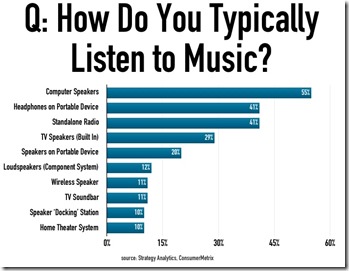
soundquality_study1If this isn’t a kick in the ears, I don’t know what is: “According to a survey conducted by Strategy Analytics, built-in computer speakers are now the most common way to listen to music, by a sizable margin.  In the study, laptop and desktop speakers overwhelmingly topped the list of frequently-used listening methods, with 55% picking the category.

“Headphones connected to a portable device followed with 41% of respondents, alongside stand-alone radio, also with 41%.  Surprisingly, TV speakers were also highly-ranked, with 29% ticking that box.”

While nothing about this information is surprising, that doesn’t keep it from being depressing. More out of habit and curiosity these days, I still read Mix Magazine, TapeOp, Recording, ProSoundWeb, and Pro Sound News. I’m mostly entertained by the seriousness audio “engineers” (an oxymoron if there ever was one) take their degraded “craft.” Almost by reflex, when I read an interview with some kid who has decided he’s the next incarnation of Tom Dowd (No, he won’t have the slightest idea who Tom Dowd was.) I chase down a few examples of the music he refers to as examples of his work. Invariably (Yes, I do know what that word means.), it will be some awful sounding collection of distortion, overused effects, trite synthesizers, and horribly recorded drums.

The critical feedback loop between musicians and their vanishing customers has been wreaked by “portable devices” and the delusional pipedream that some whackos have that high resolution audio will change any of that is nuts. I suppose I should be happy with the resurgence of vinyl, since you can’t get that shit on to a cell phone? If you know me, you know I think going back to vinyl is about as silly as abandoning cars for horses. It’s not the vinyl that matters, it’s the amplification and speaker systems, dumbasses.

webcorThis has been a long time coming. This godawful Webcor record player is pretty much what I began listening to in my audio career, way back in 1959. My father bought it for the living room, decided he didn’t like the way it looked (ours was salmon “red”) and dumped it in the basement (where I lived).

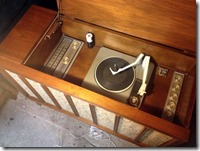
My mother had convinced him to buy an RCA console system, but he decided that took up too much room and it ended up in the basement, too. It really was pretty awful, but slightly better sounding than my Webcor. rcasteroWhen he remarried, the RCA found its way back into the living room in their new home and it remained there until they downsized after all of the kids had left home.

By then, I had long since graduated to component stereo equipment, then band sound systems, and, finally, recording studio equipment for my home audio system. Our living room system (aka “Home Theater System”) is still a decent receiver and a pair of JBL studio monitors. The down side to that is that, if I bother to listen at all carefully, it’s pretty obvious that Pandora broadcasts in a mediocre MP3 format. Usually, I’m not that focused on the music coming from the living room when I’m working in the kitchen. When I am actually critically listening, I listen to CDs. I’ll put CD quality over vinyl any day.

Too often, when someone under 30 wants to show me some music it will be demonstrated on a cell phone speaker. I have no idea what I’m supposed to get from that experience. I can usually pick out the melody and determine if it is a male or female lead voice. That’s about all I’m willing to invest in that miserable fidelity source, though, which is often disappointing to the person trying to impress me.

To be truthful, if you are a cell phone user I have to suspect you don’t care about fidelity in any form. While I haven’t had a fixed-line telephone for quite a few years, our primary telephone looks a lot like a fixed-line system. Our phone service is provided through our high-speed ISP and an Ooma Tele. The sound quality was a substantial step-up from the fixed-line system provided by Qwest and, later, Comcast in our Twin Cities home. I can, in a few moments, tell if a caller is on a cellphone because the quality is miserable. Always. My guess is if you can tolerate that level of distortion in a voice conversation you aren’t that discerning in any aspect of audio. So, while I’m not surprised that music is being listened to on actual speakers by an audience of 12%-and-shrinking I’m also not impressed by your musical tastes. Your opinion of audio quality is just going to make me laugh, so don’t waste either of our time.

Wednesday, May 10, 2017

Organization? We Don’t Need No Stinkin’ Organization

I have a pair of Electro-Voice RE-18’s in the shop that need, I hope, minor repair. The RE-18 was one of the best handheld vocal microphones ever made by anyone in audio history. That’s my opinion and I’m sticking with it because I’ve owned about a dozen of these amazing tools and everyone has been terrific. Every vocalist I’ve taught to use the RE-18 has taken to the microphone like it was a revelation. Every FOH engineer I’ve convinced to try the RE-18 has fallen in love with the mics. Obviously, the RE-18 was doomed to failure in an industry where the SM58 is considered “good enough” when it is obviously barely competent as a talkback mic or a taxi company dispatcher’s desk mike.

When I wrote EV’s misnamed “Technical Services” about obtaining repair parts for the RE-18, the response was, “Unfortunately, we no longer have parts or service to support this series." Although this was a very good mic it was discontinued around 1990.” I, of course, knew all of that except for the non-existent parts supply and EV’s arbitrary decision to discontinue their lifetime warranty, “Also, these microphones are guaranteed without time limit against malfunction in the acoustic system due to defects in workmanship and material.” [Words taken right from the RE-18’s Product Manual.] That warranty was one of the reasons EV was able to ask a premium price on all of the RE Series microphones: $350 back when an SM58 had a street price of $75. Bosch, a German company, has no clue how to deal with customer service, manage quality, or produce a competent product: a typical condition for German companies. Nothing new here. If a German company didn’t totally hose up customer service functions, I’d be suspecting someone else actually owned the company.

EV does, however, still make and sell the RE-16. Many of the RE-16;s parts are identical or close enough for practical purposes. After going around via email with the “we no longer have parts or service” Tech Service guy, I called Tech Services today. Same song and dance, except this guy knew he didn’t know much and really, really wanted to transfer me to “Parts.” Usually, I have had to go through Tech Service to get part numbers and/or assembly drawings. At EV/Bosch, Tech Service has none of that. In fact, I have to wonder what technical services Tech Services can provide without actual product information at hand.

Lucky for me, the woman who answered the parts call was, essentially, an actual Tech Services technician. We quickly identified the parts I wanted to buy, she priced them, she told me when I’d receive those parts (about 14 days), and took my order.

ev-re20-service-manual-coverAll of this hassle could have been easily resolved with a simple parts manual/service data sheet, like the one that is well-distributed and easily found for the RE-20. The fact that this information doesn’t seem to be even in-house at EV/Bosch is disturbing. A lot of companies seem to think manufacturing or service information is “proprietary” information. That philosophy is excessively customer-hostile and leads the company down a path of becoming known for lowered capabilities and lowered expectations from customers turns into lower performance. That results in lower price points because customers assume the company’s products are poor quality, poorly designed, poorly supported, and incompetently represented at all ends of the product chain. That is certainly what has happened to EV over the last 40 years. From a well-known, often used microphone supplier and technical resource in the early days through the 70’s, EV has slowly become a second tier company, mostly known for cheap knock-off microphones and with no real presence in the condenser market at all. In fact, the RE-20 is probably the company’s only well known, well respected microphone. That seems like a pretty serious problem.

Tuesday, January 10, 2017

Reflections on Guitar Building

When I started actively looking at moving, I stopped at Southeast Community Technical College to get a feel for the possibilities (for me) in that program if we moved to Red Wing. Luckily, I hit a day when David Vincent was working on course preparation and he spent a couple hours with me showing me the facilities, talking about my experiences at McNally Smith, and my experience with tools, shop equipment, and guitar repairs.

David also described the first year of classes and when he told me about “GTRB 1400 Intro to Tools,” I admit that I balked at having to take a basic hand and power tools class after a lifetime of tool-using. Since I wouldn’t be able to get in to the program for about a year, David recommended that I consider the cabinet-making class in Winona just to get my woodworking skills up a bit. So, I did. That was a pretty awful class, but it did show me how much I didn’t know about power tools I thought I was fairly familiar with.  I really didn’t want to take “Intro to Tools.” David made it clear that skipping that class wasn’t an option.

So, I signed up for all but one of the classes a first year student takes in the fall of 2015. I didn’t take the Electric Guitar Design class my first year because I wasn’t yet convinced I wanted to build an electric guitar. After three weeks of “Intro to Tools” I wasn’t convinced I was going to be building any sort of guitar. David’s class was kicking my ass. It turns out that my personal quality standards weren’t even close to good enough for a luthier.

To start, we all had a list of fairly expensive tools to buy. Four Canadian-made chisels for about $120 for the set, were on the list. You’d think that if you paid that kind of cash for a couple of pounds of steel they would come sharpened by the manufacturer. You’d be wrong. There was also a 4” plane on the list. It cost about $70 and it also needed sharpening. We spent about a week (it felt like a month) learning how to properly sharpen these tools. In the end, I was able to create an edge that would easily shave the hair off of my arm. The factory edge was far from that sort of edge.

IMG_7887For example, this sanding stick. It’s about 10” long, with a prescribed taper, different on both sides, and two different radiused sides, also prescribed by Mr. Vincent. I worked on that stick for days and, after three weeks, didn’t feel I was any closer to getting it right (+/-0.002” for all specified dimensions) than I was when I started. Everyday, for a couple of weeks, I wrestled with myself and my failure to be able to do the work to David’s standards. I was not that far from the edge of saying, “Screw this. I’m retired and I don’t need eight hours a day of failure.” Then, I got it. All of a sudden, I was not only getting the assignments but I was bringing in work from  home and doing it to my new workmanship standards.

2016 SETC Guitar Show (8)In the end, I did pretty well. I made the Dean’s list and, even more importantly, I made this guitar. Yeah, I know it’s a long ways from a Gibson Hummingbird, but it is exactly what I wanted to build, including a fairly individual semi-V shaped neck that I LOVE.

Also, I have a trio of super-sharp planes—from a 6” 1950’s Stanley to a 24” Stanley/Bailey that found in a Red Wing garage sale for $10 (with two new 7” saw blades tossed in for good measure) that I turned into a terrific manual joiner.

Occasionally, in my 68 years, I have learned things that if I’d have had them in hand when I was young would have made a world of difference in my life. This first year at Southeast Community Technical College was full of that kind of experience. I’m not kidding when I say that I think every kid who doesn’t know what he or she wants to post-high school ought to seriously consider the Southeast Tech Guitar Bulding and Repair Program. You will not be the same person after you’ve experienced the high standards this school and these instructors set for you.

Saturday, September 3, 2016

A Backward Look at the Music Industry

Lots of people are selling their insights into “the music industry” these days and, mostly, that’s because making an actual living in what’s left of that so-called industry is next-to-impossible. It always has been, so that shouldn’t surprise anyone familiar with the territory.

A Facebook discussion with a friend today reminded me of one of my many missed “opportunities” to dive into the music business face (and life) first. When I moved to California to work for QSC Audio Products as a Design/Test Engineer, leaving Nebraska required selling off almost all of my recording studio equipment, most of my musical instrument back-line, and the disposal of probably 90% of my family’s personal possessions. We were moving from a 2,200 square foot house with a full basement and double car garage to a 650 square foot apartment in Huntington Beach, California. It was a sacrifice-filled “adventure” that required all of us, including my two adolescent daughters, to give up a lot of stuff.

1983 was a seriously economically depressed time in the Rust Belt and finding technical or manufacturing work of any sort in Lincoln, Omaha, Des Moines, Kansas City, Denver, or any of the smaller Midwestern cities was unlikely. Make that doubly-unlikely in my case, since I was 35 and still going to school nights working on my Electrical Engineering degree. Thanks to an old connection, I got a few job offers from the coasts and QSC seemed like the best of the lot. In fact, for almost a decade, my jobs with QSC were close to a dream come true. I got to work closely with Patrick Quilter, one of the best, most creative engineers I’ve ever known. I was instrumental in turning a small, still mostly start-up after a decade of struggle, manufacturer into one of the first American-made quality-driven manufacturers. California still provided incredibly cheap education and actually catered to non-traditional students, so I was able to continue my pursuit of a degree and hold down a 60-80 hour/wee management job. Most of all, we built the absolute best professional power amplifiers in the world and could prove it with customer testimonials.

It’s hard to imagine now, but I was a driven, workaholic for most of my life. While I was engineering and testing products for QSC and going to school nights, I also ran a repair business that serviced much of Roland and Yamaha’s customer returns and provided equipment and studio repair services to Orange and LA counties. That business began through an AES contact, Wes Dooley, who introduced me to several studio owners and maintenance engineers at our local AES meetings. One of the techs was a young man who was the maintenance engineer for Record Plant on Third Street in LA and for a few years in Hollywood. When he was overloaded with clean-up (often vacuuming the coke out of the faders) and repair work, I occasionally filled in to help: for a price, of course.

When he decided it was time for him to crawl out of his repair shack and get a life, he let me know the Record Plant job would be open. I drove up to Hollywood to hear more about the job and, eventually, he told me it paid about $20k/year. Without overtime, that works out to about $9/hour and there would be plenty of unpaid overtime (it was a salary job). I thought he was joking, but he reminded me that he “lived” in the repair shack about 5 days out of a week and his “home” was a rented room. 

My kids were teenagers, my wife didn’t work, and my family depended on my income. Honestly, I couldn’t find any way to consider what my friend had been doing for a decade anything resembling a “career.” Today, I suspect we’d call that sort of wage-slave an “intern.” Back then, in LA, I lost about 90% of the respect I had for my friend’s job and the Record Plant in that one conversation. I have never been able to do much with the “do what you love and the money will follow” philosophy because the cost of my reality always trumped the income my dreams would produce. Getting married at 19 and becoming a father at 23 will do that for you.

As we were winding down the job conversation, my friend offered to show me the resumes from the other applicants. I expected a bunch of right-out-of-tech-school kids with no experience in audio equipment repair or use. What I saw were guys (and a couple of women) with EE degrees from schools like UCLA, Cal Tech, Georgia Tech, and other decent electrical engineering schools along with the applicant pool I had expected. There were also guys I knew from the LA AES chapter who had good jobs with manufacturing companies. Some of those guys were decent engineers, too.

Before that moment, it never occurred to me that working for a recording studio would pay that poorly. While a friend back in Omaha did the maintenance engineering job for the city’s one-and-only professional studio, Sound Recorders, and I knew he still lived with his parents, I hadn’t considered the possibility that he lived like a college kid because that’s the kind of money he was making.

Way back in the 1960’s, I had a 1959 MGA. The MGA was a dream car, until it was my responsibility to maintain it. In less than six months, that awful vehicle wiped out my fairly substantial savings and left me broke and transportation-less. I have never envied a sports car owner since. In fact, I usually pity any sports car goofball, unless he is obviously a trust-fund brat: then I’m happy for his misery and transportation disabilities. Likewise, since my moment-of-zen at the Record Plant, it’s tough for me to consider recording studio work seriously and I can’t generate any level of jealousy when it comes to working for peanuts, regardless of the work. I’ve done a lot of studio work since then, but other than my own studio maintenance business I have never considered the studio business anything but a fun hobby. Not only do I not have a trust fund to fall back on, you could burn up my entire inheritance on a decent New York restaurant in one meal for two.

A couple decades later, I made a connection with an old acquaintance, Skip Cave, from my hometown. He had wandered off to L.A. in the 60's to make his fortune as a musician after graduating high school. His aunt was married to Howard Roberts who took Skip to one of the seedy nightclubs where the jazz guys hung out. The music was amazing, as the band was the core of the famous Wreaking Crew, and the audience was filled with jazz musicians the kid knew about from his record collection. Possibly Skip's strongest memory of that place was the gist of most conversations, "Have you got a couch I can crash on tonight?" Famous jazz musicians who didn't have a place to stay or anything resembling dependable income. Skip went back home determined to look for something else to obsess on, which turned out to be electrical engineering. His obsession was a lot more focused than mine and he did really well for himself. He still plays music at a high level, in retirement, and always has a bed to sleep in.


Friday, February 12, 2016

Getting My Geek Vitamins

I’m obviously vitamin-starved. At the last Fair Trade Book Store open mic, I blew off my usual mediocre acoustic guitar piece and brought my MacBook Pro to demonstrate a vintage musical piece to the small group of musicians and musical kids. My wife warned me to “keep it short,” so I wouldn’t bore anyone (meaning her). I did my best to make it brief, but mostly what I pointed out to myself was how much I miss having a few friends to talk about recording, recording technology, and music.

For a few years, working at Musictech (then McNally Smith College of Music) was a full emersion geek-out experience. Every day, I was close to instructors and students who not only loved music but who were fascinated with the physics, electronics, acoustics, and psycho-acoustics that is core to the production of modern music in any of its forms. The geek factor slowly vanished from the school as many of the tech-intensive instructors left and were replaced by people whose claim to fame was Pro Tools expertise. I guess there is a geekiness associated with being really good with function and quick-keys, but it’s not something I care much about. You can polish turds until they shine, but they are still just little bits of crap. Without some knowledge of how the physical equipment works (microphones, preamps and signal chain, acoustics, signal processing, and human hearing), knowing how to cut up performances into well-aligned bits just isn’t very interesting.

So I retired and moved from the Twin Cities to Red Wing, where we made new friends, found more things to do than we have time to do them, and picked up some new hobbies (like guitar building and cabinet-making). It turns out that I miss some of what I lost.

25 years ago, I quit my last full-time music industry job and found work in medical devices. Admittedly, too much of my motivation was money. Eventually, it turned into lots of money. While the money was good, one of the first things I noticed about the people I worked with was “this is not my culture.” While there were a few outdoor recreation types in Engineering, most everyone in medical devices and medicine was focused on making money, getting promotions, and acquiring stuff. I could easily go for months without hearing anyone hum atonally to themselves, let alone sing or play a musical instrument. I felt a little like a Stranger in A Strange Land. Or a lot.

I guess I have to do something about that. It turns out that not working with musicians and technical people is more of a deprivation than I expected. Go figure.

Wednesday, June 26, 2013

Making Real Music

A few years ago, a good and perceptive friend remarked that a point was passed about two decades ago where (then) musicians made music and engineers tried not to screw up the performance with limited and unreliable technology and (now) musicians make limited and flawed attempts at providing aural content for the engineers to turn into music. This is not a brag, but a sad commentary on the state of what’s left of the art of making pop music.

This month’s ProSoundNews has a wonderful front page article titled, “Seeing the Small Picture” that describes the half-hearted attempts some engineers and musicians are making to reverse this disgusting trend. Some of the highlights of this excellent article from the Sound Quality Matters event described a scene where “Engineers face the same sort of conundrums. Too man options slow progress. Unfortunately, musicians know that their contributions can be endlessly finessed—by the engineer as opposed to them polishing their own performance. That knowledge multiplied by a room full of players can turn an efficient session into a quagmire of minutia. Then you add a producer who is satisfied to play with the recorded tracks ad nauseam, rather than entice the desired performance out of a human being. The same morasses of options that can drag a tracking session down apply to the mix stage as well. Particular after overdriven tracking and overdub sessions, the mix engineer can have too many details to deal with, too many tracks, too many choices and possibly tracks overproduced to the level of sterility.” Chuck Ainlay summed up the dead music problem’s solution with, “The less you do as an engineer, the better the record.” The Orson Welles/Stephen Webber comment, “The absence of limitations is the enemy of art” carries some significant impact, too.

This is not, however, the direction what passes for “recording engineer education” is taking. I have a sense that somewhere there has been an industry/academic consensus that the Eagles’ “Hotel California” is the greatest record ever produced and that “edit every syllable until the song is completely lifeless” attitude is considered state of the art. Not being any kind of Eagles fan, I missed the meeting or was not invited because I’m not a “true believer.” (The only image I pull up from hearing anything from Hotel California is Ronald Reagan and his merry band of economic and cultural bandits, so it’s not high on my list of fond aural memories.)

Debating “good music” and recording engineering philosophy with 19-year-olds is a depressing activity/occupation. These kids have grown up believing that stringing together loops in Garageband is “making music.” It’s how their heroes do it, so why shouldn’t they buy into this bullshit? I admit, I’m not a modern poetry fan and I really don’t like monotonic, monotonous, childish, whining chit-chat scored with an irritating, repetitive “beat,” so what do I know? Not much, I admit. But I’m willing to bet that this generation of “music” is going to be poorly reflected on in a couple of decades. Like the “lost generation” of No Kid’s Behind Left Untouched, this has been largely a lost generation of music; music by machines for machines.

However, if you are a recording engineer with an interest in music that actually has life, I strongly recommend you read and think about “Seeing the Small Picture.” If you are a Pro Tools certified douchebag who believes musicians are just the data source for your brilliant sonic manipulations and amazing plug-in and keystroke chops, none of this will mean anything and you should carry on with your hobby in your mom’s basement until the trust fund runs its course.


The author, Frank Wells, sums up the state of current confusion with, “Ponder how many of the recordings you love best are based on simple arrangements of honest, if imperfect, performances.” In fact, all of my favorite recordings have serious imperfections that make them as close to “perfect” as I can imagine.

Saturday, January 15, 2011

Then and Now

While suffering a 21st Century moderately high-tech DJ/VJ presentation last week, I was reminded of a similar experience from 25 years ago. Friends of my wife did a regular AV show in a small performance area in a restaurant in southern California. This was in the early days of semi-affordable video processing and one of the artists was a laser tech who did work for Disney and lots of rock bands.

For that particular show, these guys wanted to include a blast from AV's psychedelic past along with their high tech gear. So, they brought in an old fashioned overhead projector and my wife added an oil-paint-on-water component to the one large screen where all three visual artists combined their output.

The other aspect of this performance was aural. For that the "musicians" were two electronic music performers and a percussionist. The link between the three musicians was a click/sync signal provided by one of the performer's sequencer-synths that electronically tied the two synth performers together and provided the percussionist with an audible beat. In the mid-80's, SMPTE could have been used to tie it all together but the visual artists chose to make most of their component respond to the audio. The laser artist used a lot of Lissajous figures generated by some or all of the audio. By today's tech standards, this sounds pretty benign but all of the artists were pioneers in computer art technology and they all went on to be a big part of that world in the next 20 years. It was, in retrospect, a big deal. It was, in fact, a a pretty amazing event. Visually and musically it was one of the best live events I've participated in (I provided the sound for the show.).

The point of this article is that, at the end of the night, the audience was overwhelmingly interested in the sounds and sights that came from . . . the percussionist and my wife's oil-on-water work. $300k worth of lasers and $100k in cameras were grossly overshadowed by a 2nd hand public school overhead projector (slightly modified for higher output by the laser guy). A dozen synthesizers and a couple of 1980's Apple computers were put into the background by "that little Indian drum" or an ordinary drum kit. I don't mean mostly, I mean entirely. At the wrap-up party all of the tech artists complained about being relegated to being background for "prehistoric" instruments and a lady who dripped oil colors into a glass pan and swirled them with a stick.

The more recent version of this combination of visual and aural art was missing the percussionist and the old-school hippy artist and it was boring as death. What does that tell you?

Thursday, August 5, 2010

Stepping Backwards

For most of my "career," I've been driven by a corporate demand to "stay current"; to use the most up-to-date technology. I've worked for small companies and Fortune 500 corporations that had IS departments who automatically updated the software I used, regardless of security, function, or need. The school where I currently work has the same policies. Like some sort of braindead robot, I have followed suit personally.

Not any more.

My current office computer came with Win7 and Office 2007 installed. I put up with those two user-hostile programs for as long as it took to complete my 2009 taxes and a couple of pressing projects that had been held up when my last office computer died. Once those tasks were out of the way, I reformatted my OS hard drive, installed WinXP SP3 and Office 2003. I'm done with "upgrades" for the rest of my life, most likely. My production computer, a Mac PPC tower, is probably my last Mac, too. I can do anything I need to do on that machine. Apple has decided to obsolete the PPC machines and their support, so I can't upgrade my software even if I had a reason to want to upgrade my software. So, I am motivated to stick with what I have. The upside to this is I'm done spending money and have nothing left to do but do work.

Win7 wasn't terrible, but it isn't particularly compatible with Office 2003 or many of my other programs. The real reason for moving backwards was that Office 2007 is a joke. Almost every function I regularly use in MS Office has been buried in a completely obscure menu structure. I have no good reason to spend time learning a brand new software layout. The one I used for decades works fine. If MS had its head out of its ass, the company would have left users with a "classic" option. They didn't and because of that I'm more inclined to mess with a completely different program (like Open Office) rather than figure out the new organization of MS Office.

The same goes for Apple's new Intel machines. Rather than buying new, expensive equipment from a company that has a long user-hostile history, I'm tempted to build a Hackintosh and avoid Apple whenever possible. Since my PPC is working and doing the job, I'll put that off for a while but it's the logical option.

I know guys who are running productive, profitable recording studios on OS 9 machines. I know a couple of authors who write on Win for Workgroups 3.11 and make a boatload more money as authors than I'll ever approach. A fair number of authors still use Wordstar on MSDOS machines, for that matter. Upgrading isn't even a question for these people. They are too busy working. I'm going to try to follow their example.

Wirebender Audio Rants

Over the dozen years I taught audio engineering at Musictech College and McNally Smith College of Music, I accumulated a lot of material that might be useful to all sorts of budding audio techs and musicians. This site will include comments and questions about professional audio standards, practices, and equipment. I will add occasional product reviews with as many objective and irrational opinions as possible.