Showing posts with label live sound. Show all posts

Sunday, August 27, 2023

The Deaf Leading the Deaf

Because I’m a slow learner, I went to a local outdoor concert this past weekend. The headliner is a friend and I know a couple other folks who would be playing earlier in the day.Honestly, I felt a bit of an obligation to be part of the audience for their music. I know that a Red Wing, MN audience isn’t typical of pop music audiences with an average age approaching at least 70, but music “fans” of all ages are sadly similarly hearing-impaired. Depending on perspective, I was or wasn’t disappointed with the “music.”

Over the past couple of decades, I have become less inclined to suffer for someone else’s “art,” in the form of painfully loud, distorted, weirdly-mixed live music. This isn’t the first time I’ve written about this, so it might be boring. It struck me, about 3 songs into the set I’d come to see, that live music today is doomed because all ends of the people involved in production and listening are functionally deaf or, worse, don’t care about sound quality at all. My friend is a songwriter and his band is tasteful, talented, and they make an extreme effort to stay out of the vocalist’s way. The soundgoober (the man leaning on the console as if it were a drunk’s crutch) started the show with a severely distorted and loud kick drum and bass guitar blast and took 3 songs to squeeze the vocal a little way into the mix; not enough to understand the lyrics but enough to know there was a vocalist. Worse, it took him 45 minutes of “check, one, check, two” crap to do a musically pointless soundcheck, making the headline show start time 30 minutes late.

As usual, when I described my disappointment to other people who had seen the show, I was the Lone Ranger of Criticism. According to the National Institute on Deafness and Other Communication Disorders, “About 2 percent of adults aged 45 to 54 have disabling hearing loss. The rate increases to 8.5 percent for adults aged 55 to 64. Nearly 25 percent of those aged 65 to 74 and 50 percent of those who are 75 and older have disabling hearing loss.” I, personally, think that is grossly optimistic, based on my own experience with live and recorded music listeners. Back in the 80s, the Audio Engineering Society invited an otolaryngologist organization to test the Society’s convention participants on a voluntary basis. The outcome was the discovery that practically everyone involved in music recording and, especially, live music was functionally deaf. Today, most or much of the audience is equally hearing damaged. It is not even slightly odd to be in a small music venue with a band blasting deafening volume and some of the audience, even so-called critical listening reviewers, shouting “I can’t hear you!” In their arrogant, self-centered manner, they are clearly willing to damage everyone else in the room because they are disabled.

Standard NIOSH OSHACheck out these two charts, one from OSHA that was established during WWII manufacturing, and the other from NIOSH that more accurately reflects what is currently known about hearing loss from environmental “noise” (aka “music”). In some fairly progressive companies, the first numbers on either chart are used to determine when hearing protection is required for workers in those benevolent work environments. Typical amplified pop concerts subject their audiences to noise levels upwards from 115dBC, which means after about 30S of “music” you are experiencing permanent hearing damage. The music better be damned amazing to give away your hearing in exchange.

Friday, June 16, 2023

Ego Noise

This has been a week where two of my blogging interests, motorcycling and blogging, have unfortunately grown together into one large irritation. Last Monday, a parade of nitwit of bikers blubbered past our home at their usual barely-above-a-crawl speed and well-above-a-thunderstorm noise level, proving that there are more than enough reasons to defund the lazy, cowardly couch-potatoes who inhabit our local police and sheriff's departments. If you can’t identify a national, state, and local crime that produces enough noise to drown out a freight train, you are too dumb to be carrying a gun and badge and do not deserve to be wasting public funds pretending to be “law enforcement.” 

A few days later, I went to a downtown outdoor concert and was assaulted by another of the many painful, anti-musical sound systems I’ve suffered in my lifetime. I have an stock of ear plugs in the car, but I shouldn’t have to use them to protect myself in an outdoor concert that drew 75 people max. It took me a few moments to realize that it would only get worse and, as a result, my ears rang all through the next day.

A few days after that, we went to a graduation party for a friend who had been workingm part-time and nights, on her Master’s degree for the last 25 years. Her husband made the event into a “look at me” episode by playing in 3 different bands that were all so loud that nobody could carry on a conversation anywhere in the building. His wife’s celebration was turned into a “I can do stuff too” event for her husband. We all only have a wild hope that she heard, or recognized, at least a few of the many congratulations that were mimed her way.

At the first event, I got into a discussion with a self-admitted deaf guy who argued that the sound system wasn’t as bad as I alleged because he could pick out the three instruments and two voices with some effort. We’re talking about a male and female vocal, acoustic guitar, mandolin, and cajon. If you couldn’t at least make out the existence of those “voices,” the sound would amount to pure cacophony. That is a massively low bar for a sound goober to achieve. At the second event, a musician friend and I decided that an upside to this nonsense is that as long as live sound is this bad, there is no point in wasting a lot of energy on learning lyrics. As Ms. Day said, “Every song is ‘Louie, Louie’ so why bother learning any other song?” Honestly, as long as the vocals were sorta in the general territory of the key, even the melody was obscured by the noise, the dominating mediocre bass and guitars.

A few nights ago, an old friend and his daughter went to a Bastille, Nile Rodgers & CHIC, Duran Duran concert at the Atlanta State Farm Arena. His comment on the show was, "The bands were good. The sound was fairly unintelligible due to extreme loudness. But, I didn't let the sound people steal my joy!" He has been nearly a life-long fan of Rodgers and CHIC and “I didn't let the sound people steal my joy” was the best he could say for his outlay of several hundred dollars for the tickets, the cost of the trip and an overnight stay, and the experience. He also spent a good bit of his life working backstage and FOH with professional sound systems and touring companies. That is how low the bar for live, amplified music has become, at best, we hope the sound system doesn’t ruin the experience for us.

Sunday, February 19, 2023

Kick Drums and SM58s

For the first time in a while, I “experienced” a live sound-reinforced show last Friday night. At Red Wing’s Sheldon Theater, to be specific. I’d volunteered to monitor one of the Big Turn Music Festival venue’s gate and had occasional moments to wander the theater to hear the three acts from that evening. I’m sure you wouldn’t be surprised to know I was less-than-impressed with the sound goober’s “work.” In fact, it was about as SNAFU as is typical. The goober clearly believed impressing the audience with how much bass (exclusively kick drume) he could shovel into the mix was more important than attempting a musical demonstration. Nothing new there, but it was particularly depressing with the evening’s first act, Tony Cuchetti’s band, because Tony’s powerful voice did not blend well with a kick drum-dominated mix and the other musicians in his band, including the bass player, suffered the same clueless sonic disaster.

From my perspective, if the sound is obviously “reinforced, “ the sound goober is a screwup. Obviously, there are types of music where the sound has to be reinforced because the input is garbage and must be manipulated to resemble music: DJs, too much of hip hop, most metal, and almost all of the crap that falls into today’s Top 100, for example. But music and musicians only need subtle assistance from the sound goober to carry their music into the cheap seats. Doing more than that is just a sound goober projecting his/her own insecurities, sort of like the Harley Davidson characters trying to disguise their lack of motorcycling skills with the “loud pipes save lives” nonsense.

After my Sheldon shift, I took in a couple of the other venues and, Saturday, returned to tour the lot of the bars, stores, and churches that had volunteered to be in the Big Turn. A big part of the problem with several acts I heard over the two days was the chronic poor choice of vocal mics for every kind of singer. Over the past 50 years, I haven’t been shy about voicing my opinion of Shure’s SM58 workhorse. The mic is a brick, almost impossible to damage with all sorts of abuse, but it has limited musical applications. The mic’s bandwidth, proximity problems, self-noise, and polar pattern severely limits the SM58’s practical application; especially on quality voices.

Even more confusing is the fact that most vocalists don’t seem to know or care about the damage this lowfi hammer does to their voices. (If your own tool is an SM58, every voice sounds like a nail?) Why do musicians insist on playing their own instruments through their own amplifiers while appearing to be totally indifferent to the instrument their voice passes through? It’s not like it would be complicated to simply remove the 58 from the stand, clip and all, and replace it with a more suitable mic. If the goober can’t deal with the slight (or major, in the case of a condenser) variation in microphone sensitivity, that will be the least of your problems.

The advantage a serious vocalist would have in knowing how to replace the default poor microphone choice with their own well understood and properly selected replacement would be a night-and-day difference in the performance outcome. You could defuse any objections by telling the goober, “My RE20 (for example) has, essentially, the same sensitivity as your SM58, so you won’t need to change the preamp levels. However, I would like to have the vocal EQ set flat and I have selected my own high pass filter values. Thank you.” Or, in the case of a condenser, telling the goober how much gain to take off of the pre.

You might have to actually walk to the sound board to verify the goober knows how to do those things, but it would be worth a trip. It is always a good bet to assume incompetence when it comes to sound goobers. If you are pleasantly surprised, say so. One of the reasons bottom-of-the-barrel types end up running live shows is that the job is too often thankless. If no one notices a good job, the techs who know what they’re doing end up doing something else and the ones who don’t end up wreaking every show they touch.

Friday night, the one place the 58 did an acceptable job was with the last act’s “vocalist.” He was an atonal screamer whose range began where Tony’s left off. and never approached anything resembling musical. I still couldn’t understand the lyrics, but I wasn’t particularly tempted to put much effort into that task. 

Thursday, October 20, 2022

Talent, Technique, and Tone: How to Hide Them All

Back in the mid-70s (as an old friend would say, “When the sun was little-tiny and the moon wasn’t born yet.”), I was a wannabe rock lead guitarist with a lot more confidence than talent and had just moved from rural Nebraska to a city within easy striking and gigging distance from the “Big City”: Omaha, Nebraska and, almost as often, Lincoln, Nebraska and, occasionally, Kansas City and Des Moines. It didn’t take long for me to learn that all of the hot players in town got together fairly regularly at the Saddle Creek Bar for an open mic/jam session and as soon as I figured out where Saddle Creek was I geared up to go into battle.

The Steel Guitar Forum :: View topic - Peavey Pre VT series Artist 240-TMy amp and gear, at the time, was a 1970s Peavey Artist 100W combo with a Peavey 12” speaker. It was more than enough amp for any gig my band ever did and with an assortment of pedals screwed to a board and a Morley wah, I could handle almost anything on the pop charts at the time. That was considered a “tiny” rig at the time for a rock band guitar player. The Artist was the first amp I ever owned that had a “switched” input setup where I could go from a clean channel to a distorted one with a footswitch. The distortion that amp provided was pretty much fuzz-box quality and, at the time, my tone roll model was probably Carlos Santana.

The Saddle Creek jam session was a different setup than I’d expected. The stage backline was a permanent setup. As I remember there were a couple of Fender Twin Reverbs for the guitars, a Rhodes, a drum kit, an Ampeg bass amp of some sort, and 3 or 4 vocal mics; all set up and ready to go. This was 40 years ago, so my memory of the equipment is open to question, but I won’t be far from wrong. As a guitar player, I was “allowed” to bring myself and my guitar, but no pedals and sure-as-hell no amp. What I learned about myself that first time at Saddle Creek was that I sucked. Without the crutch of distortion and sustain to cover up my mediocre right and left hand technique, I sounded embarrassingly mediocre and having to pick every note or cleanly hammer-on or off slowed me down to 1970s country and western music territory. I went home with my tail between my legs, my ego squashed, and my confidence turned into brutal humiliation. Not that anyone I was on stage with or who heard me said anything. They didn’t need to, I said it all to myself.

Fender Harvard 1956 Tweed Price Guide | ReverbAfter getting my ass handed to me, I went home and re-evaluated my equipment choices and my playing technique. There were a lot of terrific musicians at the Saddle Creek jam and I desperately wanted to go back and, even more, I did not want to suck in front of my peers. I started practicing on an acoustic guitar, even with the band. We lowered our practice volume drastically to accommodate my acoustic guitar and to protect our hearing. For performances, I sold the Peavey Artist and lucked into a 1950s Fender Harvard, which I immediately “hot-rodded” with a JKL K120 12” speaker, Marshall-style tone controls, and a foot-switched gain-boost circuit (all tube). [Yeah, I know. I destroyed the “collector value” of the amp. I did that sort of thing to a few hundred amps between 1974 and 1984, so get over yourself.] No more pedal board, no fuzz box sound, just a collection of tones produced by my Moonstone guitar, my amp, occasional contributions from the Morley wah pedal, and my fingers.

A few months and dozens of gigs later, I went back to Saddle Creek and I didn’t suck. I went back often over the next few years and learned more from that experience than I had from practicing and playing in bands in the previous dozen years. In the process, I also learned a lot about live sound systems, acoustics, electronics, and even audiences. Not only did I improve, as a player, enough to feel reasonably happy with my performance among the great players at the Saddle Creek Bar, but my band’s overall sound improved enough that I would often have other musicians walk right by my little Harvard, on it’s folding stand right behind me on stage, They’d often ask, “How do you get that sound from that amp?” And they’d be pointing at the bass player’s SVT, totally ignoring the little Harvard they’d walked past.

And so, sometime around 1976 I discovered “small is better” and I have never found any evidence to the contrary. But I have seen a lot of evidence that big is bad from everyone from the rich and famous to the godawful cacophony produced by wannabe guitar players in cover bands from Texas to Nebraska to California to Colorado to Minnesota and the surrounding territories. When my Nebraska sound company was designing and building sound systems for bands in the late 70s, I’d tell whoever was spending the money “For every 100W Marshall you let on to your stage, you’ll need at least 1,000W of PA system to get the vocals over the guitar.” I haven’t seen any evidence to conflict with that advice, either.

Thursday, September 8, 2022

“You Can’t Hear What I’m Hearing”

This scene in the movie “Crazy Heart” is probably my favorite music business scene in any movie ever, including documentaries. Bear, the deaf-and-dumb front-of-house goober, tries to tell Jeff Bridges’ character, Bad, that he can’t believe his lyin’ ears and should trust someone who probably never critically or competently listened to a record in his life. “The mix is good man. You can’t hear what I’m hearin’ out here.”

Instead, Bad does what every musician should do in a live performance; he stops the rehearsal until the goober does what he tells him to do. “Yeah, you’d be surprised. Set it the way I tell you and leave it!” After a short, hilarious wrestling match between the goober and Bad, the show goes on. Of course an even better solution would be to have a bodyguard/assistant standing behind the FOH nitwit smacking him every time he touches a fader. It doesn’t matter how much the assistant knows about music, it will always be more than the FOH goober.

The power of the mix should be on the stage, but usually it isn’t because the musicians are so swollen up with their ego crap they don’t bother to listen to what the audience is suffering through. They smother themselves in a wash of stage monitor noise that buries the FOH sound and allows the worst people on the planet to torture their fans with incompetence. Worse, most musicians are convinced that being loud will cover up flaws, which is beyond stupid.

There are at least two ways (both negative) to take Bear’s reply, though:

  1. “You can’t hear what I’m hearin’ out here” could be a reflection of Bear’s deafness: “I’m mixing to compensate for decades of severe hearing loss and general stupidity and you’ll never know what I’m hearing.”
  2. Or Bear is pretending the FOH position is important enough to tell Bad “you can’t hear” what he’s doing because what Bear isn’t going to allow it. The goober thinks Bad’s opinion doesn’t matter. In other words, you don’t have permission to “hear what I‘m hearin’ out here.”

Wednesday, June 22, 2022

From Whence It All Began

Recently, I saw a Facebook post on Pat Metheny’s page where he said, “"The Beatles were huge for me. Without them, I don't know if I even would have become a musician or a guitar player. When their hits started coming out, I was 8 and 9 years old and it had a tremendous impact on me. . .” and he proceeded to play “And I Love Her.” Obviously, Pat turns a fairly deplorable song into something very likeable and almost infinitely more complex than the original composition.

I have been a Pat Metheny fan since his Gary Burton days and he is in my Top 5 guitarists, some days at the top of that list. I played in bands that had a fair share of Beatles songs for 20 years, but in my mind I was always pandering to the lowest common denominator when I played most of those songs. (I admit to liking “Taxman,” “While My Guitar Gently Weeps,” “Got to Get You into My Life,” and “Birthday[for about a decade, the only song I would play when someone requested “The Birthday Song” and one of the Beatles only actual rock songs]). Otherwise, the band often labeled as “the greatest Rock and Roll band ever” mostly left me wishing for silence.

I absolutely admire George Martin’s genius in recognizing that 4 moderate talents were visually (and could be made to aurally be) the exact right thing for a crowd of blooming Boomer teenagers to obsess on. His commitment to molding that mess of “talent” into what the Beatles became is historic in R&R history. If Martin hadn’t forced the Goofy Three into dumping a mediocre drummer and accepting a professional musician who rewrote the job of pop drumming forever, they likely would have been a one-hit-wonder; if that. To highlight that point, in 1971 neglected and mostly unsuccessful John Lennon asked “What's he done now?” in regard to George Martin’s post-Beatle career. I have loved that typically clueless moment in John’s feet-in-mouth career for 50 years. Wikipedia’s George Martin discography is only a partial list of Martin’s accomplishments before and after the Beatles. “Blow by Blow” alone changed as much in pop music and recording history as had most of the Beatles’ output. (There, I said it and I hope that is out of my system forever.)

But Pat’s comment started me thinking about my own considerably less creative or interesting original musical path origins. One band is probably most responsible for me giving up on my Dizzy Gillespie clone trumpet-player pipedreams and that would be The Ventures. I’m older than Pat, so there is that, too. I was 12 when Walk Don’t Run became a hit in 1960 and had been flailing at the trumpet for 3 years by then. With paper route money, I bought a terrible Sears acoustic guitar and two years later gave up on the trumpet forever. When I was 13, I was in a kid band playing (badly) surf music and Venture’s hits and the summer I turned 14 someone in that band had a connection to the nun (not a typo) who was responsible for bringing the Ventures to the Dodge City, Kansas City Auditorium. Their concert was being promoted and organized by the now-defunct St. Marys of the Plains Catholic College and two of my bandmates were very Catholic Italians and at least one of them had a good enough connection to the college to get me a “job” as a stage hand for the Ventures’ show.

Back in those days, setting up a stage for a rock and roll show was a whole world different than the past 40 years of pop music. The Ventures had three guitar amps and one bass amp, all Fenders, and their instruments, also all Fenders. The auditorium provided the “sound system” for any vocals or dialog, a three or four-channel Bogen tube mixer with about 20W of power and a pair of awful Bogen columns. Worse, it was all being manned by an old man who, I think, was a plumber by day and, later, ran a Suzuki motorcycle shop. As I remember, the “sound check” amounted to him plugging in a mic on a stand and tapping on it. He quickly went sleep next to the mixer before the show even started. Talk about a harbinger of what live sound would become in the future!

I carried amps and guitar cases from the loading dock to the stage and did whatever the band wanted me to do and was finished with my part of the job in an easy hour or so. They noodled around a bit with the guitars and amps, but didn’t really do anything resembling a sound check or rehearsal before they headed off to the backstage area to wait for the crowd to show up. With no adults in the room to care about what I did until after the show and load-out, I climbed the ladder to the grid over the stage and found a great seat right over the middle of the band about 20’ up and well out of sight of the audience. In the dark, I dangled my legs over the edge of the waffled grid and hung out in nervous excitement for the band to appear and the curtains to open.

Someone from the college walked in front of the curtains and said something like “Ladies and gentlemen, the world famous Ventures!” and the current opened up, the band walked to their instruments, strapped them on, and with a short count-in started with the as-yet-to-be-recorded or released Ventures’ version of Richard Rogers’ opera “Slaughter on Tenth Avenue.” When they struck the opening chord, I almost bounced off of the grid and rained down on their unsuspecting heads. Only luck and a good last minute grip kept me from “bringing the house down” before the first verse. As good as this remastered version of their record sounds, in my memory the live performance was 1,000 times better and more powerful.

Except for the songs they played that night that I’d yet to hear, my band covered almost everything in their catalog from “Walk, Don’t Run” to “Sleepwalk” and all of the surf tunes. Nothing I’d heard in those recordings prepared me for the real, live Beatles . . . I mean Ventures. My life was changed forever and for the next 15 years I was focused on becoming as much like those four guys as possible, except for the greasy hair. Not that I didn’t admire their hair, I was just too lazy to comb mine let alone coat it in Brylcreem.

Classic lineup of the Ventures in 1967After the concert was over and I’d helped load everything back into their vehicle, I remember walking across the parking lot with Nookie Edwards, Bob Bogle, and Don Wilson and asking them to autograph something I’d managed to find that was autographical. The response from Nookie Edwards was, “Surely.” And he reached for whatever I had to sign.

Bob Bogle said, “Don’t call the kid Shirley.” And they all broke up. That was the first of a few thousand times I head that joke, but every other time I’ve heard the lines it brings up a fabulous memory of getting to hang out with my childhood idols. For me, the Ventures started it all, first with their records, second with a live performance. Live sound, recorded music, technology and a life-long fascination with audio electronics, and whatever music I have managed to reproduce or create in my limited-talent life as a bass and guitar player. No band, ever, more deserved to be in the Rock and Roll Hall of Fame.

Sunday, April 3, 2022

It Is Not A Victimless Crime

At the moment where the US Congresscritters are contemplating decriminalizing marijuana use and establishing “procedures for expunging previous convictions from people’s records,” I’m thinking about ways to refill the nation’s for-profit prisons with real criminals. [We can’t ask those prison-owning billionaires to suffer just because the country has decided to be slightly more just and rational.] For years, I’ve advocated several punishment for lousy live sound reinforcement. In “What I Have Learned about Live Sound” I pretty much wrapped up a lifetime experiences and suffering with amplified . . . music? (For lack of a more accurate term.) In 2013, I wrote “Weapons of Mass Destruction – Live Sound” when someone I know butchered a Robert Randolph and the Family Band’s live show so badly I haven’t bothered to listen to or buy an RR record since. “Snarky Puppy in St. Paul” described one of the most embarrassing, awful, and disappointing anti-musical experiences I’ve suffered and one that was a turning point for me in that my response was “never again” regarding all things related to that band. “Isolation from the Audience,” “Where Did the Audience Go?,” back in 2004 I wrote an article for FOH Magazine that disappeared after my friend Mark Amundson died “Loud Noises,” and way back in 1991 one of my first Wirebender Audio website essays was “Loudly Killing Live Music.” I think I have sufficiently documented my case for prosecuting the “the moron behind the sound board.” Back in 1991 I said, “The solution is simple. When you think the sound clown is wreaking your favorite national or local band, he probably is. Walk up behind him and broom his line of coke into the crowd. Smack him in the back of the head with a mid-sized brick. Kick his chair over and spill him, head first, into the mosh pit. Unplug his effects rack. Narc him to the cops. Do whatever you have to do to make his life miserable. Scare him into going back to his boombox pickup truck and out of the wonderful world of music. No punishment is too severe.”

This moment in history presents us, the members of the civilized world and music lovers world wide, an opportunity that shouldn’t be missed. As the nation and even the world considers relaxing penalties for victimless crimes, we could turn to prosecuting criminals with thousands of victims who to get our punishment ya-ya’s out. Obviously, the thousands of big bank financial scammers, government officials who advocate the overthrow the government, corporate executives who have profited from decimating the environment or harming citizens with dangerous products, and anyone who betrays the public trust should be on that list. Beside that, though, what about the many “morons behind the sound board?” These violent criminals have deafened thousands of unsuspecting music lovers without suffering even civil prosecution since the early 1960s; 60 years of blatant negligent criminal behavior without even minor financial penalties.

If it were up to me, I’d just put the bastards against the wall and shoot them. Your mileage may vary, but at the last I think doing the kind of violence to music and a musical audience that I witnessed at the St. Paul Palace Theater in 2019 deserves as much jail time as a minor marijuana possession used to earn: back in the 60s, someone caught with practically any quantity of grass might expect a life sentence in toothless hillbilly states like Texas and much of the Midwest. Today, there are still parts of the country, like Minnesota  where possession of as little as 42.5g (1.5oz) gets a 5 year, $10,000 sentence. And if you don’t think those nutty laws are still being applied, you’re nuts. I especially like the idea of applying the three-strikes “mandatory 25-years imprisonment for repeated serious crimes” to live sound goobers. Like I said, in 1991, what’s the worst that happens if idiots suddenly don’t want to do the job because of the risk? If no one ever touched a live sound board again, music would be the primary beneficiary.

Tuesday, February 15, 2022

This Is How Stage Monitors Are Supposed to Work

Back in 2015, I was a regular volunteer back stage at the Red Wing Sheldon Theater. Initially, I did volunteer work pretty much the same way I’d worked paying gigs for the previous 40-some years. I’d show up for the unloading and setup and stand around back stage out of the way until the show was over and be there for the tear-down and load-out, staying until all of the cables were wrapped and put away and the stage and theater were swept up and ready for the next show. Almost like a theater employee, except without a paycheck. I don’t have any idea how many shows I worked, but it was a lot for the first 2-3 years we lived in Red Wing.

One of the weird things about volunteering is that most of the people who get paid to do these things are often way too impressed with themselves and they act as if they are granting you a favor in letting you do the grunt work. I’d run into that often long before I retired and was pretty much on a hair-trigger, ready to escape quickly on the first signs of that attitude when we moved to Red Wing. My tolerance for bullshit from “kids” (anyone 20 years younger than me or more) has slowly vanished with experience over the last 20 years. Lucky for me, the Sheldon’s Production manager, Russell Johnson, is not that kind of manager. As a professional lighting guy and stage manager, Russell actually appreciated my audio experience and as a result I got to do some really fun shows and escape the stuff I usually don’t like about live music: often that includes the actual live performances. My habit, after a few months of establishing myself as useful, was to stick around through setup and the sound check and if the sound check was a typical noise-producing disaster, I’d sneak out the back stage door and call it a night. Live music rarely gets better as the evening proceeds and if the band and/or sound goober are deaf at the beginning they will only be much worse a few minutes into the show. Been there, done that for decades. Don’t have any reason to suffer through it again. And Russell was fine with that.

I’ve been an Arlo Guthrie fan since the Alice’s Restaurant days, the record and the movie. So, when the Sheldon booked Arlo in 2015 I signed up to be part of that crew. The initial setup was pretty straight forward with the band bringing most of the gear they needed flushed out with some of the Sheldon’s backline and stage equipment. The sound check started off with the band, which included his kids—Abe and at least one of his daughters—doing what bands usually do with a sound check: making individual monitors and mixes as loud as possible. I’d pretty much decided not to stay for the show at that point.

After a bit of the usual musical ego-pumping, Arlo came out, moving to his mic at the front of the stage and listening for a bit. A few moments of that and he asked to have all of the monitor sends cut so he could hear the FOH mix. He had some suggestions for Russell about the house mix and asked for a bit of his voice and guitar added to his stage monitors. After he was satisfied, he turned to the band and said, “That’s good for me. You can do anything you want with your monitors as long as I don’t have to hear it.” And that is the way you manage stage volume. After Arlo’s sound-check moment, I decided to see if I could stay for the show and Russell let me find a SRO spot on the 2nd balcony where I could hear and see the show. It was terrific, musically and sonically.

After that, I had a spectacular experience with Leo Kottke at the Sheldon, a terrific evening hanging out with Buckwheat Zydeco, an excellent Ladysmith Black Mambazo show,  and a couple of weirdly fun experiences with the Southeast Tech “Strings, Winds & Brassshows in 2016 & 2017. Eventually, general disappointment in amplified live music plus some conflicting opportunities working with Hobgoblin Music and the Crossings in 2016 and 2017, ending with a show with one of my all-time favorite live performers, Peter Mayer at the Crossings, convinced me it was time to hang up my live music tech shoes.

My days of lugging heavy equipment are in the past. I don’t need to injure myself doing stuff I would just as soon avoid (I’m talking to you, Elvy. I don’t need to rupture anything lugging giant pots full of weeds around the yard and house, either.) and 99% of amplified live music is at lest 50% distortion, 40% crappy mix, and rarely more than 10% music. I’ve seen everyone I have ever wanted to see and a few of them were even worth seeing. Almost nobody is worth what it costs to see them in concert today. Snarky Puppy put the last nail in that coffin in 2019. A lifetime of seeing most of the big name bands when labels were subsidizing tours and tickets were rarely more than $10, working shows and getting paid for being there, getting free concert tickets as an industry perk, and being invited backstage by someone in the band or the touring company has probably given me a severely devalued outlook on what live music is worth. But I’m glad I was there on those few occasions when everyone involved was more concerned with the music and the audience. Those are the shows I remember best.

Monday, February 10, 2020

It Just Doesn’t Matter to Me? I Guess Not

The title of a GetPocket.com article, “Are You Forgetful? That's Just Your Brain Erasing Useless Memories” struck a nerve with me. The contents of the article reinforced that reaction. For almost 40 years, I’ve complained that when I quit playing in bands in the early-80’s I lost the ability to remember song lyrics. A neuroscientist, Dr. Blake Richards explains that we mistakenly believe that the “argument is that memory isn’t supposed to act like a video recorder, but instead like a list of useful rules that help us make better decisions.”

For 15+ years, I had hundreds of songs memorized—lyrics, chord progressions, solos, harmonies and melodies—and within a few weeks, of my deciding that playing in a live band wasn’t for me, all of that vanished. Before the year was out, all of those once-useful memories disappeared and, for the most part, I didn’t give it a moment of thought. I was very busy in my new life. Off and on over the next four decades I would occasionally and unsuccessfully try to learn a new song and be mildly baffled at my lack of success. I wouldn’t make the attempt again for several years each time.

This idea that importance is linked to memory isn’t new to me. 30 years ago, I started a new career as an engineer in a medical device company. Part of my job included training new employees, sales representatives, doctors and nurses in the company’s products. I had been doing in-house industrial training since the 1970’s, but those experiences were considerably less formal (product certifications were involved in medical devices) and the outcome of my new job’s training product could be life-or-death. I was renting a room from a friend when I first started in that job and he regularly amazed me with his ability to remember our “students’” names. I am sure I told him, “I just can’t remember names.”

We regularly watched NBA games after work, I was still a big Showtime L.A. Lakers fan and we were watching a game at the time. He replied, “Bullshit. You know the names of every NBA player down to the 13th guy on the bench. You just don’t care about the sales reps’ names.”

Of course, he was right. I didn’t. For the most part, I never did care about sales reps’ names, ever.

A decade later, I was beginning another new career as a college educator. One of the instructors in my new department was fired, partially, because he couldn’t be bothered to learn the names of the students in his half-dozen student labs. Listening to my new boss talk about how he felt that was disrespectful, I promised myself that I would learn my students’ names if it required tattooing their names on my eyeballs. For the most part, I managed that objective and I did it be making sure that I always cared about my students as human beings and potential associates in the industry within which we were all aspiring to work.

Finally, back to why I can’t remember songs today, I really don’t care about individual songs enough to memorize them. I have to admit that. I don’t believe, at this point in my life, songs are an important thing in my life. Music is important, but specific songs are not. Pop music has been the soundtrack to my whole life, but it has been a 50-year-long soundtrack. Other than the jazz that I stumbled upon when I was 11 or 12, specific pieces of music have held almost no claim to my life. Music as an overall thing is not-lifesaving or threatening. Musicians and their music comes and goes and is forgotten or remembered at random based on mostly emotional, juvenile nonsense. People in my generation “love” the Beatles because they were young and cute and hopeful when they first heard that music. Today, they are mostly MAGA assholes who would burn the world to a crisp just to hang on to their gas-guzzling SUVs and golf carts. My kids’ generation clings to punk and metal and disco for the same lame reasons. And on that silliness goes.

I like all kinds of music from pretty much every generation that has touched my life: not all of any of it, but there is some music from every period between the 1920’s (my grandparents’ music) to today (my grandkids’ music) that strikes my fancy in some way. But I don’t love any of it, at least any of it that I’m technically capable of playing, enough to spend the energy and braincells to memorize it. And now that I know why I seem to be unable to memorize music, I’m going to quit beating myself up for that “inability.” I have almost 500 songs on my performance tablet, charted, organized,

The one exception to that failed memory in the last 10 years has been Tom Waits’ “Shiver Me Timbers.” The lyric to that song, if you know me and my life, is clearly why that song remains important to me:

  • I'm leaving my family,
  • leaving all my friends.
  • My body's at home,
  • but my heart’s in the wind.

The first time I heard that song, at the end of a “Numb3rs” television episode, it struck a chord (literally and pun intended) with me that stuck like glue. That song’s lyrics are important to me. In the last year, a John Mayer song, “Walt Grace's Submarine Test, January 1967," is beginning to stick, too. The lyric, “with a library card and a will to work hard” found a place in me that is as personal and important as “Shiver Me Timbers.”

Monday, December 9, 2019

My Momentary Folk Singer Career

In the fall of 1967, my father withdrew about $3,000 from my college savings fund and the family took a “vacation” and dumped me in Dallas, Texas. The plan was that I would be attending a fly-by-night Texas for-profit computer school. The reality was that my father thought I was wasting my life trying to be a musician and he figured I’d follow my money where ever he decided to send it. He was, of course, right; in his weird, passive-aggressive way. I had earned that money throwing newspapers between the ages of 11 and 13 and working at the Dodge City Boot Hill Front Street Replica tourist trap for two summers from age 13 to 14. I, of course, wanted to spend that money on music equipment, but my father would have none of that. Worst case, I figured I would be far enough from Kansas and my fundamentalist whackadoodle family to completely break free from them and start my own life. 

The school, as you would expect, turned out to be a fraudulent joke. The school’s “dormitory” was a 1920’s flophouse full of bums, drunks, thieves, and a dozen-or-so computer school “students.” After a week in the flophouse, a half-dozen of us started looking for a better place to live. We found a house we could rent for about the same money as the flophouse, sans flophouse food. That lasted for a month because one of our roommates ate everything that came into the house and bought nothing. When he tried to “borrow” money for the 2nd month’s rent, we scattered. Two of the guys, twin brothers (Larry and Gary)  from Lawrence, KS, found an apartment in Old East Dallas and I rented a tiny garage apartment from the same landlord. By then, more than half of the school’s students had dropped out and most of them were suing the school for fraud; among other things. One of the more experienced guys had recommended that we join the lawsuit, but my father had already been conned into giving the school a 2nd semester tuition as a payoff for my dropping out. For an accounting teacher, his math skills were consistently suspect. His capacity for critical thinking was never suspect because it was never evident. I kept going to the school, even though most of the instructors had quit and the already obsolete computer equipment had been repossessed. 

About the time I moved into the garage apartment, a friend from Kansas, Ed, who was burning time before his delayed induction into the Army date moved in with me. We had written a few dozen songs together and decided to try some of them as folk songs. There was a bar a few blocks from the apartment and coffee shops from Lakewood Heights to downtown Dallas. Best of all was the Rubaiyat, the premier Texas folk club/coffee shop of the day. Ed stayed for a couple of weeks, just long enough to help me connect to some of the folk music scene. Toward his last few days in Dallas, our act had started to attract a weird collection of “side men” to our act; percussion players, “singers,” guys blowing into bottles and South American flutes, an upright bass player or two. Some characters brought instruments they often couldn’t play at all, so they’d just bang on them. There was no money in any of it, so that act took on a name that included the words “jug band.” That is all I remember about the group name, too. Jug bands were a thing then, for a brief moment. 

Once, we accidentally ended up being one of the intro acts for a major (for the time) folk singer. It kills me that I can’t remember if it was Tom Paxton, Tom Rush, Tim Buckley, Tim Hardin, or it could have been someone I have completely forgotten. The first name stated with “T,” I was not a folk music guy at the time, although I loved Bob Dylan and covered several of his pre-electric era songs. I wouldn't have known Rush from Paxton from Buckley at the time, but I did cover Hardin's "Reason to Believe."

Ed and I showed up, but the rest of the menagerie did not, so we did a half-dozen original songs and gave up the stage to the headliner. As I walked off of the stage, whoever that T-guy was said, “You know what it’s supposed to sound like.” 

[The picture at right is just a Rubaiyat poster, not a bill that our group was on.]

I will never know if that was a compliment or sarcasm. If you know me, you would be correct in assuming I lean toward believing it was sarcasm. We were 19 and 20-year-old kids from Kansas.

A day or two later, Ed headed off to basic training. I ended up dropping out of my bogus computer school, shacking up with my wife, Robbye, diving into the Dallas hippie world (sans drugs), and almost giving up music entirely. I really wanted to be an R&B guitarist, but couldn’t cut it in that competitive environment. I loved playing guitar or bass in an R&B band, but playing solo folk music scared the crap out of me. Still does. Occasionally, I would stop in at the Rubaiyat and play with one of the other groups or do a couple original songs. One of those songs, “Dixie Lead,” was recorded at the club and got a little late night FM radio play, as a protest against one of the many grossly polluting factories in east Dallas. And that was my first experience in the big city.

Tuesday, October 29, 2019

Intermittents and Typical Repairs

A while back, a friend “gave” me a Mackie 12” TH-12A powered stage monitor when he was clearing out his shop of things he either didn’t want or didn’t want to spend time trying to fix. I have no reason to want a powered stage monitor, but for whatever reason I decided I wanted to take a crack at seeing if I could fix the monitor. I like Mackie gear and when it breaks unreasonably easily, I get curious. The symptom was “no power indicator or output.” Supposedly, someone renting the speaker had dropped it and it didn’t power up after that incident. My friend had already made a quick attempt at troubleshooting the speaker and confirmed the reported symptom. 

Because of the previous repair, the amp panel had already been removed from the speaker box and the wiring disconnected. My first suspicion is always “connectors and solder connections.” To remove the first likely candidate, I always check the connectors, physically, and clean the connections. A smarter person would re-connect the amp to the speakers and confirm the initial diagnosis, but I wasn’t doing this for money and I didn’t really care if the solution turned out to be overly simple. I was back in my teenage mode of just wanting to see how the product was assembled and looking at the thing out of curiosity, first, and problem-solving, second. There are advantages to being less-than-meticulous about documenting an organized repair. The first of those advantages is that I spend more effort exploring, examining, and learning than I do ticking off boxes and accounting for my time. 

A disadvantage to this process is that it is entirely possible to trip an intermittent fault back into operation and I wouldn’t know that I’d even passed over the intermittent. In my experience, at least 50% of the electronic problems I’ve been asked to troubleshoot are intermittent, which is the nature of connectors and solder connection failures. They rarely outright fail, unless there is enough current in the area of the fault to cause complete failure by burning, arcing, or in-rush current causing damage to other related components. 

What I found during my inspection was that several of the Molex connectors (see red circled connectors in the picture at right) had received enough tension from their attached wires to pull the male base up along the length of the pins; possibly removing contact from the female socket. That isn’t a problem you’d expect to see in a typical application, but Mackie had cut the speaker wires short enough that there was no strain relief possible and the weight of the wire put some strain on the connectors. One of the first things I noticed in inspecting the power amp board was that the woofer male base had slid more than half-way up the pins. Looking around the boards, I found at least two more connectors with a similar appearance. 

With that background, I disconnected, one-at-a-time, all of the Molex connectors, pressed the male header firmly against the PCB, cleaned the connectors with Caig DeoxIT, reassembled the male and female connectors, and glued the connectors to each other and the PCB with a latex adhesive. After cleaning and reattaching all of the Mackie’s connectors, I power up the speaker and found that it worked. I let the adhesive cure for a few hours and gave the amp some signal while tapping all over the amp and power supply assemble looking for intermittent operation. Not finding any evidence of intermittent operation, I “burned it in” for several hours at a variety of volume levels. With some confidence that I’d found the problem, I gave the speaker back to its owner. 

This kind of repair reminds me of the many things that were always frustrating as a repair tech. First, troubleshooting intermittent failures is miserable work. When you are "finished," at best you feel you've done everything you could to be certain you've fixed the problem(s), but you are never even close to 100% confident. Intermittent faults have a Murphy's Law mind of their own. I used to joke that about half of the problems I'd been called in to repair "fixed themselves the moment they saw a toolbox." Of course, half of that half were user error issues that often cleared themselves up before or immediately after I arrived. That kind of repair is really difficult to convince customers that my time still needed to be paid for. 

Early on in the last version of Wirebender Audio Services, I quit taking telephone calls for service work because a few customers would pretend they didn't know who called me, when the problem "fixed itself." A few of those customers learned that I never forget being stiffed and whined like spoiled children when they learned that under no circumstances would I ever do work for them again. In the case of the Mackie speaker repair, I have a couple other ideas to chase down if the intermittent operation comes back to haunt me, but since I didn't have an associated bill with the original repair I can be fairly relaxed about the whole affair. 

Monday, August 26, 2019

Requests, Are We Musicians or Just Player Pianos?

One of the many things I do not miss about being a working musician is requests from the audience. For all of my life, audience members not only assume they have the right to ask performers to play "their music," but that it is the obligation of the musicians performing to accommodate individual audience member's tastes; even when the request is in no way similar to the obvious performer's style. Throw in a tip jar and now you have a fully entitled audience who believes that the performers are barely more (or maybe less) than a player piano. Hell, even player pianos have a limited number of song selections, so being a performer in those situations is existing somewhere below the status of 1800's music replication equipment. 

What's the reward for putting up with that sort of disrespect? Continued employment, I guess. Of course, at the pay rate most music provides you'd be much better off taking a 2nd job at a convenience store. 

The often neglected motivation for doing any art is self-gratification. With music performance, there are at least two ways to achieve that: 1) pleasing yourself and 2) the power associated with manipulating an audience. Most art is some kind of self-expression, but not all art is that. Advertising art is absolutely designed to manipulate consumers; the "art's" audience. Cover bands are very similar to advertising art, especially show bands that cater to corporate gigs. A good friend has occasionally mentioned how much he enjoys reading a crowd and manipulating their energy with his song selections (and the resulting small fortune he makes in tips doing that). When I read the chapter on performing in Rockonomics, I was intrigued and a little baffled by the idea that many artists feel "powerful" or "indestructible" on stage, which sometimes leads to feeling weak and fragile when they are off-stage; followed by drug abuse and death. Tom Petty's story, alone, is a terrible example of that, since Petty practically had to be carried to the edge of the state, due to his broken hip and pain, but once he stepped out on the stage he was "indestructible." Until he wasn't.

Performing has never made me feel anything but incredibly nervous. In my cover-band and original music band years, I would almost always stay on stage playing solo while the rest of the band took a break, because the odds were good that if I left the stage I'd find a reason not to go back. Some of the open mics I frequent locally "offer the opportunity" to take a second pass at the performance stage. I often avoid that. Once I've managed to struggle through a song or three, I'm ready for a drink, something to eat, and a good while to unwind.I have to believe that if I had become a performing, professional musician I would, also, have become a drunk or drug addict to calm my nerves. None of that has improved with age, either.

Monday, August 5, 2019

Why Your PA Will Never Beat Physics

Live sound goobers delude themselves into imagining that with enough of the right equipment they can overcome room acoustics.( As a baseline reminder, these are the same people who can’t deliver a decent mix in an outdoor environment where they have absolutely no excuse for their incompetence and performance failures.) This is one more place where not knowing the basic concepts of a profession creates gross amateurs who do far more damage than good in their existence. If fact, sound goobers are often far greater performance offenders than enhancers. (See Snarky Puppy, for example.) 

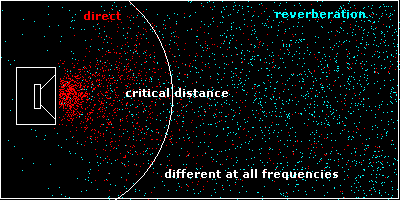
The problems with a typical performance venue is that the RT60 time (reverberant energy from the loudest point to where the reverberant energy has degraded by 60dB) is measured in, at least, substantial portions of one second (1S). Due to room resonances, the decay is not typically a nice clean exponential curve, either. In fact, due to room modes the actual decay curve can be pretty long and lumpy. So, for a simple drum beat at 120bpm, it is likely that the constant reverberant energy in the room might be within 3-6dB of the original sound source. A highly counter-intuitive fact of reverberation is that, except for room resonance variables, reverberant energy is equal everywhere in a room. If the measured reverberant energy is 90dBSPL at the back of the room, it will be very close to that at every microphone on the stage. If the sound system is delivering 125dBSPL at the room’s critical distance (where the reverberant energy and direct sound energy are equal, the “noise level” (unwanted reverberant energy) will be very near 120dBSPL everywhere in the room. 

So, keeping that fact in mind, you might realize that the sound pressure level (aka noise level) at the element of every microphone on a stage in my last example (above paragraph) will be 120dBSPL. So, to achieve any level of isolation/discrimination/intelligibility at each microphone, at least 6dB and ideally 20dB or more of signal (direct signal) will need to be delivered to the microphone. This problem is neatly, if not particularly musically, resolved with the use of direct injection (DI) boxes. There is no acceptable fix, except for atrocious microphone technique, for vocals and instruments that require a microphone. The reason musicians use microphones like the SM57/58 and its lo-fi clones is because of that instrument’s undeserved reputation for high MaxSPL capability. There is a reason that Shure does not specify a “maxSPL” value and it is not because it is a happy marketing story. The SM57, for example, is selected for close mic’ing of loud guitar amplifiers because of the additional distortion it introduces. There are many far better choices for that job if you are not looking for the distortion contribution of the microphone. In the kind of high volume environment we’re talking about in the previous paragraph, hyper-high maxSPL specifications are a must: 140dBSPL and above, for example. 

140dBSPL and above sounds like an impossible sound pressure level, but if a loud voice is typical 88dBSPL at 1 foot, every halving of that distance results in a 6dB increase in sound pressure, eight half-steps would result in a 142dBSPL at the element. Since many pop singers insist on planting their lips right on the microphone grill (even though there is typically some space between the grill and the actual element) it is not inconceivable that sound pressure levels greater than 130dB are typical. That would provide at least a 12dB signal-to-noise range for the microphone in my worst case example; assuming the microphone can function in that hostile environment. 

Signal-to-noise ratios sum exponentially, though. If you have two channels combining where each channel has a 12dB S/N ratio, combining the two channels will cost you half of your S/N ratio. If you are going for any sort of quality sound, the key will always be to drive the average sound pressure level down, not up. I suspect, if you are a typical amplified music performer you are going for something other than quality sound. What that is I can’t guess.

Thursday, August 1, 2019

Real Time with the SM58

As much as I bitch about the Shure SM58, my recent experience with that blunt instrument has been as rare as possible. I really do dislike the damn things and recent familiarity bred a whole new level of contempt. 

Last night, at the Sheldon Theater’s Open Mic I had that dreaded experience for three different performances (as a vocalist and backup singer) and was reminded of how primitive that 1966-designed mic really is. 1st, the pop filter is a joke. At distance, for example the unspecified distance used in the Shure spec shee (at left), you'd think the 58's LF response would be fairly useful for vocals. Best I can figure, that distance must be at least a foot if not a meter. Anything within a could of inches from on-axis to the 58 gets a burst of breath noise that is unlike any other microphone sold today. If you don't roll off every thing below 150Hz or even higher, plosives and breath noise will wreak any attempt at a subtle vocal. 2nd, that infamous 3-6k bump mostly emphasizes sibilance artifacts without making any useful contribution to clarity or intelligibility. 3rd, Shure doesn't spec "max SPL" for the 57/58 models for obvious reasons; it isn't nearly high enough for modern applications. Many vocalists are able to blow the 58 into gross overload, even without the lousy mic hyper-close technique required for their out-of-control stage monitor environment. Likewise, the 57 is famous for it's contribution to the distorted sound of loud electric guitar. 

The spec sheet's description of the 57/58 polar pattern isn't anything I have ever put much faith in, either. You'd think that the damn thing was practically flat and feedback-predictable based on that highly creative illustration (see at right). In practice, that would be anything but true.

All of those 50+-year-old "qualities" have been improved upon by everyone from Shure to AT to Sennheiser to Neumann to Audix to cheap Chinese no-name microphones costing even less than the 57 or 58. You actually have to make an effort to find a microphone that delivers worse performance today and, based on what I see on live stages, that might be the only actual work many live sound goobers do.

The one and only claim to fame the 57/58 will hold maybe forever is indestructibility. If an ability to drive nails and keep squawking is the most important thing to you, you are the consummate SM58 customer. 

POSTSCRIPT:  (8/6/2019) This past week I had a double-whammy experience with the 58 vs something better. After years of wanting to see the John Mayer live "Where the Light Is" concert, I finally managed to snag a copy. It is particularly ironic to watch Mayer agonize over which multi-thousand-dollar watch to wear between sets, swap out various overpriced vintage Strats, while his voice consistently gets slaughtered by the 58 he mindlessly sings into as if it were as well-considered an instrument as his watches or guitars. Clearly, a lot of work went into cleaning up that vocal for the final product, but there is no way to make a silk purse from a sow's ear. Mayer tends toward mushmouth qualities in the studio, but live all of the worst qualities of his voice are emphasized. What a missed opportunity. 

My 2nd experience was with recording a local country/pop songwriter in a live setting that, acoustically, left a lot to be desired. Lucky for me, the artist was open to my swapping out his 58 with a recently rebuilt EV RE18. My job, post-recording, was made dramatically easier than what Chad Franscoviak and Martin Pradler had to contend with on the Mayer live recording. Getting a clear, crisp sound from the live vocal took minimal processing and the rest of my job was working with the rhythm section and lead guitar. Regardless of the song style, tempo, arrangement complexity, or vocalist's technique, the vocal sat where it belongs at the front and center of the mix. The fact that the artist's technique is excellent didn't hurt, but the fact that I wasn't wrestling with garbage-in/garbage-out was equally huge.

Monday, July 22, 2019

Backing Away from Students

Teaching humans anything is a frustrating task. Most people are infested with Dunning-Kruger Effect symptoms and are incapable of absorbing information on subjects that they have convinced themselves they are natural experts. By "most," I mean well over the average 50% of mediocrity. Unfortunately, that group are naturally inclined to be in a position where they need all of the educational help on the planet just to survive. They are ones most likely to be in a classroom and most likely to be unteachable.

I experienced a big contrast in local musicians a few weeks ago. It reminded me of why I have developed an “I don’t give a shit” attitude toward most musicians and their music; especially live. At one end has been working on a half-dozen recordings with Leonard McCracken. One of the best things about moving to Red Wing has been my friendship with Leonard. He is an incredibly generous musician/person and one of the nicest people I have ever known.

A few weeks earlier, after hearing him perform at Marie's Underground and knowing the difference between Leonard’s voice and what comes out of a microphone (SM58) with his traditional rock star technique, I carefully broached Len with the idea that eating the mic is only really useful when there is so much noise on stage that you’re just trying to get some damn vocal in the mic over the din of drums and stage bullshit. Playing solo, there is none of that competition and I suggested he could back off a few inches and let the microphone do some of the work. We talked a little about proximity effect and how that distorts the mic’s output (and emphasizes plosives and sibilance) so that the best you can hope from an already mediocre tool, the SM58, was a mediocre-to-awful signal that needed lots of assistance from EQ circuits that also introduce distortion, phase shift, and an output that barely resembled the input. Then I held my breath, realizing that I’d overstepped a few boundaries and probably pissed him off.

He ate it up and asked the kind of questions my favorite students often asked when they discovered that microphones are not a simple tool. He’s totally revised his technique and you can understand what he is saying and singing on any system. The following Friday night, I brought an EV RE18 to Marie's for Leonard to use in a gig there. Holy shit, he just sounded magical even on Beatles songs (which I usually hate) and was having a great time using a real microphone on his own system (which is pretty good). Then I went the other way. Leonard took a break and he asked a friend to do a song or two to hold his audience. The RE18 is hard for even a typical country singer to fuck up, although he gave it a shot. For the first time ever, I could hear his lyrics over a PA and discovered that I didn’t dislike his voice as much as I’d thought.

Leonard’s friend, Esther, was sitting next to me and started asking questions about microphones and technique and I explained a little, although her technique is pretty good in the first place. The country guy came back to the table and I complimented him on how good he sounded. He listened in for a bit and started contradicting me with total bullshit myths about microphones and tossed out a lot of terms he clear misunderstands (polarity patterns, frequency response, the tube mic religion, etc) and it turned pissy for a bit. Eventually, he resorted to “good microphones are too expensive,” which I thought was  hilarious coming from a fairly average guitarist who insists on an expensive guitar but even mostly considers himself a vocalist. Funny, but not even a little unusual.

Music stores make their living off of guitar players who think spending money will fix their playing, but who may never realize an acoustic guitar is, for most of us, just providing an simple accompaniment to our voices and songs and stories. Leonard regularly proves that cheap (<$300) guitars are fine. He has a fine collection of cheap Chinese and South Korean electric and acoustic guitars that our local repair guy says "are killing the sales of expensive brands because Leonard's guitars sound so good." Of course, the real story is that Leonard makes them sound good.

The other guy and I are probably not likely to be friends and I can’t say I give a fuck. I am, however,  using the experience to try to fashion this Wirebender blog piece. The experience did remind me that I am mostly done with teaching. It was plenty hard trying to teach anything technical,. controversial, or complicated to 20-somethings, but it’s almost always impossible to teach anything to people who have never studied a single adult subject, are cursed with Dunning-Kruger syndrome, and are OLD. Since Trump, my tolerance for stupid and stubborn has just shriveled to zip and my ideal retirement home looks better every day. Ignorant is a different case. I have no problem with people not knowing much about a subject. There are thousands of subjects that I know nothing about and about which would love to learn more. That is ignorance and there should be no shame in that. Stupidity is a chosen quality, though. Arrogance is even worse.

The cheap microphone argument leaves me pretty cold though. Yeah, I know your favorite rock stars lip-sync into SM58's on SNL and stage and if faking it with a cheap Shure mic is good enough for them it should be good enough for you. (About a decade ago, there was a brief period where Neumann and Sennheiser replaced the SM58's on the SNL stage and that was the ONLY period in that program's history where the music performers didn't sound awful.)

The problem is garbage-in/garbage-out. You can not "fix" the original signal; although you can remove some of the crappier parts and try to hide the deficiencies with EQ and compression. That's not a fix, that's just lipstick on a pig. Transient response, sensitivity, phase and frequency accuracy, off-axis response, and the collection of microphone characteristics that are even harder to quantify but we "know 'em when we hear 'em" are not fixable. If you've tried any of the microphone modeling programs, you (hopefully) have realized that you can not make a Neumann U87 out of an SM58 recording. Ideally, you start with either a well-known microphone of high quality or, even better, with a precision condenser microphone. You can always reduce the quality of a signal, but fixing it is beyond science or software and not even on the same planet as live music.

The question I'm asking is, if a $3,000 guitar will make your mediocre guitar playing sound better, why wouldn't a $500-1,000 microphone do the same for your voice? Trust me, it will do far more than the guitar could ever hope to do.

POSTSCRIPT: I recently watched John Mayer's "Where the Light Is" video. The effort he puts into selecting clothing, a watch, and his guitars vs the thoughtless decision to sing into a CB mic (the Shure SM58) is telling. Obviously, the recording and mix engineers put a lot of work into cleaning up the vocal mess Mayer dripped into their preamp, but his voice still sounds as muffled, sibilant, and distorted as does everyone else who improperly uses an already defective tool.

Recently, I talked a local songwriter into using my RE18, instead of his SM58 for a live recording of a performance that we recorded and will be sold as part of an artist grant project. I had to do almost nothing to the output of the RE18 to make the vocal stand clearly on top of the mix. The artist has commented several times on how great his voice sounded both during the performance and on the recording. He is now deciding on whether he will be replacing his 58 with either an RE15 or RE20, both of which has has owned for years and didn't realize were great live microphones. So, sometimes you win and sometimes you don't.

Tuesday, July 16, 2019

Ending on A Great Note

In late 2017, I'd pretty much decided that my tech "career" in live music was about wrapped up. Then, a wonderful and generous friend (Thanks Doug!) who knew how much I enjoyed Peter Mayer's music tossed me the FOH gig at Crossings in Zumbrota last August. Doug handed it to me again this year and the odds are good that the June 22 performance at Crossings will be Peter's last Crossings show (Marie is retiring and selling the shop.). I don't have much of an opportunity to work with Peter anywhere else, so my interest in schlepping more gear is rapidly vanishing. (Although why Peter hasn't been a headliner at the Sheldon Theater in Red Wing totally escapes me. He's several times the performer and has a far bigger following than many of the acts the theater has booked in the past few years. More importantly, he has a large local group of dedicated fans who would love to see him in a Sheldon-style setting.) Hell, I'd even pay for that and Snarky Puppy pretty much put an end to my interest in seeing live music in person (From here out, I want my own volume control. I wouldn't trust a live doofus with a battery-powered megaphone.).

The Crossings stage, as you can see, is (or was) one of the rare "listening room" environments left on the planet. Working with Peter is a total throwback to a different, much better age. Peter is as disinterested in getting a perfect monitor mix as Bach or John Coltrane would have been. His total focus in a relatively long and detailed pre-show sound check is working toward a great sound for his audience. If you know me, you might guess that is right down my alley. For that goal, I'd show up, unpaid, ten hours early for a sound check.

Sunday, July 14, 2019

Support Live Music and Deafness

Entertaining, isn't it? It used to be that "metal concert" was some sort of barometer for 
tasteless, pointless ear-damaging volume. Today, it's just live music everywhere you find it.

A hallmark of a civilized society has always been some sort of concern for the rights, health, and safety of everyone in the society. Here in the USA, we abandoned civilization in the 1980's and never looked back. Reagan and the "greed is good" characters taught a couple generations of mindless, work-slaves that the wealth of a few is a higher goal than the good of many. It has filtered down to every aspect of what remains of our culture. Music, for example; particularly, live music. There was a time, about 20 years ago, when I predicted that "Noise pollution will become the air pollution of today." I was wrong. We went backwards. Today we don't care about air pollution, global warming, economic inequality or insecurity, and noise pollution is practically celebrated.

If you bothered to look at the chart above, you'd notice that pretty much everything we're exposed to in modern life is likely to cause permanent hearing damage. Live music anywhere but in an acoustic (unamplified) environment is hazardous: all amplified live music is hazardous to your hearing health. Is that complicated? Is the risk worth whatever gratification the experience provides? Your mileage is probably different than mine. In my opinion, any live music that uses amplification of any sort better damn well sound at least as good as, and ought to be substantially better than, what I can experience on my car stereo system. Anything less than that is just pointless risk of a fragile hearing mechanism for no justification at all.

In all cases, the only safe way to "enjoy" amplified live music is with significant hearing protection firmly in place. There is absolutely no way to take children to an amplified live music performance that should not be called "criminal child abuse." Children are usually born with terrific hearing and lose it fairly quickly in our modern noise-polluted world. Exposure to the quantity and "quality" of noise a modern sound system produces is flat-out child abuse and should be criminally prosecuted. Personally, I do not understand how the venues, cities, and other adults involved in a well-known medically-unsafe practice are not regulated and prosecuted when they violate public safety, but that's the post-Reagan libertarian nuthouse we live in today.

Sunday, June 23, 2019

Great Interview with A Great Guitarist

"Great" doesn't even come close to describing Larry's talent.


One of the amazing moments in my life was getting to talk, briefly, with Larry after a performance at the Costa Mesa WAVE smooth jazz concert sometime between '89 and '91.

I was doing some testing, backstage, on new QSC products and subb'ing for the Sound Image monitor tech (Dave Shadoan, the owner of the company at the time).  During David Benoit's set, there was an FOH problem and Dave asked me to watch the monitor board while he went to the FOH desk. There wasn't much to do, since Benoit's set was about over, so I just re-familiarized myself with the board and flipped through the stage mixes to see what Dave had setup for each player. Benoit's set ended and Dave still wasn't back and one of his guys and I started setting up for the next set, with me on the board, mostly, and the other guy positioning equipment and telling me what each aux needed for the next band. I was pretty overwhelmed with the complexity of it all, since I was used to a 36-channel, 8-aux version of the board and this was a lot more of everything than I'd ever used. We got it done barely before the band hit the stage and I didn't even look up to see who it was. I had my hand poised over the aux bus solo buttons, waiting to ratchet though the stage mixes correcting whatever the musicians wanted fixed during the first song. I heard someone say something like, "This is my first time on a stage since I got shot . . . "and I looked up to see Larry Carlton talking into a mic I had a little control over. The song, "Smiles and Smiles to Go" was the opening tune and I was back to work getting nods and directions from the band until Dave came back and took over about 3/4 of the way through the first song. I went back to work monitoring our amplifiers' performance.

When Larry's set finished, we all went into another frenzy of setup berserk-ness and about the time the next band started its set, I saw Larry exiting the dressing room trailer and head down the backstage area toward the parking lot. I sort of hate most things about being a fan and all things fanatical, but it struck me that I would only get one chance in this life to tell Mr. Carlton how much his music had meant to me. I usually become totally tongue-tied and lose about 100 IQ points in those situations, but I managed to run up behind him and say something like, "Mr. Carlton, I have loved your playing on the Crusaders records since #1 and especially Southern Comfort and Those Southern Nights." He turned around, looking slightly fearful, saw a dumbass yokel wearing a QSC jacket with tools, test equipment, and cables dangling from his belt, a tool bag, and wrapped around his (my) neck and relaxed. We had a really nice 5-10 minute conversation about that music and his love for jazz and I managed not to be a bigger Kansas hick than usual through most of it.

I have been lucky to meet and talk to a few of the people who kept me coming back to music for almost 60 years and meeting Larry Carlton is close to the top of those experiences.

Wirebender Audio Rants

Over the dozen years I taught audio engineering at Musictech College and McNally Smith College of Music, I accumulated a lot of material that might be useful to all sorts of budding audio techs and musicians. This site will include comments and questions about professional audio standards, practices, and equipment. I will add occasional product reviews with as many objective and irrational opinions as possible.