Showing posts with label economics. Show all posts

Saturday, April 6, 2024

What Are You Going to Do with It?

Since COVID shut us down locally, some friends and I have been “getting together” to play music  online regularly for about 4 1/2 years. It began when a couple of us, who had been getting together once a week at the local music store for a few hours of round-the-circle music, wanted to keep something like that going while the world was shutdown. We started out fumbling around with Zoom and the other online meeting platforms, but they are all half-duplex (like cell phones) and that is pretty hopeless for music. Eventually, one of us found Jamkazam and we used that for two years. Weirdly, when Jamkazam started charging for the service in January of 2021 the program and support went to hell. We paid for it for a year, as a group, but eventually quit fighting and moved over to Sonobus, which is still free as of now. Both platforms allowed us to record our music and we shared the duties of organizing the performances/takes into recording sessions. Sonobus turned out to be massively better for recording purposes than Jamkazam.

Now, almost 4 1/2 years later, we have managed to record sixteen original songs written by one-to-three of our group and twenty-five covers. A while back, I took to putting all of our stuff on the USB sticks that provide the background music in our two vehicles and I’ve had a great time showing off what we’ve done to friends, family, and other victims who happen to find themselves in my car. I put one of the first songs I’d written and we’d recorded on YouTube and, mostly, re-discovered how much I hate video editing in the process:

In a fit of ego and silliness, I put about half of my compositions and productions up on Distrokid last year and made about $8 in streaming “income” from a $10 initial fee. I did my annual purge of credit card re-enlistments and I’ve been getting Distrokid warnings (“UPDATE: Your music is at risk of being deleted”) on a weekly basis since that initial subscription ran out. A friend who is much more committed to promoting his music said I actually did “pretty well,” but for most of us bothering with streaming distribution is obviously more about ego than anything else. All I have to do is look in the mirror and my ego is busted to bits. I am old. The normal Distrokid price is $20/year and that’s just silly and Distrokid is the cheapest way I’ve found to get nearly universal music streaming distribution.

About 40 years ago, after 15 years of being all sorts of bands and blowing my wad on owning a sound company and recording studio, a friend (Mike) called me with an “exciting opportunity” to be lead guitarist for a band he was assembling. Mike’s band had serious promotion, gigs lined up, and financial backing. I was well into my career as an electronics engineer, about half-way through my zillion-year attempt to get a college degree, and had just moved my family to Omaha, Nebraska. I was burned out from beating my head against the local and semi-national music scene and in a bad mode.

“So, what you’re asking is do I want to leave my family for several weeks while we woodshed somewhere putting together a line-up, spend a bunch of money on equipment I just got through selling, drive a few hundred miles every night for six months, every night haul a ton of equipment up or down stairs to the gig, set everything up in an hour or so, maybe cram down a bar burger before the show, play music I don’t like for three hours for a crowd I won’t like, tear everything down and haul it up or down stairs, load the trailer, probably sleep in the van half the time on the way to the next gig, and take my shif driving about the time I finally start to fall asleep? All that to, maybe, clear $5,000?” I pretty much delivered that soliloquy in one breath without thinking.

Mike was quiet for a bit. “You could have just said ‘no.’”

“Sorry, Mike. I probably didn’t know that would be the answer until I was about half-way through that rant. But, yeah, no. I’m good. I hope your blow ‘em away and have a great tour, Mike. Thanks for thinking of me.” We signed off pretty quickly and I didn’t hear from Mike again until several years later when he was in a similar situation with a band in Denver. That band wanted to record two of my songs—”Down on the Beach” and “I’m Gonna Quit”—without paying me anything for the publication rights. I passed on that “opportunity for exposure,” too.

Other than as a technician, I was pretty much done with the music business by 50. I was a technology instructor at a music college for 13 years, but if students were looking for an encouraging word about making a living in music they went to someone else. When a friend listened to one of our latest recordings, he asked “So what are you going to do with all that material?”

“Listen to it, enjoy the memories, share it with friends and family.”

“You don’t want to try to sell it? Put it on the Internet? Maybe put a band together and play this stuff for an audience?”

“Oh hell no! I’m happy that we managed to put up with each other for so long. I love putting on a set of headphones and recalling the feeling of playing with these guys over these past 4 years.” I told him about my experience with Distrokid. “There are a lot easier ways to lose $10 a year and more fun, too.

“And I definitely don’t want to be in a band ever again.” And I explained to him why, “Again, I can find easier ways to lose money than playing gigs. This is one of my hobbies and one that I enjoy. I’m not going to do anything to mess that up.” 

Wednesday, April 3, 2024

Sloppy Luck, Part 1

I’ve had “sloppy luck” for most of my life. I’ve never won a lottery, but I’ve won some stuff at company parties. My “career plan” was squashed in infancy, but my emergency “plan” (to grossly abuse that concept) turned out surprisingly well. There is nothing special about my genetics, but I have often “been able to take a punch” of all sorts and make some kind of comeback and keep going. Best of all, I have had a life full of wonderful, reliable, loving, brilliant friends. That is plain good luck.

Columbia Record Club ad 1962 vintage magazine orig print 1960s retro art  offer - Picture 1 of 1One of my first sloppy luck moments was when I was 11 or 12-years-old. On a whim, I signed up for the Columbia Record Club’s “special offer.” I remember it being 10 for $1, but that was a long, long time ago. First, I had to pick a music genre and I didn’t know squat about music except for my parents’ 78-rpm collection that I’d listened to in the basement of our home when I was supposed to be baby-sitting my 8-year-old brother. All of the records in our basement were from the 1940s or earlier and that big wooden console record player/radio had a tone arm that probably weighed a couple of pounds. My mother had died just a couple of years earlier and the records might have been hers. I never really saw any evidence that my father cared about music, other than singing in the choir or pep bands leading cheers for his basketball teams. The records I’d experienced were “classics” by Spike Jones, Duke Ellington, Tommy Dorsey, Glenn Miller, etc. On a whim, I picked Jazz and from among the jazz record category options I picked:
  • An Electrifying Evening with The Dizzy Gillespie Quintet (still my all time favorite record)
  • Birth of the Cool, Miles Davis
  • Sophisticated Swing, Cannonball Adderley
  • Brazil, Bossa Nova, and Blues, Herbie Mann 
  • Silver Vibes, Lionel Hampton
  • Cool Velvet, Stan Getz

Over the next year, every month the “pick of the month” card would show up in the mail and I’d procrastinate sending it back to reject the selection because I didn’t even know how to buy stamps. (The card with the original offer was postage paid.) After most of a year, I had a pretty decent collection of jazz albums and owed Columbia Record Club more than $100 before they stopped sending me the “pick of the month” selections. I listened to every one of those records practically until I could see light through the grooves. With those monthly picks and the Columbia catalog I discovered Davis’ “Kind of Blue,” “Brazil, Bossa Nova & Blues” by Herbie Mann, “Time Out” by the Dave Brubeck Quartet, Wes Montgomery’s “Movin’” and ”Bumpin’” and special members-only records by Charles Mingus, and Thelonious Monk.

After receiving a half-dozen unpaid-for-records , Columbia Record Club became less friendly. In fact, their letters became downright threatening. Their pick of the month was “only” $7.95, but after shipping-and-handling it was closer to $10. It’s only fair to mention that 1961’s $100 is the equivalent of more than $1,000 today. My father’s high school teaching annual salary was about $5,000 that year. For quite a while, I managed to intercept the mail before Dad got home from school, but eventually he spotted on of the “final notice” envelopes and opened it up. By then, I was getting the occasional bill collector telephone call, too. After chewing my ass into bite-sized bits, Dad got one of the bill collector calls and the conversation went something like this:

“Hello, who is this””

“My name is ____ and I’m calling for Columbia Record Club. Is this Mr. Thomas Day?”

“No. This is his father, Fred Day. What can I do for you?”

“Thomas has received almost a dozen records from our company and he owes Columbia Record Club $__. How do you plan to pay for the records?”

”I don’t and if you know how to put a lien on an 11-year-old boy I suggest you proceed with that action. However, I am not responsible for his bills and you should be ashamed of yourselves for being foolish enough to give credit to an 11-year-old kid. Tell you what, though. I’ll put all the records in a box and leave them on the front porch and you can come pick them up at your convenience.”

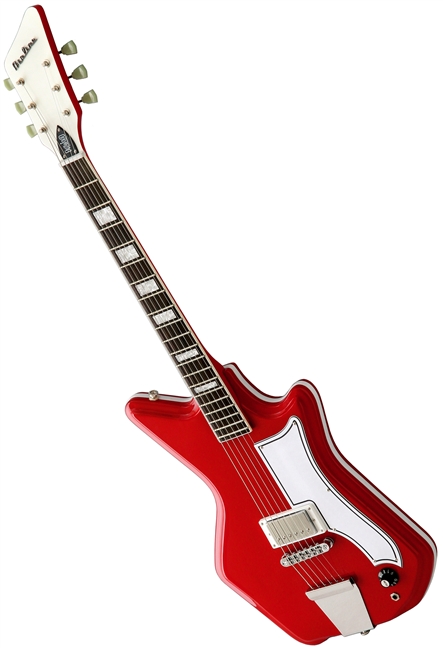
Airline '59 1P Custom Single Pickup Solid Body Electric ...We didn’t hear from Columbia Record Club again and Dad, eventually, let me take the box of 33rpm records back to the basement where I totally wore out all of them. Listening to Gillespie and Davis inspired me to want to play trumpet. Being always short on cash, I eventually inherited an awful Conn cornet from my step-mother’s brother and discovered that I had no talent for teaching myself trumpet, let alone jazz trumpet. A few years after taking up the trumpet, I managed to score an awful Sears Airline acoustic guitar. After struggling with that instrument for a while, I used my paper route money to buy a $35 Airline electric guitar from my local Western Auto store. Thanks to my Columbia Record Club jazz exposure, no part of early 60’s vocal music appealed to me, but I could get my teeth into The Ventures, Dick Dale, The Surfaris, and, thanks to the local music magician, Howard Roberts.

By the time the Beatles and the British Invasion straggled into the Midwest and KOMA radio, I had no interest in either British muppet music or vocals in general. Somewhere in that period, I found WLS out of Chicago and soul music. Imagine hearing Wilson Picket, James Brown, Otis Redding, the Staples, the Bar-Kays, or anything from Motown before you hear the Beatle’s chipmunk voices and the Stone’s limp R&B imitations and you’ll have a clue where I was coming from as a wannabe musician. It wasn’t until I heard “The Freewheelin' Bob Dylan” before I developed any kind of appreciation for lyrics.

I consider all of that sloppy luck. Every bit of it, from mailing in that Columbia Record Club enrollment card to picking “jazz” as my musical preference to that  music leading me to R&B instead of R&R pop to the trumpet-to-guitar progression to becoming who I am as a person and a still-tryin’-to-be-a-musician 76-year-old. It was all good luck.

Wednesday, December 6, 2023

My Slantmaster 50 Story

Back in the early 2000s, I was happily working as a college instructor for a music school in St. Paul. I was the school’s Student AES Club faculty advisor and I was having the time of my life working with brilliant, inspiring, energetic young people who were fascinated with all things audio. Back in my early-QSC Audio days, I’d built a pretty cool ABX tester and, later (after I’d left California and the pro audio business), QSC decided to build a much more sophisticated ABX tester and use it to promote the company’s products. That didn’t work out well and the ABX testers were recalled from the company’s sales force and, I’d been told, crushed to bury the evidence that someone at QSC once thought professional audio people gave a crap about audio fidelity and honest listening tests. I’d been that same dumbasss a decade earlier, so they had my sympathy. Because I’m lazy and that wheel had already been built, I’d bothered Pat Quilter often to see if he could find an unwanted ABX test box that hadn’t died in the garbage compactor.

Quilter letter

So, in late 2008 when Pat sent me an email warning me that there was a package coming my way, I thought I knew what would be in it. When it arrived, it seemed almost Amazon-oversized for what I thought would be a 1 rack-space piece. The box was also a lot lighter than I’d expected. I cracked the tape at the top of the box and saw the beige tolex, the leather handle, and the black dust cover and I was confused. I knew Pat was retiring from QSC Audio, so I assumed he’d built a model amp as a memento. When I pulled the amp from the box and saw the Slantmaster backCelestion Century 12” I suspected it was more than an empty box demo. I plugged it in, turned it on, and (like everyone I’ve ever show the amp to) said, “Wow!” There is a cool, brief light show from the backlit front panel as the amp powers up that blows everyone away. I spent the rest of the day playing with the amp, which was more guitar playing than I’d done in the past 20-some years.

https://images.reverb.com/image/upload/s--Yp0LAsA9--/f_auto,t_large/v1571546406/frdbeloncpgmtfp50wns.jpgI brought it to school the next day to show it off to students, employees and instructors, and anyone who was interested. We used it several times in recording sessions over the next couple of weeks. One to-be-unnamed guitar instructor tried to buy it from me, tried to get me to have Pat build one for him, and coveted it so blatantly that I started storing it in the secured record lab area so that it wouldn’t disappear. Over the next year, I used the Slantmaster dozens of times with all sorts of guitars and guitarists and it was universally loved by everyone who heard it. It is kind of sad to admit that the amp has never been used outside of McNally Smith College or my home studio. It has never seen a live gig other than the MSCM’s auditorium stage a couple of times by players who I trusted not to abuse it.

This is what the Quilter Labs website has to say about the Slantmaster 50, “Built to celebrate QSC’s 40th anniversary, the Slantmaster 50 used a linear amplifier to deliver 50 ‘hot watts’ to a simply awesome Celestion ‘Century’ neodymium speaker.

“This was the precursor to Quilter Labs foundation.

“Only one hundred were made and featured a spring reverb! These are very limited, so if you have one you are lucky!”

I have one (#72 of 100) and I am well aware of the fact that I am lucky to do so. I have meant to write something about this amazing gift for nearly 15 years, but a conversation about the Slantmaster in the Facebook “Quilter Musical Equipment Owners Group” about the Slantmaster moved me to finally do the work.

https://media.gettyimages.com/photos/patrick-quilter-of-qsc-started-making-guitar-amplifiers-in-the-1960s-picture-id566045317The day I started work at QSC Audio Products in Costa Mesa in early 1983 was the day Pat took his first vacation in a decade. Pat and his mother had booked a tour of Europe on the Orient Express and he’d entrusted me with overseeing the initial production of the first Series One amp, the 1400, without a single unit having yet passed through production. There were . . . problems, but the QSC team of that day pulled together and by Monday afternoon we were cranking out 1400s at a pretty decent pace. The Series One and Three amps were the breakthrough products that put QSC on the pro equipment map and for the next 9 years I was a product engineer, test engineer, manufacturing engineer, manufacturing engineering manager, and tech services manager: 5 different jobs, with a couple that lapped-over each other a bit, in 9 years. Pat and I became friends, partially because I was the interface between his working hours (noon to whenever in the evening) and everyone else and me (7AM to 5-or-whenever-PM). We shared an interest in audio electronics, psychoacoustics, music, guitars and guitar amplifiers, electric vehicles, science fiction and fantasy, literature, and the people we worked with. I quit QSC and left California, after giving notice almost 3 years earlier that I would be leaving when I graduated from Cal State Long Beach, because I could never see myself breaking even economically in southern California and for personal reasons. Pat and I have continued to communicate through email for the past 30 years. I keep his Xmas letters in the same envelope as the letter that came with the Slantmaster.

Sunday, April 2, 2023

Placing Bets

The music/audiophile equipment business has been selling snake oil to a gullible portion of the public for at least since Emile Berliner began making 5-inch “gramophone” recordings of chamber orchestras. Connectors and conductors are one of the biggest scams perpetrated on the gullible and wealthy “customers.” Lots of people have spent more energy than I on dispelling the myths and bullshit and I think this paper does it as well as anyone, Mission Engineering’s “Measuring Guitar Cables.” I’ve also spent some energy in my past career and more recent articles on some of this stuff, but I’d old, tired, and more amused than outraged these days. In fact, for the most part I’m now totally on the side of the con artists. The past 40 years of watching the incredibly stupid folks who call the rest of us “libtards” has convinced me that there is nothing unethical about scalping people who want to be scalped.

A few nights ago, I was hanging out with a couple of local musicians and one of them began to explain why his $250 guitar cable was better than a regular cable. He is an electrician, by trade, and I’ve found that those guys are typically strong on the NEC and weak on electrical theory and this guy was no exception. He first started off by tossing out a word, “hysteresis,” that he clearly did not understand as some kind of quality connected to electrical conductors. Then, he went on to try and tag the “skin effect” to how he imagined that his new, grossly over-priced cable could make a passive electric bass guitar sound like one of his active instruments.

Pause here while I explain why I am not rich: I am slow-witted. When people say stuff that either blows me away with insight or astounds me in their stupidity I am equally stumped for an unacceptably long time. Sometimes days will pass before I come up with a relevant question or a snappy comeback. As disappointing as I am in print, I am way slower and dumber in person.

A day later, I realized I could have made some serious money that night. I am not a gambling man (at least not with my money), but this wasn’t a gamble. The next time this comes up in conversation I hope to be ready to bet $1,000 that I can easily setup a test that will prove this dude can’t tell the difference from a $10 Chinese-made cord and his grossly over-priced spread. All it will take is an agreement on what would be “proof” in the test (at least a 75% success rate), a blindfold, a pen and paper, a quiet unbiased witness or two, the two test cables, an instrument (especially a bass), an amplifier, and a dozen cable-swaps and about 15 minutes and I’ll be $1,000 richer.

In case you care, the ONLY things that matter in guitar cables are reliability and shielding quality. Reliability is directly connected to the size and quality of the connectors, the ability of the inner conductors to “slip” inside the outer sheath (either with slippery insulation materials or paper/plastic wrapping), and the care the manufacturer takes in assembly. Most shielding, either braided or double-wrapped, provides 100% shielding and, contrary to your high school football coach’s bullshit, 100% is as good as it gets. Avoid aluminum foil shielding because it will become noisy when it is flexed. Long cables are less reliable and more likely to become noisy. Noise is a relative thing with guitars, though. Since they are unbalanced and high impedance, your pickups are likely to be a bigger noise issue than your cables.

Sunday, November 6, 2022

A Declining Market or Just Laziness?

dave'sAt the suggestion (to put it mildly) of a couple of friends, I finally visited Dave’s Guitar Shop in La Crosse, Wisconsin this past week. Weirdly, this small town near the border of Iowa and just across the Mississippi River from Minnesota is known as a “guitar mecca” to lots of guitar collectors. The store deserves that reputation, if for no other reason than not much else about La Crosse is likely to attract national attention. It’s a perfectly nice small city, but not much different from at least 10,000 other similar sized cities. Dave’s Guitar Shop, however, is quite a bit different from other guitar shops. For starters, there are hundreds of guitars and Dave’s is a premier Taylor and PRS dealer along with several other brands. That, alone, is pretty cool.

The reason it has been suggested that I “need to see” this store is that several of my musical friends think my fascination with my two Composite Acoustics carbon fiber guitars is “sick.” I live in a small Minnesota town with a lot of guitar freaks, many of the rich guys who don’t play much but have substantial guitar collections plus there is a community college here that specializes in teaching Guitar Repair and Construction; wood only, of course. One of my local friends died in late August and I helped his widow find homes for his guitar collection and assorted gear over the past couple of months. Even though three of those instruments were high end guitars, it didn’t occur to me that I should play them to see if I had any interest. Several years ago, he swapped a red Composite Acoustics Cargo for my black sunburst Cargo and that turned out to be his favorite guitar to the end of his life. He, still, thought I should own at least one wood acoustic guitar. I made one a few years ago, but gave it to my grandson.

Mrs. Day and I did not travel to La Crosse solely for the purpose of me looking at guitars. That was just a side-benefit of our trip, which was to look at migrating birds (who have yet to arrive in our area). We’re celebrating her 6th cancer-free year after successful treatment by the Mayo Clinic in 2016 and this trip was part of the celebration. After a 120 mile drive and a 2 hour medical exam, Mrs. Day was ready for a nap. I left her and the cat to relax in the hotel and I slipped off to play with guitars at Dave’s.

To be honest, I am not a motivated buyer; mostly just curious. I’d just read the last hard-copy Taylor in-house magazine and there were lots of “this guitar just spoke to me” comments from their many owners. I wondered if a guitar could speak to me or make me feel anything different than I already feel about my pair of carbon fiber acoustic guitars. Contrary to my friends’ opinion of my instruments, I’m pretty happy with them. They are definitely capable of more than I can do, they play easily and comfortably, are simple to maintain, and I like the way they look. So sue me.

https://s3-media2.fl.yelpcdn.com/bphoto/8j-RBwpuuAw9O3uPhBwcww/o.jpgFirst up, on a Wednesday afternoon, I was not surprised to see that The Gig Store, a live and studio sound equipment place (in the same building) and a drum shop next door to Dave’s, appeared to be closed indefinitely. The retail music business is in rough shape and it is likely to get rougher. Dave’s was open and full of guitars. The entrance is all electric stuff all the time, which was fun but not my reason for being there.

The acoustic guitar area is on the south side of the building, through a short and narrow hallway that could easily be mistaken for a shop area. There must have been 100s of acoustic guitars and I played a couple dozen of them. I was most attracted to the Eastman AC series, with a upper bout sound port and a chamfered edge, Eastman seemed to be at least making some effort to be different than the crowd. Feel-wise, though, all of the acoustic guitars I played had pretty much the same neck, body style and feel, general design, and other than variations on the appearance of the wood they might as well been the same guitar; for my purposes. I really wanted to grab a guitar by the neck and feel that comfortable, natural grip I have with my hot-rodded hand-carved Yamaha V-neck. I had wild hopes that someone would take a chance on doing something inventive with the most important part of any guitar.

Guitar necksBut, nope. Vintage Martins are a slight V-shape, but too slight for me. In fact, I had to move fairly quickly from a typical round guitar neck to a Martin to feel the guitar-neck-contoursdifference it is so slight. Somewhere between a “hard V” and this “medium V” is what I’m looking for. And there was nothing like that in Dave’s great big guitar store. Even the lone carbon fiber brand carried in that store, McPherson, totally wimps out on the neck shape. They don’t even list neck shape options on their custom build page. If I wanted one, I’d have to build it myself, but at this stage in my life I’m not sure I want one bad enough to mess with it.

The music business has undergone some huge changes, mostly for the worse, in the past couple of decades. What has been called “Moneyball-for-Everything” has done a lot of damage, if you’re interested in any sort of variety or creativity. Like every other area of US culture, the guitar is not the hip instrument it once was and the majority of folks buying (and collecting) guitars are old farts. Old farts are not looking for anything new, unusual, or even odd. They want a ‘55 Strat or Tele or a 40’s Martin or a 60’s Gibson and not much else. Companies not in that collector strata are making instruments similar enough to the old standbys that you can’t tell much difference between a 1950 Gibson or Martin and a 2022 Taylor or the rest of the crowd of wannabes. So, I did not find anything that tripped any sort of trigger or even interest in all of those fine instruments.

I did leave that shop wondering how I’d feel when I got home and played my own instruments and the next day I found out. I’m unreasonably satisfied with what I have.

Sunday, April 3, 2022

It Is Not A Victimless Crime

At the moment where the US Congresscritters are contemplating decriminalizing marijuana use and establishing “procedures for expunging previous convictions from people’s records,” I’m thinking about ways to refill the nation’s for-profit prisons with real criminals. [We can’t ask those prison-owning billionaires to suffer just because the country has decided to be slightly more just and rational.] For years, I’ve advocated several punishment for lousy live sound reinforcement. In “What I Have Learned about Live Sound” I pretty much wrapped up a lifetime experiences and suffering with amplified . . . music? (For lack of a more accurate term.) In 2013, I wrote “Weapons of Mass Destruction – Live Sound” when someone I know butchered a Robert Randolph and the Family Band’s live show so badly I haven’t bothered to listen to or buy an RR record since. “Snarky Puppy in St. Paul” described one of the most embarrassing, awful, and disappointing anti-musical experiences I’ve suffered and one that was a turning point for me in that my response was “never again” regarding all things related to that band. “Isolation from the Audience,” “Where Did the Audience Go?,” back in 2004 I wrote an article for FOH Magazine that disappeared after my friend Mark Amundson died “Loud Noises,” and way back in 1991 one of my first Wirebender Audio website essays was “Loudly Killing Live Music.” I think I have sufficiently documented my case for prosecuting the “the moron behind the sound board.” Back in 1991 I said, “The solution is simple. When you think the sound clown is wreaking your favorite national or local band, he probably is. Walk up behind him and broom his line of coke into the crowd. Smack him in the back of the head with a mid-sized brick. Kick his chair over and spill him, head first, into the mosh pit. Unplug his effects rack. Narc him to the cops. Do whatever you have to do to make his life miserable. Scare him into going back to his boombox pickup truck and out of the wonderful world of music. No punishment is too severe.”

This moment in history presents us, the members of the civilized world and music lovers world wide, an opportunity that shouldn’t be missed. As the nation and even the world considers relaxing penalties for victimless crimes, we could turn to prosecuting criminals with thousands of victims who to get our punishment ya-ya’s out. Obviously, the thousands of big bank financial scammers, government officials who advocate the overthrow the government, corporate executives who have profited from decimating the environment or harming citizens with dangerous products, and anyone who betrays the public trust should be on that list. Beside that, though, what about the many “morons behind the sound board?” These violent criminals have deafened thousands of unsuspecting music lovers without suffering even civil prosecution since the early 1960s; 60 years of blatant negligent criminal behavior without even minor financial penalties.

If it were up to me, I’d just put the bastards against the wall and shoot them. Your mileage may vary, but at the last I think doing the kind of violence to music and a musical audience that I witnessed at the St. Paul Palace Theater in 2019 deserves as much jail time as a minor marijuana possession used to earn: back in the 60s, someone caught with practically any quantity of grass might expect a life sentence in toothless hillbilly states like Texas and much of the Midwest. Today, there are still parts of the country, like Minnesota  where possession of as little as 42.5g (1.5oz) gets a 5 year, $10,000 sentence. And if you don’t think those nutty laws are still being applied, you’re nuts. I especially like the idea of applying the three-strikes “mandatory 25-years imprisonment for repeated serious crimes” to live sound goobers. Like I said, in 1991, what’s the worst that happens if idiots suddenly don’t want to do the job because of the risk? If no one ever touched a live sound board again, music would be the primary beneficiary.

Saturday, June 13, 2020

Making Your Own TC Helicon Perform and Play Acoustic 3 and 6 Switch Pedal Boxes

 Just for laughs, I decided to make my own version of the TC Helicon Switch 3 and Switch 6. First, because I'm cheap and have the "spare time" to do the research and assembly work and, second, because I wanted to fool around with "swirl painting."So, I did. 

What you see in these picture at left is the result. To highlight how cheap I really am, the 6-switch unit was made with the cover of  a gas water heater I had to replace this past winter. I made a nice looking wooden base for it, but you can only see the wood base when you are holding the switch box. The wood does add a decent amount of mass to the assembly, though, which helps to hold it in place on the floor. 

The 3-switch unit is a pretty simple and obvious device, except for the 3rd switch. As you can see from the schematic at right, the first two switches connect from ground/common to the ring or tip connector of the TRS jack. The third switch connects to both tip and ring through a pair of diodes (pay attention to the correct polarity) and to ground/common. It's not complicated wiring and the parts are cheap. 

I bought a pile (10) of cheap SPST momentary switches from Amazon and used them on both switch boxes. After almost a year of use, they are still working well. They are cheap plastic and I'm sure ham-footed use would break them and if you dawdle with the soldering iron you'll likely melt the plastic holding the solder tab. The switches must be momentary. If they aren't, you'll have to press the switch twice for each change action. That is NOT handy.

The six-switch unit is a little trickier than the three switch unit and requires some planning and assembly skills. Not many, though. Along with the  six SPST momentary switches, you'll need another TRS jack and seven 10k ohm resistors (anything, wattage-wise, will work). You can see I staggered my switches, mostly because I did not want a long switch box and because my TC Helicon PerformVG only has four harmony combinations that I am likely to use, so the two offset switches are for voice echo and guitar echo, which I almost never use. 
 
 I've included a second drawing for the six-switch unit, in case that layout makes more sense to you. They look different, but they are exactly the same circuit. The drawing at right might more resemble the physical layout of your assembly, which might make error-free assembly easier. I should note that I did not create any of the drawings included in this blog. I snagged them off of the internet, like you probably did when you found this essay. I should go back and find my sources, but that was about a year ago and I'm lazy. So, I didn't draw them, I apologize for not giving full credit where credit is due, and I used them and they work. In fact, the 3-switch unit works incredibly well on my Roland Cube Bass, too.

This is what my performance rig looks like, including a Bluetooth page-turner footswitch, a cheap Android 10" tablet for lyrics and chords, the TC Helicon PerformVG voice and guitar processor, and my trusty and beloved EV RE18 microphone. That and a powered speaker and I'm a louder-than-I-should-be busker or coffee house performer (should I ever want to be such a thing). With a set of in-ears, I can entertain myself for hours.

Monday, August 26, 2019

Requests, Are We Musicians or Just Player Pianos?

One of the many things I do not miss about being a working musician is requests from the audience. For all of my life, audience members not only assume they have the right to ask performers to play "their music," but that it is the obligation of the musicians performing to accommodate individual audience member's tastes; even when the request is in no way similar to the obvious performer's style. Throw in a tip jar and now you have a fully entitled audience who believes that the performers are barely more (or maybe less) than a player piano. Hell, even player pianos have a limited number of song selections, so being a performer in those situations is existing somewhere below the status of 1800's music replication equipment. 

What's the reward for putting up with that sort of disrespect? Continued employment, I guess. Of course, at the pay rate most music provides you'd be much better off taking a 2nd job at a convenience store. 

The often neglected motivation for doing any art is self-gratification. With music performance, there are at least two ways to achieve that: 1) pleasing yourself and 2) the power associated with manipulating an audience. Most art is some kind of self-expression, but not all art is that. Advertising art is absolutely designed to manipulate consumers; the "art's" audience. Cover bands are very similar to advertising art, especially show bands that cater to corporate gigs. A good friend has occasionally mentioned how much he enjoys reading a crowd and manipulating their energy with his song selections (and the resulting small fortune he makes in tips doing that). When I read the chapter on performing in Rockonomics, I was intrigued and a little baffled by the idea that many artists feel "powerful" or "indestructible" on stage, which sometimes leads to feeling weak and fragile when they are off-stage; followed by drug abuse and death. Tom Petty's story, alone, is a terrible example of that, since Petty practically had to be carried to the edge of the state, due to his broken hip and pain, but once he stepped out on the stage he was "indestructible." Until he wasn't.

Performing has never made me feel anything but incredibly nervous. In my cover-band and original music band years, I would almost always stay on stage playing solo while the rest of the band took a break, because the odds were good that if I left the stage I'd find a reason not to go back. Some of the open mics I frequent locally "offer the opportunity" to take a second pass at the performance stage. I often avoid that. Once I've managed to struggle through a song or three, I'm ready for a drink, something to eat, and a good while to unwind.I have to believe that if I had become a performing, professional musician I would, also, have become a drunk or drug addict to calm my nerves. None of that has improved with age, either.

Monday, July 1, 2019

Common Elements

Once upon a time, I was a college instructor in the “Production Department” of a music school. After the first few years of watching students pass through my classes and recording studio labs, I began to develop my “Theory of Abundance.” After watching what seemed like amazing talents pass through my classrooms, I began to suspect that there are three things of which there are a nearly-infinite supply in the universe: hydrogen, good guitar players, and beautiful young women. (Hopefully, it is equally needless to say that there are more than enough pretty young boys, too?)

Honestly, outside of physics there isn’t much value to take from the understanding that hydrogen is 75% of the mass in the universe. The over-abundance of the other two things should be really informative to a young person starting out in life: you do not want to place all of your bets on being special in a commodity market. Being special requires some rarity. Corn, sow bellies, soybeans, car tires, oil, coal, electricity, electronic components, cell phones, computers, and guitars are, mostly, commodities. That means one example of any of those things will serve the purpose as well as any other example. In a rational world, that would mean that the price of any of those things would be the same and as low as the cost of production allows.

In the case of over-produced farm products, the price is artificially held high to maintain the rural status quo. In the case of musicians and music, the price appears to be heading for the dead bottom because there are no powerful 1%’er special interests who have the money to buy off our state and federal congresscritters who could easily create the same artificially high price structure that they have built for energy, oil and coal, ethanol, cell phone providers, corn and soybeans, meat and dairy, exports, housing, and medical industries from insurance companies to Big Pharma. Don’t look for help from that direction, there just isn’t enough money in the industry to create much interest and the money that was in that business model is going away and most of it is long-gone.

Monday, June 17, 2019

What You Sound Like Is Immaterial

In 1966 Eric Clapton recorded with John Mayall & the Bluesbreakers and music has steadily gone downhill ever since. In the book, The Birth of Loud, the author talks about how Clapton’s insistence on playing his Vox amp at full tilt during the session is what drove zillions of half-witted guitarists to “want his sound” and buy Les Paul guitars. Wrong. The recording tech’s ability to blend the guitar and sonic mess Clapton created into a coherent recording is what misled a generation of wannabe guitar heroes into breaking their backs with overweight Les Paul guitars and driving themselves deaf trying to “get that sound” in the real world. 

That Blues Breakers sound was the result of a coherent group of musicians playing together to create a piece of work that was a musical composition; even though that composition was artificial as hell. Every sucker who ever attended the sonic disasters that all Clapton concerts were from then on (with the possible exception of the Unplugged MTV concert) would confirm that Clapton no more resembled the musician on that recording than I resemble Lebron James. As for the Blues Breaker recording, I’m sure Clapton’s guitar mess bled into every mic in the room, but through a variety of Gus Dudgeon's clever acoustic and mixing tricks Mayall and the Blues Breakers got a decent recording in spite of Clapton’s ego. That’s my take, anyway. After making that record, Eric threw one of his trademark tantrums and moved on, leaving rock history with a mangled story to argue over. Several years of awful Cream concerts marketed by three brilliantly engineered and produced Tom Dowd records (including two miracle live records that almost made the group sound competent in concert) created a couple of generations of tone-deaf, functionally deaf, brain-dead guitar wannabe-heroes. Even someone as clueless as Ginger Baker could figure it out, “The incredible volume was one of the things that destroyed the band. Playing loud had nothing to do with music.”

For the next 50-some years, guitar players have been messing around with guitars, pickups, amplifiers, and techniques trying to create some sort of sound that either identifies them as individuals or covers them in the reflective glory of copying someone else fairly well. Been there, done that. What an audience is looking for is not a single instrument's "tone," but a well-constructed, balanced and interesting performance from a group (even if the "group" is an acoustic musician and his/her voice) and a song worth remembering. Except in a few instances, nobody would cross the street to hear the average guitarist fumble with their instrument, but most of us would dedicate some of our precious vanishing time to hear a great song.

In the end, Eric’s tone was about as important to the song as was the “tone” of every other instrument in the recording; especially the dubbed-in horn section. The song, the arrangement, and the mix are what make this tune worth listening to and that is the message that appears to be getting further lost in the weeds as time goes on. Pop “music” has become more of a visual performance “art” than a musical performance and audiences reflect that weirdness. “Musicians” spend more time on their dance steps and posing than their instruments or arrangements. At the club level, musicians are being taught to perform as a random bunch of individuals with self-interest overwhelming anything resembling music. Even jazz musicians in clubs as tiny as coffee shops “need” amplification because they are incapable of listening to each other and too egotistical to imagine that someone else might be the most important thing in a particular tune. And music dies a painful, sad death at the hands of electronics.

Monday, June 10, 2019

Holding A Grudge or Just Paying Attention?

After the Snarky Puppy misadventure, my wife (Elvy) and I had a couple of long conversations about concerts we’ve seen and loved or hated and the end results. Turns out, my Geezer with A Grudge habits apply to music, too. I have never been punished by an artist twice and we have made a habit of seeing the people who exceed my expectations at every opportunity. The last bit has slowed up considerably now that I am no longer in the business and live some distance from where most of the action happens. Because of the expense and hassle, I probably won’t be seeing many artists twice from here out.

For example, I’ve seen Pat Metheny almost a dozen times at a dozen different venues and never once felt betrayed, abused, or let down by his band’s performances. After that many shows, I am still willing to go a long distance to see him again. A small part of my motivation for moving to L.A. in the 80’s was to see the Crusaders in their native element; especially since that was the only way to see them by that late period in their careers. I saw them as the headlines for the 1983 Playboy Jazz Festival at the Hollywood Forum, at our local club (The Golden Bear) in Huntington Beach, and at a couple of outdoor shows in the South Beach area. Every show was knocked out and amazingly close to their recordings, quality-wise. Same for Jeff Beck; who I have seen 3 times and 4 if you count a 1960’s Yardbirds concert in a Denver bar. Jeff is often loud, but always musical and the sound quality has been close to state-of-the-art every time I’ve seen him play. Elvy isn’t as much of a jazz fan as me, so many of the above shows were my experience alone. On the other hand, we’ve been to more than a few pop music concerts because of her interests; Queen, for example.

An example of the other spectrum would be Robert Randolph and the Family Band. I bought 2003's Unclassified and 2006's Colorblind the moment they arrived. I used to intro my auditorium lecture classes with Squeeze or Ain’t Nothing Wrong with That. Like Snarky Puppy, I missed my first opportunity bto see RR when the band was at First Ave because I was working a gig, out of town, that evening. Then I saw Robert and his band at the Minnesota State Fair. The sound was terrible and, being an outdoor concert in a facility where I’ve heard some terrific shows, all of the blame landed on the band (and the FOH nitwit). I tried that show twice and the 2nd time was worse than the 1st. I haven’t paid a moment of attention to Robert Randolph since; nor bought any of the band’s newer music. I still think they are a good recording act, but as a live band they suck and I wouldn’t cross the street to see them for free.

To be clear, what I’m expecting in a live concert is at least the sound quality of a decent car stereo (sans hip-hop sub-woofer mess); at the dead minimum. There is no point in spending tens of thousands of dollars on a sound system that is worse than a car stereo; and that is not a high bar. A better goal would be to match the fidelity of a good home entertainment system. Still not a stretch, but an improvement over a car stereo. Excuses from FOH goobers for room acoustics, audience behavior, and the band’s stage excesses don’t mean a thing to me. The band and the FOH engineer are totally responsible for and in control of the concert sound quality. If, as is the usual case, they don’t care one result is either do I.

Even 20-50 years later, I can remember many of the concert moments that blew me away; some as if it were a recent experience. What I remember about the lousy sounding concerts I’ve experienced is “I’ll never do that again.” That, literally, is all I remember of non-musical experiences. That would be my Geezer reflex: “Fool me once, shame on you. Fool me twice, shame on me.” I had thought about doing a chart of a few of my concert experiences, but it would be a lot of one-time experiences and my HTML charting capabilities suck. Put it simply, there are far more “artists” who I have seen once and wouldn’t cross the street to see again. Too many musicians are more concerned with their egos than with their music. This is not a new thing, but a long-established tradition; especially with jazz and pop musicians.

The conversation Elvy and I had about our 50+ years of going to concerts together was a little surprising. She was even more adamant in her “I’ll never do that again” response. We did remember many of the same great shows close to exactly the same. For both of us, the memory of the sonically disappointing-to-awful shows was limited and a little irritating. We’re not rich and wasting money is something we’ve tried to avoid for all of our adult lives.

Monday, June 3, 2019

A Musician in Charge of Suffering with the Audience

My disappointing experience in May at a Snarky Puppy concert in St. Paul somehow reminded me of someone I heard about back in the 80’s. A friend worked, for a short time, for a medical device company in the L.A. Valley. That company was one of the few US corporations that screwed up so badly that it was pretty obvious that someone would end up going to jail. Don’t worry your pretty little conservative head, nobody who was really to blame was punished. My friend met a well-dressed, middle-aged white man at a company party who introduced himself as “the vice-president in charge of going to jail.” And, eventually, he did. Still, you can keep your little skull in place; he went to Lompoc back when the Santa Barbara facility was the show place for Club Fed. 2 years later, he was out with a big cash and stock option bonus for taking the fall and none of the real villain spent a moment in jail, court, or even a little inconvenienced. No real corporate criminals were harmed pretending that USA laws "apply to everyone."

All of this brings me to my current best solution for crappy live music sound systems: a musician in charge of suffering with the audience (MICOSWTA). 40 years ago, on the sound company side of Wirebender Audio, we discovered that nobody in pop music cared what the FOH system sounded like. (Maybe not “nobody,” but close enough for statistical purposes: 99.9999999 . . . %.) As long as the stage monitors fed the egos of the performing “talent,” the audience could drop dead as long as they bought tickets before they croaked. Today, that level of excess has multiplied to the point of total indifference and independence. In-ear monitoring systems not only allow musicians to receive exactly the mix they want but provide 25-35dB of isolation from the hostile acoustic environment their suckers/audiences suffer.

The solution to that problem, which was strongly suggested to me by Michael League’s obvious oblivious take on the job his FOH nitwit was doing at the Snarky Puppy concert, is to make someone in the band (ideally a band leader) suffer exactly the mix the audience hears. By that I mean, either that person either stands near the mains with no other source of audio or, best of all, put a microphone a dozen feet in front of the mains and that all the band’s sacrificial victim gets to hear; either through a traditional floor monitor or in-ears. I mean exactly what the audience at that point receives; including he sound pressure. If the band is deafening the audience with 120+dBSPL, that’s what MICOSWTA gets.

I suspect that not only would live music improve drastically and quickly, but many FOH nincompoops would be unemployed forever. At MSCM, we used to talk about "getting fired moments," often when a recording tech screwed up the headphone mix and caused permanent hearing damage to a client. Likewise, making the band leader live with the potential hearing loss his audience experiences would be nothing but positive.

Monday, May 27, 2019

Snarky Puppy in St. Paul

A couple of years ago, my ”yet to see” list was down to one artist and one group: Van Morrison and Snarky Puppy. There is, literally, no other live pop music act that I’m interested in suffering for. I have seen every group I’ve wanted to see and most of them have been sonically and musically grossly disappointing. Overwhelmingly, attending a live music performance is mostly about as fun for me as being one of Dick Cheney’s captured “armed combatants.” Venues and performers alike are careless with my hearing and their sound quality. From the performances on their live recordings, I had high hopes that seeing Snarky Puppy on 5/25/2019 at the St Paul Palace Theater might be an exception to what has become a hard-and-fast rule. When the tickets went on sale, in late January, I drove 100 miles round-trip to get a pair. Through the last few months of age-related medical problems and way too many doctors’ appointments and tests, I clung to the hope that I would see something like the kind of performances Snarky Puppy puts on its DVDs. I was wrong. I knew the odds were against me, since "quality" and "live sound" rarely coexist, but I had unrealistically high hopes based on Snarky Puppy's "live" recorded existing music catalog.

It’s hard to know who to fault for the generally awful sound of this terrifically talented band in what should have been pretty easy-to-manage venue. The Palace Theater (or Snarky Puppy’s road company) does have an array system, which more often than not seems to be an identifying marker for lousy sounding shows. Unfortunately, the sound system also includes subwoofers; hardware and technology that almost no live sound doofuses know how to use half-competently. I didn’t bother to get close enough to the FOH sound doofus to look at the console, but it was (obviously) digital and I suspect it was either Avid or DiGiCo. I figured if I got close enough to evaluate the mixer I’d be tempted to strangle or knife the moron. Seriously. There were many moments in Saturday night’s concert where I considered the risk of terminating that useless human wastebasket vs. the few months or years I might have left on my odometer spent incarcerated. He was that incompetent and destructive. I have to suspect he has never listened to a Snarky Puppy CD or heard an actual non-distorted musical instrument. He is too young to have grown up listening to AM radio, but just right for the iTunes 128kBPS MP3 experience.

From the start, it was obvious that the subwoofer component of the system overwhelmed his “talent” level. The first clue to what was to come arrived quickly as the intro act—a vocalist, keyboard, sax, bass, and drums—was as grossly distorted, poorly balanced and mixed, and unintelligible as the usual First Avenue sound disaster. The bass and kick drum merged into an atonal train rumble and the bottom end of the keyboard (anything under 200Hz) was added to the constant drone of the overloaded and poorly managed sub-channel. My wife, Elvy, kept looking at me, wondering, “Is this really the band you wanted to see?” It wasn't, but the band I came to see would prove to be an even bigger disappointment. 

After a pointlessly extended intermission break between acts, Snarky Puppy came on stage. Michael League mumbled some incoherent stuff about the band and, I think, the band crew, as an introduction and the mix went downhill from there. Even reinforcing simple speech was beyond the capabilities of the FOH moron. There was never a moment where anything in the mix improved, but it did get much louder and more distorted as the night went on.

From everything I thought I knew about Snarky Puppy, I did not imagine I would need hearing protection during one of their concerts. By the 3rd tune, I was cutting pieces of my clothing to stuff into my ears. If that was Nic Hard on the board, he has passed his prime (if he had one) and is well into needing hearing aids and another less complicated and largely unskilled profession. Hard gets credit for Culcha Vulcha, one of the Grammy-nominated SP records and the only one of their CDs I've sent back to Amazon due to what I thought was a defect (intermittent gross distortion) and I now suspect was "intended." My local library's copy of Culcha Vulcha has the same distortion, so I've moved from suspicious to sad confidence. I think League even threatened that the FOH nitwit would be mixing their next CD, which is no kind of good news. 

The sound was so out of control that we were even often abused by the high-pitched squeal of microphone feedback that the FOH doofus usually made worse before he “solved” it. He clearly never heard a sound system that was loud or distorted enough for his tastes. The sub-channel flat-out rattled, it was so overloaded. I would estimate that the overall sound system regularly produced 20-30% distortion at 125-130dBSPL and often pegged at solid clipping well over 30-50%. Close to the end of the show, League mentioned that the audience could buy downloaded copies of the show we saw. I could almost be convinced to spend that money since the live show was one of the least musical experiences I have ever had in a concert venue. On a perverse and unlikely level, I would kind of like to know what I missed.

The 9 pieces of Snarky Puppy were introduced as "band leaders in their own right," which was sadly reflected in the performances, too. Instead of a coherent group intent on blending their talents into the kind of rhythmic orchestrations we hear on the early Snarky Puppy recordings, Saturday night's performance was more like the usual 90% of jazz, which is a loose collection of individuals demonstrating their technical prowess at the expense of anything resembling "music." Unlike their best recordings where "solos" often are enhancements of the theme, most of the night's solos were exactly that; solos. Sadly, most of those excursions reminded me of the mindless and boring 60's and 70's guitar hero days or what my studio partner used to call jazz; "meandering saxophones." Weirdly, in 2021, Puppy released a double-CD set of their 2019 "Live at the Royal Albert Hall" performance that sounds absolutely nothing like an actual live Snarky Puppy show, based on my experience. If this record was an attempt to build their audience, I suspect it won't work with the victims who have heard an actual Snarky Puppy show.

Elvy, an experienced visual artist, called the light show “painful.” She spent a lot of the show with her eyes closed to avoid looking at the stage. For some weird reason, a good bit of the white spots were randomly aimed into the audience, creating a blinding effect similar to the deafening effect of the awful audio mix. So, pretty much every aspect of the show that the Snarky Puppy crew touched was a fucked-up mess. I'd love to report that the band overcame this deficit with tremendous performances, but from where we sat and stood it was almost impossible to make out any detail of the music. So, much of the evening seemed like a repetitive hip-hop loop of kick drum, snare, and gurgling subwoofer distortion. Rather than a jazz band, the best SP managed that night was something more akin to 1980's Studio 54 electronica "dance music." Perfect music for a near-overdose of coke, PCP, or ecstasy. The light show was probably aimed at those customers.

As a general principle, I’m against capital punishment. However, I would regularly make an exception for FOH doofuses who ruin otherwise excellent shows. At the least, I think morons like the Snarky Puppy FOH doofus should have been smacked on the back of his empty head by each of the 3200 sold-out show victims. The beauty of either beating to death or shooting FOH morons is that, if no one volunteered to do that job because of the risk no one would be inconvenienced. Many of the best shows I have ever heard were completely managed by the band from the stage. All of the worst shows had a “professional” mangling the mix from FOH. Two constant factors in the sound quality of the shows I have seen has been the FOH tech and the band. The sound system is inconsequential. The equipment is NEVER the problem and the people using said equipment are ALWAYS responsible for the sound quality of a show. You can find examples of that fact in many of the show reviews on this website and some of my rants about live music in general.

The Palace’s “acoustic treatments” are pretty hilarious, at best. Typical of First Avenue penny-pinching mismanagement habits, there are some tiny and pointless 1” thick strips of “acoustic foam” dangling from the balcony overhang and, maybe, some absorption materials behind the side curtains on the first floor. Otherwise, it’s a big oval-shaped 1900’s theater sans chairs with absorptive padding, a concrete floor, bare walls with residual bits of 1900’s fresco and artwork clinging to the walls, and a 21st Century high-volume, low fidelity array sound system poorly placed and aimed. In other words, 1st Ave spent as little as possible to bring this venue to life and expects to get a big return on the investment since the audience “taste” for actual music is declining exponentially in the current MP3-earbud-cellphone-industrial-noise climate.

Due to my wife's mobility problems, we were kindly given ADA seats right behind the FOH console. Our purchased seats were fairly high in the balcony and the Palace has limited elevator capabilities, so that was a really generous act by one of the facility's managers. We were there early, because of her limitations, which gave me the opportunity to move around a lot early in the show. I listened to the opening act at several points in the balcony and, before and during SP's set, on the floor (mostly in the 10-20' just in front of the house console). It wasn't any better than our seats at any of those spots, but most of the areas were considerably worse: closer was painfully louder and further away was incoherently more distorted and muddier. The balcony is a giant bass resonator, which only exacerbated the low frequency problems I've described above.

Speaking of the crowd, when did drill-Sargent level yelling throughout a concert become normal? On the floor level and all around the bar, most of the “audience” were more involved in max-volume yapping at each other than the music. On the floor, the crowd noise was at least as irritating as the sound system. I do believe the excessive volume of the sound system is partly to blame, since there was no effort at reproducing dynamics, fidelity, or even decent bandwidth in the sound system, it is clear that the band wasn’t particularly concerned with the audience's musical experience. That being the case, I guess a concert is an expensive way for people to come together for a really loud conversation about the usual drivel people talk about in bars. I generally avoid live music in bars for this reason and from here out I'll be avoiding indoor live music in general. I do not need the hear about the boring lives of wealthy 20-to-40-somethings at screaming volume.

I can’t decide if I would be relieved or disappointed to learn that the sound system was not the Palace’s house system. The upside might be that it could still be possible to see a show there that didn’t suck. The downside would be that Snarky Puppy and Michael League have lost their edge and concern for their fans’ experience. For me, it’s kind of the end of the trail, regardless. Live music has become such a painful experience, physically and sonically, that I generally avoid any indoor concerts out of self-protection. My anticipation and disappointment in this show was pretty obvious. On the way home, Elvy kept asking “Are you ok?” The next morning, she even cried in sympathy, knowing better than anyone how much I had looked forward to this concert. Since were were there early, I bought a copy of SP's Immigrance CD and a shirt before the show started. I have yet to open the wrapper of the CD and the shirt ended up in the rag bag this morning. I do not need a reminder of that evening. If I had waited to the end, I wouldn't have wasted that money.

Over the years, I have seen a handful of amazing live music performances. I’m OK with that, disappointed that part of my life is over, but I have some great memories. Snarky Puppy will not be among those, though.

Sunday, May 12, 2019

That Is Not A Studio

About 5 years ago, I wrote a diatribe about motorcycle helmets, titled “That’s Not A Helmet.” After hearing a friend’s description of a few hours in a local “recording studio,” a lot of the thoughts behind that motorcycle rant came back to me.

First, a recording studio should be an excellent acoustic space. If it is not that, the best you could call it would be a “practice space that also stores some recording equipment.” Let’s be honest with why people want to call an overdub space, lousy practice room, or even a living room “a recording studio.” Money. Money. Money.

1) Money spent by the wannabe recording engineer on equipment that far exceeds both the talent of the user and the acoustic capabilities of the space. If you spend $5,000 on a half-dozen high end preamps and an outragesously cool A-to-D interface and your acoustic space is like any of the spaces I’ve collected in the pictures in this rant, you’re fooling yourself. You don’t need 100dB S/N or 126dB of dynamic range, because your crappy space has a 55dBA noise floor. No manufacturer currently selling equipment makes a preamp that is anywhere near as awful as your recording space. $200 is overkill for your room.

2) Money being made by boutique and so-called pro-level manufacturers over-selling equipment to people who don’t need anything near high-end, wouldn’t know how to obtain high-end performance in a pro studio with a professional assistant, and who have almost infinitely more money than sense or talent. While I saw some of this when I was teaching at a music college, I’ve seen way more of it since living in what is essentially a retirement community in southeastern Minnesota. Every little rich kid in this 16,000 person town seems to have a “studio.” That universally means they have thousands of dollars worth of equipment and instruments crammed into a spare bedroom or basement family room space. At the most, they might have spent $200 on an Auralex kit, which they mindlessly applied to the walls in odd places. Everyone in the supply chain saw these suckers coming and sold them on the idea that “there is money to be made in those recording hills.” Trust me, there isn’t. As a brilliant and experienced friend often says, “The only way to end up with a million from a recording studio is to start with three.” You won’t even make minimum wage renting your space to friends and suckers and if you ever knew how to calculate ROI you’ll have to completely ignore that knowledge if you want to stay sane.

3) Money being made by the various vanity distribution channels from CD Baby to YouTube to Spotify. Every one of those characters will be telling you that “you too can be a rock star.” You can’t. You won’t. And you shouldn’t be.

I’m no saying that you can’t make great music in a non-studio environment. You absolutely can. It’s just a lot harder to get great acoustic sounds in a lousy-to-mediocre acoustic environment. My real complaint is that calling a bedroom or basement rec room a “recording studio” degrades the phrase in the same way calling a garbage man a “sanitation engineer” pisses on the training and education required to actually be an “engineer.” Find another word. I call my workspace “our spare bedroom” or “my office.”

Monday, April 1, 2019

One Story, Two Books

One of my wife’s favorite concepts is “evolutionary convergance”; where the same evolutionary decision is made independently, likely because it is a good idea. The two books are The Birth of Loud: Leo Fender, Les Paul, and the Guitar-Pioneering Rivalry That Shaped Rock ‘N’ Roll by Ian S. Port and Play It Loud: An Epic History of the Style, Sound, and Revolution of the Electric Guitar by by Brad Tolinski and Alan di Perna. Play It Loud is a 2016 publication and The Birth of Loud came out this year. Your take on these two books will depend on your personality. The stories are, essentially, the same.

I read Play It Loud first and am just now finishing up The Birth of Loud. Of the two, Play It Loud is my choice.

There are too many technical flaws in The Birth of Loud and the writing style is too emotional and concentrated on personalities rather than technicalities. Your mileage will, probably, vary. Lines like this are show stoppers for me, “When Leo heard this story [about his pickups failing during a performance], he made sure that if the Esquire’s wiring shorted, the signal would only be diminished, not completely cut.” Wrong. If the wiring is “shorted,” there will be no output, regardless of Leo’s technical “genius.” Birth of Loud is littered with this kind of technical foolishness, to the point that when the author attempts to describe how anything works I have to kick into speed reading mode to get past his mistakes and misunderstandings. Otherwise, I’d toss the book in a pile and find something more interesting to read. There are moments in Birth of Loud that make suffering the flaws worthwhile, though. I knew almost nothing about Paul Bigsby, other than the fact that he knew the difference between vibrato and tremolo; unlike Leo Fender. By himself, he would be an interesting story, so the fact that there is a little more about Bigsby in Birth than Play makes that book worth reading; at least, for me. I do have to suffer through an awful lot of hyperbole, emotional language, and outright silliness to get to the good stuff, though. Port’s descriptions of the music discussed in the book are so over-the-top silly that it’s hard to take any of the book seriously.

Play it Loud is less emotional, more technically accurate, and a more entertaining and interesting read. The authors either check each other’s excesses and technical misunderstandings or they are simple more knowledgeable; or they had a better editor.

Interestingly, neither book is the usual Les Paul pandering that we’ve suffered for the last 40 years. I suppose Paul has been dead “long enough” that the shadow of his self-promotion is fading. I remember watching a Los Angeles AES discussion in the 80’s where Les Paul and Tom Dowd were on the panel and when Les started bragging about buying the “first Ampex 8-track machine,” Dowd reminded him that most of the design work on that machine came from Dowd and Ross Snyder’s idea of making a single 1” multi-track head, instead of Paul’s stacked individual heads and eight stacked ¼” tapes. Also, both Dowd and Paul ordered 8-track machines, more or less, at the same time and Paul’s was supposed to be delivered first, but Dowd snatched it off of the Ampex loading dock and installed it himself. Ampex delivered the 2nd one to Les Paul’s studio and installed it for him. Les Paul was the Jimmy Page of his time, claiming the creation of everything from electric guitar pickups to solid body Spanish-style guitars to recording techniques to tube amplifiers. Of course, there were predecessors for all of those inventions, but Paul made his claims more often, louder, and more prominently than that actual inventors. His contribution to the famous Gibson Les Paul guitars is accurately reduced to his signature on the instruments and some of people who actually designed those instruments are credited. History is catching up to Les Paul’s legacy.

Leo Fender gets a similar look in both books, probably more harshly/realistically in The Birth of Loud. His personal and technical limitations have been rarely discussed outside of knowledgeable conversations between engineers or technicians. The fact that Leo overcame his technical limitations with hard work is a fact, but the fact that his products were littered with the downside of those technical limitations has barely received a mention. The contributions of the many people who compensated for Leo’s limitations are finally documented in both of these books. Rarely, does one person actually “create” a significant product; almost never, in fact. Fender’s guitars and amplifiers are the product of a lot of unheralded effort by many people who at least get acknowledged in both of these books, more so in The Birth of Loud, to the credit of Ian Port.

Wirebender Audio Rants

Over the dozen years I taught audio engineering at Musictech College and McNally Smith College of Music, I accumulated a lot of material that might be useful to all sorts of budding audio techs and musicians. This site will include comments and questions about professional audio standards, practices, and equipment. I will add occasional product reviews with as many objective and irrational opinions as possible.