Showing posts with label education. Show all posts

Wednesday, April 3, 2024

Sloppy Luck, Part 1

I’ve had “sloppy luck” for most of my life. I’ve never won a lottery, but I’ve won some stuff at company parties. My “career plan” was squashed in infancy, but my emergency “plan” (to grossly abuse that concept) turned out surprisingly well. There is nothing special about my genetics, but I have often “been able to take a punch” of all sorts and make some kind of comeback and keep going. Best of all, I have had a life full of wonderful, reliable, loving, brilliant friends. That is plain good luck.

Columbia Record Club ad 1962 vintage magazine orig print 1960s retro art  offer - Picture 1 of 1One of my first sloppy luck moments was when I was 11 or 12-years-old. On a whim, I signed up for the Columbia Record Club’s “special offer.” I remember it being 10 for $1, but that was a long, long time ago. First, I had to pick a music genre and I didn’t know squat about music except for my parents’ 78-rpm collection that I’d listened to in the basement of our home when I was supposed to be baby-sitting my 8-year-old brother. All of the records in our basement were from the 1940s or earlier and that big wooden console record player/radio had a tone arm that probably weighed a couple of pounds. My mother had died just a couple of years earlier and the records might have been hers. I never really saw any evidence that my father cared about music, other than singing in the choir or pep bands leading cheers for his basketball teams. The records I’d experienced were “classics” by Spike Jones, Duke Ellington, Tommy Dorsey, Glenn Miller, etc. On a whim, I picked Jazz and from among the jazz record category options I picked:

  • An Electrifying Evening with The Dizzy Gillespie Quintet (still my all time favorite record)
  • Birth of the Cool, Miles Davis
  • Sophisticated Swing, Cannonball Adderley
  • Brazil, Bossa Nova, and Blues, Herbie Mann 
  • Silver Vibes, Lionel Hampton
  • Cool Velvet, Stan Getz

Over the next year, every month the “pick of the month” card would show up in the mail and I’d procrastinate sending it back to reject the selection because I didn’t even know how to buy stamps. (The card with the original offer was postage paid.) After most of a year, I had a pretty decent collection of jazz albums and owed Columbia Record Club more than $100 before they stopped sending me the “pick of the month” selections. I listened to every one of those records practically until I could see light through the grooves. With those monthly picks and the Columbia catalog I discovered Davis’ “Kind of Blue,” “Brazil, Bossa Nova & Blues” by Herbie Mann, “Time Out” by the Dave Brubeck Quartet, Wes Montgomery’s “Movin’” and ”Bumpin’” and special members-only records by Charles Mingus, and Thelonious Monk.

After receiving a half-dozen unpaid-for-records , Columbia Record Club became less friendly. In fact, their letters became downright threatening. Their pick of the month was “only” $7.95, but after shipping-and-handling it was closer to $10. It’s only fair to mention that 1961’s $100 is the equivalent of more than $1,000 today. My father’s high school teaching annual salary was about $5,000 that year. For quite a while, I managed to intercept the mail before Dad got home from school, but eventually he spotted on of the “final notice” envelopes and opened it up. By then, I was getting the occasional bill collector telephone call, too. After chewing my ass into bite-sized bits, Dad got one of the bill collector calls and the conversation went something like this:

“Hello, who is this””

“My name is ____ and I’m calling for Columbia Record Club. Is this Mr. Thomas Day?”

“No. This is his father, Fred Day. What can I do for you?”

“Thomas has received almost a dozen records from our company and he owes Columbia Record Club $__. How do you plan to pay for the records?”

”I don’t and if you know how to put a lien on an 11-year-old boy I suggest you proceed with that action. However, I am not responsible for his bills and you should be ashamed of yourselves for being foolish enough to give credit to an 11-year-old kid. Tell you what, though. I’ll put all the records in a box and leave them on the front porch and you can come pick them up at your convenience.”
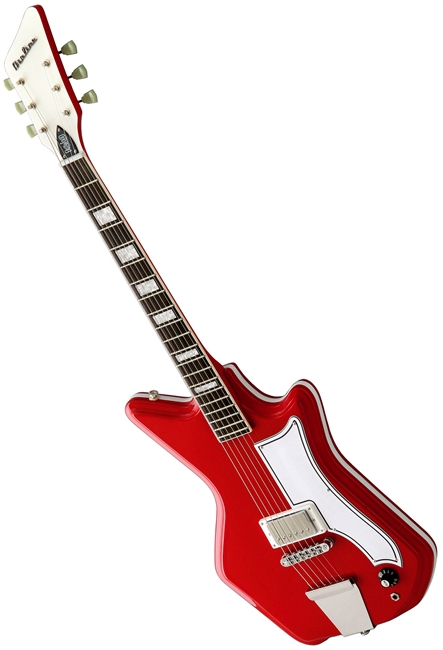
Airline '59 1P Custom Single Pickup Solid Body Electric ...We didn’t hear from Columbia Record Club again and Dad, eventually, let me take the box of 33rpm records back to the basement where I totally wore out all of them. Listening to Gillespie and Davis inspired me to want to play trumpet. Being always short on cash, I eventually inherited an awful Conn cornet from my step-mother’s brother and discovered that I had no talent for teaching myself trumpet, let alone jazz trumpet. A few years after taking up the trumpet, I managed to score an awful Sears Airline acoustic guitar. After struggling with that instrument for a while, I used my paper route money to buy a $35 Airline electric guitar from my local Western Auto store. Thanks to my Columbia Record Club jazz exposure, no part of early 60’s vocal music appealed to me, but I could get my teeth into The Ventures, Dick Dale, The Surfaris, and, thanks to the local music magician, Howard Roberts.

By the time the Beatles and the British Invasion straggled into the Midwest and KOMA radio, I had no interest in either British muppet music or vocals in general. Somewhere in that period, I found WLS out of Chicago and soul music. Imagine hearing Wilson Picket, James Brown, Otis Redding, the Staples, the Bar-Kays, or anything from Motown before you hear the Beatle’s chipmunk voices and the Stone’s limp R&B imitations and you’ll have a clue where I was coming from as a wannabe musician. It wasn’t until I heard “The Freewheelin' Bob Dylan” before I developed any kind of appreciation for lyrics.

I consider all of that sloppy luck. Every bit of it, from mailing in that Columbia Record Club enrollment card to picking “jazz” as my musical preference to that  music leading me to R&B instead of R&R pop to the trumpet-to-guitar progression to becoming who I am as a person and a still-tryin’-to-be-a-musician 76-year-old. It was all good luck.

Sunday, April 2, 2023

Placing Bets

The music/audiophile equipment business has been selling snake oil to a gullible portion of the public for at least since Emile Berliner began making 5-inch “gramophone” recordings of chamber orchestras. Connectors and conductors are one of the biggest scams perpetrated on the gullible and wealthy “customers.” Lots of people have spent more energy than I on dispelling the myths and bullshit and I think this paper does it as well as anyone, Mission Engineering’s “Measuring Guitar Cables.” I’ve also spent some energy in my past career and more recent articles on some of this stuff, but I’d old, tired, and more amused than outraged these days. In fact, for the most part I’m now totally on the side of the con artists. The past 40 years of watching the incredibly stupid folks who call the rest of us “libtards” has convinced me that there is nothing unethical about scalping people who want to be scalped.

A few nights ago, I was hanging out with a couple of local musicians and one of them began to explain why his $250 guitar cable was better than a regular cable. He is an electrician, by trade, and I’ve found that those guys are typically strong on the NEC and weak on electrical theory and this guy was no exception. He first started off by tossing out a word, “hysteresis,” that he clearly did not understand as some kind of quality connected to electrical conductors. Then, he went on to try and tag the “skin effect” to how he imagined that his new, grossly over-priced cable could make a passive electric bass guitar sound like one of his active instruments.

Pause here while I explain why I am not rich: I am slow-witted. When people say stuff that either blows me away with insight or astounds me in their stupidity I am equally stumped for an unacceptably long time. Sometimes days will pass before I come up with a relevant question or a snappy comeback. As disappointing as I am in print, I am way slower and dumber in person.

A day later, I realized I could have made some serious money that night. I am not a gambling man (at least not with my money), but this wasn’t a gamble. The next time this comes up in conversation I hope to be ready to bet $1,000 that I can easily setup a test that will prove this dude can’t tell the difference from a $10 Chinese-made cord and his grossly over-priced spread. All it will take is an agreement on what would be “proof” in the test (at least a 75% success rate), a blindfold, a pen and paper, a quiet unbiased witness or two, the two test cables, an instrument (especially a bass), an amplifier, and a dozen cable-swaps and about 15 minutes and I’ll be $1,000 richer.

In case you care, the ONLY things that matter in guitar cables are reliability and shielding quality. Reliability is directly connected to the size and quality of the connectors, the ability of the inner conductors to “slip” inside the outer sheath (either with slippery insulation materials or paper/plastic wrapping), and the care the manufacturer takes in assembly. Most shielding, either braided or double-wrapped, provides 100% shielding and, contrary to your high school football coach’s bullshit, 100% is as good as it gets. Avoid aluminum foil shielding because it will become noisy when it is flexed. Long cables are less reliable and more likely to become noisy. Noise is a relative thing with guitars, though. Since they are unbalanced and high impedance, your pickups are likely to be a bigger noise issue than your cables.

Wednesday, June 22, 2022

From Whence It All Began

Recently, I saw a Facebook post on Pat Metheny’s page where he said, “"The Beatles were huge for me. Without them, I don't know if I even would have become a musician or a guitar player. When their hits started coming out, I was 8 and 9 years old and it had a tremendous impact on me. . .” and he proceeded to play “And I Love Her.” Obviously, Pat turns a fairly deplorable song into something very likeable and almost infinitely more complex than the original composition.

I have been a Pat Metheny fan since his Gary Burton days and he is in my Top 5 guitarists, some days at the top of that list. I played in bands that had a fair share of Beatles songs for 20 years, but in my mind I was always pandering to the lowest common denominator when I played most of those songs. (I admit to liking “Taxman,” “While My Guitar Gently Weeps,” “Got to Get You into My Life,” and “Birthday[for about a decade, the only song I would play when someone requested “The Birthday Song” and one of the Beatles only actual rock songs]). Otherwise, the band often labeled as “the greatest Rock and Roll band ever” mostly left me wishing for silence.

I absolutely admire George Martin’s genius in recognizing that 4 moderate talents were visually (and could be made to aurally be) the exact right thing for a crowd of blooming Boomer teenagers to obsess on. His commitment to molding that mess of “talent” into what the Beatles became is historic in R&R history. If Martin hadn’t forced the Goofy Three into dumping a mediocre drummer and accepting a professional musician who rewrote the job of pop drumming forever, they likely would have been a one-hit-wonder; if that. To highlight that point, in 1971 neglected and mostly unsuccessful John Lennon asked “What's he done now?” in regard to George Martin’s post-Beatle career. I have loved that typically clueless moment in John’s feet-in-mouth career for 50 years. Wikipedia’s George Martin discography is only a partial list of Martin’s accomplishments before and after the Beatles. “Blow by Blow” alone changed as much in pop music and recording history as had most of the Beatles’ output. (There, I said it and I hope that is out of my system forever.)

But Pat’s comment started me thinking about my own considerably less creative or interesting original musical path origins. One band is probably most responsible for me giving up on my Dizzy Gillespie clone trumpet-player pipedreams and that would be The Ventures. I’m older than Pat, so there is that, too. I was 12 when Walk Don’t Run became a hit in 1960 and had been flailing at the trumpet for 3 years by then. With paper route money, I bought a terrible Sears acoustic guitar and two years later gave up on the trumpet forever. When I was 13, I was in a kid band playing (badly) surf music and Venture’s hits and the summer I turned 14 someone in that band had a connection to the nun (not a typo) who was responsible for bringing the Ventures to the Dodge City, Kansas City Auditorium. Their concert was being promoted and organized by the now-defunct St. Marys of the Plains Catholic College and two of my bandmates were very Catholic Italians and at least one of them had a good enough connection to the college to get me a “job” as a stage hand for the Ventures’ show.

Back in those days, setting up a stage for a rock and roll show was a whole world different than the past 40 years of pop music. The Ventures had three guitar amps and one bass amp, all Fenders, and their instruments, also all Fenders. The auditorium provided the “sound system” for any vocals or dialog, a three or four-channel Bogen tube mixer with about 20W of power and a pair of awful Bogen columns. Worse, it was all being manned by an old man who, I think, was a plumber by day and, later, ran a Suzuki motorcycle shop. As I remember, the “sound check” amounted to him plugging in a mic on a stand and tapping on it. He quickly went sleep next to the mixer before the show even started. Talk about a harbinger of what live sound would become in the future!

I carried amps and guitar cases from the loading dock to the stage and did whatever the band wanted me to do and was finished with my part of the job in an easy hour or so. They noodled around a bit with the guitars and amps, but didn’t really do anything resembling a sound check or rehearsal before they headed off to the backstage area to wait for the crowd to show up. With no adults in the room to care about what I did until after the show and load-out, I climbed the ladder to the grid over the stage and found a great seat right over the middle of the band about 20’ up and well out of sight of the audience. In the dark, I dangled my legs over the edge of the waffled grid and hung out in nervous excitement for the band to appear and the curtains to open.

Someone from the college walked in front of the curtains and said something like “Ladies and gentlemen, the world famous Ventures!” and the current opened up, the band walked to their instruments, strapped them on, and with a short count-in started with the as-yet-to-be-recorded or released Ventures’ version of Richard Rogers’ opera “Slaughter on Tenth Avenue.” When they struck the opening chord, I almost bounced off of the grid and rained down on their unsuspecting heads. Only luck and a good last minute grip kept me from “bringing the house down” before the first verse. As good as this remastered version of their record sounds, in my memory the live performance was 1,000 times better and more powerful.

Except for the songs they played that night that I’d yet to hear, my band covered almost everything in their catalog from “Walk, Don’t Run” to “Sleepwalk” and all of the surf tunes. Nothing I’d heard in those recordings prepared me for the real, live Beatles . . . I mean Ventures. My life was changed forever and for the next 15 years I was focused on becoming as much like those four guys as possible, except for the greasy hair. Not that I didn’t admire their hair, I was just too lazy to comb mine let alone coat it in Brylcreem.

Classic lineup of the Ventures in 1967After the concert was over and I’d helped load everything back into their vehicle, I remember walking across the parking lot with Nookie Edwards, Bob Bogle, and Don Wilson and asking them to autograph something I’d managed to find that was autographical. The response from Nookie Edwards was, “Surely.” And he reached for whatever I had to sign.

Bob Bogle said, “Don’t call the kid Shirley.” And they all broke up. That was the first of a few thousand times I head that joke, but every other time I’ve heard the lines it brings up a fabulous memory of getting to hang out with my childhood idols. For me, the Ventures started it all, first with their records, second with a live performance. Live sound, recorded music, technology and a life-long fascination with audio electronics, and whatever music I have managed to reproduce or create in my limited-talent life as a bass and guitar player. No band, ever, more deserved to be in the Rock and Roll Hall of Fame.

Monday, August 26, 2019

Being A Musician

Lots of people believe that there is something sort of magical about being a musician or being “musical.” A friend who is the poster child for all things musical once came to a local weekend jam session when he was visiting for a week. Afterwards, he said something about the folks from that group not being “musicians.” And I asked what he meant, mostly because I have always been fairly embarrassed at the fact that after playing guitar for almost sixty years I still suck. 

He said, “There are three things that you have to have to be a musician; 1) you need to know music theory and technique for your instrument, 2) you need a decent sense of rhythm, and 3) you need to listen. If you have any one of those qualities, you could be a musician. If you have all of them, you probably are a good musician. Most of the people in that room (the local jam session) couldn’t make a claim to any of those qualities.” 

And he was right. 

To be fair, some of the people in the jam session were beginners; regardless of age. However, my friend’s #3 point, listening, is something anyone who wants to be a musician should develop really early. Honestly, it should come easier than it apparently does. 

One of the many things that drove me away from live performance was the fact that it was close to impossible to put together a group of 4 or more people who would bother to listen to the output of the group. In the recording studio, you can compensate for your performers’ inability to listen to the music. You track every instrument and every voice, one-at-a-time, and you mix the outcomes into something that may resemble a “performance.” Getting human beings to act like musicians is, sometimes, as close to impossible as getting old white people to think about anything but themselves. 

For example, that same jam session occasionally attracts a local character who thinks of himself as being almost famous. He knows a half-dozen songs, mostly old time bluegrass/country tunes, and he plays and sings them really loud. The format in this session is generally set and designed so that everyone gets a chance to pick a song and sing it; if they want to. You can always pass on your turn, but everyone usually gets one. Unless “almost famous” shows up. He uses every pause in the action as his moment to either tell a story about himself or to start hammering away on another song. At best, the cycle goes: someone in the group picks a song, “almost famous” does a song, someone else does a song, “almost famous” does another, and so on. 

Not surprisingly, “almost famous” complained that he couldn’t hear the other players guitars over his own instrument; especially when someone took a solo on one of his tunes. His solution was to get a PA into this normal, reverberant room. The person he complained to, one of the better players in the group, suggested that he try to hammer his guitar more quietly when others were playing. His response was, “This guitar just doesn’t do quiet well. It’s really loud.” I was fortunate not to be eating or drinking anything at that moment. Otherwise, I might have sprayed the group. 

Guitars, especially acoustic guitars, are capable of substantial dynamic range. Guitar players, especially electric guitar players, are rarely able to shut up or lower their volume at all unless you put sheet music in front of them. This particular acoustic guitarist had never been in a situation where he had to listen to anyone else while he played. At almost 70-years-old with five decades of “music" performance behind him, it’s probably too late for him to learn the most basic requirement of being a musician. That is something really scary to consider.

Monday, August 12, 2019

Where Did You Come From?

Kids in class who have an over-inflated sense of their self-awareness and experience remind me that, someday, there will be a payback and it will be a bitch.

Not that many years ago, my author-music-reviewer-daughter Holly, wrote a review of Bad Plus that included some pretty silly proclamations about the gap between her music knowledge and appreciation and mine. I was entertained. In a similar conversation earlier, she had said, "Dad, I'm a music reviewer" as a statement of superior expertise when we had a disagreement about what qualified as ‘good music” and what didn’t. There are few things on the planet musicians or artists of any sort despise and ignore more than reviewers.

Our other daughter once told me that "It is great being in a family that is so musical," in reference to her husband's family who are dedicated karaoke fans. My kids grew up in a house full of musical instruments, musicians, recording and live sound equipment, and with music of some sort happening all the time, but somehow none of that registered. With all of that background, the first time she held a cheap microphone and sang along with canned muzak in front of a crowd of drunks in a karaoke bar was her first “real musical experience.”

Holly's son is now 22 and is convinced that none of the adults in his family know squat about music. Holly has written one of the biggest selling music theory books ever, The Dummies Guide to Music Theory, and gets a buttload of free CDs in the mail every month from her history as a music reviewer. Not a credential in her son’s mind, because . . . I don’t know what. When I was paging through the weirdly disorganized music list on my car stereo, he had to ask, “Why do you have all of that crap in with your music?” I don’t even want to know what he calls “crap.” He is his mother’s son, with even sillier tastes, and my interest in educating or even talking about music with non-musicians is vanishing into nothingness.

No matter what you have done, your kids will think you have done nothing. Tony Hawk’s kids, apparently, think he is a loser. Of course, most likely the only thing Tony Hawk’s kids will be ever be known for is being Tony Hawk’s kids. So, there is that.

Monday, July 29, 2019

You Haven’t Done Nothin’

Kids in class who have an over-inflated sense of their self-awareness and experience remind me that, someday, there will be a payback and it will be a bitch. Not that many years ago, my author-music-reviewer-daughter Holly, wrote a review of Bad Plus that included some pretty silly proclamations about the gap between her music knowledge and mine. I was entertained. In a similar conversation earlier, she had said, "Dad, I'm a music reviewer" as a statement of superior expertise. 

There are few things on the planet musicians or artists of any sort fear and despise more than reviewers. Our other daughter once told me that "It is great being in a family that is so musical," in reference to her husband's family who are dedicated karaoke fans. My kids grew up in a house full of musical instruments, musicians, recording and live sound equipment, and with music of some sort happening all the time, but somehow none of that registered. The first time she held a cheap microphone and sang along with canned Muzak in front of a crowd of drunks in a karaoke bar was her first real musical experience. 

Holly's son is now 20 and is convinced that none of the adults in his family know squat about music. Holly has written one of the biggest selling music theory books ever, The Dummies Guide to Music Theory, and gets a buttload of free CDs in the mail every month from her history as a music reviewer. 

No matter what you have done, your kids will think you have done nothing.


Sunday, May 12, 2019

That Is Not A Studio

About 5 years ago, I wrote a diatribe about motorcycle helmets, titled “That’s Not A Helmet.” After hearing a friend’s description of a few hours in a local “recording studio,” a lot of the thoughts behind that motorcycle rant came back to me.

First, a recording studio should be an excellent acoustic space. If it is not that, the best you could call it would be a “practice space that also stores some recording equipment.” Let’s be honest with why people want to call an overdub space, lousy practice room, or even a living room “a recording studio.” Money. Money. Money.

1) Money spent by the wannabe recording engineer on equipment that far exceeds both the talent of the user and the acoustic capabilities of the space. If you spend $5,000 on a half-dozen high end preamps and an outragesously cool A-to-D interface and your acoustic space is like any of the spaces I’ve collected in the pictures in this rant, you’re fooling yourself. You don’t need 100dB S/N or 126dB of dynamic range, because your crappy space has a 55dBA noise floor. No manufacturer currently selling equipment makes a preamp that is anywhere near as awful as your recording space. $200 is overkill for your room.

2) Money being made by boutique and so-called pro-level manufacturers over-selling equipment to people who don’t need anything near high-end, wouldn’t know how to obtain high-end performance in a pro studio with a professional assistant, and who have almost infinitely more money than sense or talent. While I saw some of this when I was teaching at a music college, I’ve seen way more of it since living in what is essentially a retirement community in southeastern Minnesota. Every little rich kid in this 16,000 person town seems to have a “studio.” That universally means they have thousands of dollars worth of equipment and instruments crammed into a spare bedroom or basement family room space. At the most, they might have spent $200 on an Auralex kit, which they mindlessly applied to the walls in odd places. Everyone in the supply chain saw these suckers coming and sold them on the idea that “there is money to be made in those recording hills.” Trust me, there isn’t. As a brilliant and experienced friend often says, “The only way to end up with a million from a recording studio is to start with three.” You won’t even make minimum wage renting your space to friends and suckers and if you ever knew how to calculate ROI you’ll have to completely ignore that knowledge if you want to stay sane.

3) Money being made by the various vanity distribution channels from CD Baby to YouTube to Spotify. Every one of those characters will be telling you that “you too can be a rock star.” You can’t. You won’t. And you shouldn’t be.

I’m no saying that you can’t make great music in a non-studio environment. You absolutely can. It’s just a lot harder to get great acoustic sounds in a lousy-to-mediocre acoustic environment. My real complaint is that calling a bedroom or basement rec room a “recording studio” degrades the phrase in the same way calling a garbage man a “sanitation engineer” pisses on the training and education required to actually be an “engineer.” Find another word. I call my workspace “our spare bedroom” or “my office.”

Monday, December 17, 2018

Messy Exits and Revising History

I started writing this the day I came back from the auction of McNally Smith College’s equipment. I wrestled with all of my thoughts for several months afterwards. The end of that school was in no way a surprise to me, but hearing that the end came so incompetently and ruthlessly was a surprising disappointment. I'd thought that I had put the place and its dysfunction behind me after retiring in 2013, leaving the Cities in 2015, and unintentionally disconnecting from too many of the people I loved and respected because the 50 miles between the Cities and Red Wing turned out to be a far greater psychological gap than physical. When I started getting emails from friends still at the school and friends who were still more connected to the place than me, my first response was anger. I'd been there long enough to blip past the "denial" stage without much effort. "Bargaining, depression and acceptance" weren't difficult to transition through, either. But, if I'm being honest with myself, I'm still holding on to some anger about the way good people were treated by seriously bad people and how academia's incompetent, corrupt, and lazy fingers got hold of an otherwise useful school and turned it to crap so easily. 
MSCM auction
The scene of the MSCM auction on June 22.
Almost all of the bidding was done on-line.
Like the nitwit I am, Thursday morning (June 22, 2018) I decided to attend the 2nd day, Thursday, of the McNally Smith College of Music (MSCM) equipment auction. As a more intelligent person might have suspected, it was a sad affair that offered no closure, no celebration of the good years the school experienced, and not even much camaraderie (except for the lucky chance that ex-student, ex-MSCM employee Sam Clark was there for a few moments and he stopped to talk before heading back to work). At the 9AM start of the auction, most of the people physically at the auction quickly realized that they would be overwhelmed by the on-line bidders, which meant very few of the in-person participants participated enough to make their presence worthwhile. Like me, they didn’t stay long even though the auction continued until a little after 6PM. I left about 10:30AM and by then there were fewer than a dozen people in the auditorium who were not associated with the auctioneer’s staff.

In a perfect world, I’d have found some comfort in a group of graduates and faculty outside in the court yard playing music. Instead, I discovered the school’s ex-president, Harry Chalmiers, talking to a friend who also was once a McPhail instructor, like Harry. Over the years Harry headed McNally Smith, he took advantage of more perks than you’d hope a small college might have to offer; from luxury housing, to overseas vacations with his wife, to free recording services and performers for his “compositions,” to using his position for self-promotion, to an large and well-appointed office that might make a Washington lobbyist blush, to casual work obligations for the school that often seemed secondary to his actual interests. To many of us, his claim to fame and his office was an unlimited willingness to lavish outlandish public compliments on Jack McNally and Doug Smith (aka “J&D”): words that would have made people with actual accomplishments want to escape out of embarrassment. The first half hour of every commencement Harry presided over was a hilarious litany of Jack and Doug worship. If you where there before Harry, Jack and Doug’s minimal contributions (and financial profiteering) were pretty much a given and their efforts to purge the school’s history of the people who actually made the place work and to replace their efforts and success with a fabricated fable of themselves was a sad, painful story. Harry used to brag that “I have the best job in the world” as president of the school. Many of us suspected that was true, even if we couldn’t figure out the functional aspect of that “job” outside of flattering J&D at every opportunity and creating as much distance between administration and the actual activity and function of the school as possible.
jack and doug
harry chalmiers
It is slightly entertaining that these
characters liked to pose next to
equipment they didn’t use, understand,
or even know why it was there.


For a moment while standing outside of the wreckage of Jack, Doug, and Harry’s legacy that June morning, Harry’s story and opinions changed substantially since his last formal public statement to the press. Now, he imagined he had a book to write about “what really happened” in the whole MSCM debacle. Worse, he thought he had the insight and skills to write a “leadership” book. (I guess if JP Morgan’s Jamie Dimon can claim some place in the “leadership” hierarchy anyone can.) Right after the school’s collapse, Harry was hustling the delusion was that the school simply ran out of time in making the conversion from for-profit to non-profit. In reality, the universe doesn't print enough time for incompetent, greedy people to find a mission. Jack, Doug, and Harry never really got a grip on what the school's business was. Jack and Doug thought the school was about "making me a ton of money without me having to do a lick of work." Harry thought it was a place where he could pretend to be a "leader" and a musician and make a lot of money without having to get his hands dirty making hard decisions that would involve requiring administrative people to be more useful and productive and less political. Harry built an empire of administration, equal to the number of instructors in the school and way more expensive, and that is what toppled the business. Jack and Doug extracted money from the school like it was a rich daddy who just wanted to keep his kids happy and out of the way without having a clue what would happen when daddy's pile of money ran out.

I was in the room for some of those discussions, years before Harry arrived, and it was obvious why non-profit was a non-starter: Jack and Doug weren’t willing to give up the giant pile of cash they paid themselves from the school’s annual profits. Suddenly, as of that June morning’s conversation, Harry said the school ran out of money because Jack and Doug extracted “millions” from the school’s bottom line during the flush years and put as little as possible back into the facilities and nothing into what probably should have been an endowment for the school to use in hard times. That Thursday morning, Harry’s argument for the school’s failure was that J&D’s “share” of the school’s income was so large that it didn’t allow the school to build any sort of savings buffer to carry it through when emergency expenses came up or income went down. Harry was not the first employee to realize that, but he might have been one of the last. Around the time the school changed its name from Musictech College to MSCM it became obvious that the real school mission was "make Jack and Doug rich without asking them to do anything useful. From equipment purchases to using student fees for actual student activities, it was clear that administrative lackeys had received the message, "Don't spend any money that can be flipped into Jack and Doug's profits at the end of the semester."

Harry’s new insight was not even close to being a new story. I’ve heard variations of that from everyone I know who was in a position of administration at the school. Jack and Doug, two mostly absentee company owners (to them it was always more a “company” than a school), extracted enough money from the school every year to fund a second school. According to Harry, Jack never met a pile of money too large to be quickly and foolishly spent. So, it’s possible that Jack is at least inconvenienced, if not bankrupt. Unlikely, but almost imaginable. Most likely, his money is safely protected in “retirement savings” and property and bankruptcy is just a corporate tax and responsibility dodge. According to Harry, Doug, has squirreled away “plenty of money” in retirement accounts that are untouchable by bankruptcy courts. The media’s stories about Jack and Doug “loaning” the school money to keep the doors open are as half-researched and gullible as you’d expect from a news media staffed mostly with lazy, entitled, rich-kid interns. If I were betting my money, I’d bet that J&D put themselves on the list of creditors just to make one more extraction from the school’s victims: sorry, I mean “students” and ex-employees.

In the 13 years I worked at the school, I never saw any evidence that sacrifice was among the things Jack and Doug were willing to do for the good of the school. J&D liberally used facilities, employees, and students to produce their own musical abortions; as did Harry. Their seldom-used offices were as large as most student apartments, while their participation in actual school management was so slight someone who was once the head of Admissions barely knew who they were. Harry’s office could have been, and should have been, a classroom or an office for several administration characters.

harry piling it on
Harry going on about how brilliant J&D
were to hire him and to manage to
dress themselves in robes that day.
NOTE: At this point, does anyone else see the irony in McNally and Smith being bounced from McPhail, starting Guitar Center/Musictech, moving to St. Paul which spawned IPR and the other Twin Cities music production competition, and finally naming their school after themselves forever cementing their memories as incompetent mismanagers in business and academic history? Maybe they should have skipped some steps and just called their new guitar lesson business “McFail?” At least when someone looks up Jack McNally and Doug Smith it wouldn’t be a story about their personal failures with their names plastered all over it. For a pair who were once so concerned about “perpetuity” they sure found an interesting way to get there. 
 
the-last-graduation-ceremony-at-mcnally-smith-college-of-musicThere are good things to be taken away from the school and my experience there. The school became successful largely because of the vision, hard work, talent, and expertise of one great manager, the school’s director when it was still called “Musictech” and the man in charge of the move to St. Paul; Michael McKern. McKern staffed the school with excellent teachers, found, hired, and managed an incredibly efficient administration staff, designed the school’s studio complex, administrative offices, and classrooms, managed the school’s rapid growth with class and competence, oversaw maintenance and expansion, carefully selected and installed appropriate equipment for the school’s educational mission, and provided staff and students with a mission that was summed up in the school’s name and reinforced by consistent commitment to our students’ best interests and careers. J&D observed all of this hard work from a safe, comfortable, and non-functional distance. After it appeared that Michael had the school running smoothly, they “took over” by replacing him with an assortment of academic “professionals” who steadily degraded the school to its final state. McKern’s efficient and lean administration was replaced with a staff that, in the end, gave the school a 1:1 administrator-to-faculty ratio that was not only inefficient and unresponsive to anything but serving itself, but inexcusable in its expense and irrelevance.

Once J&D decided to turn the school over to traditional academic administrators, all of that mission stuff vanished. When they decided to honor themselves by renaming the school, and selling that as something that was decided by anyone but themselves, the die of self-destruction was cast. Any interaction with Jack or Doug would immediately inform a sentient person that their sole “mission” for the school was to pack their pockets as quickly as possible with the least possible effort required from them. J&D were particularly susceptible to lavish and slavish compliments and most of the so-called “professional academic” mismanagers and academics picked up on that quickly and used it to pad their own nests and degrade the school and its operations.

Not many businesses—educational or otherwise—have a real mission. Most organizations arrive by accident, succeed by accident and luck, and wander through their history as clueless as a headless horseman. For a brief period in its 35 year history, Musictech College had a mission and any student or employee lucky enough to be there then should treasure that memory for what it was; a rare opportunity in a rare moment.

Thursday, December 6, 2018

Brave Spirits or Just Dumbasses?

In August of this year, John Baccigaluppi wrote a TapeOp End Rant titled "An Endangered Species?" The gist of this article was "The beauty of older analog gear is that we can actually fix it with fairly common parts, or at least we have been able to so far. I recently sent a pair of 1950's-era RFT bottle mics to Scott Hampton, of Hamptone in order to upgrade their power supplies and he had this to say, ‘These things are beautiful, in the fact that it's like working on a 1940's truck. Everything is easy to access and is straightforward. [The work is] going quick and smooth.’" This is a much different experience than troubleshooting why a DAW stopped working after the operating system was updated." I’ve owned 1940’s trucks and I remember that they needed major work about every 10,000 miles, could barely make 10mpg, puked out climate-changing emissions including lots of unburned fuel, were noisy, unsafe at most speeds, and rusted as fast as sugar in water. I’m unimpressed. My response to that column was: 


While it is always entertaining to hear old men (or old souls) rhapsodizing about when “spirits were brave, the stakes were high, men were real men, women were real women and small furry creatures from Alpha Centauri were real small furry creatures from Alpha Centauri,” tools_Header_JointsJohn Baccigaluppi’s “An Endangered Species” harping about the deficits of lead-free solder was funnier than I suspect it was intended to be. Solder defects have always been a substantial part of electronic equipment failures. In the 80’s, I had a side business repairing Roland Guitar-to-MIDI converters because that company failed to anticipate the mechanical stress of their power supply components on their fragile circuit boards. In my MI equipment repair career, I would estimate that at least 75% of all electronic component failures were initiated by solder connection failures. Even the often-praised point-to-point tube circuits were known to rely on their unreliable mechanical attachment to the terminal posts because the heat from the tube circuits and the lack of flux removal caused the lead to degrade into powdery lead-oxide. As many companies demonstrated over the last century, the beauty of tin-lead solder was that any half-trained chimp could make a mediocre but hard-to-inspect solder connection, but the flaw in that technology was that the circuit designs were rarely conducive to sufficient removal of the flux residue which led to deterioration of the connections with heat, moisture, or just oxygen exposure. 


Like the lovers of big iron American cars, unreliable but repairable out of necessity overweight vintage motorcycles, and lead-based ceramics, Baccigaluppi’s rhapsody for the days past when equipment failed often but could sometimes be repaired with enough effort, patience, and money is nothing new. However, those old vehicles rarely survived 50,000 miles without some sort of major overhaul and while they might have survived in a climate-controlled garage for “60 to 70 years” they were useful transportation for about three years before the cost of repair overwhelmed the cost of replacement. Today, a car that doesn’t last for at least 200,000 miles before needing major work is clearly a lemon.


Electronic Recycling Likewise, I suspect at least a few thousand “vintage” large format consoles have ended up polluting the nation’s water supply because their performance and capabilities didn’t warrant the cost of repair, let alone the real estate necessary to house that equipment. Like old cars, motorcycles, and pottery, the collector/hoarder business in audio equipment is coming to an end. Baccigaluppi asked, “how many pieces of classic recording gear have you seen in a trash dump?” Last fall, I took a “ghost town Detroit” photo tour and saw a building full of “classic recording gear” and broadcasting gear abandoned to metal scavengers in a Detroit public school building: MCI and Otari tape decks, racks of AT&T patch panels, recording and broadcast consoles, effects and signal processing gear, and piles of audio and video patch cables. The school had, supposedly, tried to find a buyer for the broadcast vocational school’s equipment, but no one was interested. So, sooner or later all of that stuff will end up in a trash dump. About a decade ago, I had the opportunity to obtain a pair of Otari consoles that had been used on the first Star Wars movie, just for the cost of getting the consoles out of a 3rd floor warehouse and finding a place to store them. No thanks. So, to the trash dump they went along with a warehouse full of 1970’s and 80’s video equipment.


Some products are worth salvaging, if just for the historical value. Most electronic products are obsolete regardless of whether that was “planned” or not. There is an educational value to repairing an old piece of gear and that shouldn’t be discounted too quickly. There are, however, good reasons why the old equipment gets discarded for the new. There is a wide line between tossing a $600-1,000 phone every year to “stay current” and spending hundreds of hours maintaining old equipment that isn’t even close to capable of performing to modern standards. I suspect the best way to decide where you draw that line is by determining what your time is worth.

That response appeared in this month’s TapeOp Letters to the Editor. It was also interesting to read this month’s end rant about how much maintenance analog equipment needs to be marginally musical and how TapeOp’s editor warns newbies away from the stuff for that reason. 

POSTSCRIPT: My grandson gave me his old eBike because it needs a lot of work after a season and a half of daily commuting; especially because of the damage the bike suffered during a Minnesota winter in the Cities. One of the components that failed was the throttle, which is a Hall Effect transistor-controlled electronic device. Wholesale, the throttle is a $2 Chinese-made part, but there doesn’t seem to be an easy way to obtain that part in the USA except through the bike’s distributor. 

The part is assembled in a way that doesn’t allow for disassembly for repair without either carving into the case or finding a way to dissolve the cyanoacrylate that was used to glue the part together. So, repair is close to impossible and impractical. While waiting for the replacement, I’ve fooled with troubleshooting the circuit and became facinated with the idea that this kind of assembly would fail since it has not real moving parts. 

rt-01-lgWhen an engineering friend was visiting us, I asked if he had some thoughts about why this part might have failed and he tossed it back in my face, “Are you kidding? You know the transistor is mounted on a circuit board, right? Most likely a solder joint failed.” Of course, I should have known that. Consistent with my 55+ years of electronic engineering and manufacturing experience, most likely the failure is a soldering fault.

Monday, September 3, 2018

Pearls before Swine

In the late-70’s I was playing out my string with a show band I’d led for about three years. Everybody was moving on. The bass player’s wife had their first kid and another was on the way and he needed to focus on his career (mechanical engineering). The drummer wanted to work a lot more, since he was a low-paid Nebraska high school teacher, and he’d found a 5-day-a-week supper club band he wanted to join. The first to leave, our keyboard player, had snagged a scholarship at Juilliard.and he was leaving for school in another month. I had started working with a kid who I’d eventually end up partnering with in the Wirebender studio and live sound. We all wanted it to end and we all had good reasons. We stayed friends and occasionally hung out after the last gig, but that was the end of our musical relationships.

When this band was a 4-piece, we covered most of the Top 40 and filled in spaces with originals and blues oddities and we played for money. We’d fired our management company a few months earlier, but the agency still wanted us to work some of the last scheduled gigs. We owned the band name, so it was either us or find someone else to sell the customer on. The 3-piece version was a lot more bluesy and original than the band the customers thought they were getting. There weren’t many complaints, but I suspect our rate would have gone down if we’d have done a 2nd round with that personnel and repretiour.

AL 1207aOne of the last gigs we did was in a southeastern Nebraska town that had an actual 1920’s ballroom with a vintage 30’ foot bar and a round stage slightly off-centered in the room, toward the bar. The audience had room to maneuver behind the stage, between the bar and the stage, and there was a large dance floor (people used to dance, believe it!) to the front and side of the stage. There was a runway, about 5’ wide, that ran about15’ from the stage into the middle of the dance floor. There was a slight downward slope on the ramp, high at the stage and low at the end of the ramp, but it was still a 3’ drop from the end of the ramp to the dance floor. I setup the mains, six (we had eight) Altec Lansing 1207A columns, behind and to the side of the band and ran the show from a 12-channel board on a mic stand near my guitar amp. No monitors, we could all hear the mains and ourselves well enough that we didn’t need more crap to haul up and down staircases. I only used one small condenser on the drums, the three vocal mics were all RE18s, the bass went direct ino the board from the bass player’s amp, keys also went direct, and I had a Beyer M500 on my guitar amp; a modified 1956 Fender Harvard. The room held about 350 people and we always packed it. We were doing one of our last 4-piece gigs, so we pretty much went full-out.

In deference to the large turnout and the money we were getting paid, we pretty much played our old lineup with slightly more originals and less blues. The crowd was into it, the dance floor was constantly full, people were screaming their heads off at the oddest times, and the band was rockin’. Because I am a Townshend freak and we did “Won’t Get Fooled Again.” During the synth middle-break where the guitar comes crashing in and we added a short solo and I’d slide on my knees down the ramp while I played the solo; mildly Townshend-style. I didn’t realize that Pete used knee pads under those coveralls, so my style hurt more than his. On the way toward the ramp, the bass player turned into me and clipped the top of my guitar hard enough to break two tuners and take the whole guitar out of tune. As I slid down that ramp, I discovered nothing on my instrument was in any sort of European-shape of tune. So, I did the only thing a lead guitarist can do under any non-ideal conditions: I played as fast as my fingers would move and stayed as high on the neck as possible to mask the complete dysfunction of my guitar. I cut the slide and the solo short and twiddled trills, hammer-ons and pull-offs, and did pick-slide sound effects until we could end the song.

We took a break and I tuned up my back-up guitar. While I tuned the guitar, sitting on the edge of the stage, people crowded around me. I ignored them at first, but after a few moments I realize they were shouting at me but they weren’t mad. “That was the greatest guitar solo I’ve ever heard” and “Great guitar playing, man!” and and “Damn! That was incredible” and even nuttier stuff. It was not just tone-deaf guys, either. Twenty-or-so girls where in the pack squealing away like something good and true had happened. I, literally, didn’t spend a musical micro-second on that solo. Not one “note” was intended and I didn’t even waste much thought on what the rest of the band was doing. And nobody seemed to be laughing (other than the band guys) at my predicament?

As I was finishing up the work on my back-up guitar, in that moment I decided I’d had all of the “pearls before swine” experience I could stand for a lifetime. I spent hundreds, thousands of hours practicing my craft and all I had to do was wiggle my fingers fast and I’m “great?” I thought, “I quit. No more of this band-shit. I’m done.” When we played our last booked gig a few weeks later, that was it for me. Until a friend talked me into a gig doing his music in St. Paul in 2016, I hadn’t played in front of an audience since 1982. I did a lot of live sound tech work, some recording as a tech and as a guitarist, and lots of electrical audio design work, but for the next three decades I had no interest in being “a musician” for a live audience. To this day, there are a really limited number of places I’ll consider exposing myself to an audience. I’m not that fast anymore.

Tuesday, May 15, 2018

You Can't Go Home Again

In late-March, a friend from Detroit visited the Cities and we got together at the downtown St. Paul Keys Restaurant for breakfast Saturday morning. I can't remember the last time I was in downtown St. Paul and didn't run into someone I know, but that Saturday was a time when that happened (or didn't happen). I couldn't help look around the restaurant for familiar faces. From 2001 on, I ate a lot of meals in that place with a lot of friends and it was eye-opening to realize that they were all scattered to the winds because of the McNally Smith College debacle. St. Paul isn't the same place it was a few years ago. As a result of that hole in our visit, we decided to walk over to the former home of the school. He sent me a few of the pictures he took and those pictures inspired this essay.

For the first time since I turned in my last course grades in 2013, I returned to the scene of the McNally Smith College crimes. Not long after I retired, my wife and I took a winter-long camper trip west. When we came back, we got serious about downsizing our possessions, bought a house in Red Wing, sold our Little Canada house, and started our new life in small town Minnesota. Other than by staying in touch with former students through Facebook and a few of the school's instructors and administrative employees, I didn't think much about the school or its fortunes until in late December of 2017 when I received a flurry of emails from friends still working at the school; the school's owners suddenly decided to close the school a week before Christmas break.
There are people who claim they had no idea the school was in trouble when it suddenly closed the doors. I'm not among that group. There were multiple times during the 13 years I worked at MSCM when it was apparent the school's management was dysfunctional, uncommitted, and disconnected. In fact, pretty much every time I came in contact with either Jack McNally or Doug Smith it was obvious that they were incredibly lucky to have been owners of something like a music "college" rather than desperately poor marginal musicians trying to make a living teaching guitar in a music store closet. Unless you’ve ever met a “job creator,” you could be fooled into believing that all sorts of positive attributes contributed to their success. In most cases, the successful entrepreneurs I’ve known were just incredibly lucky and their real work behind their success had nothing to do with the owners’ involvement; or lack of.

All of the school's success was due to people McNally and Smith hired more out of accident than management brilliance. Somehow a few competent and committed people who found their way into positions of authority and management; mostly because Jack and Doug were busy admiring themselves in the mirror. Michael McKern, for example was exclusively responsible for the complicated and timely move from the Minneapolis Musictech facility to the abandoned St. Paul Science Museum building in 2001. Occasionally, Michael would shepherd Jack and Doug through the construction project, showing them where the money was being spent and describing what the school would look like when the contractors were finished (just in time for the beginning of the 2002 spring semester). The two "owners" were about as involved in that process as a pair of squirrels watching a house being constructed across the street from the forest where they lived.

I was in a few committees that included either Jack or Doug during the years I worked for MSCM. I was always amazed at how decoupled they seemed from what was going on in the facility they later decided to rename after themselves. One of my favorite fables about MSCM is pretty much the story about the school's name found on Wikipedia, "Formerly known as Musictech College, McNally Smith College took its new name in honor of its two founders, Jack McNally and Doug Smith, on its 20th anniversary celebrated in 2005." That is a pretty funny take on the fact that the accrediting organizations (to use that term loosely) strongly advised the school to lose the "tech" aspect from the original school name, MusicTech. The goofballs from National Association of Schools of Music (NASM) met with the accreditation committee members and told us that they had a problem with "tech" being associated with higher education. I wondered if they had the same problem with MIT, the three Cal Tech variations, Georgia Tech, Illinois Institute of Technology,
Florida Tech, Texas Tech, Virginia Polytech, etc? It was a rhetorical question, since I doubt any of those schools would bother with a low-life group of wannabe academics like the NASM characters. Nobody even tried to answer that question, though. In the end, the naming committee recommended a collection of music-related possibilities with the suggestion that "anything but McNally Smith College" would be a not-awful possibility. The "in honor" part of Musictech College being renamed to “McNally Smith College of Music” was purely inspired and demanded by Jack and Doug. I suppose, otherwise how would anyone know they had anything to do with the school?

In a Star Tribune article about the closing, Jack McNally was quoted as having sent an email "asking faculty and staff to 'consider finishing the term and issue grades as usual to avoid these horrific consequences for our students, even if it is without pay, simply for the sake of our students.'” That might be the first thing I ever heard of that Jack did "for the sake of our students." However, since all of the effort and cost of providing that service would be coming from faculty and administration personnel who would not be paid for the work, it's tough to cut Jack even a little slack. One of the last things the remaining administration folks did was on display on one of the school's doors: a "transfer fair." That must have been sobering, disappointing, and a slap in the face for everyone involved. It has been a well-known fact for most of the school's life that few credits were transferable to any real college. Often, no credits were transferable and sometimes no credential was allowed for a MSCM degree when a student decided to try to continue his or her education with one of the more traditional and substantial higher education facilities.
I admit I felt sad and disappointed when I saw the state of the school and when I took these pictures. A lot of effort and commitment went into creating the facilities inside this building and even though much of that work was done 16 years ago, it could have gone on being useful and valuable for a lot more years. Everything ends, but this particular institution ended in the most despicable way possible.

From the beginning of the semester in August 2017, there is no chance (other than gross incompetence) that the administration and ownership did not know precisely the day, or week at the worst, the school would run out of cash, based on the registration and tuition available. IYou’d think at least some regulatory agency would be taking note. In a decent world, you’d think the employees of the school would be owed a formal explanation and apology along with substantial severance pay for the interruption to their careers, the economic strain the sudden closure and unpaid work the owners expected from them, and their inconvenience and displacement.

Yeah, I admit it. I’m pissed off. I left a lot of friends at MSCM when I retired in 2013. I expected the school to slowly wind down and, eventually, either close or be absorbed by a competitor or just someone who either wanted the facility for a school or someone who wanted the real estate. At no point during the years that I knew them did I expect much from either Jack McNally or Doug Smith or Harry Chalmiers, but I expected more than this. If this turns out to be a ruthless cashout of the real estate and assets, I will not be surprised.

Sunday, March 25, 2018

How Much Will This Cost?

repair_costOne of the many things students don’t get much of in school is practical economics. As a result, the hourly rate lots of freshly-hatched audio technicians earn is embarrassingly unlivable. One of many reasons the career-longevity of people in the music and entertainment business is notoriously short. While I was working on one of those projects that usually inspires the notion “I could be doing better than this working at a convenience store,” I decided to write something about my own business experience in the music and audio business.

Until the day I retired, I had a price list for the various services I supplied to a variety of; from musicians and facilities who hired me for location recording gigs to studio and audio equipment repair services for musicians and recording studios to building contractors (acoustic design consulting) to law firms (audio forensics). Some of my price list was determined by the liability insurance required which was mostly determined by the customer (law firms) and the risk (to me, financially) involved in making a court statement about whatever the law suit involved. Acoustic consulting work for commercial construction was almost as risky and required similar insurance protection.

My rates ran from $75/hour to $275/hour. Those are “billable” rates, however, which are not necessarily the same as the hours I actually spent on a project. For example, a lot of recording work requires prep time and effort that the customer doesn’t see or appreciate. So, it just gets folded in to the billed rate. Recording projects are particularly expensive, time-wise, from my perspective. It’s possible at the high end of the “audio engineering” world that people actually make a decent income, but I always suspect a trust fund is involved when someone can afford to spend a career in entertainment.

pyg7cOddly and classically American, my experience with the high-ticket projects came dangerously close to being volunteer work because my liability insurance was so expensive. When I started planning for retirement and was winding down my businesses, the legal work went first. That saved me about $3500/year in insurance costs. The only way doing that work makes sense is if you do enough of it to make up for the insurance cost; at least 20 billable hours. It isn’t reliable work and lawyers, as you might guess, don’t pay their bills quickly and are hard to collect from. It was easy work to give up.

closedFor that same reason, the acoustic consulting work went next. That saved me about $1500/year in insurance costs. Again, it is work you can’t count on and it’s usually not much fun. Although the engineer for the last contractor I worked with was terrific. He did everything he could to take responsibility from me for liability and customer interaction. Designing a quiet staircase in a multi-use building or plugging all of the sound passage routes between a first floor pediatric dental office and a lower-level computer programming company is just not exciting work. Recording studio work is fun, but not particularly profitable. Most of your customers are cheap and not particularly sophisticated and your competition all has a trust fund to spend.

Mostly because several of my ex-Studio Maintenance students were doing a lot of studio maintenance and looking for more work, that business was mostly easy to quit. I just started directing inquiries to them. In the last two years, I’d raised my prices to $225/hour hoping that would drive the business to cheaper techs. When that didn’t work, I had to tell a few customers that I was absolutely no longer interested in crawling around their studios or scouring the food, drink, and drugs out of their wreaked equipment. At least one of those characters had alienated every decent tech I knew of and, I suspect, they simply shut down the studio after the last piece of gear quit working.

Since the 70’s, I haven’t done music equipment repair for anyone other than myself, mostly buying broken gear and selling it in original or hot-rodded condition. In March, 2018, I had about a half-dozen pieces of equipment left in my shop and I am slowly working my way through the pile. When it’s done, I’ll probably convert the electronics shop to a guitar building and repair shop. Or maybe I’ll hand the bench over to my wife for her art projects.

I still do occasional location recording gigs, but with really limited capabilities: no more than 8 simultaneous channels and my interest in working on overdub or large-track-count projects is close to zero. My simple rule for recording projects is, “If I like what you’re doing and the project is fun (meaning, you are not an asshole), I do the job for my cost. If I don’t like you or the project, you can’t afford me.” Most people can’t afford me. I’ve quit pretending like people or projects that I’d just as soon avoid.

c7bbc0570f684ac0ca8fa94366f438dd27c40c37562726a6e386da61927fae2eI’m not being a snob, I would just rather be retired and working on my own projects than worrying about pleasing someone else. I spent more than 50 years of my life trying to make other people happy. For the few years I have left to live, the only person I’m interested in satisfying (avocationally and vocationally) is me. I’ve paid all of the multi-tasking, menial labor, service-job dues I’m planning on paying until I croak. For a long while, I was fairly good at pretending to care what marginally-talented, egotistical, humorless, joyless people thought of my work. Those days are done and, unless I find a way to go broke between now and my last breath, they will never return.

Wednesday, February 7, 2018

They Were Giants


When I first moved to the Twin Cities, there was a music school called "Music Tech College," mostly known as "Music Tech." I quickly met a few musicians around town, mostly my age or a little younger, and they all complained about what they called "Music Tech bands." It took a bit, but I learned that meant "kids who can read music, play every style from classical to jazz to hard rock and everything between, and who put together bands and shows that make everyone else look amateurish." Music Tech bands really did piss off a lot of the old guard because they raised the bar so high for club jobs.

The instructors in this video are the people who created that monster and made it into something so special that schools around the country copied that model. When Music Tech's owners, jack McNally and Doug Smith, decided to remake the school in their own image, into a traditional music college with liberal arts requirements, "higher education" rules and curriculum, and renamed it after themselves (McNally Smith College of Music) the eye came off of the ball, the mission turned into a marketing slogan, and the value to students rapidly diminished. This video is a great reminder of what that school was once all about.

Saturday, September 30, 2017

"To be radical in your art, you need to be conservative in your life."

In an article about the NBA’s Allen Iverson’s economic troubles, the author quoted his artist-girlfriend, "To be radical in your art, you need to be conservative in your life." Similar to the excellent advice Dessa once gave to McNally Smith’s graduates, “Keep your overhead low,” this way of looking at finance and freedom is critical to artistic integrity. Honestly, I think it’s good advice for anyone with a creative bent.

debtThese days, most Americans are “conservative”; which is another way of saying that we are terrified of pretty much everything, especially ideas. The only thing we appear to be fearless in the face of is debt. Our president is a king of leveraged fake “wealth” and many Americans appear to admire Trump’s willingness to pretend to be rich in the face of constant business and investment failure. The US median household owes around $140,000, pays about $1,300 in annual credit card interest, and even the over-65 crowd’s median savings is well under $100k while middle-aged Americans average about $25k in savings. There is nothing conservative about those numbers.

So long ago I can’t remember when or who, someone told me that you can’t retire until you own your home. This isn’t the bullshit “homeownership” crap people spout when they still owe 20-150% of their home’s value to a bank. This is outright ownership. To own a home, you need some luck and a lot of financial restraint. You’ll have to give up a lot to be a homeowner at the end of a 50 year work life.

Giving up things for a better future or to obtain a goal seems to be a vanishing American trait. Most Americans appear to believe they can have it all: new cars, new computers, new big screen televisions, cell phones, an active social life, etc. The fact is, if you aren’t earning big money you can’t afford to spend big money.When I left McNally Smith College in 2013, it was pretty obvious that the school had totally lost sight of any aspect of that fact. There were a few more folks in administration than there were instructors and the administration people were clearly convinced the purpose of the school was to support them and their habits, hobbies, and perversions. It was not a fun place to work anymore.

Paraphrasing Larry Niven and Greg Benford, from, Bowl of Heaven, “[He] thought that life’s journey wasn’t to get to your grave safely in a well-preserved body, but rather to tumble in, wreaked, shouting, What a ride!” Of course, the trick is to do that tumbling in the last few minutes of your life. Crashing with a decade or two of life left means living under a bridge for a couple of decades and that isn’t an adventure, it’s a disaster. I think you have to “live to scale”: meaning you set your expectations, expenses, and anticipated opportunities based on your average past income and expenses. If you plan on being rich in the future and spend like that in the present you’re more than likely going to be worse than disappointed. You are going to be homeless, broke, and without a chance in hell of any sort of hopeful future.
On the other hand, if you are conservative with your resources and expectations, you can go way out on a limb in your art. You can take the kind of risks that so often leads to success because you have something to fall back on and are not gathering so much karmic and economic mass that when you have to fall back you are crushed. That’s what being conservative is really all about. Creating a space cushion for yourself that provides time and resources to regroup and make another run at your goals.

Wirebender Audio Rants

Over the dozen years I taught audio engineering at Musictech College and McNally Smith College of Music, I accumulated a lot of material that might be useful to all sorts of budding audio techs and musicians. This site will include comments and questions about professional audio standards, practices, and equipment. I will add occasional product reviews with as many objective and irrational opinions as possible.