Thursday, August 1, 2019
Real Time with the SM58
Last night, at the Sheldon Theater’s Open Mic I had that dreaded experience for three different performances (as a vocalist and backup singer) and was reminded of how primitive that 1966-designed mic really is. 1st, the pop filter is a joke. At distance, for example the unspecified distance used in the Shure spec shee (at left), you'd think the 58's LF response would be fairly useful for vocals. Best I can figure, that distance must be at least a foot if not a meter. Anything within a could of inches from on-axis to the 58 gets a burst of breath noise that is unlike any other microphone sold today. If you don't roll off every thing below 150Hz or even higher, plosives and breath noise will wreak any attempt at a subtle vocal. 2nd, that infamous 3-6k bump mostly emphasizes sibilance artifacts without making any useful contribution to clarity or intelligibility. 3rd, Shure doesn't spec "max SPL" for the 57/58 models for obvious reasons; it isn't nearly high enough for modern applications. Many vocalists are able to blow the 58 into gross overload, even without the lousy mic hyper-close technique required for their out-of-control stage monitor environment. Likewise, the 57 is famous for it's contribution to the distorted sound of loud electric guitar.
The spec sheet's description of the 57/58 polar pattern isn't anything I have ever put much faith in, either. You'd think that the damn thing was practically flat and feedback-predictable based on that highly creative illustration (see at right). In practice, that would be anything but true.
All of those 50+-year-old "qualities" have been improved upon by everyone from Shure to AT to Sennheiser to Neumann to Audix to cheap Chinese no-name microphones costing even less than the 57 or 58. You actually have to make an effort to find a microphone that delivers worse performance today and, based on what I see on live stages, that might be the only actual work many live sound goobers do.
The one and only claim to fame the 57/58 will hold maybe forever is indestructibility. If an ability to drive nails and keep squawking is the most important thing to you, you are the consummate SM58 customer.
POSTSCRIPT: (8/6/2019) This past week I had a double-whammy experience with the 58 vs something better. After years of wanting to see the John Mayer live "Where the Light Is" concert, I finally managed to snag a copy. It is particularly ironic to watch Mayer agonize over which multi-thousand-dollar watch to wear between sets, swap out various overpriced vintage Strats, while his voice consistently gets slaughtered by the 58 he mindlessly sings into as if it were as well-considered an instrument as his watches or guitars. Clearly, a lot of work went into cleaning up that vocal for the final product, but there is no way to make a silk purse from a sow's ear. Mayer tends toward mushmouth qualities in the studio, but live all of the worst qualities of his voice are emphasized. What a missed opportunity.
My 2nd experience was with recording a local country/pop songwriter in a live setting that, acoustically, left a lot to be desired. Lucky for me, the artist was open to my swapping out his 58 with a recently rebuilt EV RE18. My job, post-recording, was made dramatically easier than what Chad Franscoviak and Martin Pradler had to contend with on the Mayer live recording. Getting a clear, crisp sound from the live vocal took minimal processing and the rest of my job was working with the rhythm section and lead guitar. Regardless of the song style, tempo, arrangement complexity, or vocalist's technique, the vocal sat where it belongs at the front and center of the mix. The fact that the artist's technique is excellent didn't hurt, but the fact that I wasn't wrestling with garbage-in/garbage-out was equally huge.
Sunday, July 14, 2019
Support Live Music and Deafness
A hallmark of a civilized society has always been some sort of concern for the rights, health, and safety of everyone in the society. Here in the USA, we abandoned civilization in the 1980's and never looked back. Reagan and the "greed is good" characters taught a couple generations of mindless, work-slaves that the wealth of a few is a higher goal than the good of many. It has filtered down to every aspect of what remains of our culture. Music, for example; particularly, live music. There was a time, about 20 years ago, when I predicted that "Noise pollution will become the air pollution of today." I was wrong. We went backwards. Today we don't care about air pollution, global warming, economic inequality or insecurity, and noise pollution is practically celebrated.
If you bothered to look at the chart above, you'd notice that pretty much everything we're exposed to in modern life is likely to cause permanent hearing damage. Live music anywhere but in an acoustic (unamplified) environment is hazardous: all amplified live music is hazardous to your hearing health. Is that complicated? Is the risk worth whatever gratification the experience provides? Your mileage is probably different than mine. In my opinion, any live music that uses amplification of any sort better damn well sound at least as good as, and ought to be substantially better than, what I can experience on my car stereo system. Anything less than that is just pointless risk of a fragile hearing mechanism for no justification at all.
In all cases, the only safe way to "enjoy" amplified live music is with significant hearing protection firmly in place. There is absolutely no way to take children to an amplified live music performance that should not be called "criminal child abuse." Children are usually born with terrific hearing and lose it fairly quickly in our modern noise-polluted world. Exposure to the quantity and "quality" of noise a modern sound system produces is flat-out child abuse and should be criminally prosecuted. Personally, I do not understand how the venues, cities, and other adults involved in a well-known medically-unsafe practice are not regulated and prosecuted when they violate public safety, but that's the post-Reagan libertarian nuthouse we live in today.
Monday, November 5, 2018
Technology Is Gonna Do What?
The telephone has been around almost 150 years, since 1870. By 1879, telephone service subscribers began to be identified by their phone numbers, not by their names and by 1918 a million telephones were in service just in the USA. In 1962, Telestar, the first communications satellite was launched. In 1973, the beginning of the end of telephone communications arrived when Martin Cooper developed the first handheld mobile telephone. The first analog cell phone system went into service in Japan in 1979. In the 1990’s, cell phones began the switch to digital and there are hundreds of millions of people now frustrated by the awful sound of low-fidelity (at best an 8bit/8kHz sample rate, 200-3.2kHz bandwidth, 64kbs data compression) digital cell phone conversations and miscommunication created by lousy digital connections.
In fact, according to an Atlantic Magazine article "Don't Hate the Phone Call, Hate the Phone" a whole generation, Millennials, have been diagnosed with a “kind of telephoniphobia” regarding voice telephone communications. Now that half of Americans under 35 use cell phones exclusively, “the intrinsic unreliability of the cellular network has become internalized as a property of telephony.” It isn’t. It’s a property of fuckin’ cell phones and I absolutely hate the damn things. I hate getting calls from people on their cell phones. I hate calling people who I know will answer my call on their cell phone. Between the distortion, the Auto-Tune-like Mr. Roboto voices, and the forced long pauses while we try to determine if there is still a usable connection (on their side) I just assume that at least 3/4 of the things that were said were misunderstood or not heard at all.
I have stopped listening to audio fidelity complaints from people who tolerate cell phones. This is not an anti-digital rant. I love digital data storage and have been perfectly happy with digital audio for music since the early 1980’s. However, the fact that cell phone users don’t even insist on full duplex communications capability from their crap-stick phone providers is evidence enough to me that they are not serious audiophiles of any sort. If you don’t know the difference between half and full duplex, I particularly like this comment and response for an answer: “GSM operates in duplex (separate frequencies for transmit and receive), the mobile station does not transmit and receive at the same time. That's called half-duplex. It's done to save bandwidth and battery power, and to make cell phone conversations more difficult.” While I’m sure the real reason cell phone providers don’t deliver full duplex is because it would be technically slightly more demanding and marginally more expensive, I’m entertained by the assumption that “it's done to . . . make cell phone conversations more difficult.” No matter why it’s done, it sure as hell makes conversations more difficult, less convenient, less entertaining, less personal, and less pleasant.
This afternoon, I tried to have a conversation with my brother who lives in Phoenix and this statement from that Atlantic Magazine article on why people hate phone calls rang true, “On the infrastructural level, mobile phones operate on cellular networks, which route calls between between transceivers distributed across a service area. These networks are wireless, obviously, which means that signal strength, traffic, and interference can make calls difficult or impossible. Together, these factors have made phone calls synonymous with unreliability. Failures to connect, weak signals that staccato sentences into bursts of signal and silence, and the frequency of dropped calls all help us find excuses not to initiate or accept a phone call.”
It’s not just “weak signals” that are the problem. Grossly misnamed “communications companies” have jammed so much data into so little bandwidth that signal strength is just one of many factors that creates an incoherent telephone call. My brother, for example, said he had “five bars” of signal strength, but our conversation was mostly a collection of Mr. Roboto vocoder noises, weird electronic bird song tweeting and screeches, and long pauses where neither of us were able to get anything across the satellite signal path. After a bit, we gave up and went back to email to carry on our “conversation.” A few moments later, my daughter called. We both have “land line” phone systems; hers is provided by her telephone company and mine is through the internet and an Ooma Telo system. We had a pleasant 1/2 hour conversation; with each of us laughing at the other’s jokes and stories made even more personal by being able to hear the laughter while we continued the stories. No weird noises, no Auto-Tuned Kayne West sound effects, no forced pauses waiting for the phone system to reboot itself and reconnect us; just a normal telephone conversation. The kind we used to have every time we picked up a telephone that was wired to the fuckin’ wall; 75 years ago.
The fact that the quality of telephone data transmission is lousy allows cell phone manufacturers to dumb-down the whole signal path. The microphones, the “speaker,” and the analog electronics connecting those transducers to the crappy data transmission system are all degraded. Why connected a decent micro-condenser microphone to an 8bit/8kHz sample rate, 200-3.2kHz bandwidth, 64kbs data compression system? It doesn’t make sense to waste a decent transducer on a crappy ADC system. Likewise, at the receiving end why connect a half-decent speaker to a low-fidelity DAC? So, they don’t. You clearly don’t notice or care. Some of you low-life weirdoes even listen to music on your phone, out of that godawful speaker!
Cell phones have rendered over-the-wire conversations pointless and painful. They are helping us all grow apart. “Can you hear me now?” is not a question of coverage and hasn’t been for at least a decade. Now, it’s a question of did you understand that simple question through the hash of garbled transmission, Star Bores sound effects, and cut-out segments of the phrase? I’ve said this before, “I can, in a few moments, tell if a caller is on a cellphone because the quality is miserable. Always. My guess is if you can tolerate that level of distortion in a voice conversation you aren’t that discerning in any aspect of audio. So, while I’m not surprised that music is being listened to on actual speakers by an audience of 12%-and-shrinking I’m also not impressed by your musical tastes. Your opinion of audio quality is just going to make me laugh, so don’t waste either of our time.” It’s still true, but now I also don’t think you care much about communicating with your fellow human beings.
Thursday, August 23, 2018
Hey! This Guy Sounds Like Me
![]() | ||
| From rap to country to pop, it all sucks. |
Tuesday, September 26, 2017
Use ‘em if You Got ‘em?
I recently did FOH and monitors for a rock band in a small (250 seat), historic, municipal auditorium. It was a four-piece group: two guitars, bass, and drums along with three vocals. I’d never worked that room before, which meant a lot of new things for me to figure out. It would be my first time out with the Behringer X32 digital mixer along with a few other firsts. One of the reasons I took the job was that the director of the facility is a big proponent of low volume shows and there had been some discussions about keeping it small and quiet from past show experiences. The room acoustics weren’t great, but they weren’t terrible either. The auditorium’s equipment was decent and so, it turned out, was the band.
Mostly because the previous house engineer had a show “scene” from the last year’s show, I sort of went with his stage setup. I mic’d both guitar amps and ran a DI from the bass. I setup two overhead mics and a kick mic on the kit, abandoning the previous session’s snare and tom mics. In the end, I used about 16 channels for the 4-piece band. We did a quick sound check, first with the FOH system for me followed by ringing out the monitors. The guitar player at far stage right complained that he couldn’t hear the bass (who was setup far stage left) and I ran up the bass in his monitor to the point it was cancelling the output from the bass player’s amp and overwhelming the FOH bass output. He still couldn’t hear it, so I dialed it back to where it interfered less with the FOH sound. He was the old guy in the group and the loudest amp on stage, so I made the assumption that he was stereotypically R&R deaf. It’s also possible that there was a LF phase-cancellation problem on the stage.
The facility manager complained about the volume during the sound check and I got the bass player and lead guitarist to dial it back a bit. The rhythm guitarist made a show of fake adjusting his amp, but it was obvious that he didn’t intend to comply with the venue’s volume limits. I didn’t bring an SPL meter because I assumed the venue had one, based on the fact that there is a loudness restriction there. I’d guess the show was somewhere between the low and mid-90dBSPL territory.
I started the show with instrument volumes very low to see where the players would go once they got into the performance. Pretty quickly, I pulled the rhythm guitar, bass, and kit out of the mix. I tried to mix the lead guitar signal, up during solos and down the rest of the time, but his signal was mostly so distorted (It was a Neil Young cover band after all.) that my addition to the distortion fog only served to screw up the rest of the mix. That was really demonstrated during a song where he solo’d without his distortion pedals and the guitar lept out of the mix all by itself. That clue’d me into the fact that, if I wanted to hear his solo guitar I needed to band-limit it drastically. I low-passed the lead guitar at about 3kHz and high-passed it at 300Hz, which gave me a signal that I could work with.
In the end, I found myself with faders up on three vocal mics, a DI’d acoustic guitar, and everything else fully attenuated or close to it. I had one moment, about 30 seconds long, where I brought the kit up noticably and I flailed away for most of the first set trying to figure out how to get the lead guitar prominently into the mix. I should have taken a picture of the console: two-to-three faders up and the rest all the way out. All that equipment, all that processing power, and no real need for me to be there for most of the show.
If I’d have just setup up three mics and one DI, I’d have had more sound than the room and audience needed. Even from the monitor standpoint, no one asked for drums in their monitors. The drummer wanted a little lead guitar and bass in his mix. I already talked about the rhythm guitarist’s problems. The end result, from front of house, of the monitor mix was that the bass was constantly overpowering the rest of the band; even though I didn’t put any of the bass in the FOH mix. I nagged the bass player to turn down during the break and he claimed that he didn’t change anything from the sound check. In retrospect, I should have believed him because I was what changed when I tried to make the drummer and rhythm guitarist happy with bass blast in their monitors.
It’s a serious temptation to use ‘em if you got ‘em. You spent all that time and energy setting up mics and running cables for no good reason other than the wild hope that you might actually get to mix a show. In my case, 12 of the 16 lines and mics I’d run were unnecessary. I suspect if I did this on a regular basis, I’d be inclined to give myself more faders to play with just out of boredom. The volume would creep up, the sound quality would disintegrate, but I’d be occupied. It’s something to keep in mind if mixing live sound is going to be your life. You are often unnecessary.
Tuesday, June 20, 2017
Telephones or High Fidelity
Written 6/20/2017
Sitting in the Chicago Amtrak station, surrounded by incomprehensible public address messages, OSHA-defying damaging noise levels from vehicles, police and Amtrak walky-talkies, people talking and shouting, and other machinery and equipment, I’m contemplating the death of the concept of high fidelity. While the bullshit end of the professional and audiophile audio industry are pretending to provide some sort of improved value from vinyl and high-def audio, 99+% of the public could not care less. It’s obvious in their everyday lives. The best evidence that a person doesn’t care about sound quality is the persistence of cellular telephones in their lives. Bandwidth-wise, a cell phone is about five generations down from 1950’s AM radio quality and not much better than an old Edison cylinder recording system. But that doesn’t seem to bother anyone. Except me, anyway.
I have friends who will speculate for hours on the fidelity difference between a half-dozen decent capacitor microphones and will carry on this conversation over a communications system that would make Patrick Stewart sound like Donald Duck. Asking for a repeat of a phrase a half-dozen times because the phone garbled that information into nonsense doesn’t bother them at all, but they pretend they can discern a 1dB difference between two microphones into a high quality preamplifier and recording system. I don’t buy it. If garbage in, garbage out doesn’t bother you on a daily basis, opining about one form of nearly perfect reproduction over another is pure self-delusion.
Fine tuned senses don’t work that way. Use ‘em or lose ‘em. Be picky (rightly) everywhere or be adult enough to admit you just don’t care.
Years ago, I changed our home telephone to a DSL-connected system from Ooma, on the advice of an engineer with whom I worked at the time and a small business man who was simply trying to save money. Immediately, I heard a dramatic improvement in sound quality over the hard line system we had previously from Comcast. Still, when I talk to many business tech or customer service or sales people, I’m impressed with how clear the audio quality is. When I get a call from an individual or, worse, a phone solicitor who is obviously on a cell phone, my first response is to hang up and see if they can call back on a better line. My second response is to downgrade my opinion of the person with whom I am having the conversation. Between the low fidelity, in the best moments, and the cut-outs, glitches, noises, and distortion during the worst, I am hard-pressed to imagine why anyone would consider a cell phone to be anything but an emergency communications device. Honestly, I’d be nervous about hoping to convey emergency information on a 911 call via cell phone, but if I’m lying in a ditch freezing to death or bleeding out, it’s probably the best I can hope for. If I’m home where I could be making the call from a decent telephone system, I can not imagine picking up a cell phone.
So, here’s my point. Pick one: your concern and obsession for high fidelity or your cell phone addiction. You can’t do both without making me laugh at your ridiculousness. If you can tolerate your cell phone, but whine about MP3 compression, you are only fooling yourself.
Tuesday, May 16, 2017
Why Bother?
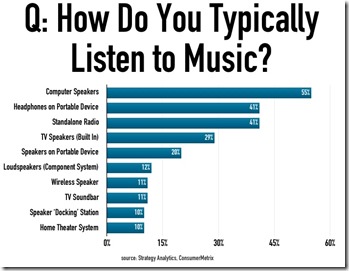
If this isn’t a kick in the ears, I don’t know what is: “According to a survey conducted by Strategy Analytics, built-in computer speakers are now the most common way to listen to music, by a sizable margin. In the study, laptop and desktop speakers overwhelmingly topped the list of frequently-used listening methods, with 55% picking the category.
“Headphones connected to a portable device followed with 41% of respondents, alongside stand-alone radio, also with 41%. Surprisingly, TV speakers were also highly-ranked, with 29% ticking that box.”
While nothing about this information is surprising, that doesn’t keep it from being depressing. More out of habit and curiosity these days, I still read Mix Magazine, TapeOp, Recording, ProSoundWeb, and Pro Sound News. I’m mostly entertained by the seriousness audio “engineers” (an oxymoron if there ever was one) take their degraded “craft.” Almost by reflex, when I read an interview with some kid who has decided he’s the next incarnation of Tom Dowd (No, he won’t have the slightest idea who Tom Dowd was.) I chase down a few examples of the music he refers to as examples of his work. Invariably (Yes, I do know what that word means.), it will be some awful sounding collection of distortion, overused effects, trite synthesizers, and horribly recorded drums.
The critical feedback loop between musicians and their vanishing customers has been wreaked by “portable devices” and the delusional pipedream that some whackos have that high resolution audio will change any of that is nuts. I suppose I should be happy with the resurgence of vinyl, since you can’t get that shit on to a cell phone? If you know me, you know I think going back to vinyl is about as silly as abandoning cars for horses. It’s not the vinyl that matters, it’s the amplification and speaker systems, dumbasses.
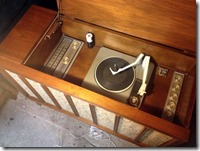
This has been a long time coming. This godawful Webcor record player is pretty much what I began listening to in my audio career, way back in 1959. My father bought it for the living room, decided he didn’t like the way it looked (ours was salmon “red”) and dumped it in the basement (where I lived).
My mother had convinced him to buy an RCA console system, but he decided that took up too much room and it ended up in the basement, too. It really was pretty awful, but slightly better sounding than my Webcor. When he remarried, the RCA found its way back into the living room in their new home and it remained there until they downsized after all of the kids had left home.
By then, I had long since graduated to component stereo equipment, then band sound systems, and, finally, recording studio equipment for my home audio system. Our living room system (aka “Home Theater System”) is still a decent receiver and a pair of JBL studio monitors. The down side to that is that, if I bother to listen at all carefully, it’s pretty obvious that Pandora broadcasts in a mediocre MP3 format. Usually, I’m not that focused on the music coming from the living room when I’m working in the kitchen. When I am actually critically listening, I listen to CDs. I’ll put CD quality over vinyl any day.
Too often, when someone under 30 wants to show me some music it will be demonstrated on a cell phone speaker. I have no idea what I’m supposed to get from that experience. I can usually pick out the melody and determine if it is a male or female lead voice. That’s about all I’m willing to invest in that miserable fidelity source, though, which is often disappointing to the person trying to impress me.
To be truthful, if you are a cell phone user I have to suspect you don’t care about fidelity in any form. While I haven’t had a fixed-line telephone for quite a few years, our primary telephone looks a lot like a fixed-line system. Our phone service is provided through our high-speed ISP and an Ooma Tele. The sound quality was a substantial step-up from the fixed-line system provided by Qwest and, later, Comcast in our Twin Cities home. I can, in a few moments, tell if a caller is on a cellphone because the quality is miserable. Always. My guess is if you can tolerate that level of distortion in a voice conversation you aren’t that discerning in any aspect of audio. So, while I’m not surprised that music is being listened to on actual speakers by an audience of 12%-and-shrinking I’m also not impressed by your musical tastes. Your opinion of audio quality is just going to make me laugh, so don’t waste either of our time.
Monday, February 27, 2017
This Is Revenge?
On the way out of my local library last week, I spotted The Revenge of Analog by David Sax on the “new books” shelves. The sub-title is “Real Things and Why They Matter,” which is oddly confusing. I guess I had no idea that real things had ceased to matter or that analog was particularly “real.” Design Magazine did a brief review of this book a while back and I was entertained by the gushing over vinyl records, as I usually am. Revenge spends the first chapter raving about how and why vinyl records have made a big comeback. I think Sax has the how down pat, but is a little fuzzy on the why.
Jack White, the big proponent of vinyl who has yet to make a record that doesn’t sound like shit, has a quote in Revenge that seems to sum up his philosophy, “With vinyl, you’re down on your knees. You’re at the mercy of the needle. You watch the record spoin and it’s like you’re sitting around a campfire. It’s hypnotic.” I have not problem imagining X-geners and Millenials wanting to be down “on their knees” to mediocre technology, but “romance” and messing with cleaning records and putting up with manufacturing defects and high prices don’t seem compatible to me. White, like his idol Neil Young, claims “the actual sound of analogue is ten times better than that of digital.” If that were true, Young would have made a second decent record and White would have made at least one.
If you read Revenge, don’t expect technical competence. Statements like, “Digital music takes an analog sound wave and translates it into 1’s and 0’s, inevitably sacrificing chunks of information, and sound, in the process. Usually, digital files are compressed to a smaller size to make them easier to download and stream, and their volume levels are jacked up to compensate. But none of that really matters to the vast majority of music listneers, who aren’t really that concerned about sound quality.” You might think Sax would have passed something this stupid by someone who knows something about audio engineering, but you’d be wrong.
The book does make one solid point in the chapter on vinyl, though. In explaining why “digital data” is at fault for devaluing popular music,:the ease at which decent recordings can be made with digital technology put the lie to the idea that artists are a rare commodity. With 8 billion people on the planet, it’s pretty hard to imagine that world wouldn’t produce twenty to fifty million musical geniuses. With access to professional quality recording equipment available to most of those few hundred million musicians, the result is a flood of brilliant, original popular music (and hundreds of millions of dramatically lessor talents) and a swamped buying public.
Sax’s take on the studio recording process is even more open-mouthed baffled and impressed. He is so enamored with the past that he didn’t even bother to ask if analog tape and vinyl have any sonic drawbacks. Likewise, when he finally discovers live music, he writes, “a great live band is a bolt of lightning, and an iPod is a lightning bug.” Imagine what he would think if he were to attend an orchestra concert?
The 2nd chapter is titled “The Revenge of Paper.” You’d think it would be about books and magazines, but it’s about a fashion accessory called the “Moleskine notebook.” There is a chapter for “The Revenge of Print,” but since I’m reading this book on my Android tablet it may not carry the appropriate clout, at least in my case.
Monday, January 20, 2014
ARTICLE: Rounding Out the Sound
All Rights Reserved © 1999 Thomas W. Day
(Originally published in Recording Magazine, May 1999 Volume 12, Number 8, p112, in the "Fade Out" guest editorial column under the title "Rounding Out the Sound.")
In the early 80's, a lot of engineers and musicians fell in love with our brand new digital masters. In the compromised world of vinyl, you would have to pick "the lesser evil" out of a group of master disks sent back from the mastering lab. The records that were made from those masters were, yet another, big step away from our master tape. With digital masters and CDs we got to hear what we originally recorded. The panning, bass, and volume are all where we put them. We seem to be taking that huge step for granted, lately.
The 90's seemed to introduce a new era of doubt for recording engineers. The ABX-shy golden ears crowd and other audiophile terrorists ranted about the loss of all those "pure" varieties of vinyl distortion (frequency, phase, and harmonic). For some reason, we listened to them and started trying to find ways to "round out" the clear, noiseless recordings we could make with our snazzy new digital toys.
There are lots of ways to take the edge (read "top end") off of what you put on disk. The current trendy method seems to be to stick a tube preamp between the mike and the digital gear and go on with life as you normally live it. I have some problems with that theory.
First, where are you going with all those "warm" tube amp even-harmonics? The basic idea behind the hoodoo is that solid state amplifiers add "bad" odd-harmonics to whatever they amplify. Tube amps add "warm" even-harmonics. If you believe there's something inherently evil about the extremely low harmonic distortion generated in modern semiconductor circuits, complicating (distorting) the signal you sent them makes no sense at all. You've created something extremely complicated that has to be "rounded out" in the solid state signal chain. A more conservative and informed "rounding" approach to smooth recording involves a collection of tactics.
Digital recordings got their "harsh" reputation when recording engineers tried to apply their dubious overdriven "tape saturation" tactics to the new digital equipment, resulting in lots of square waves showing up on all kinds of instruments. The same thing happened in the transition years from analog tube equipment to transistorized gear. The first thing you can do to round-out your sound is to keep your levels a safe distance from your headroom. Clip indicators flashing all over the board is a bad thing and your tube preamp isn't going to fix any part of that. After each technology evolution, design engineers learned to build in enormous amounts of headroom to compensate for deaf people in the sound room. Just having all that space for error doesn't require using it.
If you aren't trashing the input amplifiers with overdriven signal, you may be providing them with a harsh signal due to your microphone selection. Microphones and monitors are signal sources that even the lowest caret golden ears can identify in an ABX test. Microphones do not sound alike. Sometimes, two mikes of the same make and model will be considerably different. One of the basic distinctions between good engineers and everybody else is that the good ones have spent a lot of time experimenting with microphones, microphone placement, and stereo microphone configuration (XY, M-S, 3:1, etc.).
Some famous old tube condenser mikes will round off the edges of anything you care to record. Some of the newer FET condensers can do the exact same job for a lot less money. Of course, stuffing a delicate, large capsule condenser mike into a bass drum will give you a harsh, overloaded signal that no tube circuitry can round out. Part of the time you need to spend experimenting with microphones should be spent learning which mikes work on certain instruments and where those mikes are absolutely useless.
Finally, and critically important, you have to do your recording in a decent room. The tracks that need the most rounding-out are the ones that had a microphone stuffed into the guts of every instrument in the mix. If you want a smooth, clean sound that has depth and warmth, you ought to do at least a little bit of the recording in a room that has those characteristics. A grand piano sounds terrific in a decent room, heard from a decent listening position, but it will sound like a poor sample if you cram your head against the sound board. When was the last time you listened to an acoustic guitar with your head stuffed into the sound hole? Pickups are useful in live applications, but on record they make great acoustic guitars sound like mediocre ones. There is supposed to be an advantage to being in the studio. That advantage doesn't get used nearly enough.
Your ears should be the best audio reproduction equipment you own. The best way to achieve a smooth, well rounded recording is listen carefully and critically to what you are putting on tape (or disk). Don't blindly follow someone else's rules. If you have carefully studied your craft, you will have learned that Goldman's Rule applies to art in general, "Nobody knows anything." Our audience will put up with almost any godawful recording technique to hear great songs and performances. I think our goal should be to get between them and their music as little as possible. There have been great records taped directly to 2-track tube decks and on 128-track digital rigs. Patching a tube preamp between a poorly selected microphone and your mixing and recording medium will not correct for abuse of technology or mediocre music.
Saturday, September 7, 2013
Bigger is Always Better?
I had a weird confluence of audio technology moments this past week. #1 One of the guys who has haunted my Minnesota audio life was amazed at the fact that Behringer and Presonus make “under $5,000” digital consoles. He was raving about the fact that he never imagined he’d be able to buy a 24-channel digital console for his budget in his lifetime. #2 The school where I used to teach bought an Avid D-Show console and one of the kids who will use that system on a regular basis posted a picture and mini-rave about the features available on his new toy. #3 I heard one of the worst sounding shows from one of the best bands ever butchered by a sound system in an outdoor venue that had no excuse for being anything but terrific. That show was “mixed” (to abuse the term) on an Avid D-Show. #4 A guy who I respect a lot advertised his upcoming analog audio class with the claim “once we master the discipline of 4-tracks, we'll do some 24-track sessions.”
When I replied to the first guy’s rave about being able to buy a “large scale” console for less than a grand, I said something along the lines of “you get what you pay for.” 24 full-featured channels with automation, dynamic processing, EQ, and other toys for less than $1,000 means some really cheap and unreliable components have been used in the design. Like it or not, great faders still cost about $100 each and pretty good motorized faders (digital or analog) are still $40 each in quantity. Do the math and you’ll see that nothing in the “pretty good” category can be used in the product we’re discussing. He replied with a rant about how I’m not only a motorcycle “bigot” (for considering cruisers and big, blubbering twins to be the awful engineering botch-up they are) but an audio bigot because I have some quality standards there also.
I always take his insults with a block of salt because he is about as close to stone-deaf as a human can get and still carry on a conversation. Still, his fascination with more gear than he can figure out how to use was a reminder of how goofy the live sound business has become. Pretty much everyone has to have a 24-or-more channel digital console to call themselves “professional” and hardly anyone knows how to do a guitar-and-songwriter folk act in a small coffee shop without fucking it up.
Which leaps us to #4 above. The idea that anyone living today is capable of mastering “the discipline of 4-track” recording is laughable. Mastering anything is a lifetime accomplishment and spending a few hours watching someone else play with a 1/2” tape deck won’t get students anywhere near being basically competent, let alone in the master territory. The same goes for these large-scale, over-featured live sound consoles. If you can’t do a decent simple show, you have no chance in hell of doing any better with more equipment than you know how to use. My deaf friend, for example, wouldn’t know where to start in creating a balanced mix if he only had to balance a voice and an acoustic guitar (very much like the deaf guy who is in charge of screwing up the sound at First Avenue). Adding dynamics, time-based processing, and dozens of channels and signal-path options would only make anything these guys do . . . worse.
So, I think it’s safe to assume that live music is only going to become more of a punishment than entertainment and the only revenue stream available to modern pop musicians will dry up like recorded music sales. Someday, I can only hope that musicians will discover that “less is more” in the sound reinforcement world, just like it is everywhere else in human activity.
Wednesday, September 4, 2013
Madness to the Method – Gain Structure
NOTE: This article was sent to me by the author, Mark Amundson, several years ago to use in my Audio Engineering classes. The article had been on my website as a link in the original Microsoft Word format for a decade. Unfortunately, Mark’s article seems to have vanished from FOH Magazine’s article history, which is a huge loss for audio engineers who actually care about optimizing distortion and noise characteristics in their signal path. A version of this discussion is included in his book; Live Sound Practice and Theory.
Manuscript: Madness to the Method – Gain Structure
Magazine: FOH
Manuscript Type: Technical Article
Issue Assignment: May 2003
Word Doc No: GainStructureMadness.doc
Figures: -
Photos: One
Editor: Bill Evans
Revision: -
Date: 05/12/03
Word Count: 1516
Madness to the Method – Gain Structure
By Mark Amundson
In this dissertation I am going to do a little Q&A, ala the old Audio Cyclopedias about questions you may have wondered about, but just did what you were told. I am going to throw down a generous helping of electronics history as a way of answering the question, and to remind us all were all this technology came from.
Q: WHY IS 0dBu THE REFERENCE SIGNAL LEVEL?
The question could easy re-phrased why is 0.773 volts RMS (0dBu) the standard and not some other convenient number like 0.1, 1, or 10 volts?
The answer goes way back to Alexander Graham Bell’s era when no such thing as radio or broadcasting was thought of. As the “Bell System” and “American Telephone and Telegraph” (AT&T) became the monopoly in the phone service industry, Western Electric Company was formed as a subsidiary of the Bell System to design and produce telephone gear for the whole country. After much trial and error, a standard two-wire pair transmission line was developed with 600-ohm source and load impedances to maximally send carbon microphone signals down the wires. With the right construction materials, voice signals (about –20dBu) could transit 5 miles with a passable loss of signal amplitude.
When Lee DeForest invented the Vacuum Tube Triode for signal amplification, his “killer app” was re-boosting feeble telephone signals, thus creating long-distance phone service in the second decade of the last century. Western Electric still had a lock on the electronics industry in the 1920’s as broadcast radio was just emerging, so naturally it had the highest technology suitable to fulfill civilian and military requests for standard “Public Address” apparatus. By the early 1930’s Western Electric had the first quality dynamic microphone (requiring no DC power unlike carbon mics) and combined vacuum tube amplification connected to the first efficient “loud-speaking apparatus” that we now know as horn loaded drivers.
As broadcast radio became widespread, and specialized companies like Electro-Voice, MagnaVox, and Shure Brothers came to supply (with Western Electric) the needs of public address and broadcast gear, the 600-ohm line cabling still held as the lowest loss method of distributing and processing audio signals. From that era, a one-milliwatt reference level into 600-ohms became the reference level, or 0dBm (zero deci-Bels referenced to one milliwatt). 0dBm is exactly 0.773 volts RMS, but as technology marched on audio electronics moved from power matching to “bridging” impedance matching, the 0.773 volts without any specified load impedance was now described as 0dBu (zero deci-Bels unreferenced).
To answer the lingering question of what became of Western Electric, government anti-monopoly policies in the 1930’s forced the breakup of AT&T (the first time) into RCA for broadcast, Bell Labs for telephony, and All-Technical Products (Altec) for public address. Altec slowly became Altec-Lansing, then split back to Altec and James B Lansing Inc., then on to JBL.
Q: WHY GAIN (TRIM) TO LINE LEVELS AND THEN MIX AFTERWARDS?
This question is more math than history, but we still thank the early broadcast pioneers of the 1930’s for the first work on defining signal-to-noise and noise source definition. This question could also be formed as what is the best method to minimize hiss in the mixing console?
The answer comes from the invention of the radio, and techniques used to maximize signal-to-noise ratio; and thus transmission distance. As a signal is created, processed, and sent to its final destination; there is a signal-to-noise ratio (SNR) degradation. As each stage, or processing block passes on the signal, the noise eventually encroaches on the signal level. The number of dB drop of SNR per stage is defined as its noise figure (or noise factor for you dB challenged). A noise factor of 6dB or less per amplification (gain) stage is considered a low-noise design for a preamp.
To better visualize this idea, lets put some example numbers to work. If a typical dynamic mic and voice put out –50dBu signal peaks, and the console’s referred input noise is –128dBu, you have a 78dB SNR which is respectable in live sound applications. As the signal proceeds through the channel mic preamp, eq section, channel fader or VCA, summing amps, master fader, and balanced line driver, there is a noise figure penalty to be paid. The good news is if two gain stages are cascaded together, the noise figure of the first stage dominates with the second gain stage noise figure effectively divided by the gain of the first. What this means is that cheaper electronics can be used after the mic preamp, with a high gain preamp covering for the sins of the rest the console’s electronics.
On other item to be shared is that attenuation circuits (eq filters, faders, pots, VCA’s, etc.) can generally be assumed to be direct losses in SNR, with every dB in attenuation a corresponding dB increase in noise figure. So the theoretical perfect (low noise) mixing console setup would be faders maxed, eq flat, and amplifier gains a perfect match between mic level and power amp full power sensitivity.
But no realistic scenario exists on a mixer without faders to “mix” with. So the next best answer is take your desired loudest channel in the mix, set its preamp gain control (gain, trim, etc.) for about 0dBu average level, and keep the channel, group, master faders reasonably high, but preserve some headroom for the occasional “louder” demand. This minor compromise yields the best SNR while still giving mix flexibility. This practice also applies to the gain of all the other signal source channels, but with the obvious idea that their faders would be more attenuated.
Q: WHY IS +22dBu THE COMMON MAXIMUM LEVEL
This answer also comes from electronics history, but only a half-century back. The dawn of the first mass-produced transistors had a typical maximum voltage level of 30 to 40 volts. Of these early transistors, many were targeted for industrial controls and “analog” computers for military and aerospace usage. The most common analog computer section was the “operational amplifier” or “op-amp”. Because these op-amp sections were designed to be near perfect mathematical gain stages with both positive and negative voltage swing capabilities. By taking the limitations of the transistors plus the need for a bi-polar (plus and minus) power supply, the standard of +/-15 volt supply levels was instituted, and is still used today.
As transistors got grouped on one silicon die, integrated circuits (ICs) were born with the first standard products becoming IC op-amps. As IC prices dropped in the late 1960’s and early 1970’s, more IC op-amps started finding there way into audio equipment, still requiring their +/-15 volt power supplies. Today’s pro-audio signal processing and mixing gear is largely composed of IC op-amps and a few application-specific ICs plus just a few necessary un-integrated transistors. The common legacy of supplying them with +/-15 volt levels still exists, with op-amps capable of near +/-14 volt audio signal swings. This level translates to about 10 volts RMS, or +22dBu at which the circuits would exhibit clipping of the signals. Some math trickery maybe also in maximum output specifications as you can gain another 6dB in level by stating the output as balanced; in which each balanced output contact swings in opposite polarity to double the levels.
With the above explanations that we should set our levels close to 0dBu and keep away from the clip levels around +22dBu, there leaves plenty of headroom for classifying what peak signals can be and what is required to get the drive channels (eqs, crossovers, and power amps) to full output. Most power amp manufacturers set their sensitivity values to around 0 to +9dBu for full unclipped speaker drive. By keeping the post pre-amp levels at or below the power amp sensitivity values, mostly assures a clipping free production. Of course that relies on your keeping the power amp input attenuator controls full up. You do not want to be “low-noise” all the way to the amp, and then throw away all that SNR at the last attenuator do you?
FINAL WORDS
Our latest generation of audio production personnel deserve to be educated on how we use our gain structure procedures, and why these methods came about. Some may argue about exact levels and forming up mixes, but I am coming at this from an electrical engineering view and attempting to shine light on what the design engineers consider optimum use, rather than operator tactics “that seem to work for me”. We need to appreciate that live sound borrowed heavily from the telephone and radio broadcast pioneering work, plus how electronics achievements impacted our practices. The twentieth century could be termed the “electronics” century, and it looks like the twenty-first century will be the “photonics” century; with fiber-optics promising near unlimited bandwidth for passing analog or digital signals from baseband to radio-frequency to optical-frequency signals.
MDA
Friday, February 5, 2010
MP3 Comparison Tests
All Rights Reserved © 2006 Thomas W. Day
A while back, I read an editorial in Mix Magazine that claimed to “prove once and for all” that MP3 audio compression was low-fi. The author was a Mac user, so maybe he can’t be faulted for the many flaws in his test procedure, but be that as it may be, I read between his lines and found a few statements that I couldn’t believe. His procedure was incredibly flawed and rigged to make MP3 files test poorly, even if the file format and compression were perfect. His built-in bias was so strong that it was obvious how the test would turn out, even before the second sentence. This author claimed to hear a “robust difference signal,” proving that the MP3 format was defective and high distortion.
I listen to MP3s, mostly in my car and I was suspicious of that “robust difference signal.” First, probably because of the limitations of his computer equipment and/or software, the author took an audio sample, inverted the phase of that sample, played the two (in-phase and out-of-phase together), and found that the resulting signal was the expected nothing. The result was a near-perfect cancellation, proving that the two samples were equal, with practically non-existent distortion.
Here is where the example died a non-scientific death. The author converted the phase-inverted signal to an MP3 format and, because his software could only play AIFF wave files, converted the MP3 back to AIFF and ran the above test again. Back in my audio manufacturing employment history, I built an ABX test rig for my employer and did a ton of ABX testing on anyone I could con into submitting to the ABX protocol. Mostly, we learned what the audiologist discovered at the 1985 AES Convention in LA; that most people involved in professional audio are “functionally deaf” or, at least, “hearing impaired.” Instead of spending our time trying to figure out what subtle differences in equipment were audible, we discovered that drastic defects in the signal path went undetected by most of our listeners. I went so far as to install defective active components (ICs producing as much as 10% THD) into the signal path of otherwise identical pieces of equipment and found that an alarming number of audio professionals were unable to hear the difference in a reasonably good listening environment. On the other hand, one of my own employees was able to hear signal differences that my test equipment (which was Audio Precision’s finest of the time) barely identified as measurable (except for substantial very-low-frequency phase differences that I’m still hard-pressed to believe explained the listening test results).
With that history behind me, I decided to replicate the magazine test myself, using a Windows-based software (Adobe Audition) which doesn’t have the limitation of only being able to play one file format simultaneously. This eliminates the multiple conversion errors from the author’s test and makes the test more of an apple-to-apple test. I picked three MP3 formats, 128Kbps, 192Kbps, and 320Kbps, constant bitrate, with CRC checksums and a pair of 44kHz, 16-bit CD recordings (“Afternoon” from Pat Metheny Group, Speaking of Now, and L’Adoration de la Terre from Telarc’s Cleveland Orchestra recording of the Stravinsky The Rite of Spring) for the test. I, first, copied a section of the music and made an inverse-phase mono copy of that section. In Audition’s Multitrack View, I inserted the two sections into a pair of tracks and compared the resulting signal; or lack of signal.
![]() |
| Figure 1 |
The two WAV copies exactly cancelled, both according to my ears and Audition’s metering system. Figure 1 (from the Afternoon recording) displays a section of the original signal from the recording that I will use to display the results of the signal-canceling comparison tests. Figure 1 (on right): The original signal, with peaks approaching 0dB. I tried both Windows’ Media Player v9.0 and dBpowerAMP Music Converter™ for the creation of my MP3 files (all made from the reversed-phase WAV file with an already established signal accuracy). I believe I saw a very slight reduction in distortion using the 320Kbps Music Converter™ version of the Media Player output, so I created the rest of my MP3 samples using that program. I inserted the 3 MP3 inverse-phase signals into a 5 channel Multitrack file and listened to the resulting output, comparing each MP3 to the original in-phase WAV file.
![]() |
| Figure 2 |
The first problem you will discover in performing this test is that the MP3 converters both added a short leader (approximately 50mS) to the files. Ignoring this anomaly produces the “robust” distortion difference signal that started this investigation for me. Time-aligning my files took some time, but produced a much more believable result from the comparisons. Figure 2 (on right): 128Kbps distortion result waveform The 128Kbps compression produced a tinny output, with a little low end and a sound quality that was obviously distortion components. The resulting distortion component waveform is pictured in Figure 2.
![]() |
| Figure 3 |
![]() |
| Figure 4 |
At this point in the original recording, the peaks are touching 0dB, so the peak distortion output was approximately 25dB below the peak recording signal level. Figure 3 (left) and 4 (right) picture the results of repeating this test with the 192Kbps and 320Kbps MP3 samples. The distortion components of the 320Kbps compression sample are 33-36dB below the original signal. Those residual signal values roughly translate to 5% THD for 128Kbps, 3% THD, for 192Kbps, and around 1% THD for 320Kbps MP3 samples. I’ll agree that these are substantial distortion values, but “robust” is not how I’d describe the resultant signal and I question the ability of most professionals to clearly hear the difference signal in an ABX environment. After all, I’ve simulated much worse distortion components that appeared to have been inaudible.
Regardless of my test results, I recommend that you try a similar test with material of your own choosing and in a controlled listening environment. Personally, I discount the results of any listening test that doesn’t live up to the rigor of the ABX protocol. You can believe any fantasy you like, though. Part of what makes working in audio so entertaining is the delusions under which we labor and the resulting, sometimes silly, products produced to cater to those illusions. I do, however, intensely suspect the opinions of someone who claims that consumer cassettes were musical and that MP3 reproduction systems are deficient in comparison. Compared to FM radio, a high resolution MP3 is practically pristine. Pop recordings are often so distorted that the minimal harmonic addition low-fi 64Kbps compression introduces can do no more harm to what’s left of the musical content. If we’re not going to complain about these traditional high distortion delivery systems, where is our credibility regarding new technology? Most analog consoles don’t produce 40dB cancellation artifacts when one channel is beat against another in producing the side component in a Mid-Side microphone signal. Analog tape recording systems are far from capable of producing this level of signal uniformity. Dis’ing our customers’ sonic standards, because they are listening to a technology that has an economic impact on our industry, is dishonest, unbelievable and ineffective. They know the MP3 files they listen to are higher fidelity than past and current commercially delivered formats and once they suspect the industry is lying about quality, what else do we have to offer?