Showing posts with label FOH. Show all posts

Friday, June 16, 2023

Ego Noise

This has been a week where two of my blogging interests, motorcycling and blogging, have unfortunately grown together into one large irritation. Last Monday, a parade of nitwit of bikers blubbered past our home at their usual barely-above-a-crawl speed and well-above-a-thunderstorm noise level, proving that there are more than enough reasons to defund the lazy, cowardly couch-potatoes who inhabit our local police and sheriff's departments. If you can’t identify a national, state, and local crime that produces enough noise to drown out a freight train, you are too dumb to be carrying a gun and badge and do not deserve to be wasting public funds pretending to be “law enforcement.” 

A few days later, I went to a downtown outdoor concert and was assaulted by another of the many painful, anti-musical sound systems I’ve suffered in my lifetime. I have an stock of ear plugs in the car, but I shouldn’t have to use them to protect myself in an outdoor concert that drew 75 people max. It took me a few moments to realize that it would only get worse and, as a result, my ears rang all through the next day.

A few days after that, we went to a graduation party for a friend who had been workingm part-time and nights, on her Master’s degree for the last 25 years. Her husband made the event into a “look at me” episode by playing in 3 different bands that were all so loud that nobody could carry on a conversation anywhere in the building. His wife’s celebration was turned into a “I can do stuff too” event for her husband. We all only have a wild hope that she heard, or recognized, at least a few of the many congratulations that were mimed her way.

At the first event, I got into a discussion with a self-admitted deaf guy who argued that the sound system wasn’t as bad as I alleged because he could pick out the three instruments and two voices with some effort. We’re talking about a male and female vocal, acoustic guitar, mandolin, and cajon. If you couldn’t at least make out the existence of those “voices,” the sound would amount to pure cacophony. That is a massively low bar for a sound goober to achieve. At the second event, a musician friend and I decided that an upside to this nonsense is that as long as live sound is this bad, there is no point in wasting a lot of energy on learning lyrics. As Ms. Day said, “Every song is ‘Louie, Louie’ so why bother learning any other song?” Honestly, as long as the vocals were sorta in the general territory of the key, even the melody was obscured by the noise, the dominating mediocre bass and guitars.

A few nights ago, an old friend and his daughter went to a Bastille, Nile Rodgers & CHIC, Duran Duran concert at the Atlanta State Farm Arena. His comment on the show was, "The bands were good. The sound was fairly unintelligible due to extreme loudness. But, I didn't let the sound people steal my joy!" He has been nearly a life-long fan of Rodgers and CHIC and “I didn't let the sound people steal my joy” was the best he could say for his outlay of several hundred dollars for the tickets, the cost of the trip and an overnight stay, and the experience. He also spent a good bit of his life working backstage and FOH with professional sound systems and touring companies. That is how low the bar for live, amplified music has become, at best, we hope the sound system doesn’t ruin the experience for us.

Thursday, September 8, 2022

“You Can’t Hear What I’m Hearing”

This scene in the movie “Crazy Heart” is probably my favorite music business scene in any movie ever, including documentaries. Bear, the deaf-and-dumb front-of-house goober, tries to tell Jeff Bridges’ character, Bad, that he can’t believe his lyin’ ears and should trust someone who probably never critically or competently listened to a record in his life. “The mix is good man. You can’t hear what I’m hearin’ out here.”

Instead, Bad does what every musician should do in a live performance; he stops the rehearsal until the goober does what he tells him to do. “Yeah, you’d be surprised. Set it the way I tell you and leave it!” After a short, hilarious wrestling match between the goober and Bad, the show goes on. Of course an even better solution would be to have a bodyguard/assistant standing behind the FOH nitwit smacking him every time he touches a fader. It doesn’t matter how much the assistant knows about music, it will always be more than the FOH goober.

The power of the mix should be on the stage, but usually it isn’t because the musicians are so swollen up with their ego crap they don’t bother to listen to what the audience is suffering through. They smother themselves in a wash of stage monitor noise that buries the FOH sound and allows the worst people on the planet to torture their fans with incompetence. Worse, most musicians are convinced that being loud will cover up flaws, which is beyond stupid.

There are at least two ways (both negative) to take Bear’s reply, though:

  1. “You can’t hear what I’m hearin’ out here” could be a reflection of Bear’s deafness: “I’m mixing to compensate for decades of severe hearing loss and general stupidity and you’ll never know what I’m hearing.”
  2. Or Bear is pretending the FOH position is important enough to tell Bad “you can’t hear” what he’s doing because what Bear isn’t going to allow it. The goober thinks Bad’s opinion doesn’t matter. In other words, you don’t have permission to “hear what I‘m hearin’ out here.”

Sunday, August 19, 2018

Peter Mayer and Live Music

mayer at Crossings

Saturday night (9/14/2018), I was the sound tech at Zumbrota’s Crossings Gallery for a Peter Mayer show. I’ve been a fan of Peter’s since I first heard “Brand New Harley” at least a decade ago. I bought the CD that song was a part of and discovered other Mayer gems: “John’s Garden,” “Africa,” “Holy Now,” among many other great songs of Peter’s that I’ve discovered (for myself) since. Peter has a solid, dedicated following of fans across the country and, according to posts on his Facebook page, the world.

20180714_212704He earnes it. Not only does he put on a show that covers as much of his huge discography as you would hope and could expect, he puts so much of himself into the performance he has to wind himself up and, then, down again; before and after the show. The sound check is as much a ritual he uses to gear himself up for the performance as it is an opportunity to optimize the sound system.

There is an aspect of performing this kind of personal music in this kind of venue that feels like someone has stripped themself naked in front of you. An audience can sense that kind of intimacy and, if the performer is lucky and talented, the audience can feedback some of that energy and love to the performer closing the loop and creating an environment that is particularly special to music.

Friday, April 6, 2018

What I Learned This Winter

I learned a lot about running sound for a play, which was my 2018 late-winter, early-spring “experience.” I was the “sound designer” and FOH tech for a play, “Appropriate,” at the Sheldon Theater in Red Wing. I had a LOT to learn, since I have only been to kids’ and grandkids’ plays as a cheering section rather than participant or even an active and conscious observer. I have never thought about any aspect of sound for live drama . . . ever. When Bonnie Schock asked me to take this job back in late 2017, I asked about a few details and decided it wouldn’t be too much of a strain on my retirement. As I almost always am, when I say “yes,” I was wrong.

For starters, the reason I haven’t been a play-goer is because the historic quality of the performances or the non-subtle style of stage acting doesn’t work for me. I get the commitment and talent required and I respect that, but the art form just isn’t my bag. During my college years, a couple classes required watching video recordings of Shakespeare (who’s writing I love) performances and that reinforced my dislike of the aural aspect of stage acting. My wife, Elvy, is more of a fan of the format than me, partially because she enjoys the art of stage design. For her, the visual qualities distract her from the sound; as long as the audio isn’t awful. She really likes the traditional orchestra performances that are part of many plays, but I’d just as soon hear the orchestra without the play. I had given exactly NONE of that any thought when I agreed to be part of the Sheldon’s performance. At the time, it didn’t seem to matter much, because I figured getting a handle on the play’s audio would be fairly simple. Again, I was wrong.

I have done, and still occasionally do, sound design for television and budget film projects. It’s not like the job of creating audio cues and environments is foreign to me. However, that work has always involved a list of fairly concise sound-effect descriptions and audio cues that come reasonably far into the project’s development. There are usually some changes required, often determined after I deliver my first “draft” of the work, but the few directors I’ve worked with are pretty good at describing the changes they want and I’m billing them on an hourly basis so they have some motivation to be efficient. Plays are, apparently, not like that. The work is endless and the communications are as half-hearted as the focus on television and film audio was 50 years ago. In this production, I’d guess the director and stage manager put about 40 hours into the lighting design and about 15 minutes into the audio; although, there was always plenty of post-show and rehearsal criticism.


IMG_9278Like most facilities, the Sheldon’s FOH mix position is a good distance from ideal; sonically. As you can see from this picture, there is about 15’ of balcony overhang, a couple of very directional EV ceiling speakers, and a large projector shading the speaker and stage output from the FOH position. An upside is the extremely limited vertical dispersion (a claimed 5o, if you can believe that) of the main speaker system. The diffraction from that balcony edge provides a very noticeable phase error signal-mix with almost any level of volume from the FOH speakers. I’ve only worked a couple of live music events here and I never know what the rest of the room is hearing. That, however, is true for everyone in that room, though. The historic 1900’s architectural features of the Sheldon Theater are acoustically hostile. Sound is oddly reflected, focused by concave surfaces, lost through glass and doors, co-reverberated by coupled spaces, and unevenly absorbed by stage curtains and padded seats. So, the upside is that no seat in the house sounds like any other seat, but only a few locations are capable of rendering decent fidelity under limited conditions.

I have some personality quirks that make me imperfect for theater work. I hadn’t put these pieces together before the third or sixth or tenth rehearsal, but there are no more than a half-dozen movies that I’ve watched twice in my life. There are maybe three I’ve watched more than twice. Most of those, I was doing other things while the second run of the movie was playing in the background in my shop. I have never learned to recite a poem because I get bored and wander away after one or two passes.

IMG_9287
FOH tech, it is absolutely necessary to know the play almost as well as the actors, since no one cues the audio guy. However, you will have to listen to the lighting cues in your headset while you are trying to mix the show. Document the hell out of the script and color-code your documents. In the example at right, I have blue tabs are for my sound effects Pro Tools markers, the orange are sound effects fader positions, and the yellow are DiGiCo Snapshots. The underlined text are “key points” in the script to keep me in sync with the play action and the boxed text is where the Snapshots need to switch. Creating a document like this means I needed to be present for almost every full run-through of the play, which about quadrupled the amount of time I thought I’d need to invest in the project (Creating an hourly rate that I do not want to talk about.). Like I said at the beginning, I’m not a theater-goer, but I’d be surprised if many theater spaces are much better than this, acoustically or sonically. Theater is an art form mostly propped up by government and arts organization grants and one that mostly exists only in a few major cities. There are many reasons for that.

I can listen to the same ten second segment of a musical performance all day long without getting bored. The same is NOT true for a speech or play. I write a lot of stuff for a lot of outlets and industries, but once I’ve handed off a piece to an editor and I get paid or posted it to a blog, I do not ever re-read what I’ve written. No only does that mean I’m the wrong kind of audio guy for plays, but I have no chance of being a successful author because I would hate going to readings of my stuff. That is a deal-breaker.

The big picture for this kind of work is that you, the sound designer and/or FOH tech, are just a tool in the director’s pallet. More often than not, you will be the smallest, least important, least used tool in that toolbox. You will have as close to no control of your output as you would have working on a factory floor. Nobody wants your creativity, experience, or ideas unless those ideas can be morphed into the director’s vision. The audio tech is the low guy on the pecking order on stage, so expect to step and fetch for anyone from the props and scenery people to the lighting geeks. Audio is considered a necessary evil on the play stage and you are probably the only person in the organization who is not only unnecessary, you are unwanted. Keep that in mind when you ask for help, a budget, or equipment.

So, there are only two good reasons for doing this kind of job and, ideally, both justifications will be met in every project you do: #1 it pays a shit pile of money for the hours you’ll be working and/or #2 you desperately want the work to learn the equipment, the techniques, the credential, and the experience. I suppose you could do it for the art, too, but that means you don’t have any of your own and that’s just sad.

Epilogue: Not long after I wrote this, my wife and I watched a collection of big budget movies on our home theater system. The big takeaway from that experience was that with all of the talk about CG visuals and high tech videography, a substantial portion of all of those movies were . . . dark or pitch black. In other words, while we'd spent some money on our high resolution television, the audio system was about all that got a workout during several of these movies. 

As I wrote to a friend this week during a discussion about this play experience, "I did a bunch of television work between 1998 and 2010 and working the play was a lot like that. It's funny because when a camera guy screws up or a lighting cue gets missed or a whole bank of lights don't work, almost no one notices. It has to be a huge mistake before the audience will realize it wasn't an intended 'effect.' When one (out of a dozen or more) wireless mic cuts out or makes noise or a small part of the sound system fails or there is a break in the music, everyone is all over it. But we stay at the bottom of the pecking order because everybody thinks it's easy." It isn't and the general level of amateurism in most audio outside of movies and modern television demonstrates how hard audio is to do well and how "a little knowledge" isn't even close to enough to do a good job. 


When I was teaching audio students, I used to recommend that they stay to watch the credits roll after movies, just to see how many audio jobs there were in a typical big league film. The movies my wife and I watched this week were a good example; the audio credits roll for several minutes. As they should. Remember, sound without pictures is radio but a movie without sound is just pictures. These days, many people "watch" movies on their telephone or tablet screen but they listen to those movies on headphones. They are sacrificing the picture, but they don't lose much of the audio and they get the story just fine. 

Monday, August 7, 2017

Isolation from the Audience

Live sound goofballs do a lot of dumb things—from lousy gain structure to creating mixes that more resemble heavy equipment in operation than any sort of musical expression—but one of the most abused parts of a live sound system is, and probably will always be, the stage monitor system. The purpose of monitor systems is to give the performers some additional subtle feedback regarding timing, pitch, and balance beyond what they should be hearing from the FOH system. That purpose was lost sometime at least 40 years ago, when sound companies realized that most performers don’t give a good shit what the FOH system sounds like and could care less what their audience hears once those suckers have paid good money for an awful experience.

The the standard setup procedure, today, is to “wring out the monitors” as the band is setting up. That means some doofus will make huffing and plosive noises into various microphones until the monitor engineer has obtained the loudest, least musical possible sound from the monitor system. By the time the monitors are setup in this manner, the FOH system is usually unnecessary, volume-wise, and the FOH engineer is left to try to provide a micron of clarity to the mess that is blasting off of the stage. Usually, that underpaid and untalented soundclown takes that job slightly less seriously than the effort expended by a minimum wage private “security guard” at an abandoned Detroit public school building. The result is what we’ve all come to expect from most live music performances; even people in the industry are amazed at how awful live music sounds.

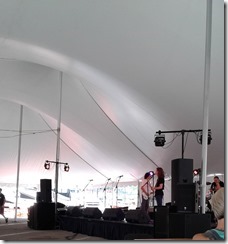
20170805_131950This weekend, I went to an outdoor show in town. The performance was hampered by being partially enclosed in a polyester PVC-coated stretched tents, which are pretty effective mid-range and above audio reflectors, but that didn’t explain how awful the sound was. The group was a 3-piece, very young, pop band with an over-achieving drummer who hammered the snare as if it were a tent post needing to be drilled deep into the asphalt. That set some kind of baseline for the monitor setup, since the drummer was (for once) the first guy on stage to be ready for the sound check. From there, everything went downhill fast. [You can tell by the stage picture, at left, that the sound company had a lot more monitor volume capacity than FOH capabilities.] I watched the sound check, but other than bumping monitor gains up until hitting the gain-before-feedback limits, I didn’t hear any output from the mains during the sound check. Honestly, I couldn’t tell if the mains ever made a contribution to the overall sound; even well into the show.

Obviously, there was zero intelligability from the system. Regardless of where I sat or stood, I couldn’t understand a word coming from the stage. They might as well been speaking French or Chinese, or both. Toward the end of the performance, I walked behind the stage and found (to no surprise at all) that the on-stage volume was substantially louder than the FOH output. While the on-stage sound quality was somewhat better than the FOH, it was mostly deafeningly loud. Probably so loud that the FOH mixer was already past the allowed volume for the venue (an outdoor festival).

For a few hours after leaving that show, I thought about the purpose of stage monitors in the current context. As best I can figure, monitor systems are intended to create acoustic space and physical distance between musicians and their audience. Not to bring the two together in a shared musical experience, but to drive a sonic wedge between the musicians, their fears and and insecurities and frustrations, and the overly-tolerant (and shrinking) audiences who are clearly not particularly discriminating because they put up with this abuse.

20170729_212142Earlier in the week, I was the FOH tech for a small venue performance. When I set up the system and stage, I took advantage of the fact that the performers didn’t list “monitors” in their equipment rider and left the monitors to the side where I could set them up if I needed them. Lucky for me and the audience, when the performers started testing their mics and instruments they were satisfied with the main’s spill and decided to go sans-monitors. The difference between the communication these musicians had with their audience, obviously aided by the close physical proximity, and the performance I saw later in the week was night-and-day. That physical proximity thing isn’t just a function of the venue setup, though. The loud group didn’t provide any high fidelity place for their audience to hear their music. Close or distant, it sounded muffled and distorted everywhere. In contrast, the acoustic/electric duo pictured next to this paragraph sounded clear, present, and natural everywhere in the room.

There has to be some sort of compromise louder acts can make to provide their audience with a decent aural experience. While most bands sound like crap, not all do. Not all bands that sound musical start with the mains, either, but they do make an effort to get out front and listen to the mains sometime before the show or early in the show. And when it sounds like crap, they do what it takes to fix it. One solution for the monitor mess is in-ear monitors, but that provides another level of isolation between the musicians and the audience; especially if the FOH system is overbearing. In-ears or traditional monitors, someone has to care what the audience is hearing and no artist worth listening to will leave that to a hired hand.

Friday, January 27, 2017

Where Did the Audience Go?

In the last month, I’ve participated in two conversations about how difficult it is to find and maintain an audience: one with a bookstore owner who has struggled to find an audience for and participants in his store’s monthly “open mic” and the other with an “acoustic musician” who believes the US is no longer supportive of “good” live music. The one thing both of these men have in common is that they are unwilling to give up their addiction to their sound systems and unnecessary/excessive volume. I’ve written about this before, in “Killing Music Loudly,” and I’ll probably beat this horse again. However, these two conversations reminded me of an incident from 40 years ago that stuck with me because of its relevance to my own live musical history.

When Wirebender Audio was in its prime, there were two of us: Dan and me. Dan’s special interest was loudspeaker cabinet design. Between our dissatisfaction with commercially available speaker systems of the time (1976-1982) and his fascination with recent developments in loudspeaker and speaker cabinet theory, our company deviated from just being a user and vendor into system design and sales. Over a period of a couple years, Dan made one great sound system after another. We were on a Biamp craze, amplification and mixer-wise (Remember the Biamp 1642 and the TC-120 and TC-225’s? They needed a lot of mechanical engineering and some component replacement,for reliability, but they were well designed for their price-point.) and some of those systems were just huge audiophile rigs. Dan was particular enamored with front-loaded, non-horn, non-vented systems, which are notoriously inefficient, but very high-fidelity. Likewise, our systems were some of the cleanest, quickest sound systems I’ve yet experienced. Repeatedly, after Dan would wrap up a system and take it out the band he’d be working with would buy the whole system and he’d have to start over. Not a bad problem to have as a systems designer. Eventually, he built what became his “ultimate” system, using everything he’d learned in every area of system design. On a budget, I like to think a lot of what Dan ended up with resembles much of the Meyer Sound system designs.

Coincidentally, we were recording a power-pop band that he really liked and when their record was finished he did a few shows with the band at local Lincoln, NE clubs to showcase their music. In one of the more upscale clubs in town, Dan met his Waterloo. During the first set, when he’d dialed in everything beautifully and the band was cooking, the bartender kept coming back to the FOH position and telling Dan to “make it louder.” It was pretty loud in the first place, being an early 80’s rock band with the usual collection of Fender, Marshall, and Orange amps on the stage, but the bartender insisted it wasn’t loud enough. Dan brought it up incrementally, but knowing the limits of his system and trying to stick with his quality sound concept he didn’t bring it up nearly loud enough for the bartender.

During a break, the bartender and owner ganged up on Dan and explained their philosophy with words something like this, “When the music sounds good, the crowd is a bunch of music lovers. They don’t drink or tip much and we don’t make any money. Crank it up, drive those cheap bastards out and make room for the drunks. They don’t care what it sounds like, as long as it’s loud, and they’ll drink until they drop.” Dan did push the system a little harder, the music got crappier, the audience morphed into brainless drunks, and the night went on.

Afterwards, Dan lost interest in live music speaker system design. After a few really great non-rock gigs with the University of Minnesota orchestra and a couple of outdoor musical performances, he sold that last system and told me he’d had enough of what we were doing. He didn’t like the commercials we were making most of our money doing and he’d lost interest in sound system design and live sound engineering. We packed up the company, after selling the last 100 of our “Musician’s Preamp” product and finishing the recordings we’d committed to, and went our separate ways. Dan became a tech school electronics instructor and stayed as far from popular music as possible for the rest of his life. I moved to Omaha, built a small production studio for a friend and went to work for a company that owned Aarakis Systems, building broadcast consoles and A/V switching systems. A year later, I was in California working for QSC Audio Products, doing live sound for a 9-piece horn band, and hustling Wirebender as a backline supplier, studio equipment and electronic musical instrument repair service, and contract audio and industrial electronics design service.

The lesson learned that would, today, apply to those two conversations that inspired this trip down Memory Lane is that the problem may be that you have both misidentified your audience. The bookstore isn’t trying to attract drunks and the acoustic musician isn’t trying to appeal to people who shout “Freebird” at every pause in the music. However, the quality of your sound system is exactly aimed at that audience. The bookstore, for example, isn’t large enough to warrant a sound system at all. Most of the people who used to attend the bookstore’s open mic have been punished enough by kids who imagine that more volume hides imperfections. They’ve decided that suffering through the loud awful stuff for the occasional loud decent stuff isn’t worth the effort. The acoustic musician isn’t acoustic at all. I’ve check out his YouTube performances and he is always surrounded by at least two stage wedges and he’s highly electrified. Yeah, he plays a beat up hipster’s acoustic guitar, but it’s plugged-in and so is he. With those monitor demands, the FOH has to be painfully loud for any bandwidth to exist out front. Again, he’s misunderstanding his target audience. He imagines himself to be a weird combination of Leo Kottke and Eric Clapton, but he’s neither and the audience he is best suited for would be more Kottke and no Clapton. Volume is the enemy of both of these guys, but they don’t know it, won’t accept it, and it will continue to defeat their objectives until they figure it out.

Wednesday, September 4, 2013

Madness to the Method – Gain Structure

NOTE: This article was sent to me by the author, Mark Amundson, several years ago to use in my Audio Engineering classes. The article had been on my website as a link in the original Microsoft Word format for a decade. Unfortunately, Mark’s article seems to have vanished from FOH Magazine’s article history, which is a huge loss for audio engineers who actually care about optimizing distortion and noise characteristics in their signal path. A version of this discussion is included in his book; Live Sound Practice and Theory.

Manuscript: Madness to the Method – Gain Structure
Magazine: FOH
Manuscript Type: Technical Article
Issue Assignment: May 2003
Word Doc No: GainStructureMadness.doc
Figures: -
Photos: One
Editor: Bill Evans
Revision: -
Date: 05/12/03
Word Count: 1516

Madness to the Method – Gain Structure

By Mark Amundson

In this dissertation I am going to do a little Q&A, ala the old Audio Cyclopedias about questions you may have wondered about, but just did what you were told. I am going to throw down a generous helping of electronics history as a way of answering the question, and to remind us all were all this technology came from.

Q: WHY IS 0dBu THE REFERENCE SIGNAL LEVEL?

The question could easy re-phrased why is 0.773 volts RMS (0dBu) the standard and not some other convenient number like 0.1, 1, or 10 volts?

The answer goes way back to Alexander Graham Bell’s era when no such thing as radio or broadcasting was thought of. As the “Bell System” and “American Telephone and Telegraph” (AT&T) became the monopoly in the phone service industry, Western Electric Company was formed as a subsidiary of the Bell System to design and produce telephone gear for the whole country. After much trial and error, a standard two-wire pair transmission line was developed with 600-ohm source and load impedances to maximally send carbon microphone signals down the wires. With the right construction materials, voice signals (about –20dBu) could transit 5 miles with a passable loss of signal amplitude.

When Lee DeForest invented the Vacuum Tube Triode for signal amplification, his “killer app” was re-boosting feeble telephone signals, thus creating long-distance phone service in the second decade of the last century. Western Electric still had a lock on the electronics industry in the 1920’s as broadcast radio was just emerging, so naturally it had the highest technology suitable to fulfill civilian and military requests for standard “Public Address” apparatus. By the early 1930’s Western Electric had the first quality dynamic microphone (requiring no DC power unlike carbon mics) and combined vacuum tube amplification connected to the first efficient “loud-speaking apparatus” that we now know as horn loaded drivers.

As broadcast radio became widespread, and specialized companies like Electro-Voice, MagnaVox, and Shure Brothers came to supply (with Western Electric) the needs of public address and broadcast gear, the 600-ohm line cabling still held as the lowest loss method of distributing and processing audio signals. From that era, a one-milliwatt reference level into 600-ohms became the reference level, or 0dBm (zero deci-Bels referenced to one milliwatt). 0dBm is exactly 0.773 volts RMS, but as technology marched on audio electronics moved from power matching to “bridging” impedance matching, the 0.773 volts without any specified load impedance was now described as 0dBu (zero deci-Bels unreferenced).

To answer the lingering question of what became of Western Electric, government anti-monopoly policies in the 1930’s forced the breakup of AT&T (the first time) into RCA for broadcast, Bell Labs for telephony, and All-Technical Products (Altec) for public address. Altec slowly became Altec-Lansing, then split back to Altec and James B Lansing Inc., then on to JBL.

Q: WHY GAIN (TRIM) TO LINE LEVELS AND THEN MIX AFTERWARDS?

This question is more math than history, but we still thank the early broadcast pioneers of the 1930’s for the first work on defining signal-to-noise and noise source definition. This question could also be formed as what is the best method to minimize hiss in the mixing console?

The answer comes from the invention of the radio, and techniques used to maximize signal-to-noise ratio; and thus transmission distance. As a signal is created, processed, and sent to its final destination; there is a signal-to-noise ratio (SNR) degradation. As each stage, or processing block passes on the signal, the noise eventually encroaches on the signal level. The number of dB drop of SNR per stage is defined as its noise figure (or noise factor for you dB challenged). A noise factor of 6dB or less per amplification (gain) stage is considered a low-noise design for a preamp.

To better visualize this idea, lets put some example numbers to work. If a typical dynamic mic and voice put out –50dBu signal peaks, and the console’s referred input noise is –128dBu, you have a 78dB SNR which is respectable in live sound applications. As the signal proceeds through the channel mic preamp, eq section, channel fader or VCA, summing amps, master fader, and balanced line driver, there is a noise figure penalty to be paid. The good news is if two gain stages are cascaded together, the noise figure of the first stage dominates with the second gain stage noise figure effectively divided by the gain of the first. What this means is that cheaper electronics can be used after the mic preamp, with a high gain preamp covering for the sins of the rest the console’s electronics.

On other item to be shared is that attenuation circuits (eq filters, faders, pots, VCA’s, etc.) can generally be assumed to be direct losses in SNR, with every dB in attenuation a corresponding dB increase in noise figure. So the theoretical perfect (low noise) mixing console setup would be faders maxed, eq flat, and amplifier gains a perfect match between mic level and power amp full power sensitivity.

But no realistic scenario exists on a mixer without faders to “mix” with. So the next best answer is take your desired loudest channel in the mix, set its preamp gain control (gain, trim, etc.) for about 0dBu average level, and keep the channel, group, master faders reasonably high, but preserve some headroom for the occasional “louder” demand. This minor compromise yields the best SNR while still giving mix flexibility. This practice also applies to the gain of all the other signal source channels, but with the obvious idea that their faders would be more attenuated.

Q: WHY IS +22dBu THE COMMON MAXIMUM LEVEL

This answer also comes from electronics history, but only a half-century back. The dawn of the first mass-produced transistors had a typical maximum voltage level of 30 to 40 volts. Of these early transistors, many were targeted for industrial controls and “analog” computers for military and aerospace usage. The most common analog computer section was the “operational amplifier” or “op-amp”. Because these op-amp sections were designed to be near perfect mathematical gain stages with both positive and negative voltage swing capabilities. By taking the limitations of the transistors plus the need for a bi-polar (plus and minus) power supply, the standard of +/-15 volt supply levels was instituted, and is still used today.

As transistors got grouped on one silicon die, integrated circuits (ICs) were born with the first standard products becoming IC op-amps. As IC prices dropped in the late 1960’s and early 1970’s, more IC op-amps started finding there way into audio equipment, still requiring their +/-15 volt power supplies. Today’s pro-audio signal processing and mixing gear is largely composed of IC op-amps and a few application-specific ICs plus just a few necessary un-integrated transistors. The common legacy of supplying them with +/-15 volt levels still exists, with op-amps capable of near +/-14 volt audio signal swings. This level translates to about 10 volts RMS, or +22dBu at which the circuits would exhibit clipping of the signals. Some math trickery maybe also in maximum output specifications as you can gain another 6dB in level by stating the output as balanced; in which each balanced output contact swings in opposite polarity to double the levels.

With the above explanations that we should set our levels close to 0dBu and keep away from the clip levels around +22dBu, there leaves plenty of headroom for classifying what peak signals can be and what is required to get the drive channels (eqs, crossovers, and power amps) to full output. Most power amp manufacturers set their sensitivity values to around 0 to +9dBu for full unclipped speaker drive. By keeping the post pre-amp levels at or below the power amp sensitivity values, mostly assures a clipping free production. Of course that relies on your keeping the power amp input attenuator controls full up. You do not want to be “low-noise” all the way to the amp, and then throw away all that SNR at the last attenuator do you?

FINAL WORDS

Our latest generation of audio production personnel deserve to be educated on how we use our gain structure procedures, and why these methods came about. Some may argue about exact levels and forming up mixes, but I am coming at this from an electrical engineering view and attempting to shine light on what the design engineers consider optimum use, rather than operator tactics “that seem to work for me”. We need to appreciate that live sound borrowed heavily from the telephone and radio broadcast pioneering work, plus how electronics achievements impacted our practices. The twentieth century could be termed the “electronics” century, and it looks like the twenty-first century will be the “photonics” century; with fiber-optics promising near unlimited bandwidth for passing analog or digital signals from baseband to radio-frequency to optical-frequency signals.

MDA

Saturday, August 31, 2013

Weapons of Mass Destruction – Live Sound

Nothing disappoints like a good band and a lousy live sound company. I’d been waiting to hear Robert Randolph and the Family Band for half a decade when I discovered the band would be on one of the outdoor stages at the Minnesota State Fair. I own three of the band’s CDs and have seen several of their shows on YouTube, so I’m familiar with their stuff and had high expectations for the band.

My wife and I showed up early to get good seats and my first indication that there was bad news on the way was the fact that the band’s crew appeared to be a sad mix of clueless kids completely out of their depth with the Avid monitor console and biker bar bouncers. The two kids spent the whole setup making “yup, yup” noises into Randolph’s SM58 and demonstrating a sort of ignorance that only music school graduates exhibit. Even the traditional “testing one, two, three” seemed beyond their grasp. Looking for a couple of friends we expected to join us, I ran into Michael and Claudia McKern near the back of the seating area and invited them to sit with us. They wisely declined with the expectation that the sound would be deafening and painful any closer than their nosebleed seats. I should have taken the hint right then. The show started on time and got going with more than few technical hitches as Randolph’s crew spent the first twenty minutes running on and off stage wrestling with instrument and microphone problems. Their lethargic stage setup and goofy concentration on unimportant trivia were a sure sign that show problems were on the way.

The sound company was a local vendor and I’ve heard this system before. It’s a small “array” system (a glorified term for speaker columns on steroids) that is incapable of reproducing anything more sophisticated than “the white zone is for parking” announcements. The only “quality” the system has is volume. Accuracy and frequency response have been sacrificed for output and the company has a habit of pushing their pitiful equipment far past it’s meager capabilities. Last night was no exception. My best description of the sound quality is “a really loud, but damaged, AM radio accompanied by an equally lo-fi cardboard tube subwoofer.” Mostly what was demonstrated was that throwing money at a lack of talent is just good money after bad. The people in charge of running this system are hearing impaired. No amount of equipment can fix deafness.

The sound of the kick drum was one of the two most disgusting options live sound clowns seem to have; lots of 100Hz with no definition and enough resonance in the system to make every kick strike ring for no less than half a measure, even on slower tunes. The bass guitar was equally indistinguishable from rumbling earthquake noises, except when Danyel Morgan slaps his bass which produced weird quacking sounds. The band’s great voices were reduced to public address system quality monotone speech. The rest of the mix was a wash of distortion and mid-range confusion. The only way this could have been worse would be to take it indoors where lousy acoustics would add to the mess.

The band struggled to generate energy with their technical handicap and produced some moments that transcended the sound system. As for us, we filtered from the front rows back to the street without any real improvement. The FOH clown was busy fooling with a personal computer or his cell phone during the worst moments of the show and he made no attempt to clean up the sonic mess he was making. Clearly, this band would be better off running sound from the stage without the interference of “professionals.” In fact, the best three shows I’ve seen this summer were all sans-soundmen. All of the worst shows had some fool in charge of the sound system whose job was, apparently, to create as much audio havoc as possible.

All of this reminded me of why I decided to quit making professional power amplifiers twenty years ago. “Sound reinforcement” is just a polite term for making loud noises intended to damage hearing on a large scale. There is no excuse for allowing this kind of audio garbage in a modern world. Musicians and the industry have no business complaining about MP3s or file-sharing when there appears to be no quality control in any aspect of live music. Nothing could sound worse than this kind of PA system with this kind of fool in charge. So, if our customers can’t hear the difference between high resolution audio and a 128kbs MP3, we only have ourselves to blame. Honestly, this kind of sound system is largely responsible for the fact that a whole generation is going deaf. A decibel meter anywhere in sight of the stage would have measured hazardous sound levels.

Postscript: The second night's show was better, musically, but the sound system was even worse, if that was possible. After almost a decade of looking forward to seeing and hearing the Robert Randolph Family Band live, I most likely won't make that pilgrimage again.

Thursday, November 5, 2009

A Friend, Indeed

I've been putting this off for an unreasonable time. A friend, Mark Amundson, died in early September, 2009. He was 49. It's still hard to imagine that he's not on the other end of the phone or email, waiting to explain some complicate problem in simple terms that even I can understand. 

I'm getting used to people older than me dying, but I will never get used the deaths of people I once considered to be "kids." Mark was a dozen years younger than me and while he was infinitely wiser, kinder, more educated, and smarter than me, I still think of him as a kid. Mark and I met while we both worked for Guidant, a medical device company. We hit it off immediately, in spite of disagreeing about almost everything outside of musical equipment design. We ate lunch often and he gave me an incredible collection of insights into the audio equipment industry and big time pro live sound. 

Bill Evans did a much better job of writing about Mark Amundson's life, personality, and contributions than I can hope to accomplish. Bill's obituary, Music and Order, described Mark as "both liked and respected by both the industry and the [FOH] readers." I can vouch for that. Mark was an extraordinary engineer and technician. He was a generous, insightful friend. He loved music, musicians, and was practically compulsive in his desire to share what he knew (or wanted to know) about music, audio equipment design, and live music reinforcement. He sometimes introduced me to his friends as "the guy I hire to run sound when I'm on stage," which was an incredible compliment and an overwhelming endorsement considering that I ran sound one time for a band he was in and my end of the show was unremarkable. He was being typically generous and I will always appreciate his generosity. 

Once, when I was beating him up for reviews in FOH that were uniformly positive and uninformative, he told me I needed to "read between the lines" for his real opinion of those products he was less than impressed with. I replied, "what's between the lines is white space." His answer was a long explanation of how modern publishing works. He explained that readers provide absolutely none of the money required to publish a magazine and that manufacturers and, worse, publicity agents have long, long memories and are particularly brutal on writers who tell the truth. Not long after that discussion, Mark tailed back his product reviews. He told me, about a year later, that he'd lost his ability to believe in readers' capacity to read "between the lines." In person, 

Mark didn't talk between the lines. He was opinionated and exceptionally well-informed, but he was always hopeful that even the worst companies would do better if he just tried to help them see the error in their ways. He exhibited that patience with me, too; for the same reasons. I abused our friendship several times when I asked him to talk to my live sound classes at the school where I work. He not only put together a terrific presentation, every time, but he gave me PowerPoint slides of his presentation so that I could use that data in future classes. He never wanted to repeat himself, so he expected not just my students to "get" what he talked about, he expected me to take advantage of his gratis work and to benefit from it. 

His ability to explain complicated, often mathematical, audio problems was beyond anything I've experienced in my formal education. I use his work, his explanations, every semester in my classes and it always provides breakthrough insights in my students' understanding of our subjects. It will be impossible to replace Mark as a resource for questions I will always have about audio design, component design, and music reinforcement. More important, it will be impossible to replace Mark's friendship. I've never known anyone like him. Here are a few of his articles and insights: Live Sound: Theory & Practice, Poor Man's Power Distribution, Speaker Cables — You Get What You Pay For, Turn It Up! No, Down! No, Up! No. . ., Mic Selection and Placement.

Wirebender Audio Rants

Over the dozen years I taught audio engineering at Musictech College and McNally Smith College of Music, I accumulated a lot of material that might be useful to all sorts of budding audio techs and musicians. This site will include comments and questions about professional audio standards, practices, and equipment. I will add occasional product reviews with as many objective and irrational opinions as possible.