Showing posts with label quality. Show all posts

Friday, June 16, 2023

Ego Noise

This has been a week where two of my blogging interests, motorcycling and blogging, have unfortunately grown together into one large irritation. Last Monday, a parade of nitwit of bikers blubbered past our home at their usual barely-above-a-crawl speed and well-above-a-thunderstorm noise level, proving that there are more than enough reasons to defund the lazy, cowardly couch-potatoes who inhabit our local police and sheriff's departments. If you can’t identify a national, state, and local crime that produces enough noise to drown out a freight train, you are too dumb to be carrying a gun and badge and do not deserve to be wasting public funds pretending to be “law enforcement.” 

A few days later, I went to a downtown outdoor concert and was assaulted by another of the many painful, anti-musical sound systems I’ve suffered in my lifetime. I have an stock of ear plugs in the car, but I shouldn’t have to use them to protect myself in an outdoor concert that drew 75 people max. It took me a few moments to realize that it would only get worse and, as a result, my ears rang all through the next day.

A few days after that, we went to a graduation party for a friend who had been workingm part-time and nights, on her Master’s degree for the last 25 years. Her husband made the event into a “look at me” episode by playing in 3 different bands that were all so loud that nobody could carry on a conversation anywhere in the building. His wife’s celebration was turned into a “I can do stuff too” event for her husband. We all only have a wild hope that she heard, or recognized, at least a few of the many congratulations that were mimed her way.

At the first event, I got into a discussion with a self-admitted deaf guy who argued that the sound system wasn’t as bad as I alleged because he could pick out the three instruments and two voices with some effort. We’re talking about a male and female vocal, acoustic guitar, mandolin, and cajon. If you couldn’t at least make out the existence of those “voices,” the sound would amount to pure cacophony. That is a massively low bar for a sound goober to achieve. At the second event, a musician friend and I decided that an upside to this nonsense is that as long as live sound is this bad, there is no point in wasting a lot of energy on learning lyrics. As Ms. Day said, “Every song is ‘Louie, Louie’ so why bother learning any other song?” Honestly, as long as the vocals were sorta in the general territory of the key, even the melody was obscured by the noise, the dominating mediocre bass and guitars.

A few nights ago, an old friend and his daughter went to a Bastille, Nile Rodgers & CHIC, Duran Duran concert at the Atlanta State Farm Arena. His comment on the show was, "The bands were good. The sound was fairly unintelligible due to extreme loudness. But, I didn't let the sound people steal my joy!" He has been nearly a life-long fan of Rodgers and CHIC and “I didn't let the sound people steal my joy” was the best he could say for his outlay of several hundred dollars for the tickets, the cost of the trip and an overnight stay, and the experience. He also spent a good bit of his life working backstage and FOH with professional sound systems and touring companies. That is how low the bar for live, amplified music has become, at best, we hope the sound system doesn’t ruin the experience for us.

Monday, September 19, 2022

Product Review: Positive Grid Spark Mini

Silly me, I thought the Positive Grid Spark Mini was a fairly new product, but my resident guitar repair guru and guy-who-will-try-to-fix-anything about town, Brian Stewart (Tree Strings Music), has already repaired one in his Red Wing shop. I haven’t yet heard what the fault was in that unit. I ordered a white one from Amazon, thinking it might be a fun practice and outdoor jamming amp. I’ve had it about a week and, sadly, the fun is wearing off fast. The good and bad news is that almost everything about this amp is driven by a phone/tablet app, iPhone or Android. The good is that it has hidden power if you’re willing to climb the usual steep software learning curve. The bad is, like most apps, it’s glitchy, unpredictable and often counter-intuitive, almost completely inflexible, and very dumbed-down while pretending to be a product for the sophisticated, discriminating guitarist (the ultimate oxymoron?). A lot of the positive reviews you will find for this amp begin with something like “I’m new to guitar and have only been playing about a few months . . .” It’s easy to like or even love something if you don’t have anything to compare it to. In my case, it’s hard for me to look at any product with the eyes of a newbie. So prepare to be disappointed if you’re hoping for that kind of bubbly, happy-talk review. At 74 and after 50 years in various areas of pro audio and music, there is nothing new about me except for the crap that keeps popping up every time I have a doctor’s appointment. Having spent 20-some years in test and reliability engineering I tend to find more things wrong with software than right.


You can’t beat the Mini’s physical controls for simplicity. On the top of the amp chassis, you get 4-position Preset switch (Rhythm, Lead, Solo, and Custom), a Guitar volume, a Music volume control (Bluetooth or Aux In signals), and a guitar input. The back of the chassis has 3.175mm (aka 1/8”) Line Out and Aux Input jacks, a USB-C port for charging the battery and (sometime in the future) a functioning digital audio interface), a Bluetooth “Pair” switch (the Pair switch also fires up a rudimentary guitar tuner), and a power switch. The amp comes with a cute leatherette strap and a pair of buttons to attach the strap on the side. The amp is a 10W Class-D unit that, supposedly produces 90dBSPL at 1m. The cabinet has two 2” speakers and a bottom-facing passive radiator. The 3Ah battery supposedly provides power for 8 hours (on mid-to-low power output) and charges from empty to full in 3 hours. The firmware contains “33 Amp Models, 43 Effects, (Noise Gate, Compressor, Distortion, Modulation/EQ, Delay, Reverb – fixed in that order) and the USB interface is a 44kHz/16 bit A/D. You also get a a free download of PreSonus Studio One Prime recording software with your original purchase. Registering for your software is the closest thing to registering for warranty with Positive Grid. You can buy (for $110) a Spark Control footswitch to either control the presets, turn on and off various virtual pedals, or a combination of those functions. The amp is 146.5 x 123 x 165 mm (5.76 x 4.84 x 6.49 in) and weighs 1.5 kg (3.3 lb).

As usual, the included paper “Quick Start Guide” is close to useless. Not so typically, Positive Grid hasn’t provided much in the way of useful information on their website, YouTube, or anywhere else. Figuring out the app and the various features of the amp that are only accessed through the app is up to the buyer.

For a beginning guitarist who doesn’t know any other musicians, some of the Mini’s app features are probably fun-to-useful. This “screenshot” is really a compilation of three different screens as typically displayed on a phone.Positive Grid Spark mobile app The middle one is an example of a dumbed-down imitation of a fairly common DAW guitar pedal screen; like the one in Logic Pro. A big difference between the DAW pedal boards and the Spark is that you can’t reshuffle the order of the pedals to suit your purposes.

After spending considerable time playing with the various pedals I can say “they work.” The compressors in the Comp/Wah section aren’t up to DAW standards, but they are probably as good as most hardware pedals. The “Wah” function, also included in this group, is “Temporarily Disabled.” As usual, I don’t like the distortion (Drive) pedals much, but I rarely do. About half of the Drive pedals are red-flagged, which means you’ll have to spend $20 or more to enable those pedals on your device. So it goes for the Amp models, too. Most of the red-flagged amp models are variations on the mediocre Marshall models. The Mod/EQ models are predictable and not bad. The Delays are ok, except for the absence of a multi-tap delay. The Reverbs are typically pretty good, since digital reverb plug-ins have been fairly well staked-out territory for at least 20 years. I didn’t find a favorite from the verbs, but I didn’t find anything I hated either.

Irritatingly, with my Samsung tablet and the Samsung Music player, anytime I open the Spark app the music player starts playing something from my current playlist through the Spark Mini. Before you start babbling about some “play on Bluetooth connection” toggle in the player, get a grip on yourself. No other Bluetooth device that I own has this behavior: from consumer buds to Shure in-ears to three different Bluetooth speaker systems. It is a glitch in the Spark app and that has been logged by Positive Grid’s customer service and I wasn’t the first to make the complaint. If everything else was excellent this wouldn’t be a deal-breaker, just unpredictably irritating. (If it does this when I first open up the app, will it spontaneously do the same during a gig?) Yes, I could turn off the Music volume, but if I am using it as a backing track at the time it sort of defeats the purpose of that function.

With that out of the way, my impression of the guitar amp is somewhat positive. I’m not fond of electric guitar distortion in the usual buzz-box fashion, but some of the amp models deliver decent slightly over-driven sounds with the kind of amp EQ and tone you’d expect from what I’m guessing are the amps being modeled. Some of the setups both by other users and Positive Grid are fair-to-decent. I had some high hopes for Pat Metheny style sounds, but the lack of multi-tap delays squashed that. You could just add a pedal delay up front but that would defeat my purpose. I have an old MacBook Pro with MainStage that will do everything this unit does with a ton more effects including my multi-tap delay that I’d rather use with a small wired power speaker than add a pedal that is almost as big as this amp.

And speaking of power, I wouldn’t be surprised if the Mini an produce 10W, but the distortion at that output would be objectionable. That goes for the spec’d 90dBSPL@1m acoustic output, too. At any volume over a moderately loud voice or a strummed full-size acoustic guitar, the bottom end of this amp clips indecently. It is not a pleasant distortion, either. It is the usual splatting sound of digital clipping. That was the straw that broke the back of my interest in the Positive Grid Spark Mini. There were moments when I thought I was about to find the sweet spot for several of the Presets but “almost there” was as close as I got to something useful. When the amp sounded good, it was too quiet to compete with a couple of acoustic guitars. When it was loud enough to cut through a small instrument crowd, it sounded awful.

For a beginning practice amp the Spark Mini isn’t bad. Most beginners, however, will have a terrible time with the mediocre application software that is an absolute necessity for using the amp. Advanced users will be frustrated with the user-hostile programming of the app and disappointed with the little amp’s small performance.

Monday, May 27, 2019

Snarky Puppy in St. Paul

A couple of years ago, my ”yet to see” list was down to one artist and one group: Van Morrison and Snarky Puppy. There is, literally, no other live pop music act that I’m interested in suffering for. I have seen every group I’ve wanted to see and most of them have been sonically and musically grossly disappointing. Overwhelmingly, attending a live music performance is mostly about as fun for me as being one of Dick Cheney’s captured “armed combatants.” Venues and performers alike are careless with my hearing and their sound quality. From the performances on their live recordings, I had high hopes that seeing Snarky Puppy on 5/25/2019 at the St Paul Palace Theater might be an exception to what has become a hard-and-fast rule. When the tickets went on sale, in late January, I drove 100 miles round-trip to get a pair. Through the last few months of age-related medical problems and way too many doctors’ appointments and tests, I clung to the hope that I would see something like the kind of performances Snarky Puppy puts on its DVDs. I was wrong. I knew the odds were against me, since "quality" and "live sound" rarely coexist, but I had unrealistically high hopes based on Snarky Puppy's "live" recorded existing music catalog.

It’s hard to know who to fault for the generally awful sound of this terrifically talented band in what should have been pretty easy-to-manage venue. The Palace Theater (or Snarky Puppy’s road company) does have an array system, which more often than not seems to be an identifying marker for lousy sounding shows. Unfortunately, the sound system also includes subwoofers; hardware and technology that almost no live sound doofuses know how to use half-competently. I didn’t bother to get close enough to the FOH sound doofus to look at the console, but it was (obviously) digital and I suspect it was either Avid or DiGiCo. I figured if I got close enough to evaluate the mixer I’d be tempted to strangle or knife the moron. Seriously. There were many moments in Saturday night’s concert where I considered the risk of terminating that useless human wastebasket vs. the few months or years I might have left on my odometer spent incarcerated. He was that incompetent and destructive. I have to suspect he has never listened to a Snarky Puppy CD or heard an actual non-distorted musical instrument. He is too young to have grown up listening to AM radio, but just right for the iTunes 128kBPS MP3 experience.

From the start, it was obvious that the subwoofer component of the system overwhelmed his “talent” level. The first clue to what was to come arrived quickly as the intro act—a vocalist, keyboard, sax, bass, and drums—was as grossly distorted, poorly balanced and mixed, and unintelligible as the usual First Avenue sound disaster. The bass and kick drum merged into an atonal train rumble and the bottom end of the keyboard (anything under 200Hz) was added to the constant drone of the overloaded and poorly managed sub-channel. My wife, Elvy, kept looking at me, wondering, “Is this really the band you wanted to see?” It wasn't, but the band I came to see would prove to be an even bigger disappointment. 

After a pointlessly extended intermission break between acts, Snarky Puppy came on stage. Michael League mumbled some incoherent stuff about the band and, I think, the band crew, as an introduction and the mix went downhill from there. Even reinforcing simple speech was beyond the capabilities of the FOH moron. There was never a moment where anything in the mix improved, but it did get much louder and more distorted as the night went on.

From everything I thought I knew about Snarky Puppy, I did not imagine I would need hearing protection during one of their concerts. By the 3rd tune, I was cutting pieces of my clothing to stuff into my ears. If that was Nic Hard on the board, he has passed his prime (if he had one) and is well into needing hearing aids and another less complicated and largely unskilled profession. Hard gets credit for Culcha Vulcha, one of the Grammy-nominated SP records and the only one of their CDs I've sent back to Amazon due to what I thought was a defect (intermittent gross distortion) and I now suspect was "intended." My local library's copy of Culcha Vulcha has the same distortion, so I've moved from suspicious to sad confidence. I think League even threatened that the FOH nitwit would be mixing their next CD, which is no kind of good news. 

The sound was so out of control that we were even often abused by the high-pitched squeal of microphone feedback that the FOH doofus usually made worse before he “solved” it. He clearly never heard a sound system that was loud or distorted enough for his tastes. The sub-channel flat-out rattled, it was so overloaded. I would estimate that the overall sound system regularly produced 20-30% distortion at 125-130dBSPL and often pegged at solid clipping well over 30-50%. Close to the end of the show, League mentioned that the audience could buy downloaded copies of the show we saw. I could almost be convinced to spend that money since the live show was one of the least musical experiences I have ever had in a concert venue. On a perverse and unlikely level, I would kind of like to know what I missed.

The 9 pieces of Snarky Puppy were introduced as "band leaders in their own right," which was sadly reflected in the performances, too. Instead of a coherent group intent on blending their talents into the kind of rhythmic orchestrations we hear on the early Snarky Puppy recordings, Saturday night's performance was more like the usual 90% of jazz, which is a loose collection of individuals demonstrating their technical prowess at the expense of anything resembling "music." Unlike their best recordings where "solos" often are enhancements of the theme, most of the night's solos were exactly that; solos. Sadly, most of those excursions reminded me of the mindless and boring 60's and 70's guitar hero days or what my studio partner used to call jazz; "meandering saxophones." Weirdly, in 2021, Puppy released a double-CD set of their 2019 "Live at the Royal Albert Hall" performance that sounds absolutely nothing like an actual live Snarky Puppy show, based on my experience. If this record was an attempt to build their audience, I suspect it won't work with the victims who have heard an actual Snarky Puppy show.

Elvy, an experienced visual artist, called the light show “painful.” She spent a lot of the show with her eyes closed to avoid looking at the stage. For some weird reason, a good bit of the white spots were randomly aimed into the audience, creating a blinding effect similar to the deafening effect of the awful audio mix. So, pretty much every aspect of the show that the Snarky Puppy crew touched was a fucked-up mess. I'd love to report that the band overcame this deficit with tremendous performances, but from where we sat and stood it was almost impossible to make out any detail of the music. So, much of the evening seemed like a repetitive hip-hop loop of kick drum, snare, and gurgling subwoofer distortion. Rather than a jazz band, the best SP managed that night was something more akin to 1980's Studio 54 electronica "dance music." Perfect music for a near-overdose of coke, PCP, or ecstasy. The light show was probably aimed at those customers.

As a general principle, I’m against capital punishment. However, I would regularly make an exception for FOH doofuses who ruin otherwise excellent shows. At the least, I think morons like the Snarky Puppy FOH doofus should have been smacked on the back of his empty head by each of the 3200 sold-out show victims. The beauty of either beating to death or shooting FOH morons is that, if no one volunteered to do that job because of the risk no one would be inconvenienced. Many of the best shows I have ever heard were completely managed by the band from the stage. All of the worst shows had a “professional” mangling the mix from FOH. Two constant factors in the sound quality of the shows I have seen has been the FOH tech and the band. The sound system is inconsequential. The equipment is NEVER the problem and the people using said equipment are ALWAYS responsible for the sound quality of a show. You can find examples of that fact in many of the show reviews on this website and some of my rants about live music in general.

The Palace’s “acoustic treatments” are pretty hilarious, at best. Typical of First Avenue penny-pinching mismanagement habits, there are some tiny and pointless 1” thick strips of “acoustic foam” dangling from the balcony overhang and, maybe, some absorption materials behind the side curtains on the first floor. Otherwise, it’s a big oval-shaped 1900’s theater sans chairs with absorptive padding, a concrete floor, bare walls with residual bits of 1900’s fresco and artwork clinging to the walls, and a 21st Century high-volume, low fidelity array sound system poorly placed and aimed. In other words, 1st Ave spent as little as possible to bring this venue to life and expects to get a big return on the investment since the audience “taste” for actual music is declining exponentially in the current MP3-earbud-cellphone-industrial-noise climate.

Due to my wife's mobility problems, we were kindly given ADA seats right behind the FOH console. Our purchased seats were fairly high in the balcony and the Palace has limited elevator capabilities, so that was a really generous act by one of the facility's managers. We were there early, because of her limitations, which gave me the opportunity to move around a lot early in the show. I listened to the opening act at several points in the balcony and, before and during SP's set, on the floor (mostly in the 10-20' just in front of the house console). It wasn't any better than our seats at any of those spots, but most of the areas were considerably worse: closer was painfully louder and further away was incoherently more distorted and muddier. The balcony is a giant bass resonator, which only exacerbated the low frequency problems I've described above.

Speaking of the crowd, when did drill-Sargent level yelling throughout a concert become normal? On the floor level and all around the bar, most of the “audience” were more involved in max-volume yapping at each other than the music. On the floor, the crowd noise was at least as irritating as the sound system. I do believe the excessive volume of the sound system is partly to blame, since there was no effort at reproducing dynamics, fidelity, or even decent bandwidth in the sound system, it is clear that the band wasn’t particularly concerned with the audience's musical experience. That being the case, I guess a concert is an expensive way for people to come together for a really loud conversation about the usual drivel people talk about in bars. I generally avoid live music in bars for this reason and from here out I'll be avoiding indoor live music in general. I do not need the hear about the boring lives of wealthy 20-to-40-somethings at screaming volume.

I can’t decide if I would be relieved or disappointed to learn that the sound system was not the Palace’s house system. The upside might be that it could still be possible to see a show there that didn’t suck. The downside would be that Snarky Puppy and Michael League have lost their edge and concern for their fans’ experience. For me, it’s kind of the end of the trail, regardless. Live music has become such a painful experience, physically and sonically, that I generally avoid any indoor concerts out of self-protection. My anticipation and disappointment in this show was pretty obvious. On the way home, Elvy kept asking “Are you ok?” The next morning, she even cried in sympathy, knowing better than anyone how much I had looked forward to this concert. Since were were there early, I bought a copy of SP's Immigrance CD and a shirt before the show started. I have yet to open the wrapper of the CD and the shirt ended up in the rag bag this morning. I do not need a reminder of that evening. If I had waited to the end, I wouldn't have wasted that money.

Over the years, I have seen a handful of amazing live music performances. I’m OK with that, disappointed that part of my life is over, but I have some great memories. Snarky Puppy will not be among those, though.

Monday, February 25, 2019

Red Wing’s Big Turn Music Fest

The better pro sound equipment gets, the worse the sound goobers are. That was my opinion of my first day at the 2019 festival. Part of that low opinion came from the fact that I made poor choices of venues and was stuck in one place for 4½ hours of the first day of the festival because I’d volunteered to help out with a venue. My venue assignment was the Red Wing Bicycle Company and Outfitter, which is one of the city’s coolest businesses but, unfortunately, doesn’t get the top acts. The kid running sound for our venue was . . . inexperienced. Like most of the people who end up in live sound, he didn’t know much about the equipment he was mishandling and knew even less about room acoustics. Friday’s first two acts, Theyself and Vild, didn’t give him much to work with. The wrap-up group, Loons in the Attic, had a great start, but degenerated into a noisy jam band and the sound system and mix totally came unglued. Great bass player, though. Between the musical misdeeds and the sound goober’s incompetence, I went home with a splitting headache and aggravated tinnitus.

Rudely, I know, I had to ask the goober if he paid for an “education” to become that incompetent or if it just came naturally to him. I’m pretty sure he didn’t hear well enough to know what I’d said.

I ended my Friday meeting my wife at Fair Trade Books and wandering over to see Charlie Parr at the St. James Hotel’s Portside Room. The Portside Room is a decent meeting room and a mediocre acoustic environment for music. I didn’t identify the source of this speaker system, but my takeaway from Charlie’s set was that the problem was either a miserable sound system and a deaf sound goober or just a deaf sound goober. It’s hard to imagine butchering a one piece act, but those nitwits managed it. I’ve worked with Charlie in the past and heard him a few times before in outdoor concert settings and he’s easy to work with, a lot of fun to hear, and talented. None of that straggled through the sound system. A more tolerant music fan, Brian Stewart (Treestrings Music) and his wife, Brenda, were at the show and they thought I was too hard on the sound goober. Knowing something about Charlie and his music, they said “it wasn’t that bad.” (PC code words for “it was awful.”)

So, I asked, “Did you understand anything Charlie said in his show?”

Brenda said, “I think I heard him say the word ‘soul’ a couple of times.” Brian didn’t get a single joke and couldn’t identify a single song lyric.

My case rests.

Saturday, I had no obligations. I skipped the Saturday Morning Treestrings Jam, stopped in at the Southeast Tech Guitar Program’s swap meet and bought a DiMarzio pickup I absolutely don’t need, and bought my wife takeout lunch to make up for abandoning her for the day. (Don’t knock it if you haven’t tried it. Works for me.)

I started my festival day at the 223 Barrel House with Ryan Mingone. The Barrel House has miserable acoustics, even for a tunnel-shaped bar. So, I crowded up to the “stage” with about ½ of the crowd and listened to Ryan’s keyboard work and vocals. Not bad and a tolerable start. From there, Red Wing Elks Club where Sevenseven slaughtered a variety of Minnesota-based pop band songs. I sat with some friends who are much more versed in Minnesota music and after I was the first to identify Prince’s “Little Red Corvette” it was obvious that “cover band” is a loosely-used term for Sevenseven. There were occasional moments when one of their covers sounded familiar, but mostly . . . not.

From there, I hiked past 3 or 4 venues and listened outside momentarily on my way to the Christ Episcopal Church (I know!), which is one of the festival’s coolest sounding venues, for the end of Land at Last’s set, Ben Weaver, and a brief refresher of Charlie Parr to wipe the bad taste of his Monday performance from my memory. The guy running sound at the church was not a “kid,” but a grown man with a decent pair of functioning ears. He did a fine job and disproved my theory that those weird faux-array speakers are incapable of reproducing music. Ben’s set was especially fun because . . . Ben is a cool guy and a terrific songwriter/musician. I complimented the sound tech, a couple of times, before I left. Snow was beginning to fall about the time Ben’s set ended and was coming down “briskly” when I left.

From there, I headed to the St. James, but The Old Fashioneds just didn’t do much for me. 30 seconds of rockabilly is about my limit. So, I kept heading toward the river for the Red Wing Arts Depot Gallery and the Constellation Band, a four piece, young jazz group. To be honest, I mostly wanted to look at the art on display and see where a band would perform in the old train station. The Constellation Band could have been the highlight of my evening. They started off sluggish, but kicked into gear after the 1st tune and just got better as the set went on. The young man who sound tech’d the show did a fine job and I complimented him on his work. He said, “It was all them,” but it wasn’t. Sometimes it’s about what you don’t do, rather than what you do that wasn’t necessary or desirable.

From there, I climbed the hill back to downtown and the Sheldon Theater for Dessa’s set. I’ve seen Dessa a few times, but it was a while ago, when and before she was an “artist in residence” at McNally Smith and, maybe, once after that. Her music has evolved dramatically since then. I do not know how to describe her performance other than “she knocked it out of the park.” Again, the sound tech (her guy) did a fine job and I told him so. I checked my truck on the way past and it had about 6” of snow cover and I wondered if the snow plows would start to bury me or if it would get towed and ticketed if I didn’t move it. I wondered all that, but kept walking.

My last stop was back at the St. James Portside Room because I am a glutton for punishment. The People Brother’s Band looked like a good bet, an 8-piece R&B group with several good vocalists. The band started off decently but slowly began to degenerate into blubbering subwoofer dominated garbage heavily doctored with massive midrange distortion. Eventually, either the band lost control of their stage volume and sabotaged the FOH goober (unlikely, since during the sound check the most consistent hand signal from the band was "turn it down") or the sound goober went even more deaf than he started and completely forgot what music sounds like; substituting industrial noise for anything resembling melody, harmony, rhythm, and clarity.

I’d planned on seeing a couple of other bands after that, requiring either a walk back across town or moving the truck. I decided to clear a foot of snow off of the truck, move it, and see how I felt after all of that. A couple of nitwits almost wiped me off of the planet as I cleared the driver’s side of the truck and I think that experience and my ringing ears (although Saturday night I wore earplugs for all but two of the shows) convinced me I was done for the night. Getting up my driveway and into the garage was an adventure and I think I made the right decision. Still, I would have liked to have seen Light45 and General B and the Wiz. Maybe next year.

Sunday, November 25, 2018

Concert Review: Crash Test Dummies at the Fitzgerald

crash test dummies 2The concert was billed as the "Crash Test Dummies: God Shuffled His Feet 25th Anniversary Tour." A better person would have known what that meant, but I was mostly a first Crash Test Dummies album fan. The tour started in St. Paul with the core band of Brad Roberts, Ellen Reid, Dan Roberts, Mitch Dorge, Stuart Cameron, and Eric Paulson.

Local bar solo act, Paul Metsa, was the opener. He was as surprised to be there on the Fitz stage as we were to see him there. He didn’t even manage to get the performance up on his webpage retroactively. He had moments of ok-ness and talked way more than he played, which was an odd choice since he seemed to believe he was getting a lucky showcase that night and should have used the time to demonstrate his musicianship. Ending with a patronizing version of the Star Spangled Banner was pure Toby Keith schmaltz. He was, apparently, desperate to get audience attention.

The FOH guy, as usual, was near deaf. As usual, from the start it was obvious he’d never heard an actual record and imagined that we were all just dying to hear kick drum and bass solos; especially that all-captivating territory between 15Hz and 80Hz. (Or maybe his own hearing is so damaged he needed those frequencies boosted 10-20dB to compensate.) As the night went on, the sound goof became more hearing-impaired and eventually it was difficult to even sense the existence of the vocals unless all three of the band’s singers were really wailing. That was particularly disappointing because I don’t often get to hear a singer with Brad Roberts’ mic and vocal technique. If there was ever a band that deserved to have the vocals upfront and on point, Crash Test Dummies are it.

crash test dummiesDuring the many quiet moments and, especially, when the musicians except Stuart Cameron (acoustic guitar) were absent, Roberts really knocked it out of the park. Heart of Stone” was so incredible that my wife and I simultaneously and spontaneously turned to each other and said “that was worth the price of the trip, hotel, and concert tickets.” Of course the lyrics are close to our own story, "And so now we are old, both our stories are told and we wait for the end. If you're first to go I will follow you, know that my heart will not mend. And I wish I owned a heart of stone.” Trust me, it does not read as emotionally powerful as it sounded with Roberts’ incredible voice.

As hard as he tried, the FOH goof did not destroy the evening. The musicianship was solid and the spare arrangements allowed many of the high points to fight their way through the sound system incompetence. There were few moments where the lyrics were decipherable, but when those words were either heard or memorized the whole point of this philosophical, insightful band was proven to be true. If there was a Crash Test Dummies’ song that someone didn’t hear Friday night, it was a really obscure one. I held my breath hoping to hear Superman’s Song, but not expecting it if this was really supposed to be the God Shuffled His Feet 25th Anniversary Tour. They played Superman as the end of the regular set and the last song of the encore was "Mmm Mmm Mmm Mmm" Go Figure.

There were many moments that were worth the trip to St. Paul, the hotel hassle, and even the downtown St. Paul parking hassle. It takes a lot to overcome those obstacles, but Crash Test Dummies pulled it off.

Wednesday, August 22, 2018

Worshiping Tin-Lead and other Old Bits of Junk Technology

The following is a letter I sent to TapeOp Magazine regarding a silly end rant by John Baccigaluppi about how much he loves tin-lead solder and big iron audio electronic equipment. A year ago, I took a “ghost town Detroit” photography tour and I have stuck a video of that

While it is always entertaining to hear old men (or old souls) rhapsodizing about when “spirits were brave, the stakes were high, men were real men, women were real women and small furry creatures from Alpha Centauri were real small furry creatures from Alpha Centauri,” John Baccigaluppi’s “An Endangered Species” harping about the deficits of lead-free solder was funnier than I suspect it was intended to be. Solder defects have always been a substantial part of electronic equipment failures. In the 80’s, I had a side business repairing Roland Guitar-to-MIDI converters because that company failed to anticipate the mechanical stress of their power supply components on their fragile circuit boards. In my MI equipment repair career, I would estimate that at least 75% of all electronic component failures were initiated by solder connection failures. Even the often-praised point-to-point tube circuits were known to rely on their unreliable mechanical attachment to the terminal posts because the heat from the tube circuits and the lack of flux removal caused the lead to degrade into powdery lead-oxide. As many companies demonstrated over the last century, the beauty of tin-lead solder was that any half-trained chimp could make a mediocre but hard-to-inspect solder connection, but the flaw in that technology was that the circuit designs were rarely conducive to sufficient removal of the flux residue which led to deterioration of the connections with heat, moisture, or just oxygen exposure.

Like the lovers of big iron American cars, unreliable but repairable out of necessity overweight vintage motorcycles, and lead-based ceramics, Baccigaluppi’s rhapsody for the days past when equipment failed often but could sometimes be repaired with enough effort, patience, and money is nothing new. However, those old vehicles rarely survived 50,000 miles without some sort of major overhaul and while they might have survived in a climate-controlled garage for “60 to 70 years” they were useful transportation for about three years before the cost of repair overwhelmed the cost of replacement. Today, a car that doesn’t last for at least 200,000 miles before needing major work is clearly a lemon.

Likewise, I suspect at least a few thousand “vintage” large format consoles have ended up polluting the nation’s water supply because their performance and capabilities didn’t warrant the cost of repair, let alone the real estate necessary to house that equipment. Like old cars, motorcycles, and pottery, the collector/hoarder business in audio equipment is coming to an end. Baccigaluppi asked, “how many pieces of classic recording gear have you seen in a trash dump?” Last fall, I took a “ghost town Detroit” photo tour and saw a building full of “classic recording gear” and broadcasting gear abandoned to metal scavengers in a Detroit public school building: MCI and Otari tape decks, racks of AT&T patch panels, recording and broadcast consoles, effects and signal processing gear, and piles of audio and video patch cables. The school had, supposedly, tried to find a buyer for the broadcast vocational school’s equipment, but no one was interested. So, sooner or later all of that stuff will end up in a trash dump. About a decade ago, I had the opportunity to obtain a pair of Otari consoles that had been used on the first Star Wars movie, just for the cost of getting the consoles out of a 3rd floor warehouse and finding a place to store them. No thanks. So, to the trash dump they went along with a warehouse full of 1970’s and 80’s video equipment.

Some products are worth salvaging, if just for the historical value. Most electronic products are obsolete regardless of whether that was “planned” or not. There is an educational value to repairing an old piece of gear and that shouldn’t be discounted too quickly. There are, however, good reasons why the old equipment gets discarded for the new. There is a wide line between tossing a $600-1,000 phone every year to “stay current” and spending hundreds of hours maintaining old equipment that isn’t even close to capable of performing to modern standards. I suspect the best way to decide where you draw that line is by determining what your time is worth.

Sunday, August 19, 2018

Peter Mayer and Live Music

mayer at Crossings

Saturday night (9/14/2018), I was the sound tech at Zumbrota’s Crossings Gallery for a Peter Mayer show. I’ve been a fan of Peter’s since I first heard “Brand New Harley” at least a decade ago. I bought the CD that song was a part of and discovered other Mayer gems: “John’s Garden,” “Africa,” “Holy Now,” among many other great songs of Peter’s that I’ve discovered (for myself) since. Peter has a solid, dedicated following of fans across the country and, according to posts on his Facebook page, the world.

20180714_212704He earnes it. Not only does he put on a show that covers as much of his huge discography as you would hope and could expect, he puts so much of himself into the performance he has to wind himself up and, then, down again; before and after the show. The sound check is as much a ritual he uses to gear himself up for the performance as it is an opportunity to optimize the sound system.

There is an aspect of performing this kind of personal music in this kind of venue that feels like someone has stripped themself naked in front of you. An audience can sense that kind of intimacy and, if the performer is lucky and talented, the audience can feedback some of that energy and love to the performer closing the loop and creating an environment that is particularly special to music.

Saturday, June 9, 2018

Going Downhill

20180607_10001220180607_100039

Fortunately, I didn't have to listen to this nightmarish "sound system," but just looking at it was pretty depressing. This tiny faux-array JBL “full-range” speakers perched above and well behind apartment-sized subwoofers immedately made me want to ask, “When did Bose buy JBL?” From time alignment to diffraction and sound pressure field distortion problems, nothing about this mess would be able to reinforce anything resembling music. It isn’t even easy to move, unless the tiny speakers pack inside the subwoofer boxes. If there is any value system here, it must be “gain before feedback” because sound quality clearly is no consideration.

Tuesday, September 26, 2017

Use ‘em if You Got ‘em?

I recently did FOH and monitors for a rock band in a small (250 seat), historic, municipal auditorium. It was a four-piece group: two guitars, bass, and drums along with three vocals. I’d never worked that room before, which meant a lot of new things for me to figure out. It would be my first time out with the Behringer X32 digital mixer along with a few other firsts. One of the reasons I took the job was that the director of the facility is a big proponent of low volume shows and there had been some discussions about keeping it small and quiet from past show experiences. The room acoustics weren’t great, but they weren’t terrible either. The auditorium’s equipment was decent and so, it turned out, was the band.

Mostly because the previous house engineer had a show “scene” from the last year’s show, I sort of went with his stage setup. I mic’d both guitar amps and ran a DI from the bass. I setup two overhead mics and a kick mic on the kit, abandoning the previous session’s snare and tom mics. In the end, I used about 16 channels for the 4-piece band. We did a quick sound check, first with the FOH system for me followed by ringing out the monitors. The guitar player at far stage right complained that he couldn’t hear the bass (who was setup far stage left) and I ran up the bass in his monitor to the point it was cancelling the output from the bass player’s amp and overwhelming the FOH bass output. He still couldn’t hear it, so I dialed it back to where it interfered less with the FOH sound. He was the old guy in the group and the loudest amp on stage, so I made the assumption that he was stereotypically R&R deaf. It’s also possible that there was a LF phase-cancellation problem on the stage.

The facility manager complained about the volume during the sound check and I got the bass player and lead guitarist to dial it back a bit. The rhythm guitarist made a show of fake adjusting his amp, but it was obvious that he didn’t intend to comply with the venue’s volume limits. I didn’t bring an SPL meter because I assumed the venue had one, based on the fact that there is a loudness restriction there. I’d guess the show was somewhere between the low and mid-90dBSPL territory.

I started the show with instrument volumes very low to see where the players would go once they got into the performance. Pretty quickly, I pulled the rhythm guitar, bass, and kit out of the mix. I tried to mix the lead guitar signal, up during solos and down the rest of the time, but his signal was mostly so distorted (It was a Neil Young cover band after all.) that my addition to the distortion fog only served to screw up the rest of the mix. That was really demonstrated during a song where he solo’d without his distortion pedals and the guitar lept out of the mix all by itself. That clue’d me into the fact that, if I wanted to hear his solo guitar I needed to band-limit it drastically. I low-passed the lead guitar at about 3kHz and high-passed it at 300Hz, which gave me a signal that I could work with.

mixer faderIn the end, I found myself with faders up on three vocal mics, a DI’d acoustic guitar, and everything else fully attenuated or close to it. I had one moment, about 30 seconds long, where I brought the kit up noticably and I flailed away for most of the first set trying to figure out how to get the lead guitar prominently into the mix. I should have taken a picture of the console: two-to-three faders up and the rest all the way out. All that equipment, all that processing power, and no real need for me to be there for most of the show.

If I’d have just setup up three mics and one DI, I’d have had more sound than the room and audience needed. Even from the monitor standpoint, no one asked for drums in their monitors. The drummer wanted a little lead guitar and bass in his mix. I already talked about the rhythm guitarist’s problems. The end result, from front of house, of the monitor mix was that the bass was constantly overpowering the rest of the band; even though I didn’t put any of the bass in the FOH mix. I nagged the bass player to turn down during the break and he claimed that he didn’t change anything from the sound check. In retrospect, I should have believed him because I was what changed when I tried to make the drummer and rhythm guitarist happy with bass blast in their monitors.

It’s a serious temptation to use ‘em if you got ‘em. You spent all that time and energy setting up mics and running cables for no good reason other than the wild hope that you might actually get to mix a show. In my case, 12 of the 16 lines and mics I’d run were unnecessary. I suspect if I did this on a regular basis, I’d be inclined to give myself more faders to play with just out of boredom. The volume would creep up, the sound quality would disintegrate, but I’d be occupied. It’s something to keep in mind if mixing live sound is going to be your life. You are often unnecessary.

Tuesday, June 20, 2017

Telephones or High Fidelity

Written 6/20/2017

Sitting in the Chicago Amtrak station, surrounded by incomprehensible public address messages, OSHA-defying damaging noise levels from vehicles, police and Amtrak walky-talkies, people talking and shouting, and other machinery and equipment, I’m contemplating the death of the concept of high fidelity. While the bullshit end of the professional and audiophile audio industry are pretending to provide some sort of improved value from vinyl and high-def audio, 99+% of the public could not care less. It’s obvious in their everyday lives. The best evidence that a person doesn’t care about sound quality is the persistence of cellular telephones in their lives. Bandwidth-wise, a cell phone is about five generations down from 1950’s AM radio quality and not much better than an old Edison cylinder recording system. But that doesn’t seem to bother anyone. Except me, anyway.

I have friends who will speculate for hours on the fidelity difference between a half-dozen decent capacitor microphones and will carry on this conversation over a communications system that would make Patrick Stewart sound like Donald Duck. Asking for a repeat of a phrase a half-dozen times because the phone garbled that information into nonsense doesn’t bother them at all, but they pretend they can discern a 1dB difference between two microphones into a high quality preamplifier and recording system. I don’t buy it. If garbage in, garbage out doesn’t bother you on a daily basis, opining about one form of nearly perfect reproduction over another is pure self-delusion.

Fine tuned senses don’t work that way. Use ‘em or lose ‘em. Be picky (rightly) everywhere or be adult enough to admit you just don’t care.

Years ago, I changed our home telephone to a DSL-connected system from Ooma, on the advice of an engineer with whom I worked at the time and a small business man who was simply trying to save money. Immediately, I heard a dramatic improvement in sound quality over the hard line system we had previously from Comcast. Still, when I talk to many business tech or customer service or sales people, I’m impressed with how clear the audio quality is. When I get a call from an individual or, worse, a phone solicitor who is obviously on a cell phone, my first response is to hang up and see if they can call back on a better line. My second response is to downgrade my opinion of the person with whom I am having the conversation. Between the low fidelity, in the best moments, and the cut-outs, glitches, noises, and distortion during the worst, I am hard-pressed to imagine why anyone would consider a cell phone to be anything but an emergency communications device. Honestly, I’d be nervous about hoping to convey emergency information on a 911 call via cell phone, but if I’m lying in a ditch freezing to death or bleeding out, it’s probably the best I can hope for. If I’m home where I could be making the call from a decent telephone system, I can not imagine picking up a cell phone.

So, here’s my point. Pick one: your concern and obsession for high fidelity or your cell phone addiction. You can’t do both without making me laugh at your ridiculousness. If you can tolerate your cell phone, but whine about MP3 compression, you are only fooling yourself.

Tuesday, May 16, 2017

Why Bother?

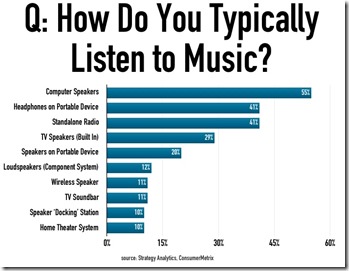
soundquality_study1If this isn’t a kick in the ears, I don’t know what is: “According to a survey conducted by Strategy Analytics, built-in computer speakers are now the most common way to listen to music, by a sizable margin.  In the study, laptop and desktop speakers overwhelmingly topped the list of frequently-used listening methods, with 55% picking the category.

“Headphones connected to a portable device followed with 41% of respondents, alongside stand-alone radio, also with 41%.  Surprisingly, TV speakers were also highly-ranked, with 29% ticking that box.”

While nothing about this information is surprising, that doesn’t keep it from being depressing. More out of habit and curiosity these days, I still read Mix Magazine, TapeOp, Recording, ProSoundWeb, and Pro Sound News. I’m mostly entertained by the seriousness audio “engineers” (an oxymoron if there ever was one) take their degraded “craft.” Almost by reflex, when I read an interview with some kid who has decided he’s the next incarnation of Tom Dowd (No, he won’t have the slightest idea who Tom Dowd was.) I chase down a few examples of the music he refers to as examples of his work. Invariably (Yes, I do know what that word means.), it will be some awful sounding collection of distortion, overused effects, trite synthesizers, and horribly recorded drums.

The critical feedback loop between musicians and their vanishing customers has been wreaked by “portable devices” and the delusional pipedream that some whackos have that high resolution audio will change any of that is nuts. I suppose I should be happy with the resurgence of vinyl, since you can’t get that shit on to a cell phone? If you know me, you know I think going back to vinyl is about as silly as abandoning cars for horses. It’s not the vinyl that matters, it’s the amplification and speaker systems, dumbasses.

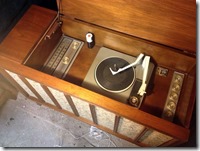
webcorThis has been a long time coming. This godawful Webcor record player is pretty much what I began listening to in my audio career, way back in 1959. My father bought it for the living room, decided he didn’t like the way it looked (ours was salmon “red”) and dumped it in the basement (where I lived).

My mother had convinced him to buy an RCA console system, but he decided that took up too much room and it ended up in the basement, too. It really was pretty awful, but slightly better sounding than my Webcor. rcasteroWhen he remarried, the RCA found its way back into the living room in their new home and it remained there until they downsized after all of the kids had left home.

By then, I had long since graduated to component stereo equipment, then band sound systems, and, finally, recording studio equipment for my home audio system. Our living room system (aka “Home Theater System”) is still a decent receiver and a pair of JBL studio monitors. The down side to that is that, if I bother to listen at all carefully, it’s pretty obvious that Pandora broadcasts in a mediocre MP3 format. Usually, I’m not that focused on the music coming from the living room when I’m working in the kitchen. When I am actually critically listening, I listen to CDs. I’ll put CD quality over vinyl any day.

Too often, when someone under 30 wants to show me some music it will be demonstrated on a cell phone speaker. I have no idea what I’m supposed to get from that experience. I can usually pick out the melody and determine if it is a male or female lead voice. That’s about all I’m willing to invest in that miserable fidelity source, though, which is often disappointing to the person trying to impress me.

To be truthful, if you are a cell phone user I have to suspect you don’t care about fidelity in any form. While I haven’t had a fixed-line telephone for quite a few years, our primary telephone looks a lot like a fixed-line system. Our phone service is provided through our high-speed ISP and an Ooma Tele. The sound quality was a substantial step-up from the fixed-line system provided by Qwest and, later, Comcast in our Twin Cities home. I can, in a few moments, tell if a caller is on a cellphone because the quality is miserable. Always. My guess is if you can tolerate that level of distortion in a voice conversation you aren’t that discerning in any aspect of audio. So, while I’m not surprised that music is being listened to on actual speakers by an audience of 12%-and-shrinking I’m also not impressed by your musical tastes. Your opinion of audio quality is just going to make me laugh, so don’t waste either of our time.

Saturday, April 8, 2017

You Think You Know What It Sounds Like?

One of the many painful things about being “experienced” (read, “old”) and having a technical background is that not that much surprises me any more. That is not a good thing, it’s not something I can brag about, it’s not something I’m happy about, it’s just a fact. Being surprised, having my stereotypes burst, learning something new and interesting is one of the joys of living. One of the things I loved about teaching music technology to “kids” who were three decades younger than me was being forced to re-evaluate my own biases and experience in a different context. Being retired deprives me of that opportunity and being more than a little disengaged from the necessity of making a living has scraped away some of the desire and requirement to compromise my own standards in the interest of “getting the job done.” When the job isn’t worth doing well, I’d just as soon avoid it altogether. 

So, when I had the opportunity to experience the value of a high quality microphone on vocals I wrote about it on a Facebook group called Move the Mics!, “I was part of an educational experiment this weekend. I ran sound for a regional bluegrass band, The High 48's, who use an AT4050 as their primary vocal mic and a collection of small and large condensers for solo instrument mics. They also have the usual SM58 at one end of the stage for introductions and a few backup vocals. When the banjo player sang or talked into the 58, he was unremarkable. When he sang or spoke into the AT4050, he was a dead ringer for Geoff Muldaur. I should note that I have always disliked the sound of 90% of most vocals through SM58's, but this was just a killer demo of why 58's should only be used to drive nails and for crappy punk vocals.”

I’m exaggerating, of course, and expecting sound geeks to get either humor or comprehend an experiment in quality evaluation is always a mistake. But I was surprised at the “loyalty” and emotion the defenders of the overused, rarely understood, and very successful Shure SM57/58. For example, “There are plenty of other mics I like better, but in a live environment, a 58 on vocals is rarely the weakest link in the chain. It's got good rejection, low handling noise, does well in wind, and is pretty hard to kill. With a little EQ, it works for almost anyone. Better mics are generally less neutral and can be quite picky about which vocalists they sound good on. If I was doing a tour for a band, I'd make sure I had everyone matched up with a great mic, but for doing random shows where you're lucky to get a sound check, a 58 is a safe bet that a good engineer can use to make just about anyone sound decent (well, a decent version of themselves). I wouldn't normally use it for vocals in a studio, but numerous great studio vocal tracks have been made with a 58 over the years, either as scratch vocals that got kept or when a vocalist insisted on holding a mic.


“If the banjo player sounded like a different person through the 58, I would have been scowling at the FOH engineer, not the mic.”


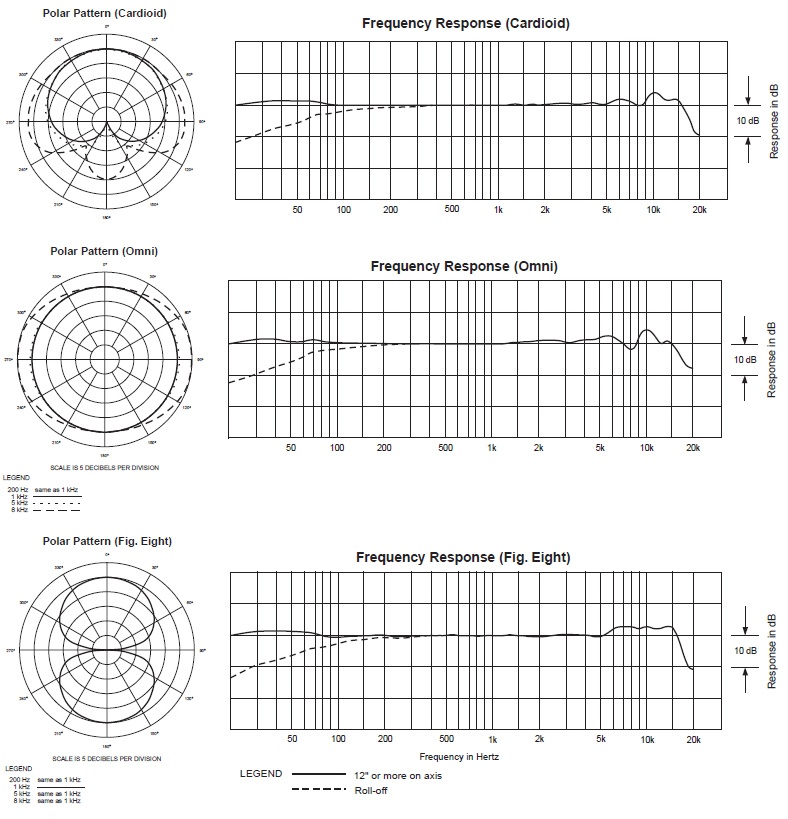
The idea that an SM58 could be EQ’d to sound like a high quality condenser microphone should be ludicrous to anyone experienced with either type of microphone. The delusion that “a 58 on vocals is rarely the weakest link in the chain” demonstrates a severe misunderstanding of the “garbage in, garbage out” concept. A quick look at the basic characteristics of the Shure SM58 should point out more than a few flaws in that claim. Add transient repsonse, noise rejection, phase accuracy, and harmonic and intermodulation distortion to the comparison and the idea that you can “fix” the differences with EQ becomes depressingly familiar.

A comparison to the characteristics of the Audio Technica AT4050 should be enlightening to an experienced, educated audio technician. In it’s worst, least accurate configuration the AT4050 delivers dramatically better frequency response, polar response, and a massively improved proximity characteristic when used at a foot or greater distance. In a group setting, this alone should be eye-opening. One of the defenders of the SM58 went on to say he’d used an SM58 in a chorus performance and it had performed “superbly.” When I expressed both doubt in his hearing and technical competence and gratitude that I hadn’t been forced (ever in my life) to make that kind of sacrifice, his response was to whine that I was jumping to conclusions without having had the pleasure of hearing the mess he’d made out of the performance. I will confess to that “crime.” I’ve heard thousands of miserable amplified live music performances and do not need any more of that kind of experience.
http://studiospares.s3.amazonaws.com/prd/401820/at4050dia.jpg
Maslow's golden hammer rule explains, "I suppose it is tempting, if the only tool you have is a hammer, to treat everything as if it were a nail." When the only microphone you know well enough to “trust” is an SM57/58 (and they are not the same hammer), every sound source has the characteristics as a nail. When your only expectation from a microphone is excessive gain-before-feedback and indestructibility, concepts like distortion, transient response, intelligibility, and accuracy are insignificant details. This is one of many reasons why live music is too often a painful and depressing experience to the few remaining people in this country who love music, know what musical instruments sound like, and would like to continue their lives with their hearing undamaged. I wish there was a fix for stupid, but unlike ignorance stupid can not be fixed.

Tuesday, January 10, 2017

Reflections on Guitar Building

When I started actively looking at moving, I stopped at Southeast Community Technical College to get a feel for the possibilities (for me) in that program if we moved to Red Wing. Luckily, I hit a day when David Vincent was working on course preparation and he spent a couple hours with me showing me the facilities, talking about my experiences at McNally Smith, and my experience with tools, shop equipment, and guitar repairs.

David also described the first year of classes and when he told me about “GTRB 1400 Intro to Tools,” I admit that I balked at having to take a basic hand and power tools class after a lifetime of tool-using. Since I wouldn’t be able to get in to the program for about a year, David recommended that I consider the cabinet-making class in Winona just to get my woodworking skills up a bit. So, I did. That was a pretty awful class, but it did show me how much I didn’t know about power tools I thought I was fairly familiar with.  I really didn’t want to take “Intro to Tools.” David made it clear that skipping that class wasn’t an option.

So, I signed up for all but one of the classes a first year student takes in the fall of 2015. I didn’t take the Electric Guitar Design class my first year because I wasn’t yet convinced I wanted to build an electric guitar. After three weeks of “Intro to Tools” I wasn’t convinced I was going to be building any sort of guitar. David’s class was kicking my ass. It turns out that my personal quality standards weren’t even close to good enough for a luthier.

To start, we all had a list of fairly expensive tools to buy. Four Canadian-made chisels for about $120 for the set, were on the list. You’d think that if you paid that kind of cash for a couple of pounds of steel they would come sharpened by the manufacturer. You’d be wrong. There was also a 4” plane on the list. It cost about $70 and it also needed sharpening. We spent about a week (it felt like a month) learning how to properly sharpen these tools. In the end, I was able to create an edge that would easily shave the hair off of my arm. The factory edge was far from that sort of edge.

IMG_7887For example, this sanding stick. It’s about 10” long, with a prescribed taper, different on both sides, and two different radiused sides, also prescribed by Mr. Vincent. I worked on that stick for days and, after three weeks, didn’t feel I was any closer to getting it right (+/-0.002” for all specified dimensions) than I was when I started. Everyday, for a couple of weeks, I wrestled with myself and my failure to be able to do the work to David’s standards. I was not that far from the edge of saying, “Screw this. I’m retired and I don’t need eight hours a day of failure.” Then, I got it. All of a sudden, I was not only getting the assignments but I was bringing in work from  home and doing it to my new workmanship standards.

2016 SETC Guitar Show (8)In the end, I did pretty well. I made the Dean’s list and, even more importantly, I made this guitar. Yeah, I know it’s a long ways from a Gibson Hummingbird, but it is exactly what I wanted to build, including a fairly individual semi-V shaped neck that I LOVE.

Also, I have a trio of super-sharp planes—from a 6” 1950’s Stanley to a 24” Stanley/Bailey that found in a Red Wing garage sale for $10 (with two new 7” saw blades tossed in for good measure) that I turned into a terrific manual joiner.

Occasionally, in my 68 years, I have learned things that if I’d have had them in hand when I was young would have made a world of difference in my life. This first year at Southeast Community Technical College was full of that kind of experience. I’m not kidding when I say that I think every kid who doesn’t know what he or she wants to post-high school ought to seriously consider the Southeast Tech Guitar Bulding and Repair Program. You will not be the same person after you’ve experienced the high standards this school and these instructors set for you.

Monday, March 7, 2016

How Quality Feedback Really Works

A while back, I was arguing with one of my MNSCU instructors about why he needed to get over his fear of lead-free solder and move his instruction program into this century. During this “discussion,” mentioned that the electrical assembly portion of almost every electric guitar I’ve ever disassembled has been an embarrassment. From the major factories to the boutique builders, the soldering, component placement and security, and wiring have been . . . sad. Likewise, many of the guitars (and other audio products) I’ve repaired in my career have failed because of soldering defects. His response was, “Don’t you think one of my long term customers would have complained if my soldering failed?”

My short answer was, “No.”

This isn’t the first time I’ve written about this discussion, but it keeps coming back to haunt me. There is an old 5/5/5 restaurant rule that says something like “It takes $5 in advertising to get a new customer to try a business, 5 seconds of poor service to drive them away, and $5,000 in advertising to get them back again.” It’s a fact. I may be the Geezer with A Grudge, but I’m not the only person on the planet with a long memory or who would rather just move along than wrestle with convincing a company that I’d experienced poor service or had an unsatisfactory experience with their products. 

A couple of days after our discussion, I remembered my last relationship with a luthier, back in the late 1970’s in Lincoln, Nebraska. For almost a decade, I’d fallen into the habit of buying guitars and, if I planned on keeping the instrument for any time, I hauled it to Lincoln and had my luthier setup the guitar at $150-250 per instrument. That seems like a lot for the time, but I was buying guitars idiotically cheaply from stoners and starving artists and had the margin to spare with most of my purchases.

Sometime in the early 80’s I brought in an old Gibson Explorer that clearly needed fretwork and a trussrod adjustment. The luthier had a couple of new employees, but I assumed that since I was an old customer my instrument would be serviced by the owner. I was wrong and the setup was awful. I lived about 75 miles from Lincoln and, while my studio was in Lincoln and I was in town for 2-3 days every weekend, I bought a book and made the corrections to the setup myself. Not only did I not complain to the store owner, I never brought in another instrument again and when my own customers asked where I’d have guitar work done I sent them to a shop in Omaha. I didn’t really know the shop in Omaha all that well, but I felt like I knew the Lincoln shop too well.

So, again my answer is “no.” I do not think the average customer, long-term or not, will bother to complain about lousy service. They’ll just move on unless you have set up some really clever system to almost require them to let you know how they felt about your product or service. 

In my dotage, I’m taking a “guitar repair and construction” course at my local community college; mostly for access to the school’s incredible wood shop tools. After a couple of semesters, I began to wonder why none of the classes ended with the usual student course/instructor evaluations. Since the dropout rate in my class has been extraordinary, you’d think someone might care about student retention. After a little inquiry into the school’s policies I received the following response from administration, “According to policies set forth by both the State of Minnesota and MnSCU the tenured faculty are only required to assess their class once per year - and they can do so in whatever format they choose. Probationary instructors need to assess much more frequently. I should mention that we are in full compliance with the policies, so I'm not sure what you're looking to do with this.”

All I can say to that response is "Wow!" No wonder my experience with MNSCU's programs (from the UofM to Inver Hills to Southeast Tech) has been so marginal. It sounds like a system totally driven by teacher union contracts and management disregard with no system for maintaining quality-of-program or delivery performance considerations. There is no such thing as a feedback-free system that provides any sort of quality control.

Now I really feel like I'm officially in the Midwest, the home of the most mediocre educational experiences I suffered in my 30+ years as a student. It does explain the proliferation of for-profit schools here, though. Apparently, the solution is for the student senate to recommend RateMyProfessors.com and give up on the school administration doing any sort of job.

Wirebender Audio Rants

Over the dozen years I taught audio engineering at Musictech College and McNally Smith College of Music, I accumulated a lot of material that might be useful to all sorts of budding audio techs and musicians. This site will include comments and questions about professional audio standards, practices, and equipment. I will add occasional product reviews with as many objective and irrational opinions as possible.