Showing posts with label analog recording. Show all posts

Wednesday, June 7, 2023

1966 Was A Weird Year

By now it should go without much explanation that I’m not a big Beatles fan. In my decline and fading memory, the one album that I remembered liking was “Revolver.” While pawing around some books about pop music, I stumbled on Robert Rodriguez’s Revolver: How the Beatles Re-Imagined Rock 'n' Roll and checked it out from my library. While I was at it, I checked out “Revolver,” too.

Product Cover for Revolver How the Beatles Re-Imagined Rock 'n' Roll Book Softcover by Hal LeonardFirst, the book was a huge disappointment. Mostly, it’s 250 pages of fanboy gushing over Beatles trivia. Since the book was published in 2013, I’d had irrational hope that we’d be past that and into something more technically interesting. There is a small middle section about the actual creation and recording of the record. Some bits of that are interesting, especially the revisionism of the revisionism and some of the funny stuff about how the memories of a quartet of stoners and the people around them were notoriously unreliable. The “correction” several people added to Geoff Emerick's George Harrison grudge from Here, There and Everywhere: My Life Recording the Music of the Beatles was sort of interesting. Before and after that, I could have used some of the Beatle’s 1966 stimulants to stay awake through the book.

History has a nasty habit of dragging us back to reality. Boomers weirdly remember the late 60’s fondly, which makes me suspect they either weren’t there or they we drugged/drunk into oblivion. The crap that was regularly on the late-60’s charts should embarrass my generation into never-again speaking of our musical opinions. Rodriguez regularly puts up US and British record sales chart and consistently 7-8 of 10 songs on those lists are, thankfully, consigned to the sad history of crap music. WLS’s June 1966 playlist put Tommy James’ “Hanky Panky” at the top, followed by “Paperback Writer/Rain” and “Strangers in the Night.” If you ever want to be humbled, musically, poke your birthday into “Find the #1 Song on the Day You Were Born” and get ready to be disgusted. For me, it's “Woody Wood-Pecker” by Kay Kyser and His Orchestra. Yeah, I know, poetic justice at work.

Has Britain lost its faith? - Full Fact“Revolver” was the record whackjobs liked to smash in the 60s. It came out right after John’s famous opinion on American religion hit the news,  “Christianity will go. It will vanish and shrink. I needn’t argue about that; I know I’m right and I will be proved right. We’re more popular than Jesus now. I don’t know which will go first – rock & roll or Christianity. Jesus was all right, but his disciples were thick and ordinary. It’s them twisting it that ruins it for me.” Later, he claimed he was talking about Christianity in England and he probably was and he was pretty obviously right. The chart at left ends in 2011 and, as of 2021, British religious participation declined another 13.1%. Whatever, that controversy did some serious damage to “Revolver’s” record sales, which is partially why it is mostly a forgotten Beatles record.

Revolver (Beatles album) - WikipediaAfter suffering through the book, I decided to see if any part of my good memories of “Revolver” were valid. The library copy was an analog-to-digital version of the 1966 stereo release. First, John Lennon was notoriously unhappy with his voice and gets some credit for whining about having to actually double-track his vocals,.which inspired EMI engineer Ken Townsend to invent the Automatic Double-Tracking (ADT) device used on practically everything in “Revolver.” After listening to “Revolver,” I’m with John. I was painfully reminded of their Chipmunk voices and the squeaky harmonies. While US engineers like Tom Dowd were knocking stereo recording out of the park in 1966 with records like The Young Rascal’s “What Is the Reason,” the Brits were still panning vocals hard left and instruments hard right (or the reverse or other weird combinations) and managing to get some bass into the recordings, too.

Considering the privative 4-track recording technology Martin and Emerick were cursed to be using on “Revolver” and the inflated egos (and lazy spoiled boy habits) they were dealing with it isn’t a terrible record. Listening to it pretty much demolished any fond memories I had. Compare “Revolver” to one of my favorite records of the day, Lorraine Ellison’s “Stay With Me” and get back to me on how great the Beatles were. As much as I appreciated George Martin, Phil Ramone more than topped anything that came out of England for the next decade with his engineering work on this song. And this is exactly why I resented The Beatles in the 60s because the British crap knocked this kind of music off of the charts for almost a decade.

Monday, April 18, 2022

Missing the Analog Point

For the last couple of days, I’ve been enjoying Short Nights of the Shadow Catcher: The Epic Life and Immortal Photographs of Edward Curtis, by Timothy Egan. It is a story about the most famous photographer of the American Indian in our history. But it is also a story about a man and his art, photography, at the beginning of that technology. When I was a kid, for a little while I was a photography geek in school. I had a few cameras, stuff that I’d found in pawn shops, from 120/620 Kodak film and a huge and beat-up Kodak Vollenda expandable camera to assorted low cost 35mm cameras. I wasn’t particularly good with the cameras (no change from today), but I was fascinated with the developing process and was fairly competent at that for a while. Music drug me away from photography pretty quickly and until digital cameras made taking pictures easy and cheap I pretty much gave up the habit.

Edward Curtis and "The North American Indian": An Exploration of Truth and  Objectivity - Photography Ethics CentreShort Nights of the Shadow Catcher has a lot of detailed descriptions of the chemistry and experimental quality of the developing process that reminded me of the analog recording processes and equipment that I grew up working with and wrestled with for more than 40 years. The book made me wonder if modern analog camera fans are as clueless about the technology they use as are modern analog recording freaks? Edward Curtis was a wizard in the darkroom, creating his own developing emulsions, processes, and creating effects with chemicals, development time and temperatures, and other techniques. His gallery in McCloud, California is a national treasure as was his art. Most modern analog photographers bypass the darkroom, for good reason. The chemicals are often toxic, at best, and the processes are tedious, hazardous, and unpredictable. Sending your roll of film into a company that owns and maintains the automated processing equipment is the surest, easiest, safest way to get pictures developed. It also eliminates at least half of the art of being a photographer.

The analog recording process, at its best, is a similar mess of technologies, lots of subjective judgement, experience, tedious technologies that require constant (expensive) maintenance, and ridiculous quantities of patience. Like analog photography, the results of all of those qualities can be emulated relatively simply and predictably with digital technologies with little-to-no downside. I am not saying that those emulations are perfect and I am absolutely not arguing that an analog master can not do things in that format that might be impossible to duplicate in the digital world. I am saying that if you aren’t a master of the technology, you’re probably bullshitting yourself if you think plowing money into obsolete equipment and media is going to magically buy you something you couldn’t do better with digital equipment.

Thursday, October 29, 2020

The “I’m Gonna Quit” Story

There is a long, semi-funny story behind that song and the first recording and THIRD recording. We were living in Fremont, Nebraska at the time. I’d been laid off of my 1st engineering job and had taken a position as tech services manager for an Omaha office equipment company, servicing Burroughs Corporation word processors and IBM Selectric typewriters among other electric and electronic equipment. It was a miserable job with a terrible company, but there weren’t many tech jobs in 1976 Nebraska. A few days before the song’s birth the owner of the company told me I had to lay off 2-3 of my newest, most capable technicians because they were “overqualified” and he wanted the money for raises for a couple of his bimbo saleswomen. The tech service department was not only making the company money, for the first time in the company’s history, but our service was attracting IBM customers and the sales commissions on those machines was better than anything a car salesman could make. Today, I would assume he was screwing the sales bimbos, then I was a pretty innocent/gullible 28-year-old.

Another insane Republican had driven the US economy into the dirt and times were somewhere between terrible and disastrous. We “sold” our house at a $5,000 loss (on a $20,000 original purchase), although on paper it looked like we broke even; I paid the “buyers” $5,000 under the table to make their down payment. I had arranged an Omaha apartment for us to move to, but at the last minute (before any money changed hands) Elvy wasn’t going to go. She’d asked a friend in Scribner, Nebraska for help and he’d offered her (and us) a house he owned that needed a lot of work but was livable and he would pay for the work and materials. $80 a month rent, which was workable on Nebraska’s unemployment. One morning, I called the office company owner and said, “I was sick when I took this job, I’m better now and I quit.” No notice, no two weeks, nothing. I hadn’t worked there long enough to damage my Unemployment from my engineering job so I had nothing to lose.

Before we packed up our belongings and gave away everything that wasn’t going to fit in our new far-smaller home, two friends (Dan Tonjes and Mark Von Seggern) and I hit the basement “studio” for one last blast of our past and we recorded the twanging electric guitar part, vocal, bass (Dan), and drums (Mark) to my new song, “I’m Gonna Quit” on two of my Teac 3340’s four tracks (drums ALWAYS get tracked in stereo). After we were sort of settled in to the house in Scribner, I wanted to add a distorted guitar part and an extended percussion into and outro. Dan and/or Mark knew the Scribner school music instructor and “borrowed” a wheelbarrow full of school percussion instruments. We used the other two 3340 tracks on I don’t remember how many percussion players gathered from our friends in Scribner and my guitar part and I had a song and a recording. I still love that original recording, as rough as it is.

A decade later, a Nebraska friend and one of the guys (a drummer) who we used in the studio occasionally was in a band being fronted by Barry Fey’s company. I’d given him a cassette of my songs back in the 70s and he’d played it for the band and they wanted two of my songs: “Down on the Beach” and I’m Gonna Quit.” By “wanted” I mean they wanted me to give them the publishing rights and authorship in exchange for . . . nothing. I declined, but they recorded the two songs anyway and the band dissolved and nothing happened to the recordings after a lot of money was spent and the usual 80’s rock and roll silliness ensued.

When I moved to Denver in 1991, I looked up the lead singer of that band and she gave me a cassette copy of their take on my song. It was . . .entertaining, but I could see how the band didn’t take with audiences or promoters. Too much Pat Benatar, too late.

Through my following studio years, I always wanted to redo “I’m Gonna Quit” with a little more fidelity, but recreating the attitude, energy, random-ness and creativity of the performance and percussion section overwhelmed me. Sometime around 2002, Michael McKern and I gave it a shot with the original recording as our “click track,” we recorded his drums, the clean electric guitar parts, some background vocal ideas, and a decent acoustic guitar part to his 24-track MCI JH24 deck and bounced that to Pro Tools. And . . . nothing. I was still stuck without a way to pull off the percussion section and that was a gumption trap.

Jump to August 2020 and I’ve been playing music, on-line, through JamKazam, with four friends: Harold Goodman, Stu Anderson, and Scott Jarrett since March. We’re messing with original music and covers and they’ve irrationally designated me “vocalist” because no one else wants to sing, including Scott who is an infinitely better vocalist than me and about 1,000 times the musician. Michael has been dubbing drum parts to my original songs via Dropbox and, when I tell him I can’t get into finishing off “I’m Gonna Quit” because my attempts at doing a percussion part either with real instruments or Logic X’s loops or MIDI just sucked, Michael knocks out six tracks of the percussion instruments you will hear on the recording. Hesitantly, I offer up “I’m Gonna Quit” to Harold and we fool with it for a bit on line and he, as usual, asks “Should we record it?”

This was the first time I had sung the song since 1978, other than noodling around with ideas with Michael almost 20 years ago. The vocal you hear on this recording, for better or worse, is my first take at the song in August of this year. I’ve sung it with the group on JamKazam a dozen or more times, since, and tried to overdub it with a “better” microphone in my office/studio and I still like this take the best. I musta been really pissed off at something (probably Trump) that day. Harold’s bass line was the perfect foil for the busy percussion and guitars and Stuart’s steel guitar and Scott’s organ and the rest was my problem. My wife, Robbye, suggested industrial, work sounds to go with the percussion intro and outro and that pretty much filled in everything I thought was missing. I did keep a lot of my last vocal stuff from the times we recorded the song on JamKazam for the outro. All of that “I don’t need this” and “I’m gonna quit” and the rest after the last chorus was cut-and-pasted from every other take of the song.

This is the final, newest, bestest version of my song, “I’m Gonna Quit,” featuring my friends Michael McKern, Harold Goodman, and Scott Jarrett. I can not express the obligation I feel toward all of them for making this happen. Not out of arrogance but out of personal history, I do love this song and I am really happy with this version. It is, finally, done.

Monday, October 26, 2020

Serious Music

Back in the late 70s, I signed up for a recording seminar at the University of Iowa. Believe it or not, Iowa City, IA had a very small recording program and decent studios (primarily for classical music and the college jazz band) in the 70s. The presenter was Stephen Temmer, who must have been in his early 50's when I met him but who seemed "ancient" to me at the time (I was in my late 20's.) Temmer died in 1992 at 64, which I would probably consider "young" today. 

Mr. Temmer later became an adjunct professor at the University of Iowa, but at the time we met he was still President and owner of Gotham Audio Corporation, the only North American distributor for AKG, Neumann, Studer, EMT (plate reverbs), Lexicon, and many other things European. At the time of the course I took, Temmer was just beginning to market a collection of audio cables that he claimed were significant improvements over "ordinary wires" and we had some spirited discussions about that subject, too. 

I was at least as big an asshole then as I am now. During Temmer's introduction to the two-week-long, 8-10 hour/day course, he said something like, "We won't be discussing popular music recording in this class. Our topics will all be regarding the recording of 'serious music.'" 

I couldn't let that pass. Up my hand went and I said, "I didn't think music was a 'serious' thing. If it's not fun, it doesn't have much point does it?" I got a scowl and no reply. That was on Wednesday, the first day of class. For the next two days, Mr. Temmer pretty much ignored me. 

Luckily, the school's studio maintenance tech, Stephen Julstrom and I had hit it off pretty well, mostly talking about tape deck and console maintenance and design. The "in" with Mr. Julstrom, who was about my age (and who later became a design engineer with Shure Brothers in Chicago about the time I went to work for QSC Audio Products), provided me with some amazing opportunities including recording student classical performances and the college jazz orchestra (I still have a copy of that last one.). Unfortunately, one of the nights I'd volunteered to help Stephen record a student jazz group at a local coffee shop was the night the rest of the class went to see one of my lifelong heroes, Dizzy Gillespie, direct the UofI's big band. I've always regretted that and didn't get to see Gillespie until the early 90s in Long Beach with a small, mostly electric band. However, I got to play with some very expensive microphones that I'd only read about up to that moment and work in the college's great performance spaces using the school's very expensive equipment; although some of it was expensive, but not particularly high fidelity.

When the first weekend came, Steve Julstrom had invited Mr. Temmer and me out to his lakeside place for an afternoon barbecue. Because we were a one-vehicle family at the time, I'd taken the bus from Nebraska to Iowa City and Mr. Temmer offered to give me a ride to the lake. The school had rented a Cadillac for Mr. Temmer and I hadn't been in a new Caddy for several years. At the least, it would be a comfortable drive, even if we didn't talk much. I'd mentioned this experience in another Wirebender essay a couple of years ago, "That’s Not Serious, It’s Art." Who knows why, maybe to irritate me, maybe because it's how he always traveled by car, maybe he thought he was going to educate me, but Stephen fired up the stereo as we took off and found a classical station. When the orchestra started playing something I wish I could remember, Temmer began to wave his arms while he drove and sing along with a pretty decent voice. I watched him for a bit and about the time I started to smile at his performance, he looked at me and started laughing. We laughed together for a bit and had a great conversation about music being about "fun" and entertainment and a distraction from serious stuff and by the time we arrived at Julstrom's home we were more than acquaintances. 

The next day, Sunday, the Stephen's invited me to help record a piano-violin Bartok record with two of the school's faculty musicians and a collection of Temmer's Neumann microphones; new and historical (Including a Neumann omni that Temmer said was either "Hitler's microphone" or one like that used to record Hitler's speeches. It looked a lot like the one in this picture, as I remember. Temmer was an Austrian immigrant.) I also included several of the Audio Technica and Tascam microphones from my own collection in the recording and, later, we did a single-blind comparison of all the microphones used in this recording with the rest of the class. To Temmer's mild disappointment, the class overwhelmingly selected my Teac ME-120 condensers as their favorite in that test. The "Hitler mic" was pretty obviously lacking in high end response as the violin would often slide above the mic's capabilities far enough that it vanished in the mix. If nothing else, that proved that there are some limits to the vintage cache. 

For the next several years, any time I came upon a low-to-moderate cost microphone that I thought was either interesting or exceptional, I would write Stephen Temmer about it and, often, he'd ask to borrow it for a bit. I fell out of that habit a little before I moved to California in 1983, after my 2nd studio closed and I was convinced my life in music was all but finished. At the time, I was managing a manufacturing company building everything from high voltage inductance test equipment to the Arrakis Systems broadcast equipment. That might seem like I was still working in audio, but it didn't feel much like it. In my last few months in Omaha, massive personal turmoil pretty much squashed everything in my life but work and home. I'd been working with a friend, Mark Hartman, on jingles and pitches for commercial music, but that sort of withered away in those last months before I accepted the QSC job. 

Once in California, I was a regular member and occasional officer with the Orange County Audio Engineering Society (which no longer exists) and I bumped into Stephen at least once at the LA AES Show before he retired from and sold Gotham Audio in '85. A year or two later, I ran into him at Wes Dooley's AEA Micophones facility in Pasadena, when I was buying a couple Audio Precision test fixtures for the QSC assembly line. It still would be a few years before I started collecting and messing with microphones again, but I always clung to the idea that music wasn't a serious thing. If it's not fun for someone it's not music. I didn't see or hear from Stephen again and didn't know he'd died in 1992 until recently.

Note: Heidevolk and their one and only flash-in-the-pan semi-hit, Vulgaris Magistralis, are the poster children for my music is "fun" point. It's hard to tell from their other songs, but I can only hope these characters are posing as Viking assholes. Regardless, I love this song and it never fails to make me laugh when i hear it. I would just as soon not know anything more about the band or their opinions on "life, the universe, and everything." They might be "serous," but I think they are hilarious.

Monday, December 9, 2019

My Momentary Folk Singer Career

In the fall of 1967, my father withdrew about $3,000 from my college savings fund and the family took a “vacation” and dumped me in Dallas, Texas. The plan was that I would be attending a fly-by-night Texas for-profit computer school. The reality was that my father thought I was wasting my life trying to be a musician and he figured I’d follow my money where ever he decided to send it. He was, of course, right; in his weird, passive-aggressive way. I had earned that money throwing newspapers between the ages of 11 and 13 and working at the Dodge City Boot Hill Front Street Replica tourist trap for two summers from age 13 to 14. I, of course, wanted to spend that money on music equipment, but my father would have none of that. Worst case, I figured I would be far enough from Kansas and my fundamentalist whackadoodle family to completely break free from them and start my own life. 

The school, as you would expect, turned out to be a fraudulent joke. The school’s “dormitory” was a 1920’s flophouse full of bums, drunks, thieves, and a dozen-or-so computer school “students.” After a week in the flophouse, a half-dozen of us started looking for a better place to live. We found a house we could rent for about the same money as the flophouse, sans flophouse food. That lasted for a month because one of our roommates ate everything that came into the house and bought nothing. When he tried to “borrow” money for the 2nd month’s rent, we scattered. Two of the guys, twin brothers (Larry and Gary)  from Lawrence, KS, found an apartment in Old East Dallas and I rented a tiny garage apartment from the same landlord. By then, more than half of the school’s students had dropped out and most of them were suing the school for fraud; among other things. One of the more experienced guys had recommended that we join the lawsuit, but my father had already been conned into giving the school a 2nd semester tuition as a payoff for my dropping out. For an accounting teacher, his math skills were consistently suspect. His capacity for critical thinking was never suspect because it was never evident. I kept going to the school, even though most of the instructors had quit and the already obsolete computer equipment had been repossessed. 

About the time I moved into the garage apartment, a friend from Kansas, Ed, who was burning time before his delayed induction into the Army date moved in with me. We had written a few dozen songs together and decided to try some of them as folk songs. There was a bar a few blocks from the apartment and coffee shops from Lakewood Heights to downtown Dallas. Best of all was the Rubaiyat, the premier Texas folk club/coffee shop of the day. Ed stayed for a couple of weeks, just long enough to help me connect to some of the folk music scene. Toward his last few days in Dallas, our act had started to attract a weird collection of “side men” to our act; percussion players, “singers,” guys blowing into bottles and South American flutes, an upright bass player or two. Some characters brought instruments they often couldn’t play at all, so they’d just bang on them. There was no money in any of it, so that act took on a name that included the words “jug band.” That is all I remember about the group name, too. Jug bands were a thing then, for a brief moment. 

Once, we accidentally ended up being one of the intro acts for a major (for the time) folk singer. It kills me that I can’t remember if it was Tom Paxton, Tom Rush, Tim Buckley, Tim Hardin, or it could have been someone I have completely forgotten. The first name stated with “T,” I was not a folk music guy at the time, although I loved Bob Dylan and covered several of his pre-electric era songs. I wouldn't have known Rush from Paxton from Buckley at the time, but I did cover Hardin's "Reason to Believe."

Ed and I showed up, but the rest of the menagerie did not, so we did a half-dozen original songs and gave up the stage to the headliner. As I walked off of the stage, whoever that T-guy was said, “You know what it’s supposed to sound like.” 

[The picture at right is just a Rubaiyat poster, not a bill that our group was on.]

I will never know if that was a compliment or sarcasm. If you know me, you would be correct in assuming I lean toward believing it was sarcasm. We were 19 and 20-year-old kids from Kansas.

A day or two later, Ed headed off to basic training. I ended up dropping out of my bogus computer school, shacking up with my wife, Robbye, diving into the Dallas hippie world (sans drugs), and almost giving up music entirely. I really wanted to be an R&B guitarist, but couldn’t cut it in that competitive environment. I loved playing guitar or bass in an R&B band, but playing solo folk music scared the crap out of me. Still does. Occasionally, I would stop in at the Rubaiyat and play with one of the other groups or do a couple original songs. One of those songs, “Dixie Lead,” was recorded at the club and got a little late night FM radio play, as a protest against one of the many grossly polluting factories in east Dallas. And that was my first experience in the big city.

Monday, April 1, 2019

One Story, Two Books

One of my wife’s favorite concepts is “evolutionary convergance”; where the same evolutionary decision is made independently, likely because it is a good idea. The two books are The Birth of Loud: Leo Fender, Les Paul, and the Guitar-Pioneering Rivalry That Shaped Rock ‘N’ Roll by Ian S. Port and Play It Loud: An Epic History of the Style, Sound, and Revolution of the Electric Guitar by by Brad Tolinski and Alan di Perna. Play It Loud is a 2016 publication and The Birth of Loud came out this year. Your take on these two books will depend on your personality. The stories are, essentially, the same.

I read Play It Loud first and am just now finishing up The Birth of Loud. Of the two, Play It Loud is my choice.

There are too many technical flaws in The Birth of Loud and the writing style is too emotional and concentrated on personalities rather than technicalities. Your mileage will, probably, vary. Lines like this are show stoppers for me, “When Leo heard this story [about his pickups failing during a performance], he made sure that if the Esquire’s wiring shorted, the signal would only be diminished, not completely cut.” Wrong. If the wiring is “shorted,” there will be no output, regardless of Leo’s technical “genius.” Birth of Loud is littered with this kind of technical foolishness, to the point that when the author attempts to describe how anything works I have to kick into speed reading mode to get past his mistakes and misunderstandings. Otherwise, I’d toss the book in a pile and find something more interesting to read. There are moments in Birth of Loud that make suffering the flaws worthwhile, though. I knew almost nothing about Paul Bigsby, other than the fact that he knew the difference between vibrato and tremolo; unlike Leo Fender. By himself, he would be an interesting story, so the fact that there is a little more about Bigsby in Birth than Play makes that book worth reading; at least, for me. I do have to suffer through an awful lot of hyperbole, emotional language, and outright silliness to get to the good stuff, though. Port’s descriptions of the music discussed in the book are so over-the-top silly that it’s hard to take any of the book seriously.

Play it Loud is less emotional, more technically accurate, and a more entertaining and interesting read. The authors either check each other’s excesses and technical misunderstandings or they are simple more knowledgeable; or they had a better editor.

Interestingly, neither book is the usual Les Paul pandering that we’ve suffered for the last 40 years. I suppose Paul has been dead “long enough” that the shadow of his self-promotion is fading. I remember watching a Los Angeles AES discussion in the 80’s where Les Paul and Tom Dowd were on the panel and when Les started bragging about buying the “first Ampex 8-track machine,” Dowd reminded him that most of the design work on that machine came from Dowd and Ross Snyder’s idea of making a single 1” multi-track head, instead of Paul’s stacked individual heads and eight stacked ¼” tapes. Also, both Dowd and Paul ordered 8-track machines, more or less, at the same time and Paul’s was supposed to be delivered first, but Dowd snatched it off of the Ampex loading dock and installed it himself. Ampex delivered the 2nd one to Les Paul’s studio and installed it for him. Les Paul was the Jimmy Page of his time, claiming the creation of everything from electric guitar pickups to solid body Spanish-style guitars to recording techniques to tube amplifiers. Of course, there were predecessors for all of those inventions, but Paul made his claims more often, louder, and more prominently than that actual inventors. His contribution to the famous Gibson Les Paul guitars is accurately reduced to his signature on the instruments and some of people who actually designed those instruments are credited. History is catching up to Les Paul’s legacy.

Leo Fender gets a similar look in both books, probably more harshly/realistically in The Birth of Loud. His personal and technical limitations have been rarely discussed outside of knowledgeable conversations between engineers or technicians. The fact that Leo overcame his technical limitations with hard work is a fact, but the fact that his products were littered with the downside of those technical limitations has barely received a mention. The contributions of the many people who compensated for Leo’s limitations are finally documented in both of these books. Rarely, does one person actually “create” a significant product; almost never, in fact. Fender’s guitars and amplifiers are the product of a lot of unheralded effort by many people who at least get acknowledged in both of these books, more so in The Birth of Loud, to the credit of Ian Port.

Thursday, December 6, 2018

Brave Spirits or Just Dumbasses?

In August of this year, John Baccigaluppi wrote a TapeOp End Rant titled "An Endangered Species?" The gist of this article was "The beauty of older analog gear is that we can actually fix it with fairly common parts, or at least we have been able to so far. I recently sent a pair of 1950's-era RFT bottle mics to Scott Hampton, of Hamptone in order to upgrade their power supplies and he had this to say, ‘These things are beautiful, in the fact that it's like working on a 1940's truck. Everything is easy to access and is straightforward. [The work is] going quick and smooth.’" This is a much different experience than troubleshooting why a DAW stopped working after the operating system was updated." I’ve owned 1940’s trucks and I remember that they needed major work about every 10,000 miles, could barely make 10mpg, puked out climate-changing emissions including lots of unburned fuel, were noisy, unsafe at most speeds, and rusted as fast as sugar in water. I’m unimpressed. My response to that column was: 


While it is always entertaining to hear old men (or old souls) rhapsodizing about when “spirits were brave, the stakes were high, men were real men, women were real women and small furry creatures from Alpha Centauri were real small furry creatures from Alpha Centauri,” tools_Header_JointsJohn Baccigaluppi’s “An Endangered Species” harping about the deficits of lead-free solder was funnier than I suspect it was intended to be. Solder defects have always been a substantial part of electronic equipment failures. In the 80’s, I had a side business repairing Roland Guitar-to-MIDI converters because that company failed to anticipate the mechanical stress of their power supply components on their fragile circuit boards. In my MI equipment repair career, I would estimate that at least 75% of all electronic component failures were initiated by solder connection failures. Even the often-praised point-to-point tube circuits were known to rely on their unreliable mechanical attachment to the terminal posts because the heat from the tube circuits and the lack of flux removal caused the lead to degrade into powdery lead-oxide. As many companies demonstrated over the last century, the beauty of tin-lead solder was that any half-trained chimp could make a mediocre but hard-to-inspect solder connection, but the flaw in that technology was that the circuit designs were rarely conducive to sufficient removal of the flux residue which led to deterioration of the connections with heat, moisture, or just oxygen exposure. 


Like the lovers of big iron American cars, unreliable but repairable out of necessity overweight vintage motorcycles, and lead-based ceramics, Baccigaluppi’s rhapsody for the days past when equipment failed often but could sometimes be repaired with enough effort, patience, and money is nothing new. However, those old vehicles rarely survived 50,000 miles without some sort of major overhaul and while they might have survived in a climate-controlled garage for “60 to 70 years” they were useful transportation for about three years before the cost of repair overwhelmed the cost of replacement. Today, a car that doesn’t last for at least 200,000 miles before needing major work is clearly a lemon.


Electronic Recycling Likewise, I suspect at least a few thousand “vintage” large format consoles have ended up polluting the nation’s water supply because their performance and capabilities didn’t warrant the cost of repair, let alone the real estate necessary to house that equipment. Like old cars, motorcycles, and pottery, the collector/hoarder business in audio equipment is coming to an end. Baccigaluppi asked, “how many pieces of classic recording gear have you seen in a trash dump?” Last fall, I took a “ghost town Detroit” photo tour and saw a building full of “classic recording gear” and broadcasting gear abandoned to metal scavengers in a Detroit public school building: MCI and Otari tape decks, racks of AT&T patch panels, recording and broadcast consoles, effects and signal processing gear, and piles of audio and video patch cables. The school had, supposedly, tried to find a buyer for the broadcast vocational school’s equipment, but no one was interested. So, sooner or later all of that stuff will end up in a trash dump. About a decade ago, I had the opportunity to obtain a pair of Otari consoles that had been used on the first Star Wars movie, just for the cost of getting the consoles out of a 3rd floor warehouse and finding a place to store them. No thanks. So, to the trash dump they went along with a warehouse full of 1970’s and 80’s video equipment.


Some products are worth salvaging, if just for the historical value. Most electronic products are obsolete regardless of whether that was “planned” or not. There is an educational value to repairing an old piece of gear and that shouldn’t be discounted too quickly. There are, however, good reasons why the old equipment gets discarded for the new. There is a wide line between tossing a $600-1,000 phone every year to “stay current” and spending hundreds of hours maintaining old equipment that isn’t even close to capable of performing to modern standards. I suspect the best way to decide where you draw that line is by determining what your time is worth.

That response appeared in this month’s TapeOp Letters to the Editor. It was also interesting to read this month’s end rant about how much maintenance analog equipment needs to be marginally musical and how TapeOp’s editor warns newbies away from the stuff for that reason. 

POSTSCRIPT: My grandson gave me his old eBike because it needs a lot of work after a season and a half of daily commuting; especially because of the damage the bike suffered during a Minnesota winter in the Cities. One of the components that failed was the throttle, which is a Hall Effect transistor-controlled electronic device. Wholesale, the throttle is a $2 Chinese-made part, but there doesn’t seem to be an easy way to obtain that part in the USA except through the bike’s distributor. 

The part is assembled in a way that doesn’t allow for disassembly for repair without either carving into the case or finding a way to dissolve the cyanoacrylate that was used to glue the part together. So, repair is close to impossible and impractical. While waiting for the replacement, I’ve fooled with troubleshooting the circuit and became facinated with the idea that this kind of assembly would fail since it has not real moving parts. 

rt-01-lgWhen an engineering friend was visiting us, I asked if he had some thoughts about why this part might have failed and he tossed it back in my face, “Are you kidding? You know the transistor is mounted on a circuit board, right? Most likely a solder joint failed.” Of course, I should have known that. Consistent with my 55+ years of electronic engineering and manufacturing experience, most likely the failure is a soldering fault.

Monday, October 1, 2018

Overrating Repairability

1100.pdf-0Back in the mid-80’s I thought I had a small vision of the future. I imagined that there would be a much larger market for small, high fidelity, high reliability power amplifiers for the home studio market. First, I talked Pat Quilter into designing a one-rack-space Series One amplifier for that market; the QSC 1080/1100. From my own studio experience, I added a pair of headphone jacks for control room monitoring, with independent and easily replaceable limiting resistors so that two different monitor headphones could be plugged into that amp with the expectation that the acoustic output would be the same on both phones regardless of sensitivity or impedance. My contribution to the company’s documentation was the schematics that were found at the back of every owners’ manual for more than a decade. I also spec’d all of our circuit boards at 2 mil thickness to make servicing easier without causing damage to our boards during repair and to add to the durability of our products. I even argued that slotted screws were more repair-friendly than Philips screws, due to my experience working on Japanese motorcycles. (I was wrong in that argument.) 40 years ago, I was a big believer in designing field-repairable products. Today, not so much.

bad solderI have a long career in music instrument (MI) and audio equipment repair. That means, I have worked on equipment from the end of the tube design period through the 30-some years of analog equipment and discrete-to-integrated-circuit designs to today’s surface mount technology (SMT) components and our current age of equipment that is so complicated it is very nearly unrepairable for anyone but factory technicians. I have worked for several manufacturers, either as a captured employee repairing company products or as an independent tech working as an authorized service center or repairing equipment long past warranty. I’ve worked on a lot of equipment after someone else has attempted to make repairs. I’ve seen butchered single-sided printed circuit boards (PCBs), slaughtered double-sided PCBs with nonsensical jumpers scattered all over the board to bypass the wreaked traces, and point-to-point terminal strips so buried in cold solder that I needed a bottle of flux to get the solder to flow well enough to remove past repair attempts. And those messes were often created by factory authorized service center technicians and even the factory technicians! There are at least two well-known, high end Eurotrash console makers (who may or may not remain nameless) that were infamous for shipping new consoles with so many butchered and jumpered boards and wiring harnesses that we just assumed their crap would need reworking out of the crate. All of that equipment was repairable, but it needed repairing on a constant basis; rarely less than every 100 hours of use.

interstate-vw-junkyard-2016-06-10-16-05-58In fact, most of the products from our past that are “repairable” were made that way because their expected lifetime was incredibly short without occasional repairs. The old VW air-cooled motors lasted about 35,000 to 50,000 miles between major overhaul (35 for the van, 50 for the Beatle). In the good old days, an analog tape deck required recalibration with every new reel of tape and serious and expensive maintenance every two thousand hours (about 250 8-hour-days) of operation. In modern vehicles, safety features like crumple zones, air bags, ABS brakes, and other electronic-controlled features and functions limit repairability to module replacement because of their complexity and design. It’s not just the SMT components, but the incredible increase in complexity of the circuit designs that limits field repairs.

However, we’re at a point in auto manufacturing history where any vehicle that doesn’t last 200,000 miles between major service intervals is considered a lemon. Other products offer similar longevity expectations. I’m still using a 2008 Dell laptop, although it is on its 3rd keyboard (which was designed to be easily replaceable). While Millennials seem to think a cell phone is obsolete after a year or less, my flip phone has been working just fine for the last decade and it is still on the original battery. Televisions usually get replaced becauses they are “too small” or don’t have current features, not because the CRT or other tubes and components have failed. Appliances are often handed down to a home’s next owners because, on average, Americans stay in their houses fewer years than an appliance survives.

Much of what we buy today can be repaired, it just costs so little to replace it that we do that instead. Click and Clack, the guys on the old Car Talk NPR radio show once estimated that it cost an average of $600/year to maintain an old car, far less than car payments. People still buy new cars, even when their current vehicle is probably good for another decade or two. My father, on the other hand, habitually traded in his “old” Chevy at 50,000 miles because he was used to his cars falling apart about then; and losing trade-in “value.” My first decent vehicle, a 1973 Toyota Hilux pickup, lasted for 350,000 miles with a valve job at 250,000 and a rear transmission seal at 275,000 being the only significant necessary repairs. I sold it for almost exactly what I paid for it, thirty years later. Now that is both longevity and repairability, but no crumple zones, no ABS, decent fuel economy but lousy emissions, lots of vehicle noise, and not much interior comfort. My current 2008 Nissan pickup has most of the creature comforts and safety features of the best car; at least as of 2008. It is pretty servicable, too. My brother’s new Toyota coupe looks like a nightmare to service, but it has a 100,000 mile power train warranty.

Finally, while there is lots of talk about fighting the disposable product economy, there isn’t much energy going into actually doing it. Consumers are quite happy being ignorant about how practically everything they own works. I would bet that the percentage of consumers (including musicians and studio owners) who are capable of repairing even the most simple electro-mechanical problem is less than 1% and many of those would rather they didn’t need to. At some point in manufacturing history, someone asked “How many customers read our detailed owner’s manual with maintenance and service information?” When the answer came back, it was obvious that was a waste of time and effort. Soon after, someone asked, “How many customers care if a service manual is available?” That discouraging answer eliminated service manuals. As long as those kinds of questions keep getting money-saving answers, you can assume servicability will continue to vanish.

4ce1c0104f027.imageIf you really like working on old junk, there is more than enough of that crap availble out there for you to play with. Since all of the post-Boomer generations appear to be mostly bdisinterested in “vintage” crap, prices are falling and demand is vanishing. At that rate, you should be able to buy Grandpa’s muscle car for less than your father paid for it. Hurry, though. Old stuff is showing up in the dump on an accelorated schedule. Turns out, most people would rather recycle old equipment rather than wrestle with fixing it.

The other end of the decision process is function, value, and price. For the cost of a 24-track record head you can buy 24-or-more high definition preamps with a high-resolution A/D interface that will likely last for a decade or more with no maintenance required. For the repair cost of a vintage Eurotrash tube condenser microphone, you can buy a modern condenser microphone that will emulate a whole collection of vintage microphones. If that kind of analysis doesn’t convince you to reconsider tossing good money after bad, you are clearly convinced that there is something special from obsolete technology and I can’t (and wouldn’t want to) change that.

Wednesday, August 22, 2018

Worshiping Tin-Lead and other Old Bits of Junk Technology

The following is a letter I sent to TapeOp Magazine regarding a silly end rant by John Baccigaluppi about how much he loves tin-lead solder and big iron audio electronic equipment. A year ago, I took a “ghost town Detroit” photography tour and I have stuck a video of that

While it is always entertaining to hear old men (or old souls) rhapsodizing about when “spirits were brave, the stakes were high, men were real men, women were real women and small furry creatures from Alpha Centauri were real small furry creatures from Alpha Centauri,” John Baccigaluppi’s “An Endangered Species” harping about the deficits of lead-free solder was funnier than I suspect it was intended to be. Solder defects have always been a substantial part of electronic equipment failures. In the 80’s, I had a side business repairing Roland Guitar-to-MIDI converters because that company failed to anticipate the mechanical stress of their power supply components on their fragile circuit boards. In my MI equipment repair career, I would estimate that at least 75% of all electronic component failures were initiated by solder connection failures. Even the often-praised point-to-point tube circuits were known to rely on their unreliable mechanical attachment to the terminal posts because the heat from the tube circuits and the lack of flux removal caused the lead to degrade into powdery lead-oxide. As many companies demonstrated over the last century, the beauty of tin-lead solder was that any half-trained chimp could make a mediocre but hard-to-inspect solder connection, but the flaw in that technology was that the circuit designs were rarely conducive to sufficient removal of the flux residue which led to deterioration of the connections with heat, moisture, or just oxygen exposure.

Like the lovers of big iron American cars, unreliable but repairable out of necessity overweight vintage motorcycles, and lead-based ceramics, Baccigaluppi’s rhapsody for the days past when equipment failed often but could sometimes be repaired with enough effort, patience, and money is nothing new. However, those old vehicles rarely survived 50,000 miles without some sort of major overhaul and while they might have survived in a climate-controlled garage for “60 to 70 years” they were useful transportation for about three years before the cost of repair overwhelmed the cost of replacement. Today, a car that doesn’t last for at least 200,000 miles before needing major work is clearly a lemon.

Likewise, I suspect at least a few thousand “vintage” large format consoles have ended up polluting the nation’s water supply because their performance and capabilities didn’t warrant the cost of repair, let alone the real estate necessary to house that equipment. Like old cars, motorcycles, and pottery, the collector/hoarder business in audio equipment is coming to an end. Baccigaluppi asked, “how many pieces of classic recording gear have you seen in a trash dump?” Last fall, I took a “ghost town Detroit” photo tour and saw a building full of “classic recording gear” and broadcasting gear abandoned to metal scavengers in a Detroit public school building: MCI and Otari tape decks, racks of AT&T patch panels, recording and broadcast consoles, effects and signal processing gear, and piles of audio and video patch cables. The school had, supposedly, tried to find a buyer for the broadcast vocational school’s equipment, but no one was interested. So, sooner or later all of that stuff will end up in a trash dump. About a decade ago, I had the opportunity to obtain a pair of Otari consoles that had been used on the first Star Wars movie, just for the cost of getting the consoles out of a 3rd floor warehouse and finding a place to store them. No thanks. So, to the trash dump they went along with a warehouse full of 1970’s and 80’s video equipment.

Some products are worth salvaging, if just for the historical value. Most electronic products are obsolete regardless of whether that was “planned” or not. There is an educational value to repairing an old piece of gear and that shouldn’t be discounted too quickly. There are, however, good reasons why the old equipment gets discarded for the new. There is a wide line between tossing a $600-1,000 phone every year to “stay current” and spending hundreds of hours maintaining old equipment that isn’t even close to capable of performing to modern standards. I suspect the best way to decide where you draw that line is by determining what your time is worth.

Saturday, March 24, 2018

Series Review: Soundbreaking, Stories from the Cutting Edge of Recorded Music

clip_image001Quite a while ago, a friend recommended that I watch the 2016 PBS series “Soundbreaking, Stories from the Cutting Edge of Recorded Music.” At that time, I gave it a show by watching the segments on the PBS website and gave it up as a bad experience, mostly because the PBS webpage was a pain in the ass and I’ve never subscribed to cable television. The reminder came around again this past week and I finally hunted the series down on DVD from my local library. It was worth it.

clip_image002I should have known it would be worth the effort, since one of my heroes, George Martin, was the show’s producer. It was Sir Martin’s last projects and one worthy for a career cap of one of the most competent, creative, and original people ever involved in music and recording. While I’ve never been much of a Beatles fan, I have always been a George Martin fan. When Lennon was throwing his poncy hissy fit about Martin being the “5th Beatle,” Lennon said, “When people ask me questions about 'What did George Martin really do for you?,' I have only one answer, 'What does he do now?' I noticed you had no answer for that! It's not a putdown, it's the truth," I, immediately thought, “What about ‘Blow by Blow’?” Lennon would never sit in a recording studio that accomplished that much from his first day to his last. But, I was never a Beatles fan, so what do I know? I am, however, a lifetime Jeff Beck fan and, lucky for me, there are a few Jeff Beck interviews in the series.

Some of the show’s highlighted producers, like Phil Spector, would naturally put me off because the records the show is celebrating from Phil and his ilk are records I have never liked much. Spector’s “Wall of Crap” sound always made me wish my stereo was quieter and of lower quality. Every single record he ever recorded made me wish someone had been able to tell Spector “that’s enough crap, stop while you are ahead.” Never happened, until the police finally delivered that message after he murdered an actress in 2003. Lennon brought Spector in to trash-up “Let It Be” and I never had much use for that record until “Let It Be, Naked” came out in 2003. That record stripped off the Spector crap and demonstrated the power of George Martin’s arrangements and engineering at the peak of that band’s capabilities. As Martin said when he was asked about the credits for “Let It Be,” “How about ‘produced by George Martin, over-produced by Phil Spector?”

The segments on Dr. Dre, Sly Stone, Les Paul, Jeff Beck, Al Schmidt, Tom Scholtz, Don Was, Brian Wilson, Marvin Gaye, etc. paid the viewer-bill, for me. The series is a terrific primer on the history of recording technology and, more importantly, the people who pushed the technology to its limits. It was especially fun to see Giles Martin, George’s son, playing with the old EMI console. Watching him reproduce segments of “Revolver;” “Tomorrow Never Knows” makes it pretty clear how much George Martin, Geoff Emerick, and the EMI engineers contributed to the sound we describe as “The Beatles.” Of course, John Lennon never approached that level of greatness again, but George Martin did.

The series episode titles tell you a lot about what you will see and hear:

  • Episode One: The Art of Recording.
  • Episode Two: Painting with Sound.
  • Episode Three: The Human Instrument.
  • Episode Four: Going Electric.
  • Episode Five: Four on the Floor.
  • Episode Six: The World is Yours.
  • Episode Seven: Sound and Vision.
  • Episode Eight: I Am My Music.

In this day of hyper-expensive microphones and zillions of digital plug-ins and analog or digital effects, it’s hard to imagine that many of the records today’s artists hope to equal were done using incredibly limited equipment and downright cheap dynamic microphones (many of them omnidirectional). Practically every home studio in the country has better and more powerful technology, more available tracks, easier access to instruments and sounds, and no excuse for not making equal or better music; except for the talent problem. The “Painting with Sound” segment does a wonderful job of describing how many of the great pop records were made: warts and all.

One of the series’ silly aspects, technology, was often highlighted by having Ben Harper explain a variety of technologies. Ben is a fine performer, but what he knows about electronics, acoustics, or technology in any form could be well-documented on a single fingernail with a relative coarse Sharpie. His “thoughts” were good for a laugh, though. There are a few other moments like that, but there are plenty of technically-sound moments to spell the laughter: Tom Scholtz, for example, Les Paul, Al Schmidt, Don Was, and more than a few other recording greats.

I almost held my breath through “I Am My Music,” waiting for the usual MP3 snobbery and I was really surprised and pleased with the absence of all that silliness. Mostly, my experience with ABX testing and audio repair work makes me really suspicious of “pros” who make claims to golden ear-ed-ness. But we didn’t have to listen to any of that here because the focus of the episode was about how the MP3, digital downloads, and the industry’s shortsightedness caused the music business to go into freefall; for good reasons.

Do NOT forget to watch the “extras” on the 3rd DVD.

Tuesday, May 16, 2017

Why Bother?

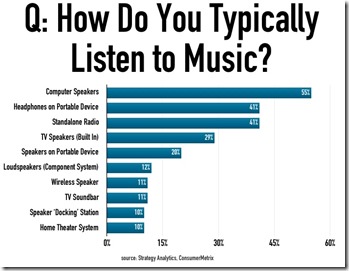
soundquality_study1If this isn’t a kick in the ears, I don’t know what is: “According to a survey conducted by Strategy Analytics, built-in computer speakers are now the most common way to listen to music, by a sizable margin.  In the study, laptop and desktop speakers overwhelmingly topped the list of frequently-used listening methods, with 55% picking the category.

“Headphones connected to a portable device followed with 41% of respondents, alongside stand-alone radio, also with 41%.  Surprisingly, TV speakers were also highly-ranked, with 29% ticking that box.”

While nothing about this information is surprising, that doesn’t keep it from being depressing. More out of habit and curiosity these days, I still read Mix Magazine, TapeOp, Recording, ProSoundWeb, and Pro Sound News. I’m mostly entertained by the seriousness audio “engineers” (an oxymoron if there ever was one) take their degraded “craft.” Almost by reflex, when I read an interview with some kid who has decided he’s the next incarnation of Tom Dowd (No, he won’t have the slightest idea who Tom Dowd was.) I chase down a few examples of the music he refers to as examples of his work. Invariably (Yes, I do know what that word means.), it will be some awful sounding collection of distortion, overused effects, trite synthesizers, and horribly recorded drums.

The critical feedback loop between musicians and their vanishing customers has been wreaked by “portable devices” and the delusional pipedream that some whackos have that high resolution audio will change any of that is nuts. I suppose I should be happy with the resurgence of vinyl, since you can’t get that shit on to a cell phone? If you know me, you know I think going back to vinyl is about as silly as abandoning cars for horses. It’s not the vinyl that matters, it’s the amplification and speaker systems, dumbasses.

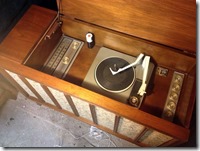
webcorThis has been a long time coming. This godawful Webcor record player is pretty much what I began listening to in my audio career, way back in 1959. My father bought it for the living room, decided he didn’t like the way it looked (ours was salmon “red”) and dumped it in the basement (where I lived).

My mother had convinced him to buy an RCA console system, but he decided that took up too much room and it ended up in the basement, too. It really was pretty awful, but slightly better sounding than my Webcor. rcasteroWhen he remarried, the RCA found its way back into the living room in their new home and it remained there until they downsized after all of the kids had left home.

By then, I had long since graduated to component stereo equipment, then band sound systems, and, finally, recording studio equipment for my home audio system. Our living room system (aka “Home Theater System”) is still a decent receiver and a pair of JBL studio monitors. The down side to that is that, if I bother to listen at all carefully, it’s pretty obvious that Pandora broadcasts in a mediocre MP3 format. Usually, I’m not that focused on the music coming from the living room when I’m working in the kitchen. When I am actually critically listening, I listen to CDs. I’ll put CD quality over vinyl any day.

Too often, when someone under 30 wants to show me some music it will be demonstrated on a cell phone speaker. I have no idea what I’m supposed to get from that experience. I can usually pick out the melody and determine if it is a male or female lead voice. That’s about all I’m willing to invest in that miserable fidelity source, though, which is often disappointing to the person trying to impress me.

To be truthful, if you are a cell phone user I have to suspect you don’t care about fidelity in any form. While I haven’t had a fixed-line telephone for quite a few years, our primary telephone looks a lot like a fixed-line system. Our phone service is provided through our high-speed ISP and an Ooma Tele. The sound quality was a substantial step-up from the fixed-line system provided by Qwest and, later, Comcast in our Twin Cities home. I can, in a few moments, tell if a caller is on a cellphone because the quality is miserable. Always. My guess is if you can tolerate that level of distortion in a voice conversation you aren’t that discerning in any aspect of audio. So, while I’m not surprised that music is being listened to on actual speakers by an audience of 12%-and-shrinking I’m also not impressed by your musical tastes. Your opinion of audio quality is just going to make me laugh, so don’t waste either of our time.

Wirebender Audio Rants

Over the dozen years I taught audio engineering at Musictech College and McNally Smith College of Music, I accumulated a lot of material that might be useful to all sorts of budding audio techs and musicians. This site will include comments and questions about professional audio standards, practices, and equipment. I will add occasional product reviews with as many objective and irrational opinions as possible.