Showing posts with label rock and roll. Show all posts

Wednesday, June 7, 2023

1966 Was A Weird Year

By now it should go without much explanation that I’m not a big Beatles fan. In my decline and fading memory, the one album that I remembered liking was “Revolver.” While pawing around some books about pop music, I stumbled on Robert Rodriguez’s Revolver: How the Beatles Re-Imagined Rock 'n' Roll and checked it out from my library. While I was at it, I checked out “Revolver,” too.

Product Cover for Revolver How the Beatles Re-Imagined Rock 'n' Roll Book Softcover by Hal LeonardFirst, the book was a huge disappointment. Mostly, it’s 250 pages of fanboy gushing over Beatles trivia. Since the book was published in 2013, I’d had irrational hope that we’d be past that and into something more technically interesting. There is a small middle section about the actual creation and recording of the record. Some bits of that are interesting, especially the revisionism of the revisionism and some of the funny stuff about how the memories of a quartet of stoners and the people around them were notoriously unreliable. The “correction” several people added to Geoff Emerick's George Harrison grudge from Here, There and Everywhere: My Life Recording the Music of the Beatles was sort of interesting. Before and after that, I could have used some of the Beatle’s 1966 stimulants to stay awake through the book.

History has a nasty habit of dragging us back to reality. Boomers weirdly remember the late 60’s fondly, which makes me suspect they either weren’t there or they we drugged/drunk into oblivion. The crap that was regularly on the late-60’s charts should embarrass my generation into never-again speaking of our musical opinions. Rodriguez regularly puts up US and British record sales chart and consistently 7-8 of 10 songs on those lists are, thankfully, consigned to the sad history of crap music. WLS’s June 1966 playlist put Tommy James’ “Hanky Panky” at the top, followed by “Paperback Writer/Rain” and “Strangers in the Night.” If you ever want to be humbled, musically, poke your birthday into “Find the #1 Song on the Day You Were Born” and get ready to be disgusted. For me, it's “Woody Wood-Pecker” by Kay Kyser and His Orchestra. Yeah, I know, poetic justice at work.
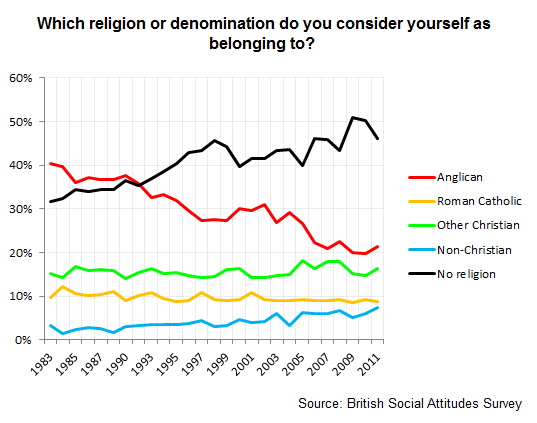
Has Britain lost its faith? - Full Fact“Revolver” was the record whackjobs liked to smash in the 60s. It came out right after John’s famous opinion on American religion hit the news,  “Christianity will go. It will vanish and shrink. I needn’t argue about that; I know I’m right and I will be proved right. We’re more popular than Jesus now. I don’t know which will go first – rock & roll or Christianity. Jesus was all right, but his disciples were thick and ordinary. It’s them twisting it that ruins it for me.” Later, he claimed he was talking about Christianity in England and he probably was and he was pretty obviously right. The chart at left ends in 2011 and, as of 2021, British religious participation declined another 13.1%. Whatever, that controversy did some serious damage to “Revolver’s” record sales, which is partially why it is mostly a forgotten Beatles record.

Revolver (Beatles album) - WikipediaAfter suffering through the book, I decided to see if any part of my good memories of “Revolver” were valid. The library copy was an analog-to-digital version of the 1966 stereo release. First, John Lennon was notoriously unhappy with his voice and gets some credit for whining about having to actually double-track his vocals,.which inspired EMI engineer Ken Townsend to invent the Automatic Double-Tracking (ADT) device used on practically everything in “Revolver.” After listening to “Revolver,” I’m with John. I was painfully reminded of their Chipmunk voices and the squeaky harmonies. While US engineers like Tom Dowd were knocking stereo recording out of the park in 1966 with records like The Young Rascal’s “What Is the Reason,” the Brits were still panning vocals hard left and instruments hard right (or the reverse or other weird combinations) and managing to get some bass into the recordings, too.

Considering the privative 4-track recording technology Martin and Emerick were cursed to be using on “Revolver” and the inflated egos (and lazy spoiled boy habits) they were dealing with it isn’t a terrible record. Listening to it pretty much demolished any fond memories I had. Compare “Revolver” to one of my favorite records of the day, Lorraine Ellison’s “Stay With Me” and get back to me on how great the Beatles were. As much as I appreciated George Martin, Phil Ramone more than topped anything that came out of England for the next decade with his engineering work on this song. And this is exactly why I resented The Beatles in the 60s because the British crap knocked this kind of music off of the charts for almost a decade.

Thursday, January 12, 2023

Jeff Was My Beatles

90% of the British Invasion went over or under my head. I was not a Beatles fan, but I liked the Who a lot and Stones fairly well. The rest of that lot was just elevator noise. But Jeff Beck changed my world. And now he’s gone. Since I heard the news, last night, I’ve had my office stereo system on an endless Jeff Beck loop. I own eight of his eighteen albums, plus two Yardbirds records, which amounts to about seven hours of non-stop Jeff Beck. Not nearly enough.

Geoffrey (Jeff) Arnold Beck (24 June 1944 - 10 January 2023) was four years older than me and light years beyond me musically from the moment I first noticed his guitar playing in “Jeff’s Boogie” on the 1966 Yardbird’s record (on Epic Records at the time, in “Simulated Stereo”). A friend and I travelled from Dodge City, Kansas to Denver, Colorado in ‘66 to see the Yardbirds. Specifically, to see the guy who played “Jeff’s Boogie.” Sadly, I don’t remember a lot about that show. It was in a fairly small venue, there were a pile of those weird looking Jordan amps on the stage, we weren’t able to get particularly close to the state, and I didn’t learn a thing from watching Jeff play. He was at least that far over my head when he was 21 and I was 17. I stupidly thought his guitar was fretless, based on his fluid technique and went home to rip the frets out of my Airline electric, rendering it useless.

The second time I saw Jeff in concert was in 1976 at the Music Hall in Omaha’s old Civic Auditorium. He was touring to promote the “Wired” album with the Jan Hammer band; Believe it or not, Billy Joel’s band was the intro act; talk about an odd couple. Mrs. Day and I had front row seats, stage right smack between Hammer’s keyboards and where Jeff stood. There was nothing between me and Jeff except a few feet and I still learned . . . nothing from watching him play. The band I was in at the time covered “Freeway Jam” and often ended our practices with “Scatterbrain.” “Scatterbrain” was slightly past my level of competence, which is why that song did not make it into our setlist, ever. There was a moment when Jeff appeared to be concentrating and I briefly imagined that if I could just get to the point where I could play the song at that speed, I’d have finally caught up to Jeff after a decade of floundering in his wake. Then, he noticed that Hammer was waving a scarf over his head while he played the song’s Lydian scale riff. Jeff walked over to Hammer, had a short conversation, and he laughed and they began to double-time the song (roughly the tempo of this 1976 live recording). At the new impossible pace, he didn’t look even slightly pressured.

Around that time, poor, sad little no-solo-hit-wonder John Lennon was whining about the credit George Martin received for turning their pitiful little bar band into a massive success, “"When people ask me questions about 'What did George Martin really do for you?,' I have only one answer, 'What does he do now?'” What George was doing about that time was Jeff’s “Blow by Blow” and “Wired.” Can anyone remember anything other than “Give Peace a Chance” or “Whatever Gets You Through the Night” from post-Beatles-Johnny? One more reason I do my best to avoid Beatlemania.

This is a quirk, I know, but vocal music rarely connects to me emotionally. Blow by Blow's "Diamond Dust" is one of the songs that practically reduces me to putty, especially when I'm listening to it on headphones. Pat Metheny's "The Moon Is A Harsh Mistress" is another song that effects me that strongly. This Rolling Stone interview has Jeff talking about the clarity of sound, purpose, and musicality George Martin brought to the studio and Jeff's music: "Jeff Beck Remembers George Martin: ‘He Gave Me a Career’." This one of my favorite stories from that interview, "Beck has particularly vivid memories of the album’s last track, the gorgeously orchestrated 'Diamond Dust.' When they first cut the song, Beck thought his band’s version 'sounded a bit lame.' But Martin suggested adding a string section to emphasize the drama in the melody. 'When he finished it, he came wafting in and said, 'This reminds me of a French love movie!'' Beck laughs. 'I said, ‘You’ve just spoiled the whole effect! I might not put it on the album!’ He didn’t realize it was the worst thing he could have said to me. But I thought it was beautiful. George lit a fire under it.”

In 2011, my daughter Holly (through a connection from her Guitar One column of the time), got a couple of amazing seats at the Minneapolis State Theater for Jeff’s group of the moment. I swear my wife was the only non-guitarist in the audience. Every time I looked away from the stage at the audience everyone around me was fumbling air guitar, totally baffled at every note Jeff played. Me too, of course. Finally, I learned something from watching Jeff play, “There are no picks in his fingers!!” said my hillbilly-self probably out loud to nobody in particular. Holly, of course, had figured that out either before or after the interview and we had a conversation about my big breakthrough. I watched some YouTube and learned even more. Jeff’s biography documentary, Still on the run: the Jeff Beck story, gave me more insight than I needed or wanted to know about his genius. As Jan Hammer said, “Jeff is the guy who took the instrument of guitar into the furthest reaches of guitar universe and nobody ever - nobody even comes close.“

636576898588220374-Jeff-Beck-840394896 jeffbeck-arrowhead1I think I’m going miss his smile the most. Not just that he was having a great time on stage, but that “Did you see what I just did?” look that every guitar player within earshot heard, saw, loved, and desperately wished they could do. Even at 78, he was pulling off stuff nobody else in the world could do. Nobody. We’ll never hear anything like Jeff Beck again.

This is one of the few moments I wish I could believe in a life-after-death. The world would be far less empty if I could imagine Jeff is still playing guitar somewhere, anywhere. Today, his live version of “Elegy for Dunkirk” seems particularly sad and relevant. When I saw him perform this song live at the State Theater in Minneapolis in 2011 (not listed on the setlist, but he did play it), it was heart-stopping then. Today, a part of me wishes my heart had stopped with his.

Thursday, October 29, 2020

The “I’m Gonna Quit” Story

There is a long, semi-funny story behind that song and the first recording and THIRD recording. We were living in Fremont, Nebraska at the time. I’d been laid off of my 1st engineering job and had taken a position as tech services manager for an Omaha office equipment company, servicing Burroughs Corporation word processors and IBM Selectric typewriters among other electric and electronic equipment. It was a miserable job with a terrible company, but there weren’t many tech jobs in 1976 Nebraska. A few days before the song’s birth the owner of the company told me I had to lay off 2-3 of my newest, most capable technicians because they were “overqualified” and he wanted the money for raises for a couple of his bimbo saleswomen. The tech service department was not only making the company money, for the first time in the company’s history, but our service was attracting IBM customers and the sales commissions on those machines was better than anything a car salesman could make. Today, I would assume he was screwing the sales bimbos, then I was a pretty innocent/gullible 28-year-old.

Another insane Republican had driven the US economy into the dirt and times were somewhere between terrible and disastrous. We “sold” our house at a $5,000 loss (on a $20,000 original purchase), although on paper it looked like we broke even; I paid the “buyers” $5,000 under the table to make their down payment. I had arranged an Omaha apartment for us to move to, but at the last minute (before any money changed hands) Elvy wasn’t going to go. She’d asked a friend in Scribner, Nebraska for help and he’d offered her (and us) a house he owned that needed a lot of work but was livable and he would pay for the work and materials. $80 a month rent, which was workable on Nebraska’s unemployment. One morning, I called the office company owner and said, “I was sick when I took this job, I’m better now and I quit.” No notice, no two weeks, nothing. I hadn’t worked there long enough to damage my Unemployment from my engineering job so I had nothing to lose.

Before we packed up our belongings and gave away everything that wasn’t going to fit in our new far-smaller home, two friends (Dan Tonjes and Mark Von Seggern) and I hit the basement “studio” for one last blast of our past and we recorded the twanging electric guitar part, vocal, bass (Dan), and drums (Mark) to my new song, “I’m Gonna Quit” on two of my Teac 3340’s four tracks (drums ALWAYS get tracked in stereo). After we were sort of settled in to the house in Scribner, I wanted to add a distorted guitar part and an extended percussion into and outro. Dan and/or Mark knew the Scribner school music instructor and “borrowed” a wheelbarrow full of school percussion instruments. We used the other two 3340 tracks on I don’t remember how many percussion players gathered from our friends in Scribner and my guitar part and I had a song and a recording. I still love that original recording, as rough as it is.

A decade later, a Nebraska friend and one of the guys (a drummer) who we used in the studio occasionally was in a band being fronted by Barry Fey’s company. I’d given him a cassette of my songs back in the 70s and he’d played it for the band and they wanted two of my songs: “Down on the Beach” and I’m Gonna Quit.” By “wanted” I mean they wanted me to give them the publishing rights and authorship in exchange for . . . nothing. I declined, but they recorded the two songs anyway and the band dissolved and nothing happened to the recordings after a lot of money was spent and the usual 80’s rock and roll silliness ensued.

When I moved to Denver in 1991, I looked up the lead singer of that band and she gave me a cassette copy of their take on my song. It was . . .entertaining, but I could see how the band didn’t take with audiences or promoters. Too much Pat Benatar, too late.

Through my following studio years, I always wanted to redo “I’m Gonna Quit” with a little more fidelity, but recreating the attitude, energy, random-ness and creativity of the performance and percussion section overwhelmed me. Sometime around 2002, Michael McKern and I gave it a shot with the original recording as our “click track,” we recorded his drums, the clean electric guitar parts, some background vocal ideas, and a decent acoustic guitar part to his 24-track MCI JH24 deck and bounced that to Pro Tools. And . . . nothing. I was still stuck without a way to pull off the percussion section and that was a gumption trap.

Jump to August 2020 and I’ve been playing music, on-line, through JamKazam, with four friends: Harold Goodman, Stu Anderson, and Scott Jarrett since March. We’re messing with original music and covers and they’ve irrationally designated me “vocalist” because no one else wants to sing, including Scott who is an infinitely better vocalist than me and about 1,000 times the musician. Michael has been dubbing drum parts to my original songs via Dropbox and, when I tell him I can’t get into finishing off “I’m Gonna Quit” because my attempts at doing a percussion part either with real instruments or Logic X’s loops or MIDI just sucked, Michael knocks out six tracks of the percussion instruments you will hear on the recording. Hesitantly, I offer up “I’m Gonna Quit” to Harold and we fool with it for a bit on line and he, as usual, asks “Should we record it?”

This was the first time I had sung the song since 1978, other than noodling around with ideas with Michael almost 20 years ago. The vocal you hear on this recording, for better or worse, is my first take at the song in August of this year. I’ve sung it with the group on JamKazam a dozen or more times, since, and tried to overdub it with a “better” microphone in my office/studio and I still like this take the best. I musta been really pissed off at something (probably Trump) that day. Harold’s bass line was the perfect foil for the busy percussion and guitars and Stuart’s steel guitar and Scott’s organ and the rest was my problem. My wife, Robbye, suggested industrial, work sounds to go with the percussion intro and outro and that pretty much filled in everything I thought was missing. I did keep a lot of my last vocal stuff from the times we recorded the song on JamKazam for the outro. All of that “I don’t need this” and “I’m gonna quit” and the rest after the last chorus was cut-and-pasted from every other take of the song.

This is the final, newest, bestest version of my song, “I’m Gonna Quit,” featuring my friends Michael McKern, Harold Goodman, and Scott Jarrett. I can not express the obligation I feel toward all of them for making this happen. Not out of arrogance but out of personal history, I do love this song and I am really happy with this version. It is, finally, done.

Monday, April 1, 2019

One Story, Two Books

One of my wife’s favorite concepts is “evolutionary convergance”; where the same evolutionary decision is made independently, likely because it is a good idea. The two books are The Birth of Loud: Leo Fender, Les Paul, and the Guitar-Pioneering Rivalry That Shaped Rock ‘N’ Roll by Ian S. Port and Play It Loud: An Epic History of the Style, Sound, and Revolution of the Electric Guitar by by Brad Tolinski and Alan di Perna. Play It Loud is a 2016 publication and The Birth of Loud came out this year. Your take on these two books will depend on your personality. The stories are, essentially, the same.

I read Play It Loud first and am just now finishing up The Birth of Loud. Of the two, Play It Loud is my choice.

There are too many technical flaws in The Birth of Loud and the writing style is too emotional and concentrated on personalities rather than technicalities. Your mileage will, probably, vary. Lines like this are show stoppers for me, “When Leo heard this story [about his pickups failing during a performance], he made sure that if the Esquire’s wiring shorted, the signal would only be diminished, not completely cut.” Wrong. If the wiring is “shorted,” there will be no output, regardless of Leo’s technical “genius.” Birth of Loud is littered with this kind of technical foolishness, to the point that when the author attempts to describe how anything works I have to kick into speed reading mode to get past his mistakes and misunderstandings. Otherwise, I’d toss the book in a pile and find something more interesting to read. There are moments in Birth of Loud that make suffering the flaws worthwhile, though. I knew almost nothing about Paul Bigsby, other than the fact that he knew the difference between vibrato and tremolo; unlike Leo Fender. By himself, he would be an interesting story, so the fact that there is a little more about Bigsby in Birth than Play makes that book worth reading; at least, for me. I do have to suffer through an awful lot of hyperbole, emotional language, and outright silliness to get to the good stuff, though. Port’s descriptions of the music discussed in the book are so over-the-top silly that it’s hard to take any of the book seriously.

Play it Loud is less emotional, more technically accurate, and a more entertaining and interesting read. The authors either check each other’s excesses and technical misunderstandings or they are simple more knowledgeable; or they had a better editor.

Interestingly, neither book is the usual Les Paul pandering that we’ve suffered for the last 40 years. I suppose Paul has been dead “long enough” that the shadow of his self-promotion is fading. I remember watching a Los Angeles AES discussion in the 80’s where Les Paul and Tom Dowd were on the panel and when Les started bragging about buying the “first Ampex 8-track machine,” Dowd reminded him that most of the design work on that machine came from Dowd and Ross Snyder’s idea of making a single 1” multi-track head, instead of Paul’s stacked individual heads and eight stacked ¼” tapes. Also, both Dowd and Paul ordered 8-track machines, more or less, at the same time and Paul’s was supposed to be delivered first, but Dowd snatched it off of the Ampex loading dock and installed it himself. Ampex delivered the 2nd one to Les Paul’s studio and installed it for him. Les Paul was the Jimmy Page of his time, claiming the creation of everything from electric guitar pickups to solid body Spanish-style guitars to recording techniques to tube amplifiers. Of course, there were predecessors for all of those inventions, but Paul made his claims more often, louder, and more prominently than that actual inventors. His contribution to the famous Gibson Les Paul guitars is accurately reduced to his signature on the instruments and some of people who actually designed those instruments are credited. History is catching up to Les Paul’s legacy.

Leo Fender gets a similar look in both books, probably more harshly/realistically in The Birth of Loud. His personal and technical limitations have been rarely discussed outside of knowledgeable conversations between engineers or technicians. The fact that Leo overcame his technical limitations with hard work is a fact, but the fact that his products were littered with the downside of those technical limitations has barely received a mention. The contributions of the many people who compensated for Leo’s limitations are finally documented in both of these books. Rarely, does one person actually “create” a significant product; almost never, in fact. Fender’s guitars and amplifiers are the product of a lot of unheralded effort by many people who at least get acknowledged in both of these books, more so in The Birth of Loud, to the credit of Ian Port.

Saturday, November 3, 2018

Movie Review: Bohemian Rhapsody

As a rule, I not only don’t do movie reviews but I don’t buy movies. I had a small (probably 15 tapes) VHS collection that I tossed when we moved to Red Wing in 2014. I have about that many DVDs, most of which my wife inherited from her father and some motorcycle DVDs that were sent to me to review when I wrote for Minnesota Motorcycle Monthly magazine. I kept most of the review DVDs because I couldn’t find anyone to give them to. Mostly, I’m happy to watch a movie once and forget about it.

Bohemian Rhapsody may prove to be an exception.

Before you get driven away from seeing Bohemian Rhapsody by the bullshit reviews—most of which apparently wanted long scenes of gay erotica, lots of orgies, and other soap opera gibberish—try to imagine that the band (and, most likely, Freddie) wanted a movie about their musical lives and the music. That is the movie they made and they have good reason to be proud of the outcome. (Brian May and Roger Taylor are listed as “Executive Music Producers) Also, remember that when the band was in its prime most of the reviewers, media rags, and television nitwits hated Queen and Queen’s music, including Bohemian Rhapsody. They were wrong then and they are wrong now, but at least they are consistent. Take everything Rolling Stone, the New York Times, Rotten Tomatoes, the Guardian, and the rest of the wannabe rock critics with a block of highly diluted salt. A typical comment from that crowd was this bit of drivel by a Pitchfork reviewer, "The film also manages to rob Mercury of nearly all his queer pleasures." Another way to say that would be that the film manages to keep its eye on the musical ball rather than Freddy Mercury's balls.

Likewise, the movie spends a little time portraying the media obscessing on Mercury’s sex life, even during band media events intended to promote their music and touring. Nobody dislikes having their image accurately held up for ridicule and nobody deserves that more than the entertainment jackals.

Rami Malek nailed Freddy Mercury perfectly and bozos like sore loser Sacha Baron Cohen are just jealous that not only did he not get the part but the members of Queen thought Cohen’s take on Mercury was pure bullshit. The movie covers more territory in 2 1/4 hours than we have a right to expect from a pop music movie. All four of the character actors who played the band’s members knocked their parts out of the park. Brian May must have felt like he was watching a 30 year old mirror Gwilym Lee had him down so perfectly. Honestly, before a recent documentary about Queen and this movie, I didn’t know squat about Roger Taylor or John Deacon, but Ben Hardy and Joseph Mazzello nailed the characters I saw in the BBC documentary and all of the scenes I’ve seen of Queen on stage.

Watching the actors in the recording studio reminded me of how much I love that world. The freedom, creativity, sounds, energy, control, fun make the recording studio one of the few places on the planet that some of us every get to be who we are; the best of who we are. Taking time away from the performances, the recording studio experience, to spend it on Mercury’s gay high life would have ruined the movie for me. Watching the band on stage, backstage, and on the road reminded me of why people get into pop music in the first place.

Movies are snapshots, at best. They are not rambling 1,000 page tomes on history, society, and sociology. Screenplay authors often have to condense moments that you and I might think are important to something that, to us, may not resemble the story we’ve heard. Often, the story we’ve heard has been distorted and doesn’t even slightly resemble the truth. Movies are not Ken Burns PBS documentaries that can go on for hours in a series of segments. 135 minutes is pushing the boundaries of movie length and if you would have rather had less of Queen’s Live Aid performance or any of the music this movie was supposed to be about and more gay bar scenes, you probably were never a Queen fan. This a movie for fans of the band’s music, but probably not a tell-all semi-porno if that’s what you’re hoping for. 


Monday, September 3, 2018

Pearls before Swine

In the late-70’s I was playing out my string with a show band I’d led for about three years. Everybody was moving on. The bass player’s wife had their first kid and another was on the way and he needed to focus on his career (mechanical engineering). The drummer wanted to work a lot more, since he was a low-paid Nebraska high school teacher, and he’d found a 5-day-a-week supper club band he wanted to join. The first to leave, our keyboard player, had snagged a scholarship at Juilliard.and he was leaving for school in another month. I had started working with a kid who I’d eventually end up partnering with in the Wirebender studio and live sound. We all wanted it to end and we all had good reasons. We stayed friends and occasionally hung out after the last gig, but that was the end of our musical relationships.

When this band was a 4-piece, we covered most of the Top 40 and filled in spaces with originals and blues oddities and we played for money. We’d fired our management company a few months earlier, but the agency still wanted us to work some of the last scheduled gigs. We owned the band name, so it was either us or find someone else to sell the customer on. The 3-piece version was a lot more bluesy and original than the band the customers thought they were getting. There weren’t many complaints, but I suspect our rate would have gone down if we’d have done a 2nd round with that personnel and repretiour.

AL 1207aOne of the last gigs we did was in a southeastern Nebraska town that had an actual 1920’s ballroom with a vintage 30’ foot bar and a round stage slightly off-centered in the room, toward the bar. The audience had room to maneuver behind the stage, between the bar and the stage, and there was a large dance floor (people used to dance, believe it!) to the front and side of the stage. There was a runway, about 5’ wide, that ran about15’ from the stage into the middle of the dance floor. There was a slight downward slope on the ramp, high at the stage and low at the end of the ramp, but it was still a 3’ drop from the end of the ramp to the dance floor. I setup the mains, six (we had eight) Altec Lansing 1207A columns, behind and to the side of the band and ran the show from a 12-channel board on a mic stand near my guitar amp. No monitors, we could all hear the mains and ourselves well enough that we didn’t need more crap to haul up and down staircases. I only used one small condenser on the drums, the three vocal mics were all RE18s, the bass went direct ino the board from the bass player’s amp, keys also went direct, and I had a Beyer M500 on my guitar amp; a modified 1956 Fender Harvard. The room held about 350 people and we always packed it. We were doing one of our last 4-piece gigs, so we pretty much went full-out.

In deference to the large turnout and the money we were getting paid, we pretty much played our old lineup with slightly more originals and less blues. The crowd was into it, the dance floor was constantly full, people were screaming their heads off at the oddest times, and the band was rockin’. Because I am a Townshend freak and we did “Won’t Get Fooled Again.” During the synth middle-break where the guitar comes crashing in and we added a short solo and I’d slide on my knees down the ramp while I played the solo; mildly Townshend-style. I didn’t realize that Pete used knee pads under those coveralls, so my style hurt more than his. On the way toward the ramp, the bass player turned into me and clipped the top of my guitar hard enough to break two tuners and take the whole guitar out of tune. As I slid down that ramp, I discovered nothing on my instrument was in any sort of European-shape of tune. So, I did the only thing a lead guitarist can do under any non-ideal conditions: I played as fast as my fingers would move and stayed as high on the neck as possible to mask the complete dysfunction of my guitar. I cut the slide and the solo short and twiddled trills, hammer-ons and pull-offs, and did pick-slide sound effects until we could end the song.

We took a break and I tuned up my back-up guitar. While I tuned the guitar, sitting on the edge of the stage, people crowded around me. I ignored them at first, but after a few moments I realize they were shouting at me but they weren’t mad. “That was the greatest guitar solo I’ve ever heard” and “Great guitar playing, man!” and and “Damn! That was incredible” and even nuttier stuff. It was not just tone-deaf guys, either. Twenty-or-so girls where in the pack squealing away like something good and true had happened. I, literally, didn’t spend a musical micro-second on that solo. Not one “note” was intended and I didn’t even waste much thought on what the rest of the band was doing. And nobody seemed to be laughing (other than the band guys) at my predicament?

As I was finishing up the work on my back-up guitar, in that moment I decided I’d had all of the “pearls before swine” experience I could stand for a lifetime. I spent hundreds, thousands of hours practicing my craft and all I had to do was wiggle my fingers fast and I’m “great?” I thought, “I quit. No more of this band-shit. I’m done.” When we played our last booked gig a few weeks later, that was it for me. Until a friend talked me into a gig doing his music in St. Paul in 2016, I hadn’t played in front of an audience since 1982. I did a lot of live sound tech work, some recording as a tech and as a guitarist, and lots of electrical audio design work, but for the next three decades I had no interest in being “a musician” for a live audience. To this day, there are a really limited number of places I’ll consider exposing myself to an audience. I’m not that fast anymore.

Wednesday, October 19, 2016

And It Will Sound Like . . .

Some friends are starting up an old guys’ R&R band and they need a bass player. They aren’t going to ask me because, “You don’t want to be in this band. It’s gonna be loud and sound like shit.” Of course, they know me too well. I don’t want to be in a band like that and haven’t since I was in my mid-twenties.

I missed the “opportunity” to run FOH for a “bluegrass band” at Hobgoblin this past Saturday because of family obligations. I know one of the band members a little and he’s a fine musician, a terrific songwriter, and a nice guy. The band’s banjo player/sound guy and I had a couple of email conversations and it was obvious (at least to me) that we wouldn’t work well together, so missing the gig wasn’t at all painful for me. Sunday, I was at Hobgoblin for another gig and, as expected, the house sound system was mangled and as far from reasonably “zero’d” as possible. [Who turns powered speaker systems’ volume controls to “off” and messes with the crossover settings?] The questions that cued me into knowing this wouldn’t be a fun gig were all about the number of monitors (4) that would be needed for a 5 piece “bluegrass” band in a 70 person (max) venue. Any is too many, four is a symptom of deaf rockers pretending to be purists.

jefferson_airplane_pillowUK1Somehow, this sequence of conversations reminded me of one of my favorite 60’s albums, Jefferson Airplane’s “Surrealistic Pillow.” There are lots of stories about how “awful” the studio experience was for the Airplane kiddies, but it’s pretty obvious from the quality of the playing that some actual musicians were involved in the making of the record. Post-Pillow, the Airplane’s zombies were big stars and in charge of their own sonic future; which accounts for the godawful sound of every other recording they made in the band’s lifetime. The band had no input as to how their instruments or voices would be recorded by RCA’s actual engineers (guys in white coats) and if they couldn’t play a part, someone else did. The lack of technical input from the kiddies resulted in a historic record of the times.

IguanaStudiosKidsParty-2386Those days will never return. Everyone with $500 and an ego can afford a decent recording rig, today. Goldman’s rule, “nobody knows anything,” has been multipled by millions of uninformed, tasteless kids with a cheap microphone, Pro Tools, and an endless collection of loops and plug-ins. I guess the logical extension of the rule would be “nobody knows anything and everybody thinks they do.”

The end result for me has been that when I’m asked if I’d be interested in a recording project and, if so, what would it cost, my reply is, “If I like it, I’ll do it for free. If I don’t, you can’t afford me.” Most of the time, I won’t like it and the conversation doesn’t get that far because I change the subject before the question is asked.

Wednesday, June 12, 2013

The Last Wagon Wheel Gig

All Rights Reserved © 1976, 1999 Thomas W. Day
[This is a semi-true (per Hunter S. Thompson's definition as best I can recall from an experience that happened several years before I started to turn it into a story) recounting of a brief period in my life as a musician.  I wasn't doing much writing at the time, thanks to a 90-100 hour/week work schedule and new parenthood.  The experience was traumatic enough that I did try to document it, though, without any thought of publishing.]

I moved to northwestern Texas, in 1971, to avoid poverty. The attempt failed, completely. I was 21, a college and vocational school dropout, earning a dollar sixty-five an hour. I had a pregnant wife, and no prospects. I was too scared and too ignorant to figure a way out of a bad job in in the Texas desert. I had fallen, screaming all the way, into responsibility. I was poor as a stray cat and desperate. So desperate that I went looking for a gig as a Country and Western (C&W, to those who care) guitar player.

Since I was fourteen, I'd spent every spare moment copying Eric Clapton, Jeff Beck, and every other hot guitarist's solos. I could play the guitar parts for every rock and roll tune that had been on the Billboard charts since 1966. When I was fifteen, I played in a popular regional band that toured the Kansas and Oklahoma high schools and junior colleges, playing Top Forty soul hits and a few original tunes. A few years later, I was the lead guitarist in a fairly successful local power rock band that did nothing but original songs, many of them were mine. Between that group and when I arrived in west Texas, I was a tiny part of the late 60's folk music scene and was a sideman in every kind of rock group that existed; from blues to R&B to folk rock to hard rock. Music was my life. Music was the one true thing in my world.

West Texas changed all of that. There was only one kind of non-C&W music alive in west Texas in 1970, but I couldn't get up for being a sideman in a swing band or Chicago-style horn band. My ego was in the way. I liked being the band's center of attention. My talent was in the way, too. I wasn't that good. In that place, at that time, my craving for regular solo minutes put me in a country band. But I didn't know what "country" meant in west Texas.

Lonny worked with me at the factory and he had a C&W band. Lonny was a welder, with three kids and a wife, and he needed the money even more than me. He needed me because his lead guitar player had moved to civilization, somewhere out of Texas. The band practiced at Lonny's house for a month, mostly for my benefit. Lonny had given up on the other guys ever giving a damn about C&W. He still had hope for me.

The drummer, Danny Lee, was a high school kid whose God was Led Zeppelin's hammer-thrower, John Bonham. Danny packed away every dollar he made playing C&W, swing, polkas, and anything that paid more than he could make as a convenience store clerk. Danny was working his way into college as a music prostitute, but he would talk about the music he loved if it looked like there was a chance that you wouldn't beat him senseless for it. Staying out of those conversations was harder than avoiding an auctioneer's eyes when you're broke. Danny was a simple kid with simple desires: money for college with as little work as possible and all the Led Zeppelin vinyl ever recorded.

In another time and place, Danny and I would have been friends. We would have hungout and talked music until we were hoarse. But he was a high school kid. I was a married man with responsibilities that weighed more than a feedwagon full of corn. We just didn't seem to be able to find anything in common.

Dick, the bass player, was not a Texan. When I recall any memory of Dick, I smell well-cured hemp and incense. Bringing back those memories makes me tense. Very tense. The kind of feeling you might have if you were in a car with a guy who can get you sent to Leavenworth for the rest of your life. Dick owned a new burgundy and black Lincoln Continental with a wet bar in the back seat. The Lincoln had an ear-bashing 8-track stereo, a megawatt CB rig, and secret stashes in every crevice Ford Motor Company left available for Dick's dope. Dick was the most zonked-out, abused substance-using, drug-dealing, bass guitar player in our time zone. His eyes had space-and-time singularities where his corneas should have been. Dick's wardrobe never varied from black, western-style shirts and tight skinny-butt jeans cinched up by a Harley-Davidson belt buckle. His oily black, mid-backbone length ponytail made it clear he was no cowboy. He was 32 years old and supplied the town's cowboys and Mexicans and high school kids with all the drugs they could eat. And he ate what they didn't.

Our backwater village was a fraction of Amarillo or Lubbock's size. But that stinking, feedlot surrounded, hillbilly and redneck town sucked up twice as much dope as those cities combined. The local bible thumpers blamed the evil influence of television, but boredom was the real villain. People did dope to have something to do. The local cops were overwhelmed and mostly stoned themselves.

Once, somebody called in the feds. The FBI didn't know Dick and, usually, they were looking for drugs in all the wrong places. Only once, the bureau boys got close to where the eggs were hidden. An undercover agent stumbled into the Wagon Wheel Bar and all the commerce within. The FBI guy was prepared for a traditional 60s undercover assignment, but he wasn't ready for Hereford. The narc had the beard, the long hair, and the paisley. He needed a cowboy hat, work boots, and a wad in his cheek. The locals beat the shit out of him, cut his hair with sheep shears, and dumped him in an irrigation ditch. I suspect they hoped he would bleed to death or a rattler would bite him and something would gangrene up and have to be amputated.

He didn't die and he didn't lose any body parts and he took the cowboys to court. He took them to local court. He filed an assault and battery charge against five local boys. He brought pictures of his wounds and his sheep shearing. The cowboys described how he looked before they "prettied him up." The judge threw the fed and his case out, with a kick in the head, "When you come in here, all lookin' like a damn hippy, you get whachu got, boy."

The scalped undercover agent quit looking for trouble and Dick was safe to carry on with his business. Dick had found that the fast track to a cowboy's heart was through cowboy music. Dick's theory was clean and simple, once you have a man's heart you can sell him drugs til he croaks. Dick was a C&W bass player and a C&W drug supplier.

For me, the beat-up FBI guy was a watermark. I had been, more or less, undercover for the months I spent in tech school, with my hair cut shorter than I liked and my mustache neatly trimmed. But after I heard about that bit of Texas justice, I really went into disguise. I practically had my head shaved into a country boy cut. I shaved off the mustache. I even tossed out my paisley shirts and bell-bottom jeans. People who'd been close friends a year before wouldn't have recognized me. I just wanted to be a nondescript part-time country guitar player. I wanted to attract absolutely no attention at all.

Danny Lee, Dick, and I practiced Lonny's songs until we were sick of them. It usually took one pass through most of the tunes to set the three of us to begging for mercy, "Yeah, we can do that one, Lonny. You got any more beer?" When two weeks of practice didn't polish our act, we settled into a tradition: Lonny would announce a song, we'd ask what key it was in, Lonny would pick C or G, count to four, and off we went. I worked on my Buck Owens/Merle Travis licks. Danny Lee played with his brushes and ignored his bass drum. Dick stayed stoned and cool looking. We were ready.

Lonny booked our first gig at the Wagon Wheel. I cut my hair even shorter. Dick took inventory and got his pharmaceuticals stocked up. Danny Lee took the night off from homework. After our day jobs, we each packed our gear and met at the bar.

Danny Lee had the most junk to set up, so we let him go first while we drank beer. Drummers like to fool around with their stuff long past when any sensible person would realize that nobody cares what drums sound like. Anyway, since Danny was underage, he had to stay on the stage and away from the bartender, at least until the bar filled up. We did our part to keep the bartender busy.

Lonny was the only one of us who looked like he belonged. Lonny should have been paid something just for the way he looked. He really was a C&W-kinda-guy. Slicked back blond pompadour, a shirt that had gold plated snaps with a saddle embroidered on the pockets, reptile-skin pointy-toed boots with an etched longhorn skull on the sides, a cowboy hat with a pheasant feather and silver medallion hatband. He'd squeezed into the tightest fitting jeans I ever saw on a man. He had big diamond rings on at least four fingers of each hand. I had seen this kind of get-up on TV before. Buck Owens had almost the exact same outfit, but I had never seen Buck Owens in color.

Before that night, I never knew Lonny was that into it. He seemed like a normal guy at work, at least normal for a guy from Tennessee. Lonny played an un-miked acoustic guitar that you could hardly hear, even on stage standing right beside him. He wore it, more than played it. It was a Gibson Hummingbird with a hummingbird stenciled onto the pickguard. He was probably stylish, but I didn't know the fashion.

And the bar filled up. By seven, cowboys and Mexicans filled the booths and lined the bar. Their women sat in the booths, against the wall, with their hair stacked on their heads like an upside-down week-old bucket of fried chicken, without the bucket. The cowgirls lips were painted red as fire engines and their eyelids and lashes smeared as dark as a blackboard. Sexy, like you never saw. The crowd looked as modern and hip as any other dirt-floor barn filled with farm hands, waitresses, packing plant butchers, drugstore cashiers, feedlot cowboys and small town whores. I felt right at home.

Then we played. Today, I don't know the name of, or the words to, a single song that we played that night. I didn't know anymore then. I played a solo in the middle of every tune; and screwed off between solos. I probably missed out on an important cultural education. Compelling stuff about truck driving men crying in their beer over women running off with guys in Volkswagens. Big tough old boys from Okie Fanoggy who salute flags and beat up fags. Ladies who love fags from Okie Fanoggy in Volkswagens. Gimme a break. I got your endemic culture right here, you know what I mean? I admit it, I was so bored even my own playing couldn't keep me awake.

In the middle of our second set, Lonny drew a blank. He couldn't find a song in his repertoire to fit the mood of the moment. The mood grew ugly.

The cowboys had been stomping around, with one arm around their cow-woman's neck, doing a bowlegged chicken hop they called the "two step." I guess it's called that because every two steps someone's foot got stomped and the stomper had to stop two-stepping and shout at the foot's owner. Or fight the new-made cripple. The lack of "music" put the fights, that had been put off for two-stepping, back on the front burner. Lonny stood at his mike running through a pointless monologue about the plight of a country-singer-turned-welder in the dark heart of west Texas, while he searched his heart for our next song. It wouldn't come; and we were no help. Between the three of us, we might have been able to name one or two songs, but we had no way of knowing what tunes we had done earlier.

We each did what we could to pass the time. Dick stared into the crowd looking for any customers he had missed during our last break. At least, he focused as well as you'd expect for someone who had smoked up most of what he had intended to sell that night. Danny Lee practiced with his brushes and did quiet toe rolls on his bass drum. I dreamed of better days. Days when the "&" separated two "R's". Days when I knew the songs I played because I believed in, and loved, my music. I turned the volume on my guitar down and quietly played through licks of my favorite headbangers. The crowd got uglier. And Lonny was still stuck.

I walked over to Danny Lee and we made jokes about Lonny's predicament. To us, it was his predicament because this was solidly his band. We were mercenaries. It didn't matter all that much to us if Lonny was stuck for the rest of the night. Although, we might care if the bar owner decided that we shouldn't get paid for standing around in our drugstore cowboy clothes, taking up space on his stage for two out of the four hours we were supposed to be playing C&W.

While we waited, Danny Lee and I mused about the music we loved. I even listened to him rant about Zeppelin and Bonham. I even encouraged him. While we talked, I fiddled with the intro to the Zep's headbanger, "Communication Breakdown." A classic. A screamer. As far from C&W as R&R gets. I still get misty when I hear that song. Danny Lee picked up the tune while we talked. He brush stroked his snare and highhat and I picked and turned up a bit, just so Danny could hear me. We weren't being obnoxious, Lonny didn't even notice.

In a few seconds, Dick turned away from his customers and leered at us, "Hey, 'Communication Breakdown.' Ah right!" A full out Fender Bassman 100 with twin four-ten cabinets started pounding, "DUN, dun dun dun, DUN, dun dun dun, DUN, DAAA DA DA."

I thought, "All right and why not?" I cranked up and Danny Lee flipped his brushes over his shoulder and grabbed his sticks. And we were jammin'.

I used to be able to do Mr. Plant's voice fairly well. I could get up there, if the cigarettes didn't get to me first. That night, I was in good voice, not having sung a note in the first two hours. I walked up to the mike and screamed. I was inspired.

I did Mr. Page's finger-flicking, hammer-on solo pretty dammed well, too. The solo was especially satisfying because early in our first set the bartender had told me to cool it, because the cowboys were stumbling over my picking. I was playing too fast for two-stepping and I had to tone my Buck Owens licks down to nothing faster than quarter notes. So, my fingers had been itching all night. I scratched during "Communication Breakdown."

This might seem weird, but while we played I didn't notice a crowd reaction. I always get tranced when I am really into what I am playing. I don't see anyone away from the stage. I look out, smile, and gaze meaningfully at the shit in front of me, but I don't see anything. Stagefright compensation, I suppose. When we stopped, and I refocused, I realized that I might have made a mistake.

The crowd was arranged. They were neatly plastered against the walls of the bar. They looked like they had been blown there by a hurricane that was centered in the middle of the dance floor. If you have ever seen people riding a carnival Spinner, you get the picture. Nailed to the wall as far as they could get from the stage. Quiet and scared as field mice. I believe these people had missed all of the 60`s and my performance was their first audition of the current state of popular music. Good thing we didn't tell them about Japanese cars, too. That would have convinced them they had slept through Armageddon.

The Wagon Wheel's bartender measured five feet in any direction; tall, wide, and deep. He wore a slimy white-once-upon-a-time cook's apron and work boots. I don't remember if he wore anything else. His finger is what I remember the most. The back wall of cowboys and off-duty waitresses parted like bowling pins and he plowed through the dance floor and up to the front of the stage. He didn't look happy. His chubby face was red as a cowboy woman's lips. He was courting a heart attack and I worried for him. He took a steaming deep breath and said, "You!" And stuck his fat greasy finger in my face. "Out!" His lips kept moving like he had more to say, but he must have been out of the necessary wind to say it with.

The bar patrons barely made a sound while we packed up and loaded our cars with instruments and equipment. I didn't try to catch anyone's eye. I didn't talk to the band guys as we packed up. We moved fast and silently. We were all in introspective moods and, mainly, we wanted to get loaded up and away before someone decided to "educate us" on correct cowboy bar music etiquette. We escaped with our instruments and lives and hair and limbs. We didn't get paid and we didn't ask about the money.

Monday, I put my electric guitar and amp in the local wantads. I planned to put in a lot of overtime on my regular job to make up the loss of income.

Monday, Lonny didn't show up for work. He didn't call in sick. He didn't show up Tuesday, either. He worked for me, so it was my job to find him or fire him. I put the job off for most of Tuesday. I wasn't looking forward to facing Lonny. He was a good deal bigger than me and he had good reason to be pretty pissed.

I drove over to his house after work. I brought a six-pack peace offering, but there was no one to make peace with. He was gone. I parked in the part of the yard that passed for a driveway. The garage was empty and the garage door was open. The house looked like an empty skull with windows. The flowery curtains were gone. The front screen door was hanging open and swinging in the wind, banging against the side of the house and the door frame. I got out of my truck, hanging on to the six-pack, and looked into the picture window. There was no sign that anyone had ever lived there.

The wind and I moved to the back of the house. A screen door was waving and banging there, too. In the alley, unwanted kid's toys, worn out kitchen appliances, twisted and stained mattresses, broken furniture, and bags of trash were piled up for the garbage man to haul away. The wind was taking off with anything it could lift. Paper and unidentifiable flying stuff was decorating a dusty horizon.

I sat on the crumbling cement slab that passed for a back porch and opened a beer. I didn't know Lonny well enough to miss him, but something was there to miss. Lonny had packed up everything he owned and left town. Like most everyone who wasn't born in west Texas, Lonnie didn't have any ties there, outside of his job. He cut that loose knot and blew off his last paycheck. Without leaving a forwarding address, he, his family, and a U-Haul left for parts unknown. But he left some silly, damned fantasies in that house for me to wrestle with.

I sat on his porch, haunted by his dreams; and my dreams. Drinking cheap beer. Hassled by a dry, cow-dung saturated wind. Watching worthless paper float around a poor neighborhood. Listening to a screen door swinging and slamming.

The End (and it was for several more years)

Tuesday, July 24, 2012

Dodge City and R&R History


If you passed through Dodge City, Kansas any time in the last 30 years, you wouldn't think the place spawned anything more interesting than ammonia, methane, and rednecks. It's a pretty dismal place in the 21st Century and has been that since the early 1970's. However, it wasn't always a dying town in the middle of the Great American Desert.

In the 1960's, Dodge City was home to Dodge Music, owned by the same people who ran Hays Music from Hays, Kansas. At one time, during the mid-60's, Fort Hays State University was the Playboy "Party School of the Year," two years running. The place was jammed with musicians and bands and some of that spilled over to the Dodge city store. Dodge Music was the first place I ever saw Gibson, Fender, Ovation, Gretch, Guild, and Martin guitars hanging on the same wall. A few years later, I was in Hays and saw about five times that many guitars on a wall, but I was a jaded Kansas Rock and Roll'er by then.

The garage in the middle of the building was the spot where the stage for the Dodge Music Battle of the Band would sit. At the end of every year's weekend "battle," the bands would select the members of an "All Star Band" made up of the folks the bands thought were the best players at each instrument: drums, bass, guitar, keys, horn/reed, and vocal. I was once on that stage and it put me in contact with two of the guys who would become the short-lived, but excellent Living Stereo Quintet.

I was reminded of all this when I stumbled on a few pictures I'd taken in my home town more than a decade ago. The Dodge Music building had been abandoned for years at that time. I don't know if it's standing today. Not much about Dodge City is musical, in any form, these days. Like most of Kansas, the place has fallen on hard, pseudo-conservative times and if anything creative dared to rear its head in the place, it would be cut off in moments. There is a reason that the Midwest has suffered a brain and population-drain in the last 100 years and will continue to do so until the state's IQ is so low that the residents forget how to feed themselves.

Not far from that music store's location was a place most locals barely knew existed, Evans Drums. In fact, Evans was at the other end of the same block, if I remember right.According to the current Evans Drumheads website, in 1956 Marion "Chick" Evans was the man (maybe the first) who fitted Mylar film to a snare drum; later to the whole drum kit. Not being a drummer, I don't know nearly enough about the history of this man and his business. His company was successful and active all through my years in Dodge, but I missed it. Evans sold the company to Bob Beals, when the inventor retired. Beals sold the company to  D'Addario and Co. in 1995 and that company moved production to Farmingdale, NY. I don't blame them.

The dreaded front entrance to Century 
Recording Studio. Some musicians claimed
the climb to the studio was "at least three stories"
of hellish stairs. It wasn't, but it was a climb with
a B3 to tote. I dreaded this entrance because I
was tossed out this door too often to count.
Another famous (to audio professionals) ex-Dodge City musical figure is Larry Blakely. Larry owned, managed, and engineered Century Recording Studio in downtown Dodge. Century Recording was the only game in town and, practically, in the state for the years Larry ran the studio. The place cranked out a boatload of regional and a few national hits and most of the bands in the area (and the area included Oklahoma City to St. Louis to Omaha to Denver) wanted to record with Larry. In my usual clueless fashion, I never knew why Larry left town, but I suspect I do now. It just seemed to me that one minute Century was the place to be, the next it was gone. In fact, I think that's exactly what happened.

Larry tossed me out of his building too many times to recall, when I was a wannabe musician/engineering kid between the ages of 14 and 16. I tried hiding in every stairway and cranny and behind every large piece of equipment in the studio, the nights when bands played gigs in the performance area the day before their recording sessions with Century. I thought I was clever, Larry thought I was an idiot. He was right.

Not long after his personal catastrophic moment in Dodge, he moved to LA and became a big time engineer. In 1983, we ran into each other while suffering Xmas in Dodge, struck up an adult friendship, and a few months later he got me a job with QSC Audio Products. Larry didn't do much for my recording or musical career, but he was key to my engineering career and I owe him a lot.

The building that used to house the
worst bar in Kansas, 
the Hillcrest Inn
(or Hillcrest Tavern, 
depending on the
moment).
The last "famous" place I took pictures of was the decaying hulk of the old Hillcrest Tavern on the northeast end of Dodge. This place was "famous" only in that it was infamously the meanest bar I ever set foot in. A night that didn't end with a riot at the Hillcrest was a night the place wasn't open for business. Dodge City high school kids and St. Mary of the Plains College boys (mostly guys from the East who thought they were tough) went to the Hillcrest to burn off testosterone and donate blood to the sawdust covered floor. Good times.

I got the nickname "Panda" from my days at the Hillcrest. A friend, Mike Morlan, and I used to find a wall to prop ourselves against, get a couple of fists full of beer, lean our bar stools against the wall, and watch and wait. Sometimes, we'd make it through the night without a scratch. Sometimes, we'd be in the middle of whatever riot was going on. Either way, we were doing what we could to get back to our wall and back to drinking beer and watching the morons beat each other to death. Someone said, "You guys are like a pair of bears, hiding in a cave ready to tear a new asshole into whoever comes into your lair." I became "Panda." I don't know why. Mike was "Grizzly." He earned that name. Mike died in 1996, after a rough career as a lawyer and dubious career as an investment adviser.


If the Blues Brothers had played the
Hillcrest, they'd have had their asses
handed to them.  Chicago wimps. 
The Hillcrest actually paid bands pretty well and in later years put up a screen between the band and the crowd. I think it was to protect one from the other. The world got a look at that environment in the cowboy bar scene in the first Blues Brothers. The drummer for the band Ten O'Clock News got the job because he could snap a drum stick with a rim shot and throw the busted stick like a knife through the screen and into anyone who threatened to claw through the chicken wire. Several of my fondest musical moments in Dodge are tied to some jackass drunk howling in pain as he stumbled away from the Hillcrest stage with a gory wound and a drum stick poking out of his body.

Wirebender Audio Rants

Over the dozen years I taught audio engineering at Musictech College and McNally Smith College of Music, I accumulated a lot of material that might be useful to all sorts of budding audio techs and musicians. This site will include comments and questions about professional audio standards, practices, and equipment. I will add occasional product reviews with as many objective and irrational opinions as possible.