Showing posts with label television. Show all posts

Monday, April 1, 2019

One Story, Two Books

One of my wife’s favorite concepts is “evolutionary convergance”; where the same evolutionary decision is made independently, likely because it is a good idea. The two books are The Birth of Loud: Leo Fender, Les Paul, and the Guitar-Pioneering Rivalry That Shaped Rock ‘N’ Roll by Ian S. Port and Play It Loud: An Epic History of the Style, Sound, and Revolution of the Electric Guitar by by Brad Tolinski and Alan di Perna. Play It Loud is a 2016 publication and The Birth of Loud came out this year. Your take on these two books will depend on your personality. The stories are, essentially, the same.

I read Play It Loud first and am just now finishing up The Birth of Loud. Of the two, Play It Loud is my choice.

There are too many technical flaws in The Birth of Loud and the writing style is too emotional and concentrated on personalities rather than technicalities. Your mileage will, probably, vary. Lines like this are show stoppers for me, “When Leo heard this story [about his pickups failing during a performance], he made sure that if the Esquire’s wiring shorted, the signal would only be diminished, not completely cut.” Wrong. If the wiring is “shorted,” there will be no output, regardless of Leo’s technical “genius.” Birth of Loud is littered with this kind of technical foolishness, to the point that when the author attempts to describe how anything works I have to kick into speed reading mode to get past his mistakes and misunderstandings. Otherwise, I’d toss the book in a pile and find something more interesting to read. There are moments in Birth of Loud that make suffering the flaws worthwhile, though. I knew almost nothing about Paul Bigsby, other than the fact that he knew the difference between vibrato and tremolo; unlike Leo Fender. By himself, he would be an interesting story, so the fact that there is a little more about Bigsby in Birth than Play makes that book worth reading; at least, for me. I do have to suffer through an awful lot of hyperbole, emotional language, and outright silliness to get to the good stuff, though. Port’s descriptions of the music discussed in the book are so over-the-top silly that it’s hard to take any of the book seriously.

Play it Loud is less emotional, more technically accurate, and a more entertaining and interesting read. The authors either check each other’s excesses and technical misunderstandings or they are simple more knowledgeable; or they had a better editor.

Interestingly, neither book is the usual Les Paul pandering that we’ve suffered for the last 40 years. I suppose Paul has been dead “long enough” that the shadow of his self-promotion is fading. I remember watching a Los Angeles AES discussion in the 80’s where Les Paul and Tom Dowd were on the panel and when Les started bragging about buying the “first Ampex 8-track machine,” Dowd reminded him that most of the design work on that machine came from Dowd and Ross Snyder’s idea of making a single 1” multi-track head, instead of Paul’s stacked individual heads and eight stacked ¼” tapes. Also, both Dowd and Paul ordered 8-track machines, more or less, at the same time and Paul’s was supposed to be delivered first, but Dowd snatched it off of the Ampex loading dock and installed it himself. Ampex delivered the 2nd one to Les Paul’s studio and installed it for him. Les Paul was the Jimmy Page of his time, claiming the creation of everything from electric guitar pickups to solid body Spanish-style guitars to recording techniques to tube amplifiers. Of course, there were predecessors for all of those inventions, but Paul made his claims more often, louder, and more prominently than that actual inventors. His contribution to the famous Gibson Les Paul guitars is accurately reduced to his signature on the instruments and some of people who actually designed those instruments are credited. History is catching up to Les Paul’s legacy.

Leo Fender gets a similar look in both books, probably more harshly/realistically in The Birth of Loud. His personal and technical limitations have been rarely discussed outside of knowledgeable conversations between engineers or technicians. The fact that Leo overcame his technical limitations with hard work is a fact, but the fact that his products were littered with the downside of those technical limitations has barely received a mention. The contributions of the many people who compensated for Leo’s limitations are finally documented in both of these books. Rarely, does one person actually “create” a significant product; almost never, in fact. Fender’s guitars and amplifiers are the product of a lot of unheralded effort by many people who at least get acknowledged in both of these books, more so in The Birth of Loud, to the credit of Ian Port.

Wednesday, August 22, 2018

Worshiping Tin-Lead and other Old Bits of Junk Technology

The following is a letter I sent to TapeOp Magazine regarding a silly end rant by John Baccigaluppi about how much he loves tin-lead solder and big iron audio electronic equipment. A year ago, I took a “ghost town Detroit” photography tour and I have stuck a video of that

While it is always entertaining to hear old men (or old souls) rhapsodizing about when “spirits were brave, the stakes were high, men were real men, women were real women and small furry creatures from Alpha Centauri were real small furry creatures from Alpha Centauri,” John Baccigaluppi’s “An Endangered Species” harping about the deficits of lead-free solder was funnier than I suspect it was intended to be. Solder defects have always been a substantial part of electronic equipment failures. In the 80’s, I had a side business repairing Roland Guitar-to-MIDI converters because that company failed to anticipate the mechanical stress of their power supply components on their fragile circuit boards. In my MI equipment repair career, I would estimate that at least 75% of all electronic component failures were initiated by solder connection failures. Even the often-praised point-to-point tube circuits were known to rely on their unreliable mechanical attachment to the terminal posts because the heat from the tube circuits and the lack of flux removal caused the lead to degrade into powdery lead-oxide. As many companies demonstrated over the last century, the beauty of tin-lead solder was that any half-trained chimp could make a mediocre but hard-to-inspect solder connection, but the flaw in that technology was that the circuit designs were rarely conducive to sufficient removal of the flux residue which led to deterioration of the connections with heat, moisture, or just oxygen exposure.

Like the lovers of big iron American cars, unreliable but repairable out of necessity overweight vintage motorcycles, and lead-based ceramics, Baccigaluppi’s rhapsody for the days past when equipment failed often but could sometimes be repaired with enough effort, patience, and money is nothing new. However, those old vehicles rarely survived 50,000 miles without some sort of major overhaul and while they might have survived in a climate-controlled garage for “60 to 70 years” they were useful transportation for about three years before the cost of repair overwhelmed the cost of replacement. Today, a car that doesn’t last for at least 200,000 miles before needing major work is clearly a lemon.

Likewise, I suspect at least a few thousand “vintage” large format consoles have ended up polluting the nation’s water supply because their performance and capabilities didn’t warrant the cost of repair, let alone the real estate necessary to house that equipment. Like old cars, motorcycles, and pottery, the collector/hoarder business in audio equipment is coming to an end. Baccigaluppi asked, “how many pieces of classic recording gear have you seen in a trash dump?” Last fall, I took a “ghost town Detroit” photo tour and saw a building full of “classic recording gear” and broadcasting gear abandoned to metal scavengers in a Detroit public school building: MCI and Otari tape decks, racks of AT&T patch panels, recording and broadcast consoles, effects and signal processing gear, and piles of audio and video patch cables. The school had, supposedly, tried to find a buyer for the broadcast vocational school’s equipment, but no one was interested. So, sooner or later all of that stuff will end up in a trash dump. About a decade ago, I had the opportunity to obtain a pair of Otari consoles that had been used on the first Star Wars movie, just for the cost of getting the consoles out of a 3rd floor warehouse and finding a place to store them. No thanks. So, to the trash dump they went along with a warehouse full of 1970’s and 80’s video equipment.

Some products are worth salvaging, if just for the historical value. Most electronic products are obsolete regardless of whether that was “planned” or not. There is an educational value to repairing an old piece of gear and that shouldn’t be discounted too quickly. There are, however, good reasons why the old equipment gets discarded for the new. There is a wide line between tossing a $600-1,000 phone every year to “stay current” and spending hundreds of hours maintaining old equipment that isn’t even close to capable of performing to modern standards. I suspect the best way to decide where you draw that line is by determining what your time is worth.

Tuesday, May 16, 2017

Why Bother?

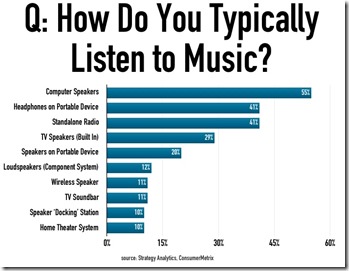
soundquality_study1If this isn’t a kick in the ears, I don’t know what is: “According to a survey conducted by Strategy Analytics, built-in computer speakers are now the most common way to listen to music, by a sizable margin.  In the study, laptop and desktop speakers overwhelmingly topped the list of frequently-used listening methods, with 55% picking the category.

“Headphones connected to a portable device followed with 41% of respondents, alongside stand-alone radio, also with 41%.  Surprisingly, TV speakers were also highly-ranked, with 29% ticking that box.”

While nothing about this information is surprising, that doesn’t keep it from being depressing. More out of habit and curiosity these days, I still read Mix Magazine, TapeOp, Recording, ProSoundWeb, and Pro Sound News. I’m mostly entertained by the seriousness audio “engineers” (an oxymoron if there ever was one) take their degraded “craft.” Almost by reflex, when I read an interview with some kid who has decided he’s the next incarnation of Tom Dowd (No, he won’t have the slightest idea who Tom Dowd was.) I chase down a few examples of the music he refers to as examples of his work. Invariably (Yes, I do know what that word means.), it will be some awful sounding collection of distortion, overused effects, trite synthesizers, and horribly recorded drums.

The critical feedback loop between musicians and their vanishing customers has been wreaked by “portable devices” and the delusional pipedream that some whackos have that high resolution audio will change any of that is nuts. I suppose I should be happy with the resurgence of vinyl, since you can’t get that shit on to a cell phone? If you know me, you know I think going back to vinyl is about as silly as abandoning cars for horses. It’s not the vinyl that matters, it’s the amplification and speaker systems, dumbasses.

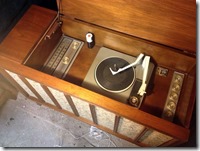
webcorThis has been a long time coming. This godawful Webcor record player is pretty much what I began listening to in my audio career, way back in 1959. My father bought it for the living room, decided he didn’t like the way it looked (ours was salmon “red”) and dumped it in the basement (where I lived).

My mother had convinced him to buy an RCA console system, but he decided that took up too much room and it ended up in the basement, too. It really was pretty awful, but slightly better sounding than my Webcor. rcasteroWhen he remarried, the RCA found its way back into the living room in their new home and it remained there until they downsized after all of the kids had left home.

By then, I had long since graduated to component stereo equipment, then band sound systems, and, finally, recording studio equipment for my home audio system. Our living room system (aka “Home Theater System”) is still a decent receiver and a pair of JBL studio monitors. The down side to that is that, if I bother to listen at all carefully, it’s pretty obvious that Pandora broadcasts in a mediocre MP3 format. Usually, I’m not that focused on the music coming from the living room when I’m working in the kitchen. When I am actually critically listening, I listen to CDs. I’ll put CD quality over vinyl any day.

Too often, when someone under 30 wants to show me some music it will be demonstrated on a cell phone speaker. I have no idea what I’m supposed to get from that experience. I can usually pick out the melody and determine if it is a male or female lead voice. That’s about all I’m willing to invest in that miserable fidelity source, though, which is often disappointing to the person trying to impress me.

To be truthful, if you are a cell phone user I have to suspect you don’t care about fidelity in any form. While I haven’t had a fixed-line telephone for quite a few years, our primary telephone looks a lot like a fixed-line system. Our phone service is provided through our high-speed ISP and an Ooma Tele. The sound quality was a substantial step-up from the fixed-line system provided by Qwest and, later, Comcast in our Twin Cities home. I can, in a few moments, tell if a caller is on a cellphone because the quality is miserable. Always. My guess is if you can tolerate that level of distortion in a voice conversation you aren’t that discerning in any aspect of audio. So, while I’m not surprised that music is being listened to on actual speakers by an audience of 12%-and-shrinking I’m also not impressed by your musical tastes. Your opinion of audio quality is just going to make me laugh, so don’t waste either of our time.

Friday, April 26, 2013

Cellphone Focus


There has been a lot of talk among educators about how to reach the dumb-phone addicted. This short video might be a decent demonstration. Show the little morons how staring at some brainless "tweet" when you're supposed to be working is a great way to crush a brand new career before it gets started. One instructor noted that, after explaining his "no electronics in class" rules, he simply explains that "If I see you staring at your crotch and smiling, you're gone." AJ could have used a little of that tough love.

This was AJ Clemente's first (and last) day on the job. In fact, I'd imagine his hopes and dreams of being a television broadcaster probably went down the toilet with his over-priced, under-disiplined education. On-line, since he won't be on screen anytime soon, Clemente said, "Unfortunately KFYRTV has decided to let me go. Thank you to them and everyone in North Dakota for the opportunity and everyone for the support." In response to some comments about his "misfortune," Clemente followed that up with "I'm a free agent. Cant help but laugh at myself and stay positive.Wish i didnt trip over my 'Freaking Shoes' out of the gate."

I'd feel sorry for him if he wasn't obviously a brainless little rich kid. He has a degree in something-or-other from West Virginia University, a state diploma mill with the usual low education standards we've come to expect from the southeast. What do you want to bet that school hands out A's at the usual 70%-of-all-grades rate? Literacy is, clearly, not one of WVU's strong points; either is a decent work ethic.

To illustrate the near-complete breakdown of society, a variety of morning-moron shows "invited" this idiot on to national television to explain how his tiny brain works. Obviously, owning a television is an invitation to become mentally disabled. My wife can put up with hours of these chittering chimpanzees, but she's 3/4 deaf. I can't stand more than a few seconds of that awful noise without wanting to toss the televisions from our house (probably grounds for divorce in most states).

Wirebender Audio Rants

Over the dozen years I taught audio engineering at Musictech College and McNally Smith College of Music, I accumulated a lot of material that might be useful to all sorts of budding audio techs and musicians. This site will include comments and questions about professional audio standards, practices, and equipment. I will add occasional product reviews with as many objective and irrational opinions as possible.