Showing posts with label musicians. Show all posts

Thursday, December 29, 2022

My Life in Surf Music

The Ventures were my first roadie gig, when I was 14. They played the Dodge City Civic Auditorium, sponsored by the local Catholic college, St. Mary’s of the Plains, in 1963 or around then. I was in a kid-band at the time and the other 3 guys in the band were a year or two older than me. They all attended the local Catholic high school and had some connections including their parents. Most importantly, they knew the nun in charge of promoting/managing the concert and they got me an invitation to be the volunteer one-man stage “crew.”

I knew how to setup a two-piece guitar amp, I could tune a guitar fairly well and set it on a stand by the amp, and I could plug all that in correctly. Mostly. The auditorium’s sound goober was an old guy named “Sears.” I don’t remember much about him other than the fact that he set out one mic, probably a Shure 55 or something like that and connected up a Shure Vocalmaster PA (two columns and a mixer/power amp tube-type head).  Once he had said “test, test, one,two, three” into the mic and heard himself from both of the columns set at opposite ends of the stage, Sears plopped himself down in a folding metal chair just behind the stage right wing curtain and . . . went to sleep during the first song of the sound check. He didn’t move again till the show was over and the audience applause woke him up. Once my tiny bit of stage-handedness was finished, I climbed up a ladder at the back of the stage left wing to the scaffold plank and sat right over the band, with my legs dangling at least 20’ over their heads.

Sadly, I remember very little about that concert. I remember almost falling off of the scaffold on to the band, bouncing up and down to the opening chords of “Slaughter on 10th Avenue.” Their hit, “Slaughter on 10th Avenue” was yet to be released, but they played it in that concert and knocked me out. The year before, my kid band played “Walk Don’t Run” and “Wipeout” on our way to winning a city talent show. I thought I knew all of their music, but they played all sorts of songs I’d never heard before and I was so jazzed to be there, to hear them live, and so pumped to have actually talked  to them before the show that I probably bulk-erased a lot of that night with pure emotion and excitement.

Before and after the show, I got to hang out with the band and I remember walking out of the auditorium with the band, after loading their gear into a trailer. I asked Nokie Edwards for an autograph. He said, “Surely,” and took the album from me. Bob Bogle said, “Don’t call that kid Shirley.” First time I ever heard that joke. Not the last, by 100s, though.

When I moved out a year later, my parents threw out that record and a ton of other stuff. After all the times we’ve moved, there is no chance I would still have it under any circumstances. Still, it would be cool to have that record cover and have it framed in my office.

In the late-1980s, I ran Front-of-House for Dick Dale at Anaheim Stadium. The sax player/bandleader, Jack Freeman, for a group I worked with for almost a decade there, Sum Fun Band, also had a small live sound rig he rented out. Since he was playing sax in Dale’s band that day, Jack hired me to run sound for the show (a pre-baseball game warm-up act outside of the stadium to entertain the tailgaters). Dale notoriously hated sound guys and Jack and a few friends in the business warned me that he might even take a swing at me if I pissed him off. His shows were notoriously loud, past the point of pain and permanent hearing damage and I’d seen him play a couple of times at the Huntington Beach national surf championships. It was a 5-piece band and we had 5 stage monitors to work with and a bunch of QSC power amps to drive them with (thanks to my employer). I put all of the monitors around Dale and drove them as hard as possible with almost nothing in any of the monitors except “the star.” It was so loud the sound pressure moved Dale’s clothes and strands of his scrawny ponytail like a breeze.

After the set, he hunted me down and told me I was the best sound goober he’d ever worked with. Jack was less impressed because he didn’t have any sort of stage monitoring and he and the rest of the band struggled to figure out what was going on. ;-) Not my problem, Dick paid the bills.

Saturday, February 13, 2021

When Technology Becomes “Fool Friendly”

Thirty years ago (early 1992), I had just started work at my first medical devices position. One of my coworkers was the company’s brand new  IT guy, Richard, and he and I got curious about the new “World Wide Web” at about the same time. I’d been on-line with email and user groups for some time, but HTML and the web was new to both of us. The company, Telectronics Pacing Systems, was just beginning to face some of the problems that would eventually get the company regulated into history for a collection of disastrous product and engineering decisions. At the time, we were still flyin’ high and looking toward a bright future. (Hard to remember there was a time like that in the USA, isn’t it?)

As we got further into HTML, UNIX, and SQL coding, we could see that the days of these skills could be numbered in the single digits. When we first started out, to send an email message via UNIX, you first had to write an email editor with which to write the message. I had just learned how to do that bit of coding when HP-Mail, DEC’s All-in-One, and other email “clients” plus browsers like Mosaic (Netscape) came along and made many of my brand new skills obsolete.

About then, Richard said, “When the internet becomes easy for everyone to get into, it will be ruined.” What he meant was that for the time being the internet, before the WorldWideWeb, was pretty much a techie’s playground. Once browsers, email clients, and the rest of the crap that would come along to make the Internet accessible to “the common man/woman” the whole thing would turn into a clusterfuck of garbage, morons easily expressing their opinions, and lots of commerce. And he was right. That sequence of events has been true for many technical things: cars, motorcycles, synthesizers, personal computers, photography, audio and video recording and editing, and even engineering.

Jamkazam has been making fairly large strides toward creating an on-line place for musicians from all over the world to get together. The service just became fee-based, although you can experiment for a few hours each month for free. Recently, a new user went to the Facebook Jamkazam Jammers page to complain that she was unable to get “Jamkazam to work.” It turned out that she couldn’t get her Mac to work with her Presonus audio interface and, since her only reason for having an interface was to clutter up the Jamkazam fiber channels, her inability with her equipment was Jamkazam’s problem to solve. That is typical of my experience with the side-effects of dumbed-down technology. When the technology gets simple enough so that it “becomes easy for everyone to get into,” the quality, skills, commitment, and contributions of the people involved quickly drops to that common denominator. Now that on-line music is relatively simple (and getting more simple by the day), the people involved are less sophisticated, less talented, and way less capable of actually playing in a group.

There are at least a dozen groups on Facebook with clueless, talentless members claiming to be “music producers” and/or “recording engineers.” In today’s vernacular, I have no idea what a “producer” is or does. None of these people could swing a record deal if their lives and parents’ fortunes depended on it. They don’t know any actual musicians, so managing a recording date is hilariously out of their bailiwick. The first level border guard of recorded music used to be the entry fee: $100,000 14-track, 2” machines, half-million dollar consoles, multi-thousand dollar microphones, and million dollar acoustic spaces. Today, you can actually spend less than $500 and “make a record.” Most likely, that recording will suck on multiple levels, but YouTube won’t discriminate. Either will CD Baby, Tunecore, iMusician, Distrokid, or any of the other social media and on-line music distribution resources. You can be the absolute worst talent on the planet and still make a record and put it out there where people will have to step around it to avoid hearing it.

This is condition is sometimes described as the "tragedy of the commons." Wikipedia neatly defines this situation, "The tragedy of the commons describes a situation in economic science when individual users, who have open access to a resource unhampered by shared social structures or formal rules that govern access and use, act independently according to their own self-interest and, contrary to the common good of all users, cause depletion of the resource through their uncoordinated action."  The long, but detailed, way of saying, “When the internet (or anything) becomes easy for everyone to get into, it will be ruined.”

In manufacturing, quality and manufacturing engineers have a saying, “The only way to foolproof a system is to get the fools out of the system.” When it comes to systems like the internet, music, and art the fools rush in so fast and get so deep into the structure that there is no turning back.

Wednesday, January 13, 2021

Original Music: “I’m An American”

This is the first song I've actually "finished" in almost 50 years. Obviously, being fenced in during the COVID pandemic had a lot to do with it. More importantly, the contributions of four friends--Harold Goodman, Stuart Anderson, Scott Jarrett, and Michael McKern—practically forced me to move this song from a half-hearted folk song that I might play for friends hanging around our backyard on a summer evening to what it has turned into (whatever that is). I’m not sure there is a better outlet for something like this than YouTube. 

Parts of it were recorded in home studios: Michael McKern’s drums, Harold Goodman’s bass part, my vocals, acoustic and electric guitars). Some parts were recorded live through Jamkazam sessions: Scott’s keyboards and Stu’s steel guitar were pieced together, and synchronized, from several live recordings over a couple of months.  The percussion instruments and some other “instruments” are Apple Logic X effects from Logic’s “Drummer” feature.

The song was produced and mixed in Logic X (v10.3.2) by me at home in my funky upstairs spare bedroom/office on a 13-year-old Mac Pro 3,1 running OS X 10.11 (El Capitan) through a MOTU UltraLite-mk3 interface, in case you are interested in that sort of thing. If nothing else it proves that I am not constrained by not owning state-of-the-art hardware or software, as good or bad as the outcome may be. I’m old, my gear is old, and it’s a race between me and the gear to see who plays out first. I expect the gear to win. The vocals were recorded with an AKG C141ULS, an RE18, and the acoustic guitar was my Composite Acoustics OX recorded both with the C414ULS and the guitar’s pickup, a Seymore Duncan Mag-Mic pickup (thanks for the recommendation, Brian). And that’s about all there is to say about that stuff.

The song is, obviously hopefully, about the dark, decadent times we live in and the very similar times I have experienced all through my 72 years. From my early years of duck-and-cover exercises in 1950’s Cold War Midwestern grade school classrooms to the Vietnam War that commenced as I became a teenager to the collection of endless wars and invasions the country has mindlessly and arrogantly engaged in since Reagan’s gangsters and the host of faux-conservative, Republicans and Democrats, who represent the 1% of the country who profit from wars, who profit from ecological devastation and neglect, who wallow in the spoils of economic inequality that defines this country, and the despicable people who are profit by lying to a gullible public that is too lazy to read a book, who won’t bother with understanding history, science, or technology, and who imagine that complaining about their government is in some way “participating” in democracy. As the song says, we’d rather be lied to than to have to raise up on our hind legs and do something to make the country and world a better place.

One of my favorite 1950’s science fiction authors, Theodore Sturgeon, said something like “90% of everything is crap.” Since my years protesting the Vietnam War, I have been convinced that Mr. Sturgeon was an optimist. I doubt that more than 1% of anything is more than shit. So, keep lying to us and we’ll keep believing it. We’re Americans and “nobody ever went broke under-estimating the intelligence of the American consumer” (except Trump, of course, because he can’t even get that right).

Monday, February 10, 2020

It Just Doesn’t Matter to Me? I Guess Not

The title of a GetPocket.com article, “Are You Forgetful? That's Just Your Brain Erasing Useless Memories” struck a nerve with me. The contents of the article reinforced that reaction. For almost 40 years, I’ve complained that when I quit playing in bands in the early-80’s I lost the ability to remember song lyrics. A neuroscientist, Dr. Blake Richards explains that we mistakenly believe that the “argument is that memory isn’t supposed to act like a video recorder, but instead like a list of useful rules that help us make better decisions.”

For 15+ years, I had hundreds of songs memorized—lyrics, chord progressions, solos, harmonies and melodies—and within a few weeks, of my deciding that playing in a live band wasn’t for me, all of that vanished. Before the year was out, all of those once-useful memories disappeared and, for the most part, I didn’t give it a moment of thought. I was very busy in my new life. Off and on over the next four decades I would occasionally and unsuccessfully try to learn a new song and be mildly baffled at my lack of success. I wouldn’t make the attempt again for several years each time.

This idea that importance is linked to memory isn’t new to me. 30 years ago, I started a new career as an engineer in a medical device company. Part of my job included training new employees, sales representatives, doctors and nurses in the company’s products. I had been doing in-house industrial training since the 1970’s, but those experiences were considerably less formal (product certifications were involved in medical devices) and the outcome of my new job’s training product could be life-or-death. I was renting a room from a friend when I first started in that job and he regularly amazed me with his ability to remember our “students’” names. I am sure I told him, “I just can’t remember names.”

We regularly watched NBA games after work, I was still a big Showtime L.A. Lakers fan and we were watching a game at the time. He replied, “Bullshit. You know the names of every NBA player down to the 13th guy on the bench. You just don’t care about the sales reps’ names.”

Of course, he was right. I didn’t. For the most part, I never did care about sales reps’ names, ever.

A decade later, I was beginning another new career as a college educator. One of the instructors in my new department was fired, partially, because he couldn’t be bothered to learn the names of the students in his half-dozen student labs. Listening to my new boss talk about how he felt that was disrespectful, I promised myself that I would learn my students’ names if it required tattooing their names on my eyeballs. For the most part, I managed that objective and I did it be making sure that I always cared about my students as human beings and potential associates in the industry within which we were all aspiring to work.

Finally, back to why I can’t remember songs today, I really don’t care about individual songs enough to memorize them. I have to admit that. I don’t believe, at this point in my life, songs are an important thing in my life. Music is important, but specific songs are not. Pop music has been the soundtrack to my whole life, but it has been a 50-year-long soundtrack. Other than the jazz that I stumbled upon when I was 11 or 12, specific pieces of music have held almost no claim to my life. Music as an overall thing is not-lifesaving or threatening. Musicians and their music comes and goes and is forgotten or remembered at random based on mostly emotional, juvenile nonsense. People in my generation “love” the Beatles because they were young and cute and hopeful when they first heard that music. Today, they are mostly MAGA assholes who would burn the world to a crisp just to hang on to their gas-guzzling SUVs and golf carts. My kids’ generation clings to punk and metal and disco for the same lame reasons. And on that silliness goes.

I like all kinds of music from pretty much every generation that has touched my life: not all of any of it, but there is some music from every period between the 1920’s (my grandparents’ music) to today (my grandkids’ music) that strikes my fancy in some way. But I don’t love any of it, at least any of it that I’m technically capable of playing, enough to spend the energy and braincells to memorize it. And now that I know why I seem to be unable to memorize music, I’m going to quit beating myself up for that “inability.” I have almost 500 songs on my performance tablet, charted, organized,

The one exception to that failed memory in the last 10 years has been Tom Waits’ “Shiver Me Timbers.” The lyric to that song, if you know me and my life, is clearly why that song remains important to me:

  • I'm leaving my family,
  • leaving all my friends.
  • My body's at home,
  • but my heart’s in the wind.

The first time I heard that song, at the end of a “Numb3rs” television episode, it struck a chord (literally and pun intended) with me that stuck like glue. That song’s lyrics are important to me. In the last year, a John Mayer song, “Walt Grace's Submarine Test, January 1967," is beginning to stick, too. The lyric, “with a library card and a will to work hard” found a place in me that is as personal and important as “Shiver Me Timbers.”

Monday, December 9, 2019

My Momentary Folk Singer Career

In the fall of 1967, my father withdrew about $3,000 from my college savings fund and the family took a “vacation” and dumped me in Dallas, Texas. The plan was that I would be attending a fly-by-night Texas for-profit computer school. The reality was that my father thought I was wasting my life trying to be a musician and he figured I’d follow my money where ever he decided to send it. He was, of course, right; in his weird, passive-aggressive way. I had earned that money throwing newspapers between the ages of 11 and 13 and working at the Dodge City Boot Hill Front Street Replica tourist trap for two summers from age 13 to 14. I, of course, wanted to spend that money on music equipment, but my father would have none of that. Worst case, I figured I would be far enough from Kansas and my fundamentalist whackadoodle family to completely break free from them and start my own life. 

The school, as you would expect, turned out to be a fraudulent joke. The school’s “dormitory” was a 1920’s flophouse full of bums, drunks, thieves, and a dozen-or-so computer school “students.” After a week in the flophouse, a half-dozen of us started looking for a better place to live. We found a house we could rent for about the same money as the flophouse, sans flophouse food. That lasted for a month because one of our roommates ate everything that came into the house and bought nothing. When he tried to “borrow” money for the 2nd month’s rent, we scattered. Two of the guys, twin brothers (Larry and Gary)  from Lawrence, KS, found an apartment in Old East Dallas and I rented a tiny garage apartment from the same landlord. By then, more than half of the school’s students had dropped out and most of them were suing the school for fraud; among other things. One of the more experienced guys had recommended that we join the lawsuit, but my father had already been conned into giving the school a 2nd semester tuition as a payoff for my dropping out. For an accounting teacher, his math skills were consistently suspect. His capacity for critical thinking was never suspect because it was never evident. I kept going to the school, even though most of the instructors had quit and the already obsolete computer equipment had been repossessed. 

About the time I moved into the garage apartment, a friend from Kansas, Ed, who was burning time before his delayed induction into the Army date moved in with me. We had written a few dozen songs together and decided to try some of them as folk songs. There was a bar a few blocks from the apartment and coffee shops from Lakewood Heights to downtown Dallas. Best of all was the Rubaiyat, the premier Texas folk club/coffee shop of the day. Ed stayed for a couple of weeks, just long enough to help me connect to some of the folk music scene. Toward his last few days in Dallas, our act had started to attract a weird collection of “side men” to our act; percussion players, “singers,” guys blowing into bottles and South American flutes, an upright bass player or two. Some characters brought instruments they often couldn’t play at all, so they’d just bang on them. There was no money in any of it, so that act took on a name that included the words “jug band.” That is all I remember about the group name, too. Jug bands were a thing then, for a brief moment. 

Once, we accidentally ended up being one of the intro acts for a major (for the time) folk singer. It kills me that I can’t remember if it was Tom Paxton, Tom Rush, Tim Buckley, Tim Hardin, or it could have been someone I have completely forgotten. The first name stated with “T,” I was not a folk music guy at the time, although I loved Bob Dylan and covered several of his pre-electric era songs. I wouldn't have known Rush from Paxton from Buckley at the time, but I did cover Hardin's "Reason to Believe."

Ed and I showed up, but the rest of the menagerie did not, so we did a half-dozen original songs and gave up the stage to the headliner. As I walked off of the stage, whoever that T-guy was said, “You know what it’s supposed to sound like.” 

[The picture at right is just a Rubaiyat poster, not a bill that our group was on.]

I will never know if that was a compliment or sarcasm. If you know me, you would be correct in assuming I lean toward believing it was sarcasm. We were 19 and 20-year-old kids from Kansas.

A day or two later, Ed headed off to basic training. I ended up dropping out of my bogus computer school, shacking up with my wife, Robbye, diving into the Dallas hippie world (sans drugs), and almost giving up music entirely. I really wanted to be an R&B guitarist, but couldn’t cut it in that competitive environment. I loved playing guitar or bass in an R&B band, but playing solo folk music scared the crap out of me. Still does. Occasionally, I would stop in at the Rubaiyat and play with one of the other groups or do a couple original songs. One of those songs, “Dixie Lead,” was recorded at the club and got a little late night FM radio play, as a protest against one of the many grossly polluting factories in east Dallas. And that was my first experience in the big city.

Monday, December 2, 2019

Double-Edged Swords

A friend recently ended a jam session complaining, “I’m worried that musicians today don’t even know the names of the people I grew up idolizing and imitating.” (Or something close to that.) 

I responded with, “That goes both ways, with most of the folks in our generation pretending that no good music has happened since the 70’s or 80’s.” That was not received well. 

I just reviewed a book that I, mostly, disliked for the same reasons, A Craftsman’s Legacy by Eric Gorges, and you can read my opinion of that book on my Geezer with A Grudge blog. Every old generation imagines that it not only invented the wheels of society but perfected them so that every following generation can only screw up the work that went before them. It takes a special sort of arrogant blindness to believe that, but humans are really good at both arrogance and blind belief. It’s one of many things that has always convinced me that the natural state of human “civilization” is chaos. I wrapped up my review of A Craftsman’s Legacy with this: 

“Finally, I firmly believe that everything that requires skill is improved by every generation. You may be one of those addled characters who imagines that ‘good music’ stopped being made in 1960, 1970, 1980, or whenever, but you’re wrong. Likewise, most 1970’s era pro basketball players wouldn’t make the team for, even the freakin’ Clippers, today. Even Michael Jordan would have a hard time playing on a winning team today. It’s true that many people knew how to repair their cars and motorcycles in the 1950’s; because they needed to. A vehicle that lasted 25,000 miles without needing major work in 1950’s was a rarity. Today, we call any vehicle that fails before 200,000 miles a ‘lemon.’ Today, if I had to go to battle with a 15th Century sword I’d just use it on myself to get it over with efficiently. Vintage ‘skills’ are that because they are no longer state-of-the-art and, as such, are obsolete. If you think someone with a hammer and coal-fired forge can turn out a better steel tool than a modern factory, you’re only fooling yourself. If you don’t think a modern adventure touring motorcycle isn’t as well crafted as one of Gorge’s hippo-bikes, you don’t know what the word ‘craftsmanship’ means. If you think someone cobbling out plodding, non-functional ‘choppers, bobbers, and diggers’ could get a job on a modern factory motorcycle race team doing . . . anything, you are probably the ideal reader for A Craftsman’s Legacy.

I absolutely believe all of that and even a moderate amount of exposure to the best of today’s young musicians would force almost anyone to acknowledge that the “good old” stuff is practically unlistenable in comparison. I admit that I’m not a typical Boomer in my tastes. I didn’t like the Beatles (but I am a huge George Martin fan, he could turn sow's ears into silk purses, repeatedly) or much of the British Invasion in the 60’s and I like most of that stuff even less now. A lot of great music, from R&B to jazz, was bounced off of popular radio by “yeah, yeah, yeah” and other teenybopper bullshit between 1964 and the early 80’s and I don’t think popular music has ever recovered from the damage done. Another Boomer friend commented on the “trivial character” of current music lyrics, as if songs-about-nothing like the Beatle’s “Hey Jude” or “Long and Winding Road” or “Number 9” and pretty much every Led Zeppelin song that wasn’t stolen aren’t only trivial but annoying. At least the Stones had “Street Fightin’ Man” had a point. 

That is such a lame complaint. It’s pop music, dude; music for kids by kids. Don’t expect poetry or meaningful commentary on the state of humanity from kids. 

Just because we’re old and full of ourselves now doesn’t mean that we were solid citizens or brilliantly insightful and creative 50 years ago. I am a firm believer in Theodore Sturgeon’s “90% of everything is crap” rule. I can’t think of a period where the overwhelming majority of popular music wasn’t garbage. For example, the furthest up the US pop singles charts Jimi Hendrix ever made it was #20 with “All Along the Watchtower” in late 1968. The chart topper at that time was “Harper Valley PTA” followed by the Beatles’ lamest ever “Hey Jude.”  Hendrix had 4 successful albums, If you look at almost any moment in pop music history, you’ll be discouraged at how generally mediocre the “hits” are. It was true in 1920 and it will be true in 2020 and 2050. The tastes of the average imbecile are predictably dismal. That casts no reflection on that period’s best and brightest, who will likely be an improvement on the skills and creativity of previous generations until humans vanish from the planet.

Monday, August 26, 2019

Being A Musician

Lots of people believe that there is something sort of magical about being a musician or being “musical.” A friend who is the poster child for all things musical once came to a local weekend jam session when he was visiting for a week. Afterwards, he said something about the folks from that group not being “musicians.” And I asked what he meant, mostly because I have always been fairly embarrassed at the fact that after playing guitar for almost sixty years I still suck. 

He said, “There are three things that you have to have to be a musician; 1) you need to know music theory and technique for your instrument, 2) you need a decent sense of rhythm, and 3) you need to listen. If you have any one of those qualities, you could be a musician. If you have all of them, you probably are a good musician. Most of the people in that room (the local jam session) couldn’t make a claim to any of those qualities.” 

And he was right. 

To be fair, some of the people in the jam session were beginners; regardless of age. However, my friend’s #3 point, listening, is something anyone who wants to be a musician should develop really early. Honestly, it should come easier than it apparently does. 

One of the many things that drove me away from live performance was the fact that it was close to impossible to put together a group of 4 or more people who would bother to listen to the output of the group. In the recording studio, you can compensate for your performers’ inability to listen to the music. You track every instrument and every voice, one-at-a-time, and you mix the outcomes into something that may resemble a “performance.” Getting human beings to act like musicians is, sometimes, as close to impossible as getting old white people to think about anything but themselves. 

For example, that same jam session occasionally attracts a local character who thinks of himself as being almost famous. He knows a half-dozen songs, mostly old time bluegrass/country tunes, and he plays and sings them really loud. The format in this session is generally set and designed so that everyone gets a chance to pick a song and sing it; if they want to. You can always pass on your turn, but everyone usually gets one. Unless “almost famous” shows up. He uses every pause in the action as his moment to either tell a story about himself or to start hammering away on another song. At best, the cycle goes: someone in the group picks a song, “almost famous” does a song, someone else does a song, “almost famous” does another, and so on. 

Not surprisingly, “almost famous” complained that he couldn’t hear the other players guitars over his own instrument; especially when someone took a solo on one of his tunes. His solution was to get a PA into this normal, reverberant room. The person he complained to, one of the better players in the group, suggested that he try to hammer his guitar more quietly when others were playing. His response was, “This guitar just doesn’t do quiet well. It’s really loud.” I was fortunate not to be eating or drinking anything at that moment. Otherwise, I might have sprayed the group. 

Guitars, especially acoustic guitars, are capable of substantial dynamic range. Guitar players, especially electric guitar players, are rarely able to shut up or lower their volume at all unless you put sheet music in front of them. This particular acoustic guitarist had never been in a situation where he had to listen to anyone else while he played. At almost 70-years-old with five decades of “music" performance behind him, it’s probably too late for him to learn the most basic requirement of being a musician. That is something really scary to consider.

Monday, August 12, 2019

Where Did You Come From?

Kids in class who have an over-inflated sense of their self-awareness and experience remind me that, someday, there will be a payback and it will be a bitch.

Not that many years ago, my author-music-reviewer-daughter Holly, wrote a review of Bad Plus that included some pretty silly proclamations about the gap between her music knowledge and appreciation and mine. I was entertained. In a similar conversation earlier, she had said, "Dad, I'm a music reviewer" as a statement of superior expertise when we had a disagreement about what qualified as ‘good music” and what didn’t. There are few things on the planet musicians or artists of any sort despise and ignore more than reviewers.

Our other daughter once told me that "It is great being in a family that is so musical," in reference to her husband's family who are dedicated karaoke fans. My kids grew up in a house full of musical instruments, musicians, recording and live sound equipment, and with music of some sort happening all the time, but somehow none of that registered. With all of that background, the first time she held a cheap microphone and sang along with canned muzak in front of a crowd of drunks in a karaoke bar was her first “real musical experience.”

Holly's son is now 22 and is convinced that none of the adults in his family know squat about music. Holly has written one of the biggest selling music theory books ever, The Dummies Guide to Music Theory, and gets a buttload of free CDs in the mail every month from her history as a music reviewer. Not a credential in her son’s mind, because . . . I don’t know what. When I was paging through the weirdly disorganized music list on my car stereo, he had to ask, “Why do you have all of that crap in with your music?” I don’t even want to know what he calls “crap.” He is his mother’s son, with even sillier tastes, and my interest in educating or even talking about music with non-musicians is vanishing into nothingness.

No matter what you have done, your kids will think you have done nothing. Tony Hawk’s kids, apparently, think he is a loser. Of course, most likely the only thing Tony Hawk’s kids will be ever be known for is being Tony Hawk’s kids. So, there is that.

Monday, August 5, 2019

Why Your PA Will Never Beat Physics

Live sound goobers delude themselves into imagining that with enough of the right equipment they can overcome room acoustics.( As a baseline reminder, these are the same people who can’t deliver a decent mix in an outdoor environment where they have absolutely no excuse for their incompetence and performance failures.) This is one more place where not knowing the basic concepts of a profession creates gross amateurs who do far more damage than good in their existence. If fact, sound goobers are often far greater performance offenders than enhancers. (See Snarky Puppy, for example.) 

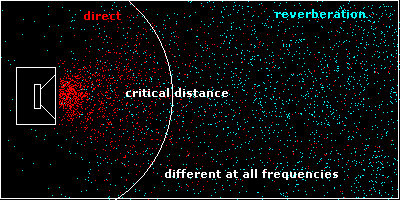
The problems with a typical performance venue is that the RT60 time (reverberant energy from the loudest point to where the reverberant energy has degraded by 60dB) is measured in, at least, substantial portions of one second (1S). Due to room resonances, the decay is not typically a nice clean exponential curve, either. In fact, due to room modes the actual decay curve can be pretty long and lumpy. So, for a simple drum beat at 120bpm, it is likely that the constant reverberant energy in the room might be within 3-6dB of the original sound source. A highly counter-intuitive fact of reverberation is that, except for room resonance variables, reverberant energy is equal everywhere in a room. If the measured reverberant energy is 90dBSPL at the back of the room, it will be very close to that at every microphone on the stage. If the sound system is delivering 125dBSPL at the room’s critical distance (where the reverberant energy and direct sound energy are equal, the “noise level” (unwanted reverberant energy) will be very near 120dBSPL everywhere in the room. 

So, keeping that fact in mind, you might realize that the sound pressure level (aka noise level) at the element of every microphone on a stage in my last example (above paragraph) will be 120dBSPL. So, to achieve any level of isolation/discrimination/intelligibility at each microphone, at least 6dB and ideally 20dB or more of signal (direct signal) will need to be delivered to the microphone. This problem is neatly, if not particularly musically, resolved with the use of direct injection (DI) boxes. There is no acceptable fix, except for atrocious microphone technique, for vocals and instruments that require a microphone. The reason musicians use microphones like the SM57/58 and its lo-fi clones is because of that instrument’s undeserved reputation for high MaxSPL capability. There is a reason that Shure does not specify a “maxSPL” value and it is not because it is a happy marketing story. The SM57, for example, is selected for close mic’ing of loud guitar amplifiers because of the additional distortion it introduces. There are many far better choices for that job if you are not looking for the distortion contribution of the microphone. In the kind of high volume environment we’re talking about in the previous paragraph, hyper-high maxSPL specifications are a must: 140dBSPL and above, for example. 

140dBSPL and above sounds like an impossible sound pressure level, but if a loud voice is typical 88dBSPL at 1 foot, every halving of that distance results in a 6dB increase in sound pressure, eight half-steps would result in a 142dBSPL at the element. Since many pop singers insist on planting their lips right on the microphone grill (even though there is typically some space between the grill and the actual element) it is not inconceivable that sound pressure levels greater than 130dB are typical. That would provide at least a 12dB signal-to-noise range for the microphone in my worst case example; assuming the microphone can function in that hostile environment. 

Signal-to-noise ratios sum exponentially, though. If you have two channels combining where each channel has a 12dB S/N ratio, combining the two channels will cost you half of your S/N ratio. If you are going for any sort of quality sound, the key will always be to drive the average sound pressure level down, not up. I suspect, if you are a typical amplified music performer you are going for something other than quality sound. What that is I can’t guess.

Thursday, August 1, 2019

Real Time with the SM58

As much as I bitch about the Shure SM58, my recent experience with that blunt instrument has been as rare as possible. I really do dislike the damn things and recent familiarity bred a whole new level of contempt. 

Last night, at the Sheldon Theater’s Open Mic I had that dreaded experience for three different performances (as a vocalist and backup singer) and was reminded of how primitive that 1966-designed mic really is. 1st, the pop filter is a joke. At distance, for example the unspecified distance used in the Shure spec shee (at left), you'd think the 58's LF response would be fairly useful for vocals. Best I can figure, that distance must be at least a foot if not a meter. Anything within a could of inches from on-axis to the 58 gets a burst of breath noise that is unlike any other microphone sold today. If you don't roll off every thing below 150Hz or even higher, plosives and breath noise will wreak any attempt at a subtle vocal. 2nd, that infamous 3-6k bump mostly emphasizes sibilance artifacts without making any useful contribution to clarity or intelligibility. 3rd, Shure doesn't spec "max SPL" for the 57/58 models for obvious reasons; it isn't nearly high enough for modern applications. Many vocalists are able to blow the 58 into gross overload, even without the lousy mic hyper-close technique required for their out-of-control stage monitor environment. Likewise, the 57 is famous for it's contribution to the distorted sound of loud electric guitar. 

The spec sheet's description of the 57/58 polar pattern isn't anything I have ever put much faith in, either. You'd think that the damn thing was practically flat and feedback-predictable based on that highly creative illustration (see at right). In practice, that would be anything but true.

All of those 50+-year-old "qualities" have been improved upon by everyone from Shure to AT to Sennheiser to Neumann to Audix to cheap Chinese no-name microphones costing even less than the 57 or 58. You actually have to make an effort to find a microphone that delivers worse performance today and, based on what I see on live stages, that might be the only actual work many live sound goobers do.

The one and only claim to fame the 57/58 will hold maybe forever is indestructibility. If an ability to drive nails and keep squawking is the most important thing to you, you are the consummate SM58 customer. 

POSTSCRIPT:  (8/6/2019) This past week I had a double-whammy experience with the 58 vs something better. After years of wanting to see the John Mayer live "Where the Light Is" concert, I finally managed to snag a copy. It is particularly ironic to watch Mayer agonize over which multi-thousand-dollar watch to wear between sets, swap out various overpriced vintage Strats, while his voice consistently gets slaughtered by the 58 he mindlessly sings into as if it were as well-considered an instrument as his watches or guitars. Clearly, a lot of work went into cleaning up that vocal for the final product, but there is no way to make a silk purse from a sow's ear. Mayer tends toward mushmouth qualities in the studio, but live all of the worst qualities of his voice are emphasized. What a missed opportunity. 

My 2nd experience was with recording a local country/pop songwriter in a live setting that, acoustically, left a lot to be desired. Lucky for me, the artist was open to my swapping out his 58 with a recently rebuilt EV RE18. My job, post-recording, was made dramatically easier than what Chad Franscoviak and Martin Pradler had to contend with on the Mayer live recording. Getting a clear, crisp sound from the live vocal took minimal processing and the rest of my job was working with the rhythm section and lead guitar. Regardless of the song style, tempo, arrangement complexity, or vocalist's technique, the vocal sat where it belongs at the front and center of the mix. The fact that the artist's technique is excellent didn't hurt, but the fact that I wasn't wrestling with garbage-in/garbage-out was equally huge.

Monday, July 1, 2019

Common Elements

Once upon a time, I was a college instructor in the “Production Department” of a music school. After the first few years of watching students pass through my classes and recording studio labs, I began to develop my “Theory of Abundance.” After watching what seemed like amazing talents pass through my classrooms, I began to suspect that there are three things of which there are a nearly-infinite supply in the universe: hydrogen, good guitar players, and beautiful young women. (Hopefully, it is equally needless to say that there are more than enough pretty young boys, too?)

Honestly, outside of physics there isn’t much value to take from the understanding that hydrogen is 75% of the mass in the universe. The over-abundance of the other two things should be really informative to a young person starting out in life: you do not want to place all of your bets on being special in a commodity market. Being special requires some rarity. Corn, sow bellies, soybeans, car tires, oil, coal, electricity, electronic components, cell phones, computers, and guitars are, mostly, commodities. That means one example of any of those things will serve the purpose as well as any other example. In a rational world, that would mean that the price of any of those things would be the same and as low as the cost of production allows.

In the case of over-produced farm products, the price is artificially held high to maintain the rural status quo. In the case of musicians and music, the price appears to be heading for the dead bottom because there are no powerful 1%’er special interests who have the money to buy off our state and federal congresscritters who could easily create the same artificially high price structure that they have built for energy, oil and coal, ethanol, cell phone providers, corn and soybeans, meat and dairy, exports, housing, and medical industries from insurance companies to Big Pharma. Don’t look for help from that direction, there just isn’t enough money in the industry to create much interest and the money that was in that business model is going away and most of it is long-gone.

Monday, June 10, 2019

Holding A Grudge or Just Paying Attention?

After the Snarky Puppy misadventure, my wife (Elvy) and I had a couple of long conversations about concerts we’ve seen and loved or hated and the end results. Turns out, my Geezer with A Grudge habits apply to music, too. I have never been punished by an artist twice and we have made a habit of seeing the people who exceed my expectations at every opportunity. The last bit has slowed up considerably now that I am no longer in the business and live some distance from where most of the action happens. Because of the expense and hassle, I probably won’t be seeing many artists twice from here out.

For example, I’ve seen Pat Metheny almost a dozen times at a dozen different venues and never once felt betrayed, abused, or let down by his band’s performances. After that many shows, I am still willing to go a long distance to see him again. A small part of my motivation for moving to L.A. in the 80’s was to see the Crusaders in their native element; especially since that was the only way to see them by that late period in their careers. I saw them as the headlines for the 1983 Playboy Jazz Festival at the Hollywood Forum, at our local club (The Golden Bear) in Huntington Beach, and at a couple of outdoor shows in the South Beach area. Every show was knocked out and amazingly close to their recordings, quality-wise. Same for Jeff Beck; who I have seen 3 times and 4 if you count a 1960’s Yardbirds concert in a Denver bar. Jeff is often loud, but always musical and the sound quality has been close to state-of-the-art every time I’ve seen him play. Elvy isn’t as much of a jazz fan as me, so many of the above shows were my experience alone. On the other hand, we’ve been to more than a few pop music concerts because of her interests; Queen, for example.

An example of the other spectrum would be Robert Randolph and the Family Band. I bought 2003's Unclassified and 2006's Colorblind the moment they arrived. I used to intro my auditorium lecture classes with Squeeze or Ain’t Nothing Wrong with That. Like Snarky Puppy, I missed my first opportunity bto see RR when the band was at First Ave because I was working a gig, out of town, that evening. Then I saw Robert and his band at the Minnesota State Fair. The sound was terrible and, being an outdoor concert in a facility where I’ve heard some terrific shows, all of the blame landed on the band (and the FOH nitwit). I tried that show twice and the 2nd time was worse than the 1st. I haven’t paid a moment of attention to Robert Randolph since; nor bought any of the band’s newer music. I still think they are a good recording act, but as a live band they suck and I wouldn’t cross the street to see them for free.

To be clear, what I’m expecting in a live concert is at least the sound quality of a decent car stereo (sans hip-hop sub-woofer mess); at the dead minimum. There is no point in spending tens of thousands of dollars on a sound system that is worse than a car stereo; and that is not a high bar. A better goal would be to match the fidelity of a good home entertainment system. Still not a stretch, but an improvement over a car stereo. Excuses from FOH goobers for room acoustics, audience behavior, and the band’s stage excesses don’t mean a thing to me. The band and the FOH engineer are totally responsible for and in control of the concert sound quality. If, as is the usual case, they don’t care one result is either do I.

Even 20-50 years later, I can remember many of the concert moments that blew me away; some as if it were a recent experience. What I remember about the lousy sounding concerts I’ve experienced is “I’ll never do that again.” That, literally, is all I remember of non-musical experiences. That would be my Geezer reflex: “Fool me once, shame on you. Fool me twice, shame on me.” I had thought about doing a chart of a few of my concert experiences, but it would be a lot of one-time experiences and my HTML charting capabilities suck. Put it simply, there are far more “artists” who I have seen once and wouldn’t cross the street to see again. Too many musicians are more concerned with their egos than with their music. This is not a new thing, but a long-established tradition; especially with jazz and pop musicians.

The conversation Elvy and I had about our 50+ years of going to concerts together was a little surprising. She was even more adamant in her “I’ll never do that again” response. We did remember many of the same great shows close to exactly the same. For both of us, the memory of the sonically disappointing-to-awful shows was limited and a little irritating. We’re not rich and wasting money is something we’ve tried to avoid for all of our adult lives.

Monday, June 3, 2019

A Musician in Charge of Suffering with the Audience

My disappointing experience in May at a Snarky Puppy concert in St. Paul somehow reminded me of someone I heard about back in the 80’s. A friend worked, for a short time, for a medical device company in the L.A. Valley. That company was one of the few US corporations that screwed up so badly that it was pretty obvious that someone would end up going to jail. Don’t worry your pretty little conservative head, nobody who was really to blame was punished. My friend met a well-dressed, middle-aged white man at a company party who introduced himself as “the vice-president in charge of going to jail.” And, eventually, he did. Still, you can keep your little skull in place; he went to Lompoc back when the Santa Barbara facility was the show place for Club Fed. 2 years later, he was out with a big cash and stock option bonus for taking the fall and none of the real villain spent a moment in jail, court, or even a little inconvenienced. No real corporate criminals were harmed pretending that USA laws "apply to everyone."

All of this brings me to my current best solution for crappy live music sound systems: a musician in charge of suffering with the audience (MICOSWTA). 40 years ago, on the sound company side of Wirebender Audio, we discovered that nobody in pop music cared what the FOH system sounded like. (Maybe not “nobody,” but close enough for statistical purposes: 99.9999999 . . . %.) As long as the stage monitors fed the egos of the performing “talent,” the audience could drop dead as long as they bought tickets before they croaked. Today, that level of excess has multiplied to the point of total indifference and independence. In-ear monitoring systems not only allow musicians to receive exactly the mix they want but provide 25-35dB of isolation from the hostile acoustic environment their suckers/audiences suffer.

The solution to that problem, which was strongly suggested to me by Michael League’s obvious oblivious take on the job his FOH nitwit was doing at the Snarky Puppy concert, is to make someone in the band (ideally a band leader) suffer exactly the mix the audience hears. By that I mean, either that person either stands near the mains with no other source of audio or, best of all, put a microphone a dozen feet in front of the mains and that all the band’s sacrificial victim gets to hear; either through a traditional floor monitor or in-ears. I mean exactly what the audience at that point receives; including he sound pressure. If the band is deafening the audience with 120+dBSPL, that’s what MICOSWTA gets.

I suspect that not only would live music improve drastically and quickly, but many FOH nincompoops would be unemployed forever. At MSCM, we used to talk about "getting fired moments," often when a recording tech screwed up the headphone mix and caused permanent hearing damage to a client. Likewise, making the band leader live with the potential hearing loss his audience experiences would be nothing but positive.

Monday, April 1, 2019

One Story, Two Books

One of my wife’s favorite concepts is “evolutionary convergance”; where the same evolutionary decision is made independently, likely because it is a good idea. The two books are The Birth of Loud: Leo Fender, Les Paul, and the Guitar-Pioneering Rivalry That Shaped Rock ‘N’ Roll by Ian S. Port and Play It Loud: An Epic History of the Style, Sound, and Revolution of the Electric Guitar by by Brad Tolinski and Alan di Perna. Play It Loud is a 2016 publication and The Birth of Loud came out this year. Your take on these two books will depend on your personality. The stories are, essentially, the same.

I read Play It Loud first and am just now finishing up The Birth of Loud. Of the two, Play It Loud is my choice.

There are too many technical flaws in The Birth of Loud and the writing style is too emotional and concentrated on personalities rather than technicalities. Your mileage will, probably, vary. Lines like this are show stoppers for me, “When Leo heard this story [about his pickups failing during a performance], he made sure that if the Esquire’s wiring shorted, the signal would only be diminished, not completely cut.” Wrong. If the wiring is “shorted,” there will be no output, regardless of Leo’s technical “genius.” Birth of Loud is littered with this kind of technical foolishness, to the point that when the author attempts to describe how anything works I have to kick into speed reading mode to get past his mistakes and misunderstandings. Otherwise, I’d toss the book in a pile and find something more interesting to read. There are moments in Birth of Loud that make suffering the flaws worthwhile, though. I knew almost nothing about Paul Bigsby, other than the fact that he knew the difference between vibrato and tremolo; unlike Leo Fender. By himself, he would be an interesting story, so the fact that there is a little more about Bigsby in Birth than Play makes that book worth reading; at least, for me. I do have to suffer through an awful lot of hyperbole, emotional language, and outright silliness to get to the good stuff, though. Port’s descriptions of the music discussed in the book are so over-the-top silly that it’s hard to take any of the book seriously.

Play it Loud is less emotional, more technically accurate, and a more entertaining and interesting read. The authors either check each other’s excesses and technical misunderstandings or they are simple more knowledgeable; or they had a better editor.

Interestingly, neither book is the usual Les Paul pandering that we’ve suffered for the last 40 years. I suppose Paul has been dead “long enough” that the shadow of his self-promotion is fading. I remember watching a Los Angeles AES discussion in the 80’s where Les Paul and Tom Dowd were on the panel and when Les started bragging about buying the “first Ampex 8-track machine,” Dowd reminded him that most of the design work on that machine came from Dowd and Ross Snyder’s idea of making a single 1” multi-track head, instead of Paul’s stacked individual heads and eight stacked ¼” tapes. Also, both Dowd and Paul ordered 8-track machines, more or less, at the same time and Paul’s was supposed to be delivered first, but Dowd snatched it off of the Ampex loading dock and installed it himself. Ampex delivered the 2nd one to Les Paul’s studio and installed it for him. Les Paul was the Jimmy Page of his time, claiming the creation of everything from electric guitar pickups to solid body Spanish-style guitars to recording techniques to tube amplifiers. Of course, there were predecessors for all of those inventions, but Paul made his claims more often, louder, and more prominently than that actual inventors. His contribution to the famous Gibson Les Paul guitars is accurately reduced to his signature on the instruments and some of people who actually designed those instruments are credited. History is catching up to Les Paul’s legacy.

Leo Fender gets a similar look in both books, probably more harshly/realistically in The Birth of Loud. His personal and technical limitations have been rarely discussed outside of knowledgeable conversations between engineers or technicians. The fact that Leo overcame his technical limitations with hard work is a fact, but the fact that his products were littered with the downside of those technical limitations has barely received a mention. The contributions of the many people who compensated for Leo’s limitations are finally documented in both of these books. Rarely, does one person actually “create” a significant product; almost never, in fact. Fender’s guitars and amplifiers are the product of a lot of unheralded effort by many people who at least get acknowledged in both of these books, more so in The Birth of Loud, to the credit of Ian Port.

Saturday, March 2, 2019

From the "Are You Completely Insane?" Department

Reverb.com often supplies me with evidence that humans are unfit to survive. This ad for a "Dumble modded Fender Brown Delux 1962" pretty much tops the list. Let's be honest, if you can afford a $22,100 guitar amplifier, you aren't a musician; you're a trustfund brat, a mobster, or a bankster.


Monday, February 25, 2019

Red Wing’s Big Turn Music Fest

The better pro sound equipment gets, the worse the sound goobers are. That was my opinion of my first day at the 2019 festival. Part of that low opinion came from the fact that I made poor choices of venues and was stuck in one place for 4½ hours of the first day of the festival because I’d volunteered to help out with a venue. My venue assignment was the Red Wing Bicycle Company and Outfitter, which is one of the city’s coolest businesses but, unfortunately, doesn’t get the top acts. The kid running sound for our venue was . . . inexperienced. Like most of the people who end up in live sound, he didn’t know much about the equipment he was mishandling and knew even less about room acoustics. Friday’s first two acts, Theyself and Vild, didn’t give him much to work with. The wrap-up group, Loons in the Attic, had a great start, but degenerated into a noisy jam band and the sound system and mix totally came unglued. Great bass player, though. Between the musical misdeeds and the sound goober’s incompetence, I went home with a splitting headache and aggravated tinnitus.

Rudely, I know, I had to ask the goober if he paid for an “education” to become that incompetent or if it just came naturally to him. I’m pretty sure he didn’t hear well enough to know what I’d said.

I ended my Friday meeting my wife at Fair Trade Books and wandering over to see Charlie Parr at the St. James Hotel’s Portside Room. The Portside Room is a decent meeting room and a mediocre acoustic environment for music. I didn’t identify the source of this speaker system, but my takeaway from Charlie’s set was that the problem was either a miserable sound system and a deaf sound goober or just a deaf sound goober. It’s hard to imagine butchering a one piece act, but those nitwits managed it. I’ve worked with Charlie in the past and heard him a few times before in outdoor concert settings and he’s easy to work with, a lot of fun to hear, and talented. None of that straggled through the sound system. A more tolerant music fan, Brian Stewart (Treestrings Music) and his wife, Brenda, were at the show and they thought I was too hard on the sound goober. Knowing something about Charlie and his music, they said “it wasn’t that bad.” (PC code words for “it was awful.”)

So, I asked, “Did you understand anything Charlie said in his show?”

Brenda said, “I think I heard him say the word ‘soul’ a couple of times.” Brian didn’t get a single joke and couldn’t identify a single song lyric.

My case rests.

Saturday, I had no obligations. I skipped the Saturday Morning Treestrings Jam, stopped in at the Southeast Tech Guitar Program’s swap meet and bought a DiMarzio pickup I absolutely don’t need, and bought my wife takeout lunch to make up for abandoning her for the day. (Don’t knock it if you haven’t tried it. Works for me.)

I started my festival day at the 223 Barrel House with Ryan Mingone. The Barrel House has miserable acoustics, even for a tunnel-shaped bar. So, I crowded up to the “stage” with about ½ of the crowd and listened to Ryan’s keyboard work and vocals. Not bad and a tolerable start. From there, Red Wing Elks Club where Sevenseven slaughtered a variety of Minnesota-based pop band songs. I sat with some friends who are much more versed in Minnesota music and after I was the first to identify Prince’s “Little Red Corvette” it was obvious that “cover band” is a loosely-used term for Sevenseven. There were occasional moments when one of their covers sounded familiar, but mostly . . . not.

From there, I hiked past 3 or 4 venues and listened outside momentarily on my way to the Christ Episcopal Church (I know!), which is one of the festival’s coolest sounding venues, for the end of Land at Last’s set, Ben Weaver, and a brief refresher of Charlie Parr to wipe the bad taste of his Monday performance from my memory. The guy running sound at the church was not a “kid,” but a grown man with a decent pair of functioning ears. He did a fine job and disproved my theory that those weird faux-array speakers are incapable of reproducing music. Ben’s set was especially fun because . . . Ben is a cool guy and a terrific songwriter/musician. I complimented the sound tech, a couple of times, before I left. Snow was beginning to fall about the time Ben’s set ended and was coming down “briskly” when I left.

From there, I headed to the St. James, but The Old Fashioneds just didn’t do much for me. 30 seconds of rockabilly is about my limit. So, I kept heading toward the river for the Red Wing Arts Depot Gallery and the Constellation Band, a four piece, young jazz group. To be honest, I mostly wanted to look at the art on display and see where a band would perform in the old train station. The Constellation Band could have been the highlight of my evening. They started off sluggish, but kicked into gear after the 1st tune and just got better as the set went on. The young man who sound tech’d the show did a fine job and I complimented him on his work. He said, “It was all them,” but it wasn’t. Sometimes it’s about what you don’t do, rather than what you do that wasn’t necessary or desirable.

From there, I climbed the hill back to downtown and the Sheldon Theater for Dessa’s set. I’ve seen Dessa a few times, but it was a while ago, when and before she was an “artist in residence” at McNally Smith and, maybe, once after that. Her music has evolved dramatically since then. I do not know how to describe her performance other than “she knocked it out of the park.” Again, the sound tech (her guy) did a fine job and I told him so. I checked my truck on the way past and it had about 6” of snow cover and I wondered if the snow plows would start to bury me or if it would get towed and ticketed if I didn’t move it. I wondered all that, but kept walking.

My last stop was back at the St. James Portside Room because I am a glutton for punishment. The People Brother’s Band looked like a good bet, an 8-piece R&B group with several good vocalists. The band started off decently but slowly began to degenerate into blubbering subwoofer dominated garbage heavily doctored with massive midrange distortion. Eventually, either the band lost control of their stage volume and sabotaged the FOH goober (unlikely, since during the sound check the most consistent hand signal from the band was "turn it down") or the sound goober went even more deaf than he started and completely forgot what music sounds like; substituting industrial noise for anything resembling melody, harmony, rhythm, and clarity.

I’d planned on seeing a couple of other bands after that, requiring either a walk back across town or moving the truck. I decided to clear a foot of snow off of the truck, move it, and see how I felt after all of that. A couple of nitwits almost wiped me off of the planet as I cleared the driver’s side of the truck and I think that experience and my ringing ears (although Saturday night I wore earplugs for all but two of the shows) convinced me I was done for the night. Getting up my driveway and into the garage was an adventure and I think I made the right decision. Still, I would have liked to have seen Light45 and General B and the Wiz. Maybe next year.

Sunday, November 25, 2018

Concert Review: Crash Test Dummies at the Fitzgerald

crash test dummies 2The concert was billed as the "Crash Test Dummies: God Shuffled His Feet 25th Anniversary Tour." A better person would have known what that meant, but I was mostly a first Crash Test Dummies album fan. The tour started in St. Paul with the core band of Brad Roberts, Ellen Reid, Dan Roberts, Mitch Dorge, Stuart Cameron, and Eric Paulson.

Local bar solo act, Paul Metsa, was the opener. He was as surprised to be there on the Fitz stage as we were to see him there. He didn’t even manage to get the performance up on his webpage retroactively. He had moments of ok-ness and talked way more than he played, which was an odd choice since he seemed to believe he was getting a lucky showcase that night and should have used the time to demonstrate his musicianship. Ending with a patronizing version of the Star Spangled Banner was pure Toby Keith schmaltz. He was, apparently, desperate to get audience attention.

The FOH guy, as usual, was near deaf. As usual, from the start it was obvious he’d never heard an actual record and imagined that we were all just dying to hear kick drum and bass solos; especially that all-captivating territory between 15Hz and 80Hz. (Or maybe his own hearing is so damaged he needed those frequencies boosted 10-20dB to compensate.) As the night went on, the sound goof became more hearing-impaired and eventually it was difficult to even sense the existence of the vocals unless all three of the band’s singers were really wailing. That was particularly disappointing because I don’t often get to hear a singer with Brad Roberts’ mic and vocal technique. If there was ever a band that deserved to have the vocals upfront and on point, Crash Test Dummies are it.

crash test dummiesDuring the many quiet moments and, especially, when the musicians except Stuart Cameron (acoustic guitar) were absent, Roberts really knocked it out of the park. Heart of Stone” was so incredible that my wife and I simultaneously and spontaneously turned to each other and said “that was worth the price of the trip, hotel, and concert tickets.” Of course the lyrics are close to our own story, "And so now we are old, both our stories are told and we wait for the end. If you're first to go I will follow you, know that my heart will not mend. And I wish I owned a heart of stone.” Trust me, it does not read as emotionally powerful as it sounded with Roberts’ incredible voice.

As hard as he tried, the FOH goof did not destroy the evening. The musicianship was solid and the spare arrangements allowed many of the high points to fight their way through the sound system incompetence. There were few moments where the lyrics were decipherable, but when those words were either heard or memorized the whole point of this philosophical, insightful band was proven to be true. If there was a Crash Test Dummies’ song that someone didn’t hear Friday night, it was a really obscure one. I held my breath hoping to hear Superman’s Song, but not expecting it if this was really supposed to be the God Shuffled His Feet 25th Anniversary Tour. They played Superman as the end of the regular set and the last song of the encore was "Mmm Mmm Mmm Mmm" Go Figure.

There were many moments that were worth the trip to St. Paul, the hotel hassle, and even the downtown St. Paul parking hassle. It takes a lot to overcome those obstacles, but Crash Test Dummies pulled it off.

Wirebender Audio Rants

Over the dozen years I taught audio engineering at Musictech College and McNally Smith College of Music, I accumulated a lot of material that might be useful to all sorts of budding audio techs and musicians. This site will include comments and questions about professional audio standards, practices, and equipment. I will add occasional product reviews with as many objective and irrational opinions as possible.