Lots of people believe that there is something sort of magical about being a musician or being “musical.” A friend who is the poster child for all things musical once came to a local weekend jam session when he was visiting for a week. Afterwards, he said something about the folks from that group not being “musicians.” And I asked what he meant, mostly because I have always been fairly embarrassed at the fact that after playing guitar for almost sixty years I still suck.
He said, “There are three things that you have to have to be a musician; 1) you need to know music theory and technique for your instrument, 2) you need a decent sense of rhythm, and 3) you need to listen. If you have any one of those qualities, you could be a musician. If you have all of them, you probably are a good musician. Most of the people in that room (the local jam session) couldn’t make a claim to any of those qualities.”
And he was right.
To be fair, some of the people in the jam session were beginners; regardless of age. However, my friend’s #3 point, listening, is something anyone who wants to be a musician should develop really early. Honestly, it should come easier than it apparently does.
One of the many things that drove me away from live performance was the fact that it was close to impossible to put together a group of 4 or more people who would bother to listen to the output of the group. In the recording studio, you can compensate for your performers’ inability to listen to the music. You track every instrument and every voice, one-at-a-time, and you mix the outcomes into something that may resemble a “performance.” Getting human beings to act like musicians is, sometimes, as close to impossible as getting old white people to think about anything but themselves.
For example, that same jam session occasionally attracts a local character who thinks of himself as being almost famous. He knows a half-dozen songs, mostly old time bluegrass/country tunes, and he plays and sings them really loud. The format in this session is generally set and designed so that everyone gets a chance to pick a song and sing it; if they want to. You can always pass on your turn, but everyone usually gets one. Unless “almost famous” shows up. He uses every pause in the action as his moment to either tell a story about himself or to start hammering away on another song. At best, the cycle goes: someone in the group picks a song, “almost famous” does a song, someone else does a song, “almost famous” does another, and so on.
Not surprisingly, “almost famous” complained that he couldn’t hear the other players guitars over his own instrument; especially when someone took a solo on one of his tunes. His solution was to get a PA into this normal, reverberant room. The person he complained to, one of the better players in the group, suggested that he try to hammer his guitar more quietly when others were playing. His response was, “This guitar just doesn’t do quiet well. It’s really loud.” I was fortunate not to be eating or drinking anything at that moment. Otherwise, I might have sprayed the group.
Guitars, especially acoustic guitars, are capable of substantial dynamic range. Guitar players, especially electric guitar players, are rarely able to shut up or lower their volume at all unless you put sheet music in front of them. This particular acoustic guitarist had never been in a situation where he had to listen to anyone else while he played. At almost 70-years-old with five decades of “music" performance behind him, it’s probably too late for him to learn the most basic requirement of being a musician. That is something really scary to consider.

Showing posts with label feedback. Show all posts
Showing posts with label feedback. Show all posts
Monday, August 26, 2019


Monday, August 5, 2019
Why Your PA Will Never Beat Physics



140dBSPL and above sounds like an impossible sound pressure level, but if a loud voice is typical 88dBSPL at 1 foot, every halving of that distance results in a 6dB increase in sound pressure, eight half-steps would result in a 142dBSPL at the element. Since many pop singers insist on planting their lips right on the microphone grill (even though there is typically some space between the grill and the actual element) it is not inconceivable that sound pressure levels greater than 130dB are typical. That would provide at least a 12dB signal-to-noise range for the microphone in my worst case example; assuming the microphone can function in that hostile environment.
Signal-to-noise ratios sum exponentially, though. If you have two channels combining where each channel has a 12dB S/N ratio, combining the two channels will cost you half of your S/N ratio. If you are going for any sort of quality sound, the key will always be to drive the average sound pressure level down, not up. I suspect, if you are a typical amplified music performer you are going for something other than quality sound. What that is I can’t guess.
Monday, March 26, 2018
My Product Review Philosophy
Almost twenty years ago, my friend Mark Amundson (FOH Magazine’s Tech
Editor at the time), answered my complaint about the vagueness of his reviews
and their general lack of criticism with, “You have to learn to read between
the lines, Tom.” Mark had just reviewed a Midas analog console followed by a
large channel count Peavey console and I could not find any reason to spend the
extra money on the Midas, based on Mark’s review. My reply was, “There is only
white space between the lines, Mark.” He followed his response about reading
between the lines (and my cynical reply) with a story about how a year of so
earlier he had made a mild negative point about a major manufacturer’s product
in a review and that manufacturer had pulled all of their advertising from the
magazine in retaliation. That one barely critical comment cost the magazine
thousands of dollars every month for almost half a year. Mark never made that
“mistake” again.

 Not only am I not an audiophile, I have done enough ABX testing
on equipment and people to doubt pretty much any “remembered” sound quality
analysis expressed by anyone. A friend, Dan Kennedy, once told a group of AES
students, “If you can hear the difference between any mic
preamp and a Mackie, Behringer, or Presonus preamp, you’re listening an
‘effect.’” I concur. Modern IC amplifier design is well-shaken-out technology
and an engineer pretty much has to be a klutz to screw up preamp design.
Transformer-less designs are, in particular, easy to do well and inexpensive.
So when it comes to things that should be a “wire with gain” don’t waste time
wondering “how does it sound?” It sounds fine . . . unless it is a disaster.
Electro-mechanical devices, like microphones and loudspeakers, are a whole
different can of worms. How a device functions, its ergonomic quality, its
construction and durability, and product support from the manufacturer are
going to be the things I want to concentrate on.
Not only am I not an audiophile, I have done enough ABX testing
on equipment and people to doubt pretty much any “remembered” sound quality
analysis expressed by anyone. A friend, Dan Kennedy, once told a group of AES
students, “If you can hear the difference between any mic
preamp and a Mackie, Behringer, or Presonus preamp, you’re listening an
‘effect.’” I concur. Modern IC amplifier design is well-shaken-out technology
and an engineer pretty much has to be a klutz to screw up preamp design.
Transformer-less designs are, in particular, easy to do well and inexpensive.
So when it comes to things that should be a “wire with gain” don’t waste time
wondering “how does it sound?” It sounds fine . . . unless it is a disaster.
Electro-mechanical devices, like microphones and loudspeakers, are a whole
different can of worms. How a device functions, its ergonomic quality, its
construction and durability, and product support from the manufacturer are
going to be the things I want to concentrate on.

In my motorcycle magazine product review days, I experienced a
similar (although less costly) kickback from a weird Chinese manufacturer, Hyosung.
For the next couple of months, fires flared and were extinguished from that unimportant
company’s sales manager and, lucky for me, my editor stood behind
me. If you look at all of the Geezer columns that
mentioned this motorcycle and experience, you might think I am someone who
holds a grudge: http://geezerwithagrudge.blogspot.com/search?q=hyosung.
You’d be right, too.
The end result is that I don’t make any money from product
reviews on this blog. I have zero motivation to say nice things about products
I don’t like. Or to dis products that don’t deserve it, the stuff I really like
will be pretty obvious. My reviews, like most reviews, are an opinion. However,
mine are weighted by 50 years of audio and electronics experience, a good bit
of practical audio engineering background, and my own biases and habits. I’m
not going to apologize for any of that. Don’t like it, don’t read it. However,
you can assume that any opinion I give is my own and no editor, advertiser, or
other outside influence will have any effect on where I go in my reviews. You
won’t find that in any modern audio equipment magazine.

Tuesday, May 16, 2017
Why Bother?
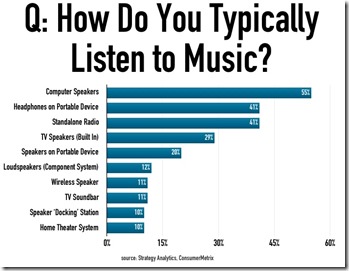
“Headphones connected to a portable device followed with 41% of respondents, alongside stand-alone radio, also with 41%. Surprisingly, TV speakers were also highly-ranked, with 29% ticking that box.”
While nothing about this information is surprising, that doesn’t keep it from being depressing. More out of habit and curiosity these days, I still read Mix Magazine, TapeOp, Recording, ProSoundWeb, and Pro Sound News. I’m mostly entertained by the seriousness audio “engineers” (an oxymoron if there ever was one) take their degraded “craft.” Almost by reflex, when I read an interview with some kid who has decided he’s the next incarnation of Tom Dowd (No, he won’t have the slightest idea who Tom Dowd was.) I chase down a few examples of the music he refers to as examples of his work. Invariably (Yes, I do know what that word means.), it will be some awful sounding collection of distortion, overused effects, trite synthesizers, and horribly recorded drums.
The critical feedback loop between musicians and their vanishing customers has been wreaked by “portable devices” and the delusional pipedream that some whackos have that high resolution audio will change any of that is nuts. I suppose I should be happy with the resurgence of vinyl, since you can’t get that shit on to a cell phone? If you know me, you know I think going back to vinyl is about as silly as abandoning cars for horses. It’s not the vinyl that matters, it’s the amplification and speaker systems, dumbasses.

My mother had convinced him to buy an RCA console system, but he decided that took up too much room and it ended up in the basement, too. It really was pretty awful, but slightly better sounding than my Webcor. 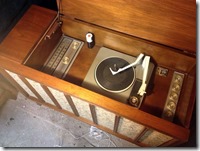
By then, I had long since graduated to component stereo equipment, then band sound systems, and, finally, recording studio equipment for my home audio system. Our living room system (aka “Home Theater System”) is still a decent receiver and a pair of JBL studio monitors. The down side to that is that, if I bother to listen at all carefully, it’s pretty obvious that Pandora broadcasts in a mediocre MP3 format. Usually, I’m not that focused on the music coming from the living room when I’m working in the kitchen. When I am actually critically listening, I listen to CDs. I’ll put CD quality over vinyl any day.
Too often, when someone under 30 wants to show me some music it will be demonstrated on a cell phone speaker. I have no idea what I’m supposed to get from that experience. I can usually pick out the melody and determine if it is a male or female lead voice. That’s about all I’m willing to invest in that miserable fidelity source, though, which is often disappointing to the person trying to impress me.
To be truthful, if you are a cell phone user I have to suspect you don’t care about fidelity in any form. While I haven’t had a fixed-line telephone for quite a few years, our primary telephone looks a lot like a fixed-line system. Our phone service is provided through our high-speed ISP and an Ooma Tele. The sound quality was a substantial step-up from the fixed-line system provided by Qwest and, later, Comcast in our Twin Cities home. I can, in a few moments, tell if a caller is on a cellphone because the quality is miserable. Always. My guess is if you can tolerate that level of distortion in a voice conversation you aren’t that discerning in any aspect of audio. So, while I’m not surprised that music is being listened to on actual speakers by an audience of 12%-and-shrinking I’m also not impressed by your musical tastes. Your opinion of audio quality is just going to make me laugh, so don’t waste either of our time.
Monday, March 7, 2016
How Quality Feedback Really Works
A while back, I was arguing with one of my MNSCU instructors about why he needed to get over his fear of lead-free solder and move his instruction program into this century. During this “discussion,” mentioned that the electrical assembly portion of almost every electric guitar I’ve ever disassembled has been an embarrassment. From the major factories to the boutique builders, the soldering, component placement and security, and wiring have been . . . sad. Likewise, many of the guitars (and other audio products) I’ve repaired in my career have failed because of soldering defects. His response was, “Don’t you think one of my long term customers would have complained if my soldering failed?”
My short answer was, “No.”
This isn’t the first time I’ve written about this discussion, but it keeps coming back to haunt me. There is an old 5/5/5 restaurant rule that says something like “It takes $5 in advertising to get a new customer to try a business, 5 seconds of poor service to drive them away, and $5,000 in advertising to get them back again.” It’s a fact. I may be the Geezer with A Grudge, but I’m not the only person on the planet with a long memory or who would rather just move along than wrestle with convincing a company that I’d experienced poor service or had an unsatisfactory experience with their products.
A couple of days after our discussion, I remembered my last relationship with a luthier, back in the late 1970’s in Lincoln, Nebraska. For almost a decade, I’d fallen into the habit of buying guitars and, if I planned on keeping the instrument for any time, I hauled it to Lincoln and had my luthier setup the guitar at $150-250 per instrument. That seems like a lot for the time, but I was buying guitars idiotically cheaply from stoners and starving artists and had the margin to spare with most of my purchases.
Sometime in the early 80’s I brought in an old Gibson Explorer that clearly needed fretwork and a trussrod adjustment. The luthier had a couple of new employees, but I assumed that since I was an old customer my instrument would be serviced by the owner. I was wrong and the setup was awful. I lived about 75 miles from Lincoln and, while my studio was in Lincoln and I was in town for 2-3 days every weekend, I bought a book and made the corrections to the setup myself. Not only did I not complain to the store owner, I never brought in another instrument again and when my own customers asked where I’d have guitar work done I sent them to a shop in Omaha. I didn’t really know the shop in Omaha all that well, but I felt like I knew the Lincoln shop too well.
So, again my answer is “no.” I do not think the average customer, long-term or not, will bother to complain about lousy service. They’ll just move on unless you have set up some really clever system to almost require them to let you know how they felt about your product or service.

All I can say to that response is "Wow!" No wonder my experience with MNSCU's programs (from the UofM to Inver Hills to Southeast Tech) has been so marginal. It sounds like a system totally driven by teacher union contracts and management disregard with no system for maintaining quality-of-program or delivery performance considerations. There is no such thing as a feedback-free system that provides any sort of quality control.
Now I really feel like I'm officially in the Midwest, the home of the most mediocre educational experiences I suffered in my 30+ years as a student. It does explain the proliferation of for-profit schools here, though. Apparently, the solution is for the student senate to recommend RateMyProfessors.com and give up on the school administration doing any sort of job.
Subscribe to:
Posts (Atom)