Showing posts with label audiophile. Show all posts

Sunday, April 2, 2023

Placing Bets

The music/audiophile equipment business has been selling snake oil to a gullible portion of the public for at least since Emile Berliner began making 5-inch “gramophone” recordings of chamber orchestras. Connectors and conductors are one of the biggest scams perpetrated on the gullible and wealthy “customers.” Lots of people have spent more energy than I on dispelling the myths and bullshit and I think this paper does it as well as anyone, Mission Engineering’s “Measuring Guitar Cables.” I’ve also spent some energy in my past career and more recent articles on some of this stuff, but I’d old, tired, and more amused than outraged these days. In fact, for the most part I’m now totally on the side of the con artists. The past 40 years of watching the incredibly stupid folks who call the rest of us “libtards” has convinced me that there is nothing unethical about scalping people who want to be scalped.

A few nights ago, I was hanging out with a couple of local musicians and one of them began to explain why his $250 guitar cable was better than a regular cable. He is an electrician, by trade, and I’ve found that those guys are typically strong on the NEC and weak on electrical theory and this guy was no exception. He first started off by tossing out a word, “hysteresis,” that he clearly did not understand as some kind of quality connected to electrical conductors. Then, he went on to try and tag the “skin effect” to how he imagined that his new, grossly over-priced cable could make a passive electric bass guitar sound like one of his active instruments.

Pause here while I explain why I am not rich: I am slow-witted. When people say stuff that either blows me away with insight or astounds me in their stupidity I am equally stumped for an unacceptably long time. Sometimes days will pass before I come up with a relevant question or a snappy comeback. As disappointing as I am in print, I am way slower and dumber in person.

A day later, I realized I could have made some serious money that night. I am not a gambling man (at least not with my money), but this wasn’t a gamble. The next time this comes up in conversation I hope to be ready to bet $1,000 that I can easily setup a test that will prove this dude can’t tell the difference from a $10 Chinese-made cord and his grossly over-priced spread. All it will take is an agreement on what would be “proof” in the test (at least a 75% success rate), a blindfold, a pen and paper, a quiet unbiased witness or two, the two test cables, an instrument (especially a bass), an amplifier, and a dozen cable-swaps and about 15 minutes and I’ll be $1,000 richer.

In case you care, the ONLY things that matter in guitar cables are reliability and shielding quality. Reliability is directly connected to the size and quality of the connectors, the ability of the inner conductors to “slip” inside the outer sheath (either with slippery insulation materials or paper/plastic wrapping), and the care the manufacturer takes in assembly. Most shielding, either braided or double-wrapped, provides 100% shielding and, contrary to your high school football coach’s bullshit, 100% is as good as it gets. Avoid aluminum foil shielding because it will become noisy when it is flexed. Long cables are less reliable and more likely to become noisy. Noise is a relative thing with guitars, though. Since they are unbalanced and high impedance, your pickups are likely to be a bigger noise issue than your cables.

Monday, November 5, 2018

Technology Is Gonna Do What?

The telephone has been around almost 150 years, since 1870. By 1879, telephone service subscribers began to be identified by their phone numbers, not by their names and by 1918 a million telephones were in service just in the USA. In 1962, Telestar, the first communications satellite was launched. In 1973, the beginning of the end of telephone communications arrived when Martin Cooper developed the first handheld mobile telephone. The first analog cell phone system went into service in Japan in 1979. In the 1990’s, cell phones began the switch to digital and there are hundreds of millions of people now frustrated by the awful sound of low-fidelity (at best an 8bit/8kHz sample rate, 200-3.2kHz bandwidth, 64kbs data compression) digital cell phone conversations and miscommunication created by lousy digital connections.

In fact, according to an Atlantic Magazine article "Don't Hate the Phone Call, Hate the Phone" a whole generation, Millennials, have been diagnosed with a “kind of telephoniphobia” regarding voice telephone communications. Now that half of Americans under 35 use cell phones exclusively, “the intrinsic unreliability of the cellular network has become internalized as a property of telephony.” It isn’t. It’s a property of fuckin’ cell phones and I absolutely hate the damn things. I hate getting calls from people on their cell phones. I hate calling people who I know will answer my call on their cell phone. Between the distortion, the Auto-Tune-like Mr. Roboto voices, and the forced long pauses while we try to determine if there is still a usable connection (on their side) I just assume that at least 3/4 of the things that were said were misunderstood or not heard at all.

I have stopped listening to audio fidelity complaints from people who tolerate cell phones. This is not an anti-digital rant. I love digital data storage and have been perfectly happy with digital audio for music since the early 1980’s. However, the fact that cell phone users don’t even insist on full duplex communications capability from their crap-stick phone providers is evidence enough to me that they are not serious audiophiles of any sort. If you don’t know the difference between half and full duplex, I particularly like this comment and response for an answer: “GSM operates in duplex (separate frequencies for transmit and receive), the mobile station does not transmit and receive at the same time. That's called half-duplex. It's done to save bandwidth and battery power, and to make cell phone conversations more difficult.” While I’m sure the real reason cell phone providers don’t deliver full duplex is because it would be technically slightly more demanding and marginally more expensive, I’m entertained by the assumption that “it's done to . . . make cell phone conversations more difficult.” No matter why it’s done, it sure as hell makes conversations more difficult, less convenient, less entertaining, less personal, and less pleasant.

This afternoon, I tried to have a conversation with my brother who lives in Phoenix and this statement from that Atlantic Magazine article on why people hate phone calls rang true, “On the infrastructural level, mobile phones operate on cellular networks, which route calls between between transceivers distributed across a service area. These networks are wireless, obviously, which means that signal strength, traffic, and interference can make calls difficult or impossible. Together, these factors have made phone calls synonymous with unreliability. Failures to connect, weak signals that staccato sentences into bursts of signal and silence, and the frequency of dropped calls all help us find excuses not to initiate or accept a phone call.”

It’s not just “weak signals” that are the problem. Grossly misnamed “communications companies” have jammed so much data into so little bandwidth that signal strength is just one of many factors that creates an incoherent telephone call. My brother, for example, said he had “five bars” of signal strength, but our conversation was mostly a collection of Mr. Roboto vocoder noises, weird electronic bird song tweeting and screeches, and long pauses where neither of us were able to get anything across the satellite signal path. After a bit, we gave up and went back to email to carry on our “conversation.”  A few moments later, my daughter called. We both have “land line” phone systems; hers is provided by her telephone company and mine is through the internet and an Ooma Telo system. We had a pleasant 1/2 hour conversation; with each of us laughing at the other’s jokes and stories made even more personal by being able to hear the laughter while we continued the stories. No weird noises, no Auto-Tuned Kayne West sound effects, no forced pauses waiting for the phone system to reboot itself and reconnect us; just a normal telephone conversation. The kind we used to have every time we picked up a telephone that was wired to the fuckin’ wall; 75 years ago.

The fact that the quality of telephone data transmission is lousy allows cell phone manufacturers to dumb-down the whole signal path. The microphones, the “speaker,” and the analog electronics connecting those transducers to the crappy data transmission system are all degraded. Why connected a decent micro-condenser microphone to an 8bit/8kHz sample rate, 200-3.2kHz bandwidth, 64kbs data compression system? It doesn’t make sense to waste a decent transducer on a crappy ADC system. Likewise, at the receiving end why connect a half-decent speaker to a low-fidelity DAC? So, they don’t. You clearly don’t notice or care. Some of you low-life weirdoes even listen to music on your phone, out of that godawful speaker!

Cell phones have rendered over-the-wire conversations pointless and painful. They are helping us all grow apart. “Can you hear me now?” is not a question of coverage and hasn’t been for at least a decade. Now, it’s a question of did you understand that simple question through the hash of garbled transmission, Star Bores sound effects, and cut-out segments of the phrase? I’ve said this before, “I can, in a few moments, tell if a caller is on a cellphone because the quality is miserable. Always. My guess is if you can tolerate that level of distortion in a voice conversation you aren’t that discerning in any aspect of audio. So, while I’m not surprised that music is being listened to on actual speakers by an audience of 12%-and-shrinking I’m also not impressed by your musical tastes. Your opinion of audio quality is just going to make me laugh, so don’t waste either of our time.” It’s still true, but now I also don’t think you care much about communicating with your fellow human beings.

Wednesday, July 18, 2018

Cool Snarky Puppy Stuff

In case I haven't made this clear, Snarky Puppy is my current favorite recording act. Someday, I hope to see them live and I really hope to make them my favorite live act. These are just a few of my favorite performances from this amazing band. At the least, listen to these pieces with decent headphones. SP goes to incredible lengths to produce high fidelity recordings. They deserve the respect of a decent reproduction system, at the least.

Tuesday, June 12, 2018

Bullshit Arguments

A TapeOp Magazine opinion piece recently presented the dumbest anti-ABX argument I’ve heard to date; and I’ve heard a lot of really stupid arguments against ABX comparisons. Allen Farmelo's article title pretty much says it all, “The Problem with A-B'ing and Why Neil Young is Right about Sound Quality.” Because I’m a nice guy and it’s early in the morning, I’m not going to spend any time whacking away at the fact that there are so many old, deaf, mediocre rockers who imagine they possess golden ears. Neil Young, probably the single most prolific creator of awful sounding records in human history, is close to the last guy on the planet who should be promoting high resolution audio. Nuts, I went there anyway. So much for being a nice quy. 

However, the bullshit argument here is, “. . . we hear people talk about how one can't make out the difference between a hi-res MP3 and a 24bit WAV file (assumedly a difference similar to the one Neil Young feels is worth fighting for).  Admittedly a hi-res MP3 and a 24bit WAV are relatively close enough in resolution that many people will not be able to pick them out in an A-B test.

“But, we don't live with music like that.  If your'e [sic] anything like me, you listen to a lot of music in a lot of styles and - over the course of, say, a month - perhaps you've absorbed well over a hundred listening hours across many different albums on a few different playback systems.”

It gets better.

To “prove” his point, he uses what he imagines to be an analogy, “For example, when I started living with my partner I introduced her to what I call ‘good coffee.’  At first she kind of shrugged it off as my snobbery at work, and she couldn't really taste the difference.  But then, after months of drinking the good stuff, she found herself to be a bit of a coffee snob, too.  She could taste the difference because she had, simply, spent time with the good stuff.  The coffee revealed itself to her, slowly and subtly.  Her palate developed.  And the thing about good coffee is that it holds more detail, nuance and, therefore, interest.

“But it takes a while to become aware of that depth and complexity.  Had she done a flip-flip-flip A-B and made her choice to only drink the cheaper stuff because, ‘you know, they're basically the same,’ she'd have missed an opportunity to develop her palate.”

Farmelo is avoiding the simple test that would at least prove his coffee snob argument; now that she has developed “her palate” can she tell the difference when she does a “flip-flip-flip A-B?” If she can’t, you’re still full of shit. Likewise, way back in 2004 the Boston Audio Society performed a simple, repeatable ABX test of ancient 44.1kHz/16-bit technology and a 96kHz/24-bit source and, so far, no high-res audio equipment or recording professional or company has found a way to prove this test was incomplete or inaccurate. Humans love their delusions. One of the most inane arguments I’ve heard from an “audio professional” was the statement “I know what I know and I hear what I hear.” Totally incomplete. Doofus should have said, “I know what I think and I know what I think I hear.” It’s a useless statement, but accurate. 

There are a lot of reasons why I don’t take the fruitcakes and goofballs who call themselves “audio engineers” seriously, but this terror of reality and the limitations of their own hearing is high on the list. No, I don’t take sanitation engineers seriously either; they are just old fashioned, hard-working garbage men (or women).

Tuesday, June 20, 2017

Telephones or High Fidelity

Written 6/20/2017

Sitting in the Chicago Amtrak station, surrounded by incomprehensible public address messages, OSHA-defying damaging noise levels from vehicles, police and Amtrak walky-talkies, people talking and shouting, and other machinery and equipment, I’m contemplating the death of the concept of high fidelity. While the bullshit end of the professional and audiophile audio industry are pretending to provide some sort of improved value from vinyl and high-def audio, 99+% of the public could not care less. It’s obvious in their everyday lives. The best evidence that a person doesn’t care about sound quality is the persistence of cellular telephones in their lives. Bandwidth-wise, a cell phone is about five generations down from 1950’s AM radio quality and not much better than an old Edison cylinder recording system. But that doesn’t seem to bother anyone. Except me, anyway.

I have friends who will speculate for hours on the fidelity difference between a half-dozen decent capacitor microphones and will carry on this conversation over a communications system that would make Patrick Stewart sound like Donald Duck. Asking for a repeat of a phrase a half-dozen times because the phone garbled that information into nonsense doesn’t bother them at all, but they pretend they can discern a 1dB difference between two microphones into a high quality preamplifier and recording system. I don’t buy it. If garbage in, garbage out doesn’t bother you on a daily basis, opining about one form of nearly perfect reproduction over another is pure self-delusion.

Fine tuned senses don’t work that way. Use ‘em or lose ‘em. Be picky (rightly) everywhere or be adult enough to admit you just don’t care.

Years ago, I changed our home telephone to a DSL-connected system from Ooma, on the advice of an engineer with whom I worked at the time and a small business man who was simply trying to save money. Immediately, I heard a dramatic improvement in sound quality over the hard line system we had previously from Comcast. Still, when I talk to many business tech or customer service or sales people, I’m impressed with how clear the audio quality is. When I get a call from an individual or, worse, a phone solicitor who is obviously on a cell phone, my first response is to hang up and see if they can call back on a better line. My second response is to downgrade my opinion of the person with whom I am having the conversation. Between the low fidelity, in the best moments, and the cut-outs, glitches, noises, and distortion during the worst, I am hard-pressed to imagine why anyone would consider a cell phone to be anything but an emergency communications device. Honestly, I’d be nervous about hoping to convey emergency information on a 911 call via cell phone, but if I’m lying in a ditch freezing to death or bleeding out, it’s probably the best I can hope for. If I’m home where I could be making the call from a decent telephone system, I can not imagine picking up a cell phone.

So, here’s my point. Pick one: your concern and obsession for high fidelity or your cell phone addiction. You can’t do both without making me laugh at your ridiculousness. If you can tolerate your cell phone, but whine about MP3 compression, you are only fooling yourself.

Tuesday, May 16, 2017

Why Bother?

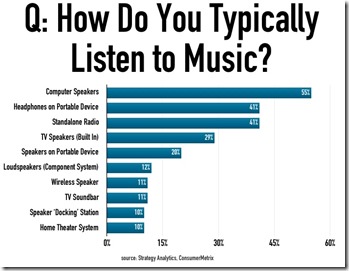
soundquality_study1If this isn’t a kick in the ears, I don’t know what is: “According to a survey conducted by Strategy Analytics, built-in computer speakers are now the most common way to listen to music, by a sizable margin.  In the study, laptop and desktop speakers overwhelmingly topped the list of frequently-used listening methods, with 55% picking the category.

“Headphones connected to a portable device followed with 41% of respondents, alongside stand-alone radio, also with 41%.  Surprisingly, TV speakers were also highly-ranked, with 29% ticking that box.”

While nothing about this information is surprising, that doesn’t keep it from being depressing. More out of habit and curiosity these days, I still read Mix Magazine, TapeOp, Recording, ProSoundWeb, and Pro Sound News. I’m mostly entertained by the seriousness audio “engineers” (an oxymoron if there ever was one) take their degraded “craft.” Almost by reflex, when I read an interview with some kid who has decided he’s the next incarnation of Tom Dowd (No, he won’t have the slightest idea who Tom Dowd was.) I chase down a few examples of the music he refers to as examples of his work. Invariably (Yes, I do know what that word means.), it will be some awful sounding collection of distortion, overused effects, trite synthesizers, and horribly recorded drums.

The critical feedback loop between musicians and their vanishing customers has been wreaked by “portable devices” and the delusional pipedream that some whackos have that high resolution audio will change any of that is nuts. I suppose I should be happy with the resurgence of vinyl, since you can’t get that shit on to a cell phone? If you know me, you know I think going back to vinyl is about as silly as abandoning cars for horses. It’s not the vinyl that matters, it’s the amplification and speaker systems, dumbasses.

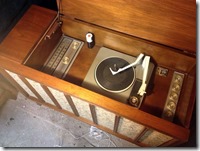
webcorThis has been a long time coming. This godawful Webcor record player is pretty much what I began listening to in my audio career, way back in 1959. My father bought it for the living room, decided he didn’t like the way it looked (ours was salmon “red”) and dumped it in the basement (where I lived).

My mother had convinced him to buy an RCA console system, but he decided that took up too much room and it ended up in the basement, too. It really was pretty awful, but slightly better sounding than my Webcor. rcasteroWhen he remarried, the RCA found its way back into the living room in their new home and it remained there until they downsized after all of the kids had left home.

By then, I had long since graduated to component stereo equipment, then band sound systems, and, finally, recording studio equipment for my home audio system. Our living room system (aka “Home Theater System”) is still a decent receiver and a pair of JBL studio monitors. The down side to that is that, if I bother to listen at all carefully, it’s pretty obvious that Pandora broadcasts in a mediocre MP3 format. Usually, I’m not that focused on the music coming from the living room when I’m working in the kitchen. When I am actually critically listening, I listen to CDs. I’ll put CD quality over vinyl any day.

Too often, when someone under 30 wants to show me some music it will be demonstrated on a cell phone speaker. I have no idea what I’m supposed to get from that experience. I can usually pick out the melody and determine if it is a male or female lead voice. That’s about all I’m willing to invest in that miserable fidelity source, though, which is often disappointing to the person trying to impress me.

To be truthful, if you are a cell phone user I have to suspect you don’t care about fidelity in any form. While I haven’t had a fixed-line telephone for quite a few years, our primary telephone looks a lot like a fixed-line system. Our phone service is provided through our high-speed ISP and an Ooma Tele. The sound quality was a substantial step-up from the fixed-line system provided by Qwest and, later, Comcast in our Twin Cities home. I can, in a few moments, tell if a caller is on a cellphone because the quality is miserable. Always. My guess is if you can tolerate that level of distortion in a voice conversation you aren’t that discerning in any aspect of audio. So, while I’m not surprised that music is being listened to on actual speakers by an audience of 12%-and-shrinking I’m also not impressed by your musical tastes. Your opinion of audio quality is just going to make me laugh, so don’t waste either of our time.

Monday, October 14, 2013

ARTICLE: How to select your stereo components

[Another Wirebender-only article.]

Don't buy by the "Buck Factor"

This can go either way. You can buy your equipment solely based on cost, low or high. If your budget is limited, you may get everything you want for the least possible cost, sacrificing quality, function, and your personal satisfaction. If your budget is unrestrained, you may buy your equipment based on snob appeal and be just as bored with your selections as the low budget buyer.

You don't necessarily get what you pay for, in quality. Obviously, you get the products you paid for, unless the dealer has some old Miniscribe employees in the shipping department and you get a box of bricks, but simply spend unlimited amounts of cash doesn't assure you of anything. Some low-to-mid cost products deliver as much sonic quality as the most expense pieces on the market.

"It ain't what you don't know that hurts you, it's what you do know that ain't right."

I really believe that some pieces of equipment can be picked by spec sheets: tuners, maybe power amplifiers, and probably turntables, for example. Again, it depends on what you listen to.

But some parts of your system have to be listened to. Especially speakers. Toss out what you have been told and listen. Use your ears, not your memory, in choosing equipment. Don't select these pieces on reviews, friends' advise,

To ABX or not to ABX

If you can't hear it, it isn't there. I firmly believe that. If you can't demonstrate a difference between the equipment you are evaluating, you are only fooling yourself. I know audiophiles don't care for this logic. Since so few people can pick out anything beyond the most gross differences using ABX tests, the gigantic price differences between top and bottom-end equipment is hard to justify. Unless you resort to mysticism and doubletalk, ie. The Holy Order of Audiophiles. A religion I am always entertained by, but have not been converted to.

Your listening material is as important as the equipment you listen to. This isn't a slam on the music, but if you listen to rap, metal, Musac, polkas, most music recorded with early fifties tape gear back to Edison's cylinder cutter, or the majority of popular genres you won't be able to tell a significant difference between a $500 Sony portable sound system and the most expensive system buyable. Hell, I know good musicians who are happy with their TV's sound system. If you aren't going to use it, don't buy it. Unless the snob appeal has some payback other than audible. Like maybe your banker is an audiophile and you want to impress him with your taste in equipment so that he will loan you money to build the Neil Bush Memorial Savings and Loan.

Which means most electronic equipment is created equal for most people.

Wednesday, August 14, 2013

Passion or Mastery?

I stumbled on an unusual book at the library this week and it has taken over my reading list until I wrap it up: Cal Newport’s So Good They Can’t Ignore You: Why Skills Trump Passion in the Quest for Work You Love. Having recently left teaching for a school that hyped the “follow your passion” delusion (The school’s demented marketing chant is “It's time to do what you love. Music is your life. You want a music school that connects you to the industry, to your inner voice, and to new worlds of possibility.”), this book struck more than a few chords with me, maybe a whole song worth.

While my institutional educational mandate was “turn half-interested hobbyists into professional recording engineers,” my personal goal was always to broaden the perspective of my students so they could see other opportunities for themselves. In case they discovered they weren’t going to be among the tiny percentage of folks destined to be rock stars or the slightly greater group employed as servants of rock stars (recording engineers), I hoped to put the bug of alternative career universes into their ears. Having watched Searching for Sugar Man last night, what I read this morning was even more relevant.

This search for meaningful work is a fairly modern human pursuit. For most of our million-something years,  our ancestors mostly struggled to live through the seasons. We white folks, in particular, had winter to contend with and the usual population die-off associated with that stark season with the occasional complete failure of spring-summer-fall due to climate catastrophes. If you were from one of the southern hemispheres, your mileage differed only in that you substituted vicious and insane plutocratic governments and a lot more warfaring to keep the populations under control. If winter didn’t kills us, we killed us and the search for meaning was reduced to searching for a safe, warm place for our families and friends. The industrial age and, later, more sane socialist governments, created the middle class and that led to people wanting work with meaning and job satisfaction. This is a BRAND NEW THING, so we aren’t good at it yet.

Most parents who spent their lives either as the idle rich children (with careers consisting of calling their money managers and asking “Am I still rich?”) of the robber barons or the lucky few who lived a significant portion of their lives during the tiny historic moment of middle class aspirations (asking themselves “How the hell did I luck into this life?”), understandably, have no idea how to guide their kids toward a meaningful, successful life. Being a parent has always been a hard, mostly thankless job, but with a rapidly evolving job market, economy, and technology it’s a lot harder. Academic marketing doesn’t help, either. With a butt-load of higher ed and bullshit vocational schools hustling the “you have to have a degree to get a job” garbage, it’s harder than it needs to be. Being hovering, genetically “old” parents adds more calories to the lard, too.

This is where So Good They Can’t Ignore You gets really valuable. The author’s three rules are #1 Don’t follow your passion, #2 Be so good they can’t ignore you, #3 Turn down a promotion, #4 Think small, act big. I am not going to summarize the big points, because there is a whole book that does that better than I can and really efficiently. Sticking with #1, the passion thing, a Canadian studio listed Canadian university students as picking “dance, hockey, skiing, reading, & swimming.” If that list doesn’t demonstrate how useless passions are as career guides, I have a list of bridges I’d like to see you. You are clearly dumb enough to buy all of them, if I price them right.

One of my personal rules for career planning is “Don’t become expert at something you hate. You’ll have to do it for the rest of your life.” It is kind of the polar opponent to Newport’s #2 and it flies in the face of the idea that we can become wonderfully skilled without passion for a career. Live with it. It’s possible and a problem if you are the kind of person who wants to do everything well.

Monday, May 20, 2013

Fair Comparisons

Years ago, I built a specialized test box for QSC Audio Products; an ABX tester. At the time, I thought that box was one of the coolest things I'd ever built and I used it as carelessly as any kid ever abused a toy. Because I didn't want any arguments about noise or distortion in the signal path, I used insanely expensive relays for the low signal switching mechanism and because they are make-before-break and mercury-whetted, switching "artifacts" were minimal unless the products under test had significant DC offset. The contacts themselves were gold-plated silver and the cases were hermetically sealed.

The high output relays were also silver contact, gold-plated but they were considerably less sophisticated, since they had to be able to withstand several amps of switching current with high power amplifiers. Later, the company produced a commercial version of the ABX tester for sales representative use and that product has received a lot of comment (mostly uninformed) on the internet:

A friend, Rob Schlette, did a well-informed article about some software based ABX testers for TheProAudioFiles.com ), Audio Perception and ABX Testing, a while back and that's a pretty good place to start your own thoughts about the subject.

A few of us--Jake Swanson (S&M Audio), Aaron Hodgson (McNally Smith Record Lab Manager), and I--recently revitalized the ABX tester for use at McNally Smith College of Music. I haven't had a chance to mess with the new unit, but I'm sure it will raise eyebrows and piss off "professionals" every bit as much as did the original QSC product.

Sunday, March 11, 2012

So Much Crazy, So Much Money, So Little Common Sense


I've kept the Mapleshade catalog in my junk mail pile for almost a year. I can't throw it away because it is such a perfect example of how nutty audiophiles can get. Statements like "Floor-mounting your amp on maple gives optimum performance. This approach sounds better than rack-mounting (even slightly better than on our SAMSON) because your amp won’t be sharing vibrations with other gear" are so full of insanity that it's hard to copy-and-paste it without throwing up a little in my mouth. 

You absolutely need to order this catalog to get the whole experience. Products like the maple-housed USB-to-S/PDIF connector are incomprehensible from an engineering perspective, but statements like "Our Amish woodworkers assemble a beautifully crafted (and ultra-low dielectric absorption) maple enclosure directly to the circuit board, thereby greatly stiffening the board while creating an ample sink for draining internal board vibrations. This maple enclosure avoids the sound-muddying effects of high dielectric absorption of the usual plastic enclosures-or, alternatively, the energy-robbing eddy currents that plague any metal enclosures (eddy currents are inevitably induced in any conductive wire or plate near signal circuitry)" explain it all. Really!

Now that I've bookmarked this nutty company in my blog, I can finally throw away the catalog. However, I will always miss the picture of a Mapleshade "recording session" in the back of the catalog. This photo will have to work as a substitute, because I can't stand looking at this book for one more minute.

Friday, February 5, 2010

MP3 Comparison Tests

All Rights Reserved © 2006 Thomas W. Day 

A while back, I read an editorial in Mix Magazine that claimed to “prove once and for all” that MP3 audio compression was low-fi. The author was a Mac user, so maybe he can’t be faulted for the many flaws in his test procedure, but be that as it may be, I read between his lines and found a few statements that I couldn’t believe. His procedure was incredibly flawed and rigged to make MP3 files test poorly, even if the file format and compression were perfect. His built-in bias was so strong that it was obvious how the test would turn out, even before the second sentence. This author claimed to hear a “robust difference signal,” proving that the MP3 format was defective and high distortion. 

I listen to MP3s, mostly in my car and I was suspicious of that “robust difference signal.” First, probably because of the limitations of his computer equipment and/or software, the author took an audio sample, inverted the phase of that sample, played the two (in-phase and out-of-phase together), and found that the resulting signal was the expected nothing. The result was a near-perfect cancellation, proving that the two samples were equal, with practically non-existent distortion. 

Here is where the example died a non-scientific death. The author converted the phase-inverted signal to an MP3 format and, because his software could only play AIFF wave files, converted the MP3 back to AIFF and ran the above test again. Back in my audio manufacturing employment history, I built an ABX test rig for my employer and did a ton of ABX testing on anyone I could con into submitting to the ABX protocol. Mostly, we learned what the audiologist discovered at the 1985 AES Convention in LA; that most people involved in professional audio are “functionally deaf” or, at least, “hearing impaired.” Instead of spending our time trying to figure out what subtle differences in equipment were audible, we discovered that drastic defects in the signal path went undetected by most of our listeners. I went so far as to install defective active components (ICs producing as much as 10% THD) into the signal path of otherwise identical pieces of equipment and found that an alarming number of audio professionals were unable to hear the difference in a reasonably good listening environment. On the other hand, one of my own employees was able to hear signal differences that my test equipment (which was Audio Precision’s finest of the time) barely identified as measurable (except for substantial very-low-frequency phase differences that I’m still hard-pressed to believe explained the listening test results). 

With that history behind me, I decided to replicate the magazine test myself, using a Windows-based software (Adobe Audition) which doesn’t have the limitation of only being able to play one file format simultaneously. This eliminates the multiple conversion errors from the author’s test and makes the test more of an apple-to-apple test. I picked three MP3 formats, 128Kbps, 192Kbps, and 320Kbps, constant bitrate, with CRC checksums and a pair of 44kHz, 16-bit CD recordings (“Afternoon” from Pat Metheny Group, Speaking of Now, and L’Adoration de la Terre from Telarc’s Cleveland Orchestra recording of the Stravinsky The Rite of Spring) for the test. I, first, copied a section of the music and made an inverse-phase mono copy of that section. In Audition’s Multitrack View, I inserted the two sections into a pair of tracks and compared the resulting signal; or lack of signal. 

Figure 1

The two WAV copies exactly cancelled, both according to my ears and Audition’s metering system. Figure 1 (from the Afternoon recording) displays a section of the original signal from the recording that I will use to display the results of the signal-canceling comparison tests. Figure 1 (on right): The original signal, with peaks approaching 0dB. I tried both Windows’ Media Player v9.0 and dBpowerAMP Music Converter™ for the creation of my MP3 files (all made from the reversed-phase WAV file with an already established signal accuracy). I believe I saw a very slight reduction in distortion using the 320Kbps Music Converter™ version of the Media Player output, so I created the rest of my MP3 samples using that program. I inserted the 3 MP3 inverse-phase signals into a 5 channel Multitrack file and listened to the resulting output, comparing each MP3 to the original in-phase WAV file. 

Figure 2

The first problem you will discover in performing this test is that the MP3 converters both added a short leader (approximately 50mS) to the files. Ignoring this anomaly produces the “robust” distortion difference signal that started this investigation for me. Time-aligning my files took some time, but produced a much more believable result from the comparisons. Figure 2 (on right): 128Kbps distortion result waveform The 128Kbps compression produced a tinny output, with a little low end and a sound quality that was obviously distortion components. The resulting distortion component waveform is pictured in Figure 2. 

Figure 3
Figure 4

At this point in the original recording, the peaks are touching 0dB, so the peak distortion output was approximately 25dB below the peak recording signal level. Figure 3 (left) and 4 (right) picture the results of repeating this test with the 192Kbps and 320Kbps MP3 samples. The distortion components of the 320Kbps compression sample are 33-36dB below the original signal. Those residual signal values roughly translate to 5% THD for 128Kbps, 3% THD, for 192Kbps, and around 1% THD for 320Kbps MP3 samples. I’ll agree that these are substantial distortion values, but “robust” is not how I’d describe the resultant signal and I question the ability of most professionals to clearly hear the difference signal in an ABX environment. After all, I’ve simulated much worse distortion components that appeared to have been inaudible. 

Regardless of my test results, I recommend that you try a similar test with material of your own choosing and in a controlled listening environment. Personally, I discount the results of any listening test that doesn’t live up to the rigor of the ABX protocol. You can believe any fantasy you like, though. Part of what makes working in audio so entertaining is the delusions under which we labor and the resulting, sometimes silly, products produced to cater to those illusions. I do, however, intensely suspect the opinions of someone who claims that consumer cassettes were musical and that MP3 reproduction systems are deficient in comparison. Compared to FM radio, a high resolution MP3 is practically pristine. Pop recordings are often so distorted that the minimal harmonic addition low-fi 64Kbps compression introduces can do no more harm to what’s left of the musical content. If we’re not going to complain about these traditional high distortion delivery systems, where is our credibility regarding new technology? Most analog consoles don’t produce 40dB cancellation artifacts when one channel is beat against another in producing the side component in a Mid-Side microphone signal. Analog tape recording systems are far from capable of producing this level of signal uniformity. Dis’ing our customers’ sonic standards, because they are listening to a technology that has an economic impact on our industry, is dishonest, unbelievable and ineffective. They know the MP3 files they listen to are higher fidelity than past and current commercially delivered formats and once they suspect the industry is lying about quality, what else do we have to offer?

Wirebender Audio Rants

Over the dozen years I taught audio engineering at Musictech College and McNally Smith College of Music, I accumulated a lot of material that might be useful to all sorts of budding audio techs and musicians. This site will include comments and questions about professional audio standards, practices, and equipment. I will add occasional product reviews with as many objective and irrational opinions as possible.