Wednesday, June 7, 2017

Because?

The explaination that I have disliked the most for 99% of my life is, “Because everyone else does it this way.” An adopted (from Bertrand Russell) mantra of my life has been, “The fact that an opinion has been widely held is no evidence whatever that it is not utterly absurd; indeed in view of the silliness of the majority of mankind, a widespread belief is more often likely to be foolish than sensible." I absolutely believe that statement: regarding subjects from technology to economics to politics to community/religion. I will always assume that “everyone else” is probably a moron, especially if the thing we’re talking about has any aspect of opinion involved. Often, it turns out that I’m wrong. Sometimes the reason people have done something the same way for a long time is that it is the most efficient, practical, easiest, and even effective way to do that thing. Sometimes I’m right and the reason people have been doing something the same way for a 1,000 years is because they are lazy, superstitious, ignorant, timid/conservative, and/or mentally challenged. With only one life to live and a limited amount of time, energy, and patience with which to live it, I am often uninspired to spend much effort worrying about why things “have always beend one this way.” That is not always (or even often) a strength, it’s just a thing, a personality glitch.

IMG_8123So, when it came time to design an electric guitar (a bass, in my case), I decided to blow off a lot of convention and explore my inner designer. Andf I learned a few things: some useful, some I could have spared myself by going with “conventional wiseom,” and some were outright surprises.

For example, I put a lot of thought and effort into creating the smallest body design possible and still retain “balance.” I started with thicker material than I expected to need and installed a 1/2” cap over the wiring routing holes, creating an instrument from which I expected to carve a lot from the back to create a slight “wrap-around” feel. As the body approached completion and the neck was finished enough to attach, I started fooling with finding the point where the strap pins could be installed to make the instrument hang in a neutral, balanced, position. To my mind, that sounded more comfortable than the body-heavy designs of most guitars.

2017-05-01 Bass (3)I was wrong. It turns out that a slight bias toward body-heavy is more comfortable, at least for my playing position. I tend to play with the instrument high and the neck much higher; probably due to short arms or some such handicapped characteristic.

It also turned out that the sculpting I intended to do was unnecessary. My body design conformed so well that additional wood-removal was pointless. It would, however, have been a good exercise. So, I might build another bass using the same general design but taking the body-shaping further.

I also blew off the trait most of my fellow students had for pickup selection. First, it’s a bass and, second, this instrument is one I built purely for my own enjoyment and playing. I’m not a particularly complicated bass player. I don’t solo, ever. I like being part of the rhythm section, in the background, just filling in the bottom. The pickup on my bass has a fairly simple task: provide as much fundamental as possible with as little noise as possible. I went for a Chinese knockoff of a Gibson humbucker design, primarily because the pickup came with individual coil wiring. When I received the pickup, I tested the two coils and found that one had slightly (10%) higher impedance and resistance. So, I unwrapped the coils and pulled wire off of that coil until it was very close to the other coil. I reassembled the pickup, soaking the winding in wax before retaping it, coated the pickup pocket and wiring channels in magnetic paint, and hooked up the pickup for series and parallel operation with a single DPDT switch. Add a volume control and a jack and that’s all I need; along with a mostly-midpoint pickup position. I never use the bridge pickup, so why install one?

You can see that my body shape is unconventional. It works beautifully, by the way. It is comfortable standing or sitting and the “handle” is a lot more useful than a horn.

Tuesday, June 6, 2017

“I Have Heard It with My Own Ears”

One of many reasons the music business is being left to the spoiled children of the 1% is that there is so much non-stop bullshit in the marketing of audio and audio equipment. This month’s Prosound News ProAudio Review, contains one of many hillarious reviews of a grossly overpriced four channel microphone preamplifier with minimal features, maginal function (only 55dB of gain) and more bullshit marketing words that translate to no information whatsoever: “punchy, fat, rich and full of character” for example. “As [Bret] Teegarden himself offers, ‘The biggest feature is, it doesn't have a boat-load of features. Nothing gets in the way of the sound!’"

“Key features of the Magic Pre 4100 include 55 dB of gain, Sifam VU meters, -20 dB pad (complete bypass in off position), and +48v phantom power (decoupling completely from the transformer).” In other words, it couldn’t have been easier to “design” this product because it doesn’t achieve a single difficult engineering task. In the magazine’s sidebar, “Why No Polarity Switch,” Teegarden describes his miraculous capability to hear the distortion introduced by the polarity switch, although he probably doesn’t know how many places that task could be accomplished where the switch would be at a point where the signal voltage is significant and where it’s introduction would only marginally complicate the design. “There are many electronic engineers out there who will debate this idea of switches affecting audio quality, but I have heard it with my own ears. So, they can argue aboput it all they want; they can buyikld the features into their preamps for marketing’s sake. . . “  Blah, blah, blah. This is the high cost of working in a field where money only exists if you inherited it. Rich kids marketing bullshit to other rich kids and, obviously, no one cares enough to verify any aspect of this product’s claims.

Our ears are the blunt tool of senses. I have long since abandoned any hope that anyone over 20 has hearing capabilities and Teegarden has been making pop recordings for “more than 35 years,” according to his own propaganda page. The cool thing about a nutty claim like this one is the only way to verify or debunk Teegarden’s claim would be with an ABX test (which he would surely fail), but he can always claim the tester switching masked the phase switch distortion.

I have one question for everyone who claims golden ear status, “Do use a cellphone or a hard line phone?” If you can tolerate the godawful quality of a cellphone transmission, it’s obvious to me that your demanding criteria for an electric guitar microphone preamp is a poor joke.

Thursday, June 1, 2017

Giving Up the Ghost

January 2017

A half-dozen years ago, during a 20-year long argument about practically everything in life, society, and our imaginations a good friend finished her email with “You are a natural born teacher chafing at the unnatural constraints & idiocy of the classroom.” Since, at the time I was seriously considering abandoning my teaching job and blowing off whatever demented thing in my head that makes me want to explore how people think and make decisions and intentionally avoid facing reality.

Oddly, I took what she’d said as sort of a compliment, even though I was convinced that teaching was a frustrating, painful, frustrating exercise in futility. Being in a classroom for 14 weeks was too often a demonstration of non-existence. Especially in the last couple of years, it felt (especially when I graded exams) that I’d been completely invisible. Looking at the experience logically, if I’d been talking about a subject, demonstrating concepts and principles, and supervising experiments about the subject for 14 weeks at at the end of that period of time the things I’d been attempting to teach were tested and many-to-most of the students’ answers were no more informed than if they’d shown up on test day as if it were the first day of class, it logically follows that I was either invisible and inaudible or non-existent altogether.

This week, I discovered this old and dear friend is dying and one of her tumors is causing her memory of our friendship to intermittently fail. So, in the end non-existence is my fate. One of the few people who recognized whatever it was that drove me to try and pass on hard-earned experience and whatever passes for knowledge I’ve aquired over the last 68 years is dying and that puts me one step closer to non-existence.

Sunday, May 28, 2017

Tuesday, May 23, 2017

Beards and Banjos

beNothing in Minnesota confuses and frustrates me more than The Current 89.3, our so-called local Public Radio pop music station. This week, as part of their never-ending fund drive, The Current is doing an incredibly irritating and enlightening run on its listeners’ “893 Essential Artists.” As a habit, l usually avoid this kind of demented shit because it is a constant reminder of how incredibly lame the average human being is. A quick look at #335 (Dwight Yoakam) and #337 (Neil Diamond) and the actual talent that fell far below these hillbillies and pop pablum peddlers explains the whole “Beards and Banjos” killer_asteroid_by_manuelberriosMillenial fuck fest. The incredibly lame Monkeys are at #338 and grocery store magazine rack icon Lyle Lovett is at #342! While the Faces are #359 and . . . aw, forget it. Humans are not worth saving. Bring on that planet killer asteroid.

Seriously. If Minnesota music dweebs are this lame, imagine how incredibly awful the degraded species is in the southeast!

Tuesday, May 16, 2017

Why Bother?

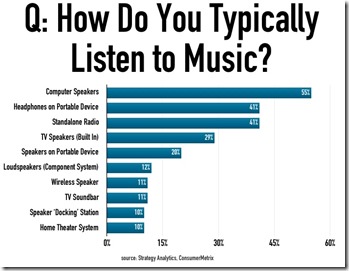
soundquality_study1If this isn’t a kick in the ears, I don’t know what is: “According to a survey conducted by Strategy Analytics, built-in computer speakers are now the most common way to listen to music, by a sizable margin.  In the study, laptop and desktop speakers overwhelmingly topped the list of frequently-used listening methods, with 55% picking the category.

“Headphones connected to a portable device followed with 41% of respondents, alongside stand-alone radio, also with 41%.  Surprisingly, TV speakers were also highly-ranked, with 29% ticking that box.”

While nothing about this information is surprising, that doesn’t keep it from being depressing. More out of habit and curiosity these days, I still read Mix Magazine, TapeOp, Recording, ProSoundWeb, and Pro Sound News. I’m mostly entertained by the seriousness audio “engineers” (an oxymoron if there ever was one) take their degraded “craft.” Almost by reflex, when I read an interview with some kid who has decided he’s the next incarnation of Tom Dowd (No, he won’t have the slightest idea who Tom Dowd was.) I chase down a few examples of the music he refers to as examples of his work. Invariably (Yes, I do know what that word means.), it will be some awful sounding collection of distortion, overused effects, trite synthesizers, and horribly recorded drums.

The critical feedback loop between musicians and their vanishing customers has been wreaked by “portable devices” and the delusional pipedream that some whackos have that high resolution audio will change any of that is nuts. I suppose I should be happy with the resurgence of vinyl, since you can’t get that shit on to a cell phone? If you know me, you know I think going back to vinyl is about as silly as abandoning cars for horses. It’s not the vinyl that matters, it’s the amplification and speaker systems, dumbasses.

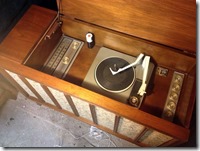
webcorThis has been a long time coming. This godawful Webcor record player is pretty much what I began listening to in my audio career, way back in 1959. My father bought it for the living room, decided he didn’t like the way it looked (ours was salmon “red”) and dumped it in the basement (where I lived).

My mother had convinced him to buy an RCA console system, but he decided that took up too much room and it ended up in the basement, too. It really was pretty awful, but slightly better sounding than my Webcor. rcasteroWhen he remarried, the RCA found its way back into the living room in their new home and it remained there until they downsized after all of the kids had left home.

By then, I had long since graduated to component stereo equipment, then band sound systems, and, finally, recording studio equipment for my home audio system. Our living room system (aka “Home Theater System”) is still a decent receiver and a pair of JBL studio monitors. The down side to that is that, if I bother to listen at all carefully, it’s pretty obvious that Pandora broadcasts in a mediocre MP3 format. Usually, I’m not that focused on the music coming from the living room when I’m working in the kitchen. When I am actually critically listening, I listen to CDs. I’ll put CD quality over vinyl any day.

Too often, when someone under 30 wants to show me some music it will be demonstrated on a cell phone speaker. I have no idea what I’m supposed to get from that experience. I can usually pick out the melody and determine if it is a male or female lead voice. That’s about all I’m willing to invest in that miserable fidelity source, though, which is often disappointing to the person trying to impress me.

To be truthful, if you are a cell phone user I have to suspect you don’t care about fidelity in any form. While I haven’t had a fixed-line telephone for quite a few years, our primary telephone looks a lot like a fixed-line system. Our phone service is provided through our high-speed ISP and an Ooma Tele. The sound quality was a substantial step-up from the fixed-line system provided by Qwest and, later, Comcast in our Twin Cities home. I can, in a few moments, tell if a caller is on a cellphone because the quality is miserable. Always. My guess is if you can tolerate that level of distortion in a voice conversation you aren’t that discerning in any aspect of audio. So, while I’m not surprised that music is being listened to on actual speakers by an audience of 12%-and-shrinking I’m also not impressed by your musical tastes. Your opinion of audio quality is just going to make me laugh, so don’t waste either of our time.

Monday, May 15, 2017

“But Everybody Does It This Way!”

\All my life, I’ve heard this argument as an excuse for continuing to do stupid stuff that doesn’t work. For half of my life, as much as I was confused by the disconnect between function and this argument I didn’t know why it didn’t seem to work in the real world I lived in. In the mid-1980’s, I took a Logic and Critical Thinking course from a brilliant instructor, Mike Scott, and learned about historical “irrational arguments,” which as it turned out were about the only sort of arguments I’d heard for most of my life having grown up in a religious family and community. One of the most startling (to me) of the beautiful list of irrationality was argumentum ad populum (Latin for "appeal to the people").

Early in my life, in 1956 when I was 8, I’d been exposed to the totally nutty propaganda regarding Elvis Presley, "50,000,000 Elvis Fans Can't Be Wrong." In fact, I was pretty sure by the time I was 10 years old, that all Elvis fans were idiots. Elvis vs. the Everly’s? Even Ricky Nelson? No contest. Later, when I got much further into music, specifically, jazz at the ripe old age of 13, I scored Elvis fans of all sorts as something less than sentient: or worse, they were emotional. As I began to think of myself as a musician (As irrational as that was, I know.) and broadened my listening palette to R&B and some classical music, the Beatles came along and blasted pretty much everything of any sort of complexity off of the AM radio band. Of course, that lowered my opinion of “everybody” to something a few notches below farm animals.

Over the course of my career, the “everybody does it this way” explanation has regularly been applied to all sorts of stupid things. Live sound system setup, for example. “Everybody” seems to think the hot sequence of events for a large or small scale sound system is to waste time getting everybody happy with the monitor system, then turn on the Front of House (FOH). One of my favorite moments in Crazy Heart came 47:28 into the movie. Jeff’s character stops the rehearsal and tells the FOH jackass, “I need kick and snare, turn down the damn guitars, you’re drownin’ out the lyrics.”

The sound jackass says, “The mix is good man. You can’t hear what I’m hearin’ out here.”
Jeff’s guy says, “Yeah, you’d be surprised. Do it the way I tell ya and leave it.”

Asshole says, “The mix is just fine, man. Trust me on this.”

Jeff says, “No. I’m an old man. I get grumpy. You heard me.” And aside, mostly to himself says, “Damn sound man. The try to fuck up the opening act. . . ” And you should listen to the rest of the conversation. Jeff became my hero in that movie.

The way 99.99…% of shows are mixed wouldn’t pass for a first attempt right out of high school for a recording engineer. A big part of the problem is that the kiddies and functionally-deaf assholes who pass for “sound men” think the monitor system is more critical than the FOH system, so they setup monitors first and there is no coming back from that fatal move.

messy drumnsAnother “everybody does it this way” audio disaster happens almost constantly on drums. In a deluded and functionally-ignorant attempt at “control,” most live and recording engineers decorate drum kits with more microphones than an actual recording engineer would use on a 90 piece orchestra. Or course, the recording is a disaster in so many ways you’d think it would be obvious, but the general mess is usually “fixed” with gates and compression and, too often, substitution with individual drum sounds recorded by sample recordists. Recording history is full of great drum recordings with as few as one mic and as “many” as three, counting the kick mic. The usual pile of microphones, like the example at left, creates a collection of phase and tonal problems that result.

A few weeks ago, I had the opportunity to record a variety of live performances at the local theater. Because we still haven’t managed to find the time to get the overly complicated and bureaucratic DiGiCo drivers to work with any recording program, I was stuck using my six channel Zoom H6 recorder for more than a dozen different acts from folk singers to a 22-piece horn section with a rhythm section. Did I mention, only six channels?

simple drumsI would be left with only one channel to dedicate to the occasional drum kit and rarely more than two on most of the acts. One of my favorite techniques is often referred to the Glyn Johns’ technique. Another excellent tactic is to place an X-Y pair behind the drummer’s head, simulating the “mix” the drummer is creating for himself. Sometimes a kick mic is useful, but for really excellent drummers I often end up barely using it or not at all. So, with only one channel to spare I put a single condenser in that position. The end result even surprised me. With only a little EQ, mostly a low end bump, the end result was a good full drum kit sound with excellent (considering the stage volume) isolation. Obviously, this tactic puts the “control” of the drum mix in the hands of the drummer. Less obviously, I think that is a good thing. I have generally found that good drummers have a better idea of what their playing sound sound like than 99-something-percent of recordists, including myself.

Wednesday, May 10, 2017

Organization? We Don’t Need No Stinkin’ Organization

I have a pair of Electro-Voice RE-18’s in the shop that need, I hope, minor repair. The RE-18 was one of the best handheld vocal microphones ever made by anyone in audio history. That’s my opinion and I’m sticking with it because I’ve owned about a dozen of these amazing tools and everyone has been terrific. Every vocalist I’ve taught to use the RE-18 has taken to the microphone like it was a revelation. Every FOH engineer I’ve convinced to try the RE-18 has fallen in love with the mics. Obviously, the RE-18 was doomed to failure in an industry where the SM58 is considered “good enough” when it is obviously barely competent as a talkback mic or a taxi company dispatcher’s desk mike.

When I wrote EV’s misnamed “Technical Services” about obtaining repair parts for the RE-18, the response was, “Unfortunately, we no longer have parts or service to support this series." Although this was a very good mic it was discontinued around 1990.” I, of course, knew all of that except for the non-existent parts supply and EV’s arbitrary decision to discontinue their lifetime warranty, “Also, these microphones are guaranteed without time limit against malfunction in the acoustic system due to defects in workmanship and material.” [Words taken right from the RE-18’s Product Manual.] That warranty was one of the reasons EV was able to ask a premium price on all of the RE Series microphones: $350 back when an SM58 had a street price of $75. Bosch, a German company, has no clue how to deal with customer service, manage quality, or produce a competent product: a typical condition for German companies. Nothing new here. If a German company didn’t totally hose up customer service functions, I’d be suspecting someone else actually owned the company.

EV does, however, still make and sell the RE-16. Many of the RE-16;s parts are identical or close enough for practical purposes. After going around via email with the “we no longer have parts or service” Tech Service guy, I called Tech Services today. Same song and dance, except this guy knew he didn’t know much and really, really wanted to transfer me to “Parts.” Usually, I have had to go through Tech Service to get part numbers and/or assembly drawings. At EV/Bosch, Tech Service has none of that. In fact, I have to wonder what technical services Tech Services can provide without actual product information at hand.

Lucky for me, the woman who answered the parts call was, essentially, an actual Tech Services technician. We quickly identified the parts I wanted to buy, she priced them, she told me when I’d receive those parts (about 14 days), and took my order.

ev-re20-service-manual-coverAll of this hassle could have been easily resolved with a simple parts manual/service data sheet, like the one that is well-distributed and easily found for the RE-20. The fact that this information doesn’t seem to be even in-house at EV/Bosch is disturbing. A lot of companies seem to think manufacturing or service information is “proprietary” information. That philosophy is excessively customer-hostile and leads the company down a path of becoming known for lowered capabilities and lowered expectations from customers turns into lower performance. That results in lower price points because customers assume the company’s products are poor quality, poorly designed, poorly supported, and incompetently represented at all ends of the product chain. That is certainly what has happened to EV over the last 40 years. From a well-known, often used microphone supplier and technical resource in the early days through the 70’s, EV has slowly become a second tier company, mostly known for cheap knock-off microphones and with no real presence in the condenser market at all. In fact, the RE-20 is probably the company’s only well known, well respected microphone. That seems like a pretty serious problem.

Friday, May 5, 2017

Gratitude Is Dead?

In 1971, I was about to be a new dad, had an incredibly demanding but low paying tech job, and was stranded in one of the planet’s armpits, Hereford, Texas; where when the world gets an enema, that’s the place the tube goes. I needed money and there weren’t a lot of options for decent payinjg 2nd jobs in that place at that time. So, I talked to a couple of Amarillo music stores and my local store and began a music equipment/instrument repair service. Fairly quickly, I learned two things: 1) music stores rarely pay their bills and 2) musicians are even less likely to pay bills. No surprise, right? It was for 23 year old me, right out of tech school and at one of the many “I’m outta here (music)” points in my life.

The truth is that it isn’t fair to imply that ALL musicians didn’t pay their repair bills. In fact, I became a regular stop for the many Mexican bands in the area and they paid their bills like clockwork. Country Western dicks, on the other hand, were reliably unreliable. They were gods of “if you let me take my amp today, I’ll gladly pay you on Saturday after the gig.” Not once did that ever happen. There weren’t many rock bands in 1970’s west Texas, but the ones that were there were only slightly less bogus than the C&W assholes. Most of the rock guys were high school kids, so I should probably cut them some slack but I was barely out of high school and I had a family to support. So fuck ‘em.

Lucky for me, I was on a mailing list from Don Lancaster, the future author of The Incredible Secret Money Machine, and his newsletter taught me some of the things that would be key to my businesses for the rest of my life. Rule #1: “Know the difference between cold cash, j-dollars, and megabucks.” “j-dollars” are the engineering business term for imaginary money. The rule for megabucks is “the odds of you ever getting one red cent are invariably much lower than you think.” Those rules stuck with me, especially after two years of wrestling with musicians and music stores for the money they owed me. The cap on that money in my business career came after I had a spare room filled from floor to ceiling with repaired equipment that had yet to be paid for and I was about to leave Texas for a new job in central Nebraska. I posted a notice in the local paper and sent post cards to the customers who had given me legitimate addresses warning them that I would be selling all of the customer equipment in my shop for the repair bills. Of course, everyone thought I was bluffing and one weekend I emptied the spare room and the following Monday we were on the road north.

paisleyOff and on over the next forty years I ran a variety of service businesses out of my home, studio, and or office. In four decades, I wrote off about a little more than $1500 in bad debts over several hundred thousand billed and collected. (One hint to the right to the source of one of those bad debts.) Lancaster’s rules became pretty much kneejerk for me, including “Doing something stupid once is just plain dumb. Doing it often is a philosophy.” Not only did I not get screwed out of a payment twice by anyone, but even if I eventually got paid after a protected hassle I did not bother testing those waters twice. Several name studios from L.A. to Denver to Minnesota discovered that I always had enough paying customers to be able to refuse work from the non-paying types: including an ex-employer. More than once, I heard the whine, “Don’t hold a grudge, Tom. This time will be different.” Thanks, but fuck you. Nobody is famous enough to con me into working for free. Although a few of the most famous people I’ve worked with were also the most reliable and generous customers I’ve ever experienced.

When I canned the acoustic consulting and the audio equipment repair businesses, an energetic, personable, and talented young man caught much of what I was tossing off. He gave me a lot of crap for bitching about how little I liked working for musicians and how much I hated the billing hassle. Less than six months later, he quit the work too, saying, “I can’t believe it took you so long to quit doing that shit.” I know what you are saying, kid.

As much of a hardass as all that makes me sound, the fact is that I have done shitloads of work that I’d have rather avoided. Repair works is rarely fun and often miserable. I used to tell my studio maintenance students, “Get used to being wrong a lot if you want to do repair work. If you are really good, you’ll be right one our of ten times.” That is not as much fun as it sounds. Along with busted stuff and lousy designs kicking my ass for 40 years, a lot of the work I did was just grunt work: equipment installation, studio wiring, CAD/CAM programming, debugging other engineers’ designs, and politics. Most of it was better than a sharp stick in the eye and some of it paid better than being a slave, but if I could have been a rock star or a trust fund baby I’d have picked those options in a heart beat.

Now that I’m retired, I’m doing all sorts of bullshit work around our house, volunteering to run sound, recording music, helping with construction or design projects, and some of the silly crap I’ve done my whole life that probably deserves the label “hobbies.” My general rule for considering a project, today, is “If I like it, I’ll do it for free. If I don’t, you can’t afford me.” That offends some people. They think I’m being an asshole for not working cheap, now that I have the spare time, especially since I do some work for free and it all looks the same to them. Learning how to say “no” took me most of my life and it still makes me very uncomfortable. However, that’s what I’m saying more often than not these days and I’m getting better at it. The day I don’t feel compelled to explain why I don’t want to record your awful music, run sound for your awful sounding cover band, make you a guitar, fix your computer, guitar amp or home stereo equipment, build you a wall or a fence just like the one I just built for my wife, help you roof your house, or whatever, will be the day I am officially comfortably retired. Until then, I’m still practicing with the “no word” and if it looks unnatural on me, it is.

Wirebender Audio Rants

Over the dozen years I taught audio engineering at Musictech College and McNally Smith College of Music, I accumulated a lot of material that might be useful to all sorts of budding audio techs and musicians. This site will include comments and questions about professional audio standards, practices, and equipment. I will add occasional product reviews with as many objective and irrational opinions as possible.