Showing posts with label software. Show all posts

Monday, September 19, 2022

Product Review: Positive Grid Spark Mini

Silly me, I thought the Positive Grid Spark Mini was a fairly new product, but my resident guitar repair guru and guy-who-will-try-to-fix-anything about town, Brian Stewart (Tree Strings Music), has already repaired one in his Red Wing shop. I haven’t yet heard what the fault was in that unit. I ordered a white one from Amazon, thinking it might be a fun practice and outdoor jamming amp. I’ve had it about a week and, sadly, the fun is wearing off fast. The good and bad news is that almost everything about this amp is driven by a phone/tablet app, iPhone or Android. The good is that it has hidden power if you’re willing to climb the usual steep software learning curve. The bad is, like most apps, it’s glitchy, unpredictable and often counter-intuitive, almost completely inflexible, and very dumbed-down while pretending to be a product for the sophisticated, discriminating guitarist (the ultimate oxymoron?). A lot of the positive reviews you will find for this amp begin with something like “I’m new to guitar and have only been playing about a few months . . .” It’s easy to like or even love something if you don’t have anything to compare it to. In my case, it’s hard for me to look at any product with the eyes of a newbie. So prepare to be disappointed if you’re hoping for that kind of bubbly, happy-talk review. At 74 and after 50 years in various areas of pro audio and music, there is nothing new about me except for the crap that keeps popping up every time I have a doctor’s appointment. Having spent 20-some years in test and reliability engineering I tend to find more things wrong with software than right.


You can’t beat the Mini’s physical controls for simplicity. On the top of the amp chassis, you get 4-position Preset switch (Rhythm, Lead, Solo, and Custom), a Guitar volume, a Music volume control (Bluetooth or Aux In signals), and a guitar input. The back of the chassis has 3.175mm (aka 1/8”) Line Out and Aux Input jacks, a USB-C port for charging the battery and (sometime in the future) a functioning digital audio interface), a Bluetooth “Pair” switch (the Pair switch also fires up a rudimentary guitar tuner), and a power switch. The amp comes with a cute leatherette strap and a pair of buttons to attach the strap on the side. The amp is a 10W Class-D unit that, supposedly produces 90dBSPL at 1m. The cabinet has two 2” speakers and a bottom-facing passive radiator. The 3Ah battery supposedly provides power for 8 hours (on mid-to-low power output) and charges from empty to full in 3 hours. The firmware contains “33 Amp Models, 43 Effects, (Noise Gate, Compressor, Distortion, Modulation/EQ, Delay, Reverb – fixed in that order) and the USB interface is a 44kHz/16 bit A/D. You also get a a free download of PreSonus Studio One Prime recording software with your original purchase. Registering for your software is the closest thing to registering for warranty with Positive Grid. You can buy (for $110) a Spark Control footswitch to either control the presets, turn on and off various virtual pedals, or a combination of those functions. The amp is 146.5 x 123 x 165 mm (5.76 x 4.84 x 6.49 in) and weighs 1.5 kg (3.3 lb).

As usual, the included paper “Quick Start Guide” is close to useless. Not so typically, Positive Grid hasn’t provided much in the way of useful information on their website, YouTube, or anywhere else. Figuring out the app and the various features of the amp that are only accessed through the app is up to the buyer.

For a beginning guitarist who doesn’t know any other musicians, some of the Mini’s app features are probably fun-to-useful. This “screenshot” is really a compilation of three different screens as typically displayed on a phone.Positive Grid Spark mobile app The middle one is an example of a dumbed-down imitation of a fairly common DAW guitar pedal screen; like the one in Logic Pro. A big difference between the DAW pedal boards and the Spark is that you can’t reshuffle the order of the pedals to suit your purposes.

After spending considerable time playing with the various pedals I can say “they work.” The compressors in the Comp/Wah section aren’t up to DAW standards, but they are probably as good as most hardware pedals. The “Wah” function, also included in this group, is “Temporarily Disabled.” As usual, I don’t like the distortion (Drive) pedals much, but I rarely do. About half of the Drive pedals are red-flagged, which means you’ll have to spend $20 or more to enable those pedals on your device. So it goes for the Amp models, too. Most of the red-flagged amp models are variations on the mediocre Marshall models. The Mod/EQ models are predictable and not bad. The Delays are ok, except for the absence of a multi-tap delay. The Reverbs are typically pretty good, since digital reverb plug-ins have been fairly well staked-out territory for at least 20 years. I didn’t find a favorite from the verbs, but I didn’t find anything I hated either.

Irritatingly, with my Samsung tablet and the Samsung Music player, anytime I open the Spark app the music player starts playing something from my current playlist through the Spark Mini. Before you start babbling about some “play on Bluetooth connection” toggle in the player, get a grip on yourself. No other Bluetooth device that I own has this behavior: from consumer buds to Shure in-ears to three different Bluetooth speaker systems. It is a glitch in the Spark app and that has been logged by Positive Grid’s customer service and I wasn’t the first to make the complaint. If everything else was excellent this wouldn’t be a deal-breaker, just unpredictably irritating. (If it does this when I first open up the app, will it spontaneously do the same during a gig?) Yes, I could turn off the Music volume, but if I am using it as a backing track at the time it sort of defeats the purpose of that function.

With that out of the way, my impression of the guitar amp is somewhat positive. I’m not fond of electric guitar distortion in the usual buzz-box fashion, but some of the amp models deliver decent slightly over-driven sounds with the kind of amp EQ and tone you’d expect from what I’m guessing are the amps being modeled. Some of the setups both by other users and Positive Grid are fair-to-decent. I had some high hopes for Pat Metheny style sounds, but the lack of multi-tap delays squashed that. You could just add a pedal delay up front but that would defeat my purpose. I have an old MacBook Pro with MainStage that will do everything this unit does with a ton more effects including my multi-tap delay that I’d rather use with a small wired power speaker than add a pedal that is almost as big as this amp.

And speaking of power, I wouldn’t be surprised if the Mini an produce 10W, but the distortion at that output would be objectionable. That goes for the spec’d 90dBSPL@1m acoustic output, too. At any volume over a moderately loud voice or a strummed full-size acoustic guitar, the bottom end of this amp clips indecently. It is not a pleasant distortion, either. It is the usual splatting sound of digital clipping. That was the straw that broke the back of my interest in the Positive Grid Spark Mini. There were moments when I thought I was about to find the sweet spot for several of the Presets but “almost there” was as close as I got to something useful. When the amp sounded good, it was too quiet to compete with a couple of acoustic guitars. When it was loud enough to cut through a small instrument crowd, it sounded awful.

For a beginning practice amp the Spark Mini isn’t bad. Most beginners, however, will have a terrible time with the mediocre application software that is an absolute necessity for using the amp. Advanced users will be frustrated with the user-hostile programming of the app and disappointed with the little amp’s small performance.

Wednesday, March 31, 2021

Product Review: TC Helicon Play Acoustic

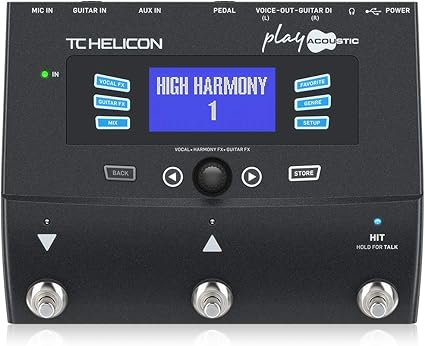
Amazon.com: TC Helicon Play Acoustic Vocal Effects Processor: Musical  InstrumentsThe TC Helicon "Play Acoustic combines all the things you need to make a live acoustic performance shine: lavish vocal sounds, perfect backing harmonies, best-selling guitar effects, and unique processing that makes your six-string sing – in perfect harmony with your voice." Sounds pretty amazing, doesn’t it? Some of those claims are even true, if only somewhat useable. Four years ago, I wrestled with the decision for a vocal and acoustic guitar performance rig I’d be using most often in jam sessions, local open mics, and recording.

After a lifetime as a techie, I wanted to work on other skills, mostly vocal and guitar performance. With that in mind, a big part of what I was looking for was ease of use because I didn’t want to be wasting my time fooling with bells and whistles when want I wanted to work on was my performance chops. Four years ago, I decided on the TC Helicon Perform-VG for its simplicity and versatility, knowing that the Perform series of products were all downscaled versions of the Play Acoustic, Play Electric, and VoiceLive devices. With the Perform-VG, I have many of the Play Acoustic features without much of the flexibility. That is the downside. The upside is that I was up and running almost instantly with the VG and wasted most of an afternoon trying to figure out how to adjust a vocal compressor and set the harmonies for the Play Acoustic.

TC Helicon Play Acoustic on OhGuitar.comA critical look at the back connector panel of the Play Acoustic illustrates two critical flaws of the Play Acoustic: 1) no guitar thru connector, 2) no vocal out signal path (both guitar and voice are stereo mixed to the two XLR output connectors. There is an “AUX” input, for bringing in external analog audio, a “Pedal” connector for either the Switch3 or Switch6 function selection foot switches, an 1/8” stereo headphone jack, and a mini-USB connector that supposedly supports "Stereo audio input and output via USB is also supported at 16 bit resolution with 44.1 or 48 kHz sample rate." I wrote “supposedly” regarding that USB recording function because there are mountains of reports on-line of users giving up on the Play Acoustic’s digital recording capability due to lousy driver support. That wasn’t going to be something I would care about, so it had no real effect on my opinion or this review.
As the YouTube research demonstrated, TC Helicon’s harmonizer is terrific and the Play Acoustic has an powerful and well-designed collection of harmony, chorus, reverb, and other effects for the voice channel. Many of the effects come from TC Electronic’s wonderful array of professional recording plugins and special effects devices. Only a portion of the Play Acoustic’s vocal harmony capability is available on the Perform-VG. The Perform-VG can, however, separate the vocal output from the guitar for both live performance mixing and recording purposes. I can’t even imagine what went through the designers’ heads when they decided that capability wasn’t necessary for the Play Acoustic.

TC Helicon | Product | VOICESUPPORT 2

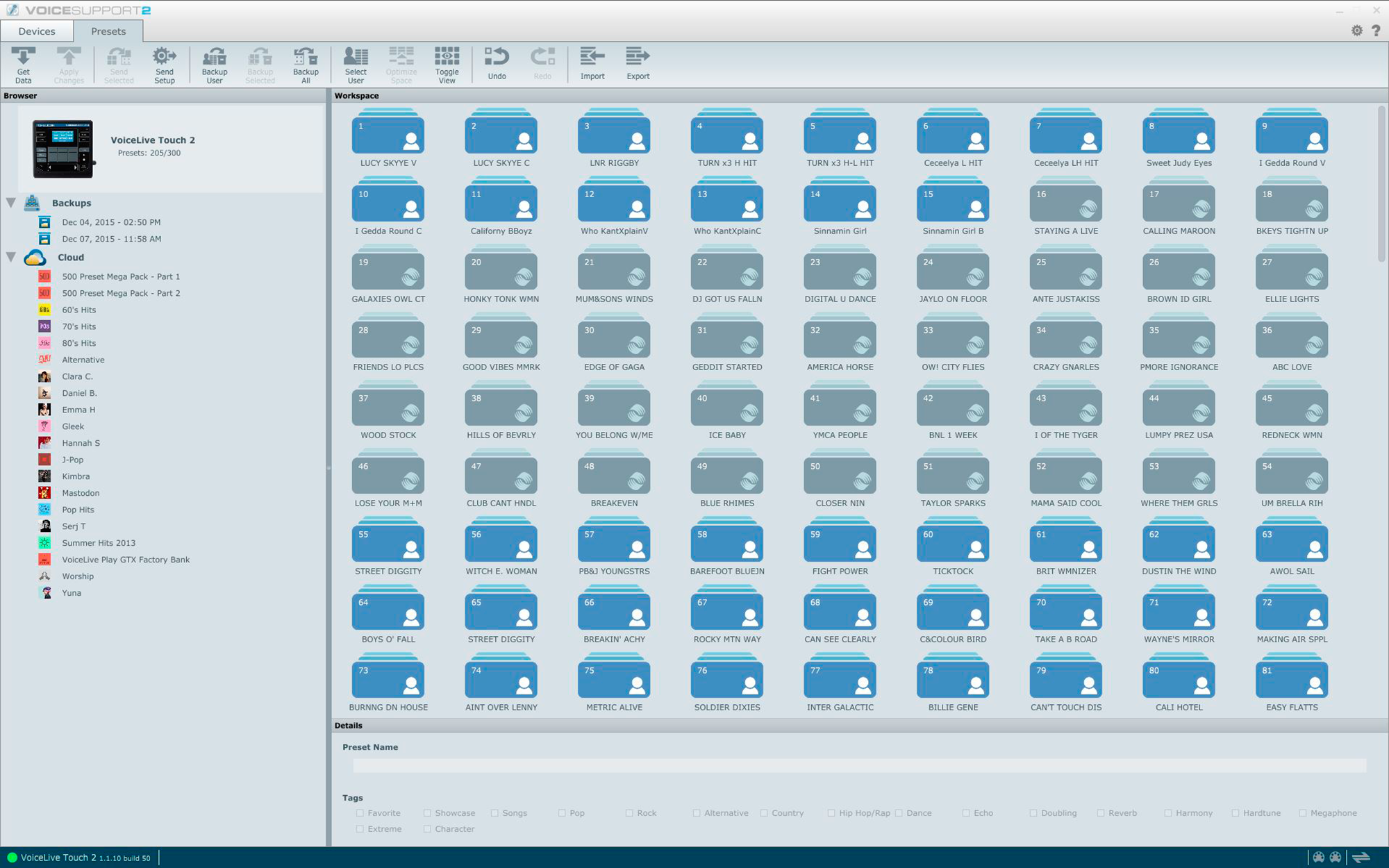
I’m not much for spending time wrestling with layered menus, either on my cars or my electronic devices. I really hate throwback software; been there, lived that. We are in an age of powerful, user-intuitive and friendly software and there is no excuse for any piece of digital electronic hardware forcing users to program a device through a crappy interface. That is exactly what you will have to do with the Play Acoustic, though. This incredibly ancient looking (and performing) piece of software is TC Helicon’s VoiceSupport 2 software as it looks on both Mac and Windows 10 machines. The software is pretty much Windows Explorer or Apple Finder for a few TC Helicon products. For the rest, this is nothing more than the overly complicated, under-performing interface TC Helicon uses to deliver firmware updates. You can reorganize your patches, you can download patches from TC Helicon’s cloud, but you can not edit anything usful with VoiceSupport 2. None of this should be surprising, though. TC Helicon/Electronic was acquired by Behringer in 2015 and it is safe to assume nothing innovative will come from the TC products in the future. Behringer is as notorious as was Norlin for taking gold and smelting it into oxidized lead.

So, for me, as powerful and interesting as the Play Acoustic is, it just isn’t worth the programming hassle. I messed with it for a day and sent it back to Sweetwater. For now, I’m fine with my Perform-VG until Zoom, Line6, Yamaha, Roland/Boss, or some other competent company comes up with a significant improvement. If you like fiddling with firmware more than playing, the Play Acoustic might be exactly what you are looking for, though. It has a lot of features, sounds great, and is a durable package (except for the notoriously fragile scroll wheel) that could give years of service. Of course, you’ll spend half of those years trying to tweek the thing into something you like using.

Tuesday, April 17, 2018

Getting Off of the Bandwagon

Mix Magazine has always been a marketing tool for the equipment industry. Rarely, the magazine actually prints an article that is of some use to a recording tech. Constantly, the pages are filled with pseudo-reviews that are barely more (or not more at all) than reprints of the product’s advertising literature. I’m not just picking on Mix, because that has been the industry standard since Recording Engineer/Producer died.

The Mix Studio Blog: article, “To Subscribe, Or Not To Subscribe” is a typical bullshit Mix faux-informational article promoting, while trying to pretend it isn’t, Pro Tools’ subscription policies. The author pads his pr work with broad statements like:

  • "Subscriptions also make it possible for developers to give customers access to a broader range of products for the money than is feasible through the purchase model."
  • "it takes a mental adjustment to stop thinking of your software as something you own, like your microphones or audio interface, and to consider it a service that you pay for. Some advocates of subscriptions respond to that concern by saying that you never really owned your software, anyway, you just licensed it."
  • "Imagine if the company that makes your DAW goes belly up and your software ceases to function."
  • "Actually, there's already one DAW developer that has a de facto subscription-only policy. Although it allows you to choose between a perpetual license or a subscription, those who choose the former also have to pony up for an ‘upgrade plan’ to get any updates (even maintenance ones)."
  • "Outside of the music space, some pretty major software titles, such as Microsoft Word and the Adobe Creative Suite are available on a subscription-only basis (I'm writing this column on a subscription version of Word, because I don't have a choice), and it could be that it's just a matter of time before that's the case with a lot of music production software, as well."

In 2004, I wrote “Who Would That Inconvenience?” In that article I wrote, "Software manufacturers estimate that they've 'lost' somewhere between two hundred million to a billion-zillion dollars due to software bootlegging. According to their estimates, everyone on the planet would have purchased their products if they hadn't had access to illegal versions. Some of us would, surely, have bought those products several times if legal channels were the only way we could obtain software. protools HDSoftware companies have moved from vaporware to vapor markets. Their hallucinations of wealth and power have infected the magazines with whom they advertise, too." Like Mix Magazine. I also said, “That's a great business, if you can find it.  Build a crappy, unreliable product and follow that up by charging your customers extra for ‘supporting’ your mistakes.  That is the next step beyond planned obsolescence, assuming that your customers don't revolt.” You’d think, that revolution would have happened when Avid started charging $300/year for their “subscription model” or $2,500 for the HD software-only purchase plan that does not provide you support or even a good price on the next version Avid releases, just to piss off non-subscription software owner.

In “Gotta Have It” I wrote, “People did perfectly professional work on Sound Tools, the first 4-track version of Pro Tools, and the first serious multi-track version of Pro Tools (2.0) that produced the first Grammy winner for Digi. Marketing squirrels can yak about why we ‘need’ whatever crap they're pedaling, but the fact is we don't. We've had all the tools we need to record good audio, digitally, for at least a decade.” We need Avid, Apple, Steinberg, etc less today than in 2012 when I wrote that essay. Software updates may be the single best argument for disbelieving the whole supply and demand delusion. Software that is doing every job necessary perfectly well suddenly becomes unusable because a new, unproven, probably buggy version of that same piece of code is available? Nonsense.

Today, I’m doing fine with my 2007 MacBook Pro and 2006 Mac Pro tower machines, both running OS X 10.7.5. My Win7 machine is a 2007 Dell Latitude. All three machines run Pro Tools 10, the Dell a little more reliably than the MacBook Pro. Both Macs also run Logic 9, Mainstage, Soundtrack Pro, and Waveburner flawlessly. I have done dozens of video projects on the Mac Pro running Final Cut Studio. I’ve seen the newest versions of Pro Tools, Logic, and Final Cut and I can’t find a reason to “need” them. Logic X, in particular, is really cool looking and I can imagine using many of the new features, once I struggled through the learning curve on another weird, counter-intuitive Apple interface. But, as usual, Apple would require me to buy new machines, use the latest OS, along with the learning curves for those formidable obstacles. For what? Honestly, just thinking about the hassle of all that makes me want to quit messing with software at all.

As for that wimpy, irritating “I'm writing this column on a subscription version of Word, because I don't have a choice” whine, grow the fuck up and grow a pair while you are at it. “Don’t have a choice” my ass. You can do what ever you want as long as you are smart enough not to fall for the “I need to be state-of-the-art” fallacy. For example, I know quite a few highly functional people who are still doing fine running Office 2003, 2007, or 2010. In fact, I run 2003 on my Windows machines and 2011 on my MacBook Pro. If I “upgrade” to anything, it will be Office 2010 for the Win7 machines. Microsoft says Win7 and Office 2010 will be maintained at least until 2020. So, I don’t have any motivation to go newer until at least 2020.

There is no chance that I will ever become a software subscriber. Worst case, I’ll be using Open Source software for everything after my current equipment and OS becomes really obsolete. By then, Open Source software may very well be superior to the expensive brands. The newest version of Audacity is currently very competitive with the version of Pro Tools I am running and it is cross-platform friendly with many versions of OS X, Windows, and Linux and it uses practically every format of plug-in on all platforms. As for a subscription for Office, forgetaboutit. Never gonna happen. I already use Open Office almost as much as Office and it is also cross-platform compatible.

Monday, November 4, 2013

ARTICLE: Who Would That Inconvenience?

[Clearly, in 2004 I was in a prolific self-publishing mode. I didn’t even try to find a home for some of these articles, as strongly as I felt then or now about their relevance.]

You can't read an entertainment or computer magazine without running into an article or ad about how much "damage" is being done to the nation's creativity by "intellectual rights theft."  The game manufacturers are, apparently, going broke because so many people are "stealing" game software.  The music industry execs are all living in cardboard boxes in New York and LA's back alleys because nobody is buying music, we're all stealing it through MP3s online.  And those poor, poor software designers are working nights at SuperAmerica to support their creativity because everyone is bootlegging software.  Billy Gates has sold his mansions and lives in a Seattle commune with 35 other desperate, but dedicated-to-their-art, Microsoft employees.  Congress and the international community needs to "do something" to protect these poor, starving, and productive folks before these vital industries are starved into non-existence.

Or not. 

I think not.  For instance, the music industry thinks nothing of "giving away" it's product on the radio.  Radio stations "give" us more of the music industry's product than most of us want to hear.  Sure, they're selling ads and using the music as a loss-leader to attract listeners, but they have worked overtime to own the broadcast business so that they have easy access to free distribution of their god-awful products.  How that is different than the distribution of these same products through websites is too indistinct for my sensitivities.  I'll admit that I'm not particularly sensitive to the needs of overstuffed executives and their desperate desire to own everything from natural resources to original thought.  But I do believe that if you give away your product in one venue, you've given up the right to be able to protect it in another.  The Supreme Court thought the same way when they prevented record companies from limiting the use of cassette recorders, 30 years ago. 

But my real reason for writing this article is to address the pitiful condition of software companies.  In our industry, bootlegged software is as common as guitar picks.  At the tech school where I sometimes teach, I hear about the use of "illegal" versions of every program from ProTools to Sonar to Logic to $50 plug-ins and $10 sampled loop CDs.  Everything you might ever want to own is available, for free, in a bootleg version.  Acquaintances who aren't even involved in the music business have copies of programs that I couldn't justify buying if I didn't need to eat regularly. 

Software manufacturers estimate that they've "lost" somewhere between two hundred million to a billion-zillion dollars due to software bootlegging.  According to their estimates, everyone on the planet would have purchased their products if they hadn't had access to illegal versions.  Some of us would, surely, have bought those products several times if legal channels were the only way we could obtain software.  Software companies have moved from vaporware to vapor markets.  Their hallucinations of wealth and power have infected the magazines with whom they advertise, too.

I beg to disagree.  In fact, I'd bet that the opposite of their argument is true.  I'd argue that if bootleg "test" software wasn't available, most of us wouldn't bother with computers at all.  The computer industry has made that a fact by its inability to build reliable, quality products.  The business tells us that bootleg software is unreliable and to obtain reliability we should pay for the software and pay again for the minimal "customer support" provided by the manufacturers.  Experiences tells us that the words "unreliable" and "software" are inseparable.  It doesn't matter if you pay for software or if you steal it, it's going to be unstable, undependable, buggy, and a constant irritant.  And you're going to have to pay, over and over again, for future versions that "fix" a few problems and create a lot more. 

That's a great business, if you can find it.  Build a crappy, unreliable product and follow that up by charging your customers extra for "supporting" your mistakes.  That is the next step beyond planned obsolescence, assuming that your customers don't revolt.

Basing a home studio around bootleg software is a risky business, because putting any faith in software is an act of unfounded faith.  The products are, simply, buggy as a Tijuana hotel bed.  Software crashes, we reboot, software crashes again, this time rebooting for us, and we pay more money in the foolish hope that, this time, the code will be more reliable.  The more features we get, the less reliable the software becomes.  It's an endless, unproductive closed-loop.  Many users are honestly "test driving" software by using hacked versions.  On the rare occasion that a piece of software is actually useful, many users turn from test drivers to legitimate owners.  I see it happen with students all the time. 

Occasionally, a company screws up and releases a version of software that crashes less often than its competition.  When that happens, many users end their search for improvement and get back to doing productive work.  A few months ago, I read a business computer article about a large number of businesses who are still using Microsoft's Windows for Workgroups, version 3.11, and the associated version of Office, because it did the job that needed doing.  Those of us who migrated to Windows 95, 98, 2000, ME, and XP often think that the few functioning features we've gained haven't repaid the investment in retraining, debugging, and the reliability problems we've suffered in transition. 

What would happen if every computer user decided to quit chasing the holy grail of the newest, coolest version of software and found something that worked reasonable well and stuck with it?  There are a fair number of analog studios out there who have gone back (or stayed) to 20 year old technology and spend their time tweaking reliable and functional technology and making music.  Computer recordists could do the same thing.  Quality work was done on almost every version of almost every program.  We could have all quit looking for something new at any time in the last decade or two. 

Of course, that would break the software company income chain.  If every software company in the industry went broke and vanished tomorrow, who would that inconvenience?  If we all were forced to use the products we're using today for the next fifty years, would we stop recording music?  If today's software glitches and crashes became a constant, known, and never-ending irritant, would that make a lick of difference to people currently using that software?  You know it wouldn't.

If the state of the art never moved an inch from its current status, we'd still be doing what we're doing today.  We'd be recording music, burning CDs, cutting vinyl, posting MP3s to websites, and looking for the next cool music.  The profits or losses of software companies means nothing to the flow of music.  We have the tools we need and a hell of a lot of tools that nobody needs.  Software companies have their problems and we have ours and the two have nothing to do with each other. 

Wirebender Audio Rants

Over the dozen years I taught audio engineering at Musictech College and McNally Smith College of Music, I accumulated a lot of material that might be useful to all sorts of budding audio techs and musicians. This site will include comments and questions about professional audio standards, practices, and equipment. I will add occasional product reviews with as many objective and irrational opinions as possible.