Showing posts with label acoustic instrument. Show all posts

Sunday, November 6, 2022

A Declining Market or Just Laziness?

dave'sAt the suggestion (to put it mildly) of a couple of friends, I finally visited Dave’s Guitar Shop in La Crosse, Wisconsin this past week. Weirdly, this small town near the border of Iowa and just across the Mississippi River from Minnesota is known as a “guitar mecca” to lots of guitar collectors. The store deserves that reputation, if for no other reason than not much else about La Crosse is likely to attract national attention. It’s a perfectly nice small city, but not much different from at least 10,000 other similar sized cities. Dave’s Guitar Shop, however, is quite a bit different from other guitar shops. For starters, there are hundreds of guitars and Dave’s is a premier Taylor and PRS dealer along with several other brands. That, alone, is pretty cool.

The reason it has been suggested that I “need to see” this store is that several of my musical friends think my fascination with my two Composite Acoustics carbon fiber guitars is “sick.” I live in a small Minnesota town with a lot of guitar freaks, many of the rich guys who don’t play much but have substantial guitar collections plus there is a community college here that specializes in teaching Guitar Repair and Construction; wood only, of course. One of my local friends died in late August and I helped his widow find homes for his guitar collection and assorted gear over the past couple of months. Even though three of those instruments were high end guitars, it didn’t occur to me that I should play them to see if I had any interest. Several years ago, he swapped a red Composite Acoustics Cargo for my black sunburst Cargo and that turned out to be his favorite guitar to the end of his life. He, still, thought I should own at least one wood acoustic guitar. I made one a few years ago, but gave it to my grandson.

Mrs. Day and I did not travel to La Crosse solely for the purpose of me looking at guitars. That was just a side-benefit of our trip, which was to look at migrating birds (who have yet to arrive in our area). We’re celebrating her 6th cancer-free year after successful treatment by the Mayo Clinic in 2016 and this trip was part of the celebration. After a 120 mile drive and a 2 hour medical exam, Mrs. Day was ready for a nap. I left her and the cat to relax in the hotel and I slipped off to play with guitars at Dave’s.

To be honest, I am not a motivated buyer; mostly just curious. I’d just read the last hard-copy Taylor in-house magazine and there were lots of “this guitar just spoke to me” comments from their many owners. I wondered if a guitar could speak to me or make me feel anything different than I already feel about my pair of carbon fiber acoustic guitars. Contrary to my friends’ opinion of my instruments, I’m pretty happy with them. They are definitely capable of more than I can do, they play easily and comfortably, are simple to maintain, and I like the way they look. So sue me.

https://s3-media2.fl.yelpcdn.com/bphoto/8j-RBwpuuAw9O3uPhBwcww/o.jpgFirst up, on a Wednesday afternoon, I was not surprised to see that The Gig Store, a live and studio sound equipment place (in the same building) and a drum shop next door to Dave’s, appeared to be closed indefinitely. The retail music business is in rough shape and it is likely to get rougher. Dave’s was open and full of guitars. The entrance is all electric stuff all the time, which was fun but not my reason for being there.

The acoustic guitar area is on the south side of the building, through a short and narrow hallway that could easily be mistaken for a shop area. There must have been 100s of acoustic guitars and I played a couple dozen of them. I was most attracted to the Eastman AC series, with a upper bout sound port and a chamfered edge, Eastman seemed to be at least making some effort to be different than the crowd. Feel-wise, though, all of the acoustic guitars I played had pretty much the same neck, body style and feel, general design, and other than variations on the appearance of the wood they might as well been the same guitar; for my purposes. I really wanted to grab a guitar by the neck and feel that comfortable, natural grip I have with my hot-rodded hand-carved Yamaha V-neck. I had wild hopes that someone would take a chance on doing something inventive with the most important part of any guitar.

Guitar necksBut, nope. Vintage Martins are a slight V-shape, but too slight for me. In fact, I had to move fairly quickly from a typical round guitar neck to a Martin to feel the guitar-neck-contoursdifference it is so slight. Somewhere between a “hard V” and this “medium V” is what I’m looking for. And there was nothing like that in Dave’s great big guitar store. Even the lone carbon fiber brand carried in that store, McPherson, totally wimps out on the neck shape. They don’t even list neck shape options on their custom build page. If I wanted one, I’d have to build it myself, but at this stage in my life I’m not sure I want one bad enough to mess with it.

The music business has undergone some huge changes, mostly for the worse, in the past couple of decades. What has been called “Moneyball-for-Everything” has done a lot of damage, if you’re interested in any sort of variety or creativity. Like every other area of US culture, the guitar is not the hip instrument it once was and the majority of folks buying (and collecting) guitars are old farts. Old farts are not looking for anything new, unusual, or even odd. They want a ‘55 Strat or Tele or a 40’s Martin or a 60’s Gibson and not much else. Companies not in that collector strata are making instruments similar enough to the old standbys that you can’t tell much difference between a 1950 Gibson or Martin and a 2022 Taylor or the rest of the crowd of wannabes. So, I did not find anything that tripped any sort of trigger or even interest in all of those fine instruments.

I did leave that shop wondering how I’d feel when I got home and played my own instruments and the next day I found out. I’m unreasonably satisfied with what I have.

Wednesday, March 31, 2021

Product Review: TC Helicon Play Acoustic

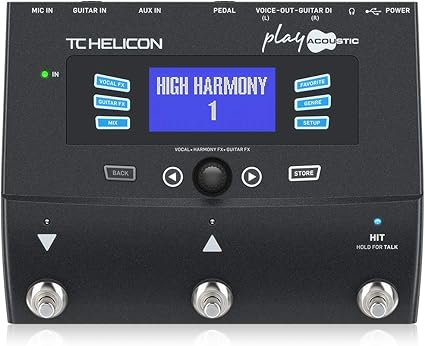
Amazon.com: TC Helicon Play Acoustic Vocal Effects Processor: Musical  InstrumentsThe TC Helicon "Play Acoustic combines all the things you need to make a live acoustic performance shine: lavish vocal sounds, perfect backing harmonies, best-selling guitar effects, and unique processing that makes your six-string sing – in perfect harmony with your voice." Sounds pretty amazing, doesn’t it? Some of those claims are even true, if only somewhat useable. Four years ago, I wrestled with the decision for a vocal and acoustic guitar performance rig I’d be using most often in jam sessions, local open mics, and recording.

After a lifetime as a techie, I wanted to work on other skills, mostly vocal and guitar performance. With that in mind, a big part of what I was looking for was ease of use because I didn’t want to be wasting my time fooling with bells and whistles when want I wanted to work on was my performance chops. Four years ago, I decided on the TC Helicon Perform-VG for its simplicity and versatility, knowing that the Perform series of products were all downscaled versions of the Play Acoustic, Play Electric, and VoiceLive devices. With the Perform-VG, I have many of the Play Acoustic features without much of the flexibility. That is the downside. The upside is that I was up and running almost instantly with the VG and wasted most of an afternoon trying to figure out how to adjust a vocal compressor and set the harmonies for the Play Acoustic.

TC Helicon Play Acoustic on OhGuitar.comA critical look at the back connector panel of the Play Acoustic illustrates two critical flaws of the Play Acoustic: 1) no guitar thru connector, 2) no vocal out signal path (both guitar and voice are stereo mixed to the two XLR output connectors. There is an “AUX” input, for bringing in external analog audio, a “Pedal” connector for either the Switch3 or Switch6 function selection foot switches, an 1/8” stereo headphone jack, and a mini-USB connector that supposedly supports "Stereo audio input and output via USB is also supported at 16 bit resolution with 44.1 or 48 kHz sample rate." I wrote “supposedly” regarding that USB recording function because there are mountains of reports on-line of users giving up on the Play Acoustic’s digital recording capability due to lousy driver support. That wasn’t going to be something I would care about, so it had no real effect on my opinion or this review.
As the YouTube research demonstrated, TC Helicon’s harmonizer is terrific and the Play Acoustic has an powerful and well-designed collection of harmony, chorus, reverb, and other effects for the voice channel. Many of the effects come from TC Electronic’s wonderful array of professional recording plugins and special effects devices. Only a portion of the Play Acoustic’s vocal harmony capability is available on the Perform-VG. The Perform-VG can, however, separate the vocal output from the guitar for both live performance mixing and recording purposes. I can’t even imagine what went through the designers’ heads when they decided that capability wasn’t necessary for the Play Acoustic.

TC Helicon | Product | VOICESUPPORT 2

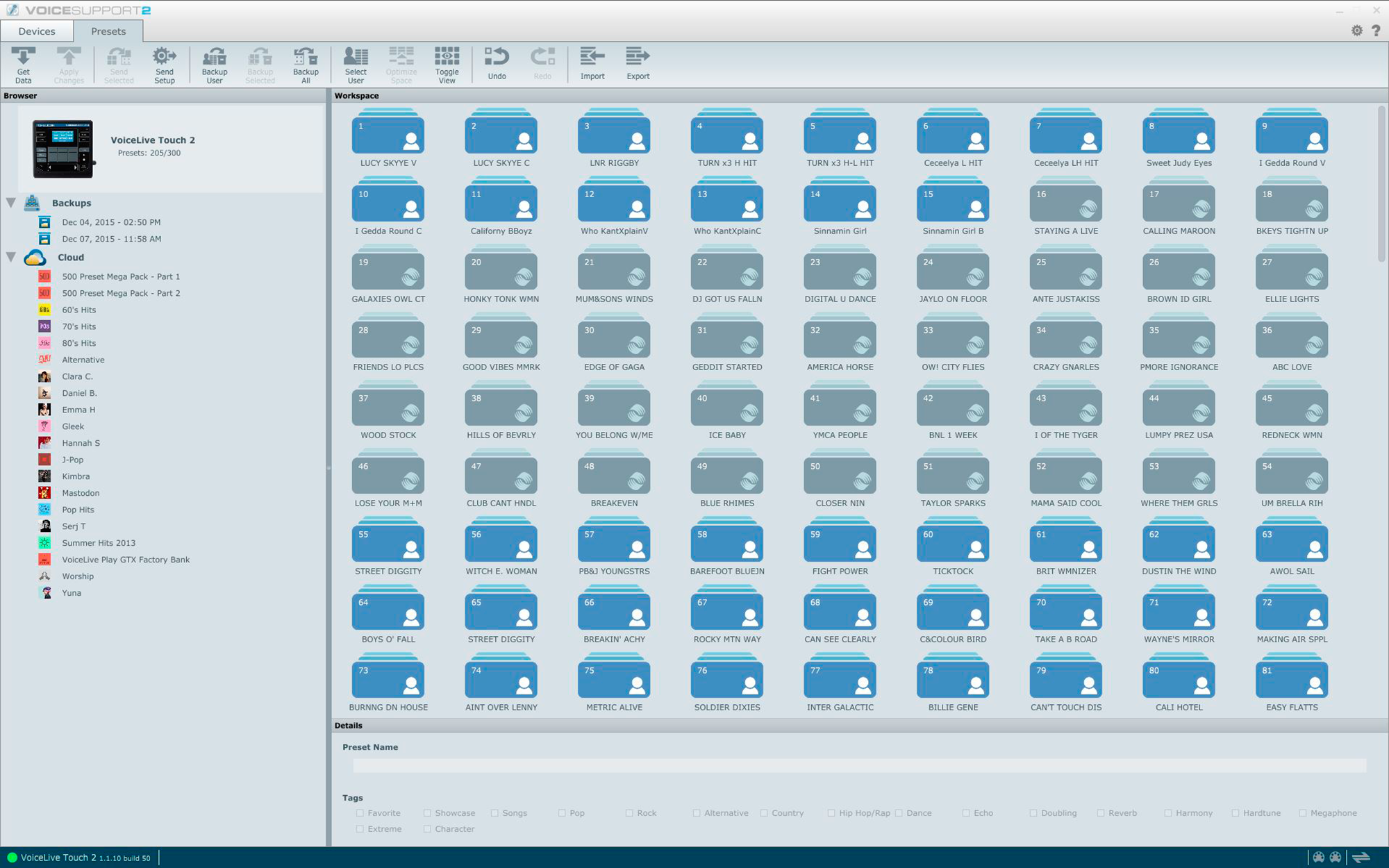
I’m not much for spending time wrestling with layered menus, either on my cars or my electronic devices. I really hate throwback software; been there, lived that. We are in an age of powerful, user-intuitive and friendly software and there is no excuse for any piece of digital electronic hardware forcing users to program a device through a crappy interface. That is exactly what you will have to do with the Play Acoustic, though. This incredibly ancient looking (and performing) piece of software is TC Helicon’s VoiceSupport 2 software as it looks on both Mac and Windows 10 machines. The software is pretty much Windows Explorer or Apple Finder for a few TC Helicon products. For the rest, this is nothing more than the overly complicated, under-performing interface TC Helicon uses to deliver firmware updates. You can reorganize your patches, you can download patches from TC Helicon’s cloud, but you can not edit anything usful with VoiceSupport 2. None of this should be surprising, though. TC Helicon/Electronic was acquired by Behringer in 2015 and it is safe to assume nothing innovative will come from the TC products in the future. Behringer is as notorious as was Norlin for taking gold and smelting it into oxidized lead.

So, for me, as powerful and interesting as the Play Acoustic is, it just isn’t worth the programming hassle. I messed with it for a day and sent it back to Sweetwater. For now, I’m fine with my Perform-VG until Zoom, Line6, Yamaha, Roland/Boss, or some other competent company comes up with a significant improvement. If you like fiddling with firmware more than playing, the Play Acoustic might be exactly what you are looking for, though. It has a lot of features, sounds great, and is a durable package (except for the notoriously fragile scroll wheel) that could give years of service. Of course, you’ll spend half of those years trying to tweek the thing into something you like using.

Monday, October 26, 2020

Serious Music

Back in the late 70s, I signed up for a recording seminar at the University of Iowa. Believe it or not, Iowa City, IA had a very small recording program and decent studios (primarily for classical music and the college jazz band) in the 70s. The presenter was Stephen Temmer, who must have been in his early 50's when I met him but who seemed "ancient" to me at the time (I was in my late 20's.) Temmer died in 1992 at 64, which I would probably consider "young" today. 

Mr. Temmer later became an adjunct professor at the University of Iowa, but at the time we met he was still President and owner of Gotham Audio Corporation, the only North American distributor for AKG, Neumann, Studer, EMT (plate reverbs), Lexicon, and many other things European. At the time of the course I took, Temmer was just beginning to market a collection of audio cables that he claimed were significant improvements over "ordinary wires" and we had some spirited discussions about that subject, too. 

I was at least as big an asshole then as I am now. During Temmer's introduction to the two-week-long, 8-10 hour/day course, he said something like, "We won't be discussing popular music recording in this class. Our topics will all be regarding the recording of 'serious music.'" 

I couldn't let that pass. Up my hand went and I said, "I didn't think music was a 'serious' thing. If it's not fun, it doesn't have much point does it?" I got a scowl and no reply. That was on Wednesday, the first day of class. For the next two days, Mr. Temmer pretty much ignored me. 

Luckily, the school's studio maintenance tech, Stephen Julstrom and I had hit it off pretty well, mostly talking about tape deck and console maintenance and design. The "in" with Mr. Julstrom, who was about my age (and who later became a design engineer with Shure Brothers in Chicago about the time I went to work for QSC Audio Products), provided me with some amazing opportunities including recording student classical performances and the college jazz orchestra (I still have a copy of that last one.). Unfortunately, one of the nights I'd volunteered to help Stephen record a student jazz group at a local coffee shop was the night the rest of the class went to see one of my lifelong heroes, Dizzy Gillespie, direct the UofI's big band. I've always regretted that and didn't get to see Gillespie until the early 90s in Long Beach with a small, mostly electric band. However, I got to play with some very expensive microphones that I'd only read about up to that moment and work in the college's great performance spaces using the school's very expensive equipment; although some of it was expensive, but not particularly high fidelity.

When the first weekend came, Steve Julstrom had invited Mr. Temmer and me out to his lakeside place for an afternoon barbecue. Because we were a one-vehicle family at the time, I'd taken the bus from Nebraska to Iowa City and Mr. Temmer offered to give me a ride to the lake. The school had rented a Cadillac for Mr. Temmer and I hadn't been in a new Caddy for several years. At the least, it would be a comfortable drive, even if we didn't talk much. I'd mentioned this experience in another Wirebender essay a couple of years ago, "That’s Not Serious, It’s Art." Who knows why, maybe to irritate me, maybe because it's how he always traveled by car, maybe he thought he was going to educate me, but Stephen fired up the stereo as we took off and found a classical station. When the orchestra started playing something I wish I could remember, Temmer began to wave his arms while he drove and sing along with a pretty decent voice. I watched him for a bit and about the time I started to smile at his performance, he looked at me and started laughing. We laughed together for a bit and had a great conversation about music being about "fun" and entertainment and a distraction from serious stuff and by the time we arrived at Julstrom's home we were more than acquaintances. 

The next day, Sunday, the Stephen's invited me to help record a piano-violin Bartok record with two of the school's faculty musicians and a collection of Temmer's Neumann microphones; new and historical (Including a Neumann omni that Temmer said was either "Hitler's microphone" or one like that used to record Hitler's speeches. It looked a lot like the one in this picture, as I remember. Temmer was an Austrian immigrant.) I also included several of the Audio Technica and Tascam microphones from my own collection in the recording and, later, we did a single-blind comparison of all the microphones used in this recording with the rest of the class. To Temmer's mild disappointment, the class overwhelmingly selected my Teac ME-120 condensers as their favorite in that test. The "Hitler mic" was pretty obviously lacking in high end response as the violin would often slide above the mic's capabilities far enough that it vanished in the mix. If nothing else, that proved that there are some limits to the vintage cache. 

For the next several years, any time I came upon a low-to-moderate cost microphone that I thought was either interesting or exceptional, I would write Stephen Temmer about it and, often, he'd ask to borrow it for a bit. I fell out of that habit a little before I moved to California in 1983, after my 2nd studio closed and I was convinced my life in music was all but finished. At the time, I was managing a manufacturing company building everything from high voltage inductance test equipment to the Arrakis Systems broadcast equipment. That might seem like I was still working in audio, but it didn't feel much like it. In my last few months in Omaha, massive personal turmoil pretty much squashed everything in my life but work and home. I'd been working with a friend, Mark Hartman, on jingles and pitches for commercial music, but that sort of withered away in those last months before I accepted the QSC job. 

Once in California, I was a regular member and occasional officer with the Orange County Audio Engineering Society (which no longer exists) and I bumped into Stephen at least once at the LA AES Show before he retired from and sold Gotham Audio in '85. A year or two later, I ran into him at Wes Dooley's AEA Micophones facility in Pasadena, when I was buying a couple Audio Precision test fixtures for the QSC assembly line. It still would be a few years before I started collecting and messing with microphones again, but I always clung to the idea that music wasn't a serious thing. If it's not fun for someone it's not music. I didn't see or hear from Stephen again and didn't know he'd died in 1992 until recently.

Note: Heidevolk and their one and only flash-in-the-pan semi-hit, Vulgaris Magistralis, are the poster children for my music is "fun" point. It's hard to tell from their other songs, but I can only hope these characters are posing as Viking assholes. Regardless, I love this song and it never fails to make me laugh when i hear it. I would just as soon not know anything more about the band or their opinions on "life, the universe, and everything." They might be "serous," but I think they are hilarious.

Sunday, August 23, 2020

Making Mistakes and Living with Them

Exactly seven years ago, today (8/23/2013), I sold my 1973 Dobro D-66 to Paul Mayasich for $1700. I wrote the following words the day after that guitar walked out of my life. I was incredibly depressed at the time. I had quit my teaching gig at MSCM after a 13+ year career there; probably the best job (at times) I had in my 55 year working life and when it ended almost all of the things I loved about that school were gone. My wife and I were leaving home for the winter and I wasn't looking forward to any part of traveling in a camper. 

This piece sounds really self-pitying; and it was. I was whipped. Since then, a few things have changed. Due to the onset of arthritis in my hands, I went back to playing guitar after we moved to Red Wing in 2015. In fact, I'm playing more now than I have in the last 30 years. I still suck, but I'm enjoying myself. I have been diagnosed with myasthenia gravis, which pretty much puts a terminal punctuation mark in my future. I'm not sure what the point in allowing this to post in 2020 would be, but I decided to let it stay on the queue to remind myself of . . . something.

I bought the Dobro (pictured at left) from one of the blues guys who used to play at the Howard Street Tavern, sometime around 1976. It was a well-used instrument when I bought it. Back in those good days, I ran sound occasionally at the Tavern, rented guitars, amps, and other gear to the bar when a traveling musician or band needed gear that wasn't available from the usual culprits, and bought and sold instruments, petals, and amps to pretty much anyone who called in the middle of the night strung-out, hung-over, in jail, or broke in Omaha or Lincoln. This great old guitar was the last holdover from that period of my life.

I can not explain this, but I was almost infinitely sad about giving up this instrument. I know, "Why did you sell it if you were going to miss it that badly?" The reason was that I was dumping all of my old pipe-dreams, one at a time, until I either found something to care about or decided I was too old, too burned out, too disappointed to care about anything.
After the guitar walked out of my life, I took our dog for a walk. It took about a mile of walking before it sank in that I'd given up an instrument that had been so much of my life during some of the best moments of my life. The real reason I was selling all of my guitars and equipment also sank in; at 65 if I never played another note, sang another song, or even whistled a tune, nobody would care. Not a single person who has ever heard me play guitar or sing has been positively affected by my love of music. A few weeks back, the wife of a friend was bugging me to pick a song and sing for a small group of friends. I begged off, eventually leaving the party to get out of being asked to perform. The real reason was that I was convinced that once she heard me sing or play that would be the last time she'd ask for that torture. When you know how the movie ends, you don't need to stay for the credits.

If you need a definition of failure, this is it. A friend, Scott Jarrett, quoted a car mechanic as saying, "You haven't failed, if you haven't quit." I quit on music, more than once in the last 60 years. When I was a kid, I was one of the few guys I knew in bands who wasn't playing music "for the chicks." In fact, I had almost no interest at all in the girls who hung out around bands and bars. I was there for the music. Worse, I didn't want to be a rock star, I wanted to be a jazzman.

Growing up in western Kansas with shit for a musical environment--and the polar opposite of the parents who used to drag their bored adolescent douchebags into the Musictech/McNally Smith College open houses hoping their offspring would become famous musicians--was a lot more than an uphill battle. It would have required superhuman abilities and commitment. I was more like subhuman. I copped out and played pop music, including a fair number of original tunes, because I had no idea how to get from beginner to jazz player. There were no such animals in Dodge City, Kansas in 1963. When I left home in 1965, there were still no such animals in Dodge or western Kansas and I wouldn't meet any until a decade later.

I got married when I was 19. Somehow, I thought my new wife liked my music and my playing. It turned out that she liked my "dependability" and the fact that I could manage to hold a job and support her. My music was rarely a significant part of me, as far as she was concerned. By the time we'd been married for six or seven years, she was close to hating the aspect of my playing that required practice. There wasn't a place in any of our homes that was far enough away from her to keep her from complaining about my playing. A real musician would have taken that as a sign that we were incompatible. I have never been a real musician or any kind of artist. Over the next two decades, I quit practicing and the less I practiced, the less I could tolerate my playing and less I wanted to play. Today, I can barely stand to touch a guitar because I suck so badly. So, seven years ago I sold my favorite guitar to a man who was a musician. I can't decide if I missed the guitar or the hope once had that I might become a musician.

Monday, December 9, 2019

My Momentary Folk Singer Career

In the fall of 1967, my father withdrew about $3,000 from my college savings fund and the family took a “vacation” and dumped me in Dallas, Texas. The plan was that I would be attending a fly-by-night Texas for-profit computer school. The reality was that my father thought I was wasting my life trying to be a musician and he figured I’d follow my money where ever he decided to send it. He was, of course, right; in his weird, passive-aggressive way. I had earned that money throwing newspapers between the ages of 11 and 13 and working at the Dodge City Boot Hill Front Street Replica tourist trap for two summers from age 13 to 14. I, of course, wanted to spend that money on music equipment, but my father would have none of that. Worst case, I figured I would be far enough from Kansas and my fundamentalist whackadoodle family to completely break free from them and start my own life. 

The school, as you would expect, turned out to be a fraudulent joke. The school’s “dormitory” was a 1920’s flophouse full of bums, drunks, thieves, and a dozen-or-so computer school “students.” After a week in the flophouse, a half-dozen of us started looking for a better place to live. We found a house we could rent for about the same money as the flophouse, sans flophouse food. That lasted for a month because one of our roommates ate everything that came into the house and bought nothing. When he tried to “borrow” money for the 2nd month’s rent, we scattered. Two of the guys, twin brothers (Larry and Gary)  from Lawrence, KS, found an apartment in Old East Dallas and I rented a tiny garage apartment from the same landlord. By then, more than half of the school’s students had dropped out and most of them were suing the school for fraud; among other things. One of the more experienced guys had recommended that we join the lawsuit, but my father had already been conned into giving the school a 2nd semester tuition as a payoff for my dropping out. For an accounting teacher, his math skills were consistently suspect. His capacity for critical thinking was never suspect because it was never evident. I kept going to the school, even though most of the instructors had quit and the already obsolete computer equipment had been repossessed. 

About the time I moved into the garage apartment, a friend from Kansas, Ed, who was burning time before his delayed induction into the Army date moved in with me. We had written a few dozen songs together and decided to try some of them as folk songs. There was a bar a few blocks from the apartment and coffee shops from Lakewood Heights to downtown Dallas. Best of all was the Rubaiyat, the premier Texas folk club/coffee shop of the day. Ed stayed for a couple of weeks, just long enough to help me connect to some of the folk music scene. Toward his last few days in Dallas, our act had started to attract a weird collection of “side men” to our act; percussion players, “singers,” guys blowing into bottles and South American flutes, an upright bass player or two. Some characters brought instruments they often couldn’t play at all, so they’d just bang on them. There was no money in any of it, so that act took on a name that included the words “jug band.” That is all I remember about the group name, too. Jug bands were a thing then, for a brief moment. 

Once, we accidentally ended up being one of the intro acts for a major (for the time) folk singer. It kills me that I can’t remember if it was Tom Paxton, Tom Rush, Tim Buckley, Tim Hardin, or it could have been someone I have completely forgotten. The first name stated with “T,” I was not a folk music guy at the time, although I loved Bob Dylan and covered several of his pre-electric era songs. I wouldn't have known Rush from Paxton from Buckley at the time, but I did cover Hardin's "Reason to Believe."

Ed and I showed up, but the rest of the menagerie did not, so we did a half-dozen original songs and gave up the stage to the headliner. As I walked off of the stage, whoever that T-guy was said, “You know what it’s supposed to sound like.” 

[The picture at right is just a Rubaiyat poster, not a bill that our group was on.]

I will never know if that was a compliment or sarcasm. If you know me, you would be correct in assuming I lean toward believing it was sarcasm. We were 19 and 20-year-old kids from Kansas.

A day or two later, Ed headed off to basic training. I ended up dropping out of my bogus computer school, shacking up with my wife, Robbye, diving into the Dallas hippie world (sans drugs), and almost giving up music entirely. I really wanted to be an R&B guitarist, but couldn’t cut it in that competitive environment. I loved playing guitar or bass in an R&B band, but playing solo folk music scared the crap out of me. Still does. Occasionally, I would stop in at the Rubaiyat and play with one of the other groups or do a couple original songs. One of those songs, “Dixie Lead,” was recorded at the club and got a little late night FM radio play, as a protest against one of the many grossly polluting factories in east Dallas. And that was my first experience in the big city.

Sunday, November 25, 2018

Concert Review: Crash Test Dummies at the Fitzgerald

crash test dummies 2The concert was billed as the "Crash Test Dummies: God Shuffled His Feet 25th Anniversary Tour." A better person would have known what that meant, but I was mostly a first Crash Test Dummies album fan. The tour started in St. Paul with the core band of Brad Roberts, Ellen Reid, Dan Roberts, Mitch Dorge, Stuart Cameron, and Eric Paulson.

Local bar solo act, Paul Metsa, was the opener. He was as surprised to be there on the Fitz stage as we were to see him there. He didn’t even manage to get the performance up on his webpage retroactively. He had moments of ok-ness and talked way more than he played, which was an odd choice since he seemed to believe he was getting a lucky showcase that night and should have used the time to demonstrate his musicianship. Ending with a patronizing version of the Star Spangled Banner was pure Toby Keith schmaltz. He was, apparently, desperate to get audience attention.

The FOH guy, as usual, was near deaf. As usual, from the start it was obvious he’d never heard an actual record and imagined that we were all just dying to hear kick drum and bass solos; especially that all-captivating territory between 15Hz and 80Hz. (Or maybe his own hearing is so damaged he needed those frequencies boosted 10-20dB to compensate.) As the night went on, the sound goof became more hearing-impaired and eventually it was difficult to even sense the existence of the vocals unless all three of the band’s singers were really wailing. That was particularly disappointing because I don’t often get to hear a singer with Brad Roberts’ mic and vocal technique. If there was ever a band that deserved to have the vocals upfront and on point, Crash Test Dummies are it.

crash test dummiesDuring the many quiet moments and, especially, when the musicians except Stuart Cameron (acoustic guitar) were absent, Roberts really knocked it out of the park. Heart of Stone” was so incredible that my wife and I simultaneously and spontaneously turned to each other and said “that was worth the price of the trip, hotel, and concert tickets.” Of course the lyrics are close to our own story, "And so now we are old, both our stories are told and we wait for the end. If you're first to go I will follow you, know that my heart will not mend. And I wish I owned a heart of stone.” Trust me, it does not read as emotionally powerful as it sounded with Roberts’ incredible voice.

As hard as he tried, the FOH goof did not destroy the evening. The musicianship was solid and the spare arrangements allowed many of the high points to fight their way through the sound system incompetence. There were few moments where the lyrics were decipherable, but when those words were either heard or memorized the whole point of this philosophical, insightful band was proven to be true. If there was a Crash Test Dummies’ song that someone didn’t hear Friday night, it was a really obscure one. I held my breath hoping to hear Superman’s Song, but not expecting it if this was really supposed to be the God Shuffled His Feet 25th Anniversary Tour. They played Superman as the end of the regular set and the last song of the encore was "Mmm Mmm Mmm Mmm" Go Figure.

There were many moments that were worth the trip to St. Paul, the hotel hassle, and even the downtown St. Paul parking hassle. It takes a lot to overcome those obstacles, but Crash Test Dummies pulled it off.

Saturday, November 17, 2018

An Acoustic Guitar Experiment

acoustic guitarOne of many irritants about getting old has been circulation issues. I sleep with at least one half of my body tingling from lack of circulation regardless of which side I sleep on, bed softness or hardness (although, hard is better), sleep position (although after being married for 51 years I am “trained” not to sleep on my back), pills, or anything else I’ve tried. Playing guitar is one more place where my poor technique has turned into a minor medical issue. Like many non-classical guitarists, I “rest” my right arm on the edge of the lower bout. For 50-some years, that hasn’t been a problem for anything but the limitations in speed and technique it causes (which are substantial, I know, Scott). This last couple of years, it has begun to cause another problem. After a few minutes of playing or practice, my wrist, hand, and fingers begin to tingle and will eventually get numb feeling from the lack of circulation caused by that pressure on the edge on the blood vessels of my inner arm.

A few months back, I saw Brian Stewart—music store owner and guitar builder/technician extraordinaire—working on an arm rest for one of his customers. I wondered if that device might help with my circulation problem? So, I built one.

Saturday morning at the TreeStrings morning jam, I tried it out. For the most part, it worked pretty well. Brian and I talked about his design verses mine and we had some other ideas as to how this might become an actual product (which he really doesn’t want to build) and I thought about some of those changes while I played this morning. I wish I’d taken a picture of my original design, if for no other reason than to show the evolution of the idea and because I thought the original piece was really pretty. It did cover more of the top than necessary and was heavier than necessary, too. To keep from having to split another piece of walnut to start from scratch, I decided to hack away at my original piece. Might have been a mistake.  

When I got back home, I took that first attempt down to my basement shop and started carving it down to about half of the original width. I smoothed out the bandsaw cuts, sanded the piece back to a beautiful gunstock satin, and tried it again. This time it wasn’t nearly as comfortable as my original design and that was a huge disappointment. So, I reshaped the top side, losing about 1/3 of the total thickness and creating a little more of a flat spot on top while keeping the soft edge I’d originally designed. I refinished that work and reattached the piece. For the initial experiments, I’m using fairly weak double-sided tape to hold the piece in place, but when I decide I’m happy with it I’ll use something more aggressive.

One of the things I did not expect to happen was for the guitar’s tone and output to change for the better. If you look at that guitar-playing picture (at the top of this essay), you’ll notice that the arm damps a fair portion of the guitar top (especially true when the player is wearing long sleeve anything). I play a very small Composite Acoustics Cargo travel guitar and I’d never really thought much about how much of the guitar’s top I was sacrificing with my playing technique (I know, Scott). After listening the “with and not-with” sound of the guitar, I was interested in the concept on a whole different level. I would guess the overall volume is close to 3dBSPL louder with the arm rest in place and it is substantially more full and brighter, too. In retrospect, all of that makes perfect sense, but I hadn’t thought about it until the evidence was right there in my arms.

I will be playing with this concept a lot more in the future. For now, I’m enjoying being able to practice guitar for several hours without numbness and that irritating feeling (or lack of) that comes with circulation problems.

Sunday, August 19, 2018

Peter Mayer and Live Music

mayer at Crossings

Saturday night (9/14/2018), I was the sound tech at Zumbrota’s Crossings Gallery for a Peter Mayer show. I’ve been a fan of Peter’s since I first heard “Brand New Harley” at least a decade ago. I bought the CD that song was a part of and discovered other Mayer gems: “John’s Garden,” “Africa,” “Holy Now,” among many other great songs of Peter’s that I’ve discovered (for myself) since. Peter has a solid, dedicated following of fans across the country and, according to posts on his Facebook page, the world.

20180714_212704He earnes it. Not only does he put on a show that covers as much of his huge discography as you would hope and could expect, he puts so much of himself into the performance he has to wind himself up and, then, down again; before and after the show. The sound check is as much a ritual he uses to gear himself up for the performance as it is an opportunity to optimize the sound system.

There is an aspect of performing this kind of personal music in this kind of venue that feels like someone has stripped themself naked in front of you. An audience can sense that kind of intimacy and, if the performer is lucky and talented, the audience can feedback some of that energy and love to the performer closing the loop and creating an environment that is particularly special to music.

Wednesday, July 18, 2018

Cool Snarky Puppy Stuff

In case I haven't made this clear, Snarky Puppy is my current favorite recording act. Someday, I hope to see them live and I really hope to make them my favorite live act. These are just a few of my favorite performances from this amazing band. At the least, listen to these pieces with decent headphones. SP goes to incredible lengths to produce high fidelity recordings. They deserve the respect of a decent reproduction system, at the least.

Saturday, June 9, 2018

Going Downhill

20180607_10001220180607_100039

Fortunately, I didn't have to listen to this nightmarish "sound system," but just looking at it was pretty depressing. This tiny faux-array JBL “full-range” speakers perched above and well behind apartment-sized subwoofers immedately made me want to ask, “When did Bose buy JBL?” From time alignment to diffraction and sound pressure field distortion problems, nothing about this mess would be able to reinforce anything resembling music. It isn’t even easy to move, unless the tiny speakers pack inside the subwoofer boxes. If there is any value system here, it must be “gain before feedback” because sound quality clearly is no consideration.

Friday, September 29, 2017

Updating the CA Story

Way back in 2014, I bought a used Composite Acoutics Cargo travel guitar. I liked it a lot then and I like it more now. Peavey bought the remnants of CA and that company appears to be purging the memory of the original company as quickly as possible. So, I thought I’d try to compile a little history while it’s still possible:

Pre-Peavey Composite Acoustics Assembly Videos

The Peavey Version

Sunday, April 9, 2017

More Me!

One of the great curses of being on the providing end of everything in audio from live sound to recording engineering is the “I need more of me syndrome.” Even in the recording studio, the concept of serving the music is a vanishing idea. Everyone who has a place at the table, regardless of how insignificant, feels the need to be treated like a star.

For example, out of the insanity of the moment I recent volunteered (for the third mindless time) to be “production manager” for a local college’s annual variety show. This isn’t even a music school, but a technical college that has one of the country’s rare and precious musical instrument and repair programs. While many of the students are extremely talented musicians and a few are even composers, arrangers, and one-time music program students, very few are planning any sort of career as performers. The show is a wild mix of everything from classical woodwind and horn groups to singer-songerwritters to large horn bands with a full rhythm section. There is about 3-5 minutes of setup time allowed between acts and often that will involve tearing down a set with a dozen chairs and music stands, moving a few large instruments (piano, drum kit), and setting up microphones. To put it mildly, there isn’t any time for either precision or fine tuning, either during the sound check/rehersal or the show. The performers have a couple of months to get their act together, but the crew sees everything for the first time the afternoon of the show.

To simplify a lot of the setup, the microphone system for the show is a pair of Earthworks cardioid condensers in X/Y configuration centered downstage and many of the acts are just positioned quickly around that microphone pair. Instruments like the piano, drum kit(s), guitar, electric bass, etc often are handled with a single well-placed (hopefully) microphone. There are no stage monitors for anyone. The house speaker system has about 170o of dispersion and the house speakers are angled toward the center of the facility (don’t ask) which provides about 100% coverage to around 10kHz to the front 15’ of the stage.

Did I mention that I do this gig for free?

The sound check is performed in reverse order so we can leave the first act’s setup on the stage at the end. This year’s show, and most years are the same, the final act (first up for the sound check) was a decent sized band: three trumpets, four saxes, four trombones, three saxes, piano, drums, bass, and guitar. They made a run through their song and one of the sax players said, “I need a monitor and a mic. Traditionally, everyone on stage would have his own mic and monitor.” My response was, “’Traditionally,’ I shouldn’t have to mic or reinforce a band this big.” There were some laughs from the adults in the room, some whining from the kiddies, and we moved on. I’m always tempted to turn moments like this into teaching opportunities, but I’m trying to learn that I am not the jackass whisperer.

Did I mention that I do this gig for free?

The show went fine, I survived it. Afterwards, when I was whining to my wife about having to put up with punk kids who think they are junior college rock stars, she said, “He’s probably confusing those music stands they used to put in front of the musicians for monitors.” I really wanted to tell her she was wrong, but I half-suspect she isn’t. Holy crap! Some dumb kid thinks every guy in Tommy Dorsey’s band had a mic and a monitor? Never underestimate the stupidity of your fellow Americans; it will cost you money.

Friday, January 27, 2017

Where Did the Audience Go?

In the last month, I’ve participated in two conversations about how difficult it is to find and maintain an audience: one with a bookstore owner who has struggled to find an audience for and participants in his store’s monthly “open mic” and the other with an “acoustic musician” who believes the US is no longer supportive of “good” live music. The one thing both of these men have in common is that they are unwilling to give up their addiction to their sound systems and unnecessary/excessive volume. I’ve written about this before, in “Killing Music Loudly,” and I’ll probably beat this horse again. However, these two conversations reminded me of an incident from 40 years ago that stuck with me because of its relevance to my own live musical history.

When Wirebender Audio was in its prime, there were two of us: Dan and me. Dan’s special interest was loudspeaker cabinet design. Between our dissatisfaction with commercially available speaker systems of the time (1976-1982) and his fascination with recent developments in loudspeaker and speaker cabinet theory, our company deviated from just being a user and vendor into system design and sales. Over a period of a couple years, Dan made one great sound system after another. We were on a Biamp craze, amplification and mixer-wise (Remember the Biamp 1642 and the TC-120 and TC-225’s? They needed a lot of mechanical engineering and some component replacement,for reliability, but they were well designed for their price-point.) and some of those systems were just huge audiophile rigs. Dan was particular enamored with front-loaded, non-horn, non-vented systems, which are notoriously inefficient, but very high-fidelity. Likewise, our systems were some of the cleanest, quickest sound systems I’ve yet experienced. Repeatedly, after Dan would wrap up a system and take it out the band he’d be working with would buy the whole system and he’d have to start over. Not a bad problem to have as a systems designer. Eventually, he built what became his “ultimate” system, using everything he’d learned in every area of system design. On a budget, I like to think a lot of what Dan ended up with resembles much of the Meyer Sound system designs.

Coincidentally, we were recording a power-pop band that he really liked and when their record was finished he did a few shows with the band at local Lincoln, NE clubs to showcase their music. In one of the more upscale clubs in town, Dan met his Waterloo. During the first set, when he’d dialed in everything beautifully and the band was cooking, the bartender kept coming back to the FOH position and telling Dan to “make it louder.” It was pretty loud in the first place, being an early 80’s rock band with the usual collection of Fender, Marshall, and Orange amps on the stage, but the bartender insisted it wasn’t loud enough. Dan brought it up incrementally, but knowing the limits of his system and trying to stick with his quality sound concept he didn’t bring it up nearly loud enough for the bartender.

During a break, the bartender and owner ganged up on Dan and explained their philosophy with words something like this, “When the music sounds good, the crowd is a bunch of music lovers. They don’t drink or tip much and we don’t make any money. Crank it up, drive those cheap bastards out and make room for the drunks. They don’t care what it sounds like, as long as it’s loud, and they’ll drink until they drop.” Dan did push the system a little harder, the music got crappier, the audience morphed into brainless drunks, and the night went on.

Afterwards, Dan lost interest in live music speaker system design. After a few really great non-rock gigs with the University of Minnesota orchestra and a couple of outdoor musical performances, he sold that last system and told me he’d had enough of what we were doing. He didn’t like the commercials we were making most of our money doing and he’d lost interest in sound system design and live sound engineering. We packed up the company, after selling the last 100 of our “Musician’s Preamp” product and finishing the recordings we’d committed to, and went our separate ways. Dan became a tech school electronics instructor and stayed as far from popular music as possible for the rest of his life. I moved to Omaha, built a small production studio for a friend and went to work for a company that owned Aarakis Systems, building broadcast consoles and A/V switching systems. A year later, I was in California working for QSC Audio Products, doing live sound for a 9-piece horn band, and hustling Wirebender as a backline supplier, studio equipment and electronic musical instrument repair service, and contract audio and industrial electronics design service.

The lesson learned that would, today, apply to those two conversations that inspired this trip down Memory Lane is that the problem may be that you have both misidentified your audience. The bookstore isn’t trying to attract drunks and the acoustic musician isn’t trying to appeal to people who shout “Freebird” at every pause in the music. However, the quality of your sound system is exactly aimed at that audience. The bookstore, for example, isn’t large enough to warrant a sound system at all. Most of the people who used to attend the bookstore’s open mic have been punished enough by kids who imagine that more volume hides imperfections. They’ve decided that suffering through the loud awful stuff for the occasional loud decent stuff isn’t worth the effort. The acoustic musician isn’t acoustic at all. I’ve check out his YouTube performances and he is always surrounded by at least two stage wedges and he’s highly electrified. Yeah, he plays a beat up hipster’s acoustic guitar, but it’s plugged-in and so is he. With those monitor demands, the FOH has to be painfully loud for any bandwidth to exist out front. Again, he’s misunderstanding his target audience. He imagines himself to be a weird combination of Leo Kottke and Eric Clapton, but he’s neither and the audience he is best suited for would be more Kottke and no Clapton. Volume is the enemy of both of these guys, but they don’t know it, won’t accept it, and it will continue to defeat their objectives until they figure it out.

Tuesday, January 10, 2017

Reflections on Guitar Building

When I started actively looking at moving, I stopped at Southeast Community Technical College to get a feel for the possibilities (for me) in that program if we moved to Red Wing. Luckily, I hit a day when David Vincent was working on course preparation and he spent a couple hours with me showing me the facilities, talking about my experiences at McNally Smith, and my experience with tools, shop equipment, and guitar repairs.

David also described the first year of classes and when he told me about “GTRB 1400 Intro to Tools,” I admit that I balked at having to take a basic hand and power tools class after a lifetime of tool-using. Since I wouldn’t be able to get in to the program for about a year, David recommended that I consider the cabinet-making class in Winona just to get my woodworking skills up a bit. So, I did. That was a pretty awful class, but it did show me how much I didn’t know about power tools I thought I was fairly familiar with.  I really didn’t want to take “Intro to Tools.” David made it clear that skipping that class wasn’t an option.

So, I signed up for all but one of the classes a first year student takes in the fall of 2015. I didn’t take the Electric Guitar Design class my first year because I wasn’t yet convinced I wanted to build an electric guitar. After three weeks of “Intro to Tools” I wasn’t convinced I was going to be building any sort of guitar. David’s class was kicking my ass. It turns out that my personal quality standards weren’t even close to good enough for a luthier.

To start, we all had a list of fairly expensive tools to buy. Four Canadian-made chisels for about $120 for the set, were on the list. You’d think that if you paid that kind of cash for a couple of pounds of steel they would come sharpened by the manufacturer. You’d be wrong. There was also a 4” plane on the list. It cost about $70 and it also needed sharpening. We spent about a week (it felt like a month) learning how to properly sharpen these tools. In the end, I was able to create an edge that would easily shave the hair off of my arm. The factory edge was far from that sort of edge.

IMG_7887For example, this sanding stick. It’s about 10” long, with a prescribed taper, different on both sides, and two different radiused sides, also prescribed by Mr. Vincent. I worked on that stick for days and, after three weeks, didn’t feel I was any closer to getting it right (+/-0.002” for all specified dimensions) than I was when I started. Everyday, for a couple of weeks, I wrestled with myself and my failure to be able to do the work to David’s standards. I was not that far from the edge of saying, “Screw this. I’m retired and I don’t need eight hours a day of failure.” Then, I got it. All of a sudden, I was not only getting the assignments but I was bringing in work from  home and doing it to my new workmanship standards.

2016 SETC Guitar Show (8)In the end, I did pretty well. I made the Dean’s list and, even more importantly, I made this guitar. Yeah, I know it’s a long ways from a Gibson Hummingbird, but it is exactly what I wanted to build, including a fairly individual semi-V shaped neck that I LOVE.

Also, I have a trio of super-sharp planes—from a 6” 1950’s Stanley to a 24” Stanley/Bailey that found in a Red Wing garage sale for $10 (with two new 7” saw blades tossed in for good measure) that I turned into a terrific manual joiner.

Occasionally, in my 68 years, I have learned things that if I’d have had them in hand when I was young would have made a world of difference in my life. This first year at Southeast Community Technical College was full of that kind of experience. I’m not kidding when I say that I think every kid who doesn’t know what he or she wants to post-high school ought to seriously consider the Southeast Tech Guitar Bulding and Repair Program. You will not be the same person after you’ve experienced the high standards this school and these instructors set for you.

Friday, July 4, 2014

Proof in Pudding

IMG_0003 July 2014

A while back, I referenced new knowledge (to me) about owning an acoustic guitar that I’d discovered in Allen St. John’s Clapton's Guitar: Watching Wayne Henderson Build the Perfect Instrument. If you look at the picture of me playing my new guitar and if you’ve read St. John’s book, you’d have to assume I learned absolutely nothing from Wayne Henderson. You might be wrong. I’m not a good enough guitarist to know much about the intricacies of acoustic guitars, but like all pedestrian art lovers “I know what I like.” I can’t describe it well enough to put forward any intelligent theories or descriptions, but I am reasonably sure I could put together a list of important criteria that might provide someone with a bigger brain some insight into what matters to me as a guitar player. 

IMG_0004 The guitar I ended up with is a Composite Acoustics Cargo, that company’s entry into the environmentally indelicate travel guitar market. Here’s what CA has to say about the Cargo, “A travel size instrument that sounds like a full size guitar? Impossible! Our Cargo is comfortable to play anywhere, from the forests of Oregon to the foothills of the Catskill mountains, and even in your favorite armchair. Finely appointed and incredibly durable, the Cargo is ready when you are. It easily fits airline overheads or anywhere space is tight. It's a portable guitar with the playability, sound and satisfaction of a full size guitar.

blackbird rider Oddly, other than the exclamation marks, I pretty much agree with CA’s self-assessment. A friend called, knowing that I was looking for a replacement for my all-around-miserable Martin Backpacker travel guitar, saying that he’d found a used Cargo at a local guitar store and wanted to know if I was interested in tagging along to play it with him. We went to Willie’s American Guitars, first, to check out the Blackbird Rider (steel string). The Rider was pretty impressive, but at $1,600 I decided to wait until I’d sold my Martin 00016C before I plunked down another pile off money on a guitar I might not play. On we went to the next guitar shop where we played a used and purple 2008 (pre-Peavey) Cargo non-electric. The shop was asking $1,000 due to the “collector value” of the pre-Peavey status and Tim and I decided to pass for a while to see how the day’s comparisons sat. When I got home, I looked up current prices on the Cargo and found that $999 was a pretty common street price for the electric-capable version of the “raw carbon” version. Tim ended up ordering one from Sweetwater. About the time he ordered his, I found a used one with the “high gloss carbon burst finish” on Craig’s List. We ended up getting our hands on our new guitars at about the same time, same day, and damn near the same place. Tim’s is new, mine is pre-Peavey used. To my ears, they look and sound pretty much the same, except for string differences and the gloss finish on my guitar.

IMG_0003Ellis Seal, an aerospace engineer, began Composite Acoustics in 1999 and after several wrong steps, over-optimistically anticipating the market for the company’s products and under-pricing their products (at least pricing them so the company didn’t make enough profit to survive), CA went bankrupt in 2010. That same year, Peavey bought the remains and began marketing the carbon graphite guitars, pretty much unchanged, in early 2011. Since then, Peavey has refined some manufacturing processes, but kept the guitars themselves most intact; in spite of the fear-mongering some “vintage guitar” dealers are promoting. 

The Cargo is an interesting work in acoustics, psychoacoustics, nearfield design, art, engineering, and ergonomics. After I got my Cargo, Willie’s picked up another Rider and I went to the store with my guitar to compare the two. The Rider has the “advantage” of a smaller body, which makes it slightly easier to store or stuff into airline overhead baggage. That aspect of the Rider turns into a disadvantage when you are playing the guitar. It does not sit comfortably  in your lap like a guitar, unlike the Cargo. While the body of the Rider is more narrow, it is also deeper so the total stored volume is pretty similar. From a distance, the two guitars sound remarkably similar. From the player’s position, the Cargo has it all over the Rider. The sound hole is high and right under the player’s face, providing more low end to that listening position than the Rider. The body shape of the Cargo puts a very resonant part of the guitar’s back right against your chest and rib cage, providing low frequency bone conduction. Just holding the guitar away a fraction of an inch or wearing a coat is enough to lose this portion of the bottom end. It is a brilliant solution to an otherwise unsolvable problem with a small body guitar. Both guitars have excellent pickups; the Rider the Fishman MiSi pickup electronics, with a tone control, and the Cargo has a less-featured but very competent LR Baggs pickup. With a half-decent acoustic guitar amplifier, the Rider’s tone controls would be unnecessary. 

Your mileage may vary, but I am more than satisfied with my Composite Acoustics Cargo electric and expect to be playing this guitar for years. When a friend first saw the CA guitars at a NAMM show, the company had three of their instruments on stands under a running waterfall. The demonstrator just pulled a guitar out of the water, shook it off, and started playing. That’s not all that far from the kind of environment living in an RV can be. 

POSTSCRIPT: A couple of years ago, after moving to Red Wing, a friend decided he also needed a travel guitar. He actually travels, so "needed" was more realistic for him than me. Through an industry connection, he spotted a used CA Cargo for a decent price . . . but it was red. I loved my old black sunburst Cargo, but I kind of don't care about color all that much, so I offered to trade if he really didn't like the red guitar. He didn't, so we traded. 

Since then, I've added a few "features" to the new Cargo (this one is, I think, a Peavey manufactured guitar). The setup wasn't great, so I made a new saddle and dressed the frets a bit. I experimented with an "arm rest" when I was having arthritis issues with my right hand and found that the guitar was substantially louder and more full sounding without my arm resting on the top (Go figure!). For several years, I got to play the black Cargo occasionally and I'm sorry to say I still like it slightly better than the red guitar, but I still kind of don't care much. My friend died recently and his wife sold the Black Cargo to a local musician. It went to a good home. The Cargo is so much my go-to guitar that it lives in the room where I do most of my living, writing, reading, and thinking. After 8 years, it is still my favorite guitar. 

Sad to say, Peavey couldn't figure out how to make and sell the Composite Acoustics line and it has languished on their website with no available inventory or support for at least 4 years. 

Tuesday, January 1, 2013

Milk of Human Kindness


Not much more to say about this, is there? Scott Jarrett is one of the most insightful artists I've ever known and you can never go wrong with his music.

Monday, May 21, 2012

Is It Music?

In an article titled "In 5 to 10 years' time, computers might catch up with traditional technologies. Might." in David Mellor's Recording-Producer.com website, Mellor described giving up on his iPad because after trying the device for a collection of tasks and discovering it was a poor tool for reading, writing, and anything else he had hoped it would be good at. His realization from that was, "Perhaps the iPad isn't actually all that cutting edge. Perhaps even fully-fledged computers are not as cutting edge as we seem to think they are."

He goes on to a variety of comparisons of musical devices and applications that might not be as wonderful in their computer form as many have claimed. The main gist of the article was a comparison of the visual resolution of a magazine (SOS, in this case) and what it takes to get to that resolution on a computer screen. He pisses off a few readers and they replied with comments like "But try also making music with that magazine. That iPad has some very interesting apps for making music in novel ways. That magazine is limited to one function, albeit it does that one thing very good."

I thought about this for a bit and realized that I've been making this same argument for decades. So, my reply was:

I'm always entertained by the claim that users are "making music" on their iPads. If grouping stolen musical loops and repeating thumping and squeeking noises is "making music" and your standards for "music" are low enough that factory sounds fit the bill, I guess the claim has some weight. At best, this noise is as musical as the stuff that comes out of grade school music classes. Until I see someone actually play an iPad like a musical instrument with some skill and creativity beyond that required to play Guitar Hero, I'm reserving my definition of "musical instrument' to actual instruments, of which synthesizers barely qualify because of their user-hostile interfaces beyond the piano keyboard. 


This is a concept with which I've had some sympathy for decades. We're hard pressed to find examples of better-made records from the digital era than from the multi-track tape years. It's not that hard to find examples of music with equal or greater emotional impact from the direct-to-disk or mono era. Digital tools are not ergonomic, on the average. They are in their infancy and may remain there forever because technology keeps marching-on from one gimmicky menu or knob-and-button format to the next without consideration of musician convenience or play-ability. As humans, we might not survive long enough to see computers as successful musical instruments. It took centuries for what we currently recognize as musical instruments to mature.

Not that long ago, I attended a seminar where an expert from Ableton Live! demonstrated the "music-making" capability of that program. I was incredibly unimpressed. The technology demonstrated wasn't the unimpressive part of the demo, the music was. "Fucking mindlessly boring" would be a compliment to the silly noises the demonstrator produced. There is a crowd of folks who imagine "dj music" is actual music, but they have grown up on repetitive video game noise and their tastes are childish, at best. These things are toys, not musical instruments, and the music reflects that lack of seriousness. The big difference between a Linus Peanuts piano or a Mickey Mouse wind-up guitar and an iPad is the price tag. The musical value is about the same. So, this isn't a generational complaint, it's more of a response to the effective marketing these toys have received.

After decades of waiting for synthesizers to become user-friendly and creativity enhancing, I've given up on the whole idea. The best we've seen from the hardware manufacturers has been cumbersome button-and-menu driven combinations that cater to "computer-users' and not to musicians. I have seen a half-dozen technically-inclined and musically capable kids (and one or three instructors) unsuccessfully fumbling over a synthesizer's menu and connector options, trying to figure out how to get the damn sustain petal to work properly. Imagine how tough it is to get an actual musical note if the pedal operation is that complicated.

Couple that hassle with the fact that hardly anyone has found a creative thing to do with a synth since Edgar Winter's "Frankenstein" or ELP's "Lucky Man" and I'm pretty convinced that I won't live to see a computer musical interface that is well thought-out. The engineering motivations are all wrong. Consumers want the next thing, not a thing that works well.

Wednesday, November 16, 2011

Serving Music?

In my manufacturing career as a quality and manufacturing engineering manager, I was always asking my employees and managers, “Who does this serve?” whenever they wanted to implement a procedure, change a process, or add paperwork to our workload. One of the late-great Quality Management concepts was that everyone in an organization "serves" someone. From the CEO to the shipping clerk, all of those jobs exist to provide service to someone in the customer or organizational chain. When that system fails, we end up with a society like the one the 1% have created today and, historically, that never lasts long.

Last week, I took some friends to the local jazz club, the Artist Quarter, to listen to a well-known local jazz saxophonist and that question popped into my head for the first time in a few years. In my opinion, the best music is created by musicians who are “serving” the assembly of sounds the whole group creates and that the rest of us call “Music.” In the classical world, I think this goal is commonly accepted principle. In an orchestra, everyone, including the featured soloists, is focused on the whole they are creating. They all obey the conductor who is the conduit to the audience for the musical environment being created. There is no shortage of oversized egos, varying talents, or personality conflicts in classical performances, but they are mostly sublimated in the service of the music printed on the page in front of every player. Even solo classical performances are still directed by the directions on that page that describe how to best service the composer’s aural vision. On average, I would argue that classical music performed in groups is more closely directed toward the service of the music.

In the pop world, this ideal is rarely reached because the service goal for popular music is profit, not music. The engineer, producer, and record label drones all serve as focus groups who analyze the gross aspects of a recorded performance for the possible financial return. “Will it sell?” is infinitely more important than “is it beautiful?” There are obviously violations of this generalization, but those only occur when the “music industry” is in disarray and the financial interests have lost control of where the music is going. That may never happen again in our constantly-connected, followed, friended, and information-manipulated world. Pop music is so thoroughly commercialized that musicians call it that, “commercial music.” That’s a term that used to apply to music made as background for advertisements. Today, a prime goal of popular musicians is to have a song end up in a commercial or as background in a television series. The service of music as an ideal entity is becoming a vanishing cause in the pop world.

Jazz pretends to be a different animal than either pop or classical music. Since jazz presents practically no possibility for financial reward, jazz musicians can imagine themselves to be in a similar boat as classical musicians. Since improvisation is valued over sheet music regurgitation, jazz musicians tell themselves they are more purely serving music, following the muse, as it pops into their heads.

In application, jazz often fails to live up to the best goals of either pop or classical music. The performance I took my friends to was a case-in-point. As if there were some rule that stated each of the four musicians would be allowed a moment in every song to show off, every tune followed the same sax-melody-sax-solo-piano-solo-bass-solo-drum-solo, rinse, and repeat routine.

To be upfront, I have to say that 99.9% of every bass and drum solo I have ever heard has been a miserable exercise in gymnastics. Bass players insist on showing off how fast they can play “pittoon-pitoon-thump-thump-pitow.” Drummers piddily-piddle, paradiddle, and whack the crap out of their percussion paraphernalia until the audience is looking for any excuse to drink more or take up smoking outside in the rain. There is nothing musical about listening to the rhythm section be non-rhythmic. On a commercial basis, selling a drum solo (outside of the Safari’s 1963 fluke hit Wipeout or the few seconds of Steve Gadd’s work in Steely Dan’s Aja) or a bass solo (I have no examples of that.) is ludicrous. Can’t happen. Outside of nihilistic minimalist modern weirdness, classical music is without any examples of extended bass or drum solos. Only jazz musicians imagine that an audience wants to listen to that silliness.

Music is not what is being served in traditional combo jazz, at least in the live performance venue. Musicians’ egos are the one and only focus. Everyone gets a place to show off and disrupt the music for a moment of self-proclaimed glory.
I believe, that’s why modern jazz musicians like Pat Metheny and Lyle Mays, Stanley Clarke, Keith Jarrett, Gary Burton, Larry Carlton, Chick Corea, Larry Coryell, Al Di Meola, Mark Egan, Béla Fleck, Jeff Lorber, and hundreds of other pop-influenced, jazz oriented musicians have found an audience. They waste minimal time stroking their egos and maximum time serving their vision of Music. Sometimes, that veers toward commercial music, for the same reason pop music was perverted by hard cash, but just as often modern jazz musicians reflect the attitudes and dedication of the players who created jazz. While many of the players in Duke Ellington’s bands received solo opportunities, they didn’t expect ten minutes of attention in every tune. Most of the acknowledged classic jazz albums featured incredibly brief moments of rhythm section solo time, if any at all; Miles Davis’ Kind of Blue, Dizzy Gillespie’s An Electrifying Evening, and Charles Mingus Mingus Ah Um, Dave Brubeck Time Out, and an almost infinitely long list of great performances that created a genre and audience.

Live jazz, however, still appears to be working at repelling all but the most tolerant audience more interested in X-games performance and less absorbed in Music.

Wirebender Audio Rants

Over the dozen years I taught audio engineering at Musictech College and McNally Smith College of Music, I accumulated a lot of material that might be useful to all sorts of budding audio techs and musicians. This site will include comments and questions about professional audio standards, practices, and equipment. I will add occasional product reviews with as many objective and irrational opinions as possible.