Showing posts with label history. Show all posts

Thursday, December 29, 2022

My Life in Surf Music

The Ventures were my first roadie gig, when I was 14. They played the Dodge City Civic Auditorium, sponsored by the local Catholic college, St. Mary’s of the Plains, in 1963 or around then. I was in a kid-band at the time and the other 3 guys in the band were a year or two older than me. They all attended the local Catholic high school and had some connections including their parents. Most importantly, they knew the nun in charge of promoting/managing the concert and they got me an invitation to be the volunteer one-man stage “crew.”

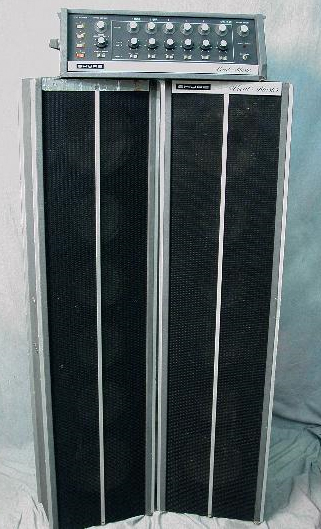
I knew how to setup a two-piece guitar amp, I could tune a guitar fairly well and set it on a stand by the amp, and I could plug all that in correctly. Mostly. The auditorium’s sound goober was an old guy named “Sears.” I don’t remember much about him other than the fact that he set out one mic, probably a Shure 55 or something like that and connected up a Shure Vocalmaster PA (two columns and a mixer/power amp tube-type head).  Once he had said “test, test, one,two, three” into the mic and heard himself from both of the columns set at opposite ends of the stage, Sears plopped himself down in a folding metal chair just behind the stage right wing curtain and . . . went to sleep during the first song of the sound check. He didn’t move again till the show was over and the audience applause woke him up. Once my tiny bit of stage-handedness was finished, I climbed up a ladder at the back of the stage left wing to the scaffold plank and sat right over the band, with my legs dangling at least 20’ over their heads.

Sadly, I remember very little about that concert. I remember almost falling off of the scaffold on to the band, bouncing up and down to the opening chords of “Slaughter on 10th Avenue.” Their hit, “Slaughter on 10th Avenue” was yet to be released, but they played it in that concert and knocked me out. The year before, my kid band played “Walk Don’t Run” and “Wipeout” on our way to winning a city talent show. I thought I knew all of their music, but they played all sorts of songs I’d never heard before and I was so jazzed to be there, to hear them live, and so pumped to have actually talked  to them before the show that I probably bulk-erased a lot of that night with pure emotion and excitement.

Before and after the show, I got to hang out with the band and I remember walking out of the auditorium with the band, after loading their gear into a trailer. I asked Nokie Edwards for an autograph. He said, “Surely,” and took the album from me. Bob Bogle said, “Don’t call that kid Shirley.” First time I ever heard that joke. Not the last, by 100s, though.

When I moved out a year later, my parents threw out that record and a ton of other stuff. After all the times we’ve moved, there is no chance I would still have it under any circumstances. Still, it would be cool to have that record cover and have it framed in my office.

In the late-1980s, I ran Front-of-House for Dick Dale at Anaheim Stadium. The sax player/bandleader, Jack Freeman, for a group I worked with for almost a decade there, Sum Fun Band, also had a small live sound rig he rented out. Since he was playing sax in Dale’s band that day, Jack hired me to run sound for the show (a pre-baseball game warm-up act outside of the stadium to entertain the tailgaters). Dale notoriously hated sound guys and Jack and a few friends in the business warned me that he might even take a swing at me if I pissed him off. His shows were notoriously loud, past the point of pain and permanent hearing damage and I’d seen him play a couple of times at the Huntington Beach national surf championships. It was a 5-piece band and we had 5 stage monitors to work with and a bunch of QSC power amps to drive them with (thanks to my employer). I put all of the monitors around Dale and drove them as hard as possible with almost nothing in any of the monitors except “the star.” It was so loud the sound pressure moved Dale’s clothes and strands of his scrawny ponytail like a breeze.

After the set, he hunted me down and told me I was the best sound goober he’d ever worked with. Jack was less impressed because he didn’t have any sort of stage monitoring and he and the rest of the band struggled to figure out what was going on. ;-) Not my problem, Dick paid the bills.

Monday, October 26, 2020

Serious Music

Back in the late 70s, I signed up for a recording seminar at the University of Iowa. Believe it or not, Iowa City, IA had a very small recording program and decent studios (primarily for classical music and the college jazz band) in the 70s. The presenter was Stephen Temmer, who must have been in his early 50's when I met him but who seemed "ancient" to me at the time (I was in my late 20's.) Temmer died in 1992 at 64, which I would probably consider "young" today. 

Mr. Temmer later became an adjunct professor at the University of Iowa, but at the time we met he was still President and owner of Gotham Audio Corporation, the only North American distributor for AKG, Neumann, Studer, EMT (plate reverbs), Lexicon, and many other things European. At the time of the course I took, Temmer was just beginning to market a collection of audio cables that he claimed were significant improvements over "ordinary wires" and we had some spirited discussions about that subject, too. 

I was at least as big an asshole then as I am now. During Temmer's introduction to the two-week-long, 8-10 hour/day course, he said something like, "We won't be discussing popular music recording in this class. Our topics will all be regarding the recording of 'serious music.'" 

I couldn't let that pass. Up my hand went and I said, "I didn't think music was a 'serious' thing. If it's not fun, it doesn't have much point does it?" I got a scowl and no reply. That was on Wednesday, the first day of class. For the next two days, Mr. Temmer pretty much ignored me. 

Luckily, the school's studio maintenance tech, Stephen Julstrom and I had hit it off pretty well, mostly talking about tape deck and console maintenance and design. The "in" with Mr. Julstrom, who was about my age (and who later became a design engineer with Shure Brothers in Chicago about the time I went to work for QSC Audio Products), provided me with some amazing opportunities including recording student classical performances and the college jazz orchestra (I still have a copy of that last one.). Unfortunately, one of the nights I'd volunteered to help Stephen record a student jazz group at a local coffee shop was the night the rest of the class went to see one of my lifelong heroes, Dizzy Gillespie, direct the UofI's big band. I've always regretted that and didn't get to see Gillespie until the early 90s in Long Beach with a small, mostly electric band. However, I got to play with some very expensive microphones that I'd only read about up to that moment and work in the college's great performance spaces using the school's very expensive equipment; although some of it was expensive, but not particularly high fidelity.

When the first weekend came, Steve Julstrom had invited Mr. Temmer and me out to his lakeside place for an afternoon barbecue. Because we were a one-vehicle family at the time, I'd taken the bus from Nebraska to Iowa City and Mr. Temmer offered to give me a ride to the lake. The school had rented a Cadillac for Mr. Temmer and I hadn't been in a new Caddy for several years. At the least, it would be a comfortable drive, even if we didn't talk much. I'd mentioned this experience in another Wirebender essay a couple of years ago, "That’s Not Serious, It’s Art." Who knows why, maybe to irritate me, maybe because it's how he always traveled by car, maybe he thought he was going to educate me, but Stephen fired up the stereo as we took off and found a classical station. When the orchestra started playing something I wish I could remember, Temmer began to wave his arms while he drove and sing along with a pretty decent voice. I watched him for a bit and about the time I started to smile at his performance, he looked at me and started laughing. We laughed together for a bit and had a great conversation about music being about "fun" and entertainment and a distraction from serious stuff and by the time we arrived at Julstrom's home we were more than acquaintances. 

The next day, Sunday, the Stephen's invited me to help record a piano-violin Bartok record with two of the school's faculty musicians and a collection of Temmer's Neumann microphones; new and historical (Including a Neumann omni that Temmer said was either "Hitler's microphone" or one like that used to record Hitler's speeches. It looked a lot like the one in this picture, as I remember. Temmer was an Austrian immigrant.) I also included several of the Audio Technica and Tascam microphones from my own collection in the recording and, later, we did a single-blind comparison of all the microphones used in this recording with the rest of the class. To Temmer's mild disappointment, the class overwhelmingly selected my Teac ME-120 condensers as their favorite in that test. The "Hitler mic" was pretty obviously lacking in high end response as the violin would often slide above the mic's capabilities far enough that it vanished in the mix. If nothing else, that proved that there are some limits to the vintage cache. 

For the next several years, any time I came upon a low-to-moderate cost microphone that I thought was either interesting or exceptional, I would write Stephen Temmer about it and, often, he'd ask to borrow it for a bit. I fell out of that habit a little before I moved to California in 1983, after my 2nd studio closed and I was convinced my life in music was all but finished. At the time, I was managing a manufacturing company building everything from high voltage inductance test equipment to the Arrakis Systems broadcast equipment. That might seem like I was still working in audio, but it didn't feel much like it. In my last few months in Omaha, massive personal turmoil pretty much squashed everything in my life but work and home. I'd been working with a friend, Mark Hartman, on jingles and pitches for commercial music, but that sort of withered away in those last months before I accepted the QSC job. 

Once in California, I was a regular member and occasional officer with the Orange County Audio Engineering Society (which no longer exists) and I bumped into Stephen at least once at the LA AES Show before he retired from and sold Gotham Audio in '85. A year or two later, I ran into him at Wes Dooley's AEA Micophones facility in Pasadena, when I was buying a couple Audio Precision test fixtures for the QSC assembly line. It still would be a few years before I started collecting and messing with microphones again, but I always clung to the idea that music wasn't a serious thing. If it's not fun for someone it's not music. I didn't see or hear from Stephen again and didn't know he'd died in 1992 until recently.

Note: Heidevolk and their one and only flash-in-the-pan semi-hit, Vulgaris Magistralis, are the poster children for my music is "fun" point. It's hard to tell from their other songs, but I can only hope these characters are posing as Viking assholes. Regardless, I love this song and it never fails to make me laugh when i hear it. I would just as soon not know anything more about the band or their opinions on "life, the universe, and everything." They might be "serous," but I think they are hilarious.

Monday, April 1, 2019

One Story, Two Books

One of my wife’s favorite concepts is “evolutionary convergance”; where the same evolutionary decision is made independently, likely because it is a good idea. The two books are The Birth of Loud: Leo Fender, Les Paul, and the Guitar-Pioneering Rivalry That Shaped Rock ‘N’ Roll by Ian S. Port and Play It Loud: An Epic History of the Style, Sound, and Revolution of the Electric Guitar by by Brad Tolinski and Alan di Perna. Play It Loud is a 2016 publication and The Birth of Loud came out this year. Your take on these two books will depend on your personality. The stories are, essentially, the same.

I read Play It Loud first and am just now finishing up The Birth of Loud. Of the two, Play It Loud is my choice.

There are too many technical flaws in The Birth of Loud and the writing style is too emotional and concentrated on personalities rather than technicalities. Your mileage will, probably, vary. Lines like this are show stoppers for me, “When Leo heard this story [about his pickups failing during a performance], he made sure that if the Esquire’s wiring shorted, the signal would only be diminished, not completely cut.” Wrong. If the wiring is “shorted,” there will be no output, regardless of Leo’s technical “genius.” Birth of Loud is littered with this kind of technical foolishness, to the point that when the author attempts to describe how anything works I have to kick into speed reading mode to get past his mistakes and misunderstandings. Otherwise, I’d toss the book in a pile and find something more interesting to read. There are moments in Birth of Loud that make suffering the flaws worthwhile, though. I knew almost nothing about Paul Bigsby, other than the fact that he knew the difference between vibrato and tremolo; unlike Leo Fender. By himself, he would be an interesting story, so the fact that there is a little more about Bigsby in Birth than Play makes that book worth reading; at least, for me. I do have to suffer through an awful lot of hyperbole, emotional language, and outright silliness to get to the good stuff, though. Port’s descriptions of the music discussed in the book are so over-the-top silly that it’s hard to take any of the book seriously.

Play it Loud is less emotional, more technically accurate, and a more entertaining and interesting read. The authors either check each other’s excesses and technical misunderstandings or they are simple more knowledgeable; or they had a better editor.

Interestingly, neither book is the usual Les Paul pandering that we’ve suffered for the last 40 years. I suppose Paul has been dead “long enough” that the shadow of his self-promotion is fading. I remember watching a Los Angeles AES discussion in the 80’s where Les Paul and Tom Dowd were on the panel and when Les started bragging about buying the “first Ampex 8-track machine,” Dowd reminded him that most of the design work on that machine came from Dowd and Ross Snyder’s idea of making a single 1” multi-track head, instead of Paul’s stacked individual heads and eight stacked ¼” tapes. Also, both Dowd and Paul ordered 8-track machines, more or less, at the same time and Paul’s was supposed to be delivered first, but Dowd snatched it off of the Ampex loading dock and installed it himself. Ampex delivered the 2nd one to Les Paul’s studio and installed it for him. Les Paul was the Jimmy Page of his time, claiming the creation of everything from electric guitar pickups to solid body Spanish-style guitars to recording techniques to tube amplifiers. Of course, there were predecessors for all of those inventions, but Paul made his claims more often, louder, and more prominently than that actual inventors. His contribution to the famous Gibson Les Paul guitars is accurately reduced to his signature on the instruments and some of people who actually designed those instruments are credited. History is catching up to Les Paul’s legacy.

Leo Fender gets a similar look in both books, probably more harshly/realistically in The Birth of Loud. His personal and technical limitations have been rarely discussed outside of knowledgeable conversations between engineers or technicians. The fact that Leo overcame his technical limitations with hard work is a fact, but the fact that his products were littered with the downside of those technical limitations has barely received a mention. The contributions of the many people who compensated for Leo’s limitations are finally documented in both of these books. Rarely, does one person actually “create” a significant product; almost never, in fact. Fender’s guitars and amplifiers are the product of a lot of unheralded effort by many people who at least get acknowledged in both of these books, more so in The Birth of Loud, to the credit of Ian Port.

Thursday, August 2, 2018

Describing “Good Sound”

A few days ago at a local outdoor concert, while I was suffering with the irratic, distorted, and sometimes painful mix of a local blues band a friend (a drummer) was practically luxuriating in exactly the same mix. His enjoyment came from the fact that when the rest of the group wasn’t blaring or a solo or lead vocal wasn’t totally overpowering the music, he could clearly hear the high hat. That was, in fact, true. Although most of the kit was masked by a muddy and too loud bass and the rest of the kit practically vanished when either one of the two lead guitars were soloing, the vocalist was singing, or the harmonica had either a solo or a fill, when none of those things were happening the high hat and other cymbals were audible. For a while, I was baffled by the thought that someone with a lot of musical talent and experience would zero-in on one aspect of the sound quality of the instrument he plays. After a few hours of thinking about it, I realized that the current state of live music “sound reinforcement” is so inconsistent and generally awful that anyone who really wants to enjoy live music is forced to concentrate on the few, little things that are done not-awfully.

That isn’t anythng new to me and it took me longer than it should to recognize it. As a recording engineer often working for bands and musicians rather than producers and record labels, I developed a psychoacoustics tactic that would often get me past the usual problem of volume wars between band members. Early in every song mix, I “introduced” every player at a level slightly above what I thought might be musicially ideal. If I picked a level and moment that was early and prominent enough that each player had an opportunity to focus on their part and its recorded quality each player would hang on to that impression of their place in the mix and carry it through to the end of the recording. More importantly, every time they listened to the mix hearing that moment would reinforce their feeling of presence and importance in the mix.

I’d love to say I invented this technique, but I have no idea where it came from. I do know that listening to Manfred Eicher’s Pat Metheny Group mixes taught me that “introducing” a solo player’s fills before that player’s solo arrived is a way to familiarize the audience to the music as they are listening to it. It makes something new and different feel familiar and comfortable, which is important when you are trying to fulfill Eicher’s idea that an /engineer or producer’s “role is to capture the music he likes, to present it to those who don't know it yet.” It’s an attempt to reduce the alienation listeners feel when they are exposed to new ideas and sounds. It also works, somewhat, when you are trying to convince a band or musician that your way of presenting their music to listeners has validity.

Monday, September 25, 2017

Another Brick Falls Out of the Wall

In late 1991, I left my job at QSC Audio Products and my 9 year career with that company for what turned out to be one of the dumbest career and relocation moves I could have possibly made. My tolerance for high density overpopulation and the Southern California pace had played out. A couple of QSC’s direct competitors had been trying to recruit me for a year or so and one company that was in a slightly different audio market made me an offer I decided not to refuse. That resulted in the shortest period of employment in my 55 year career; 30 days. The manufacturing leg and my office for my new employer were in Elkhart, Indiana and the headquarters were in Chicago. No decisions could be made without several meetings in the Chicago office and most decisions were undermined by the office politics that took place after I had returned to Elkhart. After what seemed like an infinite number of pointless meetings and product and production decision reversals and constantly shrinking mismanagement expectations and commitments, I began to suspect my employment with the company was a mistake. So, I expressed a little of my frustration to the CEO, “I’m surprised a $50M company has so many more financial limitations than a $25M company (my previous employer).”

He said, “What makes you think we’re a $50M company?”

“That’s what you had told me in the cover letter that came with your employment offer.”

“I guess that proves you can’t believe everything you read.”

I thought about that conversation on the way back to Elkhart, collected my test equipment and personal belongings from my office that evening, and wrote a letter of resignation that night. The next day I started shipping resumes to everyone I thought might be interested in my skills and experience, including both of those companies that had been interested before I moved to Indiana.

Within a few days, I had lined up interviews with a Bose design site in Michigan, a medical device company in Denver, Sony in San Diego, Underwriter’s Laboratory in Chicago, Audio Precision in Oregon, and Crown Audio in Elkhart, Indiana. I didn’t leave California with a lot of resources and quitting my new job on such short order meant Unemployment Insurance wasn’t an option, so time was fairly critical. I did phone and in-person interviews with UL, Bose, the Denver medical device company, and Crown by the end of my first full unemployed week. Crown called to setup a second interview for the end of the next week. Early that week, I received firm offers from the medical device company and Bose and both companies wanted a decision from me on fairly short order. For mostly personal reasons, I decided to accept the Denver offer on Thursday. I have liked Denver and loved Colorado since I was a kid. I was a little lonely and a good friend (who I would be working with) offered to put me up in his home for as long as I wanted to stay. Finally, the opportunity to work in an entirely new-to-me industry was an interesting challenge. Partially out of curiosity, I went back to Crown on Friday for the 2nd interview.

The Manufacturing Engineering Manager, whose name I have long forgotten, brought me into a fairly large corporate meeting room that was lined with poster paper full of relationships, responsibilities, activities, anticipated results and achievements, and likely advancement possibilities. Crown’s management had put more effort into my possible employment with the company than the management all of my previous 25 years of work. What followed was an interesting interview with a half-dozen managers and another half-dozen people I’d be working with or who would be working for me. I was a little more blunt and honest in my answers to their questions, since I was pretty committed to the Colorado offer I’d already conditionally accepted and to getting the hell out of Indiana (a generally low income state that could be the poster child for economical inequality). I hadn’t yet received the written details to the Colorado offer and the formal offer, so I could still change my mind without too much guilt and I could discuss the possible Crown job without feeling like I was wasting their time.

CROWN AUDIO harmon internationalOn Monday, the Denver job offer arrived in the mail with a Wednesday decision deadline. I hung on to it until a little before the end of the work day Wednesday and called to accept that job. My new employer sent a moving van for my stuff the next day and I was on the road to Denver Thursday evening. Friday night, I was camping in southern Illinois and called my wife in California to check in. She said someone from Crown had called and really wanted to talk to me, leaving a home number. It wasn’t that late, so I called the number and discovered that Crown had tried to contact me in my Elkhart apartment that afternoon to make a very generous offer of employment. I had to tell him I was “taken” and wouldn’t be coming back to Indiana any time soon. He sounded disappointed, but I had warned them my decision was time-sensitive and that there were lots of factors that would determine my next career move.

I left Indiana in mid-November and didn’t have to be at my new job until January 2 and my new employer had provided me with a signing bonus and moving allowance so I wasn’t even in much of a hurry to get to Denver. The friend I’d be staying would be available to receive the moving van, so even making sure my stuff arrived intact wasn’t pressing. I took a full month to get from Indiana to Denver and, other than a little recording engineering and occasionally music equipment repair business, I was out of audio for the next decade. I never forgot the impression Crown made with me, though. I honestly felt like I’d been working in a poorly equipped garage at QSC for the previous 9 years, Crown felt that much more substantial and organized than we’d been while I thought we were their most serious competitors.

vinAd73CrownProSo, when I read that Crown had been absorbed in 2000 by the music business’ brain-drain conglomerate, Harmon, I was both disappointed and glad I’d passed on the Crown job. Honestly, other than Crown there wasn’t much about Indiana that appealed to me. I might not have lasted long there. Harmon was purchased by Samsung Electronics last November and the writing was on the wall for Elkhart before that depressing news. This month, when I read that Crown was closing the Indiana facility doors for good and only 115 jobs were affected, I have to admit I felt more than a little sadness. When I interviewed with Crown, I’d guess the facility employed at least 500 people. More importantly, there were a lot of decent, hard-working, competent people making and designing Crown products in 1991 and I hate to think that their efforts were wasted.

dc300At one time, Crown was the only target in our sights at QSC. They were the industry leaders and everyone else was at our level or below. Go back to the late 1960’s and Crown’s DC300 solid state power amp was the only serious pro power amplifier game in town. Crown was an innovative, trustworthy, and decent American company and there is nothing good to say about the death of that sort of business. There aren’t many left and as the US continues to de-evolve into a minor 3rd world industrial power there will be a whole lot fewer in our future.

Monday, January 27, 2014

Evolution 001

Once upon a time, there was a wonderful music college that specialized in training young people for the cut-throat relatively-high technology world of modern music. That school had a great name, considering its mission; MusicTech College. The school's mission was to help young musicians and musical technologists find their way into a "life of music." Since modern music is technological in function and design, "MusicTech" was a terrific brand for the school. So much so, in fact, that groups of graduates from the school were called "MusicTech Bands": a description that indicated to other musicians that these kids were a special breed of skilled, theoretically informed, technically adept musicians who were a head above the rest of the pack. I know, that's not saying much since obtaining a music degree isn't known for being a smart economic decision

Being a MusicTech College instructor was a thing to be proud of. The faculty was focused and mission-driven and we were led by a man, Michael McKern, who epitomized that mission and focus. The school's two founders, Jack McNally and Doug Smith, were somewhere in the background in those days, but were not academically involved and barely seemed to know what was going on in the facility they owned. That was particularly apparent when the school moved to St. Paul from Minneapolis and in the last days of construction the two owners were occasionally shepherded around the nearly finished building marveling at the accomplishment. I was on the studio construction crew, which worked 18-20 hours a day for a couple dozen days to get the building in shape for the spring 2002 semester and, before they appeared for one of those tours, I thought McKern owned the school.

In 2005 and after a couple years of wrangling with accrediting bullshit, politics, egomania, and academia, general foolishness, and the usual American mismanagement disconnect from rational business conspired to force the school to "re-brand" the school and the mission went with the brand. The liberal arts community feels threatened by anything connecting "tech" to education. Apparently, MIT, Georgia Tech, Cal Tech, and the host of America's best institutions that proudly label themselves with the dreaded word "tech" don't live up to the dubious standards of today's for-profit fluffball liberal arts and Cardboard Blue trade school accrediting organizations. I'm sure the fact that a half-conscious, completely incompetent liberal arts accrediting agency disrespects "tech" bothers those great institutions deeply.

Sometimes I remember those days, probably unrealistically and overly fondly, and I do a search on "Music Tech" and hope to see some remembrance of that school and its students and instructors. In early February, I got a bunch of hits on that word (brand?) that was incredibly encouraging: The SF MusicTech Summit.

"The SF MusicTech Summit brings together visionaries in the evolving music/business/technology ecosystem, along with the best and brightest developers, entrepreneurs, investors, service providers, journalists, musicians, and organizations who work with them at the convergence of culture and commerce. We meet to do business and discuss, in a proactive, conducive to deal-making environment."

Shades of the good old days.

Another hit produced Music-Tech.com, which is the personal business site of "Award Winning Mixing Engineer" Stephen Sherrard. Sherrard has put together a fairly interesting "Resources for the Recording Musician" blog/informational website and also seems to be an echo of the old Musictech College mission.

One of the copout justifications for the name change was that their was competition for the name from the British music magazine MusicTech Magazine. That made no sense in 2005, since the school had been operating under the MusicTech College name for more than a decade and MusicTech Magazine came into existence in March of 2003. Anthem Publishing, the owner of the magazine version of "Musictech" didn't do much with the magazine for a couple of years, but after the college relinquished the name the magazine seems to have really taken off. Good for them. (Oddly, one of the school's most talented ex-instructors, Rob Schlette, named his mastering business Anthem Mastering. My wife would call that something more spiritually coincidental than "odd.")

My favorite MusicTech reincarnation might be the Musictech Society.  "We are the society in Imperial College Union for Music Producers and DJs. We meet to make music, mix music and discuss music (and drink and things)." Like rap (the printer left off the "c"), the whole DJ thing loses me, but I like their attitude.

Epilogue: It took me more than a few years to remove all of the old MusicTech College links and logos from my school presentations. Even in recent years, I have uncovered hidden MT logos or reference in my stuff. I, clearly, did not want to let go of the idiotic dream that MSCM would come to its senses and return to the name that implied a mission (and that mission). Instead of replacing it with the new brand, I eventually decided to stamp my work with my Wirebender logo and wait to see if anyone would notice.

Monday, June 10, 2013

Old Stuff in the Pipe

I just uploaded the entire history of my audio publication work to this blog. Over the next few months, pretty much everything I’ve ever written about audio will show up here. Some of it is pretty antique, including reviews of long-dead companies or obsolete products. Sooner or later, the Wirebender Audio Systems website will vanish from the internet and it will be nice to know that some of that stuff will still be here as long as Google keeps Blogger alive.

Wednesday, May 1, 2013

Educational Theory

I have a theory (surprise!) about traditional education. Academia is, contrary to popular opinion and its own self-image, always behind the curve. Because of the "accreditation" and "credentials" hang-ups, it's all-but-impossible for traditional universities to hire people who actually know something useful. So, by the time one of these institutions figures out that an industry has a need for qualified, trained, and skilled entry-level employees, the industry is practically historic and the need is long gone.

Here, for example, is a job posting for an instructor in a substantial state school:

Position: Assistant Professor of Music Technology (Tenure –Track)
Department: Music 

Rate: Minimum Starting $46,400
 

SUMMARY: The faculty in this position must have a strong commitment to teaching excellence, creative activity, scholarship, student advisement, and university and community service.
 

DUTIES & RESPONSIBILITIES: Faculty contractual duties include, but are not limited to:
 Teach a full load of Music courses equivalent to four courses (12 credit hours) per semester or eight (24 credit hours) per academic year;
 Teach and /or oversee the teaching of music education courses such as instrumental conducting, instrumental techniques, and music education techniques;
 Provide leadership and recruitment of students who major in music technology, composition, and education;
 Participate in professional music education organizations, fostering relationships with local and state secondary school music programs;
 Procure and maintain music technology equipment and software, musical instruments, and instrumental music library materials;
 Observe Field Base Level III music students as they near graduation;
 Direct student instrumental wind and jazz ensembles;
 Instruct applied brass and/or bass in a variety of styles, including jazz;
 Advise students;
 May be assigned to teach evening and/or Saturday classes, courses via ITV, and/or develop and teach Desire to Learn courses;
 May be assigned to supervise field experiences;
 Develop and maintain collaborative and professional partnerships/relationships with local schools and provide service at the university, state, local and national levels;
 Hold office hours as required;
 Direct and/or supervise student research, independent study, field project, and thesis;
 Serve on faculty or University committees;
 Conduct scholarly activities such as research in a particular field of knowledge and submit findings for publication and/or presentation at professional conferences;
 Maintain regular attendance;
 Perform other related duties as assigned.
 

MINIMUM QUALIFICATIONS:
EDUCATION: Doctorate in Music and/or Music Education
EXPERIENCE: Five (5) years of teaching music technology and education courses, conducting instrumental ensembles, and teaching applied instrumental and composition lessons.


In addition to the minimum qualifications, preference will be given to the following:
o Demonstrated experience in composing and performing music for live performances, recording, editing and producing recorded music using the latest computer software programs
o Experience teaching digital audio recording, production, editing and notation software;
o Demonstrated experience excelling as a team member with good communication skills while maintaining personable relationships with educators and students;
o Demonstrated experience in facilitating improvements in music curricula;
o Experience with event planning associated with music concert performances;
o Experience participating in recruiting events and public music performances.
 

KNOWLEDGE, SKILLS AND ABILITIES Skill and expertise in the classroom;
 Ability in the use of technologies and/or strategies to enhance pedagogy;
 Ability to work effectively with a culturally-diverse student body;
 Ability to develop effective methodology for the integration of teaching and research;
 Ability to demonstrate excellent communication skills;
 Ability to teach undergraduate and graduate level courses;
 Ability to supervise undergraduate and graduate student research.


Presumably, this "instructor" is going to be useful to students as some sort of credible resource, but how is that possible? What would someone with a "Doctorate in Music and/or Music Education" and "Five (5) years of teaching music technology and education courses . . . " know that would be useful to a prospective professional recording engineer or producer? The answer is obvious, isn't it? Not to academia.

A lot of this comes from a wrong-headed delusion that is core to academia: the disconnect between what students want and expect and what educators imagine they want. Students have bought into the fantasy that "education is important." The kinds of numbers educators promote are based on some pretty sketchy numbers games. When students ask colleges to accept some of the risk, they get nothing but blank stares from those risk-adverse institutions. And for good reason, the connection between higher education and earnings are nebulous, at best. A few years back, I read an article that claimed that if you remove the "honorary" PhDs from the educated side of the ledger, the payback for higher education falls to nearly non-existent. When the Steve Jobs, Mark Zukerbers, George Soros, Richard Bransons, Bill Gates, Warren Buffetts, Steve Woziniaks, and the rest of the incredibly rich honorary PhDs are reduced to their dropout or BA status, it's possible to suspect that spending a lot of time in class might be a mistake. In some professions, it is.

So, my theory is "Any time you see a profession that is academically represented by people who should be in the prime of their careers, that profession is obsolete." It's also possible that any profession that is thoroughly ensconced in academia is history.

A while back, I got involved in a "discussion" on the AES Faculty Advisor newsgroup after I'd recommended an excellent instructor who had recently become "available for employment." When I mentioned that he had everything going for him except a college degree, several of the discussion participants chimed in that a recording engineering "terminal degree" was absolutely necessary in their institutions. When I suggested that educational paperwork was pretty much a non-issue in the industry, one instructor replied with "Well, what we're selling students is a degree, so I think it's pretty important from our standpoint." I guess I was wrong. I always thought we were trying to teach kids how do to useful work?

Friday, July 2, 2010

Public Address

The "PA system" (public address) is damn near as old as me. Maybe older. When I was a kid, an auditorium PA system was often a 15W Bogen tube amp and one or two Shure Vocalmaster columns. Some folks used Shure's mixer/power amp, but anyone who did that produced awful noises that couldn't be identified as either human or musical. The PA system has grown up in the last 60 years. It hasn't become better but it's definitely louder.

When I worked for QSC Audio in the 80's and 90's, we grew from a small company that made extremely solid, dependable, and reasonably good sounding amps to a major competitor in the pro audio field. During that period, pro audio went through some changes that it is still suffering from; the smaller and lighter is better movement. To be honest, the company that started that trend in power amps was Carver; with the PM 1.5. This POS amp was hyped as being able to drive 750W per channel into a 4 ohm load and weighed 16 pounds. When it clipped, it made exploding noises that often took out drivers. When it didn't clip, it was harsh sounding. If you pushed the amp hard, it would thermal cycle or die. Regardless, because it weighed a fraction of amplifiers with similar specs (more evidence that "anyone can write a spec sheet") the sound companies loved it. At QSC, we almost went broke before a few of our old customers came back to us after their Carver experiment.

Twenty years later, the whole industry is driven by Carver-style components: amps, speakers, consoles, and most of the signal path. Amps are multi-stepped or digital and weigh less than a 1960's microphone. Speakers are arrayed and tiny and sound like rejects from the Bose consumer product line. Consoles are digital and so menu-layered that most FOH mixers set 'em and leave 'em, regardless of how godawful the show sounds.

This week, I subjected myself to another round of suffering modern sound systems to get to see an old musical hero: Steve Winwood. Winwood was the intro act for Santana and I haven't seen Steven since Traffic. Since I had comp tickets (no concert sells out in 2010), the cost of seeing Winwood was whatever I paid for parking. Supposedly, the St. Paul Xcel Center is a great sounding room. I hoped that would be so for this show. It wasn't. As usual, the arrayed cluster-fuck of tiny horn boxes was tasked with the impossible duty of providing reinforcement for this large hockey gym. While the designers of the Xcel Center put a lot of work into deadening the room for musical performances, nothing those designers could do could have compensated for modern array speaker systems.

As best I can tell, the contract for all R&R concerts specifies a minimum volume level for shows. Nobody apparently cares how awful it sounds, as long as it is loud. In my 50 years in audio, I have never heard anything coming from an arrayed speaker system that is anything but painful and tonally irritating. Honestly, the theory behind these systems leaves me doubting the mathematical capabilities of the designers, but the practical application proves the theories to be flawed.

For the Winwood portion of the show, the system's resonances were somewhere between painful and obscuring. There was a pile of 70-400 Hz crap that the under-capable arrays failed to produce, so the system "engineer" (using that term grossly loosely) tried to correct with his subwoofer system. If you've read my take on subwoofers, you know how I am going to feel about this tactic. Winwood's bass came from the B3 petals. A B3's bass is one of the most totally cool bottom-end instruments ever invented, but you can't reproduce it with a pile of resonant horns. The sound is too complicated, too powerful, and too characteristic for a reproduction system that turns every LF note into "whoomph." So, the bottom end of the system was a muddy mess.

Winwood's voice was pretty well matched to the rest of the system's midrange capabilities, but everything else was reduced to OEM-quality car stereo fidelity and the FOH goofball's attempt to create top end from his garbage horns was painful, at best. I suspect the FOH doofus was running the system from his laptop, because I didn't see (or hear) anyone working the mix. It could be that he was at the audiologist's office getting his hearing aid battery replaced. If so, he didn't miss much.

Santana's set was about the same, only louder. He had a light show and a video screen to compensate for the lack of a sound system, but it wasn't enough. When my hearing protection was clearly failing to provide adequate protection, we left.

As usual, the show was about 1/3 attended with a substantial number of comp tickets given way to fill some of the empty seats. A lot of people gave up late in Winwood's set and left to save their hearing. When we were left, probably mid-way through Santana's set, we weren't alone in the parking lot.

I think, if live music ever hopes to make a comeback, sound companies are going to have to give up on the fantasy that light and small and loud are more important than fidelity. I'm unconvinced that making customers suffer for musicians' "art" is a winning tactic. Most of the under-30 crowd that I know consider major concerts to be miserable experiences that they hope to avoid for the rest of their lives. I'm starting to think they are right.

Sunday, February 21, 2010

Vinyl vs. Bits

For some reason, I've toted around about 100 pounds of vinyl and a last-generation direct drive Sony turntable for the last two decades. It hasn't been much of an effort for the last dozen years, since the whole pile has lived, boxed, and sealed in my basement. Last week a friend loaned me his new turntable-to-USB toy and I decided to convert some of my old records into a format I might listen to. The experience has been eye-opening. 

No, I haven't been converted to an analog fanatic. Just the opposite, in fact. 

The more I listen to the magical world of vinyl the easier it is to understand why records vanished so quickly. Another friend who loves all things old and expensive is convinced that my dislike of the classic "snap, crackle, and pop" sound of records is overly picky in a world of crappy live sound systems, digital television dropouts, and grossly over-compressed CDs and other audio media. I admit that I do like the dynamic range of a 1968 LP. However, the max s/n of a record was somewhere in the 50-60dB territory and CDs easily exceed that range. 

The fact that modern mastering standards generate non-musical products does not condemn the technology. There is a boatload of crazy vinyl philosophy on the web. One of my favorite nutty claims is "Vinyl was custom made for the human ear." Vinyl -- like CDs, MP3s, and tape -- was made to generate a pile of money for someone. Several someones, at best. There is absolutely nothing about the RIAA equalization curve that bears any relation to the best function of the human ear. The incapacity of records to tolerate the sorts of phase oddities that surround us every day is another example of how poorly vinyl records and reproduces acoustic activity. The lack of dynamic range and LF capacity and the phonograph records inability to store and reproduce distinctly different information on the left and right channels is even more data for the "vinyl sucks" argument. 

And, of course, "snap, crackle, and pop" were still everpresent. Clean them, lubricate them with expensive concoctions, put them in a vacuum chamber and records will still contribute their irritating "quality" to the listening experience. 

 But that's not the point of this rant. The real surprise for me was how often my old records had been mixed by crazy people. I'm not talking about the early "stereo" mixes that were just bastardizations of mixes that were intended for mono; like the early Beatles stereo records (instruments full left, vocals full right). No, I mean "modern" mixes intended for stereo records that are just nuts. At first I thought there was something wrong with the turntable. No one would be so careless with pan controls, would they? I was wrong. They would. A bunch of the Warner Brothers stuff I'd kept out of nostalgia is practically unlistenable because the mixer was clearly on crack. Guitars that swing from one side to the other, drums that vary their pan dimensions or are so obviously spaced mic recordings that are so radically spaced that half of the kit resides only in the left ear and the other half in the right. Of course the kick is buried in the limpid center and the bass mumbles around that same vicinity. 

The "obvious" advantage of records completely escapes me while listening to this mess. All this brings back nasty memories of my own record past. At Wirebender, we never found a mastering lab that did much more than not piss us off. When we had a budget for 3 or more mastering options, we selected the one that did the least damage to our master tapes. Never once did a record even approach the dynamic range, frequency response, or stereo image of the original final mixed tape. I remember the phrase, "I hate this one the least" as the closest thing to acceptance we ever managed. 

Finally, after all these years of lugging 100 pounds of vinyl around, I'm going to be able to clear out this section of the basement to make room for something useful. The next pile of junk I'm going to pare away is my collection of unstarted model motorcycle kits.

Wirebender Audio Rants

Over the dozen years I taught audio engineering at Musictech College and McNally Smith College of Music, I accumulated a lot of material that might be useful to all sorts of budding audio techs and musicians. This site will include comments and questions about professional audio standards, practices, and equipment. I will add occasional product reviews with as many objective and irrational opinions as possible.