Showing posts with label popular. Show all posts

Wednesday, November 13, 2024

Nothin' New Here

For as long as I have been aware of pop music, I have noticed a particular decline-and-fall-and-reinvent cycle for failed rock stars. As their rock careers either begin to fade or never get started, they merge into country “artists.” Of course, even more country stars gave up on the rock bit as soon as it was obvious they didn’t have what it takes, before anyone even noticed they were ever rock-wannabes they move to country.

Why? Because country music is a much less competitive field of music and you can get away with a lot less talent, creativity, or attractiveness. In fact, you can be seriously old and ugly and still be a country star, at least if you’re male. An article about the motivation for this career path was explained in a Houston Press article describing that Aaron Lewis’ “rationale for going country was a smart one. After all, country fans are some of the most loyal when it comes to purchasing music and listening to terrestrial radio.” You can certainly point to seriously skilled musicians and vocalists who have moved to or stayed in the country genre, Brad Paisley for example, but those exceptions are proving the rule. As always there are monster players in the studio background regardless of genre.

When your music trends change on a glacial pace, it’s hard to become obsolete in one lifetime. Check out this partial list of pop/rock-to-country stars:

  • BeyoncĂ©
  • Bob Dylan
  • Bon Jovi
  • Brett Michaels
  • Carrie Underwood
  • Cindy Lauper
  • Conrad Twitty
  • Darius Rucker
  • Don Henley
  • Elvis Costello
  • Jelly Roll
  • Jerry Lee Lewis
  • Jessica Simpson
  • Jewell
  • Kenny Rogers
  • Kid Rock
  • Lionel Richie
  • Michelle Branch
  • Nelly
  • Post Malone
  • Ray Charles
  • Shania Twain
  • Steven Tyler
  • The Byrds and Roger McGuinn
  • Tiffany
  • Tina Turner
  • Tom Jones
  • Van Morrison
  • Ween
  • and the plethora of singer-songwriters who have skirted both genres for their whole careers; Jimmy Buffett, for example.

So it goes for hip-hop/rap, without the fading and restarting part. Skipping the hassle of learning to play an instrument, obtaining some kind of vocal ability, rap allowed some serious no-talents to jump the fence from spectators to “producers” without any wasted time learning a “craft.” So, the 2nd comparison is between soul/R&B and rap/hip-hop. If you don’t have the chops for the first, you might be over-talented for the 2nd.

You can like this, laugh at it, or hate it as “racist” or intellectually unenlightened. I don’t care and you have a right to and might be right in your opinion. Country music is largely less sophisticated, far less innovative, and less difficult than comparable pop/rock branches (heavy metal vs country metal, for example). Rap is a tiny fraction as musical as R&B. 50 Cent couldn’t do any part of Seal’s musical act, but anyone who can read fairly quickly can pull off a 50 Cent vocal performance. And Kanye West’s total failure to “sing” any part of Bohemian Rapsody (Rapshoddy?) pretty much put the nails in the coffin that carried his self-image as a singer.

Tuesday, December 5, 2023

It’s A Smaller World Than I Imagined

I am working on finishing up, as it is, our basement office after my friend/contractor Dan Jacobson installed an egress window last weekend. That mostly means, so far, me puzzling together the ceiling tile mess the previous owner/nitwit/contractor made when he chopped up the ceiling to install the forced-air HVAC system the repossessing bank hired him to install. (“Wells Fargo, the dumbest bank on the planet.”) Because I don’t know what I’m doing with most of this job, that means a lot of trips to Menards and Ace for materials and, occasional, tools.

Since I’m spending more than the usual amount of time driving, I’m listening to my random playlist of music that I have stored on USB sticks in the pickup or CRV. I probably don’t have more variety on my playlist than most people, but I do have recordings from a lot of unusual artists. Not only do I have music from well-known artists from the 1930s to today, but I have lots of music that I have been personally associated with either as a musician and/or a recording technician since the mid-1970s. If I’d have known I was going to live this long, I’d have hung on to the stuff I recorded with the Tracers and other kid-bands in the 60s, especially my original songs. Sadly, all of that stuff accidentally ended up in a dump somewhere in Omaha when we moved from that city to L.A. in 1983. Still, I have almost 100 hours of music on my USB stick that I can almost guarantee nobody else in the world is playing at any given moment.

Yesterday after a hardware and grocery store run, the playlist landed on Scott Jarrett’s “Uneventful Lives” and, like everything on “The Gift of Thirst,” it’s a song I know pretty well and like a lot (I like everything on that album.). So, I ended up carrying on with the tune when I went into Aldi’s to buy the “software” for dinner last night. I listen to a lot of music that I usually assume nobody but me knows: stuff I’ve/we’ve written or recorded, music friends have recorded, records that I’ve owned for 30-50 years that was either regional or passed through the popular void unnoticed. Some days, it’s kind of a matter of pride to me that all of this great music is probably only being listened to by me at that particular moment. I mean in the whole world of 8 billion babbling nitwits I’m almost guaranteed to be the only person on the planet listening to a particular song at that moment: 1 in 8 billion, 1/8,000,000,000 or 0.0000000125% of the population are listening to what I’m listening to. I know that isn’t true for Scott’s first record, “Without Rhyme or Reason,” but, like a lot of great music, the two records he made in Hudson, WI didn’t get anywhere near the recognition and appreciation they deserved.

So with “Uneventful Lives” in my head as I left the truck, I walked into Aldi’s singing the random bits of chorus and verses (as usual, I can’t remember any lyrics accurately). About half-way into my shopping trip I was walking toward a woman about my age, pushing a cart in the opposite direction in the same isle. About that time I got to the end of a verse, “So we’ll pirouette away, as the band begins to play. And we’ll drink a toast to husbands and to wives.” And as I passed her she sang, in excellent harmony, “And the sweetness of our uneventful lives.”

Because I am incredibly slow-of-wit, I kept walking and singing to myself, but a big part of me was open-mouth stunned. Nothing like that has ever happened to me. A smarter, quicker guy would have turned around, introduced himself, and asked “Where do you know that song from?” or something equally witty. I did not. In fact, it didn’t occur to me that I should do that until I was loading groceries into the truck. By then, I probably couldn’t have picked her out of a lineup of two people, even if one wasn’t an older woman. So, we’ll likely never know who she is. But . . . damn! It is either one amazingly small world, or Scott’s music landed a lot more places than I knew.

Sunday, August 27, 2023

The Deaf Leading the Deaf

Because I’m a slow learner, I went to a local outdoor concert this past weekend. The headliner is a friend and I know a couple other folks who would be playing earlier in the day.Honestly, I felt a bit of an obligation to be part of the audience for their music. I know that a Red Wing, MN audience isn’t typical of pop music audiences with an average age approaching at least 70, but music “fans” of all ages are sadly similarly hearing-impaired. Depending on perspective, I was or wasn’t disappointed with the “music.”

Over the past couple of decades, I have become less inclined to suffer for someone else’s “art,” in the form of painfully loud, distorted, weirdly-mixed live music. This isn’t the first time I’ve written about this, so it might be boring. It struck me, about 3 songs into the set I’d come to see, that live music today is doomed because all ends of the people involved in production and listening are functionally deaf or, worse, don’t care about sound quality at all. My friend is a songwriter and his band is tasteful, talented, and they make an extreme effort to stay out of the vocalist’s way. The soundgoober (the man leaning on the console as if it were a drunk’s crutch) started the show with a severely distorted and loud kick drum and bass guitar blast and took 3 songs to squeeze the vocal a little way into the mix; not enough to understand the lyrics but enough to know there was a vocalist. Worse, it took him 45 minutes of “check, one, check, two” crap to do a musically pointless soundcheck, making the headline show start time 30 minutes late.

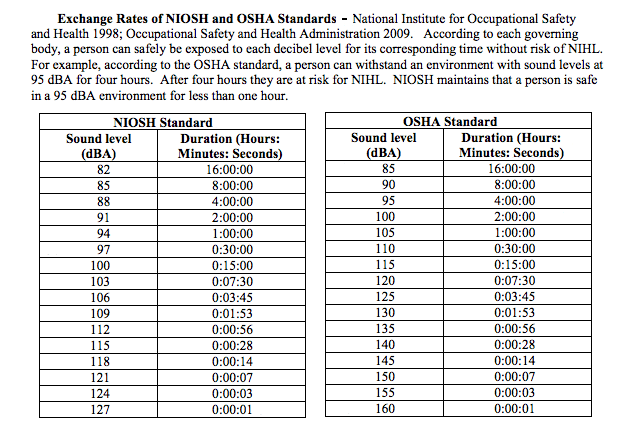
As usual, when I described my disappointment to other people who had seen the show, I was the Lone Ranger of Criticism. According to the National Institute on Deafness and Other Communication Disorders, “About 2 percent of adults aged 45 to 54 have disabling hearing loss. The rate increases to 8.5 percent for adults aged 55 to 64. Nearly 25 percent of those aged 65 to 74 and 50 percent of those who are 75 and older have disabling hearing loss.” I, personally, think that is grossly optimistic, based on my own experience with live and recorded music listeners. Back in the 80s, the Audio Engineering Society invited an otolaryngologist organization to test the Society’s convention participants on a voluntary basis. The outcome was the discovery that practically everyone involved in music recording and, especially, live music was functionally deaf. Today, most or much of the audience is equally hearing damaged. It is not even slightly odd to be in a small music venue with a band blasting deafening volume and some of the audience, even so-called critical listening reviewers, shouting “I can’t hear you!” In their arrogant, self-centered manner, they are clearly willing to damage everyone else in the room because they are disabled.

Standard NIOSH OSHACheck out these two charts, one from OSHA that was established during WWII manufacturing, and the other from NIOSH that more accurately reflects what is currently known about hearing loss from environmental “noise” (aka “music”). In some fairly progressive companies, the first numbers on either chart are used to determine when hearing protection is required for workers in those benevolent work environments. Typical amplified pop concerts subject their audiences to noise levels upwards from 115dBC, which means after about 30S of “music” you are experiencing permanent hearing damage. The music better be damned amazing to give away your hearing in exchange.

Wednesday, June 7, 2023

1966 Was A Weird Year

By now it should go without much explanation that I’m not a big Beatles fan. In my decline and fading memory, the one album that I remembered liking was “Revolver.” While pawing around some books about pop music, I stumbled on Robert Rodriguez’s Revolver: How the Beatles Re-Imagined Rock 'n' Roll and checked it out from my library. While I was at it, I checked out “Revolver,” too.

Product Cover for Revolver How the Beatles Re-Imagined Rock 'n' Roll Book Softcover by Hal LeonardFirst, the book was a huge disappointment. Mostly, it’s 250 pages of fanboy gushing over Beatles trivia. Since the book was published in 2013, I’d had irrational hope that we’d be past that and into something more technically interesting. There is a small middle section about the actual creation and recording of the record. Some bits of that are interesting, especially the revisionism of the revisionism and some of the funny stuff about how the memories of a quartet of stoners and the people around them were notoriously unreliable. The “correction” several people added to Geoff Emerick's George Harrison grudge from Here, There and Everywhere: My Life Recording the Music of the Beatles was sort of interesting. Before and after that, I could have used some of the Beatle’s 1966 stimulants to stay awake through the book.

History has a nasty habit of dragging us back to reality. Boomers weirdly remember the late 60’s fondly, which makes me suspect they either weren’t there or they we drugged/drunk into oblivion. The crap that was regularly on the late-60’s charts should embarrass my generation into never-again speaking of our musical opinions. Rodriguez regularly puts up US and British record sales chart and consistently 7-8 of 10 songs on those lists are, thankfully, consigned to the sad history of crap music. WLS’s June 1966 playlist put Tommy James’ “Hanky Panky” at the top, followed by “Paperback Writer/Rain” and “Strangers in the Night.” If you ever want to be humbled, musically, poke your birthday into “Find the #1 Song on the Day You Were Born” and get ready to be disgusted. For me, it's “Woody Wood-Pecker” by Kay Kyser and His Orchestra. Yeah, I know, poetic justice at work.

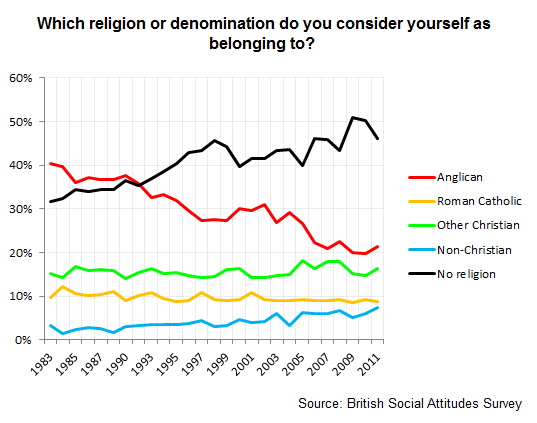
Has Britain lost its faith? - Full Fact“Revolver” was the record whackjobs liked to smash in the 60s. It came out right after John’s famous opinion on American religion hit the news,  “Christianity will go. It will vanish and shrink. I needn’t argue about that; I know I’m right and I will be proved right. We’re more popular than Jesus now. I don’t know which will go first – rock & roll or Christianity. Jesus was all right, but his disciples were thick and ordinary. It’s them twisting it that ruins it for me.” Later, he claimed he was talking about Christianity in England and he probably was and he was pretty obviously right. The chart at left ends in 2011 and, as of 2021, British religious participation declined another 13.1%. Whatever, that controversy did some serious damage to “Revolver’s” record sales, which is partially why it is mostly a forgotten Beatles record.

Revolver (Beatles album) - WikipediaAfter suffering through the book, I decided to see if any part of my good memories of “Revolver” were valid. The library copy was an analog-to-digital version of the 1966 stereo release. First, John Lennon was notoriously unhappy with his voice and gets some credit for whining about having to actually double-track his vocals,.which inspired EMI engineer Ken Townsend to invent the Automatic Double-Tracking (ADT) device used on practically everything in “Revolver.” After listening to “Revolver,” I’m with John. I was painfully reminded of their Chipmunk voices and the squeaky harmonies. While US engineers like Tom Dowd were knocking stereo recording out of the park in 1966 with records like The Young Rascal’s “What Is the Reason,” the Brits were still panning vocals hard left and instruments hard right (or the reverse or other weird combinations) and managing to get some bass into the recordings, too.

Considering the privative 4-track recording technology Martin and Emerick were cursed to be using on “Revolver” and the inflated egos (and lazy spoiled boy habits) they were dealing with it isn’t a terrible record. Listening to it pretty much demolished any fond memories I had. Compare “Revolver” to one of my favorite records of the day, Lorraine Ellison’s “Stay With Me” and get back to me on how great the Beatles were. As much as I appreciated George Martin, Phil Ramone more than topped anything that came out of England for the next decade with his engineering work on this song. And this is exactly why I resented The Beatles in the 60s because the British crap knocked this kind of music off of the charts for almost a decade.

Monday, October 26, 2020

Serious Music

Back in the late 70s, I signed up for a recording seminar at the University of Iowa. Believe it or not, Iowa City, IA had a very small recording program and decent studios (primarily for classical music and the college jazz band) in the 70s. The presenter was Stephen Temmer, who must have been in his early 50's when I met him but who seemed "ancient" to me at the time (I was in my late 20's.) Temmer died in 1992 at 64, which I would probably consider "young" today. 

Mr. Temmer later became an adjunct professor at the University of Iowa, but at the time we met he was still President and owner of Gotham Audio Corporation, the only North American distributor for AKG, Neumann, Studer, EMT (plate reverbs), Lexicon, and many other things European. At the time of the course I took, Temmer was just beginning to market a collection of audio cables that he claimed were significant improvements over "ordinary wires" and we had some spirited discussions about that subject, too. 

I was at least as big an asshole then as I am now. During Temmer's introduction to the two-week-long, 8-10 hour/day course, he said something like, "We won't be discussing popular music recording in this class. Our topics will all be regarding the recording of 'serious music.'" 

I couldn't let that pass. Up my hand went and I said, "I didn't think music was a 'serious' thing. If it's not fun, it doesn't have much point does it?" I got a scowl and no reply. That was on Wednesday, the first day of class. For the next two days, Mr. Temmer pretty much ignored me. 

Luckily, the school's studio maintenance tech, Stephen Julstrom and I had hit it off pretty well, mostly talking about tape deck and console maintenance and design. The "in" with Mr. Julstrom, who was about my age (and who later became a design engineer with Shure Brothers in Chicago about the time I went to work for QSC Audio Products), provided me with some amazing opportunities including recording student classical performances and the college jazz orchestra (I still have a copy of that last one.). Unfortunately, one of the nights I'd volunteered to help Stephen record a student jazz group at a local coffee shop was the night the rest of the class went to see one of my lifelong heroes, Dizzy Gillespie, direct the UofI's big band. I've always regretted that and didn't get to see Gillespie until the early 90s in Long Beach with a small, mostly electric band. However, I got to play with some very expensive microphones that I'd only read about up to that moment and work in the college's great performance spaces using the school's very expensive equipment; although some of it was expensive, but not particularly high fidelity.

When the first weekend came, Steve Julstrom had invited Mr. Temmer and me out to his lakeside place for an afternoon barbecue. Because we were a one-vehicle family at the time, I'd taken the bus from Nebraska to Iowa City and Mr. Temmer offered to give me a ride to the lake. The school had rented a Cadillac for Mr. Temmer and I hadn't been in a new Caddy for several years. At the least, it would be a comfortable drive, even if we didn't talk much. I'd mentioned this experience in another Wirebender essay a couple of years ago, "That’s Not Serious, It’s Art." Who knows why, maybe to irritate me, maybe because it's how he always traveled by car, maybe he thought he was going to educate me, but Stephen fired up the stereo as we took off and found a classical station. When the orchestra started playing something I wish I could remember, Temmer began to wave his arms while he drove and sing along with a pretty decent voice. I watched him for a bit and about the time I started to smile at his performance, he looked at me and started laughing. We laughed together for a bit and had a great conversation about music being about "fun" and entertainment and a distraction from serious stuff and by the time we arrived at Julstrom's home we were more than acquaintances. 

The next day, Sunday, the Stephen's invited me to help record a piano-violin Bartok record with two of the school's faculty musicians and a collection of Temmer's Neumann microphones; new and historical (Including a Neumann omni that Temmer said was either "Hitler's microphone" or one like that used to record Hitler's speeches. It looked a lot like the one in this picture, as I remember. Temmer was an Austrian immigrant.) I also included several of the Audio Technica and Tascam microphones from my own collection in the recording and, later, we did a single-blind comparison of all the microphones used in this recording with the rest of the class. To Temmer's mild disappointment, the class overwhelmingly selected my Teac ME-120 condensers as their favorite in that test. The "Hitler mic" was pretty obviously lacking in high end response as the violin would often slide above the mic's capabilities far enough that it vanished in the mix. If nothing else, that proved that there are some limits to the vintage cache. 

For the next several years, any time I came upon a low-to-moderate cost microphone that I thought was either interesting or exceptional, I would write Stephen Temmer about it and, often, he'd ask to borrow it for a bit. I fell out of that habit a little before I moved to California in 1983, after my 2nd studio closed and I was convinced my life in music was all but finished. At the time, I was managing a manufacturing company building everything from high voltage inductance test equipment to the Arrakis Systems broadcast equipment. That might seem like I was still working in audio, but it didn't feel much like it. In my last few months in Omaha, massive personal turmoil pretty much squashed everything in my life but work and home. I'd been working with a friend, Mark Hartman, on jingles and pitches for commercial music, but that sort of withered away in those last months before I accepted the QSC job. 

Once in California, I was a regular member and occasional officer with the Orange County Audio Engineering Society (which no longer exists) and I bumped into Stephen at least once at the LA AES Show before he retired from and sold Gotham Audio in '85. A year or two later, I ran into him at Wes Dooley's AEA Micophones facility in Pasadena, when I was buying a couple Audio Precision test fixtures for the QSC assembly line. It still would be a few years before I started collecting and messing with microphones again, but I always clung to the idea that music wasn't a serious thing. If it's not fun for someone it's not music. I didn't see or hear from Stephen again and didn't know he'd died in 1992 until recently.

Note: Heidevolk and their one and only flash-in-the-pan semi-hit, Vulgaris Magistralis, are the poster children for my music is "fun" point. It's hard to tell from their other songs, but I can only hope these characters are posing as Viking assholes. Regardless, I love this song and it never fails to make me laugh when i hear it. I would just as soon not know anything more about the band or their opinions on "life, the universe, and everything." They might be "serous," but I think they are hilarious.

Sunday, November 25, 2018

Concert Review: Crash Test Dummies at the Fitzgerald

crash test dummies 2The concert was billed as the "Crash Test Dummies: God Shuffled His Feet 25th Anniversary Tour." A better person would have known what that meant, but I was mostly a first Crash Test Dummies album fan. The tour started in St. Paul with the core band of Brad Roberts, Ellen Reid, Dan Roberts, Mitch Dorge, Stuart Cameron, and Eric Paulson.

Local bar solo act, Paul Metsa, was the opener. He was as surprised to be there on the Fitz stage as we were to see him there. He didn’t even manage to get the performance up on his webpage retroactively. He had moments of ok-ness and talked way more than he played, which was an odd choice since he seemed to believe he was getting a lucky showcase that night and should have used the time to demonstrate his musicianship. Ending with a patronizing version of the Star Spangled Banner was pure Toby Keith schmaltz. He was, apparently, desperate to get audience attention.

The FOH guy, as usual, was near deaf. As usual, from the start it was obvious he’d never heard an actual record and imagined that we were all just dying to hear kick drum and bass solos; especially that all-captivating territory between 15Hz and 80Hz. (Or maybe his own hearing is so damaged he needed those frequencies boosted 10-20dB to compensate.) As the night went on, the sound goof became more hearing-impaired and eventually it was difficult to even sense the existence of the vocals unless all three of the band’s singers were really wailing. That was particularly disappointing because I don’t often get to hear a singer with Brad Roberts’ mic and vocal technique. If there was ever a band that deserved to have the vocals upfront and on point, Crash Test Dummies are it.

crash test dummiesDuring the many quiet moments and, especially, when the musicians except Stuart Cameron (acoustic guitar) were absent, Roberts really knocked it out of the park. Heart of Stone” was so incredible that my wife and I simultaneously and spontaneously turned to each other and said “that was worth the price of the trip, hotel, and concert tickets.” Of course the lyrics are close to our own story, "And so now we are old, both our stories are told and we wait for the end. If you're first to go I will follow you, know that my heart will not mend. And I wish I owned a heart of stone.” Trust me, it does not read as emotionally powerful as it sounded with Roberts’ incredible voice.

As hard as he tried, the FOH goof did not destroy the evening. The musicianship was solid and the spare arrangements allowed many of the high points to fight their way through the sound system incompetence. There were few moments where the lyrics were decipherable, but when those words were either heard or memorized the whole point of this philosophical, insightful band was proven to be true. If there was a Crash Test Dummies’ song that someone didn’t hear Friday night, it was a really obscure one. I held my breath hoping to hear Superman’s Song, but not expecting it if this was really supposed to be the God Shuffled His Feet 25th Anniversary Tour. They played Superman as the end of the regular set and the last song of the encore was "Mmm Mmm Mmm Mmm" Go Figure.

There were many moments that were worth the trip to St. Paul, the hotel hassle, and even the downtown St. Paul parking hassle. It takes a lot to overcome those obstacles, but Crash Test Dummies pulled it off.

Tuesday, January 16, 2018

Flashing Backwards

While doing some cabinet making in the shop, I listened to Chicago’s self-produced “documentary” (or promotional video, depending on your perspective) “Now More Than Ever: The History of Chicago.” For me, the movie could have stopped about 1/3 way through, when the story got to Terry Kath’s suicide/accidental death/whatever it was. Kath died in 1978 from a self-inflicted “accidental gunshot wound to the head.” Do what you want with that, but I have a hard time imagining accidentally shooting yourself in the head. 

Kath played and sang on Chicago albums from CTA (Chicago Transit Authority) to Chicago VI. Most of the ballsy Chicago vocals were Terry’s, from “I’m A Man” to “Make Me Smile” to “Color My World” to “Now That You’ve Gone.” The other male vocals were Peter Lamm. After Chicago VI, the band went for whiny tenor almost-male vocals and I mostly forgot about them from 1974 on. It’s possible that Chicago did something I liked post-Kath, but I can’t think of what it would be.

In 1970, I was a married trade school dropout with a first kid on the way. I was offered a job in Hereford, Texas with an agricultural equipment company. When my wife and I drove to Texas for my interview, we passed through Amarillo at the moment a local AM radio station decided to play The James Gang’s “Funk 49.” That song allowed us to fool ourselves into imagining that Amarillo and west Texas were at least as hip as western Kansas. It wasn’t. West Texas was and is as backwards as Alabama; and that might be insulting Alabama. I’ve written about my R&R screw-up in “The Last Wagon Wheel Gig.” I haven’t written about what drove me to trying out country music during that miserable period of my history. This is that story.

After we settled into our new home and I got moderately comfortable in my new job, I started looking for a band to join. From the local music store, I quickly learned that there were only three options for a pop musician in Hereford, Texas: C&W, high school kid rock banks, and two horn bands mostly populated by college players from West Texas A&M in nearby Canyon. The kid rock bands didn’t play for money and the horn bands pretty much only worked the college circuit from Amarillo to Canyon to Lubbock and back. The good news was that the horn bands made some money, intermittently. Not much, though, since the cash was shared equally among seven to nine players and a management company out of Oklahoma City.

My last rock band was a fairly successful power trio in the Cream/ Led Zeppelin vein. To be honest, I thought I was a pretty hot guitar player. I could reasonably accurately reproduce Clapton, Page, and everyone British except for a few Jeff Beck solos, I’d been picked (by local musicians) for local All Star bands (on bass) for several years running. Before that, I’d played in a couple of bands that were considered R&B bands, doing Motown and Muscle Shoals hits without a horn section. I played bass with those groups, too. With a recommendation from the music store guy, I got a tryout with both of the horn bands as a guitar player. They both already had excellent bass players.

To make a short story honestly short, I got my ass handed to me during both tryouts. Songs like The Ides of March’s “Vehicle” were right up my alley, but both of those groups were keyed in on Chicago before I knew much about the band. “Does Anybody Really Know What Time It Is” got a little radio play, but not enough for me to recognize how great a song it was. The first audition started off with the band leader putting the Chicago Transit Authority record’s charts in front of me. With about a minute to study it, he counted off the tempo and away they went with the intention of doing the whole record straight through. By the time they got to “Does Anybody Really Know What Time It Is?” (the 2nd cut on the record), it was obvious I was out of my league. I thanked them for their time and slithered away with my tail between my legs. The 2nd band tryout didn’t get past introductions when they realized I didn’t read music and would need to hear the songs they wanted to play, practice them until I mastered the changes and solo, and come back a few weeks later ready to audition. Again, slithering away.

Several years later, when I was working with the Sum Fun Band in California, I learned that horn players often have an unfair advantage: they are committed musicians rather than guitar hero wannabes. They have been playing their instrument, often, for most of their lives; practically all the way through K-12, college, and adulthood. They read, they know theory and composition, and have been playing in a variety of performance settings from jazz clubs to college marching bands at the Rose Bowl. Using the horn player musicianship standard, most guitarists are as close to being a musician as donkeys are to being unicorns. It’s freakin’ scary how many hours a horn player has practiced by age 20.

Some time passed and Chicago came to Amarillo. I got tickets, partially because the James Gang was the headline band (or the opener, I don’t remember which). My wife was either pregnant or tending to our first daughter, but she was definitely not interested in either band. Probably, especially Chicago because, to this day, she isn’t a fan of horns or B3 organs. So, I was there on my own, which meant I found a spot near the stage where I could closely watch Kath with Chicago and Walsh with James Gang.

All I remember about Joe Walsh was that he was incredibly drunk and had roadies pretty much propping him up against amps or stage gear. His guitar playing was nothing interesting.

Terry Kath, however, ruined my day by demonstrating how much better he was than guitar playing I’d seen to that moment and any chance I ever had of getting into his league. There were guitarists of practically all sorts and Terry Kath was so far into extreme territory that he seemed like he was floating by himself. I couldn’t guess where he was going anytime during Chicago’s performance. I can count on the fingers of my hands how many times a guitar player has left me so damaged, confused, and demoralized.

Somewhere between the Wagon Wheel Gig and seeing Chicago and Terry Kath, I decided I wasn’t going to put much hope into my music career and I began to concentrate on my electronics career. I started a music equipment repair business and sold my electric guitar and amp. At the time, I thought I was through with bands and music. That sabbatical lasted two years, when I changed employers and we moved to central Nebraska. In Nebraska, I hired a kid who turned out to be a drummer. He introduced me to what he was listening to in 1974 and we started a band together. And so it goes. A few years later, I was in eastern Nebraska, met another kid, started another band, canned the band and started a sound company and recording studio. The kid tired of music and we closed the sound company and recording studio. I moved to Omaha where I started another studio with another kid and we wrote and played jingles and made some money. He moved to Washington and I moved to California. And so my quitting and returning to music looped a few more times until I ended up retiring in 2013.

Though it all, that evening watching Terry Kath play has stuck with me for almost 50 years. When I watched the Chicago documentary, it brought back some of the feeling of heartbreak and disappointment I felt in 1978 when I heard Terry Kath had died. Chicago was something amazing with him and something ordinary without. I can still imagine myself competent enough to play with a horn band, I just don’t have the energy or time to get there from here.

Wednesday, November 16, 2011

Serving Music?

In my manufacturing career as a quality and manufacturing engineering manager, I was always asking my employees and managers, “Who does this serve?” whenever they wanted to implement a procedure, change a process, or add paperwork to our workload. One of the late-great Quality Management concepts was that everyone in an organization "serves" someone. From the CEO to the shipping clerk, all of those jobs exist to provide service to someone in the customer or organizational chain. When that system fails, we end up with a society like the one the 1% have created today and, historically, that never lasts long.

Last week, I took some friends to the local jazz club, the Artist Quarter, to listen to a well-known local jazz saxophonist and that question popped into my head for the first time in a few years. In my opinion, the best music is created by musicians who are “serving” the assembly of sounds the whole group creates and that the rest of us call “Music.” In the classical world, I think this goal is commonly accepted principle. In an orchestra, everyone, including the featured soloists, is focused on the whole they are creating. They all obey the conductor who is the conduit to the audience for the musical environment being created. There is no shortage of oversized egos, varying talents, or personality conflicts in classical performances, but they are mostly sublimated in the service of the music printed on the page in front of every player. Even solo classical performances are still directed by the directions on that page that describe how to best service the composer’s aural vision. On average, I would argue that classical music performed in groups is more closely directed toward the service of the music.

In the pop world, this ideal is rarely reached because the service goal for popular music is profit, not music. The engineer, producer, and record label drones all serve as focus groups who analyze the gross aspects of a recorded performance for the possible financial return. “Will it sell?” is infinitely more important than “is it beautiful?” There are obviously violations of this generalization, but those only occur when the “music industry” is in disarray and the financial interests have lost control of where the music is going. That may never happen again in our constantly-connected, followed, friended, and information-manipulated world. Pop music is so thoroughly commercialized that musicians call it that, “commercial music.” That’s a term that used to apply to music made as background for advertisements. Today, a prime goal of popular musicians is to have a song end up in a commercial or as background in a television series. The service of music as an ideal entity is becoming a vanishing cause in the pop world.

Jazz pretends to be a different animal than either pop or classical music. Since jazz presents practically no possibility for financial reward, jazz musicians can imagine themselves to be in a similar boat as classical musicians. Since improvisation is valued over sheet music regurgitation, jazz musicians tell themselves they are more purely serving music, following the muse, as it pops into their heads.

In application, jazz often fails to live up to the best goals of either pop or classical music. The performance I took my friends to was a case-in-point. As if there were some rule that stated each of the four musicians would be allowed a moment in every song to show off, every tune followed the same sax-melody-sax-solo-piano-solo-bass-solo-drum-solo, rinse, and repeat routine.

To be upfront, I have to say that 99.9% of every bass and drum solo I have ever heard has been a miserable exercise in gymnastics. Bass players insist on showing off how fast they can play “pittoon-pitoon-thump-thump-pitow.” Drummers piddily-piddle, paradiddle, and whack the crap out of their percussion paraphernalia until the audience is looking for any excuse to drink more or take up smoking outside in the rain. There is nothing musical about listening to the rhythm section be non-rhythmic. On a commercial basis, selling a drum solo (outside of the Safari’s 1963 fluke hit Wipeout or the few seconds of Steve Gadd’s work in Steely Dan’s Aja) or a bass solo (I have no examples of that.) is ludicrous. Can’t happen. Outside of nihilistic minimalist modern weirdness, classical music is without any examples of extended bass or drum solos. Only jazz musicians imagine that an audience wants to listen to that silliness.

Music is not what is being served in traditional combo jazz, at least in the live performance venue. Musicians’ egos are the one and only focus. Everyone gets a place to show off and disrupt the music for a moment of self-proclaimed glory.
I believe, that’s why modern jazz musicians like Pat Metheny and Lyle Mays, Stanley Clarke, Keith Jarrett, Gary Burton, Larry Carlton, Chick Corea, Larry Coryell, Al Di Meola, Mark Egan, BĂ©la Fleck, Jeff Lorber, and hundreds of other pop-influenced, jazz oriented musicians have found an audience. They waste minimal time stroking their egos and maximum time serving their vision of Music. Sometimes, that veers toward commercial music, for the same reason pop music was perverted by hard cash, but just as often modern jazz musicians reflect the attitudes and dedication of the players who created jazz. While many of the players in Duke Ellington’s bands received solo opportunities, they didn’t expect ten minutes of attention in every tune. Most of the acknowledged classic jazz albums featured incredibly brief moments of rhythm section solo time, if any at all; Miles Davis’ Kind of Blue, Dizzy Gillespie’s An Electrifying Evening, and Charles Mingus Mingus Ah Um, Dave Brubeck Time Out, and an almost infinitely long list of great performances that created a genre and audience.

Live jazz, however, still appears to be working at repelling all but the most tolerant audience more interested in X-games performance and less absorbed in Music.

Wirebender Audio Rants

Over the dozen years I taught audio engineering at Musictech College and McNally Smith College of Music, I accumulated a lot of material that might be useful to all sorts of budding audio techs and musicians. This site will include comments and questions about professional audio standards, practices, and equipment. I will add occasional product reviews with as many objective and irrational opinions as possible.