
This has been a week where two of my blogging interests, motorcycling and blogging, have unfortunately grown together into one large irritation. Last Monday, a parade of nitwit of bikers blubbered past our home at their usual barely-above-a-crawl speed and well-above-a-thunderstorm noise level, proving that there are more than enough reasons to defund the lazy, cowardly couch-potatoes who inhabit our local police and sheriff's departments. If you can’t identify a national, state, and local crime that produces enough noise to drown out a freight train, you are too dumb to be carrying a gun and badge and do not deserve to be wasting public funds pretending to be “law enforcement.”
A few days later, I went to a downtown outdoor concert and was assaulted by another of the many painful, anti-musical sound systems I’ve suffered in my lifetime. I have an stock of ear plugs in the car, but I shouldn’t have to use them to protect myself in an outdoor concert that drew 75 people max. It took me a few moments to realize that it would only get worse and, as a result, my ears rang all through the next day.
A few days after that, we went to a graduation party for a friend who had been workingm part-time and nights, on her Master’s degree for the last 25 years. Her husband made the event into a “look at me” episode by playing in 3 different bands that were all so loud that nobody could carry on a conversation anywhere in the building. His wife’s celebration was turned into a “I can do stuff too” event for her husband. We all only have a wild hope that she heard, or recognized, at least a few of the many congratulations that were mimed her way.
At the first event, I got into a discussion with a self-admitted deaf guy who argued that the sound system wasn’t as bad as I alleged because he could pick out the three instruments and two voices with some effort. We’re talking about a male and female vocal, acoustic guitar, mandolin, and cajon. If you couldn’t at least make out the existence of those “voices,” the sound would amount to pure cacophony. That is a massively low bar for a sound goober to achieve. At the second event, a musician friend and I decided that an upside to this nonsense is that as long as live sound is this bad, there is no point in wasting a lot of energy on learning lyrics. As Ms. Day said, “Every song is ‘Louie, Louie’ so why bother learning any other song?” Honestly, as long as the vocals were sorta in the general territory of the key, even the melody was obscured by the noise, the dominating mediocre bass and guitars.
A few nights ago, an old friend and his daughter went to a Bastille, Nile Rodgers & CHIC, Duran Duran concert at the Atlanta State Farm Arena. His comment on the show was, "The bands were good. The sound was fairly unintelligible due to extreme loudness. But, I didn't let the sound people steal my joy!" He has been nearly a life-long fan of Rodgers and CHIC and “I didn't let the sound people steal my joy” was the best he could say for his outlay of several hundred dollars for the tickets, the cost of the trip and an overnight stay, and the experience. He also spent a good bit of his life working backstage and FOH with professional sound systems and touring companies. That is how low the bar for live, amplified music has become, at best, we hope the sound system doesn’t ruin the experience for us.


 First, the book was a huge disappointment. Mostly, it’s 250 pages of fanboy gushing over Beatles trivia. Since the book was published in 2013, I’d had irrational hope that we’d be past that and into something more technically interesting. There is a small middle section about the actual creation and recording of the record. Some bits of that are interesting, especially the revisionism of the revisionism and some of the funny stuff about how the memories of a quartet of stoners and the people around them were notoriously unreliable. The “correction” several people added to Geoff Emerick's George Harrison grudge from Here, There and Everywhere: My Life Recording the Music of the Beatles was sort of interesting. Before and after that, I could have used some of the Beatle’s 1966 stimulants to stay awake through the book.
 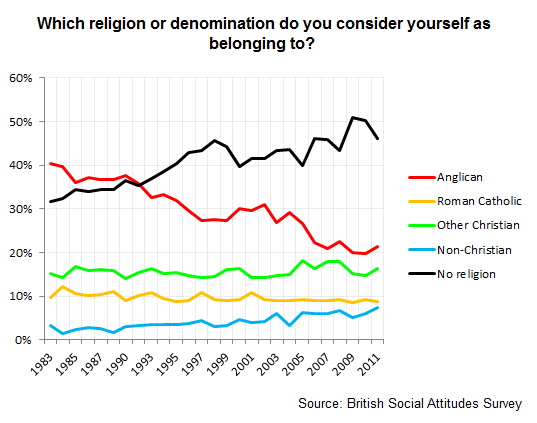 “Revolver” was the record whackjobs liked to smash in the 60s. It came out right after John’s famous opinion on American religion hit the news, “Christianity will go. It will vanish and shrink. I needn’t argue about that; I know I’m right and I will be proved right. We’re more popular than Jesus now. I don’t know which will go first – rock & roll or Christianity. Jesus was all right, but his disciples were thick and ordinary. It’s them twisting it that ruins it for me.” Later, he claimed he was talking about Christianity in England and he probably was and he was pretty obviously right. The chart at left ends in 2011 and, as of 2021, British religious participation
  After suffering through the book, I decided to see if any part of my good memories of “Revolver” were valid. The library copy was an analog-to-digital version of the 1966 stereo release. First, John Lennon was notoriously unhappy with his voice and gets some credit for whining about having to actually double-track his vocals,.which inspired EMI engineer Ken Townsend to invent the Automatic Double-Tracking (ADT) device used on practically everything in “Revolver.” After listening to “Revolver,” I’m with John. I was painfully reminded of their Chipmunk voices and the squeaky harmonies. While US engineers like

 First up, on a Wednesday afternoon, I was not surprised to see that The Gig Store, a live and studio sound equipment place (in the same building) and a drum shop next door to Dave’s, appeared to be closed indefinitely. The retail music business is in rough shape and it is likely to get rougher. Dave’s was open and full of guitars. The entrance is all electric stuff all the time, which was fun but not my reason for being there.
  My amp and gear, at the time, was a 1970s Peavey Artist 100W combo with a Peavey 12” speaker. It was more than enough amp for any gig my band ever did and with an assortment of pedals screwed to a board and a Morley wah, I could handle almost anything on the pop charts at the time. That was considered a “tiny” rig at the time for a rock band guitar player. The Artist was the first amp I ever owned that had a “switched” input setup where I could go from a clean channel to a distorted one with a footswitch. The distortion that amp provided was pretty much fuzz-box quality and, at the time, my tone roll model was probably Carlos Santana.
  After getting my ass handed to me, I went home and re-evaluated my equipment choices and my playing technique. There were a lot of terrific musicians at the Saddle Creek jam and I desperately wanted to go back and, even more, I did not want to suck in front of my peers. I started practicing on an acoustic guitar, even with the band. We lowered our practice volume drastically to accommodate my acoustic guitar and to protect our hearing. For performances, I sold the Peavey Artist and lucked into a 1950s Fender Harvard, which I immediately “hot-rodded” with a JKL K120 12” speaker, Marshall-style tone controls, and a foot-switched gain-boost circuit (all tube). [Yeah, I know. I destroyed the “collector value” of the amp. I did that sort of thing to a few hundred amps between 1974 and 1984, so get over yourself.] No more pedal board, no fuzz box sound, just a collection of tones produced by my Moonstone guitar, my amp, occasional contributions from the Morley wah pedal, and my fingers.